https://doi.org/10.15269/JKSOEH.2020.30.4.342
연구활동종사자 작업환경측정 결과 및 제도개선 방향
황제규ㆍ변헌수*
전남대학교 공학대학 화공생명공학과
Work Environment Measurement Results for Research Workers and Directions for System Improvement
Je-Gyu HwangㆍHun-Soo Byun*
Department of Chemical and Biomolecular Engineering, Chonnam National University, Yeosu, Jeonnam 59626, S. Korea
ABSTRACT
Objectives: The characteristics of research workers are different from those working in the manufacturing industry. Furthermore, the reagents used change according to the research due to the characteristics of the laboratory, and the amounts used vary. In addition, since the working time changes almost every day, it is difficult to adjust the time according to exposure standards. There are also difficulties in setting standards as in the manufacturing industry since laboratory environments and the types of experiments performed are all different. For these reasons, the measurement of the working environment of research workers is not realistically carried out within the legal framework, there is a concern that the accuracy of measurement results may be degraded, and there are difficulties in securing data. The exposure evaluation based on an eight-hour time-weighted average used for measuring the working environment to be studied in this study may not be appropriate, but it was judged and consequently applied as the most suitable method among the recognized test methods.
Methods: The investigation of the use of chemical substances in the research laboratory, which is the subject of this study, was conducted in the order of carrying out work environment measurement, sample analysis, and result analysis. In the case of the use of chemical substances, after organizing the substances to be measured in the working environment, the research workers were asked to write down the status, frequency, and period of use.
Work environment measurement and sample analysis were conducted by a recognized test method, and the results were compared with the exposure standards (TWA: time weighted average value) for chemical substances and physical factors.
Results: For the substances subject to work environment measurement, the department of chemical engineering was the most exposed, followed by the department of chemistry. This can lead to exposure to a variety of chemicals in departmental laboratories that primarily deal with chemicals, including acetone, hydrogen peroxide, nitric acid, sodium hydroxide, and normal hexane. Hydrogen chloride was measured higher than the average level of domestic work environment measurements. This can suggest that researchers in research activities should also be managed within the work environment measurement system. As a result of a comparison between the professional science and technology service industry and the education service industry, which are the most similar business types to university research laboratories among the domestic work environment measurements provided by the Korea Safety and Health Agency, acetone, dichloromethane, hydrogen peroxide, sodium hydroxide, nitric acid, normal hexane, and hydrogen chloride are items that appear
*Corresponding author: Je-Gyu Hwang, Tel: 032-890-2869, E-mail: [email protected]
Department of Chemical and Biomolrcular Engineering Chonnam National University 50 Daehakro, Yeosu, Jeonnam 59626, Republic of Korea
Received: November 11, 2020, Revised: December 1, 2020, Accepted: December 23, 2020
Je-Gyu Hwang https://orcid.org/0000-0002-1291-9853 Hun-Soo Byun https://orcid.org/0000-0003-2356-8515 This is an Open-Access article distributed under the terms of the Creative Commons Attribution Non-Commercial License (http://creativecommons.org/licenses/by-nc/3.0) which permits unrestricted non-commercial use, distribution, and reproduction in any
I. 서 론
대학교 실험실의 경우 안전보건에 대한 위험성이 항 상 상존해 있다. 실험실에는 화학물질로 인한 폭발이나 화재, 추락 등의 안전상 문제뿐 아니라 화학물질에 장기 간 반복적으로 노출됨으로 인한 건강상의 문제도 상존 하고 있다(Byun, 2011).
다양한 안전보건상의 문제점을 관리하기 위해 2006 년 4월 1일 「연구실 안전환경 조성에 관한 법률」 시행 이후 대학교 연구⋅실험실에 대한 안전, 보건 환경에 대한 관리가 강화되었다. 법령 주요 내용 중 위험물질 및 바이러스 등에 노출될 위험성이 있는 연구활동종사 자에 대하여 산업안전보건법 시행규칙 별표 22에 대한 유해인자를 취급하는 연구활동종사자에 대하여 특수건 강검진에 대한 내용은 있으나, 연구 환경을 평가할 수 있는 작업환경측정에 대한 내용은 법령 이외 연구실 안 전점검 및 정밀안전진단에 관한 지침[과학기술정보통신 고시 제2019-89호] 중 제12조 유해인자별 노출도 평 가에 대해 제시되고 있다(MSIT, 2018).
노출도평가 내용 중 국제적으로 공인된 측정방법과 산업안전보건법에 따라 고용노동부장관이 고시한 측정 방법에 준하여 실시할 것을 제시하고 있으나, 연구활동 종사자의 특성을 고려하여 평가 할 수 있는 방법은 따 로 제시하지 않고 있다(MSIT, 2018).
연구활동종사자의 특징은 제조업 형태와 달리 실험실 의 특성상 연구에 따라 사용하는 시약들이 변경되며, 사 용량 또한 다종소량의 형태를 가지고 있다. 또한 연구 (근무)시간이 거의 매일 변경에 있어, 노출기준에 따른 시간 보정도 어려움이 있다. 또한 실험실 환경, 실험 형 태 등이 모두 달라 제조업 형태와 같이 기준을 잡기에
어려움 점도 존재하고 있다(Lee, 2015).
이런 사항으로 인해 연구활동종사자의 작업환경측정 은 현실적으로 법적 테두리에서 이루어지지 않음에 있 어, 측정 결과의 정확성이 떨어질 우려가 있으며, 데이 터 확보에도 어려움 점이 있다.
본 연구에서 연구하려고 하는 작업환경측정에 사용되 는 8시간 시간가중평균치에 근거한 노출평가는 적절한 방법이 아닐 수도 있으나, 공인된 시험방법 중 가장 적 합한 방법으로 판단되어 적용하였다. 연구하고자 하는 측정 프로세스는 연구실안전관리자와 사전 회의 → 회 의를 통한 측정계획 수립 → 측정 대상 실험실 분류 및 화학물질 사용 조사 → 측정실시 → 시료분석 → 정량 평가 → 평가 결과에 따른 관리방안 제시 순서로 실시 하였다(Byun, 2011).
본 연구의 목적은 현재 대학 학과 특성에 따른 산업 안전보건법에 해당되는 물질을 확인하고, 농도를 나타 내고자 한다. 즉, 1) 학과에 따른 작업환경측정대상물질 종류, 2) 대상물질 노출농도를 국내 측정 자료와 비교 3) 돌출된 결과를 통해 연구실험실 작업환경측정 제도 개선 방향을 제시하고자 한다.
Ⅱ. 대상 및 방법
1. 연구 대상
본 연구는 연구실 안전환경 조성에 관한 법률 제정 후 유해인자별 노출도 평가(작업환경측정)를 실시하지 않는 상태에서 17년 12월 인천 지역에 소재한 00대학 교 대상으로 작업환경측정을 실시하였다. 연구 활동이 활발한 종합대학을 대상으로 하였으며, 공과대학 중심 인 종합대학을 선정하였다.
higher than the average level. This can also be expressed as a basis for supporting management within the work environment measurement system.
Conclusions: In the case of research activity workers' work environment measurement and management, specific details can be presented as follows. When changing projects and research, work environment measurement is carried out, and work environment measurement targets and methods are determined by the measurement and analysis method determined by the Ministry of Employment and Labor. The measurement results and exposure standards apply exposure standards for chemical substances and physical factors by the Ministry of Employment and Labor. Implementation costs include safety management expenses and submission of improvement plans when exposure standards are exceeded. The results of this study were presented only for the measurement of the working environment among the minimum health management measures for research workers, but it is necessary to prepare a system to improve the level of safety and health.
Key words: Chemistry laboratory, laboratory workers, exposure assessment, personal exposures, work
environment measurement
2. 연구 방법
연구 대상인 연구실험실에 대한 화학물질 사용조사, 작 업환경측정실시, 시료분석, 결과해석 순으로 진행을 하였 다. 화학물질 사용조사의 경우 작업환경측정 대상 물질을 정리한 후 연구활동종사자가 직접 사용현황, 빈도, 주기를 작성하게 하였다. 작업환경측정 및 시료분석은 공인된 시 험방법으로 실시하였으며, 결과해석은 화학물질 및 물리 적 인자의 시간가중평균치(Time Weighted Average, TWA)와 비교를 하였다(OSHA; sampling and analytical methods, NIOSH; Manual of analytical methods, KOSHA guide, MOEL). 자세한 내용은 다음과 같다.
1) 측정대상 및 물질
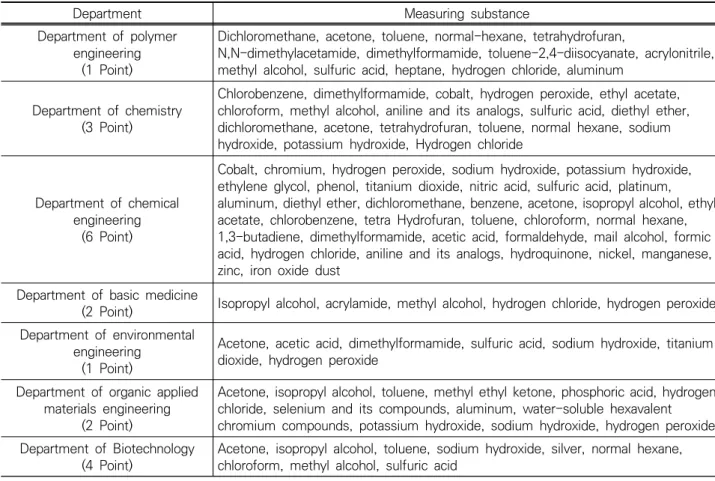
작업환경측정 대상물질 항목을 각 연구활동종사자에게 배포 후 사용현황, 빈도, 주기(현재 사용 기준)를 직접 작 성 하게 한 후 임시작업, 단시간작업을 제외한 물질 선정 은 다음의 Table 1과 같다.
7개 학과로 조사되었으며, 고분자공학과 14종, 화학과 18종, 화학공학과 36종, 기초의학과 5종, 환경공학과 7
종, 유기응용재료공학과 12종, 생명공학과 9종으로 조사 되었다.
2) 측정방법
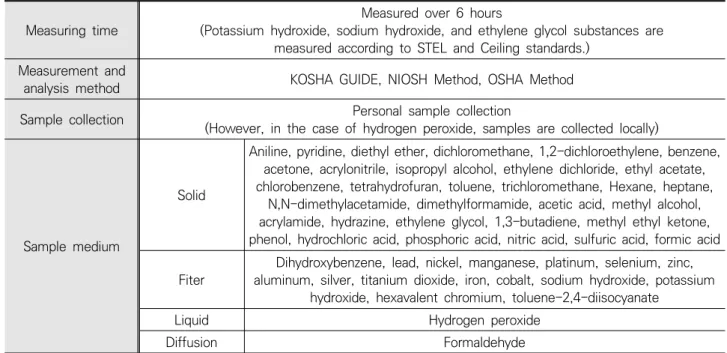
실험 연구는 간헐적 비연속적인 작업이 대부분으로 연 구활동종사자들의 노출 패턴도 변이가 크다. 변이가 큰 상 황을 감수하고, TWA 노출 수준이 제시되어 있는 결과가 없어 6시간 이상의 측정을 실시하였고, 개인 시료 포집을 적용하였다. 측정 방법에 따라 시료의 채취 전후에 유량보 정을 실시하였으며, 각 특성에 맞는 시료 매체를 이용하여 측정을 실시하였다. 측정 방법은 Table 2와 같다.
3) 분석방법
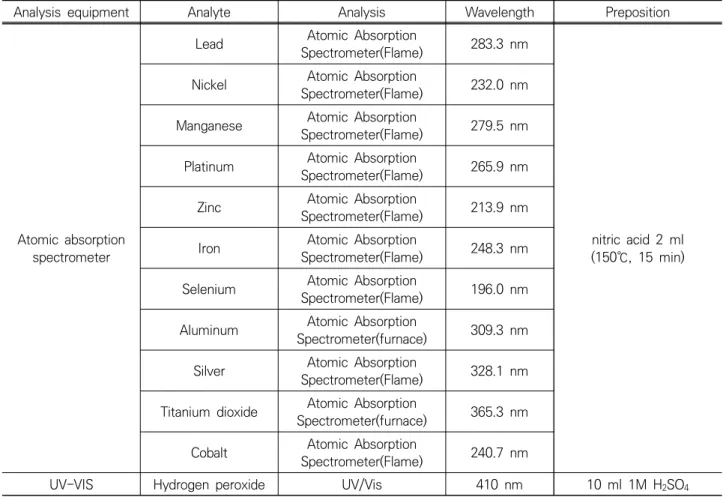
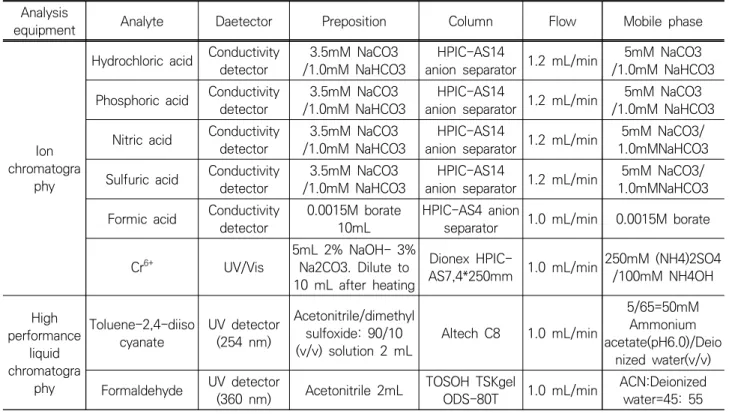
분석대상 물질이 다양함에 따라 KOSHA GUIDE, NIOSH Method, OSHA Method에 제시되어 있는 분석 방법으로 분석을 실시하였다(OSHA; sampling and analytical methods, NIOSH; Manual of analytical methods, KOSHA guide, MOEL).
분석 방법 및 분석 조건은 Table 3,4,5,6과 같다.
Department Measuring substance
Department of polymer engineering
(1 Point)
Dichloromethane, acetone, toluene, normal-hexane, tetrahydrofuran,
N,N-dimethylacetamide, dimethylformamide, toluene-2,4-diisocyanate, acrylonitrile, methyl alcohol, sulfuric acid, heptane, hydrogen chloride, aluminum
Department of chemistry (3 Point)
Chlorobenzene, dimethylformamide, cobalt, hydrogen peroxide, ethyl acetate, chloroform, methyl alcohol, aniline and its analogs, sulfuric acid, diethyl ether, dichloromethane, acetone, tetrahydrofuran, toluene, normal hexane, sodium hydroxide, potassium hydroxide, Hydrogen chloride
Department of chemical engineering
(6 Point)
Cobalt, chromium, hydrogen peroxide, sodium hydroxide, potassium hydroxide, ethylene glycol, phenol, titanium dioxide, nitric acid, sulfuric acid, platinum, aluminum, diethyl ether, dichloromethane, benzene, acetone, isopropyl alcohol, ethyl acetate, chlorobenzene, tetra Hydrofuran, toluene, chloroform, normal hexane, 1,3-butadiene, dimethylformamide, acetic acid, formaldehyde, mail alcohol, formic acid, hydrogen chloride, aniline and its analogs, hydroquinone, nickel, manganese, zinc, iron oxide dust
Department of basic medicine
(2 Point) Isopropyl alcohol, acrylamide, methyl alcohol, hydrogen chloride, hydrogen peroxide Department of environmental
engineering (1 Point)
Acetone, acetic acid, dimethylformamide, sulfuric acid, sodium hydroxide, titanium dioxide, hydrogen peroxide
Department of organic applied materials engineering
(2 Point)
Acetone, isopropyl alcohol, toluene, methyl ethyl ketone, phosphoric acid, hydrogen chloride, selenium and its compounds, aluminum, water-soluble hexavalent chromium compounds, potassium hydroxide, sodium hydroxide, hydrogen peroxide Department of Biotechnology
(4 Point) Acetone, isopropyl alcohol, toluene, sodium hydroxide, silver, normal hexane, chloroform, methyl alcohol, sulfuric acid
Table 1. Work environment measurement substance
Measuring time Measured over 6 hours
(Potassium hydroxide, sodium hydroxide, and ethylene glycol substances are measured according to STEL and Ceiling standards.)
Measurement and
analysis method KOSHA GUIDE, NIOSH Method, OSHA Method
Sample collection Personal sample collection
(However, in the case of hydrogen peroxide, samples are collected locally)
Sample medium
Solid
Aniline, pyridine, diethyl ether, dichloromethane, 1,2-dichloroethylene, benzene, acetone, acrylonitrile, isopropyl alcohol, ethylene dichloride, ethyl acetate, chlorobenzene, tetrahydrofuran, toluene, trichloromethane, Hexane, heptane,
N,N-dimethylacetamide, dimethylformamide, acetic acid, methyl alcohol, acrylamide, hydrazine, ethylene glycol, 1,3-butadiene, methyl ethyl ketone, phenol, hydrochloric acid, phosphoric acid, nitric acid, sulfuric acid, formic acid Fiter Dihydroxybenzene, lead, nickel, manganese, platinum, selenium, zinc,
aluminum, silver, titanium dioxide, iron, cobalt, sodium hydroxide, potassium hydroxide, hexavalent chromium, toluene-2,4-diisocyanate
Liquid Hydrogen peroxide
Diffusion Formaldehyde
Table 3. Work environment analysis method
Analysis method
Gas chromatography
Aniline, pyridine, diethyl ether, dichloromethane, 1,2-dichloroethylene, benzene, acetone, acrylonitrile, isopropyl alcohol, ethylene dichloride, ethyl acetate, chlorobenzene, tetrahydrofuran, toluene, trichloromethane, Hexane, heptane,
N,N-dimethylacetamide, dimethylformamide, acetic acid, methyl alcohol, acrylamide, hydrazine, ethylene glycol, 1,3-butadiene, methyl ethyl ketone, phenol Atomic absorption
spectrophotometer Dihydroxybenzene, lead, nickel, manganese, platinum, selenium, zinc, aluminum, silver, titanium dioxide, iron, cobalt, sodium hydroxide, potassium hydroxide UV/Vis
spectrophotometer Hydrogen peroxide
Ionchromatography Hydrochloric acid, phosphoric acid, nitric acid, sulfuric acid, formic acid, Cr
6+Liquid chromatography Toluene-2,4-diisocyanate, formaldehyde
Table 4. Gas chromatograph analysis conditions
Analyte Daetector Preposition Column Flow Equipment condition
Mixed organic solvent
FID, flameionizat ion detector
CS2, 1ml 1%
2-butanol in CS2 HP-1 1.0 mL/min 35℃(15 min)→3℃ UP 75℃→
75℃(2 min)→3℃ UP 89℃
Dimethylformamide Methanol BP-20 1.5 mL/min 110℃(8.5 min)
Cellosolve methylene chloride/
methanol(95:5) BP-20 0.6 mL/min 35℃(10 min)
Stodad Solvent CS2 HP-1 1 mL/min 50℃→8℃ UP 186℃
Acrylonitrile 2%Acetone, CS2 HP-1 1 mL/min 35℃(4 min)→3℃ UP 50℃
Methyl ethyl ketone CS2 BP-20 1 mL/min 35℃(13 min)
1,3-butadiene CS2 DB-624 0.6 mL/min 35℃(11 min)→50℃
→185℃→185℃(3 min)
Table 2. Work environment measurement method
Analyte Daetector Preposition Column Flow Equipment condition Methanol
FID, flameionizat ion detector
5% isopropanol/water HP-1 1 mL/min 38℃(6 min)→120℃ →158℃(7 min)
Phenol Methanol BP-20 1 mL/min 190℃(10 min)
Aniline Extract(ammonium
hyroxide, 1-hexanol) BP-20 2.5 mL/min 150℃(8 min)
Acetic acid Fornic acid FFAP 1 mL/min 130℃(11 min)→20℃ UP
170℃→170℃(14 min)
Acetonitrile Methylene
chloride/methanol HP-1 0.8 mL/min 40℃→0.5℃ UP 44℃→
80℃→124℃→124℃(14 min)
Ethylene glycol Methanol BP-20 2.4 mL/min 150℃→10℃ UP 200℃
Isoamyl alcohol 5% IPA/CS2 BP-20 1 mL/min 70℃(7 min)→15℃ UP
140℃→140℃(1 min)
Aniline Ethanol BP-20 2.5 mL/min 70℃(7 min)→15℃ UP
175℃→175℃(1 min)
Triethylamine 1N NaOH:Methanol HP-1 1.5 mL/min 70℃(7 min)→15℃ up
130℃→130℃(1 min)
Pyridine Methyl chloride BP-20 2.5 mL/min 70℃(5 min)
Table 5. Atomic absorption spectrometer Analysis, UV-VIS analysis conditions
Analysis equipment Analyte Analysis Wavelength Preposition
Atomic absorption spectrometer
Lead Atomic Absorption
Spectrometer(Flame) 283.3 nm
nitric acid 2 ml (150℃, 15 min) Nickel Atomic Absorption
Spectrometer(Flame) 232.0 nm Manganese Atomic Absorption
Spectrometer(Flame) 279.5 nm Platinum Atomic Absorption
Spectrometer(Flame) 265.9 nm
Zinc Atomic Absorption
Spectrometer(Flame) 213.9 nm Iron Atomic Absorption
Spectrometer(Flame) 248.3 nm Selenium Atomic Absorption
Spectrometer(Flame) 196.0 nm Aluminum Atomic Absorption
Spectrometer(furnace) 309.3 nm Silver Atomic Absorption
Spectrometer(Flame) 328.1 nm Titanium dioxide Atomic Absorption
Spectrometer(furnace) 365.3 nm Cobalt Atomic Absorption
Spectrometer(Flame) 240.7 nm
UV-VIS Hydrogen peroxide UV/Vis 410 nm 10 ml 1M H
2SO
4Table 4. Continued
Ⅲ. 결 과
총 23개 실험실 중 7개 학과를 구분하여 결과를 제시하 였으며, 주요 실험 내용은 합성, 정제, 세척, 추출, 증발 등 이 있었다. 작업은 간헐적, 집중적으로 단기간씩 수행이 되었으며, 연구활동종사자들이 프로젝트에 따라 실험을 수행하는 경우가 대부분이었다. 측정대상 물질 선정에서 는 유기용제, 산류, 금속류로 구분할 수 있으며, 화학과 관 련된 화학과, 화학공학과에서 측정대상 물질이 많은 것으 로 조사되었다.
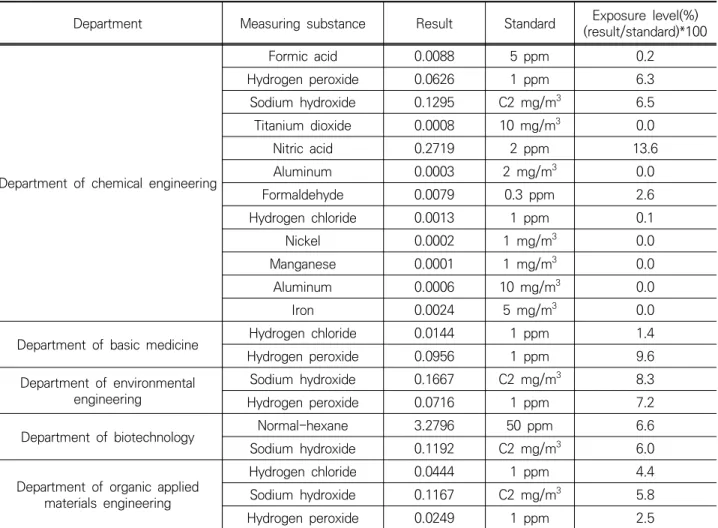
7개 학과 작업환경측정결과는 Table7와 같다. 단, 불 검출, 검출한계 미만 항목을 제외한 검출된 물질의 결과 이다.
검출된 측정 결과를 살펴보면 화학공학과 12개의 유해 인자, 화학과 6개의 유해인자 순으로 시약 실험이 빈번히 이루어지고 있는 학과에서 다양한 유해인자에 노출되는 것을 확인할 수 있다.
노출된 결과를 안전보건공단에서 제시한 국내 작업환 경측정 통계적 분석을(Jang et al., 2016) 참조하여, 각 유 해인자별 노출 수준을 대조하였다(Table 8).
Analysis
equipment Analyte Daetector Preposition Column Flow Mobile phase
chromatogra Ion phy
Hydrochloric acid Conductivity detector 3.5mM NaCO3
/1.0mM NaHCO3 HPIC-AS14
anion separator 1.2 mL/min 5mM NaCO3 /1.0mM NaHCO3 Phosphoric acid Conductivity detector 3.5mM NaCO3
/1.0mM NaHCO3 HPIC-AS14
anion separator 1.2 mL/min 5mM NaCO3 /1.0mM NaHCO3 Nitric acid Conductivity
detector 3.5mM NaCO3
/1.0mM NaHCO3 HPIC-AS14
anion separator 1.2 mL/min 5mM NaCO3/
1.0mMNaHCO3 Sulfuric acid Conductivity
detector 3.5mM NaCO3
/1.0mM NaHCO3 HPIC-AS14
anion separator 1.2 mL/min 5mM NaCO3/
1.0mMNaHCO3 Formic acid Conductivity
detector 0.0015M borate
10mL HPIC-AS4 anion
separator 1.0 mL/min 0.0015M borate Cr
6+UV/Vis 5mL 2% NaOH- 3%
Na2CO3. Dilute to 10 mL after heating
Dionex HPIC-
AS7,4*250mm 1.0 mL/min 250mM (NH4)2SO4 /100mM NH4OH High
performance liquid chromatogra
phy
Toluene-2,4-diiso
cyanate UV detector (254 nm)
Acetonitrile/dimethyl sulfoxide: 90/10
(v/v) solution 2 mL Altech C8 1.0 mL/min
5/65=50mM Ammonium acetate(pH6.0)/Deio
nized water(v/v) Formaldehyde UV detector
(360 nm) Acetonitrile 2mL TOSOH TSKgel ODS-80T 1.0 mL/min ACN:Deionized water=45: 55 Table 6. Ion chromatography analysis, high performance liquid chromatography analysis conditions
Department Measuring substance Result Standard Exposure level(%)
(result/standard)*100
Department of polymer engineering Normal-hexane 0.5233 50 ppm 1.0
Acrylonitrile 0.2028 2 ppm 10.1
Department of chemistry
Acetone 16.4208 500 ppm 3.3
Hydrogen peroxide 0.0227 1 ppm 2.3
Dichloromethane 4.9484 50 ppm 9.9
Normal-hexane 0.8693 50 ppm 1.7
Sodium hydroxide 0.0047 C2 mg/m
30.2
Hydrogen chloride 0.0174 1 ppm 1.7
Table 7. Work environment measurement result
안전보건공단에서 제시한 산술평균값과 측정 결과를 비교해 보면 일부 유해인자에서 평균치보다 높은 수준을 보이는 것을 확인할 수 있다. 화학과(아세톤–측정 결과:
16.4208 ppm, 안전보건공단 최고치: 8.373 ppm), 화학 공학과(과산화수소–측정 결과: 0.0626 ppm, 안전보건공 단 최고치: 0.052 ppm), 화학공학과(질산–측정 결과:
0.2719 ppm, 안전보건공단 최고치: 0.027 ppm), 기초 의학과부(과산화수소–측정 결과: 0.0956 ppm, 안전보건 공단 최고치: 0.052 ppm), 환경공학과(수산화나트륨–측 정 결과: 0.1667 mg/m3, 안전보건공단 최고치: 0.15 mg/m3), 생명공학과(노말헥산–측정 결과: 3.2796 ppm, 안전보건공단 최고치: 2.003 ppm), 유기응용재료공학과 (염화수소–측정 결과: 0.0444 ppm, 안전보건공단 최고 치: 0.035 ppm) 로 요약할 수 있다(Jang et al., 2016).
위에서 제시된 산출 평균은 모든 업종의 평균으로서, 대 학교 실험실에 적용하기에 무리가 있을 수 있다. 그리하여
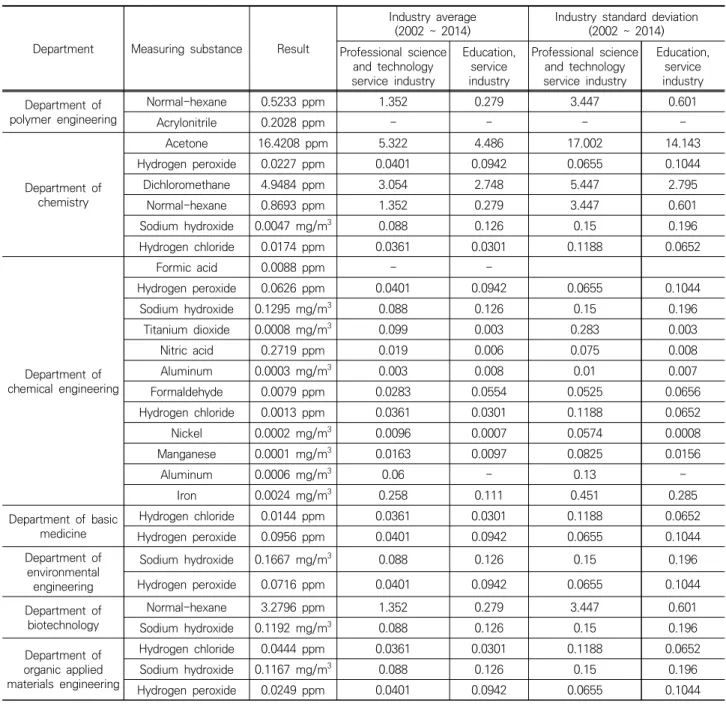
가장 관련이 있다고 판단되는 전문과학 및 기술 서비스업, 교육⋅서비스업과 산출 평균(2002년 ~ 2014년)을 대조 하였다(Table 9).
전문과학 및 기술 서비스업과 비교를 할 경우 화학과 (아세톤, 디클로로메탄), 화학공학과(과산화수소, 수산화 나트륨, 질산), 기초의학과부(과산화수소), 환경공학과(수 산화나트륨, 과산화수소), 생명공학과(노말헥산, 수산화 나트륨), 유기응용재료공학과(염화수소, 수산화나트륨) 항목에서 연구실 작업환경측정 결과가 더 높게 나왔다 (Jang et al., 2016).
교육서비스업과 비교를 할 경우 고분자공학과(노말헥 산), 화학과(아세톤, 디클로로메탄, 노말헥산), 화학공학과 (수산화나트륨, 질산), 기초의학과부(과산화수소), 환경공 학과(수산화나트륨), 생명공학과(노말헥산), 유기응용재 료공학과(염화수소) 항목에서 연구실 작업환경측정 결과 가 더 높게 나왔다(Jang et al., 2016).
Department Measuring substance Result Standard Exposure level(%)
(result/standard)*100
Department of chemical engineering
Formic acid 0.0088 5 ppm 0.2
Hydrogen peroxide 0.0626 1 ppm 6.3
Sodium hydroxide 0.1295 C2 mg/m
36.5
Titanium dioxide 0.0008 10 mg/m
30.0
Nitric acid 0.2719 2 ppm 13.6
Aluminum 0.0003 2 mg/m
30.0
Formaldehyde 0.0079 0.3 ppm 2.6
Hydrogen chloride 0.0013 1 ppm 0.1
Nickel 0.0002 1 mg/m
30.0
Manganese 0.0001 1 mg/m
30.0
Aluminum 0.0006 10 mg/m
30.0
Iron 0.0024 5 mg/m
30.0
Department of basic medicine Hydrogen chloride 0.0144 1 ppm 1.4
Hydrogen peroxide 0.0956 1 ppm 9.6
Department of environmental
engineering Sodium hydroxide 0.1667 C2 mg/m
38.3
Hydrogen peroxide 0.0716 1 ppm 7.2
Department of biotechnology Normal-hexane 3.2796 50 ppm 6.6
Sodium hydroxide 0.1192 C2 mg/m
36.0
Department of organic applied materials engineering
Hydrogen chloride 0.0444 1 ppm 4.4
Sodium hydroxide 0.1167 C2 mg/m
35.8
Hydrogen peroxide 0.0249 1 ppm 2.5
Table 7. Continued
이는 연구활동종사자도 일부 항목에서는 작업자 보다 높게 노출되고 있음을 확인할 수 있으며, 연구 내용, 실 험 방법에 따라 차이가 있으나 일부 연구활동종사자도
일반적인 근로자보다 높은 농도에 노출될 수 있음을 확 인할 수 있다.
Department Measuring
substance Result
Average data from Korea Safety and
Health Agency Standard deviation of the Korea Safety and Health Agency material 2010 2011 2012 2013 2014 2010 2011 2012 2013 2014 Department of
polymer engineering
Normal-hexane 0.5233 ppm 2.003 1.858 2.003 1.632 1.635 5.116 4.157 5.116 3.772 5.102 Acrylonitrile 0.2028 ppm 0.25 0.333 0.304 0.274 0.382 0.339 0.343 0.299 0.292 0.458
Department of chemistry
Acetone 16.4208 ppm 8.373 8.203 7.992 8.09 7.75 23.91 25.49 23.29 21.95 22.17 Hydrogen peroxide 0.0227 ppm 0.052 0.06 0.046 0.046 0.048 0.105 0.11 0.093 0.083 0.086 Dichloromethane 4.9484 ppm 6.177 6.07 5.913 5.417 5.257 9.641 9.881 10.24 9.53 9.186 Normal-hexane 0.8693 ppm 2.003 1.858 2.003 1.632 1.635 5.116 4.157 5.116 3.772 5.102 Sodium hydroxide 0.0047 mg/m3 0.098 0.104 0.118 0.128 0.15 0.168 0.172 0.182 0.194 0.22 Hydrogen chloride 0.0174 ppm 0.035 0.031 0.031 0.028 0.026 0.073 0.069 0.059 0.056 0.057
Department of chemical engineering
Formic acid 0.0088 ppm - - - - - - - - - -
Hydrogen peroxide 0.0626 ppm 0.052 0.06 0.046 0.046 0.048 0.105 0.11 0.093 0.083 0.086 Sodium hydroxide 0.1295 mg/m3 0.098 0.104 0.118 0.128 0.15 0.168 0.172 0.182 0.194 0.22 Titanium dioxide 0.0008 mg/m3 0.061 0.052 0.064 0.049 0.041 0.342 0.209 0.306 0.28 0.119 Nitric acid 0.2719 ppm 0.027 0.029 0.022 0.021 0.017 0.081 0.09 0.092 0.072 0.061 Aluminum 0.0003 mg/m3 0.024 0.013 0.014 0.015 0.015 0.052 0.045 0.039 0.045 0.058 Formaldehyde 0.0079 ppm 0.047 0.047 0.042 0.035 0.031 0.071 0.069 0.064 0.06 0.054 Hydrogen chloride 0.0013 ppm 0.035 0.031 0.031 0.028 0.026 0.073 0.069 0.059 0.056 0.057 Nickel 0.0002 mg/m3 0.004 0.007 0.006 0.005 0.005 0.018 0.025 0.021 0.224 0.25 Manganese 0.0001 mg/m3 0.074 0.066 0.069 0.055 0.05 0.214 0.201 0.214 0.194 0.172 Aluminum 0.0006 mg/m3 0.513 0.3 0.268 0.25 0.183 0.783 0.539 0.545 0.515 0.47 Iron 0.0024 mg/m3 0.572 0.465 0.39 0.323 0.272 1.35 1.101 0.903 0.821 0.784 Department of
basic medicine
Hydrogen chloride 0.0144 ppm 0.035 0.031 0.031 0.028 0.026 0.073 0.069 0.059 0.056 0.057 Hydrogen peroxide 0.0956 ppm 0.052 0.06 0.046 0.046 0.048 0.105 0.11 0.093 0.083 0.086 Department of
environmental engineering
Sodium hydroxide 0.1667 mg/m3 0.098 0.104 0.118 0.128 0.15 0.168 0.172 0.182 0.194 0.22 Hydrogen peroxide 0.0716 ppm 0.052 0.06 0.046 0.046 0.048 0.105 0.11 0.093 0.083 0.086 Department of
biotechnology
Normal-hexane 3.2796 ppm 2.003 1.858 2.003 1.632 1.635 5.116 4.157 5.116 3.772 5.102 Sodium hydroxide 0.1192 mg/m3 0.098 0.104 0.118 0.128 0.15 0.168 0.172 0.182 0.194 0.22 Department of
organic applied materials engineering
Hydrogen chloride 0.0444 ppm 0.035 0.031 0.031 0.028 0.026 0.073 0.069 0.059 0.056 0.057 Sodium hydroxide 0.1167 mg/m3 0.098 0.104 0.118 0.128 0.15 0.168 0.172 0.182 0.194 0.22 Hydrogen peroxide 0.0249 ppm 0.052 0.06 0.046 0.046 0.048 0.105 0.11 0.093 0.083 0.086
Table 8. Comparison of average results of work environment measurement
Ⅳ. 고 찰
제조업 사업장의 화학물질 취급 공정과는 달리 연구 활동종사자 실험 업무는 프로젝트에 따라 사용 물질 현 황이 달라진다. 또한 연구, 실험실 특성, 개인 실험 방법 에 따라 노출량은 다르게 나타날 수 있다. 이와 같은 이 유로 작업환경측정 결과는 프로젝트에 따라 측정하지 않을 경우 크게 의미가 없을 수 있다. 그러나 본 연구는
학과 특성에 따른 화학물질 노출량을 조사하고, 기존 제 조업 및 전문과학 기술 서비스업 노출 수준과 비교하여 대학교 연구활동종사자도 높은 수준에 화학물질에 노출 되고 있음을 나타내고자 하였다.
측정 결과 도출 할 수 있는 내용은 다음과 같다.
1. 작업환경측정 대상 물질 중에서 화학공학과가 노 출되는 항목이 가장 많았으며, 그 다음으로는 화학과로
Department Measuring substance Result
Industry average
(2002 ~ 2014) Industry standard deviation (2002 ~ 2014) Professional science
and technology service industry
Education, service industry
Professional science and technology service industry
Education, service industry Department of
polymer engineering Normal-hexane 0.5233 ppm 1.352 0.279 3.447 0.601
Acrylonitrile 0.2028 ppm - - - -
Department of chemistry
Acetone 16.4208 ppm 5.322 4.486 17.002 14.143
Hydrogen peroxide 0.0227 ppm 0.0401 0.0942 0.0655 0.1044
Dichloromethane 4.9484 ppm 3.054 2.748 5.447 2.795
Normal-hexane 0.8693 ppm 1.352 0.279 3.447 0.601
Sodium hydroxide 0.0047 mg/m3 0.088 0.126 0.15 0.196
Hydrogen chloride 0.0174 ppm 0.0361 0.0301 0.1188 0.0652
Department of chemical engineering
Formic acid 0.0088 ppm - -
Hydrogen peroxide 0.0626 ppm 0.0401 0.0942 0.0655 0.1044
Sodium hydroxide 0.1295 mg/m3 0.088 0.126 0.15 0.196
Titanium dioxide 0.0008 mg/m3 0.099 0.003 0.283 0.003
Nitric acid 0.2719 ppm 0.019 0.006 0.075 0.008
Aluminum 0.0003 mg/m3 0.003 0.008 0.01 0.007
Formaldehyde 0.0079 ppm 0.0283 0.0554 0.0525 0.0656
Hydrogen chloride 0.0013 ppm 0.0361 0.0301 0.1188 0.0652
Nickel 0.0002 mg/m3 0.0096 0.0007 0.0574 0.0008
Manganese 0.0001 mg/m3 0.0163 0.0097 0.0825 0.0156
Aluminum 0.0006 mg/m3 0.06 - 0.13 -
Iron 0.0024 mg/m3 0.258 0.111 0.451 0.285
Department of basic medicine
Hydrogen chloride 0.0144 ppm 0.0361 0.0301 0.1188 0.0652
Hydrogen peroxide 0.0956 ppm 0.0401 0.0942 0.0655 0.1044
Department of environmental
engineering
Sodium hydroxide 0.1667 mg/m3 0.088 0.126 0.15 0.196
Hydrogen peroxide 0.0716 ppm 0.0401 0.0942 0.0655 0.1044
Department of biotechnology
Normal-hexane 3.2796 ppm 1.352 0.279 3.447 0.601
Sodium hydroxide 0.1192 mg/m3 0.088 0.126 0.15 0.196
Department of organic applied materials engineering
Hydrogen chloride 0.0444 ppm 0.0361 0.0301 0.1188 0.0652
Sodium hydroxide 0.1167 mg/m3 0.088 0.126 0.15 0.196
Hydrogen peroxide 0.0249 ppm 0.0401 0.0942 0.0655 0.1044
Table 9. Comparison of professional science and technology service industry and education service industry as a result of
measuring work environment
나타났다. 이는 화학물질을 주로 취급하는 학과 실험실 에서는 다양한 화학물질에 노출될 수 있다.
2. 안전보건공단에서 제시한 국내 작업환경측정 결과 통계를 비교한 결과 아세톤, 과산화수소, 질산, 수산화 나트륨, 노말헥산. 염화수소는 국내 작업환경측정 평균 수준보다 높게 측정이 되었다. 이는 연구활동종사자도 작업환경측정 제도 안에 관리가 되어야 함을 제시할 수 있다.
3. 안전보건공단에서 제시한 국내 작업환경측정 결과 통계치 중 대학교 연구실험실과 가장 비슷한 업종인 전 문과학 및 기술 서비스업, 교육 서비스업과 비교한 결과 아세톤, 디클로로메탄, 과산화수소, 수산화나트륨, 질산, 노말헥산, 염화수소에서 평균 수준보다 높게 보이는 항 목이 있어, 역시 작업환경측정 제도 안에 관리가 되어야 함을 뒷받침하는 근거로 나타낼 수 있다.
Ⅴ. 결 론
본 연구는 연구활동종사자에 대해 작업환경측정을 실 시한 결과를 바탕으로 각종 국내 작업환경측정 자료와 비교를 하였다. 연구활동종사자도 국내 작업환경측정 평균 수준보다 일부 높게 측정되는 항목이 있어 연구활 동종사자도 작업환경측정 제도 안에 관리가 되어야 함 을 제시할 수 있다.
현재 연구활동종사자 작업환경측정 관련 내용은 연구 실 안전점검 및 정밀안전진단에 관한 지침[과학기술정 보통신고시 제2019-89호] 중 제12조 유해인자별 노출 도 평가를 한다는 내용 이외 구체적인 내용이 들어가야 할 것으로 판단된다.
구체적인 내용은 다음과 같이 제시할 수 있다.
1. 프로젝트 및 연구 변경 시 작업환경측정 실시 2. 작업환경측정 대상 및 방법은 고용노동부에서 정 한 측정 및 분석 방법으로 실시
3. 측정결과 및 노출기준은 고용노동부고시 화학물질 및 물리적 인자의 노출기준 적용
4. 작업환경측정 실시 비용은 안전관리비에서 사용 5. 노출기준 초과의 경우 개선방안 제출
본 연구 결과는 연구활동종사자의 최소한의 보건관 리 방안 중 작업환경측정에 대해서만 제시를 하였으나, 안전보건 수준을 향상시키기 위한 제도 마련이 필요로 한다.
References
Byun HJ, Ryu KN, Yoon CS, Park JI. Quantitative Assessment Strategy for Determining the Exposures to Volatile Organic Chemicals in Chemistry Laboratories. J Korean Soc Occup Environ Hyg 2011;21(1):11-24
Jang JG, Park HD, Seo HK, Roh JW, Kim SJ.
Statistical analysis of domestic work environment measurement database using big data. Institute for Industrial Safety and Health, 2016.
Korea Occupational Safety and Health Agency(KOSHA).
Kosha guide A-96-2018.
Korea Occupational Safety and Health Agency(KOSHA).
Dichloromethane Kosha guide A-19-2019.
Korea Occupational Safety and Health Agency(KOSHA).
Acetone Kosha guide A-110-2018.
Korea Occupational Safety and Health Agency(KOSHA).
Acrylonitrile Kosha guide A-96-2018.
Korea Occupational Safety and Health Agency(KOSHA).
Formaldehyde Kosha guide A-56/57-2018.
Korea Occupational Safety and Health Agency(KOSHA).
Normal-hexane Kosha guide A-64-2018.
Korea Occupational Safety and Health Agency(KOSHA).
Nickel Kosha guide A-3-2019.
Korea Occupational Safety and Health Agency(KOSHA).
Manganese Kosha guide A-5-2019.
Korea Occupational Safety and Health Agency(KOSHA).
Iron Kosha guide A-18-2019.
Korea Occupational Safety and Health Agency(KOSHA).
Aluminum Kosha guide A-10-2018.
Korea Occupational Safety and Health Agency(KOSHA).
Titanium dioxide Kosha guide A-17-2018.
Korea Occupational Safety and Health Agency(KOSHA).
Hydrogen peroxide Kosha guide A-152-2018.
Korea Occupational Safety and Health Agency(KOSHA).
Sodium hydroxide Kosha guide A-156-2018.
Korea Occupational Safety and Health Agency(KOSHA).
Hydrogen chloride Kosha guide A-183-2020.
Lee HA. An effect of safety and health education on knowledge, attitude and practice of the research laboratory workers, Yonsei University, 2015.
Ministry of Science and Technology Information and Communication(MSIT). Laboratory Safety Environment Creation Act, 2018.
Ministry of Science and Technology Information and Communication(MSIT). Guidelines for laboratory safety inspection and precision safety diagnosis, 2019-89.
Ministry of Employment and Labor(MOEL). Occupational
Safety and Health Act, 2018.
Ministry of Employment and Labor(MOEL). Enforcement Rules of the Industrial Safety and Health Act, 2018.
Ministry of Employment and Labor(MOEL). Rules exceeding occupational safety and health standards, 2018.
Ministry of Employment and Labor(MOEL). Notification on work environment measurement and quality control, etc.., 2018.
Ministry of Employment and Labor(MOEL). Exposure standards for psychological substances and physical factors., 2018.
National Institute for Occupational Safety and Health (NIOSH). Dichloromethane NMAM-1005.
National Institute for Occupational Safety and Health (NIOSH). Acetone NMAM-1300/2549/2555/3800.
National Institute for Occupational Safety and Health (NIOSH). Acrylonitrile NMAM-1604.
National Institute for Occupational Safety and Health (NIOSH). Formaldehyde NMAM-2016/2539/2541/
3500/3800.
National Institute for Occupational Safety and Health (NIOSH). Normal-hexane NMAM-1500/2549/3800.
National Institute for Occupational Safety and Health (NIOSH). Nickel NMAM-7300/7301/7302/7303.
National Institute for Occupational Safety and Health (NIOSH). Manganese NMAM-7300/7301/7302/7303.
National Institute for Occupational Safety and Health (NIOSH). Iron NMAM-7302/7304.
National Institute for Occupational Safety and Health (NIOSH). Aluminum NMAM-7313/7300/7301/7303.
National Institute for Occupational Safety and Health (NIOSH). Titanium dioxide NMAM-7302/7304.
National Institute for Occupational Safety and Health
(NIOSH). Sodium hydroxide NMAM-7907.
National Institute for Occupational Safety and Health (NIOSH). Hydrogen chloride NMAM-7907.
Occupational Safety & Health Administration(OSHA).
Dichloromethane OSHA-80.
Occupational Safety & Health Administration(OSHA).
Acetone OSHA-69.
Occupational Safety & Health Administration(OSHA).
Acrylonitrile OSHA-37.
Occupational Safety & Health Administration(OSHA).
Formaldehyde OSHA-52/1007.
Occupational Safety & Health Administration(OSHA).
Normal-hexane OSHA-PV2248.
Occupational Safety & Health Administration(OSHA).
Nickel OSHA-ID121/125G.
Occupational Safety & Health Administration(OSHA).
Manganese OSHA-ID121/125G.
Occupational Safety & Health Administration(OSHA). Iron OSHA-ID121/125G.
Occupational Safety & Health Administration(OSHA).
Aluminum dioxide OSHA-ID121.
Occupational Safety & Health Administration(OSHA).
Titanium dioxide OSHA-ID121.
Occupational Safety & Health Administration(OSHA).
Hydrogen peroxide OSHA-1019/ID006/ID126SG.
Occupational Safety & Health Administration(OSHA).
Sodium hydroxide OSHA-ID121.
Occupational Safety & Health Administration(OSHA).
Hydrogen chloride OSHA-ID174SG.
<저자정보>
황제규(박사과정, 인하대병원 직업환경의학과), 변헌수 (Professor)