Background/Aims: Sofosbuvir (SOF)-based therapy has been used in Korean patients with chronic hepatitis C virus (HCV) infection since January 2016. This study aimed to in- vestigate the real-life effectiveness and safety of SOF-based therapy in genotype 2 HCV infection. Methods: From January to December 2016, 458 genotype 2 HCV-infected patients who received ≥1 dose of SOF-based therapy were consecu- tively enrolled in seven tertiary hospitals. Sustained virologic response (SVR) rates and safety were determined by inten- tion-to-treat (ITT) and per-protocol (PP) analyses. Results: The mean age of the patients was 61.0 years; 183 (40%) were male, and 13.1% showed a high viral load (>6,000,000 IU/
mL). Among the 378 treatment-naïve patients, the SVR rates were 94.2% (ITT) and 96.7% (PP). Among the 80 treatment- experienced patients, the SVR rates were 96.3% (ITT) and 98.7% (PP). Patients with a relatively high fibrosis-4 index score (>3.25) had similar SVR rates to those with a relatively low score (p=0.756). A total of 314 patients (68.6%) were treated with a reduced ribavirin dose at the prescriber’s dis- cretion, but they showed similar SVR rates to those treated with the weight-based dose (ITT: 95.5% and 92.3%, PP:
97.4% and 96.3%, respectively). Adverse events were ob- served in 191 patients (41.7%), including 86 (18.8%) with anemia, but only one (0.2%) discontinued antiviral therapy due to nausea. Conclusions: SOF-based therapy showed high real-life efficacy and tolerability in Korean patients with genotype 2 chronic HCV infection, regardless of previous antiviral treatment experience and fibrosis score. A reduced
ribavirin dose can be considered in this patient cohort. (Gut Liver 2020;14:775-782)
Key Words: Hepatitis C; Chronic; Sofosbuvir; Ribavirin; Geno- type 2
INTRODUCTION
Hepatitis C virus (HCV)-related liver disease is a major health problem, with >185 million infected people and approximately 350,000 HCV-related deaths annually worldwide.1,2 In South Korea, the prevalence of anti-HCV is reported to be 0.78%,3 and HCV is the second leading cause of liver cirrhosis (LC) and he- patocellular carcinoma.4,5
Sofosbuvir (SOF), a nucleotide NS5B polymerase inhibitor, has been used to treat genotype 2 HCV infection in combination with ribavirin (RBV) globally.6 Although more potent pangeno- typic direct acting antiviral agents including, glecaprevir/pi- brentasvir,7,8 and SOF/velpatasvir9,10 have been developed, SOF and RBV combination therapy was the only regimen for Korean genotype 2 patients until August 2018. In the phase 3 trials, the sustained virologic response (SVR) rates of SOF+RBV therapy for genotype 2 chronic hepatitis patients were reported to be 96%–100% for treatment-naïve (TN)11-13 and 90% for treatment- experienced (TE) patients.12 However, SVR rates in LC patients were reported to be 91%–100% in TN11,12 and 60%–78% in TE14,15 patients.
Moreover, concomitant administration of RBV, which is a
This is an Open Access article distributed under the terms of the Creative Commons Attribution Non-Commercial License (http://creativecommons.org/licenses/by-nc/4.0) which permits unrestricted non-commercial use, distribution, and reproduction in any medium, provided the original work is properly cited.
Real-Life Effectiveness and Safety of Sofosbuvir-Based Therapy in Genotype 2 Chronic Hepatitis C Patients in South Korea, with Emphasis on the
Ribavirin Dose
Eun Sun Jang1, Kyung-Ah Kim2, Young Seok Kim3, In Hee Kim4, Byung Seok Lee5, Youn Jae Lee6, Woo Jin Chung7, and Sook-Hyang Jeong1
1Department of Internal Medicine, Seoul National University Bundang Hospital, Seoul National University College of Medicine, Seongnam,
2Department of Internal Medicine, Inje University Ilsan Paik Hospital, Goyang, 3Department of Internal Medicine, Soonchunhyang University Bucheon Hospital, Soonchunhyang University College of Medicine, Bucheon, 4Department of Internal Medicine, Chonbuk National University Hospital, Chonbuk National University Medical School, Jeonju, 5Department of Internal Medicine, Chungnam National University College of Medicine, Daejeon, 6Department of Internal Medicine, Inje University Busan Paik Hospital, Inje University College of Medicine, Busan, and
7Department of Internal Medicine, Keimyung University School of Medicine, Daegu, Korea
Correspondence to: Sook-Hyang Jeong
Department of Internal Medicine, Seoul National University Bundang Hospital, 82 Gumi-ro 173beon-gil, Bundang-gu, Seongnam 13620, Korea Tel: +82-31-787-7034, Fax: +82-31-787-4052, E-mail: [email protected]
Received on July 22, 2019. Revised on September 18, 2019. Accepted on October 26, 2019. Published online February 3, 2020.
pISSN 1976-2283 eISSN 2005-1212 https://doi.org/10.5009/gnl19260
synthetic guanosine analog and a prodrug showing an antiviral activity by interfering with the HCV RNA metabolism, resulted in anemia, itching, or other adverse events. In the pegylated interferon-based era, RBV-induced anemia was reported with a varying incidence of 28% to 52.2%16-19 in Asian patients. How- ever, the solitary effect of RBV dosing on the development of anemia could not be studied because the concomitantly admin- istered interferon can also cause cytopenia. In the direct acting antiviral agent era, the role of RBV dose on SVR and develop- ment of anemia can be clearly investigated, but detailed studies on the RBV dose modification are limited.
Therefore, this study aimed to investigate the effectiveness and safety of SOF-based therapy, and the effect of RBV dose modification for genotype 2 HCV infection in a real-world set- ting in South Korea.
MATERIALS AND METHODS 1. Subjects
This retrospective study consecutively enrolled 458 patients with genotype 2 HCV infection who received at least one dose of SOF-based therapy from January to December 2016 from seven tertiary hospitals, located in different major regions of South Korea. SOF was administered orally at a dose of 400 mg once daily. RBV was administered orally twice daily, with rec- ommended dose (1,000 mg daily in patients with a body weight Table 1. Baseline Characteristics of the Study Population
Characteristic Genotype 2 (n=458)
Age, yr 61.0±11.5
Male sex 183 (40.0)
HCV RNA viral load 6.06×10⁶ (15–3.21×10⁷)
>6,000,000 IU/mL 60 (13.1)
HBV coinfection 7 (1.5)
Laboratory findings
WBC, /mm3 5,080 (1,074–17,600)
Hemoglobin, g/dL 13.6 (8.8–17.5)
PLT, ×103/mm3 168 (33–592)
Cr, mg/dL 0.76 (0.38–2.10)
Albumin, g/dL 4.2 (1.7–4.9)
Bilirubin, mg/dL 0.72 (0.1–2.4)
ALP, IU/L 89 (26–728)
AST, IU/L 44 (6–784)
ALT, IU/L 35 (6–433)
GGT, IU/L 34 (2–425)
PT, INR 1.06 (0.92–1.56)
Liver disease status
CHC 339 (74.0)
LC, compensated 101 (22.0)
LC, decompensated 4 (0.9)
HCC 11 (2.4)
Liver TPL 3 (0.7)
Previous antiviral treatment
Naïve 378 (82.5)
Experienced 80 (17.5)
FIB-4 (n=435)
<1.45 73 (15.9)
1.45–3.25 165 (36.0)
>3.25 197 (43.0)
Treatment duration, wk
<12 18 (3.9)
12 375 (81.9)
>12–16 54 (11.8)
24 11 (2.4)
Dose of ribavirin (initial), mg/day
<800 30 (6.5)
800 165 (36.0)
>800 & <1,000 1 (0.2)
1,000 236 (51.5)
>1,000 & <1,200 0
1,200 26 (5.9)
Dose of ribavirin (mean), mg/day
<800 57 (12.5)
800 120 (26.3)
>800 & <1,000 56 (12.3)
Table 1. Continued
Characteristic Genotype 2 (n=458)
1,000 199 (43.5)
>1,000 & <1,200 9 (2.0)
1,200 16 (3.5)
Recommended dose 143 (31.2)
Weight-based dose* 314 (68.6)
Treatment completion
Yes 439 (95.9)
No 19 (4.1)
Viral breakthrough 1 (0.2)
Intolerance 1 (0.2)
Unaffordability 3 (0.7)
Non-liver related death 1 (0.2)
Follow-up loss 13 (2.8)
Data are presented as the mean±SD, number (%), or median (range).
HCV, hepatitis C virus; HBV, hepatitis C virus; WBC, white blood cells; PLT, platelet; ALP, alkaline phosphatase; AST, aspartate ami- notransferase; ALT; alanine aminotransferase; GGT, gamma-glutam- yltransferase; PT, prothrombin time; INR, international normalized ratio; CHC, chronic hepatitis C; LC, liver cirrhosis; HCC, hepatocellular carcinoma; TPL, transplantation recipient; FIB-4, fibrosis-4 index.
*The weight-based dose of ribavirin was defined as 1,000 mg daily in patients with a body weight of <75 kg and 1,200 mg daily in patients with a body weight of ≥75 kg.
of <75 kg, and 1,200 mg daily in patients with a body weight of
≥75 kg) according to the label. Nonetheless, the changed dose was accepted in this study with the attending physician’s deci- sion during the antiviral treatment, modifying it based on the patients’ hemoglobin level and comorbidities.
Patients who had been treated with interferon/peginterferon- based therapy or other direct acting antiviral agents except SOF-based therapy at least one dose were categorized into the TE group. This study was approved by the institutional review board of the seven hospitals, and the requirement for obtaining written informed consent was waived because this study was based on the retrospective review of the existing medical re- cords.
Chronic hepatitis C was defined as the persistence of HCV RNA for more than 6 months regardless of aminotransferase levels. The diagnosis of LC was based on histologic findings or by ≥1 clinical findings of portal hypertension,20 which are as follows: (1) cirrhotic appearance of the liver with splenomegaly on imaging study (ultrasonography, computed tomography, or magnetic resonance imaging); (2) low platelet count (<120,000/
mm3); (3) presence of varices on endoscopy; (4) presence of asci- tes; and (5) presence of hepatic encephalopathy. Decompensated LC was defined as the presence of jaundice (total bilirubin >2
Table 2. Treatment Duration of Sofosbuvir Plus Ribavirin Therapy According to Underlying Liver Disease and Treatment Experience
Regimen Duration, wk
Subtotal
<12 12 >12–16 24
SOF+RBV
TN NC 14 (4.8) 269 (92.8) 5 (1.7) 2 (0.7) 290 (65.0)
TN CC 2 (2.8) 39 (54.9) 24 (33.8) 6 (8.5) 71 (15.9)
TE NC 2 (4.7) 40 (93.0) 1 (2.3) - 43 (9.6)
TE CC - 11 (31.4) 21 (60.0) 3 (8.6) 35 (7.8)
DC - 1 (25.0) 3 (75.0) - 4 (0.9)
LT - 3 (100) - - 3 (0.7)
Subtotal 18 (4.1) 363 (81.4) 54 (12.1) 11 (2.5) 446 (100)
SOF+DCV
TN CC - 1 (100) - - 1 (100)
Subtotal - 1 (100) - - 1 (100)
SOF+DCV+RBV
TN NC - 2 (100) - - 2 (50)
TN CC - 2 (100) - - 2 (50)
Subtotal - 4 (100) - - 4 (100)
SOF
TN NC - 6 (100) - - 6 (85.7)
TN CC - 1 (100) - - 1 (14.3)
Subtotal - 7 (100) - - 7 (100)
Data are presented as number (%).
SOF, sofosbuvir; RBV, ribavirin; TN NC, treatment-naïve patients with no cirrhosis; TN CC, treatment-naïve patients with compensated cirrhosis;
TE NC, treatment-experienced patients with no cirrhosis; TE CC, treatment-experienced patients with compensated cirrhosis; DC, patients with de- compensated liver cirrhosis; LT, liver transplantation recipients; DCV, daclatasvir.
100
80
60
40
20
SVR12(%)
0 All GT2
TN NC
TN CC
TE NC
TE CC
DC LT ITT PP 100 100 100 100 100 98 100 97 97
9597 94 95 93
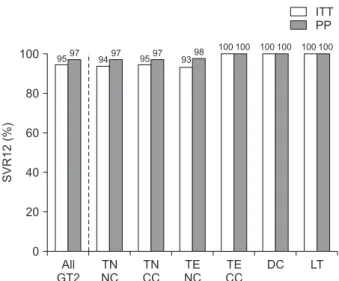
Fig. 1. Sustained virologic response rates of sofosbuvir-based therapy for Korean patients infected with genotype 2 hepatitis C virus accord- ing to their treatment experience and liver disease status.
ITT, intention-to-treat; PP, per-protocol; SVR12, sustained virologic response at 12 weeks after end of treatment; GT2, genotype 2; TN NC, treatment-naïve patients with no cirrhosis; TN CC, treatment-naïve patients with compensated cirrhosis; TE NC, treatment-experienced patients with no cirrhosis; TE CC, treatment-experienced patients with compensated cirrhosis; DC, patients with decompensated cirrhosis;
LT, liver transplantation recipients.
mg/dL), ascites (including controlled ascites by diuretics), and previous history of variceal bleeding or portosystemic encepha- lopathy. Additionally, fibrosis-4 index (FIB-4) was calculated according to the developed equation21 as an indirect marker of hepatic fibrosis.
2. Measurements for treatment response and adverse events of antiviral therapy
HCV RNA concentration was measured by a real-time poly- merase chain reaction assay at the laboratory medicine depart- ment of each study site. Treatment responses were documented according to the clinical practice guideline for hepatitis C by the Korean Association for the Study of the Liver.6 SVR was defined as undetectable HCV RNA at 12 weeks after completion of treatment. Viral breakthrough referred to the reappearance of
HCV RNA during the treatment, and relapse was defined as the reappearance of HCV RNA after initial viral elimination with undetectable HCV RNA level at the end of treatment. In patients who could not be tested for HCV RNA at the exact weeks for SVR measurement, the window period of ±4 weeks was permit- ted.
The adverse events were based on chart review by the attend- ing physician. Owing to the limitation of the study’s retrospec- tive design, the grade of adverse events could not be evaluated.
3. Statistical analysis
Analyses were conducted by descriptive statistics for viro- logical outcomes and safety. SVR with intention-to-treat (ITT) analysis was calculated for all enrolled patients (n=458) and with per-protocol (PP) analysis for subjects who completed
100
80
60
40
20
SVR12(%)
0
<1.45 >3.25
ITT PP
1.45 3.25
100
80
60
40
20
SVR12(%)
0
Reduced dose* Weight-based dose ITT PP FIB-4
Ribavirin
100
80
60
40
20
SVR12(%)
0
<12 24
ITT PP
12 >12 16
100
80
60
40
20
SVR12(%)
0
<800
ITT PP Treatment duration (wk)
Ribavirin (mg/day) 800 >800 &
<1,000
1,000 >1,000 1,200 95 99
93 96 95 98
33 50
97 97 98 98 100 100
96 97
92 96 97 98 98 98 98
9396 94
88 100
A B
C D
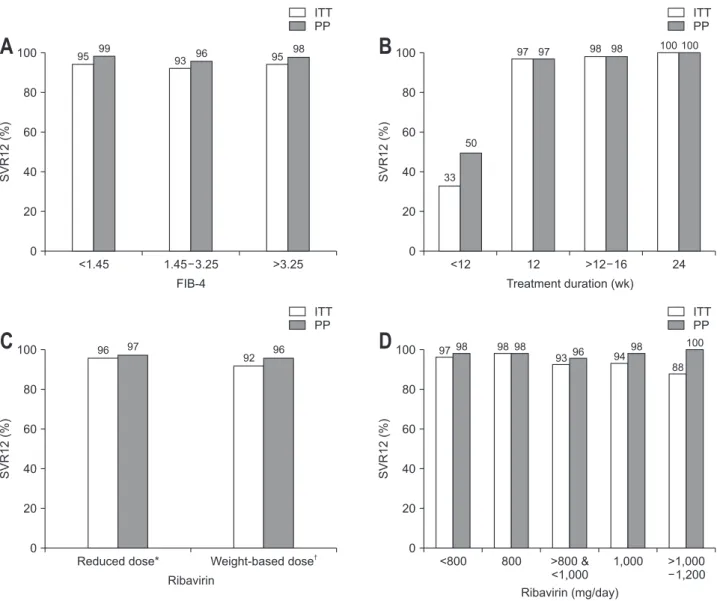
Fig. 2. Sustained virologic response rates of sofosbuvir-based therapy for Korean patients infected with genotype 2 hepatitis C virus according to the FIB-4 (A), treatment duration (B), and dose of ribavirin (C, D).
ITT, intention-to-treat; PP, per-protocol; SVR12, sustained virologic response at 12 weeks after end of treatment; FIB-4, fibrosis-4 index. *The lower dosage of ribavirin than the weight-based recommendation was defined as the reduced dose; †The weight-based dose of ribavirin was de- fined as 1,000 mg daily in patients with a body weight of <75 kg and 1,200 mg daily in patients with a body weight of ≥75 kg.
the scheduled treatment and follow-up for ≥12 weeks after the treatment completion (n=440). Patients who had withdrawn antiviral treatment according to the attending physician’s deci- sion owing to the inadequate virologic response or significant adverse events were included in the PP analysis, regardless of the follow-up duration after the cessation of treatment. All sta- tistical analyses were performed using Stata version 14.0 (College Station, TX, USA).
RESULTS
1. Baseline patient characteristics
Among the 458 participants, mean age was 61.0 years, 40%
were male, and 23% had LC (22.1% compensated and 0.9%
decompensated). The four decompensated LC patients were categorized into this group because their Child-Pugh class were B owing to the presence of ascites but it was well controlled with diuretics. A total of 378 (82.5%) were naïve for antiviral treatment, and 80 (17.5%) had experience with other antiviral therapy before the SOF-based treatment (Table 1).
With SOF+RBV regimen, 92.8% of TN and 93% of TE non- cirrhotic (NC) patients were treated for 12 weeks (Table 2).
Among the compensated cirrhotic (CC) patients, 42.3% of TN and 68.6% of TE patients were treated for more than 12 weeks (Table 2). Twelve patients were treated with thera- pies other than the SOF+RBV regimen (1 SOF+daclatasvir, 4 SOF+daclatasvir+RBV, and 7 SOF only).
2. SVR rates of SOF-based therapy
Among the 458 patients (ITT population), 18 (3.9%) were lost to follow-up during or after the scheduled treatment and could not be evaluated for SVR (440 PP population). Overall, the SVR rates of Korean genotype 2 patients treated with SOF-based regimen were 94.5% (433/458) in ITT and 97.1% (427/440) in PP analysis (Fig. 1). Among the 13 patients who did not achieve SVR, four were not tested for SVR within 16 weeks after treat- ment completion, and clinical characteristics of the remaining nine patients are listed in Supplementary Table 1.
TN patients showed SVR rates of 94.2% (356/378) in ITT and 96.7% (350/362) in PP analyses, and TE patients showed 96.3% (77/80) in ITT and 98.7% (77/78) in PP analyses (data not shown). NC patients showed SVR rates of 93.8% (318/339) in ITT and 96.6% (313/324) in PP analyses, and cirrhotic patients without decompensation (CC) showed 97.0% (98/101) in ITT and 99.0% (97/98) in PP analyses (data not shown).
Among TN patients, NC and CC did not show a significant difference in the SVR rates (94.0% vs 94.5% in ITT, p=0.609;
96.5% vs 97.1% in PP, p=0.606) (Fig. 1, Supplementary Table 2). Among TE patients, the existence of compensated cirrhosis did not affect the SVR rates (NC vs CC: 93.3% vs 100% in ITT, p=0.364; 97.7% vs 100% in PP, p=0.364) (Fig. 1, Supplementary Table 2). Four decompensated cirrhotic patients and three liver
transplant recipients had SVR of 100% (Fig. 1, Supplementary Table 2). Among the four decompensated cirrhotic patients, three tolerated 1,000 mg/day of RBV and one had reduced RBV dose of 600 mg/day.
Among the 12 patients who were treated with regimens other than SOF+RBV, 11 achieved SVR at 12 weeks (SVR12) (1 TN CC with SOF+DCV, 2 TN NC and 2 TN CC with SOF+DCV+RBV, 5 TN NC and 1 TN CC with SOF monotherapy), whereas one 70-year-old TN NC patient with FIB-4 of 2.03 treated with 12 weeks of SOF monotherapy failed to achieve SVR12 (data not shown).
3. Effect of FIB-4, treatment duration, and dose of RBV on the SVR rates of SOF-based therapy
As shown in Fig. 2A, FIB-4 did not significantly affect the SVR rate in Korean genotype 2 patients treated with the SOF- based regimen (p=0.756) (Supplementary Table 2). Each group based on the FIB-4 score21 (<1.45, 1.45–3.25, and >3.25) showed favorable SVR even with advanced fibrosis. Fig. 2B showed that the short duration of SOF-based therapy <12 weeks (short- ened therapy or early withdrawal with various reasons before 12 weeks) showed a poor SVR rate of <50%. Although most patients who were treated longer than 12 weeks had cirrhosis, they achieved a high SVR rate with prolonged therapy, similar
Table 3. All Grades of Adverse Events during Sofosbuvir-Based Therapy in Genotype 2 Hepatitis C Patients
Variable No. (%)
Any grade of adverse events 191 (41.7)
Anemia 86 (18.8)
Hemoglobin <10.0 g/dL 86 (18.8) Hemoglobin <8.5 g/dL 18 (3.9) Fatigue & general weakness 41 (9.0)
Headache 32 (7.0)
Dyspepsia 31 (6.8)
Itching 29 (6.3)
Dizziness 29 (6.3)
Nausea 22 (4.8)
Flu-like symptoms 18 (3.9)
Rash 16 (3.5)
Dyspnea 15 (3.3)
Insomnia 9 (2.0)
Vomiting 7 (1.5)
Diarrhea 6 (1.3)
Epigastric soreness 6 (1.3)
Cough 5 (1.1)
Anorexia 5 (1.1)
Depression 2 (0.4)
Alopecia 2 (0.4)
Hematuria 2 (0.4)
to NC patients treated for 12 weeks (Fig. 2B, Supplementary Table 2). Notably, 196 of the patients (42.8%) started antiviral therapy with RBV of <1,000 mg/day despite their normal hemo- globin level based on the physician’s preference. The proportion of patients requiring RBV dose reduction during treatment was 68.6% (Table 1). Nonetheless, patients treated with the reduced dose of RBV showed similar SVR rates to those treated with the recommended dose of RBV (Fig. 2C and D, Supplementary Table 2).
4. Treatment withdrawal and adverse events during SOF- based therapy in Korean HCV-infected patients
A total of 19 patients discontinued treatment before the completion of the scheduled SOF-based therapy. Virologic fail- ure was found in one patient who showed viral breakthrough at 8 weeks, the remainder discontinued therapy due to adverse events. Three subjects withdrew the treatment due to cost, and one died with pneumonia. An additional 13 were lost to follow- up during the treatment (Table 1).
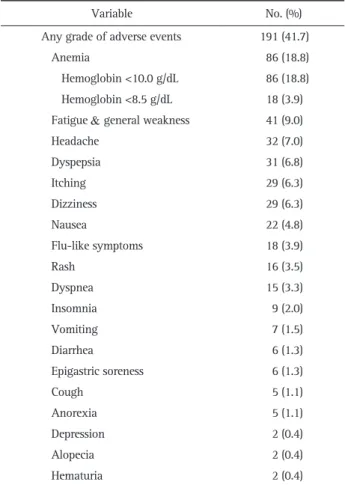
Any grade of adverse events were found in 41.7% of the par- ticipants (Table 3). The most common symptoms were anemia (18.8%), fatigue/general weakness (9.0%), headache (7.0%), dys- pepsia (6.8%), and itching (6.3%). No adverse event accounted for >10%, except for anemia, and most were tolerable with sup- portive management. Only one patient discontinued the therapy due to nausea and dyspepsia.
DISCUSSION
In this retrospective real-life study of SOF-based therapy for genotype 2 HCV-infected Korean patients, the SVR rates were high (94.5% in ITT and 97.1% in PP) and the underlying liver disease severity and previous treatment experience did not sig- nificantly affect the SVR rates. Likewise, patients with a high FIB-4 score showed comparable SVR rates with those with a low FIB-4 score. Notably, patients with very short treatment duration (<12 weeks) or without RBV showed lower SVR rates.
However, SVR rates in those treated with <1,000 mg/day of RBV combined with SOF did not differ from those treated with the recommended dose.
According to a previous real-life study using the HCV- TARGET database,22 SVR for genotype 2 patients undergoing SOF+RBV therapy was 72%, which is much lower than our result. Additionally, treatment completion rate in the HCV- TARGET was lower (90.6%) than our data (95.9%). In another study with a high treatment completion rate,23-25 the real-life SVR with SOF+RBV in genotype 2 patients was 95% to 98% in TN patients, 91.2% in TE non-responders, and 100% in TE re- lapse patients, which were comparable with the findings in the present study.
Liver disease severity is an important factor for successful SVR with antiviral therapy in HCV-infected patients; thus, as-
sessment of the fibrosis stage before the selection of treatment regimen and duration is recommended.26 A recent Japanese multicenter cohort study revealed an SVR rate of 90.8% in pa- tients with high FIB-4, which was significantly lower compared to 98.1% of those with low FIB-4 after SOF+RBV therapy.27 The reason for the universally high SVR rate in NC (97.6%) or cir- rhotic (99.1%) Korean patients might be the longer treatment duration for cirrhosis compared to that of Japanese patients who were only allowed 12 weeks of treatment due to reimburse- ment limitations for SOF-based treatment in Japan. Moreover, four decompensated cirrhotic patients showed SVR rate of 100%
without any significant adverse event. Additionally, the fibrosis stage based on FIB-4 score did not significantly affect the SVR rate (Fig. 2A). These findings were correlated with high comple- tion rate of patients with advanced cirrhosis. Treatment with- drawal rates were 4.7% in NC and 2.7% in cirrhotic patients, and 5.5%, 6.1%, and 2.5% in patients with FIB-4 score of <1.45, 1.45–3.25, and >3.25, respectively (data not shown). This result suggested that the adherence to the antiviral treatment, which was not considered in clinical studies, is more crucial than the liver disease severity for achieving successful antiviral eradica- tion in real-life settings.
Detailed prescription pattern of RBV was not investigated in previous studies because practice guidelines6,26 recommended two fixed doses (1,000 or 1,200 mg/day) based on body weight.
Nonetheless, our data showed that more than 1/3 of the physi- cians started RBV with a dose of 800 mg/day (Table 1), which was likely based on their experience in treating with pegylated interferon.28 Moreover, the weight-based dosing had to be re- duced during the whole duration of the treatment in 68.6%
(Table 1). Reduced dosing of RBV was more frequent in patients weighing <75 kg (45.4% vs 7.6%, p<0.001, data not shown) and those with chronic kidney disease grade 3 or more (90.5%
[19/21] vs 68.2% [276/403], p=0.031, data not shown). In Asian patients, the RBV-induced anemia was more frequently reported (37.0%) in a previous study related to inosine triphosphatase polymorphism,29 compared to Caucasian (25.8%) or Hispanic (20.4%) patients. Thus, the RBV dose reduction rate was high (35.6%) in the setting of peginterferon and RBV combination therapy.30 Nonetheless, our data showed the SVR rate in Korean patients receiving the reduced dose of RBV (Fig. 2C) was not inferior to that in patients receiving the full weight-based dose.
Moreover, the efficacies of stratified RBV dosing were not sig- nificantly different between those with weighted <75 and those
≥75 kg (Supplementary Fig. 1). Thus, the relevant dose reduction of RBV resulted in better treatment compliance and subsequent successful viral eradication.
There are several limitations of this study. First, the reason for treatment withdrawal was not fully documented because most patients did not visit the study site after the final prescription;
thus, the possible problem that caused treatment intolerance might be underestimated. Secondly, the frequency of adverse
events was based on medical records and might be incom- pletely categorized owing to the different tolerability of the patients. However, the most recorded symptom did not result in treatment discontinuation. Thirdly, the reason of RBV dose selection was not investigated owing to the study’s retrospec- tive design. However, the lower RBV dose was related to older age (i.e., mean of 68.7±10.5 years in patients with RBV dose of
<800 mg/day and 53.7±8.3 years in patients with RBV dose of 1,200 mg/day, p<0.0001, data not shown), lower body weight (p=0.0009), lower baseline hemoglobin level (p<0.001) and platelet count (p=0.004), and more frequent LC (p=0.005, data not shown), which are well-known predictive factors of RBV- induced anemia.31 This implies that the dose of RBV was based on the patient’s comorbidity and expected tolerance as decided by an experienced physician.
In conclusion, SOF-based therapy showed a high real-life ef- ficacy and tolerable safety in Korean patients with genotype 2 chronic HCV infection, regardless of previous antiviral treatment experience and fibrosis score. A reduced dose of RBV combined with SOF is as effective as its standard dose in genotype 2 Asian patients.
CONFLICTS OF INTEREST
No potential conflict of interest relevant to this article was reported.
ACKNOWLEDGEMENTS
This study was supported by a grant of Gilead (IN-US-334-4003), and a grant for the Chronic Infectious Disease Cohort Study (Korea HCV Cohort Study, 4800-4859-304) from the Korea Cen- ters for Disease Control and Prevention.
The authors are grateful to the devoted research coordinators (Da-Seul Lee, Dawoon Jeong, and Seon Young Park from Seoul National University Hospital, Seongnam; Hyoyoung Kang from Chonbuk National University Hospital, Chonju; Semi Jeon from Soonchunhyang University Bucheon Hospital, Bucheon; Dalli Nam from Inje University Busan Paik Hospital, Busan; Su Jin Lee from Keimyung University Dongsan Medical Center, Daegu;
and Young Soon Lee from Inje University Ilsan Paik Hospital, Goyang).
AUTHOR CONTRIBUTIONS
Study concept and design: E.S.J., S.H.J. Data acquisition: E.S.J., K.A.K., Y.S.K., I.H.K., B.S.L., Y.J.L., W.J.C., S.H.J. Data analysis and interpretation: E.S.J., S.H.J. Drafting of the manuscript: E.S.J.
Critical revision of the manuscript for important intellectual content: K.A.K., Y.S.K., I.H.K., B.S.L., Y.J.L., W.J.C. Statistical analysis: E.S.J. Obtained funding and study supervision: S.H.J.
ORCID
Eun Sun Jang https://orcid.org/0000-0003-4274-2582 Kyung-Ah Kim https://orcid.org/0000-0002-6128-6407 Young Seok Kim https://orcid.org/0000-0002-7113-3623 In Hee Kim https://orcid.org/0000-0003-3863-7907 Byung Seok Lee https://orcid.org/0000-0002-4669-8892 Youn Jae Lee https://orcid.org/0000-0003-3854-3388 Woo Jin Chung https://orcid.org/0000-0002-3736-1067 Sook-Hyang Jeong https://orcid.org/0000-0002-4916-7990
REFERENCES
1. Mohd Hanafiah K, Groeger J, Flaxman AD, Wiersma ST. Global epidemiology of hepatitis C virus infection: new estimates of age-specific antibody to HCV seroprevalence. Hepatology 2013;57:1333-1342.
2. Stanaway JD, Flaxman AD, Naghavi M, et al. The global burden of viral hepatitis from 1990 to 2013: findings from the Global Burden of Disease Study 2013. Lancet 2016;388:1081-1088.
3. Kim DY, Kim IH, Jeong SH, et al. A nationwide seroepidemi- ology of hepatitis C virus infection in South Korea. Liver Int 2013;33:586-594.
4. Lee SS, Byoun YS, Jeong SH, et al. Type and cause of liver disease in Korea: single-center experience, 2005-2010. Clin Mol Hepatol 2012;18:309-315.
5. Seong MH, Kil H, Kim YS, et al. Clinical and epidemiological fea- tures of hepatitis C virus infection in South Korea: a prospective, multicenter cohort study. J Med Virol 2013;85:1724-1733.
6. Korean Association for the Study of the Liver (KASL). 2017 KASL clinical practice guidelines management of hepatitis C: treatment of chronic hepatitis C. Clin Mol Hepatol 2018;24:169-229.
7. Toyoda H, Chayama K, Suzuki F, et al. Efficacy and safety of gle- caprevir/pibrentasvir in Japanese patients with chronic genotype 2 hepatitis C virus infection. Hepatology 2018;67:505-513.
8. Asselah T, Kowdley KV, Zadeikis N, et al. Efficacy of glecaprevir/
pibrentasvir for 8 or 12 weeks in patients with hepatitis C virus genotype 2, 4, 5, or 6 infection without cirrhosis. Clin Gastroen- terol Hepatol 2018;16:417-426.
9. Jacobson IM, Lawitz E, Gane EJ, et al. Efficacy of 8 weeks of sofosbuvir, velpatasvir, and voxilaprevir in patients with chronic HCV infection: 2 phase 3 randomized trials. Gastroenterology 2017;153:113-122.
10. Bourlière M, Gordon SC, Flamm SL, et al. Sofosbuvir, velpatasvir, and voxilaprevir for previously treated HCV infection. N Engl J Med 2017;376:2134-2146.
11. Lawitz E, Mangia A, Wyles D, et al. Sofosbuvir for previously un- treated chronic hepatitis C infection. N Engl J Med 2013;368:1878- 1887.
12. Ahn SH, Lim YS, Lee KS, et al. A phase 3b study of sofosbuvir plus ribavirin in treatment-naive and treatment-experienced Kore- an patients chronically infected with genotype 2 hepatitis C virus.
J Viral Hepat 2016;23:358-365.
13. Omata M, Nishiguchi S, Ueno Y, et al. Sofosbuvir plus ribavirin in Japanese patients with chronic genotype 2 HCV infection: an open-label, phase 3 trial. J Viral Hepat 2014;21:762-768.
14. Jacobson IM, Gordon SC, Kowdley KV, et al. Sofosbuvir for hepa- titis C genotype 2 or 3 in patients without treatment options. N Engl J Med 2013;368:1867-1877.
15. Zeuzem S, Dusheiko GM, Salupere R, et al. Sofosbuvir and riba- virin in HCV genotypes 2 and 3. N Engl J Med 2014;370:1993- 2001.
16. Kim JS, Ahn SM, Jung YK, et al. The impact of inosine triphos- phatase variants on hemoglobin level and sustained virologic response of chronic hepatitis C in Korean. J Korean Med Sci 2013;28:1213-1219.
17. Kurosaki M, Tanaka Y, Tanaka K, et al. Relationship between polymorphisms of the inosine triphosphatase gene and anaemia or outcome after treatment with pegylated interferon and ribavirin.
Antivir Ther 2011;16:685-694.
18. Kwon JH, Bae SH, Choi JY, et al. Assessment of the efficacy of reducing peginterferon alpha-2a and ribavirin dose on virologic response in Koreans with chronic hepatitis C. Korean J Intern Med 2009;24:203-211.
19. Lee H, Choi MS, Paik SW, et al. Peginterferon alfa-2a plus ribavi- rin for initial treatment of chronic hepatitis C in Korea. Korean J Hepatol 2006;12:31-40.
20. Suk KT, Baik SK, Yoon JH, et al. Revision and update on clinical practice guideline for liver cirrhosis. Korean J Hepatol 2012;18:1- 21.
21. Sterling RK, Lissen E, Clumeck N, et al. Development of a simple noninvasive index to predict significant fibrosis in patients with HIV/HCV coinfection. Hepatology 2006;43:1317-1325.
22. Reddy KR, Lim JK, Kuo A, et al. All-oral direct-acting antiviral therapy in HCV-advanced liver disease is effective in real-world
practice: observations through HCV-TARGET database. Aliment Pharmacol Ther 2017;45:115-126.
23. Akahane T, Kurosaki M, Itakura J, et al. Real-world efficacy and safety of sofosbuvir + ribavirin for hepatitis C genotype 2: a na- tionwide multicenter study by the Japanese Red Cross Liver Study Group. Hepatol Res 2019;49:264-270.
24. Kim YM, Kim SB, Song IH, et al. Efficacy and safety of sofosbuvir plus ribavirin for Korean patients with hepatitis C virus genotype 2 infection: a retrospective multi-institutional study. Clin Mol Hepatol 2018;24:311-318.
25. Ogawa E, Furusyo N, Nomura H, et al. Effectiveness and safety of sofosbuvir plus ribavirin for HCV genotype 2 patients 65 and over with or without cirrhosis. Antiviral Res 2016;136:37-44.
26. European Association for the Study of the Liver. EASL recommen- dations on treatment of hepatitis C 2018. J Hepatol 2018;69:461- 511.
27. Morio K, Imamura M, Kawakami Y, et al. Advanced liver fibrosis effects on the response to sofosbuvir-based antiviral therapies for chronic hepatitis C. J Med Virol 2018;90:1834-1840.
28. Korean Association for the Study of the Liver. KASL clinical practice guidelines: management of hepatitis C. Clin Mol Hepatol 2016;22:76-139.
29. Kozuka R, Hai H, Teranishi Y, et al. Correlation between polymor- phism in the inosine triphosphatase and the reductions in hemo- globin concentration and ribavirin dose during sofosbuvir and ribavirin therapy. J Gastroenterol Hepatol 2017;32:1495-1502.
30. Hu KQ, Freilich B, Brown RS, Brass C, Jacobson IM. Impact of Hispanic or Asian ethnicity on the treatment outcomes of chronic hepatitis C: results from the WIN-R trial. J Clin Gastroenterol 2011;45:720-726.
31. Borroni G, Cazzaniga M, Andreoletti M, et al. Low glomerular fil- tration rate is a risk factor for ribavirin-associated anaemia in old patients with chronic hepatitis C. J Viral Hepat 2013;20:e90-e95.