• 검색 결과가 없습니다.

Influence of Metallic Contamination on Photovoltaic Characteristics of n-type Silicon Solar-cells

N/A
N/A
Protected

Academic year: 2021

Share "Influence of Metallic Contamination on Photovoltaic Characteristics of n-type Silicon Solar-cells"

Copied!
4
0
0

로드 중.... (전체 텍스트 보기)

전체 글

(1)

subscript

J

SC

: short-circuit current V

OC

: open-circuit voltage FF : fill factor

PCE: power conversion efficiency

1. 서 론

태양광(photovoltaic, PV) 산업은 수십 년 동안 지속적으로 발전하며 성장을 지속하고 있다. 실리콘 태양전지 산업은 보다 더 높은 셀 효율을 달성하기 위하여 표면 텍스쳐링(surface texturing)

1)

, 플라즈마 도핑(plasma doping), 선택 에미터(selective emitter)

2)

, 후면 접촉 셀(back contact cell)

3,4)

등 다양한 연구와 개발이 지속 되었다. 태양광 산업의 성장을 주도한 것은 p-type 실리콘 기반 의 태양전지 셀이지만 최근에는 n-type 실리콘 웨이퍼 기반의 태

양전지 셀이 각광받고 있다

5-7)

. 일반적으로 인(phosphorus)으로 도핑되어 있는 n-type 실리콘 웨이퍼는 도펀트(dopant)로서 boron의 농도가 매우 낮기 때문에 붕소-산소 쌍(boron-oxygen pair) 의 형성이 적다

8,9)

. 붕소-산소 쌍은 소수 캐리어 재결합 수명 (minority carrier recombination lifetime)을 저하시키는 요인 중 하나이기 때문에

9-12)

p-type 실리콘 태양전지 셀에 비해 n-type 태양전지는 침입 산소(interstitial oxygen, O

i

)의 농도가 높더라 도 셀 효율에 비교적 영향이 적다. 비록 현재 태양광 산업의 핵심 기술이 p-type 실리콘 웨이퍼 기반의 태양전지에 최적화되어 있 지만 더 높은 셀 효율을 달성하기 위해 많은 기업 및 연구자들은 n-type 실리콘 웨이퍼 기반 태양전지의 잠재력을 높게 평가하고 있다.

또한 실리콘 태양전지는 가격경쟁력을 확보하기 위하여 제 조비용을 최대한 줄이는 것이 핵심이기 때문에, 잉곳 성장부터 웨이퍼링, 셀 제작, 모듈 공정이 반도체 산업과 비교하여 비교적 간단하다. 이는 결함(defect), 중금속을 포함한 불순물 오염에 취 약함을 의미한다. 반도체 소자에 비해 태양전지 셀은 디자인룰 이 상대적으로 크기 때문에 이러한 불순물에 대한 영향은 비교

Current Photovoltaic Research 6(1) 17-20 (2018) pISSN 2288-3274

DOI:https://doi.org/10.21218/CPR.2018.6.1.017 eISSN 2508-125X

중금속 오염이 n형 실리콘 태양전지의 전기적 특성에 미치는 영향에 대한 연구

김일환ㆍ박준성ㆍ박재근*

전자컴퓨터통신공학과, 한양대학교, 서울특별시, 04763

Influence of Metallic Contamination on Photovoltaic Characteristics of n-type Silicon Solar-cells

Il-Hwan Kim ․ Jun-Seong Park ․ Jea-Gun Park*

Department of Electrics and Computer Engineering, Hanyang University, Seoul 04763, Korea

Received December 11, 2017; Revised December 22, 2017; Accepted January 16, 2018

ABSTRACT: The dependency of the photovoltaic performance of p-/n-type silicon solar-cells on the metallic contaminant type (Fe, Cu, and Ni) and concentration was investigated. The minority-carrier recombination lifetime was degraded with increasing metallic contaminant concentration, however, the degradation sensitivity of recombination lifetime was lower at n-type than p-type silicon wafer, which means n-type silicon wafer have an immunity to the effect of metallic contamination. This is because heavy metal ions with positive charge have a much larger capture cross section of electron than hole, so that reaction with electrons occurs much more easily. The power conversion efficiency of n-type solar-cells was degraded by 9.73% when metallic impurities were introduced in the silicon bulk, which is lower degradation compared to p-type solar-cells (15.61% of efficiency degradation). Therefore, n-type silicon solar-cells have a potential to achieve high efficiency of the solar-cell in the future with a merit of immunity against metal contamination.

Key words: Si solar-cell, PV characteristics, contamination, metal, n-type

*Corresponding author: [email protected]

ⓒ 2018 by Korea Photovoltaic Society

This is an Open Access article distributed under the terms of the Creative Commons Attribution Non-Commercial License (http://creativecommons.org/licenses/by-nc/3.0)

which permits unrestricted non-commercial use, distribution, and reproduction in any medium, provided the original work is properly cited.

17

(2)

I.H. Kim et al. / Current Photovoltaic Research 6(1) 17-20 (2018) 18

적 적게 받지만, 고효율 및 저비용 태양전지의 목표를 달성하기 위해서는 불순물이 셀 효율에 미치는 영향에 대해 파악하고 오 염을 방지해야 한다.

따라서 본 연구에서는 n-type 실리콘 웨이퍼에서 Fe, Cu, Ni 과 같은 중금속의 오염이 태양전지 셀의 전기적 특성에 어떠한 영향을 미치는지에 대하여 평가하였다. Fe, Cu, Ni 이온을 실리 콘 웨이퍼 벌크(bulk) 내로 확산(diffusion)시킨 후 태양전지 셀 을 제작하여 개방 전압(open-circuit voltage, V

oc

), 단락 전류 (short-circuit current, J

sc

), 곡선인자(fill factor, FF), 전력변환효 율(power conversion efficiency, PCE) 등 태양전지 셀의 전기적 특성을 비교하였다. 또한 p-type 태양전지에 비해 n-type 태양전 지가 중금속 오염에 얼마나 덜 영향을 받는지를 평가하기 위하 여 동일한 농도로 중금속 오염 후 p-type 및 n-type 실리콘 웨이 퍼로 제조한 태양전지 셀의 특성을 비교하였다.

2. 실 험

본 실험에는 200 µm 두께의 n-type 및 p-type 실리콘 태양전 지 웨이퍼를 사용하였으며, 중금속 강제오염을 위하여 Fe, Cu, Ni 의 표준용액(from Kanto Kagaku)을 사용하였다. 0.1 ppm, 0.5 ppm, 1.0 ppm, 5.0 ppm, 10.0 ppm의 농도를 가진 중금속 용 액을 사용하여 2,000 rpm의 스핀 코팅(spin-coating)을 통해 실 리콘 웨이퍼 표면에 오염 용액을 일정한 두께로 코팅한 후, 실리 콘 벌크 내 확산을 위하여 900°C에서 15분 동안 질소 분위기에 서 열처리를 진행하였다. 그 후 790°C에서 POCl

3

가스를 도포 한 뒤 870°C에서 3분 동안 phosphorus을 확산(diffusion)하였 다. 모든 웨이퍼의 전면에는 플라즈마 화학기상 증착법(plasma enhanced chemical vapor deposition, PECVD) 을 통해 95 nm 두 께의 SiN

x

막으로 반사 방지 코팅층(anti-reflection coating, ARC)을 형성하였다. Ag 및 Al 페이스트를 사용하여 스크린프 린터를 통해 상부 및 하부 금속 전극을 형성한 뒤 680°C에서 2초 간 급속 열처리(rapid thermal anneal, RTA)를 진행하여 태양전 지 셀을 제조하였다.

3. 결과 및 고찰

Fig. 1 은 n-type 및 p-type 실리콘 웨이퍼의 중금속 오염농도 에 따른 소수 캐리어 재결합 수명을 보여주고 있다. 오염을 하지 않은 기준(reference) 샘플에 비해 Fe, Cu, Ni의 모든 중금속에 대하여 중금속 오염 농도가 증가함에 따라 소수 캐리어 재결합 수명이 감소하였다. 실리콘 벌크 내 중금속 이온은 실리콘 밴드 갭(band-gap) 내 트랩 에너지 레벨(trap energy level)을 형성하 여 재결합 중심(recombination center)으로 작용하기 때문에

13,14)

소수 캐리어 재결합 수명의 감소를 야기하며, 이러한 소수 캐리 어 재결합 수명의 감소는 셀 효율을 저하시키는 요인이다. Fig.

1(a)과 같이 n-type 실리콘 웨이퍼에 Fe, Cu. Ni이 10 ppm의 농 도로 오염되었을 때 소수 캐리어 재결합 수명은 각각 88.97, 90.26, 83.78%로 감소하였다. 이에 비해 p-type 실리콘 웨이퍼 에 동일한 농도로 중금속이 오염되었을 때 Fig. 1(b)에서 보이듯 이 Fe, Cu, Ni이 오염됨에 따라 소수 캐리어 재결합 수명은 각각 58.82, 65.98, 44.14% 로 감소하였다. 즉, 동일한 농도로 중금속 이 오염되었을 때 n-type wafer에 비해 p-type wafer에서 소수 캐 리어 재결합 수명의 저하가 급격한 것을 확인하였다. 이는 양전 하를 갖는 중금속 이온들이 정공(hole)에 비해 전자(electron)의 capture cross section 값이 훨씬 크기 때문에 전자와의 반응이 훨 씬 쉽게 발생하기 때문이다

15)

. 따라서 n-type 웨이퍼는 p-type 웨 이퍼에 비해 중금속 오염에 대해 높은 면역력(immunity)을 보유 하고 있다.

Fig. 2는 n-type 실리콘 웨이퍼로 제조한 태양전지의 중금속 오염 농도에 따른 셀 특성을 보여주고 있다. Fe, Cu, Ni의 모든 중 금속 종류에 대해 V

OC

는 Fig. 2(a)와 같이 중금속 오염 농도와는 무관하게 약 0.62 V로 일정한 값을 유지하고 있다. 반면에 Fig.

2(b)와 같이 모든 중금속 종류에 대해 중금속의 오염 농도가 증 가할수록 J

SC

는 감소하고 있다. 오염을 하지 않은 기준 샘플은 36.01 mA/cm

2

의 J

SC

값을 보이는 것에 비해, Fe, Cu, Ni을 10 ppm의 농도로 오염하였을 때 J

SC

는 각각 34.52, 34.84, 34.26 mA/cm

2

으로 최대 4.86%의 셀 특성 저하가 발생하였다. J

SC

Fig. 1. Dependency of minority-carrier recombination lifetime

on the metallic contaminant type and concentration. (a)

n-type and (b) p-type Si wafer

(3)

I.H. Kim et al. / Current Photovoltaic Research 6(1) 17-20 (2018) 19

다음과 같은 함수로 이루어져 있다

16,17)

.



      (1)

식에서  ,  ,  ,  ,  는 각각 전하량(electron charge), 생성률 (generation rate), 확산거리(diffusion length), 환산계수 (diffusion coefficient), 재결합수명(recombination lifetime)을 나타낸다.

즉 J

SC

는 소수 캐리어 재결합 수명의 제곱근에 비례하기 때문에 소수 캐리어 재결합 수명이 감소함에 따라 J

SC

는 감소하며, 소수 캐리어 재결합 수명의 저하 정도에 비해 제곱근의 비율로 감소 함을 알 수 있다. 또한 Fig. 3(c)에서 나타내듯이 FF도 중금속의 오염농도가 증가함에 따라 감소하고 있다. 오염을 하지 않은 기 준 샘플에서 76.37%의 FF 값을 보이는 것에 비해 Fe, Cu, Ni을 10 ppm 의 농도로 오염하였을 시 각각 71.90, 73.13, 72.25%로 평균 5%의 FF 값의 저하를 야기하였다.

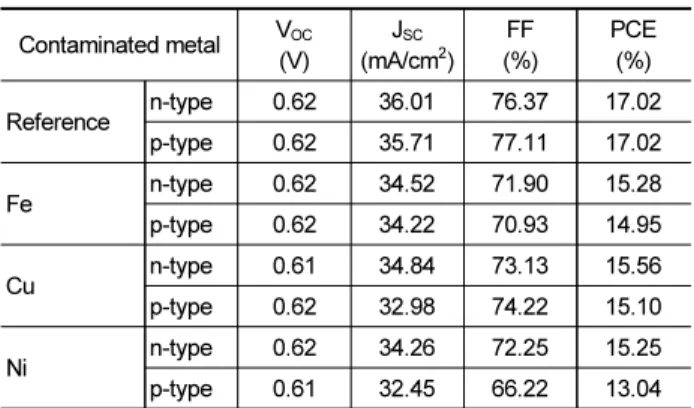
Fig. 3과 Table 1은 n-type 및 p-type 실리콘 웨이퍼로 제조한 태양전지 셀의 전력변환효율을 포함한 전기적 특성을 나타내고 있다. 모든 중금속 종류에 대해 오염 농도가 증가할수록 J

SC

및 FF가 감소하였기 때문에 PCE도 동일한 추세로 감소하였다. 특 히 n-type의 경우 Fig. 3(a) 및 Table 1과 같이 Fe, Cu, Ni을 10 ppm 의 중금속 농도로 오염되었을 때의 효율이 각각 15.28, 15.56, 15.25% 로, 17.02%의 효율을 가진 기준 샘플에 비해 평균 9.73%의 셀 효율 저하를 야기하였다. 이에 비해 p-type 실리콘 웨이퍼에 동일한 중금속 농도로 오염되었을 때 기준 샘플에 비 해 셀 효율의 저하가 평균 15.61%로 n-type에 비해 셀 효율의 저 하가 높은 것을 Fig. 3(b)과 Table 1을 통해 확인할 수 있다. 이를 통해 실리콘 벌크 내 중금속 오염은 태양전지 셀의 J

SC

, FF의 감

Fig. 2. Dependency of photovoltaic characteristics of n-type Si solar-cells on the metallic contaminant concentration and type. open-circuit voltage (VOC), (b) short-circuit current density (JSC), and (c) fill factor (FF)

Fig. 3 . Power conversion efficiency of metal contaminated solar cells as a function of contaminant concentration. (a) n-type and (b) p-type Si solar-cells

Table 1. PV characteristics of n-/p-type silicon solar-cells with metallic contaminant concentration of 10 ppm

Contaminated metal V

OC

(V)

J

SC

(mA/cm

2

) FF (%)

PCE (%)

Reference n-type 0.62 36.01 76.37 17.02

p-type 0.62 35.71 77.11 17.02

Fe n-type 0.62 34.52 71.90 15.28

p-type 0.62 34.22 70.93 14.95

Cu n-type 0.61 34.84 73.13 15.56

p-type 0.62 32.98 74.22 15.10

Ni n-type 0.62 34.26 72.25 15.25

p-type 0.61 32.45 66.22 13.04

(4)

I.H. Kim et al. / Current Photovoltaic Research 6(1) 17-20 (2018) 20

소로 인한 PCE의 저하를 유발함을 검증하였으며, 특히 p-type 에 비해 n-type 기반의 실리콘 태양전지가 중금속 오염에 덜 민 감하기 때문에 실리콘 태양전지의 고효율을 달성하기 위해 유 리함을 검증하였다.

4. 결 론

우리는 중금속 오염이 태양전지 셀의 전기적 특성에 미치는 영향에 대해 연구를 수행하였다. 실리콘 벌크 내로 중금속이 오 염됨에 따라 밴드갭 내에 트랩 에너지 레벨을 형성하여 소수 캐 리어 재결합 수명의 감소를 야기하였다. 이로 인해 J

SC

, FF 및 셀 효율도 저하되었으며, 특히 p-type 실리콘 웨이퍼에 비해 n-type 실리콘 웨이퍼는 동일한 농도의 중금속이 오염되어도 소수 캐 리어 재결합 수명의 저하 정도가 낮아 셀 효율의 저하 정도가 상 대적으로 낮았다. n-type 기반 실리콘 태양전지는 붕소-산소 쌍 의 부재, 중금속 오염에 대한 면역력 등의 장점을 가지기 때문에 향후 태양전지 셀의 고효율을 달성하기 위해서는 n-type 태양전 지에 대한 많은 연구가 수행되어야 한다.

후 기

본 연구는 산업통상자원부의 재원으로 한국에너지기술평가 원(KETEP)의 신재생에너지핵심기술사업(No.20163030013390) 및 한국연구재단의 BK21 PLUS 사업을 통해 수행한 연구과제 입니다.

References

1. P. Papet, O. Nichiporuk, A. Kaminski, Y. Rozier, J. Kraiem, J.

F. Lelievre, A. Chaumartin, A. Fave, M. Lemiti, “Pyramidal texturing of silicon solar cell with TMAH chemical anisotropic etching”, Sol. Energy Mater. Sol. Cells, Vol. 90, pp. 2319-2328, 2006.

2. U. Jager, S. Mack, C. Wufka, A. Wolf, D. Biro, R. Preu, “Benefit of selective emitters for p-Type silicon solar cells with passi- vated surfaces”, IEEE J. Photovolt., Vol. 3, No. 2, pp. 621-627, 2013.

3. E. Van Kerschaver, G. Beaucarne, “Back-contact solar cells: a review”, Prog. Photovolt: Res. Appl., Vol. 14, pp. 107-123, 2006.

4. C. Gong, S. Singh, J. Robbelein, N. Posthuma, E. Van Kerschaver, J. Poortmans, R. Mertens, “High efficient n-type back-junction

back-contact silicon solar cells with screen-printed al-alloyed emitter and effective emitter passivation study”, Prog. Photovolt:

Res. Appl., Vol. 19, pp. 781-786, 2011.

5. F. Feldmann, M. Bivour, C. Reichel, M. Hermle, S. W. Glunz,

“Passivated rear contacts for high-efficiency n-type Sisolar cells providing high interface passivation quality and excellent trans- port characteristics”, Sol. Energy Mater. Sol. Cells, Vol. 120, pp. 270-274, 2014.

6. M. Taguchi, A. Yano, S. Tohoda, K. Matsuyama, Y. Nakamura, T. Nishiwaki, K. Fujita, E. Maruyama, “24.7% Record effi- ciency HIT solar cell on thin silicon wafer”, IEEE J. Photovolt., Vol. 4, No. 1, pp. 96-99, 2014.

7. K. Masuko, M. Shigematsu, T. Hashiguchi, D Fujishima, M.

Kai, N. Yoshimura, T. Yamaguchi, Y. Ichihashi, T. Mishima, N. Matsubara, T. Yamanishi, T. Takahama, M. Taguchi, E.

Maruyama, S. Okamoto, “Achievement of more than 25% con- version efficiency with crystalline silicon heterojunction solar cell”, IEEE J. Photovolt., Vol. 4, No. 6, pp. 1433-1435, 2014.

8. A. Rehman, S. H. Lee, “Advancements in n-Type base crystal- line silicon solar cells and their emergence in the photovoltaic industry”, Scientific World Journal 2013, 2013.

9. D. Macdonald, L. J. Geerligs, “Recombination activity of in- terstitial iron and other transition metal point defects in p- and n–type crystalline silicon”, Appl. Phys. Lett, Vol. 85, pp. 4061- 4063, 2004.

10. S. W. Glunz, S. Rein, J. Y. Lee, W. Warta, “Minority carrier lifetime degradation in boron-doped Czochralski silicon”, J.

Appl. Phys., Vol. 90, pp. 2397-2404, 2001.

11. J. Schmidt, A. G. Aberle, R. Hezel, “Investigation of carrier lifetime instabilities in Cz-grown silicon”, in Proceedings of the 1997 IEEE 26th Photovoltaic Specialists Conference, pp. 13 – 18, 1997.

12. J. Schmidt, K. Bothe, “Structure and transformation of the metastable boron- and oxygen-related defect center in crystal- line silicon”, Phys. Rev. B, Vol. 69, pp. 024107, 2004.

13. K. Graff, Metal impurities in silicon-device fabrication, Springer Science & Business Media, 2013.

14. A. A. Istratov, E. R. Weber, “Electrical properties and recombi- nation activity of copper, nickel and cobalt in silicon”, Appl.

Phys. A, Vol. 66, pp. 123–136, 1998.

15. A. A. Istratov, H. Hieslmair, E. R. Weber, “Iron and its com- plexes in silicon”, Appl. Phys. A, Vol. 69, pp.13–44, 1999.

16. B. G. Streetman, Solid State Electronic Devices, Pearson Prentice Hall, 2006.

17. S. M. Sze, Physics of Semiconductor Devices, John Wiley &

Sons, Inc., 2007.

수치

Fig. 1 은 n-type 및 p-type 실리콘 웨이퍼의 중금속 오염농도 에 따른 소수 캐리어 재결합 수명을 보여주고 있다. 오염을 하지  않은 기준(reference) 샘플에 비해 Fe, Cu, Ni의 모든 중금속에  대하여 중금속 오염 농도가 증가함에 따라 소수 캐리어 재결합  수명이 감소하였다
Fig. 3 . Power conversion efficiency of metal contaminated solar cells as a function of contaminant concentration

참조

관련 문서

In particular the earlier the first exposure time of obscene media is the higher labeling type, depressive type, aggressive type, and socialized type

3. Specially, Va type these a lot of changes were seen. Va type and Ⅶ type were shown big change after 4 months. Depilation number increases if depilation is gone or it is

Canham, "Visible light emission due to quantum size effects in highly porous crystalline silicon ", Nature, vol. Herino, "Exchange mechanism responsible for

connection type abutment had larger marginal gap than the external-hex connection type abutment, it is more difficult to make customized abutment of the internal-hex

Other Nucleic_acid Lipid steroid, Other lipid carbohydrate type of carbohydrate Substance-Atom type of

As examined above, based on the type changes this study confirmed that <Seoyukyonmunrok> has plenty of 'aaba' type structures and most lines are

8 No attenuation of light by semi-transparent metal electrodes, 8 Absorption of wave-guided light is dramatically reduced through. the use of highly reflective metallization

,cl i ni calstatus,exerci se capaci ty, hemodynami c vari abl es, echocardi ographi c parameters, several markersofneurohumoralacti vati on,andbi ochemi