www.ogscience.org 274
Case Report
Obstet Gynecol Sci 2018;61(2):274-277 https://doi.org/10.5468/ogs.2018.61.2.274 pISSN 2287-8572 · eISSN 2287-8580
Introduction
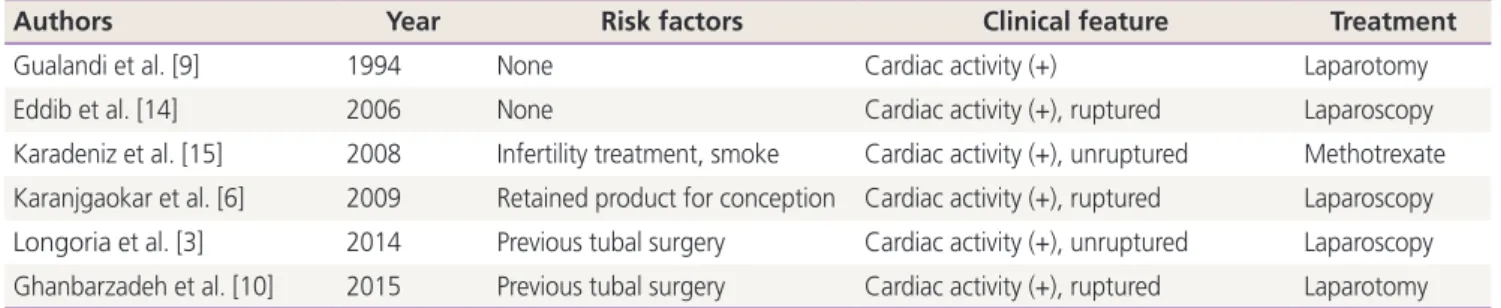
Ectopic pregnancy is a potentially life-threatening condition and is still regarded as one of the most important causes of maternal mortality [1-4]. Bilateral twin tubal pregnancy is very rare [1,2], and to the best of our knowledge, only approxi- mately 11 cases of live unilateral twin tubal pregnancies with cardiac activity have been reported in the literature (Table 1).
Thus, we report a rare case of spontaneous unilateral twin tubal pregnancy with heart activities in both fetuses and a lit- erature review.
Case report
A 31-year-old patient, gravida 1, para 0, presented to the emergency department of Hallym University Kangnam Sacred Heart Hospital at 7.7 weeks of gestation with symptoms of nausea, vomiting, and whole abdominal pain. She achieved this pregnancy spontaneously soon after she had a missed abortion 2 years ago. She had not received any infertility therapies. There were no risk factors of ectopic pregnancy in her medical and surgical history. The pain had continued for about 5 hours, and physical examination revealed tenderness and rebound tenderness on her lower abdomen.
The patient’s vital signs were unstable at the emergency room: blood pressure, 79/53 mmHg; pulse rate, 78 beats/
min. Her laboratory findings were the following: initial hemo- globin, 10.6 g/dL; white blood cell count, 18,430/µL; serum β-human chorionic gonadotropin, 35,672.3 mIU/mL. Trans- vaginal ultrasonography revealed no gestational sac in the uterine cavity but 2 gestational sacs with 2 yolk sacs at the right adnexa. Fetal heart beats were detected in both fetuses (Fig. 1A).
The crown-rump length (CRL) of each fetus was 8.3 and 7.8 mm, respectively. The CRL of each fetus matched 6.7 and 6.6 weeks of gestational age. A 3.9×3.5-cm anechogenic cystic mass was detected in the left ovary. She underwent emergent
A rare case of spontaneous live unilateral twin tubal pregnancy with both fetuses presenting with heart activities and a literature review
Chang-Ihll Kim
1, Tae-Yeem Lee
2, Sung-Taek Park
1, Hong-Bae Kim
1, Sung-Ho Park
1Department of Obstetrics and Gynecology, 1Hallym University Kangnam Sacred Heart Hospital, Hallym University College of Medicine, Seoul, 2Hallym University Dongtan Sacred Heart Hospital, Hallym University College of Medicine, Hwaseong, Korea
Ectopic pregnancy is an extrauterine pregnancy, and 98% of which occur in the fallopian tube. The incidence of twin tubal pregnancy is rare but is increasing due to assisted reproductive technology. Spontaneous unilateral twin tubal pregnancy is extremely rare, and only a small number of case reports have been made. We herein report a rare case of spontaneous unilateral twin tubal pregnancy with both fetuses presenting with heart activities and a literature review. Right salpingectomy was performed in this case. Pathologic and histologic assessment confirmed the 2 distinct pregnancies in the same tube. The twins were dichorionic and diamniotic.
Keywords: Ectopic pregnancy; Twins; Tubal pregnancy
Articles published in Obstet Gynecol Sci are open-access, distributed under the terms of the Creative Commons Attribution Non-Commercial License (http://creativecommons.
org/licenses/by-nc/3.0/) which permits unrestricted non-commercial use, distribution, and reproduction in any medium, provided the original work is properly cited.
Copyright © 2018 Korean Society of Obstetrics and Gynecology
Received: 2017.06.05. Revised: 2017.07.10. Accepted: 2017.07.21.
Corresponding author: Sung-Ho Park
Department of Obstetrics and Gynecology, Hallym University Kangnam Sacred Heart Hospital, Hallym University College of Medicine, 1 Singil-ro, Yeongdeungpo-gu, Seoul 07441, Korea E-mail: [email protected]
https://orcid.org/0000-0002-6981-2811
www.ogscience.org 275
Chang-Ihll Kim, et al. Live unilateral twin tubal pregnancy
laparoscopy under general anesthesia. Operative findings revealed a 4-cm ectopic mass with active bleeding at the am- pullary portion of the right fallopian tube and large amount of blood in the anterior and posterior cul-de-sac (Fig. 1B and C). In addition, a left ovary cyst was identified. She underwent right salpingectomy and left ovary wedge resection. Her post- operative course was uncomplicated. The gross pathologic and histologic assessments confirmed the 2 distinct pregnan- cies at the same tube. The twins were dichorionic and diam- niotic (Fig. 1D). The pathologic report of the left ovary cyst showed corpus luteum and hemorrhage.
Discussion
Although twin tubal pregnancy was thought to be very rare, its incidence has increased. In a recent review of the literature between 1918 and 2007, 242 cases of twin tubal pregnan- cies were reported, with 42 occurring during the last 10 years [1]. Assisted reproductive technology (ART) is responsible for the increase in twin tubal pregnancy. Spontaneous live uni- lateral twin tubal pregnancy is extremely rare in comparison with bilateral twin tubal pregnancy and unilateral twin tubal pregnancy with no cardiac activity [5,6]. A live unilateral twin tubal pregnancy has an incidence of 1 in every 125,000 spontaneous pregnancies [5]. Since the first case of unilateral twin tubal pregnancy was reported by De Ott [7] in 1891, an average of one case per year is reported in the literature [8].
The first unilateral twin tubal pregnancy with cardiac activity of both fetuses detected by transvaginal ultrasonography was in 1994 [9]. Most recently, Longoria et al. [3] reported the 10th case of live unilateral twin tubal pregnancy and Ghan- barzadeh et al. [10] reported the 11th case of live unilateral twin tubal pregnancy, making ours the 12th case. Of 11 cases of unilateral twin tubal pregnancies presenting with cardiac activity reported between 1994 and 2015, 3 cases had no risk
factors such as previous ectopic pregnancy, tubal pathology and surgery, previous genital infections, infertility, etc. Surgery was performed except in 1 cases, as shown in Table 1.
Both the morbidity and mortality of ectopic pregnancy are declining, mostly due to improved diagnosis and treatment protocol. However, ectopic pregnancy remains a potentially life-threatening condition in the first trimester of gestation. It is responsible for 9% to 13% of all pregnancy-related deaths [4]. The risk of complication is higher in twin tubal pregnan- cies compared with single tubal pregnancies because 2 ges- tational sacs would cause greater volume than 1 gestational sac. The risk of acute abdomen and hypovolemic shock due to rupture of one or both of the tubes is 30% to 50% in twin tubal pregnancies [1]. Therefore, in twin tubal pregnancy, early recognition, accurate diagnosis, and immediate treat- ment are very important to minimize the morbidity and mor- tality. When the diagnosis of ectopic pregnancy is established, especially when the patient conceived with ART, the pos- sibility of developing multiple ectopic pregnancies should be considered, and effort should be exerted to find the probable ectopic foci [5].
To decide the best treatment option, various factors, includ- ing patient’s hemodynamic stability and medical conditions, gestational sac size, and desire for future fertility, should be assessed. Unruptured single ectopic pregnancies can be suc- cessfully treated with systemic methotrexate. However, it is not effective in treating multiple tubal pregnancies [11]. In De Los Ríos’ review [1] of 40 cases of bilateral tubal pregnan- cies, only one case was successfully treated with systemic methotrexate, which indicates that medical treatment is ap- parently ineffective in multiple tubal pregnancies. In our case, emergent laparoscopic right salpingectomy was performed because of the ruptured ectopic mass, unstable hemodynamic status, and large amount of pelvic fluid collection noted in the transvaginal ultrasound (TVUS) image.
Table 1. Recent cases for unilateral twin tubal pregnancy presenting with cardiac activity
Authors Year Risk factors Clinical feature Treatment
Gualandi et al. [9] 1994 None Cardiac activity (+) Laparotomy
Eddib et al. [14] 2006 None Cardiac activity (+), ruptured Laparoscopy
Karadeniz et al. [15] 2008 Infertility treatment, smoke Cardiac activity (+), unruptured Methotrexate Karanjgaokar et al. [6] 2009 Retained product for conception Cardiac activity (+), ruptured Laparoscopy Longoria et al. [3] 2014 Previous tubal surgery Cardiac activity (+), unruptured Laparoscopy Ghanbarzadeh et al. [10] 2015 Previous tubal surgery Cardiac activity (+), ruptured Laparotomy
www.ogscience.org 276
Vol. 61, No. 2, 2018
Most unilateral live twin tubal pregnancies are monocho- rionic and monoamniotic [12]. However, in our case, histo- pathology result revealed dichorionic and diamniotic twins.
There were 2 gestational sacs with 2 yolk sacs in the TVUS im- age, indicating diamniotic twins. Fambrini et al. [13] reported spontaneous unilateral twin tubal pregnancy that resulted
from bilateral ovulation. They suspected bilateral ovulation because corpus luteum was seen in each ovary through the TVUS image, which was consequently proven histologically to be a corpus luteal cyst. Based on this finding, this case re- sulted from left unilateral ovulation. The possibility of mono- zygotic twins remains strong even though it is not genetically
Fig. 1. (A) Two gestational sacs with 2 yolk sacs were detected on the right adnexa, and fetal heartbeats were detected in both fetuses. (B) A 4-cm ectopic mass with active bleeding in the ampullary portion of the right fallopian tube. (C) There was large amount of blood in the anterior and posterior cul-de-sac. (D) Histopathology shows dichorionic and diamniotic twins.A B
C
D
www.ogscience.org 277