J O U R N A L O F
Veterinary Science
Short Communication
J. Vet. Sci. (2010), 11(1), 8587 DOI: 10.4142/jvs.2010.11.1.85
*Corresponding author
Tel: +82-2-880-1282; Fax: +82-2-880-1213 E-mail: [email protected]
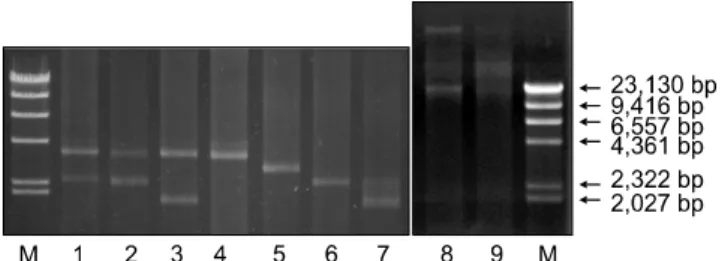
Fig. 1. Plasmids profiles extracted from Flavobacterium psychrophilum isolates using 0.70% agarose ME-TAE gels. Lane M; marker (λ DNA-Hind III digest), Lane 1; 3.5 and 2.4 kb (ayu isolate), Lane 2; 3.5 and 2.4 kb (crucian carp isolate), Lane 3; 3.5 and 1.8 kb (ayu isolate), Lane 4; 3.5 kb (ayu isolate), Lane 5; 2.7 kb (rainbow trout isolate), Lane 6; 2.4 kb (ayu isolate), Lane 7;
1.8 kb (ayu isolate), Lane 8; 100 and 23 kb (crucian carp isolate), Lane 9; none (ayu isolate).
Plasmid profiling of Flavobacterium psychrophilum isolates from ayu (Plecoglossus altivelis altivelis) and other fish species in Japan
Ji Hyung Kim
1, Dennis K. Gomez
1, Toshihiro Nakai
2, Se Chang Park
1,*
1
Laboratory of Aquatic Animal Medicine & Brain Korea 21 Program for Veterinary Science, College of Veterinary Medicine, Seoul National University, Seoul 151-742, Korea
2
Fish Pathobiology Laboratory, Graduate School of Biosphere Science, Hiroshima University, Higashi-Hiroshima 739-8528, Japan
In order to evaluate the genetic variability of the causative agent of cold water disease (CWD), plasmid profiling was used to characterize Flavobacterium (F.) psychrophilum isolates (n = 169). Size analysis of plasmids in F. psychrophilum isolates (n = 128) from several fish species demonstrated that six kinds of plasmids were harbored, and ayu isolates had different profiles compared to other isolates. Moreover, multiple isolates (n = 41) from CWD outbreaks in 2002 to 2003 at a single ayu farm were examined to determine differences between isolates from successive outbreaks and showed different profiles by the sources of seedlings.
Keywords: ayu, CWD, Flavobacterium psychrophilum, plasmid profile
In Japan, the causative agent of cold water disease (CWD), Flavobacterium (F.) psychrophilum, was first isolated from ayu (Plecoglossus altivelis altivelis) in 1987 [8] and spread widely over many host fish species in various areas, causing severe losses in aquaculture [4]. Recently, different typing methods including serotyping [9], genotyping [4]
and plasmid profiling [2,3,5,7] have been evaluated for the comparison of F. psychrophilum isolated from ayu, and these studies revealed that isolates with a specific serotype [9] or genotype [4] are specifically infectious to ayu and scarcely infectious to other fish species. However, these studies did not reflect the epidemiological situation of CWD in Japan. Therefore, the aim of this study was to determine the plasmid profiles to assist in characterizing Japanese F.
psychrophilum isolates from several fish species and CWD outbreaks in one ayu farm which cultured different sources of seedlings.
A total of 169 F. psychrophilum isolates were used in this
study. Among the isolates, 128 were provided either by prefecture disease control centers or fishery research stations, and 41 were collected from a single ayu farm (B farm) in Japan. All the isolates were stored in cytophaga broth (CB) [1] with 10% glycerol at 80
oC and subcultured in CB at 18
oC for 48 h. For bacterial plasmid DNA extraction, bacterial cell pellets of 169 isolates grown in CB were harvested after 3 min of centrifugation at 10,000 × g. The pellets were washed twice with DW. For plasmid DNA preparation, QIAprep Miniprep Kit (Qiagen GmbH, Germany) was used. The plasmids were separated on 0.70% agarose ME-TAE gels along with length markers (λ DNA-Hind III digest; New England BioLabs, USA) via electrophoresis (100 V, 60 min) and analyzed (Fig. 1).
In the first experiment, the plasmid profiles from 128 isolates and their relationship with host fish were analyzed.
Eighty-three of 128 isolates harbored four kinds of single
plasmids (1.8 kb, 2.4 kb, 2.7 kb or 3.5 kb) and ten of the
eighty-three isolates harbored combinations of two different
types of plasmids from ayu (3.5 kb and 2.4 kb or 3.5 and 1.8
kb), pale chub Zacco platypus (100 kb and 23 kb) and
86 Ji Hyung Kim et al.
Table 1. The plasmid profiles of Flavobacterium (F.) psychrophilum isolated from different host fish species Host fish species from which
F. psychrophilum was isolated (n)*
Plasmid type (kb)
100, 23 3.5, 2.4 3.5, 1.8 3.5 2.7 2.4 1.8 None
Plecoglossidae
Ayu Plecoglossus altivelis altivelis (72) Osmeridae
Pond smelt Hypomesus olidus (3) Salmonidae
Rainbow trout Oncorhynchus mykiss (14)
Amago salmon Oncorhynchus masou ishikawae (4) Biwa salmon Oncorhynchus masou rhodurus (1) Japanese charr Salvelinus leucomaenis (1) Coho salmon Oncorhynchus kisutch
†(1) Cyprinidae
Pale chub Zacco platypus (12) Crucian carp Carrassius cuvieri (20)
0 0 0 0 0 0 0 2 1
1 0 0 0 0 0 0 0 1
5 0 0 0 0 0 0 0 0
28 1 3 0 0 0 0 0 1
0 1 9 1 0 0 1 0 1
19 0 0 0 0 1 0 2 0
3 0 0 0 1 0 0 1 0
16 1 2 3 0 0 0 7 16
Total (128) 3 2 5 33 13 22 5 45
*n = number of F. psychrophilum isolates. †NCIMB1947T; National Collection of Industrial and Marine Bacteria, Aberdeen, Scotland.
Table 2. The plasmid profiles of Flavobacterium psychrophilum isolated from diseased ayu at B farm during 2002 and 2003
Plasmid type (kb)
Wild type* Cultured type
†2002 outbreak
(%)
2003 outbreak (%)
2003 outbreak (%) 3.5, 1.8
3.5 2.4 None
1 3 5 0
(11.1) (33.3) (55.5) (0)
1 11 3 2
(5.9) (64.7) (17.6) (11.8)
0 5 0 10
(0) (33.3)
(0) (66.7) Total 9 (100.0) 17 (100.0) 15 (100.0)
*Seedling source from Lake Biwa. †Seedling source from Tokushima Prefecture Fish Farming Center, Japan.
crucian carp Carassius cuvieri (100 kb and 23 kb; 3.5 kb and 2.4 kb) (Table 1). The single plasmid results were similar to previous studies [2,5], except for the new types of plasmids (1.8 kb, 23 kb and 100 kb). These results showed different plasmid profiles among host fish species compared to the previous studies [2,3,5,7]. Additionally, several types of plasmids (3.5 kb, 2.4 kb and 1.8 kb) were found mostly in ayu compared to other host fish species.
The similar plasmid harboring patterns were also observed in the second experiment, which examined the 41 isolates from diseased ayu at B Farm and experienced CWD outbreaks in successive years (2002 and 2003). Twenty-six strains were from diseased wild ayu grown from seedlings from Lake Biwa in 2002 and 2003 (wild type) and 15 were from diseased cultured ayu grown from seedlings from the Tokushima Prefecture Fish Farming Center (Japan) in 2003 (cultured type). Twenty-nine of 41 isolates harbored three types of plasmids (3.5 kb and 1.8 kb, 3.5 kb, 2.4 kb) similar to the plasmid sizes and profiles to the first experiment.
The wild type ayu isolates harbored either single or a combination of two different types of plasmids, while the cultured showed only a single type of plasmid. Moreover, F. psychrophilum isolated in the wild type predominantly harbored 2.4 kb (55.5%) in 2002 and 3.5 kb (64.7%) in 2003, showing annual differences. In contrast, F. psychrophilum isolated in cultured types predominantly harbored no plasmid (66.7%) in 2002 and 3.5 kb (33.3%) plasmid in 2003 (Table 2). These findings may demonstrate that F.
psychrophilum exhibiting special plasmid profiles (3.5 kb and 1.8 kb, 3.5 kb, 2.4 kb) are specifically infectious to ayu,
and the cultured ayu have limited exposure to F.
psychrophilum harboring different types of plasmids compared to wild type even when isolated in the same fish farm. It was previously described that F. psychrophilum with different serotypes and ribotypes were isolated from the same salmonid farm [6]. It also explains that F.
psychrophilum may transmit its plasmid because of unlimited
exposure to other isolates in the wild environment. Therefore,
it can be speculated that the specific size of plasmids is
related to its host fish species, and more than one strain
harboring different kinds of plasmids can simultaneously
infect a single farm.
Plasmid profiling of Flavobacterium psychrophilum isolates 87