KIPS Tr. Software and Data Eng.
Copyright Protection for Fire Video Images using an Effective Watermarking Method
Truc Nguyen†․Jong-Myon Kim††
ABSTRACT
This paper proposes an effective watermarking approach for copyright protection of fire video images. The proposed watermarking approach efficiently utilizes the inherent characteristics of fire data with respect to color and texture by using a gray level co-occurrence matrix (GLCM) and fuzzy c-means (FCM) clustering. GLCM is used to generate a texture feature dataset by computing energy and homogeneity properties for each candidate fire image block. FCM is used to segment color of the fire image and to select fire texture blocks for embedding watermarks. Each selected block is then decomposed into a one-level wavelet structure with four subbands [LL, LH, HL, HH] using a discrete wavelet transform (DWT), and LH subband coefficients with a gain factor are selected for embedding watermark, where the visibility of the image does not affect. Experimental results show that the proposed watermarking approach achieves about 48 dB of high peak-signal-to-noise ratio (PSNR) and 1.6 to 2.0 of low M-singular value decomposition (M-SVD) values. In addition, the proposed approach outperforms conventional image watermarking approach in terms of normalized correlation (NC) values against several image processing attacks including noise addition, filtering, cropping, and JPEG compression.
Keywords : Fire Video Watermarking, Fuzzy C-means Clustering, Grey Level Co-occurrence Matrix, Image Processing Attack
효과적인 워터마킹 기법을 사용한 화재 비디오 영상의 저작권 보호
Truc Nguyen†․김 종 면††
요 약
본 논문에서는 화재 비디오 영상의 저작권 보호를 위해 효과적인 워터마킹 기법을 제안한다. 제안하는 워터마킹 기법은 명암도 동시발생 행 렬과 퍼지 클러스터링 알고리즘을 이용하여 화재의 색상과 텍스처의 특징을 효율적으로 이용한다. 명암도 동시발생 행렬은 각 후보 화재 영상의 블록에 대한 에너지와 동질성을 계산하여 텍스처 데이터 셋을 만드는데 사용하며, 퍼지 클러스터링은 화재 비디오 영상의 색상 분할과 워터마커 삽입을 위한 텍스처 블록을 결정하기 위해 사용된다. 선택된 텍스처 블록은 이산 웨이블릿 변환을 통해 네 가지 서브밴드 (LL, LH, HL, HH)를 가지는 1차 레벨 웨이블릿 구조로 분해되고, 워터마커는 사람의 시각에 영향을 주지 않는 LH 영역에 삽입된다. 모의실험결과, 제안한 워터마킹 기법은 약 48 데시벨의 높은 첨부 신호 대 잡음 비와 1.6-2.0의 낮은 M-특이치 분해 값을 보였다. 또한, 제안한 워터마킹 기법은 노이즈 첨가, 필터링, 크로핑, JPEG 압축과 같은 영상처리 공격에서도 기존 이미지 워터마킹 알고리즘보다 정규화된 상관 값에서 높은 성능을 보였다.
키워드 : 화재 비디오 워터마킹, 퍼지 클러스터링, 그레이 레벨 동시발생 행렬, 이미지 처리 공격
1. 서 론1)
※ This work was supported by the National Research Foundation of Korea(NRF) grant funded by the Korea government(MEST) (No.
NRF-2013R1A2A2A05004566), and this research was supported by the Leading Industry Development for Economic Region (LeadER) grant funded the MKE(The Ministry of Knowledge Economy), Korea in 2013.(No.R0001220).
†비 회 원 : 울산대학교 전기공학부
††정 회 원 : 울산대학교 전기공학부 부교수 논문접수 : 2012년 11월 12일
수 정 일 : 1차 2013년 3월 25일 심사완료 : 2013년 4월 10일
* Corresponding Author : Jong-Myon Kim([email protected])
1. Introduction
Video based fire surveillance systems have been widely used to detect fire in large auditoriums, tunnels, atriums, and so on. In addition, copyright protection of these captured fire videos is important to investigate the source of fire origin as well as to protect against one’s manipulation. Recently, digital watermarking has been proposed as an effective solution to copyright protection of digital contents [1-3].
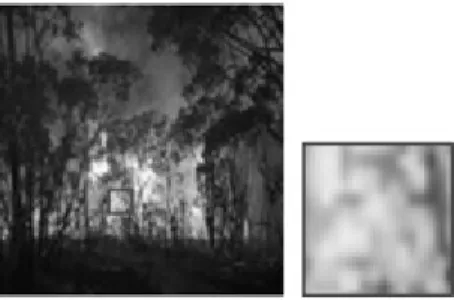
Fig. 1. Color and texture of a flame region Most of watermarking schemes embed data either in
the spatial domain or in the frequency domain. Spatial domain algorithms embed a watermark image by modifying the original image directly, while frequency domain algorithms embed the image by changing the frequency coefficients. Spatial-based algorithms are relatively easy to manipulate and are highly reliable but are only weakly resistant to various attacks. Thus, transform-based watermarking methods have become a main focus of research because they are robust to watermarking attacks [2]. The transform domain watermarking schemes generally use a discrete cosine transformation (DCT), a discrete Fourier transformation (DFT), a discrete wavelet transformation (DWT), or a combination of these transformations to increase the robustness. Furthermore, numerous properties of the human visual system (HVS) have been exploited to enhance the fidelity of watermark techniques for color images [3].
Currently, fire images and videos are widely used in surveillance systems. This paper proposes an effective watermarking approach for copyright protection of these fire media. The proposed watermarking approach employs a gray level co-occurrence matrix (GLCM) to generate a texture feature dataset by computing energy and homogeneity properties for each candidate fire block and fuzzy c-means (FCM) clustering to select blocks which have complex texture in the bright regions of a fire image. The proposed approach outperforms a conventional color image watermarking algorithm in terms of peak signal-to-noise ratio (PSNR), M-SVD values, and normalized correlation (NC) values against several image processing attacks including noise addition, filtering, cropping, and JPEC compression.
The remainder of this paper is organized as follows.
Section 2 describes the background information such as fire characteristics, color segmentation, and GLCM.
Section 3 presents the watermark embedding and extracting procedures of our proposed approach. Section 4 evaluates the proposed watermarking approach with respect to imperceptibility and robustness against various image processing attacks. Section 5 concludes the paper.
2. Background Information
2.1 Fire Characteristics
Fire has unique visual signatures that can be divided into dynamic and static features. Depending on burning materials and temperature, fire has various colors. When
fire appears, the color of flame distributes in the range from red to yellow and it becomes white when temperature gets higher. Thus, fire has two important characteristics including color and texture [4]. Color and brightness of fire are the most important features. Pixels in the flame have various color spectra and relative locations according to different spectra. In a color fire image, we might see bright white color in the core, and yellow, orange, and red colors are away from the core. In a grayscale image, we see that the core is brighter than the periphery [5].
Furthermore, texture is one of significant features to distinguish fire. For example, fire regions have a significant amount of texture characteristics because of its random nature [6]. In addition, authors in [7] analyzed texture properties of fire in terms of spatial variations, and spatial variations of flame are much larger than those of other objects. Many researchers also proposed texture analysis methods to explore texture characteristics of fire, such as discrete wavelet transformation (DWT) [4, 7], GLCM [8, 9] and local binary pattern (LBP) [10]. Fig. 1 presents a fire image and the color and texture of a flame region in a high resolution.
2.2 Color Segmentation of Flame using Fuzzy C-Means Clustering
In practice, there are a number of moving objects in video images with flame, e.g. people, vehicles and animals. However, the colours of these objects are different from the colour of flame. Thus, segmentation of flame based on the colour is considered. From the segmentation results, it is possible to identify regions of interest and objects in the scene, which is very beneficial to the subsequent image analysis or annotation [11].
Flame images usually include dark and bright regions in scene, and the human visual system (HVS) is less sensitive to noise in dark and bright regions than in regions which are characterized by any other lightness values [12]. Thus, it is important to find dark or bright
KIPS Tr. Software and Data Eng.
(a) (b)
(c) (d)
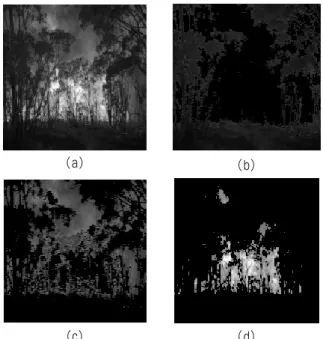
Fig. 2. FCM-based clustering results of a fire image based on the chrominance components: (a) original image,
(b)-(d) FCM clustering results with c=3
(1)
(2)
regions in a flame image for hiding a watermark for copyright protection. To accomplish this, we employ the well-known fuzzy C-means (FCM) clustering algorithm to partition an image to c clusters [13]. Furthermore, for color image watermarking, we use the CIE LAB color space to construct a generic chrominance model for flame pixel segmentation instead of red-green-blue (RGB) color space. This was because RGB has the disadvantage of illumination dependence, even though it can be used for pixel classification. In addition, in contrast to RGB colour space, CIE LAB colour space is completely device independent and makes it possible to separate luminance/illumination from chrominance information. The color components A and B are considered as inputs of the FCM algorithm. In this study, we set the number of cluster to three in order to separate the flame image to three regions such as dark, medium, and bright levels.
Fig. 2 shows segmentation results of a fire image using FCM and c = 3 for A and B components. Figure 2(a) shows an original image, Fig. 2(b) – Fig. 2(d) show the FCM-based clustering results with c = 3. The dark or the bright cluster is considered as a candidate region to embed a watermark which relies on the size of flame in the bright cluster. If one of the bright-colored clusters is enough to hide a watermark, the selected candidate region is the bright-colored cluster. Otherwise, the dark-colored cluster is chosen.
2.3 Grey Level Co-Occurrence Matrix for Generating Texture Features
According to [12], the human visual system is highly insensitive to distortions in regions of high activity (e.g., salient regions) and is more sensitive to distortions near edges than in highly textured areas. In other words, if we embed a watermark into complex regions, it is hard to recognize any changes. Thus, we measure the complexity of candidate blocks by employing GLCM introduced by Haralick et al. [14].
GLCM is defined as a two–dimension histogram of grey levels for a pair of pixels separated by a fixed spatial relationship. The GLCM of an image is calculated using a displacement vector, which is defined by its radius δ and orientation θ. In [17], overall classification accuracy was acceptable with δ = 1, 2, 4, 8 and the best result was achieved for δ = 1 and 2 [15]. Moreover, GLCMs are computed for a number of different offsets unless a priori information is available about the underlying texture. A common choise is to compute GLCMs for a distance of one and eight directions such as 00,450,900,1350,1800,2250,2700,and3150.Haralick et al. [14]
proposed fourteen measures of texture features that can be computed from the co-occurrence matrices; each measure specifies certain characteristics such as coarseness, contrast, homogeneity, and complexity of the texture.
For the proposed approach, we set δ and θ to 2 and 00.In addition, energy and homogeneity are used to evaluate the complexity of regions and these parameters are used to select optimal positions in order to hide a watermark. Energy and homogeneity are defined as follows:
where p(i, j) is the (i, j)th entry in a normalized GLCM, i is the row number, and j is the column number.
3. The Proposed Watermarking Approach
In order to make watermarks being invisible to human eyes as well as robust to various attacks, we propose an effective watermarking approach that is based on the four observations: color channel, embedding possition, suitable
Fig. 3. Watermark embedding process of the proposed approach
discrete transform band, and modified coefficients. To evaluate the performance of the proposed approach, we use different types of original images with a 512x512 size and a 16x16 binary ‘UOU’ text.
3.1 Watermarking Embedding
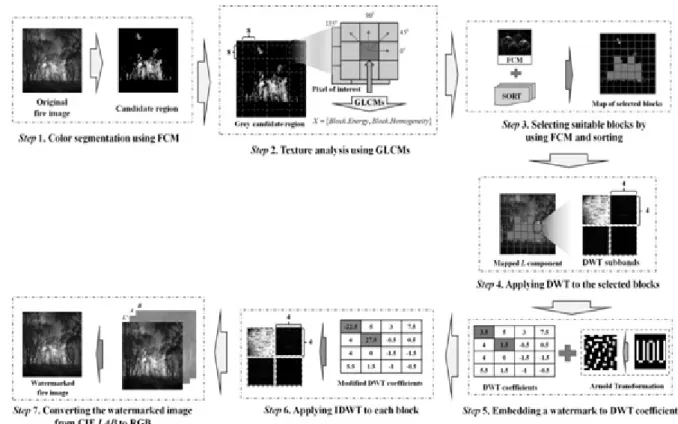
Fig. 3 shows the watermark embedding process. Color segmentation using FCM is performed to select candidate regions which have high brightness color. We then divide the candidate region of a grey-level image into 8x8 blocks and calculate GLCM parameters for all the blocks.
For the lower visibility of the embedded watermark, FCM is used to group the blocks into two classes where one class is suitable for hiding the watermark and vice versa.
In this process, a dataset X = {Block.Energy, Block.Homogeneity} is generated as an input of FCM, where Block.Energy and Block.Homogeneity are the GLCM parameters of the 8x8 blocks in term of energy and homogeneity properties, respectively. Yu Chunyu et al. observed that a high energy value reflects a texture pattern with single and regular variations, and a high homogeneity value provides the lack of changes between different regions of image texture [8]. Thus, the lower value of both energy and homogeneity are, the more complexity of blocks are. As a result, the lower value of
cluster centroids is selected, and the membership values corresponding to high values are considered for watermark embedding. After finding proper blocks, we mark their positions as a map of the selected blocks for the next step. Since lightness variations are less sensitive than hue variations in the HVS [12], L component of the CIE LAB color space is used and combined to the map in order to embed watermark. The steps for embedding a watermark are described as follows:
Step 1: Convert the RGB color space of the original cover image to CIE LAB, and use A and B components as an input of FCM for color segmentation of fire, where we set the degree of fuzzification and termination threshold to 2 and 0.001, respectively. Then, select a cluster to use as a candidate region for the next steps, where the cluster’s centroid has the highest value.
Step 2: Transform the candidate region to the grey-level region and divide it into 8x8 blocks. After then, compute the energy and homogeneity properties of GLCMs for each block to generate a texture feature dataset.
Step 3: Utilize the texture feature dataset as an input feature vector of FCM and select the suitable group which has the lower centroid value. Then, sort the membership values in a descending order, select the first
KIPS Tr. Software and Data Eng.
Fig. 4. Watermark extracting process of the proposed approach 256 blocks, and mark them as a map of the selected
blocks for the next step.
Step 4: Combine the map and L components of the cover image in the CIE LAB color space to generate mapped L components in the 8x8 size blocks. Then, decompose the selected blocks into a one-level wavelet structure with four DWT subbands [LL, LH, HL, HH]
using a Haar wavelet method. LH subband coefficients with a gain factor are selected for embedding watermark so that the visibility of the image will not be affected.
Step 5: Modify the LH coefficients of each block in the first and second diagonal possitions using the following rule:
If watermark bit w = 1, then D(1,1) > D(2,2):
D’(1,1) = D(2,2) + P D’(2,2) = D(1,1) – P
If watermark bit w = 0, then D(1,1) < D(2,2):
D’(1,1) = D(2,2) – P D’(2,2) = D(1,1) + P where P is a gain factor.
To enhance security of the proposed approach, an Arnold scrambling transform with k times as a key is used to destroy spatial relationships of the pixels of the
‘UOU’ watermark image. Then, the new watermark image is converted to one-dimensional sequence w.
Step 6: Apply IDWT(invert DWT) to obtain the watermarked L components.
Step 7: Convert the CIE LAB color space of the watermarked image to the RGB color space.
3.2 Watermarking Extracting
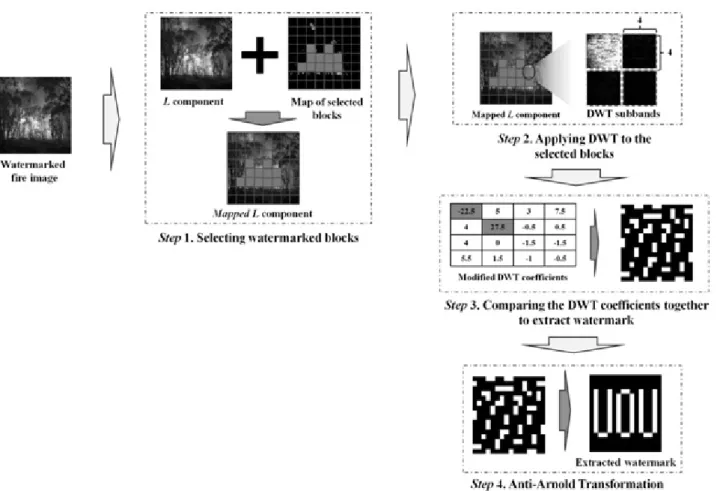
Fig. 4 shows the watermark extracting process which consists of the following four steps:
Step 1: Convert the RGB color space of the watermarked image to the CIE LAB color space, and extract the lightness component (L component). Then, combine L components and the map of selected blocks to generate mapped L components in the 8x8 size blocks.
Step 2: Decompose the selected blocks using the one-level DWT technique.
Step 3: To extract watermark, the coefficients D(1,1) and D(2,2) of the LH subband are compared as follows:
(a) (b)
(c)
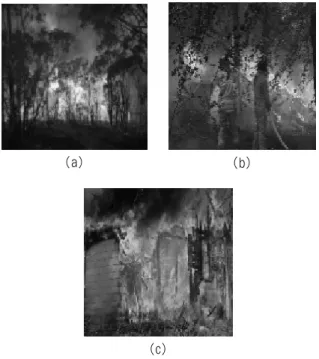
Fig. 5. Selected original fire images
log
∙
(3)
(4)
×
×
(5)
× ′
(6)
If D(1,1)>D(2,2), then w = 1;
If D(1,1)<D(2,2), then w = 0.
Step 4: Rearrange the watermark sequence into a 16x16 matrix and apply the Arnold transform for (T – k) times to obtain the watermark image, where T is the period of the Arnold transform with a 16x16 size matrix and set to 12.
4. Experimental Results
In order to evaluate the effectiveness and robustness of the proposed watermarking approach, we compare the proposed approach with a conventional color image watermarking algorithm [16] in terms of peak signal-to-noise ratio (PSNR), M-SVD, and normalized correlation (NC) values against several image processing attacks including noise addition, filtering, cropping, and JPEG compression. Fig. 5 shows the selected original fire images.
4.1 Quality Evaluation
In this paper, the quality of watermarked image is evaluated by using the peak signal-to-signal ratio (PSNR) and M-SVD. PSNR is computed as follows:
where M x N is the size of cover image, I(i, j) denotes the intensity values of the original image, and I*(i,j) denotes the intensity values of the watermarked image.
In addition, M-SVD can numerically express the quality of the distorted images. It is a bivariate measure that computes the distance between the singular values of the host image block and the singular values of the distorted image block (or watermarked image block):
where si are singular values of the original block, si*
are singular values of the distorted block, and n x n is the block size. Finally, the numerical measure is expressed as follows:
where k x k is the image size and Dmid represents the mid point of the sorted Di values. Lower M-SVD values mean that the watermarked image is less distorted by watermark insertion.
Fig. 6 shows the quality evaluation of the proposed and conventional algorithms. The proposed approach outperforms the conventional algorithm in terms of higher PSNR and lower M-SVD values.
4.2 Robustness Evaluation
We also evaluate the robustness of the proposed approach against various image processing attacks such as noise addition (Gaussian noise, salt and pepper noise), Gaussian low-pass filtering, cropping, and JPEG compression. We use the normalized correlation (NC) to evaluate the robustness of the proposed approach as follows:
where N x N is the watermark image size, w(i, j) are the pixel values of the original watermark, and w*(i, j) are the pixel values of the extracted watermark image. If
KIPS Tr. Software and Data Eng.
Attacks
Conventional algorithm Proposed approach
Fig. 4(a) Fig. 4(b) Fig. 4(c) Fig. 4(a) Fig. 4(b) Fig. 4(c)
NO 1 1 1 1 1 1
SP 0.983 0.933 0.950 0.983 0.983 0.987
GN 0.967 0.933 0.967 0.991 0.991 0.991
GF 0.983 0.950 0.916 1 1 1
Crop 0.700 0.650 0.750 0.783 0.833 0.883
JPEG 1 1 1 1 1 1
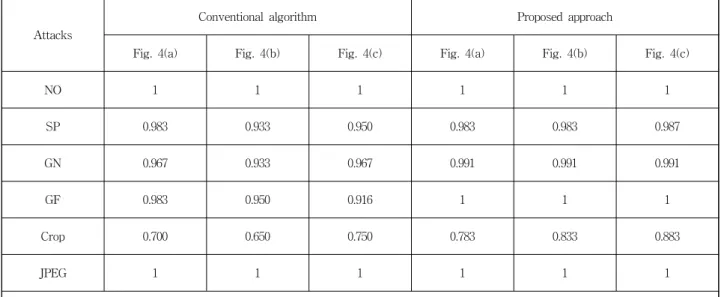
NO: No attack, SP: Salt and Pepper Noise with density of 0.1, GN: Gaussian Noise with 0.1 mean and 0.01 variance, GF: Gaussian low-pass Filtering of 3x3 window, Crop: Cropping of 10%, JPEG: JPEG Compression of 20%
Table 1. NC values of the extracted watermarks using the proposed and conventional algorithms against several attacks Fig. 6. Quality evaluation of the watermarked images in terms of PSNR and M-SVD values:
(a) results of the conventional algorithm, (b) results of the proposed approach.
the calculated NC is 1, then the original and watermarked images are exactly the same.
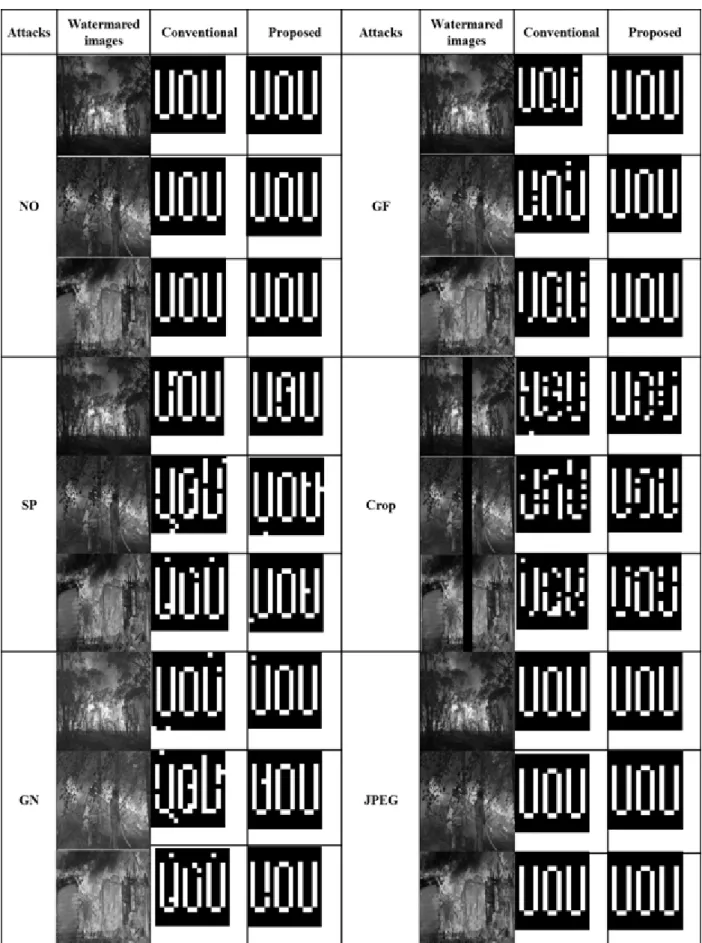
Table 1 and Fig. 7 show NC values and resulting watermarked images as well as extracted watermarks using the conventional and proposed algorithms with and without several attacks, respectively. The proposed approach outperforms the conventional
algorithm in terms of NC values. We observe that the proposed approach is very robust against Gaussian low-pass filtering and JPEG compress, resulting in no distorted watermarks. The proposed approach also provides lower NC values than the conventional algorithms against noise and cropping attacks.
Fig. 7. The extracted watermarks using the proposed and conventional algorithms against several attacks
KIPS Tr. Software and Data Eng.
5. Conclusions
In this paper, we proposed an effective and robust watermarking approach for copyright protection of fire video images. The proposed approach employed a gray level co-occurrence matrix (GLCM) to generate texture feature dataset of fire by computing energy and homogeneity properties for each candidate fire block. In addition, the proposed approach used fuzzy c-means (FCM) clustering to select feature blocks of for embedding watermarks. Each selected block was then decomposed into one-level wavelet structure using a discrete wavelet transform, and LH subband coefficients with a gain factor were selected for embedding watermark. Experimental results showed that the proposed approach outperforms a conventional color image watermarking approach in terms of PSNR, M-SVD, and NC values against several image processing attacks.
Reference
[1] N. Wang, Y. Wang, and X. Li, “A Novel Robust Watermarking Algorithm Based on DWT and DC,” International Conference on Computational Intelligence and Security, Vol.1, pp.437-441, 2009.
[2] F. Kong and Y. Peng, “Color Image Watermarking Algorithm Based on HIS Color Space,” 2nd International Conference on Industrial and Information Systems, Vol.2, pp.464-467, 2010.
[3] A. Tremeau and D. Muselet, “Recent Trends in Color Image Watermarking”. J. Imaging Sci. Tech., Vol.53, No.1, pp.1-15, 2009.
[4] T. X. Truong Y. M. Kim, and J. M. Kim, “Fire Detection in Video Using Genetic-Based Neural Networks,” International Conference on Information Science and Applications (ICISA), pp.1-5, 2011.
[5] C. B. Liu, and N. Ahuja, “Vision based Fire Detection,” 17th International Conference on Pattern Recognition, Vol.4, pp.
134-137, 2004.
[6] H. W. Choi, I. K. Min, E. S. Oh, and D. H. Park, “A Study on the Algorithm for Fire Recognition for Automatic Forest Fire Detection,” International Conference on Control Automation and Systems (ICCAS), pp.2086-2089, 2010.
[7] B.U.Toreyin, Y.Dedeoglu, and A.E. Cetin, “Flame Detection in Video using Hidden Markov Models,” IEEE International
Conference on Image Processing (ICIP), Vol.2, pp.II- 1230-3, 2005.
[8] C. Yu, Y. Zhang, J. Fang, and J. Wang, “Texture Analysis of Smoke for Real-Time Fire Detection,” Second International Workshop on Computer Science and Engineering, Vol.2, pp.511-515, 2009.
[9] J. Zhao, Z. Zhang, S. Han, C. Qu, Z. Y. Yuan, and D. Zhang,
“SVM based Forest Fire Detection using Static and Dynamic Features,” Vol.8, No.3, pp.821-841, 2011.
[10] J. Huang, J. Zhao. W. Gao, C. Long, L. Xiong, Z. Yuan, and S. Han, “Local Binary Pattern based Texture Analysis for Visual Fire Recognition”, 3rd International Congress on Image and Signal Processing (CISP), Vol.4, pp.1887-1891, 2010.
[11] Y. Deng, B.S. Manjunath, and H. Shin, “Color Image Segmentation,” IEEE Computer Society Conference on Computer Vision and Pattern Recognition, Vol.2, pp.446-451, 1999.
[12] A. Tremeau, D. Muselet, “Recent Trends in Color Image Watermarking,” J. Imaging Sci. Tech., Vol.53, No.1, pp.1-15, 2009.
[13] J. C. Bezdek, J. Keller, R. Krisnapuram, and N. R. Pal, “Fuzzy Models and Algorithms for Pattern Recognition and Image Processing.” Springer, 1st edition, 2005.
[14] R. M. Haralick, K. Shanmugam, and I. Dinstein, “Textural Features for Image Classification,” IEEE Trans. Systems, Man and Cybernetics, Vol.3, No.6, pp.610-621, 1973.
[15] D. Gadkari, “Image Quality Analysis Using GLCM,” M.S.
Thesis, University of Central Florida, 2004.
[16] F. Kong, and Y. Peng, “Color Image Watermarking Algorithm based on HSI Color Space,” 2nd International Conference on Industrial and Information Systems (IIS), Vol.2, pp.464-467, 2010.
Truc Thi Kim Nguyen
e-mail : [email protected] She received an MS degree in Electrical Engineering from University of Ulsan in 2013. Her research interests are in the area of Video Processing, Multimedia Watermarking, and Fire and Soke Detection.
김 종 면
e-mail : [email protected] He received a PhD in electrical and computer engineering from the Georgia Institute of Technology, Atlanta, USA, in 2005. He is an Assistant Professor of Electrical Engineering at the University of Ulsan, South Korea. His research interests include many-core architecture, multimedia processing, parallel processing, and embedded systems.