ISSN: 2233-601X (Print) ISSN: 2093-6516 (Online)
Received: April 11, 2019, Revised: July 17, 2019, Accepted: August 6, 2019, Published online: October 5, 2019
Corresponding author: Jae Seok Jang, Department of Cardiovascular and Thoracic Surgery, School of Medicine, Catholic University of Daegu, 33 Duryugongwon-ro 17-gil, Nam-gu, Daegu 42472, Korea
(Tel) 82-53-650-4566 (Fax) 82-53-629-6963 (E-mail) [email protected]
© The Korean Society for Thoracic and Cardiovascular Surgery. 2019. All right reserved.
This is an open access article distributed under the terms of the Creative Commons Attribution Non-Commercial License (http://creativecommons.org/
licenses/by-nc/4.0) which permits unrestricted non-commercial use, distribution, and reproduction in any medium, provided the original work is properly cited.
Mid-Term Results of Using the Seal Thoracic Stent Graft in Cases of Aortopathy: A Single-Institution Experience
Jun Woo Cho, M.D., Jae Seok Jang, M.D., Chul Ho Lee, M.D., Sun Hyun Hwang, M.D.
Department of Cardiovascular and Thoracic Surgery, School of Medicine, Catholic University of Daegu, Daegu, Korea
Background: The endovascular approach to aortic disease treatment has been increasingly utilized in the past 2 decades. This study aimed to determine the long-term results of using the Seal thoracic stent graft.
Methods: We retrospectively reviewed the outcomes of patients who underwent thoracic endovascular aortic repair or a hybrid procedure using the Seal thoracic stent graft (S&G Biotech, Seongnam, Korea) from January 2008 to July 2018 at a single institution. We investigated in-hospital mortality and the incidence of postoperative complications. We also investigated the mid-term survival rate and incidence of aorta-related complications. Results: Among 72 patients with stent grafts, 15 patients underwent the hybrid procedure and 21 underwent emergency surgery. The mean follow-up period was 37.86±30.73 months (range, 0–124 months). Five patients (6.9%) died within 30 days. Two patients developed cerebrovascular accidents. Spinal cord injury occurred in 2 patients. Postoperative renal failure, postoperative extracorporeal membrane oxy- genation support, and pneumonia were reported in 3, 1, and 6 patients, respectively. Stent-related aortic complications were observed in 5 patients (6.8%). The 1- and 5-year survival and freedom from stent-in- duced aortic event rates were 81.5% and 58.7%, and 97.0% and 89.1%, respectively. Conclusion: The use of the Seal thoracic stent graft yielded good mid-term results. Further studies are needed to examine the long-term outcomes of this device.
Key words: 1. Thoracic aorta 2. Aortic rupture 3. Stents
4. Endoleak
Introduction
Since Dake et al. [1] first used stent grafts for treating thoracic aortic aneurysms in 1992, their use as the first-line treatment of descending thoracic aortic disease has been increasing [2]. Mid- and long-term results of thoracic endovascular aortic re- pair (TEVAR) have been reported in several studies, and the durability and stability of commercially avail- able stent grafts are well characterized [3-13]. In
Korea, stent grafts have been used for thoracic aortic disease for more than 10 years. Currently, the types of stent grafts used in Korea have become more di- verse including those available on the North American or European markets, but the Seal thoracic stent graft (S&G Biotech, Seongnam, Korea) devel- oped in Korea was the only type available for the treatment of thoracic aortic disease in Korea from 2007 to 2011, because foreign stent grafts could not be used due to restrictions in the Korean medical https://doi.org/10.5090/kjtcs.2019.52.5.335
Table 1. Baseline patient profiles
Characteristic Value
Demographic characteristics
Age (yr) 64.40±15.51
Male sex 51 (70.8)
Height (m) 1.65±0.10
Weight (kg) 63.18±12.16
Past history
Hypertension 39 (54.2)
Diabetes mellitus 9 (12.5)
Cerebrovascular accident 8 (11.1)
Malignancy 4 (5.6)
Current smoker 16 (22.2)
Chronic obstructive pulmonary disease 2 (2.8)
Liver cirrhosis 0
Hyperlipidemia 2 (2.8)
Myocardial infarction 0
Heart failure 3 (4.2)
Chronic kidney disease 1 (1.4)
Atrial fibrillation 2 (2.8)
Aortic pathology
Dissection 25 (34.7)
Spontaneous 9
Traumatic 16
Intramural hematoma 7 (9.7)
Spontaneous 7
Traumatic 0
Aneurysm 33 (44.4)
Spontaneous 33
Traumatic 0
Penetrating atherosclerotic ulcer 2 (2.8)
Spontaneous 2
Traumatic 0
Rupture 6 (8.3)
Spontaneous 4
Traumatic 2
Values are presented as mean±standard deviation or number (%).
market [14]. While it is still used at numerous cen- ters in Korea, its long-term performance is unclear.
Therefore, we investigated the mid- to long-term re- sults of treating thoracic aortic disease using the Seal thoracic stent graft.
Methods
1) Patients
We studied 73 patients who received treatment for thoracic aortic disease with the Seal thoracic stent graft from January 2008 to July 2018 at Daegu Catholic University Medical Center. The thoracic aort- ic diseases included aortic dissection, intramural hematoma (IMH), aortic aneurysm, penetrating athe- rosclerotic ulcer (PAU), and aortic rupture. We in- cluded both patients with descending aortic disease and those who underwent a hybrid procedure for aortic arch disease. While hybrid procedures and TEVAR have been performed at our center since 2008 for aortic arch disease (except dissection), we have limited hybrid procedures to high-risk patients aged 75 years or older since 2015.
This study was performed after obtaining approval from the Institutional Review Board at Daegu Catholic University Medical Center (IRB approval no., CR-18-139-L), and the requirement for patient con- sent was waived due to the retrospective nature of the study.
2) Surgical considerations
An intervention was performed when the aneur- ysm size was greater than 55 mm or increased more than 5 mm per year. In addition, if the landing zone was favorable, TEVAR was performed; otherwise, a hybrid procedure was considered in elderly patients.
In cases of aortic dissection, a stent graft was consid- ered only in type B. In our center, TEVAR was per- formed in cases of complicated acute type B aortic dissection or subacute type B aortic dissection. In case of chronic type B aortic dissection, a limited op- eration was performed when surgery was considered high-risk. The classification of aortic dissection, in- cluding the definition of the complicated type, was determined based on the 2014 European Society of Cardiology guideline [2].
In cases of hybrid TEVAR, stent grafts were anch- ored in favorable landing zones. De-branched arch
vessels were directly anastomosed to the aorta or grafted between arch vessels. Our approach to TEVAR has been described in a previously published study [15].
3) Data collection and study endpoint
Data were collected retrospectively from the medi- cal records of patients who received computed to- mography scans once a year with regular outpatient visits twice a year. Mortality was estimated in pa- tients who were lost to follow-up through telephone
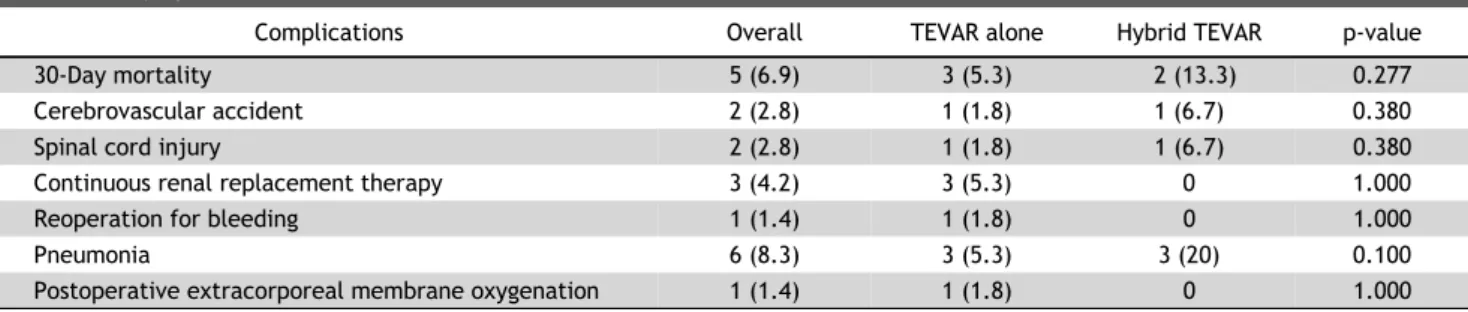
Table 2. Early operative outcomes
Complications Overall TEVAR alone Hybrid TEVAR p-value
30-Day mortality 5 (6.9) 3 (5.3) 2 (13.3) 0.277
Cerebrovascular accident 2 (2.8) 1 (1.8) 1 (6.7) 0.380
Spinal cord injury 2 (2.8) 1 (1.8) 1 (6.7) 0.380
Continuous renal replacement therapy 3 (4.2) 3 (5.3) 0 1.000
Reoperation for bleeding 1 (1.4) 1 (1.8) 0 1.000
Pneumonia 6 (8.3) 3 (5.3) 3 (20) 0.100
Postoperative extracorporeal membrane oxygenation 1 (1.4) 1 (1.8) 0 1.000
Values are presented as number (%).
TEVAR, thoracic endovascular aortic repair.
calls or by investigating whether they had lost their qualification for medical insurance.
The primary endpoint was 30-day mortality and postoperative neurological complications, including cerebrovascular accident (CVA) and spinal cord in- jury (SCI). CVA was defined as the presence of neu- rologic deficits with brain damage detected by com- puted tomography or magnetic resonance imaging, and SCI was defined clinically as paraplegia. In addi- tion, patients’ conditions were classified as transient if they recovered during the follow-up period and as permanent if they did not recover. Long-term surviv- al, freedom from aortic events, and freedom from stent-induced aortic events were investigated as the secondary endpoints. Aortic events were defined as any additional intervention or surgery on the aorta during the follow-up period. Stent-induced aortic events were defined as endoleak or stent graft-in- duced new entry (SINE).
4) Statistical analysis
Continuous variables are expressed as mean±stand- ard deviation, and categorical variables are expressed as frequency and percentage. The Mann-Whitney test was used for continuous variables and the chi-square test or Fisher exact test for categorical variables.
Survival and aortic event–free periods were calcu- lated using the Kaplan-Meier method and the log-rank test was used for comparisons between groups. All p-values <0.05 were considered to in- dicate statistical significance. All statistical analyses were performed using IBM SPSS software ver. 25.0 (IBM Corp., Armonk, NY, USA).
Results
During the study period, 72 consecutive patients underwent stent implantation, except for those who underwent a frozen elephant trunk procedure. The baseline characteristics of the patients are summar- ized in Table 1. Fifteen patients underwent hybrid TEVAR, and 21 underwent emergency surgery. The mean age of the patients was 64.40±15.51 years, and 70.8% were male. The mean follow-up period was 37.34±30.83 months (range, 0–124 months). The fol- low-up completion rate was 89.04%. There were 25 patients with aortic dissection, 7 with IMH, 32 with aneurysm, 2 with PAU, and 6 with aortic rupture. A total of 18 patients had traumatic aortic injury.
1) Operative profile
Preoperative cerebrospinal fluid drainage was per- formed in 66.7% of the 57 patients who underwent TEVAR alone, among whom the number of patients with coverage of zones 2, 3, and 4 was 11, 37, and 9, respectively. Eight of the 15 patients who under- went hybrid TEVAR underwent preoperative cere- brospinal fluid drainage. The number of patients with coverage of zones 0, 1, and 2 was 6, 5, and 4, respectively. The operation time was 111.40±66.60 minutes in patients undergoing TEVAR alone and 437.43±176.42 minutes in those undergoing hybrid TEVAR. There were no technical errors during any procedure, and the procedures were successful in all patients.
2) Early outcomes
Five patients (6.9%) died within 30 days, 4 of whom had undergone emergency surgery owing to a ruptured aorta. Two patients developed CVA, one of
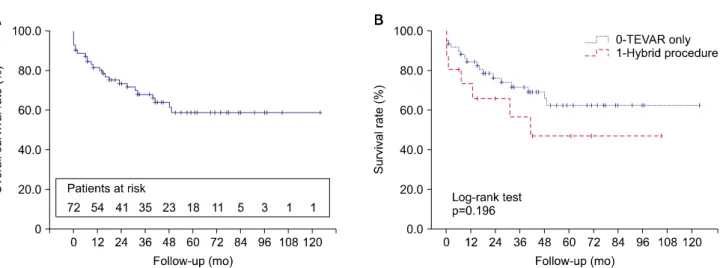
Fig. 1. Kaplan-Meier survival curves. (A) Overall survival. (B) Comparison of TEVAR and hybrid procedures. TEVAR, thoracic endovascular aortic repair.
Fig. 3. Kaplan-Meier curve of overall freedom from aortic events.
Fig. 2. Kaplan-Meier survival curve according to aortic pathology.
whom underwent a hybrid procedure. SCI occurred in 2 patients, but 1 completely recovered during the hospitalization period. Postoperative renal failure, postoperative extracorporeal membrane oxygenation support, and pneumonia were reported in 4, 1, and 6 patients, respectively. There were no specific vascular complications, such as puncture site bleeding, throm- bosis, or hematoma, after the procedures. Table 2 summarizes the complication rates according to the extent of surgery, showing no statistically significant difference.
3) Late outcomes
There were 19 late deaths due to cardiovascular causes (n=4), acute respiratory distress syndrome (n=3), sepsis due to infection (n=3), and cancer
(n=5). The overall survival rate was 81.5%, 68.1%, and 58.7% at 1, 3, and 5 years, respectively. The sur- vival curves for the TEVAR and hybrid procedure groups showed similar patterns, with no statistically significant difference (Fig. 1). When the survival rate was classified according to the aortic pathology, aneurysms had the most deleterious effect on long-term survival (Fig. 2). The overall rate of free- dom from aortic events was 93.5%, 85.6%, and 81.7% at 1, 3, and 5 years, respectively (Fig. 3).
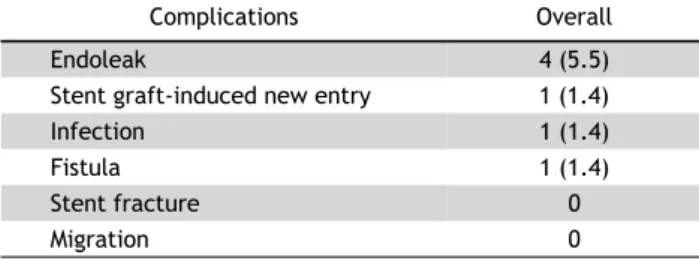
Stent-related aortic complications were observed in 5 patients (6.8%): endoleak in 4 (type Ib in 3 and type III in 1), and SINE in 1. One patient with type III en- doleak suffered from mycotic infection with an aor- toesophageal fistula, and he underwent open surgery for descending thoracic aorta replacement. Endoleak
Fig. 4. Kaplan-Meier curves for freedom from stent-induced aortic events. (A) All patients, including those who underwent hybrid procedures. (B) Patients who underwent thoracic endovascular aortic repair only.
Table 3. Late outcomes due to stent-related aortic complications
Complications Overall
Endoleak 4 (5.5)
Stent graft-induced new entry 1 (1.4)
Infection 1 (1.4)
Fistula 1 (1.4)
Stent fracture 0
Migration 0
Values are presented as number (%).
occurred in 2 patients with aneurysms and 2 with chronic type B aortic dissection, while SINE occurred in a patient with chronic type B aortic dissection.
Among the patients with endoleak, 3 had undergone hybrid procedures. Except for the above cases, there were no stent-related aortic complications, such as stent fracture or migration (Table 3). The incidence of stent-induced aortic events in all patients, includ- ing those who underwent hybrid procedures, was 97.0% and 89.1% at 1 and 5 years, respectively, and 98.0% and 95.6% in those who underwent only TEVAR (Fig. 4). Comparing the survival and freedom from aortic event rates according to the occurrence of trauma revealed better survival in patients with traumatic aortic injuries. The 1- and 5-year survival rates of patients with traumatic aortic injuries (94.4% and 81.4%, respectively) and those without them (77.2% and 49.1%, respectively) were sig- nificantly different (p=0.031), but there was no stat- istically significant difference in freedom from aortic
events. Similarly, no significant differences were ob- served when confining the analysis to patients who underwent TEVAR only. No stent-induced aortic events occurred in patients who underwent stent-graft im- plantation for traumatic aortic injuries.
Discussion
Stent graft implantation has become a cornerstone of aortic disease treatment. Our study investigated the mid- to long-term performance of stent grafts, which have been manufactured in Korea and used globally for a long period of time. Although no reli- able data are available, numerous experienced aortic surgeons have doubted the strength of the Seal thoracic stent graft compared to other products and questioned its durability. In 2017, Song et al. [14] re- ported excellent results with the Seal thoracic stent graft, but no long-term data on outcomes are available.
The Seal thoracic stent graft is the only domestic graft, and compared to other foreign devices, it has smallest introducer (16F) [14]. Therefore, less in- vasive procedures can be performed, and luminal complications can be reduced. It can also be used in patients with a small iliac artery diameter. We con- sidered that the occurrence of fewer vascular compli- cations in our study was due to this advantage of a small introducer. In addition, since it is the only do- mestic product, it is considered advantageous that the device can be supplied in an individualized man-
ner, according to patients’ anatomical configurations.
However, since it has not been in clinical use for a long time compared with foreign products, there are no known long-term results and a lack of related data. Therefore, although this study was conducted at a small-volume center, our research may be im- portant in that it documents the longest post- operative outcomes of the Seal thoracic stent graft.
In this study, there was a concern regarding whether it should be conducted only among patients receiving TEVAR alone or those undergoing hybrid procedures as well. We concluded that it was reason- able to include patients who underwent hybrid pro- cedures, since the aim of this study was to de- termine the clinical results associated with the Seal thoracic stent graft. Because of the different nature of the patient populations, we analyzed patients who underwent TEVAR alone separately.
The survival rate of patients with traumatic aortic injuries is well-known to be better than that of those with non-traumatic aortic disease [16-20]. We ana- lyzed patients with traumatic aortic injuries sepa- rately and observed good results in terms of the sur- vival and freedom from aortic event rates. However, a more-in depth analysis of trauma-related aortop- athy should be conducted. Although there was no de- tailed analysis of the trauma-related issues in this study, it was clear that patients with traumatic aortic injuries were relatively young (48.72±16.64 versus 69.63±11.04 years, p<0.001). We believe that a more detailed analysis could be conducted if the number of patients analyzed were to be increased.
Previous reports showed that the long-term surviv- al rate of patients undergoing stent graft im- plantation was low [3-6]. In accordance with our re- sults, most studies reported 5-year survival rates not exceeding 50%. However, the rates of long-term aort- ic complications associated with stent grafts is encouraging. Although Kaplan-Meier curve analysis may be inappropriate in our small study population, the 5-year outcome of freedom from stent-induced aortic events was excellent, at 89.1% in all patients and 95.6% in those who underwent only TEVAR.
These good results do not exclude the possibility of a paradoxical outcome due to death before the occur- rence of stent-related problems, since these patients with aortic disease generally have poor survival outcomes. We investigated causes of death in order
to understand their impact. Across the entire cohort, late death from cardiovascular causes, including stent-related or aortic issues, was observed in only 2 patients. This indicates that stent-induced aortic events did not have a significant effect on patient mortality.
The limitations of our research are clear. First, the retrospective nature of the study is an unavoidable limitation. In addition, undetectable bias due to the lack of randomization is another limitation. Further- more, the small study population made it difficult to analyze each aortic pathology in detail. As retro- spective single-center data were analyzed, a pro- spective multi-center study will be needed to obtain results free from bias.
In conclusion, the Seal thoracic stent graft achieved good mid-term results. Although long-term follow-up was difficult owing to the low survival in these high-risk patients, the incidence of stent-related aort- ic complications was low. Further studies will be needed to examine the long-term outcomes of this device.
Conflict of interest
No potential conflict of interest relevant to this ar- ticle was reported.
Acknowledgments
This research was supported by a grant from the Research Institute of Medical Science, Catholic University of Daegu (2019).
ORCID
Jun Woo Cho: https://orcid.org/0000-0002-0786-9775 Jae Seok Jang: https://orcid.org/0000-0002-0693-8863 Chul Ho Lee: https://orcid.org/0000-0002-9139-0619 Sun Hyun Hwang: https://orcid.org/0000-0002-2461-9604
References
1. Dake MD, Miller DC, Semba CP, Mitchell RS, Walker PJ, Liddell RP. Transluminal placement of endovascular stent-grafts for the treatment of descending thoracic aortic aneurysms. N Engl J Med 1994;331:1729-34.
2. Erbel R, Aboyans V, Boileau C, et al. 2014 ESC guidelines on the diagnosis and treatment of aortic diseases: docu-
ment covering acute and chronic aortic diseases of the thoracic and abdominal aorta of the adult. The Task Force for the Diagnosis and Treatment of Aortic Diseases of the European Society of Cardiology (ESC). Eur Heart J 2014;35:
2873-926.
3. Patel HJ, Williams DM, Upchurch GR Jr, et al. Long-term results from a 12-year experience with endovascular ther- apy for thoracic aortic disease. Ann Thorac Surg 2006;82:
2147-53.
4. Ranney DN, Cox ML, Yerokun BA, Benrashid E, McCann RL, Hughes GC. Long-term results of endovascular repair for descending thoracic aortic aneurysms. J Vasc Surg 2018;
67:363-8.
5. Desai ND, Burtch K, Moser W, et al. Long-term comparison of thoracic endovascular aortic repair (TEVAR) to open surgery for the treatment of thoracic aortic aneurysms. J Thorac Cardiovasc Surg 2012;144:604-11.
6. Stone DH, Brewster DC, Kwolek CJ, et al. Stent-graft ver- sus open-surgical repair of the thoracic aorta: mid-term results. J Vasc Surg 2006;44:1188-97.
7. Bortone AS, De Cillis E, D’Agostino D, de Luca Tupputi Schinosa L. Endovascular treatment of thoracic aortic dis- ease: four years of experience. Circulation 2004;110(11 Suppl 1):II262-7.
8. Makaroun MS, Dillavou ED, Kee ST, et al. Endovascular treatment of thoracic aortic aneurysms: results of the phase II multicenter trial of the GORE TAG thoracic endoprosthesis. J Vasc Surg 2005;41:1-9.
9. Leurs LJ, Bell R, Degrieck Y, et al. Endovascular treatment of thoracic aortic diseases: combined experience from the EUROSTAR and United Kingdom Thoracic Endograft registries. J Vasc Surg 2004;40:670-80.
10. Criado FJ, Abul-Khoudoud OR, Domer GS, et al. Endovascular repair of the thoracic aorta: lessons learned. Ann Thorac Surg 2005;80:857-63.
11. Greenberg RK, O’Neill S, Walker E, et al. Endovascular re- pair of thoracic aortic lesions with the Zenith TX1 and TX2 thoracic grafts: intermediate-term results. J Vasc Surg 2005;41:589-96.
12. Katzen BT, Dake MD, MacLean AA, Wang DS. Endovascular repair of abdominal and thoracic aortic aneurysms.
Circulation 2005;112:1663-75.
13. Hansen CJ, Bui H, Donayre CE, et al. Complications of en- dovascular repair of high-risk and emergent descending thoracic aortic aneurysms and dissections. J Vasc Surg 2004;40:228-34.
14. Song MG, Cho YK, Lee DY, et al. Clinical outcomes for en- dovascular repair of thoracic aortic disease using the seal thoracic stent graft: a Korean multicenter retrospective study. J Vasc Interv Radiol 2017;28:645-54.
15. Cho JW, Kwon OC, Lee S, Jang JS. Traumatic aortic injury:
single-center comparison of open versus endovascular repair. Korean J Thorac Cardiovasc Surg 2012;45:390-5.
16. Iannuzzi JC, Stapleton SM, Bababekov YJ, et al. Favorable impact of thoracic endovascular aortic repair on survival of patients with acute uncomplicated type B aortic dissection. J Vasc Surg 2018;68:1649-55.
17. Azizzadeh A, Charlton-Ouw KM, Chen Z, et al. An outcome analysis of endovascular versus open repair of blunt trau- matic aortic injuries. J Vasc Surg 2013;57:108-15.
18. Azizzadeh A, Ray HM, Dubose JJ, et al. Outcomes of endo- vascular repair for patients with blunt traumatic aortic injury. J Trauma Acute Care Surg 2014;76:510-6.
19. Patel HJ, Hemmila MR, Williams DM, Diener AC, Deeb GM.
Late outcomes following open and endovascular repair of blunt thoracic aortic injury. J Vasc Surg 2011;53:615-21.
20. Rousseau H, Elaassar O, Marcheix B, et al. The role of stent-grafts in the management of aortic trauma.
Cardiovasc Intervent Radiol 2012;35:2-14.