218 http://www.jchestsurg.org
JCS
Journal of Chest SurgeryCase Report
Quadriplegia after Mitral Valve Replacement in an Infective Endocarditis Patient with Cervical Spine Spondylitis
Ji Min Lee, M.D., Seon Yeong Heo, M.D., Dong Kyu Kim, M.D., Jong Pil Jung, M.D., Chang Ryul Park, M.D., Yong Jik Lee, M.D., Gwan Sic Kim, M.D.
Department of Thoracic and Cardiovascular Surgery, Ulsan University Hospital, University of Ulsan College of Medicine, Ulsan, Korea
ARTICLE INFO Received May 20, 2020 Revised August 28, 2020 Accepted September 1, 2020 Corresponding author Gwan Sic Kim
Tel 82-52-250-8726 Fax 82-52-250-8558 E-mail [email protected] ORCID
https://orcid.org/0000-0002-0648-0178
The simultaneous incidence of infective endocarditis and cervical spondylitis with an epi- dural abscess is rare, and quadriplegia as a complication after cardiac surgery is very rare.
We recently observed quadriplegia after mitral valve replacement in an infective endo- carditis patient with cervical spine spondylitis. With early symptom detection, immediate examination, and prompt surgical treatment, the patient successfully recovered without neurological symptoms.
Keywords: Mitral valve replacement, Quadriplegia, Spondylitis
Copyright
© The Korean Society for Thoracic and Cardiovascular Surgery. 2021. All right reserved.
This is an Open Access article distributed under the terms of the Creative Commons Attribution Non-Commercial License (http://creativecommons.org/licenses/
by-nc/4.0) which permits unrestricted non-commercial use, distribution, and reproduction in any medium, provided the original work is properly cited.
Case report
A 50-year-old man was admitted to the neurosurgery de- partment via the emergency room with neck pain and gen- eral weakness that had lasted several days. The patient’s medical history included smoking and chronic hepatitis B.
He denied any history of trauma or recent invasive proce- dures. His vital signs were as follows: blood pressure, 122/85 mm Hg; regular heart rate, 85 beats/min; respirato- ry rate, 20 cycles/min; and body temperature, 39°C. A neu- rological examination by a neurosurgeon yielded normal results. Laboratory tests revealed a white blood cell count of 10,190/mm
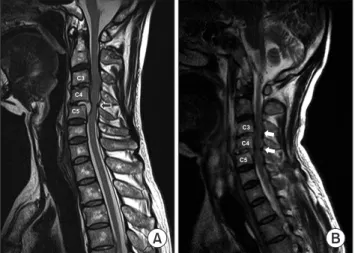
3, aspartate aminotransferase and alanine ami- notransferase levels of 114 IU/L and 90 IU/L, respectively, and C-reactive protein levels of 1.21 mg/dL; other parame- ters were within normal limits. Initial chest radiography and a 12-lead electrocardiogram were unremarkable. Mag- netic resonance imaging (MRI) of the cervical spine re- vealed an abscess with inflammatory changes in the epi- dural space and prevertebral portion at the C4–C5 level, suggesting infectious spondylitis (Fig. 1A). Subsequent transthoracic echocardiography (TTE) and transesophageal echocardiography (TEE) identified a 1.3-cm hyper-mobile vegetation on the anterior mitral valve leaflet with severe mitral regurgitation. The size and systolic function of the
left and right ventricles were normal. Because of the sys- temic embolic risk posed by the hyper-mobile intracardiac mass, the patient was referred to the department of thoracic and cardiovascular surgery at Ulsan University Hospital for surgical treatment. Emergent surgery was undertaken. The
C3
C4
C5
A B
C3
C4
C5
Fig. 1. (A) Initial cervical MRI showing an abscess with inflam- matory changes in the epidural space and prevertebral portion of C4–C5 (black arrow). (B) After cardiac surgery, emergent whole- spine MRI revealed progression of the epidural abscess and a compressed spinal cord at C3–C5 (white arrows). MRI, magnetic resonance imaging.
https://doi.org/10.5090/jcs.20.060
pISSN: 2765-1606 eISSN: 2765-1614
J Chest Surg. 2021;54(3):218-220
219
Ji Min Lee, et al. Quadriplegia after Mitral Valve Replacement
http://www.jchestsurg.org
JCS
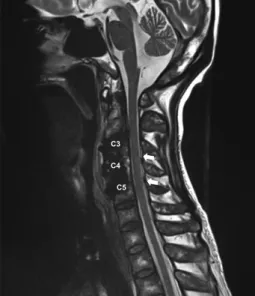
operation was performed using ascending aorta and right atrium cannulation under moderate hypothermia. Ante- grade cold blood cardioplegia was used for myocardial pro- tection. Operative findings showed a vegetation on the an- terior mitral valve leaflet. Mitral valve replacement (St. Jude Medical Regent 27 mm; St. Jude Medical Inc., St. Paul, MN, USA) was performed without complications. After cardiac surgery, the patient was transferred to the cardiac intensive care unit (ICU) while intubated and sedated. After admis- sion to the ICU, his vital signs were normal and urine out- put was satisfactory. Approximately 6 hours after the oper- ation, he opened eyes spontaneously and nodded according to instructions. However, he was unable to move his ex- tremities. A detailed neurological examination showed flaccid paralysis of all 4 limbs, with loss of sensation below the T8 dermatome level. The upper and lower limb muscle strengths were 1/5 and 0/5, respectively. Emergent whole- spine MRI revealed progression of an epidural abscess and a compressed spinal cord at C3–C5 (Fig. 1B). Immediately, a neurosurgical consultation was conducted followed by corpectomy and abscess removal (12 hours after heart sur- gery) using an anterior approach via the right side of the neck. The patient returned to the ICU while intubated and sedated. He regained consciousness, mobility, and feeling in his extremities 3 hours after surgery. On postoperative day 1, he was weaned and extubated; muscle strength was restored to all 4 limbs (grade 5/5). On postoperative day 4, he was transferred to the general ward. TTE on postopera- tive day 6 showed a well-positioned, functional prosthetic valve without paravalvular leak or dehiscence. On postop- erative day 9, cervical-spine MRI showed successful abscess removal and a decompressed spinal cord at C3–C5 (Fig. 2).
The patient was able to walk around the ward with a neck brace. Preoperative blood culture indicated the presence of Streptococcus agalactiae; however, intraoperative tissue cultures from both cardiac and spine surgery were negative for it. Preoperatively, empirical antibiotics (meropenem [1 g every 8 hours] and vancomycin [1 g every 12 hours]) were administered for 3 days. Subsequently, according to the sensitivity test for antibiotics, the preoperative antibiotics (ampicillin [2 g every 4 hours] and gentamicin [1 mg/kg ev- ery 8 hours]) were changed and administered for 5 days.
Postoperatively, intravenous antibiotics (ampicillin [2 g ev- ery 4 hours] and gentamicin [1 mg/kg every 8 hours]) were administered for 4 weeks. On postoperative day 29, the pa- tient was discharged without neurological abnormalities.
At a 12-month follow-up, the patient’s postoperative course was uneventful and clinical findings were normal without any neurological symptoms. The patient provided written
informed consent for publication of his clinical details and images.
Discussion
The simultaneous occurrence of infective endocarditis and cervical epidural abscess is rare [1], and quadriplegia as a complication after cardiac surgery is very rare and poorly understood [2-6]. The lack of management and treatment guidelines for this complication pose significant challenges for cardiac surgeons. Here, we report a case of quadriplegia after mitral valve replacement in an infective endocarditis patient with cervical spine spondylitis.
Spinal epidural abscess shows an incidence of 0.2–1.2 pa- tients per 10,000 inpatients. A MEDLINE search of infec- tive endocarditis showed an incidence of vertebral osteo- myelitis of 6.5% among 1,099 patients with infective endocarditis [1]. In particular, the occurrence of cervical spine abscess accompanied by infective endocarditis is rar- er than the occurrence of abscesses in the lumbar and tho- racic spine.
Spinal epidural abscess without neurological deficits can be safely and efficiently managed with conservative treat- ment [7,8]. Therefore, if infective endocarditis and cervical epidural abscess occur at the same time, as in this case, cardiac surgery can be performed alone if the lesion of in- fective endocarditis needs an emergent operation. Howev- er, insufficient data have been published on the deteriora-
C3
C4
C5