Study on Surface Chemical Structure and Mechanical Properties of EPDM Rubber with Microwave Irradiation Time
SeoBin Eom * , Sun Young Lee ** , Sung Han Park *** , and Seung Goo Lee *,†
*
Department of Advanced Organic Materials & Textile System Engineering, Chungnam National University, 99, Daehak-ro, Yuseong-gu, Daejeon 34134, Republic of Korea
**
Bio-applied Chemistry Research Institute Chungnam National University
***
Agency for Defense Development
(Received June 29, 2018, Revised July 16, 2018, Accepted July 20, 2018)
Abstract: Recently, microwaves have been used for desulfurization because they can selectively dissociate C–S and S–
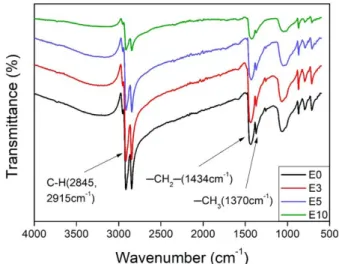
S bonds present in vulcanized rubber. In this study, we investigated the changes in structural and physical properties of EPDM (Ethylene propylene diene monomer) rubber by irradiating it with microwaves for different durations. The surface chemical composition of the irradiated EPDM rubber was analyzed by FT-IR, XPS, and EDS analyses. It was confirmed by XPS that C–S and S–S S2p peak heights greatly decreased when microwave irradiation was performed for more than 5 min. In the EPDM sample irradiated with microwaves for 10 min, the number of S–O bonds significantly increased owing to oxidation. As the microwave irradiation time was increased, SEM images showed cracks and voids on the EPDM surface.
The 20% decomposition temperature of the EPDM rubber sample was investigated by TGA, and it was found to be about 435.23°C for the EPDM rubber irradiated for 10 min. The crosslinking density of the EPDM rubber was determined by measuring the degree of swelling, and the highest value was observed for the E5 sample irradiated for 5 min. The degree of swelling of the E10 sample irradiated for 10 min was lower than that of the E5 sample. These results indicate that when irradiated with microwaves for more than a certain time, desulfurization occurs and the side chain of the EPDM rubber dis- sociates and forms additional crosslinking bonds.
Keywords: rubbers, ethylene propylene diene monomer, microwave-processing, swelling, crosslinking density, thermal properties, XPS
Introduction
EPDM (Ethylene propylene diene monomer) 은 합성고무로 서 EPM 고무에 디엔계의 제 3성분을 공중합시킨 합성고무이 다. EPDM은 일반 합성고무에 비하여 상대적으로 불포화결합 이 적기 때문에 내후성이 우수하며, 내오존성, 내용제성이 뛰 어나고 비중이 작으며, 열적 안정성 및 절연 특성을 지니고 있 어서 압력이 주어지는 오링, 자동차 범퍼(충격보강재), 타이어, 절연전선 케이블 및 항공우주 분야의 고온 단열재 등으로 널 리 사용되고 있다.
1,2마이크로파(Microwave)는 300 MHz-300 GHz의 주파수 범 위를 갖는 전자파를 말하며 고무산업에서는 가황 방법 중 하 나로도 사용하고 있다. 최근에는 마이크로파를 폐 EPDM고무 에 조사하여 고무를 재활용하는 방법이 실용화되고 있다. 마 이크로파 탈황기술은 마이크로파를 이용하여 분말화한 가황
고무의 내부에 존재하는 S-S, S-C 결합의 선택적인 절단이 가 능하다. 고분자 사슬의 분해를 일으키지 않고 가황 결합만을 분리할 수 있는 에너지 범위인 915 또는 2450 MHz 정도의 마 이크로파를 이용하여 탈황하게 되며, 이 방법은 설비가 단순 하고 부피가 작으며 소요되는 시간이 적어 경제적이라는 장 점을 갖는다.
3,4또한, 산업계에서 사용하는 열처리 공정 중 외부 가열인 열 풍가교 방식은 낮은 열전도도로 인하여 시간에 따른 가열효 율이 낮은 반면에, 마이크로파 기술은 물체에 외부 열원 없이 발열시키는 특색이 있어 큰 물체에서도 표면 및 내부를 거의 동시에 가열할 수 있기 때문에 이를 이용하여 연속적인 가교 방법으로 이용 가능하며, 다양한 분야에서 폭넓게 사용되고 있다.
5따라서 본 연구에서는 여러 분야에서 이용되는 마이크로파 를 EPDM 고무에 조사하여 조사시간에 따른 EPDM의 구조 적 변화 및 물성에 미치는 영향을 비교 고찰하였다.
†