C A S E R E P O R T Open Access
Glossectomy in the severe maxillofacial vascular malformation with jaw deformity:
a rare case report
Min-Hyeog Park
1, Chul-Man Kim
1, Dong-Young Chung
1and Jun-Young Paeng
1,2*Abstract
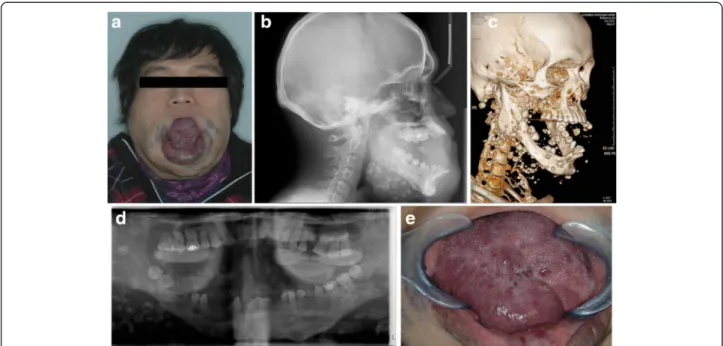
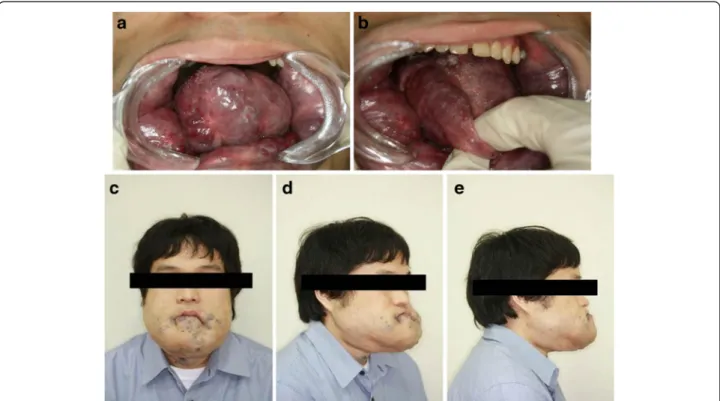
In the field of oral-maxillofacial surgery, vascular malformations present in various forms. Abnormalities in the size of the tongue by vascular malformations can cause mandibular prognathism and skeletal deformity. The risk in surgical treatment for patients with vascular malformation is high, due to bleeding from vascular lesions. We report a rare case of macroglossia that was treated by partial glossectomy, resulting in an improvement in the swallowing and mastication functions in the patient. A 25-year-old male patient with severe open-bite and mandibular prognathism presented to our department for the management of macroglossia. The patient had a difficulty in food intake because of the large tongue. Orthognathic surgery was not indicated because the patient had severe jaw bone destruction and alveolar bone resorption. Therefore, the patient underwent partial glossectomy under general anesthesia. There was severe
hemorrhaging during the surgery, but the bleeding was controlled by local procedures.
Keywords: Macroglossia, Glossectomy, Venous malformation
Background
Venous malformations are anomalies of veins or lymph vessels or both veins and lymph vessels. They are present at birth and manifest at different ages. Venous malformations in the tongue cause significant clinical problems such as swallowing difficulties and speech and airway obstruction. The incidence of vascular malforma- tion has been reported in approximately 7 % of all be- nign tumors, the majority of which develop in the head and neck region. However, when localized on the tongue, in most cases, these lesions can cause clinical problems such as active bleeding and airway obstruction from the mouth [1–3].
The current methods of treatment include electrocoagu- lation, cryotherapy, sclerotherapy, surgical excision, or combinations of these treatments. The treatment of super- ficial, localized venous malformation is relatively simple and effective. However, the treatment of deep, extensive venous malformation remains difficult and presents
various complications. For complicated cases, the results achieved with a single treatment method are not satisfac- tory. Therefore, several approaches are required to achieve acceptable results. In most cases, a surgical excision is con- sidered as the first choice to improve the function and ap- pearance. However, for large lesions, partial glossectomy can be considered after sclerotherapy to improve swallow- ing, chewing, and speech. During the surgery, care should be taken to regulate the hemorrhage and the airway [4–6].
We report a case of surgical treatment using partial glossectomy in a patient who had venous malformation of the tongue.
Case presentation
A 25-year-old man with a medical history of macroglos- sia was referred to our department for the management of the condition on October 25, 2011. The tongue was interpositioned between the teeth, interfering with chew- ing. He had discomfort in swallowing, chewing, and speech because the vascular mass accounted for most of the tongue. He had been treated previously at a vascular surgery clinic. Surgical resection was performed under general anesthesia during the plastic surgery on January 5, 1996. An excisional biopsy was performed, and the
* Correspondence: [email protected]
1
Department of Oral and Maxillofacial Surgery, School of Dentistry, Kyungpook National University, Daegu, Republic of Korea
2
Department of Oral and Maxillofacial Surgery, Kyungpook National University Hospital, 2175 Dalgubeoldae-ro, Daegu 700-705, Korea
© 2015 Park et al. Open Access This article is distributed under the terms of the Creative Commons Attribution 4.0 International License (http://creativecommons.org/licenses/by/4.0/), which permits unrestricted use, distribution, and reproduction in any medium, provided you give appropriate credit to the original author(s) and the source, provide a link to the Creative Commons license, and indicate if changes were made.