98
접수:2009년 10월 31일, 승인:2009년 11월 6일
책임저자:류 일, 405-760, 인천시 남동구 구월동 1198번지 가천대학교 의과대학 길병원 소아청소년과학교실 Tel: 032-460-3114, Fax: 032-460-3224
E-mail: [email protected]
소아청소년기의 항구토제
가천의대 길병원 소아청소년과학교실 류 일
Antiemetics in Children and Adolescents
Eell Ryoo, M.D.
Department of Pediatrics, Gil Hospital, Gacheon University of Medicine and Science, Incheon, Korea In children and adolescents with acute gastroenteritis and other gastrointestinal disease, antiemetics are frequently used. But there are insufficient data about antiemetic use in children, so it should be used carefully. Despite some significant researches, treatment guidelines of ondansetron will be carefully pre- sented through further investigation. [Korean J Pediatr Gastroenterol Nutr 2009; 12(Suppl 1): 98∼102]
서 론
구토는 소화기계의 주요한 증상 중 하나로 역류, 주 기성 구토 증후군, 반추, 다식증, 상장간막 동맥증후군 등과 같은 구토 증후군, 화학요법과 관련되어 나타나는 구토 등과 같이 적극적 치료가 필요한 것들과 여러 가 지 위장관 질환 특히 급성 위장관염에 동반되어 나타나 는 것으로 구분할 수 있다. 이 중 일반 소아과 의사가 가장 흔히 경험하는 급성 위장관염 환자에서 구토의 치 료는 주요한 관심사 중의 하나일 뿐 아니라 환자의 보 호자 입장에서 구토에 대한 처방을 요구하는 것은 어찌 보면 이해할 만한 일이라 할 수 있으나 아직까지 이 증 상에 대한 직접적 치료 원칙이 제시된 바는 없는 실정
이다. 미국소아과학회(AAP), 유럽소아소화기영양학회 (ESPGHAN) 등에서 제시한 구토 증상이 있는 급성 위 장관염 환자의 치료 원칙을 살펴보면, 경증 혹은 중등 도 탈수증이 있을 경우 경구수액제 투여와 함께 가능한 빨리 다시 먹일 것을 권장하고 있으며, 항구토제 투여 는 특별한 실익이 없을 뿐 아니라 항구토제 자체의 부 작용 때문에 금기시 하고 있다1,2). 그러나 대체적으로 많은 의사들은 항구토제 처방을 하고 있으며 특히 우리 나라 실정에서는 이런 약물 처방이 더욱 고민스러운 것 이 현실이다. 이에 본 고찰에서는 급성 위장관염과 위 식도역류증에서 구토에 대한 치료 약물들의 종류와 효 과에 대해 지금까지 알려진 여러 문헌을 통해 고찰해 보고자 한다.
본 론
1952년 Wang과 Borison이 처음으로 연수 안에 화학 수용체유발구역(chemoreceptor trigger zone: CTZ)과 중 심 구토 중추(central vomiting center)를 규명한 이후 구
토를 조절하는 약물의 개발 뿐 아니라 이와 관련한 여 러 기전 및 이해에 대한 많은 발전이 이루어져 왔다.
구토와 관련한 위장관 운동은 다른 자율 신경과 연결된 중추 신경의 미주 신경 및 교감 신경 수출로를 통해 나 타나므로 침 흘림, 호흡수의 증가, 심박수의 증가, 동공 확장 등이 동반되어 나타난다. 또한 구토는 몸운동신경 (somatomotor nerve)을 통해 복막, 외늑간근, 위장, 복근, 위 저부의 탈장 등과 같은 여러 기관의 연속적인 움직 임으로 나타난다. CTZ에는 구토를 유발할 수 있는 여 러 가지 신경 활성 물질 즉 dopamine, acetylcholine, vasopresin, enkephalin, angiotensin, insulin, serotonin, endorphin, substance P 등에 대한 수용체들이 있으며, 이 중 dopamine D2 수용체가 가장 높은 농도로 존재한 다. Serotonin은 장점막 깊은 곳의 enterochromaffin 세포 에서 장 점막의 손상 후 이차적으로 분비되는 흥분성 신경전달물질로 가장 중요하다3).
1. 급성 위장관염
세계적으로 급성 위장관염은 5세 이하의 경우 연간 30억∼50억 명의 환자가 발생하는 것으로 알려져 있으 며4), 2003년 연구를 보면 미국의 경우 연간 150만 명 이상의 환자가 발생하며 20만 명이 입원하고, 연간 300 명이 사망하는 것으로 조사되었다5). 또한 로타바이러 스 백신이 사용되기 이전의 미국 통계를 보면 입원 환 자의 13%는 설사 때문이며, 이들 중 35%는 바이러스가 원인인 것으로 조사되었다6).
일반적으로 영유아와 소아 연령층에서 구토의 원인 을 모른 상태에서는 항구토제를 사용하지 않는 것이 원 칙이다. 특히 외과적 원인이나 위장관의 구조적 원인에 의해 발생하는 구토의 경우 항구토제의 사용이 금기로 되어있다. 그러나 많은 논란과 여러 연구에도 불구하고 급성 위장관염 환자에서 항구토제를 사용하는 것이 현 실이다. 이와 관련하여 유럽과 북유럽에서 2005년 한 해 동안 위장관염 환자에게 사용하는 항구토제의 사용 빈도와 사용한 항구토제의 종류에 대한 조사에 의하면 처방된 항구토제의 종류는 나라별로 각각 다른 차이를 보였으며 항구토제를 처방하는 빈도는 소아의 경우 2
∼23%에 이르는 것으로 나타났다. 이를 구체적으로 살 펴보면 독일과 캐나다에서는 항히스타민제인 dimenhy- drinate와 diphenhydramine을, 미국에서는 promethazine
을 가장 많은 의사들이 처방하는 반면 프랑스, 스페인, 이탈리아 등에서는 도파민수용체 길항제인 domperi- done을 가장 많이 처방하는 것으로 나타났으며, ondan- setron을 처방한 경우는 0∼6%로 나타났다7).
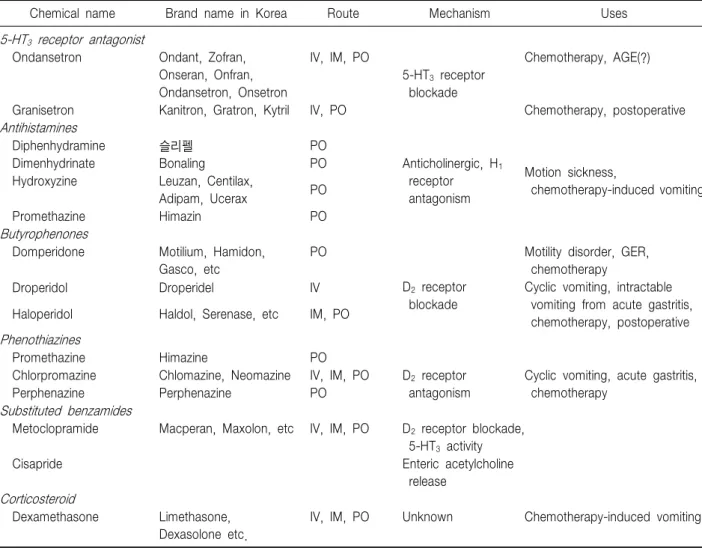
지금까지 알려진 항구역 및 항구토제로는 도파민 수 용체 특히 D2 수용체 길항제인 metoclopramide, halo- peridol 등, 항히스타민제인 dimenhydrinate, diphen- hydramine, promethazine, hydroxyzine 등이 주로 많이 쓰여 왔으며, 이 외에 항콜린약제, 5HT3 수용체 길항제, benzodiazepine, phenothiazine, corticosteroid 등이 있다 (Table 1)3). 이 외에도 NK1 수용체 길항제인 palono- setron, casopitant 등과 olanzapine, gabapentin 등의 약물 들이 화학요법과 관련된 구역 및 구토의 치료에 시도되 고 있다8,9). 또한 항암제 투여로 구역을 유발한 흰족제 비 연구에서 ghrelin이 유용하다는 보고도 있다10). 최근에는 소아에서 안전한 것으로 알려진 ondan- setron에 대한 여러 임상 결과가 발표됨에 따라 위장관 염 환자에서 이의 사용이 적절한지에 논란이 확대되고 있다. 위장관염에서 주로 사용하는 항구토제의 효과와 부작용에 대한 고찰 및 메타 분석에 대한 문헌 결과, domperidone은 주요한 부작용은 없었으나 구역과 구토 감소가 위약군에 비해 감소하지 않았다. 또한 meto- clopamide는 구역과 구토에 효과가 있다는 연구 결과와 효과가 없다는 상반된 연구 결과가 있으며 부작용에 대 한 기술 역시 다른 결과를 보인 것으로 조사되었다.
Trimethobenzamide는 위약군에 비해 효과가 없을 뿐 아 니라 pyrilamine-pentobarbital 보다 효과가 적다는 보고 가 있으나 25년 이상 오래된 연구 결과만 있다. Pyrila- mine-pentobarbital 복합제는 promethazine이나 trimetho- benzamide에 비해 구토에 대한 효과가 좋은 것으로 조 사되었으나 부작용으로 진정 작용이 있을 뿐 아니라 위 약군과 비교한 대조군 연구가 아니므로 신뢰성이 떨어 진다는 점이 있다. Promethazine에 대한 연구 역시 위약 대조군이 없을 뿐 아니라 pyrilamine-pentobarbital 에 비 해 효과가 적다는 연구 결과가 있으며, dexamethasone 역시 대조군에 비해 구토를 줄이지 못하는 것으로 조사 되었다. 반면 ondansetron은 대조군에 비해 구토 회수, 추가 치료 횟수, 정맥내 수액 투여 필요성 등이 감소하 는 것으로 조사되었고 즉시 입원하게 되는 위험도 역시 감소시키는 것으로 나타났다. 또한 설사의 빈도를 증가
Table 1. Antiemetics and Antinausea Drugs
Chemical name Brand name in Korea Route Mechanism Uses
5-HT3 receptor antagonist
Ondansetron Ondant, Zofran, Onseran, Onfran, Ondansetron, Onsetron
IV, IM, PO
5-HT3 receptor blockade
Chemotherapy, AGE(?)
Granisetron Kanitron, Gratron, Kytril IV, PO Chemotherapy, postoperative
Antihistamines
Diphenhydramine 슬리펠 PO
Anticholinergic, H1
receptor antagonism
Motion sickness,
chemotherapy-induced vomiting
Dimenhydrinate Bonaling PO
Hydroxyzine Leuzan, Centilax,
Adipam, Ucerax PO
Promethazine Himazin PO
Butyrophenones
Domperidone Motilium, Hamidon, Gasco, etc
PO
D2 receptor blockade
Motility disorder, GER, chemotherapy
Droperidol Droperidel IV Cyclic vomiting, intractable
vomiting from acute gastritis, chemotherapy, postoperative Haloperidol Haldol, Serenase, etc IM, PO
Phenothiazines
Promethazine Himazine PO
D2 receptor antagonism
Cyclic vomiting, acute gastritis, chemotherapy
Chlorpromazine Chlomazine, Neomazine IV, IM, PO
Perphenazine Perphenazine PO
Substituted benzamides
Metoclopramide Macperan, Maxolon, etc IV, IM, PO D2 receptor blockade, 5-HT3 activity
Cisapride Enteric acetylcholine
release Corticosteroid
Dexamethasone Limethasone, Dexasolone etc.
IV, IM, PO Unknown Chemotherapy-induced vomiting
V: intravenous, IM: intramuscular, PO: per oral, AGE: acute gastroenteritis, GER: gastroesophageal reflux. Adapted from Pediatric gastrointestinal diseases. 4th ed. BC Decker Co, 2004 p.206.
시킨다는 일부 보고 외에 다른 항구토제의 주된 부작용 인 추체외로 증상은 나타나지 않았다11,12). 따라서 향 후 더 많은 환자를 대상으로 더 장기간의 추적 관찰을 통 한 연구 혹은 장기간 투여에 대한 연구가 필요하기는 하지만 6개월 이하의 연령에서도 사용 가능하다는 점 과 아직까지 거의 부작용에 대한 보고가 거의 없는 것 으로 미루어 약가만 해결된다면 구토 증상의 개선에 주 요한 약물로 주목받을 것으로 보인다.
2. 위식도 역류질환(Table 2)
영유아 위식도역류에 대한 metoclopramide의 치료 효과는 각기 논문별로 대상 환자, 약물의 용량, 치료 결
과가 각기 상이하여 더 많은 환자를 대상으로 연구가 필요한 것으로 조사되었다13). 또한 metoclopramide는 영아의 20% 이상에서 중추신경계에 대한 효과와 내분 비계에 영향을 줄 수 있으므로 주의해서 사용해야 한 다. Domperidone은 75∼93%에서 효과가 있다는 보고 가 있지만 효과가 없었다는 상반되는 보고도 있으며 효 과가 있다는 보고의 경우에도 대상 환자수가 적어 코크 란 연구결과 효과가 없는 것으로 알려져 있다14). Erythromycin은 위 배출과 음식 관용(food tolerance) 증 진 효과가 있는 것으로 알려져 있지만 위식도역류와 역 류 증상에 대한 연구보고는 없다. Cisapride는 근육층신 경얼기(myenteric plexus)에서 acetycholine을 간접적으
Table 2. Prokinetics
Chemical name Doses Side effects
Metoclopramide 0.1 mg/kg/dose qid AC, HS Drowsiness, restlessness, dystonia, gynecomastia, galactorrhea Cisapride* 0.2 mg/kg/dose qid AC, HS Diarrhea, cramps, cardiac arrhythmias
Erythromycin 3∼5 mg/kg/dose tid-qid AC, HS Diarrhea, vomiting, cramps, antibiotic effect, pyloric stenosis Domperidone 0.3 mg/kg/day Hyperprolactinemia, dry mouth, rash, headache, diarrhea, nervousness Bethanechol 0.1∼0.3 mg/kg/dose
tid-qid
AC, HS Hypotension, bronchospasm, salivation, cramps, blurred vision, bradycardia
AC: ante cibum, GERD: gastroesophageal reflux disease, HS: hour of sleep, PC: post cibum. *Use in the United States restricted through a limited access program supervised by a pediatric gastroenterologist. Adapted from Pediatric gastrointestinal diseases.
4th ed. BC Decker Co, 2004 p.393.
로 분비하여 작용하며 매우 효과가 좋은 것으로 알려졌 으나 부작용으로 시장에서 사라진 상태이다15,16).
결 론
급성 위장관염을 포함한 소화기 질환에서 구토 증상 의 치료로 항구토제의 사용은 여러 나라에서 광범위하 게 사용되고 있지만 이들 질환에서 항구토제에 대한 연 구는 제한적이다. 따라서 항구토제의 사용은 최소화 되 어야하며 주의해서 사용해야 한다. 현재까지 전향적으 로 비교적 많이 연구된 항구토제로는 ondansetron이 유 일하지만 이 역시 보다 많은 연구를 통해 더 많은 검증 이 필요할 것으로 보인다.
참 고 문 헌
1) Practice parameter: the management of acute gastroen- teritis in young children. American Academy of Pediat- rics, Provisional Committee on Quality Improvement, Subcommittee on Acute Gastroenteritis. Pediatrics 1996;
97:424-35.
2) Guarino A, Albano F, Ashkenazi S, Gendrel D, Hoekstra JH, Shamir R, et al. European Society for Paediatric Gastroenterology, Hepatology, and Nutrition/European Society for Paediatric Infectious Diseases evidence-based guidelines for the management of acute gastroenteritis in children in Europe: executive summary. J Pediatr Gastro- enterol Nutr 2008;46:619-21.
3) Sondheimer JM. Vomiting. In: Walker WA, Goulet O, Kleinman RE, Sherman PM, Shneider BL, Sanderson IR, editors. Pediatric gastrointestinal diseases. 4th ed. BC
Decker Co, 2004:203-9.
4) Elliott EJ. Acute gastroenteritis in children. BMJ 2007;
334:35-40.
5) King CK, Glass R, Bresee JS, Duggan C. Managing acute gastroenteritis among children: oral rehydration, main- tenance, and nutritional therapy. MMWR Recomm Rep 2003;52(RR-16):1-16.
6) Malek MA, Curns AT, Holman RC, Fischer TK, Bresee JS, Glass RI, et al. Diarrhea- and rotavirus-associated hospitalizations among children less than 5 years of age:
United States, 1997 and 2000. Pediatrics 2006;117:1887- 92.
7) Pfeil N, Uhlig U, Kostev K, Carius R, Schröder H, Kiess W, et al. Antiemetic medications in children with pre- sumed infectious gastroenteritis - pharmacoepidemiology in Europe and Northern America. J Pediatr 2008;153:659- 62, 662.e1-3.
8) Herrstedt J. Antiemetics: an update and the MASCC guidelines applied in clinical practice. Nat Clin Pract Oncol 2008;5:32-43.
9) Roila F, Garassino M, Fatigoni S. New anti-emetic treatments. Ann Oncol 2007;18(9 Suppl):ix43-7.
10) Rudd JA, Ngan MP, Wai MK, King AG, Witherington J, Andrews PL, et al. Anti-emetic activity of ghrelin in ferrets exposed to the cytotoxic anti-cancer agent cis- platin. Neurosci Lett 2006;392:79-83.
11) DeCamp LR, Byerley JS, Doshi N, Steiner MJ. Use of antiemetic agents in acute gastroenteritis: a systematic review and meta-analysis. Arch Pediatr Adolesc Med 2008;162:858-65.
12) Szajewska H, Gieruszczak-Białek D, Dylag M. Meta- analysis: ondansetron for vomiting in acute gastroenteritis in children. Aliment Pharmacol Ther 2007;25:393-400.
13) Hibbs AM, Lorch SA. Metoclopramide for the treatment of gastroesophageal reflux disease in infants: a systematic
review. Pediatrics 2006;118:746-52.
14) Pritchard DS, Baber N, Stephenson T. Should dom- peridone be used for the treatment of gastro-oesophageal reflux in children? Systematic review of randomized controlled trials in children aged 1 month to 11 years old.
Br J Clin Pharmacol 2005;59:725-9.14.
15) Vandenplas Y. Gastroesophageal reflux: medical treat- ment. J Pediatr Gastroenterol Nutr 2005;41(Suppl 1):
S41-2.
16) Vandenplas Y, Salvatore S, Hauser B. The diagnosis and management of gastro-oesophageal reflux in infants. Early Hum Dev 2005;81:1011-24.