• 검색 결과가 없습니다.

Re-description of Chrysaora pacifica (Goette, 1886) (Cnidaria, Scyphozoa) from Korean Coastal Waters: Morphology and Molecular Comparisons

N/A
N/A
Protected

Academic year: 2021

Share "Re-description of Chrysaora pacifica (Goette, 1886) (Cnidaria, Scyphozoa) from Korean Coastal Waters: Morphology and Molecular Comparisons"

Copied!
7
0
0

로드 중.... (전체 텍스트 보기)

전체 글

(1)

Article

http://dx.doi.org/10.4217/OPR.2016.38.4.295 Ocean and Polar Research December 2016

Re-description of Chrysaora pacifica (Goette, 1886) (Cnidaria, Scyphozoa) from Korean Coastal Waters: Morphology and Molecular Comparisons

Hye Eun Lee

1

, Won Duk Yoon

2

, Jinho Chae

3

, and Jang-Seu Ki

4*

1

Ocean Climate and Ecology Research Division, National Institute of Fisheries Science Busan 46083, Korea

2

Southeast Sea Fisheries Research Institute, National Institute of Fisheries Science Tongyeong 53085, Korea

3

Marine Environmental Research and Information Laboratory Gunpo 15850, Korea

4

Department of Life Science, College of Natural Science, Sangmyung University Seoul 03016, Korea

Abstract : The nomenclature of the sea nettle jellyfish from Korea was initially described as Dactylometra quinquecirrha Agassiz, 1862. However its identity has been questioned on the basis of its local distribution and molecular data. Here, we examined morphology and DNA sequences of nuclear rDNA using spec- imens collected from southern Korean waters in August 2014. Based on morphological characteristics (bell size, umbrella pattern, number of tentacles and lappets) and distribution locality, we reassign the Korean D.

quinquecirrha to Chrysaora pacifica (Goette, 1886), and provide a re-description accordingly. The molec- ular identity of C. pacifica was further confirmed by comparison of nuclear ribosomal DNA sequences.

Key words : sea nettle, Chrysaora pacifica, scyphomedusae, rDNA

1. Introduction

The genus Chrysaora Péron and Lesueur, 1810 contains more than 10 species. Due to morphological similarities among species, this genus has much of the confusion in their taxonomic descriptions. According to authors, numbers of nominal species in this genus were varied: for instances, 11 (Péron and Lesueur 1810), 6 (Eschscholtz 1829), 13 (Lesson 1843), 9 (Agassiz 1862), 10 (Haeckel 1880), 15 (Mayer 1910) and 11 (Kramp 1961). Most recently, Morandini and Marques (2010) re- described 15 species within the genus Chrysaora on the basis of morphology, geographical distribution, and phylogeny. These taxonomic ambiguities of jellyfish morphology can be solved partly by molecular approaches (e.g. Collins et al. 2006; Ki et al. 2008). These methods

led to differentiating cryptic jellyfish species, studying population genetics, and assessing the extent and impacts of invasions (Holland 2000; Wares et al. 2005).

In Korea, Park (2002) firstly described Dactylometra quinquecirrha Agassiz, 1862 using a specimen collected from Korean southern coasts. However identity of the species has been questioned (Bayha KM, Persnal communication, Jul 26, 2007; Lee et al. 2013), because D.

quinquecirrha is distributed only in the Gulf of Mexico, not other oceanic regions (Morandini and Marques 2010).

Instead, Chrysaora pacifica, which is morphologically similar to D. quinquecirrha, distributes around Japanese coastal waters in North Pacific Ocean. In addition, phylogenetic comparison using molecular survey of Korean jellyfishes showed that it was closer to Chrysaora melanaster sensu lato than Dactylometra. Thus , we have presumed that D. quinquecirrha recorded in Korea by Park (2002) may be the other species belonging to Chrysaora,

*Corresponding author. E-mail : [email protected]

(2)

such as C. melanaster or C. pacifica. Although there are some differences in morphological characteristics and geographical distributions, C. pacifica has often been misidentified several times as C. melanaster.

In the present study, we re-describe morphology and DNA characters of already-known Korean D. quinquecirrha using specimens collected from Gyeongnam province, Korea, 2014. These results were compared with other species of the genera such as Chrysaora and Dactylometra, defining identity of Korean jellyfish.

2. Materials and Methods

Sample collection and morphological description Jellyfish samples were collected at Namildae Beach (in Sacheon), Tongyeong, Jindong, and Jangmok in Korea during August 2014 (Fig. 1). Samples were obtained using hand nets or plastic buckets to avoid the damage of jellyfish. As morphological characters, we measured diameter of umbrella, and then immediately preserved whole samples with 5% formalin in seawater. To analyze DNA of nuclear ribosomal DNA (rDNA), oral arm and gonad tissues were preserved in 100% ethanol solution (Merk, Darmstadt, Germany).

Morphological characters were examined by using the preserved specimens collected from Namildae Beach (34

o

55.59N, 128

o

5.79E), Sacheon, Korea, on 12 August, 2014. We observed morphologies, including exumbrella, subumbrella, oral arms, marginal lappets, rhopalia, tentacles, and stomach using photos, and drew key characters. The number of tentacles and lappets were counted and expressed as the number per octant.

DNA extraction and molecular analysis

Prior to genomic DNA extraction, alcohol-preserved jellyfishes were washed in distilled water to remove all ethanol, and these procedures were repeated several times through overnight. Total genomic DNA was extracted using the CTAB (Cetyl Trimethylammonium Bromide) method described by Ausubel et al. (1989). Nuclear rDNA sequences spanning 18S rDNA to 28S rDNA gene were amplified by PCR using two Eukaryotic universal primers (a forward 18F01, 5’-TCG GCA GGT GAG TTG TTA CAC-3’; a reverse 28R1318, 5’-TGG TTG ATC CTG CCA GTA G-3’), according to Ki and Han (2005).

PCR amplicons were then purified with QIAquick PCR purification Kit (Qiagen GmbH, Germany) and sequenced on a 3730Xl DNA analyzer (Applied Biosystems, USA).

Editing and contig assembly of the rDNA sequence fragments were carried out with Sequencher 4.7 (Gene Codes, MI, USA).

For molecular relationships, we constructed phylogenetic trees of separate 18S and 28S rDNA sequences belonging to Pelagiidae (Phylum Cnidaira) jellyfishes. In brief, the 18S rDNA sequences including an outgroup were aligned using Clustal W (Thompson et al. 1994). Various regions were further corrected manually, and unambiguous regions that could not be aligned were excluded from the analysis (i.e. 1,704 out of 1,830 alignment positions). Then, 18S Maximum-Likelihood (ML) trees were constructed using the General Time-Reversible (GTR) model in MEGA 6 (Tamura et al. 2013). Branch supports in the ML trees were obtained by bootstrap analysis using 1,000 replicates.

Further a 28S phylogenetic tree was analyzed with a dataset (i.e. 1,014 out of 1,150 alignment positions) and

Fig. 1. A map of sampling sites of Chrysaora pacifica (1, Namildae beach; 2, Tongyeong; 3, Jindong; 4, Jangmok in Korea)

(3)

the same method used in 18S rDNA analysis.

3. Results and Discussion

Systematic account

Class Scyphozoa Goette, 1887

Order Semaeostomeae L. Agassiz, 1862 Family Pelagiidae Gegenbaur, 1856 Genus Chrysaora Péron and Lesueur, 1810 Chrysaora pacifica (Goette, 1886)

Dactylometra quinquecirrha var. pacifica Goette 1886:

834 −835; Stiasny 1919: 81; Stiasny 1939: 183 Chrysaora pacifica: Kramp 1961: 327; Gershwin and

Collins 2002: 128, 130, 133, Table 1, Fig. 2 Chrysaora melanaster: Calder 1972: 41; Arai 1997: 14,

134, 136, 175; Collins 2002: Table 1; Morandini, Silveira and Jarms 2004: 347, 348, 352, 353;

Kawahara, Uye, Ohtsu and Iizumi 2006: 172;

Kinoshita, Hiromi and Yamada 2006: 607, 611;

Wares 2008: 81

Korean name

It has been named “Keoteun-wonyang-haepari” by Park (2002). “Keoteun” means a curtain and “wonyang” means offshore in Koran. This species belongs to Family Pelagiidae. Oral arms of this species are wrinkled and look like curtains. “Haepari” is Korean word indicating jellyfish.

Morphological description

Umbrella is almost hemispherical (Fig. 2A) and divided into eight sectors. The umbrella of young specimens is more slightly flattened than that of adults. The surface of exumbrella is finely granulated with 32 radial stripes.

Radial stripes start from midmost of exumbrella, some sample shows an indeterminate form at start point (sunburst type). Mesoglea is flexible and translucent and central portion is relatively thick, thinner at edge.

Musculature is not distinguishable. Mouth is at the center of subumbrella, with 4 oral arms (Fig. 2B). Oral arms are approximately two-three times longer than diameter of umbrella. They look delicate, curtain-like. The margin of each oral arm is finely fringed and there are numerous nematocyst warts on the surface (Fig. 2C). Distal portion of oral arm is slightly spiraled (Fig. 2D). The marginal lappets are rounded (Fig. 3A, B) and there are six lappets per octant. Total number of lappets is 48 and there are numerous nematocyst warts on its external surface. The number of rhopalia is eight. Sense organs, rhopalia are located in deep clefts between lappets and contain a concretion without ocelli (Fig. 3C). Tentacle clefts vary in depth and five tentacles per octant are on the marginal lappets (Fig. 3D). Total number of tentacle is 40. The tentacle is extremely elastic and length of tentacles is two- three times longer than diameter of umbrella in live samples (Fig. 2A). Central stomach is circular and gastric filaments are in four interradial fields. Gonads are outlining gastric filaments and look like semicircular ring with greatly folded form.

Color

The color of the exumbrellar is whitish with thin brownish radiating stripes. Oral arm is milky white.

Tentacles are brownish-orange color.

Size

The bell diameter of the collected specimens ranged between 15 and 21 cm.

Table 1. Comparison of Chrysaora pacifica, C. melanaster and C. quinquecirrha

C. pacifica C. melanaster C. quinquecirrha

Tentacle number 40 24 40

Lappet number 48 32 48

Bell size (cm) Up to 20 20−40 Up to 40

Umbrella pattern Thirty-two brownish radiating stripes and finely granulated on exumbrella

Thirty-two brown rays on exumbrella and 16 black streaks on subumbrella

Background color whitish, pinkish or yellowish, sometimes with reddish to brownish specking and streaks Distribution North Pacific Ocean

(Korea, Japan)

North Pacific Ocean (Kamchaka −Russia;

Aleutian Islands, Bering Sea, Alaska, Oregon −USA)

Western North Atlantic, east coast of USA

Reference Morandini & Marques 2010;

this study

Gershwin & Collins 2002;

Morandini & Marques 2010

Gershwin and Collins 2002;

Morandini and Marques 2010

(4)

Distribution

This species is distributed in North Pacific Ocean (most

Japanese coastal waters) (Morandini and Marques, 2010) and most coastal waters in Korea (mainly southern and eastern) and usually appeared from May to September.

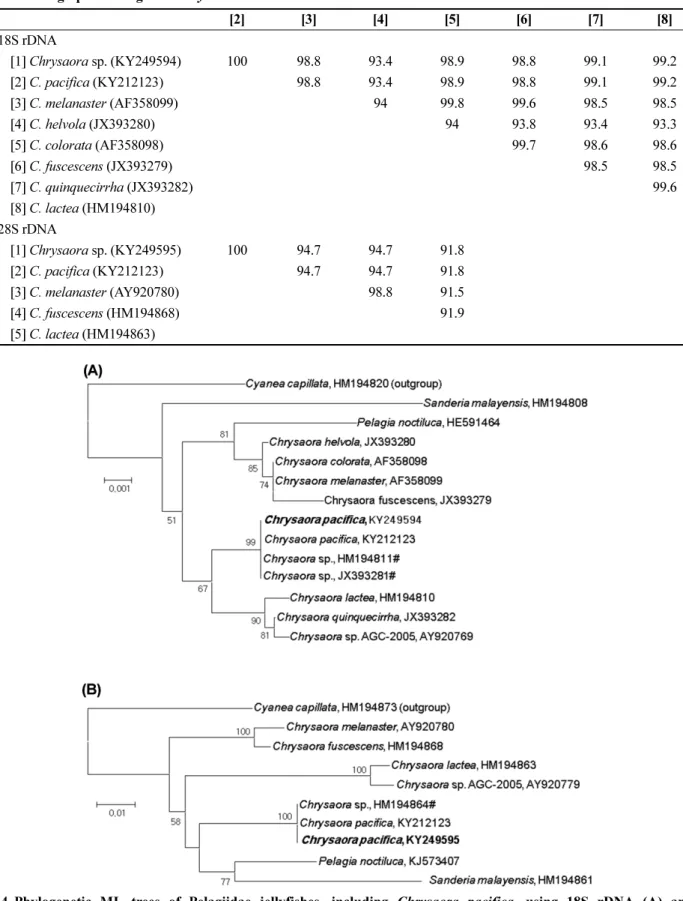
Phylogeny of jellyfish, including the genus Chrysaora The 18S and 28S rDNA sequences of Chrysaora pacifica determined here were deposited in GenBank (Accession Nos. KY249594 and KY249595). Pairwise genetic distances of 18S and 28S rDNA among Genus Chrysaora were calculated (Table 2), revealing that 18S rDNA sequences of the Korean Chrysaora pacifica were 100% similarity to that of C. pacifica available in GenBank (KY212123). However, it was different to those of C. melanater (98.8%) and C. quinquecirrha (99.1%).

In addition, its 28S sequence was 100% identical to that of C. pacifica (KY212123) and 94.7% to C. melanaster, respectively. Phylogenetic relationships of Pelagiidae jellyfishes, including Chrysaora pacifica, were inferred from their 18S, 28S rDNAs, respectively (Fig. 4).

Fig. 2. Chrysaora pacifica. A, exumbrellar view of live sample; B, subumbrellar view of specimen; C, numerous nematocyst warts of oral arm; D, oral arm of specimen

Fig. 3. Chrysaora pacifica. A, marginal lappet (exumbrellar

view); B, marginal lappet (subumbrellar view); C,

rhopalia; D, tentacles

(5)

Table 2. Pairwise genetic distances calculated for the regions of 18S (nearly complete) and 28S (partial sequence) among species of genus Chrysaora

[2] [3] [4] [5] [6] [7] [8]

18S rDNA

[1] Chrysaora sp. (KY249594) 100 98.8 93.4 98.9 98.8 99.1 99.2

[2] C. pacifica (KY212123) 98.8 93.4 98.9 98.8 99.1 99.2

[3] C. melanaster (AF358099) 94 99.8 99.6 98.5 98.5

[4] C. helvola (JX393280) 94 93.8 93.4 93.3

[5] C. colorata (AF358098) 99.7 98.6 98.6

[6] C. fuscescens (JX393279) 98.5 98.5

[7] C. quinquecirrha (JX393282) 99.6

[8] C. lactea (HM194810) 28S rDNA

[1] Chrysaora sp. (KY249595) 100 94.7 94.7 91.8

[2] C. pacifica (KY212123) 94.7 94.7 91.8

[3] C. melanaster (AY920780) 98.8 91.5

[4] C. fuscescens (HM194868) 91.9

[5] C. lactea (HM194863)

Fig. 4. Phylogenetic ML trees of Pelagiidae jellyfishes, including Chrysaora pacifica, using 18S rDNA (A) and

28S rDNA (B). Numerals above the branches refer to the percentage of the 1000 bootstrap replications support-

ing each node. # Represents tentatively assigned name, because its species did not be confirmed

(6)

Phylogenetic trees showed that our C. pacifica was clustered with other sequences of the same species, but it was segregated clearly to other species with high bootstrap supports. Molecular comparisons suggested that the Korean sea nettle was affiliated to C. pacifica, separating from close relatives C. melanaster and C.

quinquecirrha.

4. Remarks and Conclusions

Chrysaora pacifica is common species in Korean coastal waters (mainly southern and eastern) every year from spring to summer. Because the sting of this species is serious, it is known as a dangerous jellyfish to swimmers and fishermen in Korea. Park (2002) recorded this species as Dactylometra quinquecirrha. However, the genus Dactylometra is not used taxonomically at present, thus D. quinquecirrha is accepted by C. quinquecirrha (Morandini and Marques 2010; WoRMS 2016). We think that there must have been some mistakes in Park’s identification, because her morphological description of D. quinquecirrha was similar to those of C. pacifica.

Umbrella of C. quinquecirrha has plain pattern and larger than that of C. pacifica which has stripe pattern. Moreover, C. quinquecirrha may be distributed only in eastern USA and Gulf of Mexico (Gershwin and Collins 2002).

C. pacifica is closely related to C. melanaster. However, there are some differences in morphology between these two species. The number of tentacles is different: C.

pacifica has 40 tentacles, while C. melanaster has 24 tentacles. C. pacifica has up to 48 lappets, while C.

melanaster has 32. C. melanaster can grow larger than 30 cm in bell diameter, whereas C. pacifica is much smaller (Morandini and Marques 2010). Moreover, C.

pacifica is not a worldwide species, its distribution is restricted to the North Pacific Oceans (around Japan) and it thrives in sub-tropical temperatures. Toyokawa (2011) found wild polyps of this species in Sagami Bay, Japan. In contrast, Bering Sea nettle, C. melanaster is commonly found in sub-freezing waters (Kamchatka-Russia;

Aleutian Islands, Bering Sea, Alaska, Oregon-USA, reviewed by Morandini and Marques 2010). In addition, the morphology of C. pacifica is very similar to C.

chinensis, the only known morphological difference is a size of the holotrichous O-isoriza nematocysts. And C.

chinensis is distributed only in a warmer area (western Pacific Ocean: China, Indonesia, Philippines, Sumatra) than C. pacifica.

To conclude, our results of morphological and molecular

analyses indicate that the sea nettle jellyfish collected in southern Korea was Chrysaora pacifica, not Dactylometra quinquecirrha.

Acknowledgements

This work was supported by a grant from the National Institute of Fisheries Science (R2016049), and ‘Management of marine organisms causing ecological disturbance and harmful effects’ by Korea Institute of Marine Science and Technology Promotion/Ministry of Oceans and Fisheries, Korea.

References

Agassiz L (1862) Contributions to the natural history of the United States of America. Little, Brown and Co., Boston, 380 p

Arai MN (1997) A functional biology of Scyphozoa.

Chapman and Hall, London, 316 p

Ausubel FM, Brent R, Kingston RE, Moore DD, Seidman JG, Smith JA, Struhl K (1989) Current protocols in molecular biology. John Wiley and Sons, New York, 4648 p

Calder DR (1972) Development of the sea nettle Chrysaora quinquecirrha (Scyphozoa, Semaeostomeae). Chesap Sci 13:40 −44

Collins AG (2002) Phylogeny of Medusozoa and the evolution of cnidarian life cycles. J Evol Biol 15:418 − 432

Collins AG, Schuchert P, Marques AC, Jankowski T, Medina M, Schierwater B (2006) Medusozoan phylogeny and character evolution clarified by new large and small subunit rDNA data and an assessment of the utility of phylogenetic mixture models. Syst Biol 55(1):97−115 Eschscholtz F (1829) System der acalephen. Ferdinand

Dümmler, Berlin, 190 p

Gershwin L, Collins AG (2002) A preliminary phylogeny of Pelagiidae (Cnidaria, Scyphozoa), with new observations of Chrysaora colorata comb. nov. J Nat Hist 36:127−

148

Goette A (1886) Verzeichnis der medusen, welche von Dr.

Sander, Stabsarzt auf S.M.S. ‘Prinz Adalbert’ gesammelt wurden. Sitzber K Preuss Aka 39:831 −837

Haeckel E (1880) Das System der Medusen. I, 2: System der Acraspeden. Gustav Fischer Jena 2:361−672

Holland BS (2000) Genetics of marine bioinvasions. Mar Genet 144:63 −71

Kawahara M, Uye S, Ohtsu K, Iizumi H (2006) Unusual

(7)

population explosion of the giant jellyfish Nemopilema nomurai (Scyphozoa: Rhizostomeae) in East Asian waters.

Mar Ecol-Prog Ser 307:161−173

Ki JS, Hwang DS, Shin K, Yoon WD, Lim D, Kang YS, Lee Y, Lee JS (2008) Recent moon jelly (Aurelia sp.1) blooms in Korean coastal waters suggest global expansion: examples inferred from mitochondrial COI and nuclear ITS-5.8S rDNA sequences. ICES J Mar Sci 65:443 −452

Ki JS, Han MS (2005) Molecular analysis of complete SSU to LSU rDNA sequence in the harmful dinoflagellate Alexandrium tamarense (Korean isolate, HY970328M).

Ocean Sci J 40:43−54

Kinoshita J, Hiromi J, Yamada Y (2006) Abundance and biomass of scyphomedusae, Aurelia aurita and Chrysaora melanaster, and Ctenophora, Bolinopsis Mikado, with estimates of their impact on zooplankton in Tokyo Bay, Japan. J Oceanogr 62:607−615

Kramp PL (1961) Synopsis of the medusa of the world. J Mar Biol Assoc UK 40:7−469

Lee MD, Guo R, Choi YK, Yu WB, Ki JS (2013) Molecular phylogenetic affiliations of jellyfish collected in Korean coasts. Proceeding in the 10th Korea-China- Japan Jellyfish International Workshop. Center Mark Hotel, Seoul, 41 p

Lesson RP (1843) Histoire naturelle des Zoophytes, Acaléphes.

Librairie Encyclopédique de Roret, Paris, 596 p

Mayer AG (1910) The medusae of the world. Volume III.

The Scyphomedusae. Carnegie Inst Wash Publ 109:499−

735

Morandini AC, Marques AC (2010) Revision of the genus Chrysaora Péron and Lesueur, 1810 (Cnidaria: Scyphozoa).

Zootaxa 2464:1−97

Morandini AC, Silveira FL, Jarms G (2004) The life cycle of Chrysaora lactea Eschscholtz, 1829 (Cnidaria, Scyphozoa) with notes on the scyphistoma stage of three other species. Hydrobiologia 530/531:347 −354

Park JH (2002) Two new records of Siphonophora (Hydrozoa)

and Semaeostomeae (Scyphozoa) in Korea. Kor J Syst Zool 18:53 −58

Péron F, Lesueur CA (1810) Tableau des caractéres génériques et spécifiques de toutes les espéces de Méduses connues jusqu’à ce jour. Annales du Muséum National d’Histoire Naturelle, Paris 14:325 −366

Stiasny G (1919) Die Scyphomedusen-Sammlung des Naturhistorischen Reichsmuseums in Leiden. II. Stauro- medusae, Coronatae, Semaeostomeae. Zoologische Med- edeelingen 4:66−99

Stiasny G (1939) Über Dactylometra fulgida (Reymaud) von der Walfischbai. Zoologischer Anzeiger 126:172 −185 Tamura K, Stecher G, Peterson D, Filipski A, Kumar S

(2013) MEGA6: Molecular Evolutionary Genetics Analysis Version 6.0. Mol Biol Evol 30:2725−2729

Thompson JD, Higgins DG, Gibson TJ (1994) Improved sensitivity of profile searches through the use of sequence weights and gap excision. Comput Appl Biosci 10(1):19- 29

Toyokawa M (2011) First record of wild polyps of Chrysaora pacifica (Goette, 1886) (Scyphozoa, Cnidaria). Plankton Benthos Res 6:175 −177

Wares JP, Hughes AR, Grosberg RK (2005). Mechanisms that drive evolutionary change: insights from species introductions and invasions. In: Sax DF, Stachowicz JJ, Gaines SD (eds) Species invasions: insights into ecology, evolution, and biogeography, Sinauer Associates, Inc., Sunderland, MA, pp 230−257

Widmer CL (2008) Life cycle of Chrysaora fuscescens (Cnidaria: Scyphozoa) and a key to sympatric ephyrae.

Pac Sci 62:71 −82

WoRMS (2016) Dactylometra quinquecirrha Light, 1862.

http://www.marinespecies.org/aphia.php?p=taxdetails&id=

564908 Accessed 22 Sep 2016

Received Oct. 19, 2016

Revised Dec. 1, 2016

Accepted Dec. 2, 2016

수치

Fig. 1. A map of sampling sites of  Chrysaora pacifica (1, Namildae beach; 2, Tongyeong; 3, Jindong; 4, Jangmok in Korea)
Table 1. Comparison of  Chrysaora pacifica,  C. melanaster and C. quinquecirrha
Fig. 2. Chrysaora pacifica. A, exumbrellar view of live sample; B, subumbrellar view of specimen; C, numerous nematocyst warts of oral arm; D, oral arm of specimen
Table 2. Pairwise genetic distances calculated for the regions of 18S (nearly complete) and 28S (partial sequence) among species of genus  Chrysaora

참조

관련 문서