Korean J. Mineral. Petrol. Vol. 33, No. 3, p. 251~258, 2020 https://doi.org/10.22807/KJMP.2020.33.3.251
광물과 암석
완전히 탈수되고 부분적으로 칼슘 이온으로 교환된 제올라이트 A의 셀레늄 수착 화합물의 구조 연구
김후식1·박종삼2·임우택1*
1안동대학교 응용화학과, 2대구보건대학교 방사선과
Structural Study of Selenium Sorption Complex of Fully Dehydrated, Partially Ca 2+ -exchanged Zeolite A
Hu Sik Kim1, Jong Sam Park2, and Woo Taik Lim1*
1Department of Applied Chemistry, Andong National University, Andong 36729, Korea
2Department of Radiologic Technology, Daegu Health College, Daegu 41453, Korea
요 약: Ca
2+이온으로 부분적으로 치환된 제올라이트 A (|Ca
4Na
4|[Si
12Al
12O
48]-LTA) 단결정과 Se을 가는 모세 관에 넣은 후 523 K 에서 5일동안 반응을 시켜 Se이 흡착된 제올라이트 A 단결정을 합성 하였다. 이 결정 의 구조는 294 K 에서 단결정 X-선 회절 기술을 이용하여 Pm3m (a = 12.2787(13) Å) 입방 공간군에 속함 을 확인 하였고, F
o> 4s(F
o)를 사용하여 최종 오차 인자를 R
1/wR
2= 0.0960/0.3483로 정밀화 하였다. 이 구조 에서는 4개의 Na
+와 4개의 Ca
2+이온이 모든 6-ring 자리에 채워져 있었으며, 이들 이온들은 모두 6-ring 맞 은편의 3-fold 축 상의 결정학적 위치에서 발견되었다. Se 원자들은 뚜렷하게 서로 다른 3개의 결정학적 위 치에서 발견되었다. 단위 세포당 2개의 Se(1) 원자는 sodalite cavity 내 6-ring 맞은편 (Se(1)-Na(1) = 2.53(5) Å), 1개의 Se(2) 원자는 4-ring 맞은편 (Se(2)-O(1) = 2.76(10) Å), 그리고 1개의 Se(3) 원자는 large cavity 내 6-ring 맞은편 (Se(3)-Na(1) = 2.48(5) Å)에 각각 위치하고 있었다. 2가지 형태의 Se
2분자 (Se(1)-Se(1) = 2.37(7) or 2.90(8) Å and Se(2)-Se(3) = 2.91(5)) Å)가 sodalite cavity와 large cavity 내에서 발견되었으며, Se
4와 Se
8과 같은 형태의 클러스터가 large cavity 내에 존재할 수 있었다. 이들 클러스터내 Se 원자들 사이의 거리는 기체상태의 Se
2분자내 Se 원자 사이의 거리보다 더 길게 나타났다.
핵심어: 제올라이트 A, 셀레늄, 구조, 칼슘
Abstract
: Single crystal of fully dehydrated and partially Ca2+-exchanged zeolites A (|Ca4Na4|[Si12Al12O48]- LTA) was brought into contact with Se in fine pyrex capillary at 523 K for 5 days. Crystal structure of Se-sorbed |Ca4Na4|[Si12Al12O48]-LTA has been determined by single-crystal X-ray diffraction techniques at 294 K in the cubic space group Pm3m (a = 12.2787(13) Å). The crystal structure of yellow|Ca4Na4Se4|[Si12Al12O48]-LTA has been refined to the final error indices of R1/wR2 = 0.0960/0.3483 with 327 reflections for which Fo > 4s(Fo). In this structure, 4 Na+ and 4 Ca2+ ions fill every 6-ring site: These ions are all found at three crystallographic positions, on 3-fold axes equipoints of opposite 6-rings.
Selenium atoms are found at three crystallographically distinct positions: 2 Se atoms per unit cell at Se(1) are located opposite 6-rings in the sodalite cavity (Se(1)-Na(1) = 2.53(5) Å) and 1 at Se(2) opposite 4- rings (Se(2)-O(1) = 2.76(10) Å) and 1 at Se(3) opposite 6-rings in the large cavity (Se(3)-Na(1) = 2.48(5) Å). Two molecular of Se2 (Se(1)-Se(1) = 2.37(7) or 2.90(8) Å and Se(2)-Se(3) = 2.91(5) ) Å) are found in all sodalite cavity and large cavity. Other clusters such as Se4 and Se8 could be existed in large cavity.
The inter-selenium distances turned out to be longer that of gases Se2 molecule.
Keywords:
Zeolite A, Selenium, Structure, Calcium*Corresponding author Tel: +82-54-820-5454 E-mail: [email protected]
INTRODUCTION
Zeolites are three dimensional crystalline solids with well defined structures that contain aluminum, silicon, and oxygen in their regular framework, can confine molecules or clusters in their void space in a con- trolled fashion (Heron, 1995). The confined materials to the nanometer scale can have dramatic effects on the optical, electronic, vibrational, and thermodynamic properties of condensed matter (Armand et al., 1997;
Kim et al., 2006). Chalcogen elements such as S, Se, and Te can be confined within cavities or channels of different zeolites so a number of recent papers deal with the introduction of chalcogen elements into those of zeolites (Bogomolov et al., 1983; Bogomolov et al., 1985; Tamura et al., 1986; Parise et al., 1988; Gold- bach et al., 1996).
Tamura et al. extensively studied Se chains confined in the channels of synthetic mordenite by the measure- ment of the extended X-ray absorption fine structure and the photoacoustic spectroscopy and then found that the isolated Se chains in the mordenite channels were strongly photo-sensitive (Tamura et al., 1986). Bogo- molov et al. investigated single Se chains stabilized in the regular system of parallel channels of a mordenite dielectric matrix and reported that the interchain inter- action in trigonal Se crystals weakens significantly the intrachain bonding (Bogomolov et al., 1985). Parise et al. successfully loaded selenium into zeolites A, X, Y, AlPO-5, and mordenite and then characterized those products by EXAFS, solid-state NMR, and diffuse- reflectance techniques (Parise et al., 1988). Their study revealed selenium was predominantly of the trigonal (helical chains) form in all but zeolite A, where only the Se8-crown ring form was found. Goldbach et al.
studied selenium incorporated in Nd-Y zeolite by Raman spectroscopy and suggested the formation of the Se2- radical anion (Goldbach et al., 1996).
In this work, we synthesized partially Ca2+-exchanged zeolite A (|Ca4Na4|[Si12Al12O48]-LTA) which had the pore opening of the 8-ring and then treated this with selenium in an attempt to synthesize nanoclusters of selenium within the zeolite A. The single-crystal struc-
ture of the resulting product was determined to learn the positions, size, and geometry of the loaded sele- nium nanoclusters, and to observe their interactions with the zeolite framework and Ca2+ cations.
EXPERIMENTAL SECTION
Preparation of Partially Ca
2+-exchanged Zeo- lite A
Large colorless single crystals of zeolite 4A (LTA), Na12Si12Al12O48·27H2O (Na12-A·27H2O or Na-A), were synthesized by Kokotailo and Charnell. A single crys- tal about 85µm on edge was selected and lodged in a fine quartz capillary. A partially Ca2+-exchanged zeo- lite A (Ca4Na4Si12Al12O48·xH2O) was prepared by the dynamic (flow) ion-exchange of Na-A using exchange solution in which molar ratio of Ca(NO3)2 (Aldrich 99.997%) and NaOH (99%) was 100 : 1, with a total concentration 0.05M. The resulting colorless |Ca4- Na4|[Si12Al12O48]-LTA crystal in its own fine Pyrex cap- illary was completely dehydrated by gradually increasing its temperature (ca. 20 oC/h) to 623 K at a constant pressure of 1×10⁻⁶ Torr.
Synthesis of Selenium Sorption Complex in Partially Ca
2+-exchanged Zeolite A
The crystal of fully dehydrated |Ca4Na4|[Si12Al12O48]- LTA was brought into contact with Se (Aldrich Chem.
Co., 99.999%) under vacuum in fine Pyrex capillary at 523 K for 5 days. This was achieved by condensing Se on and near the crystal, whose temperature (523 K) was lower than that of the metal (623 K), in coaxially connected heating ovens. Although the vapor pressure of Se(l) is reported to be somewhat low at 523 K (3.54×10⁻² Torr) (Kwon et al., 1998), droplets of Se were seen to form very close to the zeolite crystal.
Except for this reversed temperature gradient during the reaction period, other experimental procedures for the reaction were similar in detail to those previously described for solvent-free ion exchange (Heo et al., 1997). After cooling to room temperature, the crystal, still under vacuum, was then sealed in its capillary with a small flame. The color of the resulting crystal, still
under vacuum in its capillary, was yellow.
X-ray Data Collection
The structure of the resulting crystal was deter- mined by single-crystal X-ray diffraction techniques at 294(1) K using a Bruker SMART CCD diffractometer.
The crystal evaluation and data collection were done using Mo K radiation with a sealed-tube X-ray source operating at 1.5 kW with a detector-to-crystal distance of 4.8 cm.
Preliminary cell constants and an orientation matrix were determined from three series of scans at different starting angles. Each series consisted of 20 frames col- lected at scan intervals of 0.3o with an exposure time of 10 seconds per frame. The reflections were success- fully indexed by the automated indexing routine of the SMART program (Bruker SMART, 1999). A total of
11,959 reflections for |Ca4Na4Se4|[Si12Al12O48]-LTA, was harvested by collecting four sets of frames with 0.3o scans with an exposure time of 10 seconds per frame.
The highly redundant data sets were corrected for Lorentz and polarization effects, and a (negligible) cor- rection for crystal decay was also applied. The space group Pm3m was determined by the program SAINT- plus (Bruker SMART, 1999). A summary of the experimental and crystallographic data is presented in Table 1.
Structure Determination
Full-matrix least-squares refinement (SHELXL97) (Sheldrick, 1997) was initiated with the atomic param- eters of the framework atoms [(Si,Al), O(1), O(2), and O(3)] in dehydrated |Na12|[Si12Al12O48]-LTA (Firor and Seff, 1978). The initial refinement using isotropic ther- mal parameters for all positions converged to the error indices R1= 0.2613 and R2= 0.6433. (See Table 2, footnotes.) Refinement including the Na(1) position at a peak (0.1879, 0.1879, 0.1879, opposite a 6-ring) from the initial difference Fourier function led to conver- gence with R1= 0.1817 and R2= 0.4979 and an occu- pancy of 7.1(4) Na+ ions. The next difference Fourier function (based on this model) revealed a peak at (0.2209, 0.2209, 0.2209), opposite a 6-ring in the large cavity. Refinement including this peak as Ca(1) con- verged to R1= 0.1545 and R2= 0.4184, with occupan- cies of 4.4(6) and 1.8(3) for Na(1) and Ca(1), respectively. The addition of another peak at Se(3) (0.3002, 0.3002, 0.3002, inside the large cavity) reduced the error indices to R1= 0.1465 and R2= 0.3860, with occupancies of 4.6(5), 2.2(3), and 1.91(3) for Na(1), Ca(1), and Se(3), respectively. A subsequent refine- ment included Se(1), a peak found opposite a 6-ring in the sodalite cavity at (0.0710, 0.0710, 0.0710), led to R1= 0.1211 and R2= 0.3423, with occupancies of 4.5(4), 1.96(23), 1.60(16), and 1.91(14) for isotropi- cally refined Na(1), Ca(1), Se(3), and Se(1), respec- tively. Successive Fourier functions revealed two peaks of height 2.30 eÅ-3 and 0.87 eÅ-3 at (0.1423, 0.1423, 0.1423) and (0.1927, 0.3622, 0.5). Simultaneous posi- tional, thermal, and occupancy refinement including
Table 1. Summary of experimental and crystallographic
data
Crystal cross-section (mm) 0.15
Ion exchange T (K) 294
Ion exchange for Ca2+ (days, mL) 4, 16.0 Data collection T (K) 294(1)
Scan technique -scans
Radiation (Mo K) 1 (Å) 0.70930
2 (Å) 0.71359 Unit cell constant, a (Å) 12.2787(13) 2 range in data collection (deg) 2.82<2<56.6 No. of unique reflections, m 512
No. of reflections with Fo > 4(Fo) 327
No. of variables, s 41
Data/parameter ratio, m/s 12.5 Weighting parameters, a/b 0.183/21.6 Final error indices
R1/wR2 (Fo > 4(Fo))a 0.0960/0.3483 R1/wR2 (all intensities)b 0.1573/0.4149
Goodness-of-fitc 1.232
a
R
1= |F
o-|F
c||/F
oand R
2= [w(F
o2-F
c2)2/Sw(F
o2)
2]
1/2; R
1and R
2are calculated using only the 327 reflections for which F
o>
4(F
o), where F
oand F
care observed and calculated structure
factors, respectively.
bR
1and R
2are calculated using all unique
reflections measured.
cGoodness-of-fit = (w(F
o2-F
c2)
2/(m-s))
1/2,
where m and s are the number of unique reflections and
variables, respectively.
these positions converged at R1= 0.0968 and R2= 0.3544 with occupancies of 3.6(5), 2.05(24), 1.6(3), 2.33(16), 1.6(3), and 1.1(3) for Na(1), Ca(1), Se(3), Se(1), Ca(2), and Se(2), respectively. A subsequent refinement with fixed occupancies of 4.0, 2.0, and 2.0 at Na(1), Ca(1), and Ca(2) because the cationic charge should not be exceeded +12 per Pm3m unit cell (Jang et al., 1995) converged to R1= 0.0960 and R2= 0.3483 with occupancies of 2.33(16), 1.3(4), and 1.39(14) for Se(1), Se(2), and Se(3). The final cycles of refinement with occupancies of 4.0, 2.0, 2.0, 2.0, 1.0, and 1.0 at Na(1), Ca(1), Ca(2), Se(1), Se(2), and Se(3), respec- tively, as shown in Table 2 converged to R1= 0.0968 and R2= 0.3485 with anisotropic thermal parameters for all framework. It is easy to distinguish Ca2+ from Na+ ions because (1) the atomic scattering factors are largely different, 18e- for Ca2+ vs. 10e- for Na+ and (2) If Ca2+ ions were Na+ ions on the 3-fold axis, the sum of Na+ ions on the 3-fold axes were about twelve but the maximum number of ions per unit cell at these positions cannot sum to more than eight (Jang et al., 1995).
The final difference Fourier function was feature- less; the notation |Ca4Na4Se4|[Si12Al12O48]-LTA will be used for this crystal. All shifts in the final cycles of
refinement were less than 0.1% for the corresponding estimated standard deviations. The final structural parameters are given in Table 2. Selected interatomic distances and angles are given in Table 3. Fixed weights were used initially; the final weights were assigned using the formula w = 1/[2(Fo2) + (aP)2 + bP] where P = [Max(Fo2,0) + 2Fc2]/3, with a = 0.183 and b = 21.6 as refined parameters (see Table 1).
Atomic scattering factors for Ca2+, Se, and (Si,Al)1.75+
were used (Doyle and Turner., 1968; Ibers and Hamil- ton., 1974a). The function describing (Si,Al)1.75+ is the mean of the Si4+, Si0, Al3+, and Al0 functions. All scat- tering factors were modified to account for anomalous dispersion (Cromer, 1965; Ibers and Hamilton., 1974b).
RESULTS AND DISCUSSION
Overview of Crystal Structure
In the crystal structure of Se-sorbed partially Ca2+- exchanged zeolite A (|Ca4Na4Se4|[Si12Al12O48]-LTA), all Na+ and Ca2+ ions are found on three distinguished 3- fold axis (see Table 2 and Figure 1 and 2). About 4 Na+ ions at Na(1) are recessed 0.06 Å into the large cavity from the O(3) planes of the 6-ring. Each of these Na+ ions at Na(1) is coordinated to three O(3)
Table 2. Positional, thermal, and occupancy parameters
aAtom Wyckoff position x y z U11 U22 U33 U23 U13 U12
bOccupancy Varied Fixed
Si,Al 24(k) 0 1841(2) 3735(2) 130(17) 104(15) 90(17) 34(10) 0 0 24c
O(1) 12(h) 0 2327(10) 5000d 464(82) 322(69) 218(59) 0 0 0 12
O(2) 12(i) 0 2842(8) 2842(8) 633(95) 228(42) 228(42) 198(53) 0 0 12
O(3) 24(m) 1111(6) 1111(6) 3477(8) 364(39) 364(39) 399(59) 67(36) 67(36) 239(45) 24
Na(1) 8(g) 1874(8) 1874(8) 1874(8) 76(28) 3.6(5) 4
Ca(1) 8(g) 2173(12) 2173(12) 2173(12) 323(44) 2.05(24) 2
Ca(2) 8(g) 1501(29) 1501(29) 1501(29) 1270(172) 1.6(3) 2
Se(1) 8(g) 682(20) 682(20) 682(20) 2178(173) 2.33(16) 2
Se(2) 24(l) 1843(78) 3620(72) 5000d 1666(557) 1.3(4) 1
Se(3) 8(g) 3038(23) 3038(23) 3038(23) 1667(257) 1.39(14) 1
a
Positional parameters × 10
4and thermal parameters × 10
4are given. Numbers in parentheses are the estimated standard deviations in
the units of the least significant figure given for the corresponding parameter. The anisotropic temperature factor is exp[-2π
2a
2(U
11h
2+
U
22k
2+ U
33l
2+ 2U
23kl + 2U
13hl + 2U
12hk)].
bOccupancy factors are given as the number of atoms or ions per unit cell.
cOccupancy for
(Si) = 12, occupancy for (Al) = 12.
dExactly 0.5 by
framework oxygens at 2.373(9) Å (see Table 3 and 4).
Considering that the sum of ionic radii of Na+ and O2- is 0.97 + 1.32 = 2.29 Å (Weast, 1989),the Na(1)-O(3) approach distances, 2.373(9) Å, are very reasonable.
The O(3)-Na(1)-O(3) angles are close to 120o (119.95(4)o), so the Ca2+ ions are nearly trigonal-pla- nar (see Table 3). About 2 Ca2+ ions at Ca(1) and 2 at Ca(2) extend 0.58 and 0.85 Å into the large cavity and sodalite cavity, respectively, from the (111) plane at O(3). These are coordinated to three O(3) oxygens at 2.44(11) and 2.519(23) Å, respectively, in a distorted trigonal planar arrangement (O(3)-Ca(1)-O(3) = 114.5(5)o and O(3)-Ca(2)-O(3) = 109.3(13)o). Considering that the sum of ionic radii of Ca2+ and O2- is 0.99 + 1.32 = 2.31 Å (Weast, 1989), the Ca(1)-O(3) approach dis- tances, 2.44(11) and 2.519(23) Å, are somewhat lon- ger than that, 2.31 Å.
In this work, a total of 4 sorbed Se atoms per unit cell are found at two different 3-fold axes and at 24- fold axes. The 2 Se atoms per unit cell are found at
Se(1) and 1 at Se(3) on the 3-fold axes in deep sodalite cavity and in the large cavity, respectively, while addi- tional 1 Se atom per unit cell is located at Se(2) oppo- site 4-ring in the large cavity.
Selenium in the Sodalite Cavity
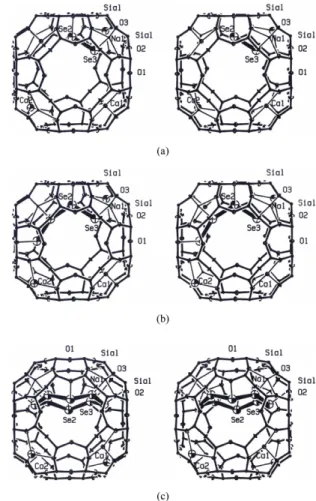
The 2 Se atoms per unit cell at Se(1) are found on the 3-fold axis in each sodalite cavity (see Figure 1).
The location of Se at Se(1), opposite 6-ring in the sodalite cavity, is unambiguous, because no other chemically possible atoms or ions. The approach dis- tances of these Se atoms to 6-ring Na+ cations of the same 3-fold axis is 2.54(5) Å (see Table 3). Considering the radii of Na+ (rNa+= 0.97 Å) and Se atom (1.20 Å)
Fig. 1. A stereoview of a sodalite cavity in |Ca
4Na
4Se
4|[Si
12Al
92O
48]-LTA (inter-Se distance is 2.37(7) Å (a), 2.90(8) Å (b)). The zeolite A framework is drawn with light bonds between oxygens and tetrahedrally coordinated (Si,Al) atoms. Ellip- soids of 20% probability are shown.
Fig. 2. A stereoview of large cavity in |Ca
4Na
4Se
4|[Si
12Al
92O
48]-LTA (100% (a), 50% (b), and 25%
(c) of large cavity). See the caption to Figure 1
for other details.
(Slater., 1964; Weast, 1989), the Se atoms have a little bit long approach distance to their neighbors to be con- sidered as having relatively weak interactions. The 2 Se atoms at Se(1) on the inner surface of the sodalite cavity may be placed within their partially occupied equipoints in various ways. Provided that Se atoms are sorbed in 100% of all of sodalite cavities, then linear Se2 clusters may exist. The shortest possible inter-Se
distance, Se(1)-Se(1) = 1.67(5) Å, is impossibly short and is dismissed. Other inter-Se distances, 2.37(7) or 2.90(8) Å, suggest the possibility of an Se(2)-Se(2) interactions. A stereoview of Se2 cluster in the sodalite cavity is shown in Figure 1(a and b).
Selenium in the Large Cavity
The 2 atoms of Se in the large cavity are found at two crystallographically distinct positions. That there are two kinds of positions indicates that the Se atoms are not arranging themselves by simple packing within the highly symmetric zeolites. It is attributed to dipo- lar interactions among the sorbed Se (vide infra). One Se atom at Se(2) lies opposite a 4-ring and another Se atom at Se(3) lies on a 3-fold axis opposite a 6-ring (see Figure 2(a)).
The closest approach of the Se atom to framework oxygen (Se(2)-O(1)) is 2.76(10) Å, while that to extra- framework cation is 2.48(5) Å for Na(1)-Se(3) (see Table 3). Considering the radii of the cations (rNa+ =
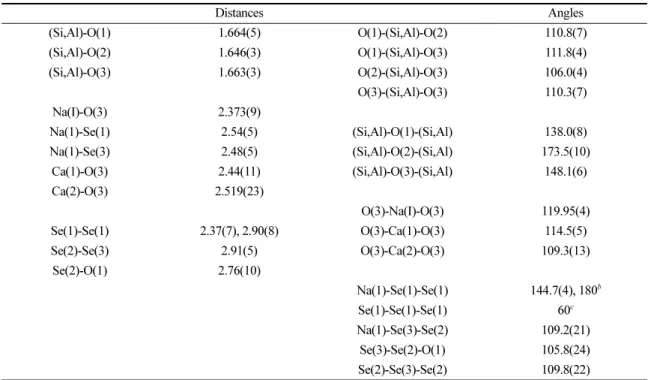
Table 3. Selected interatomic distances (Å) and angles (deg)
aDistances Angles
(Si,Al)-O(1) 1.664(5) O(1)-(Si,Al)-O(2) 110.8(7)
(Si,Al)-O(2) 1.646(3) O(1)-(Si,Al)-O(3) 111.8(4)
(Si,Al)-O(3) 1.663(3) O(2)-(Si,Al)-O(3) 106.0(4)
O(3)-(Si,Al)-O(3) 110.3(7)
Na(I)-O(3) 2.373(9)
Na(1)-Se(1) 2.54(5) (Si,Al)-O(1)-(Si,Al) 138.0(8)
Na(1)-Se(3) 2.48(5) (Si,Al)-O(2)-(Si,Al) 173.5(10)
Ca(1)-O(3) 2.44(11) (Si,Al)-O(3)-(Si,Al) 148.1(6)
Ca(2)-O(3) 2.519(23)
O(3)-Na(I)-O(3) 119.95(4)
Se(1)-Se(1) 2.37(7), 2.90(8) O(3)-Ca(1)-O(3) 114.5(5)
Se(2)-Se(3) 2.91(5) O(3)-Ca(2)-O(3) 109.3(13)
Se(2)-O(1) 2.76(10)
Na(1)-Se(1)-Se(1) 144.7(4), 180b
Se(1)-Se(1)-Se(1) 60c
Na(1)-Se(3)-Se(2) 109.2(21)
Se(3)-Se(2)-O(1) 105.8(24)
Se(2)-Se(3)-Se(2) 109.8(22)
a
The numbers in parentheses are the estimated standard deviations in the units of the least significant digit given for the corresponding parameter.
bExactly 180
oby symmetry.
cExactly 60
oby symmetry.
Table 4. Deviations of Atoms (Å) from (111) Plane at O(3)
Ions or Atoms Charge Distance
at O(3)a
Na(1) +1 0.06
Ca(1) +2 0.58
Ca(2) +2 -0.85
Se(1) 0 -2.59
Se(3) 0 2.42
a
A negative deviation indicates that the atom lies on the same
side of the plane as the origin, i.e., inside the sodalite cavity of
zeolite A
0.97 Å), framework oxygens (1.32 Å), and Se atoms (1.20 Å) (Slater., 1964; Weast, 1989), the Se atoms have a little bit long approach distances to their neigh- bors to be considered as having relatively weak inter- actions. In particular, when the distances are compared to the sum of the above radii for Na+ and Se, 0.97 + 1.20 = 2.17 Å (Slater., 1964; Weast, 1989), the approach distance of the 3-fold axis Se atom, Se(3), to the 6-ring Na+ ion (2.48(5) Å) indicates relatively weak Na+-Se interaction. This interaction between Se atom at Se(3) in the large cavity and 6-ring Na+ ion is very similar with the interaction between Se at Se(1) in the sodalite cavity and 6-ring Na+ (Na(1)-Se(1) = 2.53(5) Å).
The 2 Se atoms at Se(2) and Se(3) on the inner sur- face of the large cavity may be placed within their par- tially occupied equipoints in various ways. The shortest inter-Se distance, Se(2)-Se(3) = 2.91(5) Å, is possible and suggests the possibility of an Se(2)-Se(3) interac- tion with favorably oriented induced dipoles (see Figure 2(a)). In this linear Se2 cluster, Se atoms alternatively approach Na+ ion and 4-oxygen ring and are polarized oppositely, allowing their inter-Se approaches to be attractive, like O(1)d--Se(2)d--Se(3)d+-Na(1)d+.
Provided that Se atoms are sorbed in only 50% of all large cavities, then bent linear Se4 clusters may exist.
The 4 Se atoms at Se(2) and Se(3) on the inner sur- face of the large cavity may be placed in similar way to above. A distance found between Se(2) and Se(3), 2.91(5) Å, is also possible and suggests the possibility of an Se(2)-Se(3)-Se(2)-Se(3) interaction with favor- ably oriented induced dipoles (see Figure 2(b)). In this bent linear Se4 cluster, Se atoms alternatively approach 2 Na+ ions and 2 4-oxygen rings; they are therefore polarized oppositely, allowing their inter-Se approaches to be attractive, like O(1)d--Se(2)d+-Se(3)d--Se(2)d+- Se(3)d--Na(1)d+.
If 25% of the large cavity is sorbed by Se atoms, the most favorable arrangement of 8 Se atoms is a butter- fly-shape, [-Se(2)-Se(3)-Se(2)-Se(3)-Se(2)-Se(3)-Se(2)- Se(3)-], Se(2)-Se(3) = 2.91(5) Å, and Se(2)-Se(3)-Se(2)
= 109.8(22)o, because of its higher symmetry and the considerations regarding alternating polarizations of Se atoms as seen in Figure 2(c).
SUMMARY
Single crystal of fully dehydrated and partially Ca2+- exchanged zeolite A (|Ca4Na4|[Si12Al12O48]-LTA) was reacted with Se at 523 K for 5 days. Crystal structure of Se-sorbed partially Ca2+-exchanged zeolite A (|Ca4- Na4Se4|[Si12Al12O48]-LTA) has been determined by sin- gle-crystal X-ray diffraction techniques in the cubic space group Pm3m. The crystal structure of |Ca4- Na4Se4|[Si12Al12O48]-LTA has been refined to the final error indices of R1/wR2= 0.0960/0.3483 with 327 reflec- tions for which Fo > 4s(Fo). In the crystal structure of Se-sorbed partially Ca2+-exchanged zolite A (|Ca4Na4Se4
|[Si12Al12O48]-LTA), a total of 4 sorbed Se atoms per unit cell found at two different 3-fold axes and at 24- fold axes. The 2 Se atoms per unit cell are found at Se(1) on the 3-fold axis in the sodalite cavity and another Se atom at Se(3) is located on the 3-fold axis in deep large cavity. Additional one Se atom per unit cell is found at Se(2) opposite 4-ring in the large cavity.
The Se clusters in zeolite A are stabilized by interac- tion with cations and framework oxygen. In sodalite cavity, Se-Se distance of 2.37(7) Å exhibit strong cova- lent property due to their interaction with Na+ ions.
Inter-Se distance, 2.90(8) Å, in sodalite cavity could be also possible. On the other hand, in large cavity, that of 2.91(5) Å in zeolite framework shows ionic property because alternative ionic interaction was formed through framework oxygen at one end and Na+ ions at the other end.
ACKNOWLEDGEMENTS
This work was supported by a Research Grant of Andong National University. We gratefully acknowl- edge the support of the Central Laboratory of Andong National University for the diffractometer and comput- ing facilities.