This study was supported by the campus research expenses of Sangmyung University in 2014, and also Global Professional Technology Development Project of 2012-2013 by KEIT
Corresponding Author:Hakyung Cho (Department of Research LUCIS. CO. Ltd.,) E-mail:[email protected]
TEL:02-368-3800 FAX:02-368-3828
Design of Illuminating Car Seats based on Woven Fabric of Optical Fiber
HaYoung Song*․Hakyung Cho**†
*Department of Textile Design, College of Design, Sangmyung University
**Department of Research LUCIS. CO. Ltd.,
Specific Areas of Study: Fusion, Emotional, Textile Design
Abstract
In recent days, according as ergonomics and aesthetic engineering are important factors in the product market, there is a demand to develop automobile seat and interior designs which are focused on sensitive elements such as aesthetic and comfort features in order to satisfy the sensitive needs of consumers. To meet such demands, car seats are turning into functional and sensitive products that reflect elements of function and entertainment. According to such trends, this research is aimed to develop the illuminating car seat fabric that serve such functions as recognizing and reacting to car environments, which includes sensing over-speed, open doors, and unfastened safety belts through the illuminating car seat fabrics by optical fiber. For this purpose, basic physical properties of optical fiber are analyzed, appropriate weaving and etching technologies are applied, and the woven fabric of optical fiber for car seats are illuminating depend upon car environments. Moreover, the applicable woven fabric of optical fiber is deduced after evaluating the physical properties (such as tensile strength, heatproof, anti-fouling, washable and combustible traits) for the appropriateness of applying the woven fabric of optical fiber to car seats. For this purpose, the woven fabric of optical fiber is covered according to car seat processes; the optical fiber applied to seats is composed that it may be connected to one end of the connector linked to a LED so that it may perform functions like sensing over-speed, open doors, and unfastened safety belts; the sensed signals are transmitted to the control part, and luminescent signals are transmitted to LED.
Key words:Woven Fabric, Optical fiber, Car Seat Fabric, LED, Illuminating Car Seat
1. Introduction
Recently, as cars are more and more considered to be a second living space, consumers are demanding the development of new designs for automobile seats and interiors that apply comfortable, aesthetic, and functional traits (Park, 2009). Furthermore, in addition to the outward shape of cars, the seats and interior design act as an element that stimulates consumers' purchasing desire (Shin, 2007). As a result, the necessity is increasing for the development of car seat technologies based on the needs of consumers. The current car seat and interior materials focus mainly on soft and smooth sensitivities. Yet, in recent times, as technologies are developed and consumer sensitivities are diversified, changes in technological designs increase as metal, neon and other elements are used to improve optical colors and qualities (IAA Motor Show, 2008). Also, modern day car seats and interiors apply ergonomics and aesthetic engineering as major elements. Recently, passengers feel it is more important to recognize their safety and other passengers than the driver think it is more essential to perceive information on driving environments comprising various factors such as safety, aesthetics, multi-functionality, comfort, and convenience (Park, 2009). In compliance with such trends, highly sensitive seats in which car seat and interior textile are fused with IT functions are attracting attention as a major technological trend, with research being conducted into an illuminating car seat which is a kind of highly sensitive seats since it is applied with a technology turning optical fiber into textile so that it may react to car environments and have an optical expression (Song, 2012; Song, 2013). Optical fiber as the main material of an illuminating car seat, which is used for optical communication, is characterized that its clad layer is etched so that it may be linked to LED and the etched part may emit light. Recently, due to its discriminative characteristics, optical fiber textile is used as a next-generation flexible textile in various fields like
clothing, interior, and construction (Masuda et al, 2006).
In particular, various researches have been conducted in the clothing field comprising logo design, in order to turn optical fiber into textile with a view towards securing nighttime safety by applying luminescent textile effects (Kim, 2011; Kim, 2012; Yang, 2011; Yang, 2011). However, optical fiber is different from textile fibers for weaving in its physical properties like thickness and tensile strength. Optical fiber does have its weaknesses; because of the fact that the clad layer is now etched on its surface so that light may be permeated for optical expression, weaving after etching weakens the stiffness of optical fiber so that it may be cut obliquely. Furthermore, etching after weaving has an effect on optical and other fibers so that overall physical properties of fibers may be weakened. Therefore, it is not easy to turn optical fiber into woven textile through general weaving processes and, due to this weakness, mass production and commercialization of the product is difficult. In particular, because optical fiber woven textile applicable to car seats requires strong physical properties like anti-abrasion, soil release, and heat-proofing, satisfying these requirements calls for relevant approaches from various sides such as weaving and etching processes and textile structural designs. Therefore, this research is intended to develop the illuminating car seat of woven fabric by optical fiber, which satisfies physical property conditions of car seats by means of weaving and etching processes for mass production. In addition, by applying the processes, this research is intended to develop illuminating car seats that have such functions as sensing over-speed, open doors, and unfastened safety belts; and finally, to suggest illuminating car seats that meet commercialization requirements after evaluating their physical properties.
2. Materials and Methods
2.1. Physical properties of mono optical fiber
The physical properties of optical fiber were evaluated to develop illuminating car seats and its weaving appropriateness were assessed. In this research, plastic optical fiber with an external diameter of 1 mm was used. The efficiency of light of optical fiber (TORAY PFO FB1000S) was measured by changing the 650 nm-wavelength laser, whose absorption of PMMA is minimal, and by combining a tungsten lamp and a mono-chromator that can be measured. It is known that the optical fiber used in this research has an optical loss of 150 dB/km or less (Shin, 2002). In evaluating the possibility of weaving, the stiffness and extensiveness of optical fiber (whose diameter is 0.5㎜) was used for the illuminating car seat fabric. It is analyzed that optical fiber has a tenacity of 1.01 g/d and elongation of 81.8%
(Table 1).
Table 1. Physical properties of optical fiber
Physical properties A diagram and SEM photo
Fineness mm 0.5
magnification of 295×
Filaments mono 1
Tenacity gram/denier 1.01
Elongation % 81.8
Melting Point ℃ 126
2.2. Yarn textile of the woven illuminating car seat fabric
The illuminating car seats were made with the polyester filament of a warp and the optical fiber of a weft. The warp yarn consisted of a flame retardant polyester yarn of 75 denier (75D/36f) in the S-direction, and the weft yarn was composed of an effective yarn and a ground yarn. The optical fiber was a mono fiber of 0.5mm as an effective yarn, and the flame retardant
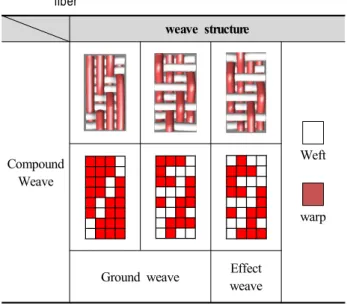
polyester yarn was 300 denier (300D/96f) as a ground yarn in the weft direction. As shown in Tables. 2 & 3, the weave structure of car seat fabrics was based on the double-cloth structure, which consisted of a ground layer of polyester yarn and an effective layer of optical fiber in a two layering system. The car seat fabrics of the two layering system were woven by a Stabuli-JC5 (C.Illies &
Co., Germany) jacquard loom with 240 EPI (ends per inch) of polyester warp yarn, 120 PPI (picks per inch) of polyester yarn in the ground layer, and optical fiber(mono fiber) in the effective layer.
Table 2. Fabric specification of car seats applied with optical fiber
Fabric specification Warp yarn Polyester DTY* 75d/36f
Weft yarn
① Ground Yarn** - Polyester, 300d/96f
② Effect Yarn*** - Optical fiber(Mono fiber), Diameter 0.5mm
③ Ground Yarn:Effect Yarn = 4:10
Warp density 240 ends/Inch
Weft density 120 ends/Inch
* DTY:Draw Textured Yarn
** Ground Yarn:yarns for ground weave
***Effect Yarn:yarns for effective weave
Table 3. Weave structures of car seats applied with optical fiber
weave structure
Compound Weave
Weft
warp
Ground weave Effect weave
2.3. The etching device of optical fiber in weaving
A jacquard-weaving test on optical fiber was conducted, and it was found that in order to minimize inferior weaving caused by oblique amputation, develop the weaving equipment needed to be employed first to minimize the width when a weaving loom is in a shedding motion. Thus, the weaving loom is reformed so that the maximal width of its upper and lower mouths may be 10cm, and the maximal tension imposed on one warp 0.8N, so as to ensure that minimal tensile strength is acted on optical fiber. When this method is applied, a change in warp tension differences is minimized so that high density fabric may be woven.
The etching of optical fiber involves damaging the clad of optical fiber so as to emit light from the core of the fiber. Since the durability of clad is very low, its oblique amputation is serious due to its friction and tension when it is woven; in most cases, the clad is etched after weaving. Yet, when this method is applied, the etching process needs to be progressed once again after weaving, and the physical and chemical processes of etching incur a problem in the productivity and weaken the physical properties of not only optical fiber, but the fabric as well. Therefore, in order to complement such weakness, this research is intended to develop and apply a clad etching device that conducts etching when optical fiber is woven. As a result, this research has developed a clad etching device, with which optical fiber forms a scratch or scar on optical fiber clad so that light of the core may be dispersed from the surface to the outside, and that the fabric of optical fiber may be concurrently woven and etched. The weft supply device is composed in such a manner that an etching blade for scratching may rotate in a direction opposite to the progression as shown in Fig. 1.
Figure 1. Diagram of the clad etching device
In order to measure the efficiency of optical expression, a comparison was made between the results of etching by hiring the developed clad etching device, sandpaper, and knife. As a result, it was found that the woven fabric of optical fiber using a clad etching device had the lowest optical expression, which is uniformly distributed. Meanwhile, etching using sandpaper and physical etching using a knife showed a brighter optical expression than by using the clad etching device;
however, the expression was irregularly distributed and obliquely amputated, a fact that weakens the tenacity of optical fiber. Moreover, physical properties of the entire fabric are weakened since chemical or physical etching after weaving has an effect on not just the partial etching of optical fiber but the entire fabric. Consequently, it was determined that etching using a clad etching device is the most stable method to secure the physical
properties of weaving and optical fiber (Fig. 2). In this research, the woven fabric of optical fiber was developed by employing an optical fiber clad etching device installed on a weft supply device when luminescent textile was woven, so as to improve various problems of etched optical fibers, like one which is vulnerable to external impacts (friction, heat, stress, etc.) and has low durability in weaving.
Figure 2. Illuminating effect of etching optical fiber
3. Design and Development of Illuminating Car seat Fabric
3.1. The woven car seat fabric of optical fiber
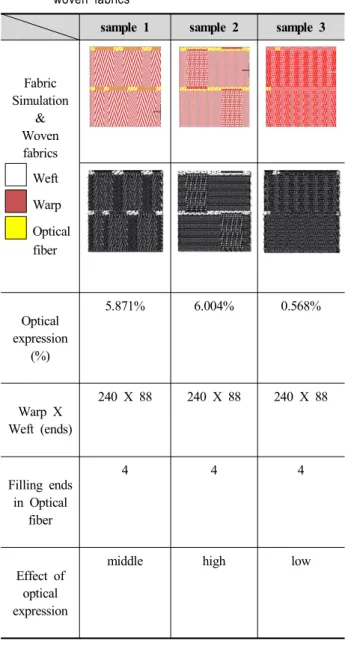
In terms of illuminating the car seats using the woven fabric of optical fiber, the light source coming from the LED needs to be efficiently transmitted to the optical fiber surface and expressed. As shown in Table 5, it shows the results of analyzing the optical expression of optical fiber for each woven design by means of simulating the composition, measuring the concentration, and assessing the optical expression. It was determined that sample 2 was the best result among the three of samples. To develop the illuminating car seat fabric, it
can be predicted that a high optical expression is found from an optical fiber sample in which the frequency of the tightening and exposure of weft is high.
Therefore, in this research, weaving was conducted by employing the design of sample 2, whose optical expression was the highest (Table 4). Compared to other samples, sample 2 has the highest weft exposure and also a high exposure repetition frequency, as well as the lowest warp tightening, which means that the exposure of optical fiber is high and the optical expression is the highest. The sample 2 was applied to the illuminating car seats in this research, as shown in Table 5.
Table 4. The comparison of optical expression level in woven fabrics
sample 1 sample 2 sample 3
Fabric Simulation
&
Woven fabrics
Weft Warp Optical
fiber
Optical expression
(%)
5.871% 6.004% 0.568%
Warp X Weft (ends)
240 X 88 240 X 88 240 X 88
Filling ends in Optical
fiber
4 4 4
Effect of optical expression
middle high low
Table 5. The sample 2 of the woven car seat fabric of optical fiber
SEM photo of Sample 2
Optical fiber
in Effective
weave
Polyester in warp &
ground weave
3.2. The physical properties of the woven car seat fabric of optical fiber
An evaluation was conducted of the physical properties of the woven fabric of optical fiber applicable to car seats, and the results follow KS K, which is an officially recognized test and evaluation method by Korea High Tech Textile Research Institute. The average value is suggested after each test had been evaluated five times. In order to evaluate the abrasion resistance of the woven fabric of optical fiber, the abrasion resistance of the woven fabric of optical fiber was measured by employing the Martindale Abrasion Tester Method; as a result, it was found that abrasion begins after the measuring is conducted 40,000 times. An anti-fouling evaluation of the woven fabric of optical fiber was conducted according to the oil contamination removal law, and it was determined that the woven fabric of optical fiber has appropriate fabric and anti-fouling for car seats, since it is proven to be level 5 which is the best (Table 6).
Table 6. The physical properties of optical fiber fabrics for car seat
Evaluation results Abrasion resistance
(KS K ISO 12947-1) Up to 40,000 times
Anti-fouling
(KS K 0610) 5 level
Tenacity(g/d) 202
Elongation(%) 30.37
Since the temperature inside a car can reach up to 8 0℃ on a hot summer day [4], textile applied to car seats must have physical properties such as anti-combustion and anti-sunlight, which are able to bear a high temperature. Differential Scanning Calorimetry (DSC) measuring was conducted of the sample fabric because the woven fabric of optical fiber for car seat must have the durability to withstand high temperatures. As a result, it was found that the woven fabric of optical fiber reaches a melting point between 127.0℃ and 128.5℃
(Fig. 3) and has an average melting point of 128.0℃. It implies that, even if the temperature inside a car reaches 100.0℃, it has sufficient durability to bear the temperature.
In order to evaluate the anti-sunlight property of the woven fabric of optical fiber, the standard discoloration time derived from KS K ISO (105-B02: 2010 20) was applied, and it was found that the woven fabric of optical fiber has the value of level 5. An evaluation was conducted of the external appearance of the woven fabric of optical fiber before and after washing KS K ISO (7768: 2010), which implies that its external appearance has little change, even after washing, which makes it appropriate for car seats.
Figure 3. The DSC result of the woven fabric of optical fiber
3.3. Design of the illuminating car seat
In order to apply the woven fabric of optical fiber to car seats, the illuminating car seat were designed. The car seat applied in this research is the subcompact segment of 1600-cc, whose functions including sensing over-speed, open doors, and unfastened safety belts, which were the primary tested components.
To develop the illuminating car seat fabric, the developer with 30 persons who were the car-seat researchers of Auto parts maker and designers of automotive maker in Korea have reached the conclusion that the bolster is considered to minimize the fabric abrasion damage by passengers. That is, such an illuminating portion is selected as minimizes friction caused by passengers and does not have a great effect on driving; the portion is composed that the woven fabric of optical fiber may be applied to the bolster, which helps the driver secure his/her view when they take a seat (Fig. 4).
Since it is a safety issue that passengers other than the driver cannot properly recognize functions related to
safety while driving, this research was aimed at developing the illuminating car seat fabric which can sense over-speed, door-opening, and unfastened safety belts, and give off light to indicate these things. The woven fabric of optical fiber for car seat has available functions such as sensing over-speed, open doors, and unfastened safety belts while the car is running; the results of the sensing are sent to the control part of the module and converted into signals (color and brightness of light, etc.) corresponding to each function and transmitted to LED, so that optical fiber linked to LED may have illuminating and color-indicating functions.
Figure 4. Simulation of the illuminating car seat
3.4. Composition of the module for illuminating car seat
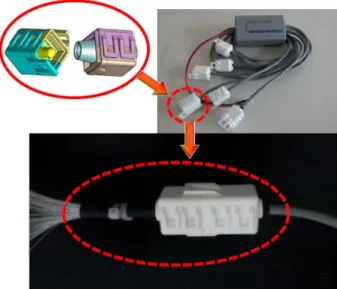
For the module used in this research to integrate the functions for sensing over-speed, open doors, and unfastened safety belts, at 16bit MCU was adopted and serial communication (RS-232 method) was mounted. An optical fiber fabric-linked LED module was designed and produced, which receives information on vehicle speed through a communication module and outputs the brightness or color of the LED corresponding to one of the five steps of traveling speed. In order to receive the signals for speeding, door opening, and unfastened safety belts from the car, the vehicle data received from an OBD module via Bluetooth communication method is converted into the Zigbee communication method and transmitted to an LED controller. RGB 3-color LED, 12bit color, and individually controllable 8-port LED are applied to the illuminating part, and the input voltage is 12~24V (Fig. 5). The integrated module is put in the case, and circuits for materializing the functions are linked to one end of the LED connector and placed under car seats. The fixed optical fiber connector is linked to the other connector (which is linked to LED) so that they may serve as one connector; additionally, the connector linked to LED may be linked to a module that has built-in circuits for the materialization of the functions (Fig. 6).
Figure 5. Communication module & LED controller
Figure 6. An optical fiber fabric-linked LED module
3.5. Prototypes of the illuminating car seat
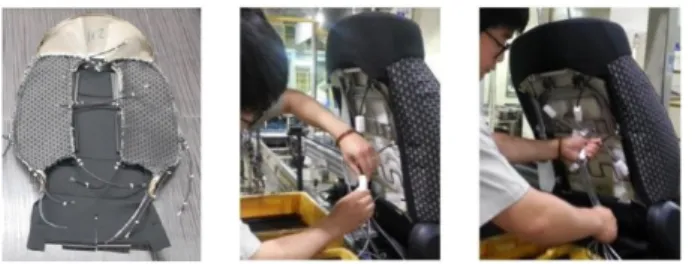
Car seat fabrication, which materializes illuminating car seat functions, is composed of these components: the optical fiber fabric, inset, bolster and the side part. The optical fiber fabric is applied to the bolster, and insert and the side part applied to the general non-inflammable car seat fabrics. In order to realize effective luminescence, the optical fiber fabric is applied to the bolster portion, which is less exposed to friction caused by passengers and which can maintain an optical effect when passengers are riding. In consideration of the connector and its linking portion, the optical fiber fabric is designed to have a surplus, and fixed to car seats. After the optical fiber fabric is mounted on car seats, a bundle of optical fiber is tied and fixed, and the tip of the bundle is fixed to one end of the connector with built-in LED. For the sake of radiating effects of illuminating car seats, the connector is linked to the optical fiber portion of car seats, the module, and LED as shown in Fig. 7.
Finally the prototype of illuminating car seats is realized the functions of sensing over-speed, open doors, and unfastened safety belts while maintaining various color expressions and optical efficiency (Fig. 8).
Figure 7. Connecting the optical fiber and LED module
Figure 8. The prototype of illuminating car seats
4. Conclusions and Future Works
To develop the illuminating car seat in this research, the optical fiber applied for communication technology was turned into the woven car seat fabric, and the etching loom for illuminating optical fiber was developed to a clad etching device of optical fiber. As a result, the car seat fabric of optical fiber satisfies the desired physical properties including abrasion resistance, anti-fouling, high temperature heat-proofing, and washable traits. The functions of the illuminating LED module have an effect on sensing and warning the driver of over-speed, door opening, and unfastened safety belts. In other words, speeding, opened doors, and unfastened safety belts are sensed and the information is sent to the control part of the optical fiber; then, the color and brightness of light for each function is converted into signals and transmitted via LED and optical fiber linked to the light of LED through the connector, so as to serve the illuminating and coloring functions.
Three woven fabrics of optical fiber linked to the illuminating functions were derived and evaluated in order to develop the car seat fabric. In order to determine the appropriateness of the woven fabrics of
optical fiber applied to car seats, its basic physical properties were evaluated. As a result, it was found that the woven fabric of optical fiber has physical properties including abrasion resistance up to 40,000 revolutions, 5-level anti-fouling, tenacity of 202(f), elongation of 30.37%, a melting point of 128.0℃, 5-level anti-sunlight tenacity, as well as no change in external appearance after washing. Based on these results, the integrated LED module was developed for the illuminating car seats. The woven fabric of optical fiber was linked to the connector and the LED module, and the prototype of an illuminating car seat was finally developed.
The bolster portion of car seats was applied with the optical fiber fabric in order to maintain durability (like anti-abrasion) and optical effects while driving; finally, an illuminating car seat was developed with functions that sense over-speed, open doors, and unfastened safety belts. This research is meaningful in that it has developed commercial seat fabric and an illuminating car seat after evaluations were conducted of the physical properties of optical fiber textile and the appropriateness of car seats. Conclusively, it is proposed for the future that a sensitivity evaluation be conducted based on consumers' demand, and the design be developed for the purpose of manufacturing commercial products.
REFERENCES
Kim, J. S. (2011). An Exploratory Study on Luminescent Properties and the Relevant Applications of POF-based Flexible Textile Display for Mountaineer Wear with Safe-guard Function, Korea Society for Emotion and Sensibility, 14(1), 165-174.
Kim, N. H. (2012). A Suggestion of Guideline for designing of logo type for Apparel products based on the technology of flexible plastic optical fiber, Korean Society for Emotion and Sensibility, 15(4), 469-476.
Masuda, A. (2006). Optical Properties of Woven Fabrics by Plastic Optical Fiber, The Textile
Machinery Society of Japan, 52(3), 93~97.
Nam, C. W. (2007). Automotive Textile, Fiber Technology and Industry, 11(1), 1~7.
Park, S. N. (2009). Development Trend of Car Seat Technology, Auto Journal, 31(4), 26-33.
Shin, Bugeon. et al, (2002). Characterization of Plastic Optical Fiber, Polymer Science and Technology, 13(2), 217~225.
Shim, J. Y. (2007). Automotive Seat Cover, Fiber Technology and Industry, 11(1), 28~37.
Song, H. Y. (2012). Illuminating Car-seat Fabric design based on Woven Textile CAD system, Journal of Korean Society Design Science, 25(4), 37~46.
Song, H. Y. (2013). A Study on Car-seat Woven fabric of Optic fiber for Illuminating to multicolor, Journal of Korean Society of Color Studies, 27(1),
38~46.
Yang, E. K. (2011). An Explorative research on the Possibility of the flexible POF for Logo design of clothing, Korean Society for Emotion and Sensibility, 14(4), 495-502.
Yang, E. K. (2011). The characteristics of the flexible POF-based fabric for application of a mountaineer jacket with digital color function, Master Thesis, Yonsei University.
ttp://www.iaa.de/presse, 65th IAA Commercial Vehicles International Motor Show.
Received:2014.02.05 Revised:2014.03.06 Accepted:2014.03.10