• 검색 결과가 없습니다.

Concise Bedside Surgical Management of Profound Reperfusion Injury after Vascular Reconstruction in Severe Trauma Patient: Case Report

N/A
N/A
Protected

Academic year: 2021

Share "Concise Bedside Surgical Management of Profound Reperfusion Injury after Vascular Reconstruction in Severe Trauma Patient: Case Report"

Copied!
5
0
0

로드 중.... (전체 텍스트 보기)

전체 글

(1)

eISSN 2287-1683 pISSN 1738-8767 Journal of Trauma and Injury Vol. 29, No. 4, December, 2016 http://dx.doi.org/10.20408/jti.2016.29.4.204

� Case Report �

� Address for Correspondence : Pil Young Jung, M.D.

Department of General Surgery, Wonju College of Medicine, Yonsei University, 20, Ilsan-ro, Wonju-si, Gangwon-do 26426, Korea

Tel : 82-33-741-0882, Fax : 82-33-736-7326, E-mail : [email protected] Submitted : December 20, 2016 Revised : December 22, 2016 Accepted : March 1, 2017

Concise Bedside Surgical Management of Profound Reperfusion Injury after Vascular Reconstruction

in Severe Trauma Patient: Case Report

Hoe Jeong Chung, M.D., Seong-yup Kim, M.D.

1

, Chun Sung Byun, M.D.

2

, Ki-Youn Kwon, M.D., Pil Young Jung, M.D.

1

Department of Orthopaedic Surgery,

1

Department of General Surgery,

2

Department of Thoracic and Cardiovascular Surgery, Wonju College of Medicine, Yonsei University, Wonju, Korea

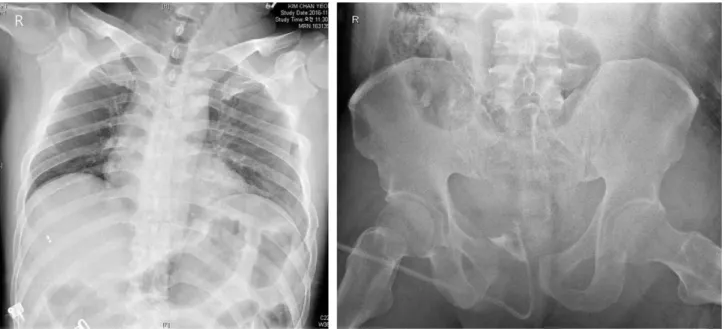
For an orthopaedic surgeon, the critical decisions to either amputate or salvage a limb with severe crushing injury with progressive ischemic change due to arterial rupture or occlusion can become a clinical dilemma at the Emergency Department (ED). And reperfusion injury is one of the fetal complications after vascular reconstruction. The authors present a case which was able to save patient’s life by rapid vessel ligation at bedside to prevent severe reperfusion injury. A 43-year-old male patient with no pre-existing medical conditions was transported by helicopter to Level I trau- ma center from incident scene. Initial result of extended focused assessment with sonography for trauma (eFAST) was negative. The trauma series X-rays at the trauma bay of ED showed a multiple contiguous rib fractures with hemothorax and his pelvic radiograph revealed a complex pelvic trauma of an Anterior Posterior Compression (APC) Type II. Lower extremity computed tomography showed a discontinuity in common femoral artery at the fracture site and no distal run off. Surgical finding revealed a complete rupture of common femoral artery and vein around the fracture site. But due to the age aspect of the patient, the operating team decided a vascular repair rather than amputation even if the antici- pated reperfusion time was 7 hours from the onset of trauma. Only two hours after the reperfusion, the patient was in a state of shock when his arterial blood gas analysis (ABGA) showed a drop of pH from 7.32 to 7.18. An imminent bedside procedure of aseptic opening the surgical site and clamping the anastomosis site was taken place rather than undergo- ing a surgery of amputation because of ultimately unstable vital sign. The authors would like to emphasize the impor- tance of rapid decision making and prompt vessel ligation which supply blood flow to the ischemic limb to increase the survival rate in case of profound reperfusion injury. [ J Trauma Inj 2016; 29: 204-208 ]

Key Words: Reperfusion injury, Closed injury, Femoral artery, Vascular reconstruction, Hip disarticulation

(2)

Fig. 1. Multiple contiguous rib fractures with hemothorax was seen on left chest and APC type II injury was seen on Pelvis AP view.

(3)

- Journal of Trauma and Injury Vol. 29, No. 4 -

Fig. 3. Lower extremity computed tomography showed a discontinuity in common femoral artery at the fracture site and no distal run off.

Fig. 4. Complete rupture of common femoral artery and vein

around the fracture site.

(4)

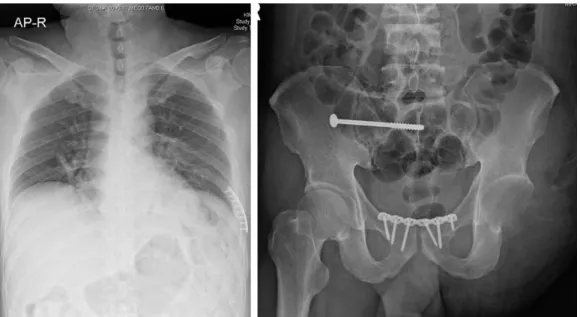
Fig. 5. Postoperative x-rays of chest and pelvis AP.

(5)

- Journal of Trauma and Injury Vol. 29, No. 4 -

REFERENCES

01) Dou C, Liu Y, Wang Q, Zhang Y. Characteristics and out- comes of traumatic major extremity amputations in Chinese population. Int J Clin Exp Med 2016; 9: 6963-7.

02) Lange RH, Bach AW, Hansen ST, Jr., Johansen KH. Open tibial fractures with associated vascular injuries: prognosis for limb salvage. J Trauma 1985; 25: 203-8.

03) Collard CD, Gelman S. Pathophysiology, clinical manifestations, and prevention of ischemia-reperfusion injury. Anesthesiology 2001; 94: 1133-8.

04) Carden DL, Granger DN. Pathophysiology of ischaemia- reperfusion injury. J Pathol 2000; 190: 255-66.

05) Percival TJ, Rasmussen TE. Reperfusion strategies in the management of extremity vascular injury with ischaemia. Br J Surg 2012; 99: S66-74.

06) Blaisdell FW. The pathophysiology of skeletal muscle ischemia and the reperfusion syndrome: a review. Cardiovasc Surg 2002; 10: 620-30.

07) Menger MD, Rucker M, Vollmar B. Capillary dysfunction in

striated muscle ischemia/reperfusion: on the mechanisms of

capillary “no-reflow”. Shock 1997; 8: 2-7.

수치

Fig. 1. Multiple contiguous rib fractures with hemothorax was seen on left chest and APC type II injury was seen on Pelvis AP view.
Fig. 3. Lower extremity computed tomography showed a discontinuity in common femoral artery at the fracture site and no distal run off.
Fig. 5. Postoperative x-rays of chest and pelvis AP.

참조

관련 문서