• 검색 결과가 없습니다.

Investigation of Setting Process of Cementitious Materials Using Electromechanical Impedance of Embedded Piezoelectric Patch

N/A
N/A
Protected

Academic year: 2021

Share "Investigation of Setting Process of Cementitious Materials Using Electromechanical Impedance of Embedded Piezoelectric Patch"

Copied!
8
0
0

로드 중.... (전체 텍스트 보기)

전체 글

(1)

Journal of the Korea Institute of Building Construction, Vol. 12, No. 6

http://dx.doi.org/10.5345/JKIBC.2012.12.6.607 www.jkibc.org

Investigation of Setting Process of Cementitious Materials Using Electromechanical Impedance of Embedded Piezoelectric Patch

Lee, Chang Joon 1 Lee, Jun Cheol 2 Shin, Sung Woo 3* Kim, Wha Jung 4 1)

School of Architecture and Civil Engineering, Kyungpook National University, Buk‐Gu, Daegu, 702-701, Korea 1 School of Architecture and Civil Engineering, Kyungpook National University, Buk-Gu, Daegu, 702-701, Korea 2

Department of Safety Engineering, Pukyong National University, Nam-gu, Busan, 608-739, Korea 3 School of Architecture and Civil Engineering, Kyungpook National University, Buk-Gu, Daegu, 702-701, Korea 4

Abstract

In this study, the evolution of the electro-mechanical impedance (EMI) of a piezoelectric (PZT) patch embedded in fresh cement paste was investigated to discuss the possibility of monitoring the setting process of cement-based materials using an EMI sensing technique. A tailored thin square PZT patch was embedded in cement paste before casting, and EMI signatures of the embedded patch were continuously measured from casting up to 12 hours. A standard penetration resistance test was performed to compare and correlate the evolution of EMI during the setting process. The results showed that EMI responses differ according to the age of the cement paste, and that the behavior of the EMI resonance peak has a clear correlation with the penetration resistance of the cement paste. Based on the results, it is concluded that an EMI sensing technique using embedded PZT patch can be effectively applied to monitor the setting process of cement-based materials.

Keywords : cement hydration, electromechanical impedance, piezoelectric, setting process monitoring

1. Introduction

Cement-based material such as concrete is a multiphase material that endures significant phase changes at a micro-structural level along cement hydration. At the beginning of cement hydration it behaves like a liquid, and after a certain period of time, the transition period known as the setting process starts when cement-based material begins to solidify. Finally, at the end of the liquid to solid transition, it starts to continuously gain strength over time in the subsequent hardening

Received : July 4, 2012

Revision received : September 28, 2012 Accepted : October 8, 2012

* Corresponding author: Shin, Sung Woo

[Tel: 82-51-629-6473, E-mail: [email protected]]

ⓒ2012 The Korea Institute of Building Construction, All rights reserved.

period[1]. Information on when the process of solidification begins and ends is very important for quality control and work scheduling. It is therefore necessary to develop a test or a monitoring method that will provide information on the time required for the setting of cement-based materials.

On the other hand, recent advances in smart sensing technologies have added a new dimension on nondestructive monitoring of structural integrity and conditions of structures. Of the related technologies, the electro-mechanical impedance (EMI) sensing technique using piezoelectric patch has shown great potential for the implementation of a built-in online structural health monitoring system[2].

Very recently, the EMI sensing technique has

been successfully applied for strength gain

monitoring of concrete[3,4,5,6]. In EMI sensing

setup for strength gain monitoring, a PZT patch is

(2)

Investigation of Setting Process of Cementitious Materials Using Electromechanical Impedance of Embedded Piezoelectric Patch

adhesively bonded on the surface of the host substrate (i.e. concrete) to couple the patch and the host[3,4,5,6]. However, surface bonding is not available for a liquid state concrete[6]. Therefore, although successful, the current EMI sensing technique for early-age concrete monitoring can only be applicable to solidified (i.e. hardened state) concrete, and cannot be applied to monitor the liquid state concrete that undergoes the setting process. Due to this limitation, EMI evolution of early age concrete - as early as immediately after mixing - is still unknown. The main purpose of this study is to investigate the evolution of the EMI response of a PZT patch embedded in hydrating cement paste, and thereby to discuss the possibility and effectiveness of the use of an embedded EMI sensing technique to monitor the setting process of hydrating cement-based materials.

2. Principle of EMI sensing technique

The basic principle of an EMI sensing technique is to monitor variations in the mechanical impedance of a host structure via the electrical impedance of a piezoelectric patch attached to the host medium. In EMI sensing, the piezoelectric patch (such as PZT patch) functions simultaneously as both a sensor and an actuator; to mechanically excite the structure and to measure the mechanical response (velocity) of the structure. Specifically, if a sinusoidal voltage is applied to a piezoelectric patch attached to a host structure, it causes the local area of the structure, where the patch is attached, to vibrate due to the direct effect of piezoelectricity. At the same time, this mechanical vibration response induces an electric current in the attached patch due to the converse piezoelectric effect. Therefore, if we measure the

input electric voltage (mechanical force) and output electric current (mechanical vibration) of the piezoelectric patch, electrical (and hence mechanical) impedance, which is defined as the ratio of the voltage (force) applied to the resulting electric current (velocity), can be obtained. Liang et al.[7] proposed the following EMI model of a 1-D PZT-structure interaction system:

   

  

  

        

           

 

    

where    is the electrical admittance (inverse of impedance) of a PZT patch attached to a host structure,    is the output current,    is the excitation voltage,    is the real of the admittance (conductance),    is the imaginary part of the admittance (susceptance),  is    ,

 is the excitation frequency,  is the geometric

constant of the transducer,   is the complex

electric permittivity of the patch (at constant

stress field),   is the piezoelectric strain

coefficient in the arbitrary  direction, and  is

the complex Young ’s modulus of the patch (at

constant electric field). Finally,    is the

mechanical impedance of the patch and    is

that of the host structure. Assuming that

mechanical impedance of the PZT patch does not

change during the monitoring period, the

admittance will be solely dependent on the

mechanical impedance,    , of the host medium,

and therefore the subsequent changes in

admittance signature will be due to changes in the

mechanical impedance of the host. Any changes in

mechanical properties such as stiffness of the host

medium will influence the mechanical impedance of

the host structure.

(3)

In this study, cement paste was used in order to eliminate the effect of additives such as aggregates and thus to investigate pure EMI evolution in hydrating cement-based materials. The cement paste was prepared by 90-second manual mixing of ordinary Type I Portland cement and tap water, with a water to cement ratio of 0.40. The chemical composition of the cement provided by manufacturer is listed in Table 1.

Table 1. Chemical Composition of Type 1 Portland Cement (% by weight)

Chemicals SiO 2 Al 2 O 3 Fe 2 O 3 CaO MgO SO 3 K 2 O Ig.

Loss

Contents 21.54 5.15 3.58 61.63 3.08 2.10 1.32 1.40

To monitor the EMI response of freshly mixed liquid state cement paste, a PZT patch is embedded in the cement paste. A tailored square PZT patch (PZT5A Navy type II, Piezo Systems Inc.)  ×  ×  in size was used. The PZT patch was placed at the approximate center of the metal cubic mold (  ×  ×  ). The paste was cast in the mold immediately after mixing. One of the technical concerns regarding the embedded PZT patch is the risk of a short circuit due to the presence of water. To prevent a short circuit of the embedded PZT patch, non-conductive unsaturated polyester resin is thinly coated on the surface of the PZT patch before it is embedded.

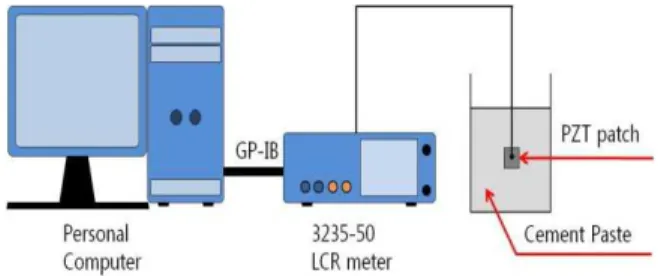
The experimental setup for EMI sensing using the embedded PZT patch is illustrated in Figure 1. A commercial LCR meter (HIOKI 3532-50 LCR HiTESTER) was used for the EMI measurements.

All the measured data was recorded using a personal computer through a GP-IB interface connected to the LCR meter. Immediately after the casting, initial measurement of the EMI of the PZT

After the initial measurement, subsequent measurements were conducted every 10 minutes for the first 12 hours (total of 72 time steps) to investigate the setting process. At each measurement, the admittance (inverse of impedance) signature was measured five times repeatedly and averaged to remove incoherent noise. The frequency range from 50 kHz to 350 kHz (500 Hz interval) was chosen for measuring EMI signal, as this is a favorable range for early-age concrete property monitoring[3,4]. It is also noted that the real part of the admittance (conductance) is more preferable for monitoring the mechanical changes in the host medium due to the capacitive nature of the PZT patch[3,4,5]. So, only the conductance signature is considered in this study.

In addition to the EMI measurements, a penetration resistance test was conducted to compare with the EMI responses during the setting process. The penetration resistance test is a standard method (ASTM C 403) to determine the initial and final setting times of cement mortar[8].

Note that it also can be successfully applied to monitor the setting of the cement paste[9]. In the test, the load required for a needle to penetrate a cement paste sample to the depth of 25mm was measured, and the penetration resistance was calculated from the ratio of the required load to the cross-sectional area of the penetrating needle.

Figure 1. Configuration of EM conductance measurement of

cement paste

(4)

Investigation of Setting Process of Cementitious Materials Using Electromechanical Impedance of Embedded Piezoelectric Patch

4. Results and Discussions

4.1 Initial EMI Response

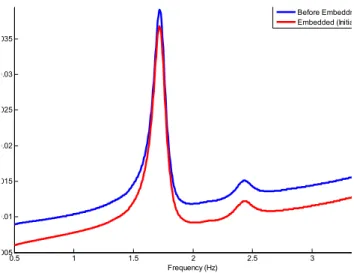
Figure 2 shows conductance (the real part of the admittance) of the PZT patch in the air (i.e., before it was embedded) and in the freshly mixed cement paste (immediately after casting). As seen in this figure, the conductance signatures for both cases are slightly different, but show clear peak behaviors. This confirms that a short circuit has been successfully prevented, and suggests that the EMI sensing can be possible even after a PZT patch is embedded in liquid. The difference between two cases is mainly due to the mechanical impedance change of the surrounding material of the PZT patch, i.e. the air and the liquid state cement paste. When a harmonic electric voltage is applied on a PZT patch, it vibrates freely.

0.5 1 1.5 2 2.5 3 3.5

x 10

5

0.005

0.01 0.015 0.02 0.025 0.03 0.035 0.04

Frequency (Hz)

C o n d u ct a n ce ( S )

Before Embeddment Embedded (Initial)

Figure 2. Measured conductance of PZT patch before and after Embedment

However, vibration mode and magnitude of the patch are altered with mechanical impedance of surrounding medium[10]. Just after mixing, the cement paste is in a viscoelastic state[11]. For a PZT patch embedded in this viscoelastic cement paste, the viscosity of the paste and the

hydrostatic fluid pressure can reduce the vibration magnitude of the PZT patch. However, in this case, the vibration mode of the patch would not be changed, since the mechanical impedance of the liquid is very low compared with that of the solid PZT patch. It is evident in Figure 2 that the frequency of the largest EM resonance peak of the patch is identical (172 kHz) for both cases, while the magnitude of the peak was slightly reduced, from 0.0391 to 0.0366.

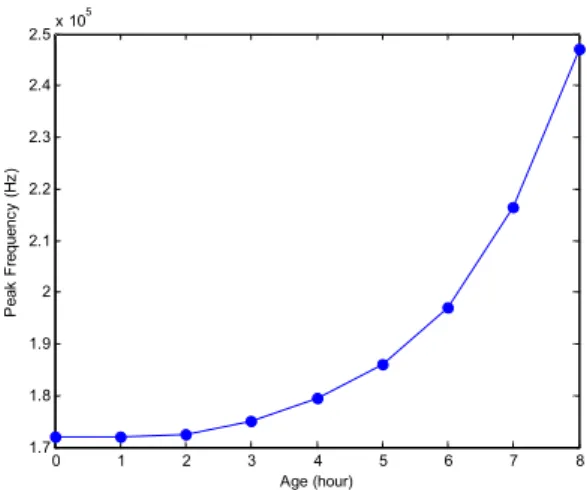
4.2 Evolution of EMI during Solidification Process Figure 3 shows the measured EM conductance signatures from initial 0 to 6 hours after casting, while Figure 4 shows those from 6 to 12 hours. It is seen that the conductance responses of the patch are different (but show a unique trend) with the age of cement paste. This suggests that EMI sensing using the embedded PZT patch can be applicable to monitor the hydration process of very early age cement-based materials. Significant changes in EMI resonance peaks are observed. The magnitude of the first largest EMI peak is gradually reduced, and the sharpness of the peak degrades with age. It is also seen that the frequency of the first peak remains constant (around 172 kHz) until 2 hours, and then gradually shifts toward a higher frequency region.

The sharpness of the peak also rapidly degrades

after 2 hours. The peak can hardly be identified

visually after 8 hours, and no significant peaks are

observed at 12 hours. Figure 5 shows the peak

frequency values with respect to the ages of

cement paste up to 8 hours after casting. Peak

frequencies after 8 hours were not available, as

they could not be identified visually in the EMI

signatures. It is seen that the peak frequency

value increases rapidly in an exponential manner

after 3 hours.

(5)

0.5 1 1.5 2 2.5 3 3.5 x 10

5

0

0.005 0.01 0.015 0.02 0.025 0.03

Frequency (Hz)

C o n d u ct a n ce ( S )

3 Hours 4 Hours 5 Hours 6 Hours

Figure 3. Measured conductance of embedded PZT patch (from 0 to 6 hours after casting)

0.5 1 1.5 2 2.5 3 3.5

x 10

5

0

0.002 0.004 0.006 0.008 0.01 0.012 0.014 0.016

Frequency (Hz)

C o n d u ct a n ce ( S )

6 Hours 7 Hours 8 Hours 9 Hours 10 Hours 11 Hours 12 Hours

Figure 4. Measured conductance of embedded PZT patch (from 6 to 12 hours after casting)

Figure 6 shows the penetration resistance at every hour, from initial to 8 hours after casting.

An exponential increase in penetration resistance is observed with respect to time, which is very similar with that of the EMI resonance peak frequency. The resistance until the age of 4 hours was less than 1MPa and at the age of 8 hours was as high as 37MPa. The exponential increase in penetration resistance is a typical behavior of a hydrating cement-based material such as mortar or cement paste[9]. One distinct feature in the penetration resistance from the EMI resonance peak frequency is that the rapid increment of the penetration resistance value is observed after 4

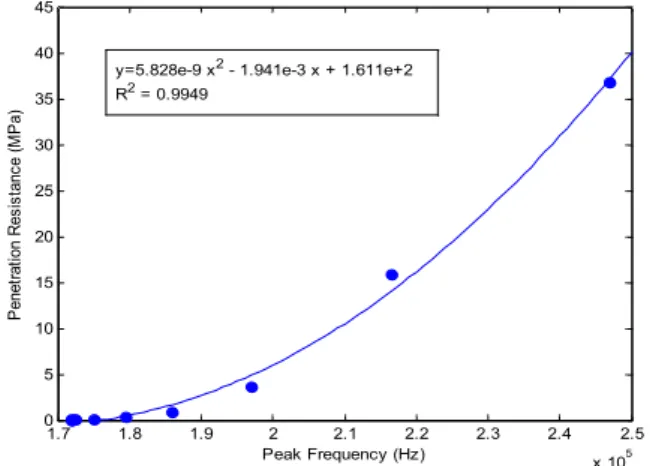
frequency is observed after 3 hours. Figure 7 shows the correlation between the EMI resonance peak frequency and the penetration resistance. A strong correlation (a second order polynomial fit with high correlation coefficient of 0.99) between them is observed. It should be noted that the equation provided in Figure 7 cannot be generalized, since the EMI resonance peak frequency may also be affected by other factors such as water/cement ratio. Factors affecting EMI resonance peak behavior during cement hydration are currently under investigation. Discussions on the results are provided as follows.

0 1 2 3 4 5 6 7 8

1.7 1.8 1.9 2 2.1 2.2 2.3 2.4 2.5 x 10

5

Age (hour)

P e a k F re q u e n c y ( H z )

Figure 5. EMI resonance peak frequency as a function of material age

0 1 2 3 4 5 6 7 8

0 5 10 15 20 25 30 35 40

Age (hour)

P e n e tr a ti o n R e s is ta n c e ( M P a )

Figure 6. Penetration resistance as a function of material age

(6)

Investigation of Setting Process of Cementitious Materials Using Electromechanical Impedance of Embedded Piezoelectric Patch

Immediately after mixing, the cement grains are dissolved in the water and then the reaction between the cement and water begins. The reaction between cement and water results in the formation of calcium hydroxide, a crystallized compound, and a colloidal gel constituted by hydrated compounds like C-S-H, which develops around the cement grains (and similarly around the PZT patch). As hydration progresses, the hydrates around the cement grains grow, first to form small isolated clusters and then bigger clusters. The isolated clusters are weakly connected to each other to form a network, and after a certain time, a solid percolation path is formed in the cement paste (solid percolation threshold)[12].

It is well known that the shear modulus of the cement paste starts to develop beyond the percolation threshold[11,13]. The magnitude of the EMI resonance peak decreases as the age of cement paste increases, as the development of a hydrated compound in the vicinity of the embedded PZT patch suppresses the vibration of the patch.

However, the vibration mode of the patch would not be significantly changed until the clusters in the vicinity of the patch are connected to each other to develop shear modulus. This is why both the frequency of the EMI resonance peak and the penetration resistance did not change until 2 hours after casting. The liquid state cement paste cannot resist the shear force applied by the penetration needle. On the other hand, when the PZT patch is coupled with the network of solid clusters, the vibration mode of the PZT patch would be significantly changed as shear stiffness in the boundary of the patch starts to develop. Normally, the EMI resonance frequency of the PZT patch attached to the solid host medium shifts to the higher frequency region as the mechanical impedance of the host medium increases[3,4,5].

This supports the frequency shifting behavior of

the embedded PZT patch after 3 hours and the increasing behavior of the penetration resistance value. It is worth noting that a significant increment of the penetration resistance value has been visibly identified after 4 hours in this study.

Therefore, it can be inferred that, within this study, the initial setting (i.e. solid percolation threshold) took place 3 hours after casting based on the EMI results and 4 hours after casting based on the penetration resistance result.

The interconnected solid network continues to develop, even after the percolation threshold is reached, until it spreads throughout the material during the solidification process[11]. Therefore, the more the solid network develops, the more the vibration of the PZT patch is restrained so that the amplitude of EMI resonance peak decreases (and hence the value of the penetration resistance increases) as the solidification process proceeds.

Normally, the final setting time is defined as the end of the solidification process and the beginning of the hardening process. However, since both the solidification and the hardening (strength development) processes are the result of the cement hydration, it is hard to distinguish one from another through a standard test method such as the penetration resistance test[9]. Therefore, in the standard test method, the final setting is empirically defined when the penetration resistance value reaches 12MPa for cement paste[8,9]. In this study, the final setting took place between 7 and 8 hours after casting based on the penetration resistance result shown in Figure 5. Similarly, the EMI resonance peak could hardly be identified visually after 8 hours from casting (see Figure 4).

This confirms the effectiveness of the embedded

PZT patch based EMI sensing technique as an

approach to determining the final setting time of

cement paste. Moreover, the magnitude of the EMI

response decreased, even after 8 hours. This

(7)

cement paste even after the final setting can be monitored by EMI sensing. Therefore, it can be concluded that the EMI sensing technique using embedded PZT patch can be effectively used not only to determine the initial and final setting times, but also to monitor the continual reaction of hydrating cement paste.

1.7 1.8 1.9 2 2.1 2.2 2.3 2.4 2.5

x 10

5

0

5 10 15 20 25 30 35 40 45

Peak Frequency (Hz)

P e n e tr a ti o n R e s is ta n c e ( M P a )

y=5.828e-9 x

2

- 1.941e-3 x + 1.611e+2 R

2

= 0.9949

Figure 7. Correlation between penetration resistance and EMI resonance peak frequency

5. Conclusion

In this study, the evolution of the EMI of PZT patch embedded in cement paste during setting process is investigated. A tailored thin square PZT patch was embedded in cement paste before casting and EM admittance signatures were continuously measured from immediately after casting up to 12 hours. EMI responses showed a clear trend with respect to the ages of hydrating cement paste. In particular, the behavior of the EMI resonance peak during the setting process has a strong correlation with that of the penetration resistance value. The initial and final setting times determined by the penetration resistance test matched well with the times when critical changes in EMI resonance peak occurred. Initial setting

peak while the final setting time related with the peak disappearance. Based on these results, it can be concluded that the property changes of very early age cement-based materials, as early as from casting, can be successfully and sensitively monitored through an EMI sensing technique using an embedded PZT patch.

Acknowledgements

This work was supported by both a research program of the National Research Foundation (NRF) of Korea (Grant No. NRF-2011-0023579) and a research project of the Korea Institute of Energy Technology Evaluation and Planning (KETEP) (Grant No. 2010-50289).

References

1. Bentz DP. A Review of Early-age Properties of Cement-based Materials. Cement and Concrete Research.

2008 February;38(2):196-204.

2. Park G, Sohn H, Farrar CR, Inman DJ. Overview of Piezoelectric Impedance-based Health Monitoring and Path Forward. The Shock and Vibration Digest. 2003 November;

35(6):451-63.

3. Shin SW, Qureshi AR, Lee JY, Yun CB. Piezoelectric Sensor Based Nondestructive Active Monitoring of Strength Gain in Concrete. Smart Materials and Structures. 2008 July;

17(5):1-8.

4. Shin SW, Oh T. Application of Electro-mechanical Impedance Sensing Technique for Online Monitoring of Strength Development in Concrete Using Smart PZT Patches. Construction and Building Materials. 2009 February;23(2):1185-8.

5. Tawie R, Lee HK. Monitoring the Strength Development in Concrete by EMI Sensing Technique. Construction and Building Materials. 2010 September;24(9):1746-53.

6. Wang D, Zhu H. Monitoring of the Strength Gain of Concrete Using Embedded PZT Impedance. Construction and Building Materials. 2011 September;25(9):3703-8.

7. Liang C, Sun FP, Rogers CA. Coupled Electromechanical

(8)

Investigation of Setting Process of Cementitious Materials Using Electromechanical Impedance of Embedded Piezoelectric Patch

Analysis of Adaptive Materials Systems–Determination of the Actuator Power Consumption and System Energy Transfer.

Journal of Intelligent Material Systems and Structures.

1994;11(3):206-14.

8. ASTM International. ASTM C403 Test Method for Time of Setting of Concrete Mixture by Penetration Resistance.

American Society for Testing and Materials; 2008.

9. Chung C, Mroczek M, Park I, Struble LJ. On the Evaluation of Setting Time of Cement Paste Based on ASTM C403 Penetration Resistance Test. Journal of Testing and Evaluation. 2010 March;38(5):527-33.

10. Perrissin-Fabert I, Jayet Y. Simulated and Experimental Study of the Electric Impedance of a Piezoelectric Element in a Viscoelastic Medium. Ultrasonics. 1994;32(2):107-12.

11. Boumiz A, Vernet C, Tenoudji FC. Mechanical Properties of Cement Pastes and Mortars at Early Ages-Evolution with Time and Degree of Hydration. Advanced Cement Based Materials. 1996;3(3-4):94-106.

12. Bernand O, Ulm FJ, Lemarchand E. A Multiscale Micromechanics-hydration Model for the Early-age Elastic Properties of Cement-based Materials. Cement and Concrete Research. 2003 September;33(9):1293-309.

13. Voigt T, Grosse CU, Sun Z, Shah SP, Reinhardt HW.

Comparison of ultrasonic wave transmission and reflection measurements with P- and S-waves on early age mortar and concrete. Materials and Structures. 2005 October;

38(8):729-38.

수치

Figure 1. Configuration of EM conductance measurement of cement paste
Figure  2  shows  conductance  (the  real  part  of  the  admittance)  of  the  PZT  patch  in  the  air  (i.e.,  before  it  was  embedded)  and  in  the  freshly  mixed  cement  paste  (immediately  after  casting)
Figure 5. EMI resonance peak frequency as a function of material age 0 1 2 3 4 5 6 7 80510152025303540 Age (hour)
Figure 7. Correlation between penetration resistance and EMI resonance peak frequency

참조

관련 문서