백화산 고도별 식물 종풍부도에 대한 기후 및 서식지 인자의 상대적 중요성
이창배1⋅천정화2*1)
1한국임업진흥원 전략기획실, 2국립산림과학원 연구기획과
(2017년 5월 19일 접수; 2017년 12월 19일 수정; 2018년 5월 21일 수락)
Relative importance of climatic and habitat factors on plant richness along elevation gradients on the Mt. Baekhwa, South Korea
Chang-Bae Lee
1and Jung-Hwa Chun
2*1
Strategic Planning Office, Korea Forestry Promotion Institute, Gangseogu, Seoul 07570, Republic of Korea
2
Research Planning and Coordination Division, National Institute of Forest Science, Dongdaemungu, Seoul 20455, Republic of Korea
(Received May 19, 2017; Revised December 19, 2017; Accepted May 21, 2018)
ABSTRACT
This study explored the richness patterns of vascular plant species and evaluated the effects of the climatic and habitat variables on the observed patterns along elevational gradients on the Mt. Baekhwa, South Korea. Plant data were recorded from 70 plots and a total of 187 plant species with 78 woody and 109 herbaceous species were recorded along two study transects, the Banyasa and Bohyunsa transects, on the Mt. Baekhwa. A total of 154 plant species with 66 woody and 88 herbaceous species and 131 plant species with 58 woody and 73 herbaceous species were recorded along the Banyasa and Bohyunsa transects, respectively.
We used simple ordinary least squares regression model, multi-model inference and variation partitioning to analyze the relative contribution of climatic and habitat variables on the elevational richness patterns. Species richness pattern for vascular plants along the Banyasa transect monotonically decreased with elevation, whereas plant species richness showed reversed hump-shaped pattern along the Bohyunsa transect. Although the elevational patterns of species richness for vascular plants were different between the both transects, habitat variables are more important predictors than climatic variables for the elevational patterns of plant species richness along our study transects on the Mt. Baekhwa. These results indicate that elevational diversity patterns of vascular plants may be different even between nearby elevational transects in a mountain ecosystem but the diversity patterns may be controlled by same drivers.
Key words: Climatic variable, Elevational gradient, Habitat variable, Mt. Baekhwa, Species richness
* Corresponding Author : Jung-Hwa Chun ([email protected])
DOI: 10.5532/KJAFM.2018.20.3.233
ⓒ Author(s) 2018. CC Attribution 3.0 License.
I. Introduction
Understanding environmental determinants of biodiversity distribution is a fundamental goal of ecology and biogeography (Jones et al., 2008).
Moreover, in ecological and biogeographical studies, one of the most conspicuous diversity patterns is the decrease of species diversity along latitudes from the equator to the poles (Rosenzweig, 1995). And it is recognized that the latitudinal diversity gradient is similar to the elevation diversity gradient, although the two gradients substantially differ in some aspects (Rahbek, 1995). Climatic variables, especially in temperature, change in similar patterns along both gradients and it is generally considered that major determinants structuring elevation diversity patterns are similar with those driving latitudinal diversity patterns (Stevens, 1992).
In many studies, mountain ecosystems are recognized as a remarkable natural experimental system to analyze ecological and biogeographical patterns and the drivers (Grau et al., 2007; Körner, 2000). The elevation in the mountain ecosystem is a very crucial physical factor for biodiversity patterns because elevation affects temperature and precipitation, thus controlling the eco-physiological adaptation of various taxa including plants, animals, and insects (Brown, 2001; Lomolino, 2001). Rahbek (1995) intensively reviewed species diversity patterns along elevational gradients and documented different patterns of the diversity in many regions and organisms. The review revealed monotonic decrease and hump-shaped patterns of species diversity to be most common (Rahbek, 1995).
For decades, numerous environmental drivers to explain the spatial variation of species diversity have been proposed along elevational gradients. Of these environmental drivers, climatic and habitat variables were recognized as major determinants shaping the patterns of species diversity along environmental gradients (Qian and Ricklefs, 2000; Currie et al., 2004). Some studies suggest that climatic variables influence on the diversity patterns (Currie et al.,
2004; Kluge et al., 2006), whereas others highlighted the crucial roles of habitat heterogeneity (Kerr and Packer, 1997; Qian and Ricklefs, 2000). However, the relative importance of both variables on diversity patterns is still controversy. In general, climatic variables such as temperature- and precipitation-related variables are recognized the most crucial determinants of worldwide species diversity patterns (Kluge et al., 2006), because climatic variables directly influence on species distributions by controlling physiological tolerances of species. And also climatic variables can indirectly affect photosynthesis and biochemical processes (Hawkins et al., 2003). Moreover, habitat-related variables are also considered important factors in structuring patterns of species diversity by leading local differences in the distributions of species and thus increasing diversity via increasing the number of habitat types or higher vertical and horizontal complexity in a region (Kerr and Packer, 1997).
Most of the mechanisms suggested to clarify the correlation between species diversity and elevation focus to explain broad large-scale hump-shaped patterns, and do not explain the reason why decrease or other patterns are also frequently observed at small scales such as local transects (Oommen and Shanker, 2005). However, diversity patterns can change with spatial scale and grain (Rahbek, 2005), and it clearly needs to examine such small-scale patterns (Storch
et al., 2006). The lacks of such analyses are partially
due to limitations such as the nature of data and the methodologies generally used in macroecological approaches, especially dependence on secondary distribution data (Oommen and Shanker, 2005).In this context, the present study explored (1) the richness patterns of vascular plant species along two study transects on the Mt. Baekhwa, South Korea, evaluated (2) the effects of climatic variables including seven temperature- and precipitation-related variables and two habitat variables such as slope and rocky area ratio on the elevational patterns of plant species richness and also statistically assess (3) the relative contributions of these climate and habitat
variables.
II. Materials and methods
2.1. Study area and data collection
This study was implemented from 23rd June to 2nd August in 2012 along the Banyasa and Bohyunsa transects on the Mt. Baekhwa, South Korea (Fig. 1), which belongs to a temperate deciduous forest biome and a mountain ecoregion (Cho et al., 1991). The mountain has an area of 15.9 km2 with the highest peak, Hansungbong (933 m a.s.l.) and the bedrock consists of granite gneiss and granite. The annual mean temperature and precipitation are approximately 13 ± 0.66 °C and 1260 ± 87 mm, respectively (Cho
et al., 1991). The vegetation types of the Mt.
Baekhawa are divided into three main types with elevation, namely (1) warm temperate deciduous
forest (< 350 m a.s.l.) mainly dominated by Platycarya
strobilacea and Q. serrate; 2) temperate deciduous
forest (350–600 m a.s.l.) dominated by Rododendronschlippenbachii and Zelkova serrata; (3) temperate
deciduous broad-leaved and coniferous mixed forest (> 600 m a.s.l.) dominated by Acer pseudosieboldianum and Pinus densiflora (Cho et al., 1991).For field sampling, two 100-m-wide transects along elevational gradients on the Mt. Baekhwa were established using the Banyasa and Bohyunsa trails to Hansungbong Peak. The approximate lengths of the Banyasa and Bohyunsa transects are 3.5 km and 4.1 km, respectively. We divided the two transects into seven elevational bands from 300 m a.s.l. to 933 m a.s.l. with 100 m intervals. The five plots in every elevational band were randomly established with a plot area of 400 m2 (20 m × 20 m) to control sampling effort in each transect. Although we randomly
Fig. 1. Location and topography of the Banyasa (survey date: 23rd-24th June, 2012) and Bohyunsa (survey
date: 31st July-2nd August, 2012) transects on the Mt. Baekhwa, South Korea.selected the location of plot for sampling, we excluded P. rigida plantation forests, which are partially distributed at low elevations (< 400m a.s.l.), from the vegetation sampling to minimize other effects on the patterns of species richness except elevation. In each plot, we exhaustively recorded plant species and cover-abundance scale in accordance with the method of Braun-Blanquet (1965). Plant data was recorded from 70 plots (35 plots on each transect) on two transects on the Mt.
Baekhwa.
2.2. Environmental variables
We used annual mean temperature, mean temperature in the coldest month (January), mean temperature in the hottest month (August), mean temperature of growing season (May-August), difference of temperature between the coldest and hottest months, annual mean precipitation and mean precipitation of growing season as climatic variables in each plot using national digital climate maps produced by the National Center of AgroMeterology, Korea Meteorological Administration (Chun and Lee, 2013). The spatial resolutions of the raster data were 30 m and 270 m for temperature- and precipitation-related variables, respectively. Temperature and precipitation data were from 1971–2008 and 1981–2009, respectively.
Principal component analysis (PCA) with all of climatic variables was implemented to reduce co-variation and redundancy in the data. The log transformation was conducted for two precipitation-related variables to achieve normality. The first PCA axis explained 86.1% of the total variation from the original variables. The PCA-derived climatic variable was named PC1climate.
In addition to the climatic variables, habitat related-variables such as slope and rocky area ratio (RAR) were also measured in each plot with field measurement. Edaphic variables such as soil moisture, nutrient and chemical contents have commonly used as proxies of habitat-related variables in previous studies (Qian et al., 2014). But slope and especially RAR were used in this study because there
are large proportions of rocky areas along the two elevational transects on the Mt. Baekhwa and thus it is not possible to collect soil samples. Many vascular plants including woody and herbaceous species on the Mt. Baekhwa do not grow in such rocky sites (Cho et al., 1991). Therefore, we decided these variables are more important to the existence and growth of vascular plant species than other habitat-related variables. The slope was measured from the four corners and the center of a plot using an inclinometer and averaged the slopes for each plot.
To measure RAR, four 50-m lines penetrative the center of the plot were randomly placed and the lines were divided into 1-m segments and recorded the ratio of various substrates (e.g., soil and rock) encountering each segment. The RAR was quantified as the ratio of rock substrates in 200 1-m segments of a plot. Slope and RAR were log-transformed and arcsine square root transformed before statistical analysis, respectively.
2.3. Statistical analysis
Linear and quadratic regression models were used to explore the relationships between elevation and species richness of vascular plants. To test the effects of individual variables such as PC1climate, slope and RAR on elevational patterns of species richness, we performed a simple ordinary least squares (OLS) regression analysis. Multi-model inference approach was also used and we selected the best model from 7 models representing all possible combinations of environmental variables, guided by the lowest corrected Akaike’s information criterion (AICc) value (Anderson et al., 1998), to establish the relative importance of environmental variables for species richness of vascular plants. In this procedure, the relative importance of each environmental variable is calculated by summing the Akaike weights across all possible models containing the environmental variables (Burnham and Anderson, 2002).
Studies related to the mechanisms driving richness patterns commonly use regression models and similar statistical methods (Diniz-Filho et al., 2003).
However, more complex strategies are applied for macroecological data analyses because the explanation on the lack of independence between paired observations across geographical space is important (Legendre, 1993). Therefore, we also used variation partitioning in this study (Legendre and Legendre, 1998) using partial regressions with the three variables partitioned into two variables, namely climate- (PC1climate) and habitat-related (slope and RAR) variables to compare and separate the explanatory power of the two new partitioned variables. All statistical analyses were performed with SAM 4.0 and PAST version 2.17.
III. Results
A total of 187 plant species were recorded from 70 plots along the two transects on the Mt. Baekhwa.
More than half of the species were herbaceous (109 species; 58%) and 42% were woody species (78 species). A total of 154 plant species with 66 woody and 88 herbaceous species and 131 plant species with 58 woody and 73 herbaceous species were recorded along the Banyasa and Bohyunsa transects, respectively (Table 1).
Species richness patterns for vascular plants along the Banyasa transect monotonically decreased with elevation (Fig. 2 and Table 2), whereas, along the
Elevational band (m) Banyasa Bohyunsa
Woody Herbaceous Total Woody Herbaceous Total
300 47 41 88 30 22 52
400 37 42 79 21 17 38
500 36 42 78 23 19 42
600 26 24 50 22 17 39
700 18 27 45 18 14 32
800 24 31 55 23 32 55
900 25 36 61 25 36 61
All bands pooled 66 88 154 58 73 131
Table 1. Observed species richness for different elevational bands and species richness of all bands pooled
for each transect for vascular plants along the two transects on the Mt. Baekhwa, South KoreaFig. 2. Relationships between elevation and species richness of vascular plants along the (a) Banyasa and
(b) Bohyunsa transects on the Mt. Baekhwa.Bohyunsa transect, plant species richness showed reversed hump-shaped patterns.
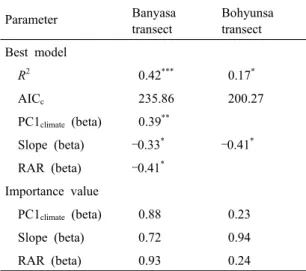
Based on the results of the simple OLS models, species richness of vascular plants showed significant relationships with slope and RAR along the Banyasa transect (Table 3). Along the Bohyunsa transect, slope was important variable for plant species richness. From the results of multi-model inference to select the best model and importance value,
PC1climate, slope and RAR were simultaneously
important for plant species richness along the Banyasa transect (Table 4). And slope was the most important to predict species richness pattern of vascular plants along the Bohyunsa transect. The results of variance partitioning with partial regression largely reinforced those of the simple OLS models and multi-model inference (Fig. 3). The pure effects of habitat variables were higher than those of the climate variables for vascular plant richness along the both study transects.
IV. Discussion
In this study, we analyzed the species richness patterns of vascular plants and the effects of climatic
Linear model Quadratic model
Transect AICc R2 P AICc R2 P
Banyasa 241.46 0.21 0.005 241.18 0.28 0.006
Bohyunsa 226.34 0.01 0.542 211.72 0.40 <0.001
Note: AICc – Akaike’s information criterion, P – Significance level.
Table 2. Relationships between elevation and species richness of vascular plants with linear and quadratic models
along the two transects on the Mt. Baekhwa, South KoreaParameter Banyasa
transect
Bohyunsa transect Best model
R2 0.42*** 0.17*
AICc 235.86 200.27
PC1climate (beta) 0.39**
Slope (beta) –0.33* –0.41* RAR (beta) –0.41*
Importance value
PC1climate (beta) 0.88 0.23 Slope (beta) 0.72 0.94
RAR (beta) 0.93 0.24
Note: Abbreviations for environmental variables are as described in Table 3. Significance levels are * P
< 0.05; ** P < 0.01; *** P < 0.001.
Table 4. Results of multi-model inference for the
environmental variables and species richness of vascular plants along the two transects on the Mt.Baekhwa, South Korea. Model selection (best model) and importance value from multi-model inference procedure were based on minimizing AICc value and AICc weights among all 7 possible models. Beta (in brackets) is the standardized regression slope for each variable in the model, which indicates the relative importance of the variables
PC1climate Slope RAR
Transect AICc R2 P AICc R2 P AICc R2 P
Banyasa 247.77 0.06 0.163 243.87 0.16 0.018 240.41 0.24 0.003
Bohyunsa 226.74 <0.01 0.984 220.27 0.17 0.014 226.24 0.10 0.494 Note: PC1climate – PC1 from seven climatic variables, RAR – Rocky area ratio, AICc – Akaike’s information criterion, P – Significance level.
Table 3. Coefficient of determination (R
2) and significance level from simple ordinary least squares regression models for environmental variables and species richness of vascular plants along the two transects on the Mt.Baekhwa, South Korea
and habitat variables on the richness patterns at local scales. Our study is different from previous studies in some aspects. Most of previous studies dealt with the importance of a single factor in controlling the elevational species richness patterns, although the interactions and combined effects of multiple variables are more important than the effect of a single variable in most cases (Rowe, 2009; Laliberté
et al., 2013). Moreover, our study also quantified and
disentangled the relative importance and magnitude of climatic and habitat variables using variation partitioning. Therefore, our study has advantages from examining elevational richness patterns and the mechanisms related to the effects of multiple variables and the decomposition of the effects.On the Mt. Baekhwa, species richness of vascular plants exhibited monotonic decrease and reversed hump-shaped patterns with elevation along the Banyasa and Bohyunsa transects, respectively. The monotonic decrease pattern of species richness along the Banyasa transect is one of the most commonly observed patterns in many organisms of various ecosystems (Rahbek, 2005). However, the reversed hump-shaped pattern observed on the Bohyunsa transect is not a usual type. Rahbek (2005) revealed that approximately 75% of the recorded elevational patterns were hump-shaped and monotonic decrease patterns and the remaining 25% of the gradients followed other patterns. This study indicates that
elevational richness pattern along the Banyasa transect exhibits one of the universal types at the most general level and the elevational richness pattern along the Bohyunsa transect belongs to one of the rare other types. These reversed hump-shaped pattern along the Bohyunsa transects was caused from steep increase of herbaceous plant richness at high elevations. Mean herbaceous plant richness at high elevations (800–900 m) was higher than the richness at mid elevations (500–600 m; 10.8 at high elevations vs. 5.8 at mid elevations). Indeed, several herbaceous species such as Potentilla freyniana, Sedum
polytrichoides, Silene seoulensis, Smilax nipponica, Syneilesis palmate were distributed only at high
elevation plots, and these species contributed to complete novel species at higher elevations along the Bohyunsa transect.Although the results were somewhat different among simple OLS model, multiple-model inference and variation partitioning, the climatic and habitat variables were simultaneously important for the richness pattern along the Banyasa transect and the habitat variables showed a strong effect on the richness pattern along the Bohyunsa transect.
In general, climate is considered a primary driver of species diversity patterns worldwide (Hawkins et
al., 2003; Rowe, 2009). Climatic variables such as
temperature and precipitation could have direct and indirect effects on species richness patterns along elevational gradients (Sanders et al., 2003). The physiological stress of climatic extremes can directly limit species distribution (Connell, 1961).Furthermore, climate may also affect species richness through its effects on primary productivity, including photosynthesis and rates of biological and chemical processes (Hawkins et al., 2003; Storch et al., 2006).
Although the relative importance of slope and RAR for species richness of vascular plants between the both transects were different, habitat variables were good predictors for elevational patterns of species richness (Liu et al., 2014; Chun and Lee, 2017).
Slope as a topographic variable is recognized as a crucial factor for plant diversity because steep slopes
Fig. 3. Variation partitioning in species richness of
vascular plants explained by climatic and habitat variables along the two transects on the Mt. Baekhwa.
tend to form shallow soils with lower nutrient and water availability (Balme, 1953; Bennie et al., 2006).
Topographic variables such as slope are an important factor controlling biodiversity regardless of the local and regional scales (Laliberté et al., 2013).
Moveover, rocky areas appear to be a factor that increases isolation and prevents colonization, especially of herbaceous plants. Area with the soil that has less rock content would have greater availability of resources such as soil moisture and nutrition, which are directly used by vascular plants (Lee et al., 2014).
In conclusion, the species richness of vascular plants along the Banyasa transect depicts clear monotonic decrease pattern, whereas the species richness showed reversed hump-shaped pattern with elevation along the Bohyunsa transect on the Mt.
Baekhwa. Although the effects of climatic and habitat variables are different between the study transects, habitat variables are more important predictors than climatic variables for the elevational patterns of plant species richness at least along our study transects on the Mt. Baekhwa. Many studies report that the elevational patterns of species richness can be influenced by a series of climatic, habitat, spatial and historical factors (Lomolino, 2001; Grytnes and Vetaas, 2002; Rahbek, 2005; Li et al., 2009). In this study, we evaluated the relationships between climatic and habitat variables and the elevational richness patterns of vascular plants. However, spatial and evolutionary historical variables were not considered. Further study on spatial and evolutionary variables, including geographical distance, evolutionary contingency and phylogenetic signal for functional trait, could help ecologists and biogeographers gain a better understanding for the variables regulating the elevational patterns of the diversity and distribution of plant communities in macroecological perspectives.
적 요
본 연구는 백화산 지역 고도 구배에 따른 식물 종풍 부도 패턴을 구명 하고, 관찰된 고도별 식물 종풍부도
패턴에 대한 기후 및 서식지 인자들의 효과를 구명하 고자 수행되었다. 백화산 지역 두 개의 조사 구간인 반야사에서 한성봉 구간과 보현사에서 한성봉 구간을 따라 총 70개 조사구에서 목본식물 78종, 초본식물 109종 등 총 187종의 식물종이 관찰되었다. 구간별로 살펴보면, 반야사 구간에서 목본식물 66종, 초본식물 88종을 포함한 154종이 관찰되었으며, 보현사 구간에 서는 목본식물 58종, 초본식물 73종 등 131종이 관찰 되었다. 고도별 종풍부도 패턴에 대한 기후 및 서식지 인자의 상대적 중요성을 분석하기 위해 단순최소제곱 회귀모형, 다수준모형 및 변이분할을 수행하였다. 분 석결과, 반야사 구간의 고도별 종풍부도 패턴은 감소 형 패턴을 나타내었으며, 보현사 구간의 종풍부도 패 턴은 역단봉형 패턴을 나타내었다. 비록, 고도별 식물 종풍부도 패턴은 조사구간 별로 서로 다른 양상을 나 타내었으나, 백화산 지역 본 연구 조사 구간에 있어서 고도별 식물 종다양성 패턴에 영향을 미치는 인자들의 상대적 중요성은 서식지 인자가 기후 인자보다 큰 것 으로 나타났다. 이러한 결과는 동일한 산악 생태계 내 에 위치하는 인근 조사구간에서 조차 고도별 식물 종 풍부도 패턴은 다를 수 있다는 것을 나타낸다. 하지만, 동시에 동일 산악 생태계 내에서의 상이한 패턴에도 불구하고 그 패턴을 제어하는 인자는 동일할 수 있음 을 나타낸다.
ACKNOWLEDGMENTS
We thank Mr. Hyo-Hyun Ahn and Mr. Sung-Yeol Cho for their invaluable help during the fieldwork and the data analysis in this study. Thanks are also due to Dr. Hyun-Je Cho and Dr. Joon-Hwan Shin for their support and encouragement. This paper forms a part of the Korea Big Tree Project funded by the Korea Green Promotion Agency, Korea Forest Service.
REFERENCES
Acharya, B. K., B. Chettri, and L. Vijayan, 2011:
Distribution pattern of trees along an elevation gradient of Eastern Himalaya, India. Acta
Oecologica 37, 329-336.
Anderson, D. R., K. P. Burnham, and G. C. White, 1998: Comparison of Akaike information criterion
and consistent Akaike information criterion for model selection and statistical inference from capture-recapture studies. Journal of Applied
Statistics 25, 263-282.
Balme, O. E., 1953: Edaphic and vegetation zoning on the Carboniferous limestone of the Derbyshire Dales. Journal of Ecology 41, 331-344.
Bennie, J., M. Hill, R. Baxter, and B. Huntley, 2006: Influence of slope and aspect on long-term vegetation change in British chalk grasslands.
Journal of Ecology 94, 355-368.
Braun-Blanquet, J., 1965: Plant Sociology. Hafner Publishing Company, 472pp.
Brown, J., 2001: Mammals on mountainsides:
elevational patterns of diversity. Global Ecology
and Biogeography 10, 101-109.
Burnham, K. P., and D. R. Anderson, 2002: Model
selection and inference: a practical information- theoretic approach (2nd ed.). Springer, 488pp.
Cho, H. J., Y. W. Lee, D. S. Lee, and S. C. Hong, 1991: Forest vegetation of Mt. Baekhwa. Journal
of Korean Forest Society 80, 42-53. (In Korean
with English abstract)Chun, J. H., and C. B. Lee, 2013: Assessing the effects of climate change on the geographic distribution of Pinus densiflora in Korea using Ecological Niche Model. Korean Journal of
Agriculture and Forest Meteorology. 15, 291-233.
(In Korean with English abstract)
Chun, J. H., and C. B. Lee, 2017: Disentangling the local-scale drivers of taxonomic, phylogenetic and functional diversity in woody plant assemblages along elevational gradients in South Korea. PLoS
ONE 12, e0185763.
Connell, J. H., 1961: The influence of interspecific competition and other factors on the distribution of the barnacle Chthamalusstellatus. Ecology 42, 410-423.
Currie, D. J., G. G. Mittelbach, H. V. Cornell, R.
Field, J. F. Guégan, B. A. Hawkins, D. M.
Kaufman, J. T. Kerr, T. Oberdorff, E. O’Brien, and J. R. G. Turner, 2004: Predictions and tests of climate-based hypotheses of broad-scale variation in taxonomic richness. Ecology Letters 7, 1121-1134.
Diniz-Filho, J. A. E., L. M. Bini, and B. A.
Hawkins, 2003: Spatial autocorrelation and red herrings in geographical ecology. Global Ecology
and Biogeography 12, 53-64.
Grau, O., J. A. Grytnes, and H. J. B. Birks, 2007:
A comparison of altitudinal species richness patterns of bryophytes with other plant groups in
Nepal, Central Himalaya. Journal of Biogeography
34, 1907-1915.
Grytnes, J. A., and O. R. Vetaas, 2002: Species richness and altitude: a comparison between null models and interpolated plant species richness along the Himalayan altitudinal gradient, Nepal.
American Naturalist 159, 294-304.
Hawkins, B. A., R. Field, H. V. Cornell, D. J.
Currie, J. F. Guégan, D. M. Kaufman, J. T. Kerr, G. G. Mittelbach, T. Oberdorff, E. M. O’Brien, E.
E. Porter, and J. R. G. Turner, 2003: Energy, water, and broad-scale geographic patterns of species richness. Ecology 84, 3105-3117.
Jones, M. M., H. Tuomisto, D. Borcard, P.
Legendre, D. B. Clark, and P. C. Olivas, 2008:
Explaining variation in tropical plant community composition: influence of environmental and spatial data quality. Oecologia 155, 593-604.
Kerr, J. T., and L. Packer, 1997: Habitat heterogeneity as a determinant of mammal species richness in high-energy regions. Nature 385, 252-254.
Kluge, J., M. Kessler, and R. R. Dunn, 2006: What drives elevational patterns of diversity? A test of geometric constraints, climate and species pool effects for pteridophytes on an elevational gradient in Costa Rica. Global Ecology and Biogeography
15, 358-371.
Körner, C., 2000: Why are there global gradients in species richness? Mountains might hold the answer.
Trends in Ecology and Evolution 15, 513-514.
Laliberté, E., J. B. Grace, M. A. Huston, H.
Lambers, F. P. Teste, B. L. Turner, and D. A.
Wardle, 2013: How does pedogenesis drive plant diversity? Trends in Ecology and Evolution 28, 331-340.
Lee, C. B., J. H. Chun, and H. H. Ahn, 2014:
Elevational patterns of plant richness and their drivers on an Asian mountain. Nordic Journal of
Botany 32, 347-357.
Legendre, P., 1993: Spatial autocorrelation: trouble or new paradiam? Ecology 85, 1659-1673.
Legendre, P., and L. Legendre, 1998: Numerical
ecology (2nd ed.). Elsevier, 853pp.
Li, J., Q. He, X. Hua, J. Zhou, H. Xu, J. Chen, and C. Fu, 2009: Climate and history explain the species richness peak at mid-elevation for
Schizothorax fishes (Cypriniformes: Cyprinidae)
distributed in the Tibetan Plateau and its adjacent regions. Global Ecology and Biogeography 18, 264-272.Liu, J., T. Yunhong, and J. W. F. Slik, 2014:
Topography related habitat associations of tree species traits, composition and diversity in a Chinese tropical forest. Forest Ecology and
Management 330, 75-81.
Lomolino, M. V., 2001: Elevational gradients of species-density: historical and prospective views.
Global Ecology and Biogeography 10, 3-13.
Oommen, M. A., and K. Shanker, 2005: Elevational species richness patterns emerge from multiple local mechanisms in Himalayan woody plants.
Ecology 86, 3039-3047.
Qian, H., and R. E. Ricklefs, 2000: Large-scale processes and the Asian bias in species diversity of temperate plants. Nature 407, 180-182.
Qian, H., Z. Hao, and J. Zhang, 2014: Phylogenetic structure and phylogenetic diversity of angiosperm assemblages in forests along an elevational gradient in Changbaishan, China. Journal of Plant Ecology
7(2), 154-165.
Rahbek, C., 1995: The elevational gradient of species richness: a uniform pattern? Ecography 18, 200-205.
Rahbek, C., 2005: The role of spatial scale and the
perception of large-scale species-richness patterns.
Ecology Letters 8, 224-239.
Rowe, R. J., 2009: Environmental and geometric drivers of small mammal diversity along elevational gradients in Utah. Ecography 32, 411-422.
Sanders, N. J., J. Moss, and D. Wagner, 2003:
Patterns of ant species richness along elevational gradients in an arid ecosystem. Global Ecology
and Biogeography 12, 93-102.
Stevens, G. C., 1992: The elevational gradient in altitudinal range, an extension of Rapoport’s latitudinal rule to altitude. American Naturalist
140, 893-911.
Storch, D., R. G. Davies, S. Zajíček, C. D. L.
Orme, V. Olson, G. H. Thomas, T. S. Ding, P.
C. Rasmussen, R. S. Ridgely, P. M. Bennett, T.
M. Blackburn, I. P. F. Owens, and K. J. Gaston, 2006: Energy, range dynamics and global species richness patterns: Reconciling mid-domain effects and environmental determinants of avian diversity.