1)
※ 이 논문은 소프트웨어 정책연구소와 한국연구재단
(No. 2017R1A2B4010875)의 지원을 통해 수행된 연구 결과임.
†비 회 원 : 한국기술교육대학교 컴퓨터공학과 박사과정
††비 회 원 : 한국기술교육대학교 컴퓨터공학과 석사과정
†††비 회 원 : 소프트웨어 정책연구소 책임연구원
††††정 회 원 : 한국기술교육대학교 컴퓨터공학부 교수 Manuscript Received : January 09, 2019 Accepted : January 19, 2019
* Corresponding Author : Won-Tae Kim([email protected])
A Novel Reference Model for Cloud Manufacturing CPS Platform Based on oneM2M Standard
Seongjin Yun
†⋅Hanjin Kim
†⋅Hyeonyeop Shin
††⋅Hoe Seung Chin
†††⋅Won-Tae Kim
††††ABSTRACT
Cloud manufacturing is a new concept of manufacturing process that works like a single factory with connected multiple factories.
The cloud manufacturing system is a kind of large-scale CPS that produces products through the collaboration of distributed manufacturing facilities based on technologies such as cloud computing, IoT, and virtualization. It utilizes diverse and distributed facilities based on centralized information systems, which allows flexible composition user-centric and service-oriented large-scale systems. However, the cloud manufacturing system is composed of a large number of highly heterogeneous subsystems. It has difficulties in interconnection, data exchange, information processing, and system verification for system construction. In this paper, we derive the user requirements of various aspects of the cloud manufacturing system, such as functional, human, trustworthiness, timing, data and composition, based on the CPS Framework, which is the analysis methodology for CPS. Next, by analyzing the user requirements we define the system requirements including scalability, composability, interactivity, dependability, timing, interoperability and intelligence. We map the defined CPS system requirements to the requirements of oneM2M, which is the platform standard for IoT, so that the support of the system requirements at the level of the IoT platform is verified through Mobius, which is the implementation of oneM2M standard. Analyzing the verification result, finally, we propose a large-scale cloud manufacturing platform based on oneM2M that can meet the cloud manufacturing requirements to support the overall features of the Cloud Manufacturing CPS with dependability.
Keywords : Large-Scale CPS, Smart Factory, Cloud Manufacturing, CPS Platform, Internet of Things
제조 클라우드 CPS를 위한 oneM2M 기반의 플랫폼 참조 모델
윤 성 진
†⋅김 한 진
†⋅신 현 엽
††⋅진 회 승
†††⋅김 원 태
††††요 약
제조 클라우드는 여러 공장이 연결되어 단일 공장처럼 구성되어 사용자의 요구사항에 유연하게 대처할 수 있는 새로운 제조 패러다임이 다. 이러한 기능을 제공하는 제조 클라우드 시스템은 클라우드 컴퓨팅, 사물인터넷, 인공지능과 같은 컴퓨팅 기술을 활용하여 분산되어 있 는 제조 시설 간의 협업을 통한 유연 생산에서 안정성, 고신뢰성, 연동성 등을 제공하는 일종의 대규모 CPS이다. 제조 클라우드 CPS는 많 은 수와 다양한 종류의 이기종 서브시스템들로 구성되어 있는데 이 때문에 서브시스템 간 연동, 데이터 교환, 시스템 통합 등에 문제가 발 생할 수 있어 대규모의 제조 클라우드 CPS을 구성하는데 어려움을 겪고 있다. 본 논문에서는 이러한 어려움을 극복하기 위하여 제조 클라 우드를 체계적으로 분석하고 분석 결과를 바탕으로 제조 클라우드 CPS를 효과적으로 지원할 수 있는 플랫폼 참조 모델을 제안한다. CPS 분석 방법론인 CPS 프레임워크를 활용하여 제조 클라우드 CPS의 기능적, 인간적, 신뢰성, 시간적, 데이터 및 구성의 측면에서 사용자 요구 사항을 도출하고 이들을 분석하여 확장성, 구성성, 상호 작용성, 신뢰성, 시간성, 상호 운용성, 지능성의 영역에서 시스템 요구사항을 정의한 다. 정의된 제조 클라우드 CPS 시스템 요구사항을 바탕으로 플랫폼을 구성하기 위하여 IoT 플랫폼 표준인 oneM2M의 요구사항에 매핑하 고 oneM2M 구현물인 Mobius를 통하여 요구사항 지원성 검증 실험을 수행하였다. 수행 결과를 분석하여 현재 사물인터넷 플랫폼의 제조 클라우드 CPS 지원성을 확인하고 이를 확장하여 대규모 제조 클라우드 생산을 지원하는 플랫폼 참조 모델을 제안한다.
키워드 : 대규모 CPS, 스마트 팩토리, 제조 클라우드, CPS 플랫폼, 사물인터넷
※ This is an Open Access article distributed under the terms of the Creative Commons Attribution Non-Commercial License (http://creativecommons.org/ licenses/by-nc/3.0/) which permits unrestricted non-commercial use, distribution, and reproduction in any medium, provided the original work is properly cited.
1. Introduction
Cyber-physical system(CPS) is a kind of a dependable control system in which physical systems or processes are monitored and controlled by well-designed software[1, 2].
Especially, an entire system, as a system of systems(SoS), consists of heterogeneous sub-systems or sub-components which are interconnected by reliable networking services. The subsystems precisely control each other in order to allow the entire system to perfectly achieve its mission under any conditions. The development of large-scale control mechanisms between many subsystems is very difficult in legacy system development methods, which make subsystems first and then integrate them into a total system without an accurate analysis of the control effects between subsystems. The philosophy of the legacy system engineering is that the dependability of subsystems can guarantee the dependability of the entire system. As X-by-Wire, however, widely spreads on safety- critical systems where subsystems are not directly connected by a physical link but indirectly connected with intermediate electronic devices, each subsystem, in terms of functionality and performance, is not sufficient for the dependable operation of the entire system. This is because there are little considerations about big interactions between subsystems.
Recently, IoT networks have become a common infrastructure of smart things’ connectivity; thus it is widely believed that large-scale CPSs, such as smart city, will be based on IoT networks. As a result, there will be a large number of serious interactions between subsystems, or between systems, or
between subsystems and systems in the CPS domain. In particular, the technology for mutually controlling the individual subsystems to constitute one dependable system, in which subsystems are tightly coupled to enhance the overall performance of the system, is essential in the domain of systems engineering. Therefore, a dependable CPS should be developed by a unified framework which guarantees the quality of CPS in the design phase, the implementation phase, and V&V(Validation & Verification) phase, respectively[3].
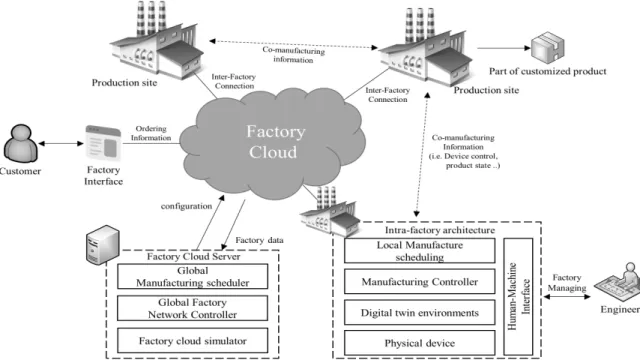
Smart manufacturing may be a representative CPS domain in which the entire production system must be operated with high-efficiency optimal control[4]. In recent years, cloud manufacturing is proposed to provide a service-ented personalized manufacturing environment through advanced computing technologies such as IoT, artificial intelligence, and cloud. Fig. 1 shows a service-oriented service of cloud manufacturing(CMfg) CPS[5, 6]. It is a new conceptual manufacturing form in which several smart factories are linked together to form one large manufacturing system[7].
The CMfg CPS is a software-based service-oriented system that constitutes a scalable manufacturing system with the real-time interworking of many CPS objects by advanced networking technologies[8]. It can support personalized production systems by providing user-centric services through cloud computing-based resource management in the central server[9]. The CMfg CPS can satisfy user's requirements by reconfiguration of the whole system as well.
It utilizes digital twinning, artificial intelligence, and modeling and simulation(M&S) technology to provide efficient and
Fig. 1. A Manufacturing Service of the CMfg CPS
reliable facility forecasting and manufacturing system optimization[10-12]. Since the performance and functionality of the system in these smart manufacturing CPSs is heavily dependent on software rather than hardware, the role of system software is emphasized[4]. Large-scale CPSs such as the CMfg CPS have various features, which make it difficult to design and configure[13]. It is necessary to have the proper platform technology to effectively support the functional requirements of the CPS[14].
In this study, we propose a CMfg CPS platform based on the CPS analysis procedure of CMfg CPS. We derive the CMfg CPS user requirements for the functional, human, trustworthiness, timing, data and composition aspects, which are suggested in the CPS framework[16]. By means of an analysis process about user requirements, we define the CMfg CPS system requirements as including scalability, composability, interactivity, dependability, timing, interoperability, and intelligence, corresponding to the CMfg CPS user requirements. Then, we map the CMfg CPS requirements to the oneM2M requirements to verify satisfaction and demonstrate the supportability based on Mobius, the well-known implementation of oneM2M standard[17]. Finally, we propose a CMfg CPS platform based on IoT standard to effectively support service-oriented manufacturing service through the analysis of the experimental results and other CMfg CPS requirements.
The remainder of the paper is as follows. In chapter 2, we discuss the methodology for CPS analysis and platform technology to support the CMfg CPS. We define the user and system requirements of the CMfg CPS using CPS analytical methodology in chapter 3. In chapter 4, we propose a reference platform model to support the overall requirements by experimentation based on oneM2M standard.
2. Related Works
2.1 NIST CPS Framework
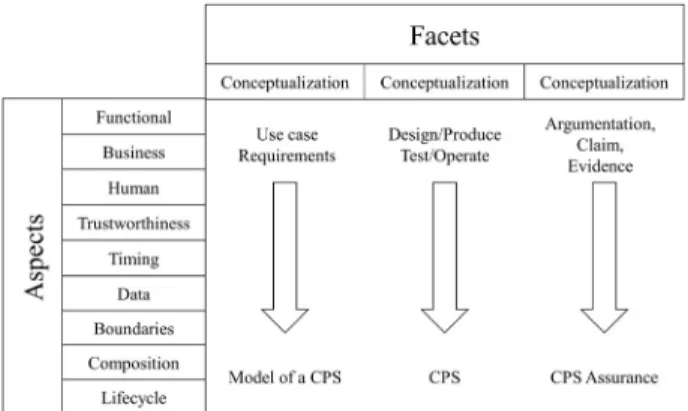
The CPS framework is the methodology for CPS definition proposed by the National Institute of Standard and Technology(NIST)’s CPS PWG[16]. It is a framework for analyzing the entire system of physical and cyber worlds. Fig.
2. shows the overview of CPS Framework The goal of this framework is to form a System of Systems that can interoperate between multiple domains by providing a common language to describe CPS architecture. The NIST CPS Framework defines CPS application domains, concerns, aspects, facets, and properties.
Aspects, which are the basic tools of analysis, consist of conceptually the same or related user requirements. They are classified as follows: the Functional aspect refers to the
functions of CPS; the Business aspect relates to markets and regulations; the Human aspect concerns interactions between human and components; the Trustworthiness aspects take into consideration security and stability of CPS; the Timing aspect concerns real-time features of CPS; the Data aspect relates to data interaction of CPS; the Boundaries aspect considers inter-domain interworking; the Composition aspect relates to component attributes; and lastly, the Lifecycle aspect involves the CPS system development process. They are used for defining the functional user requirements of CPS. Analyzing CPS based on this framework allows the CPS to be described in view of its overall features.
Fig. 2. Overview of CPS Framework
2.2 Platform Research on the CMfg CPS
1) IoT platforms for industrial domains
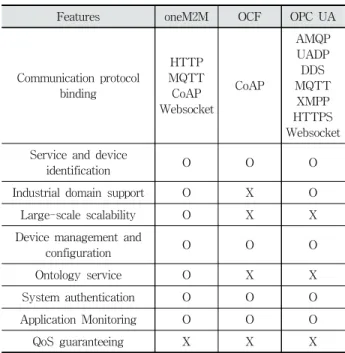
OCF has advantages in data security and the management of operational communication in the IoT environment[18].
Since the target IoT environment is a home environment, such as a smart home, it has difficulty supporting various industrial domains. Large-scale environmental considerations are also lacking. OPC UA is a technology used in the construction of an Industrial-IoT(IIoT) environment[19]. It supports various communication protocols and functions required by IoT environments such as security, operation, and management OPC UA is, however, focused on inter-factory interworking.
It has difficulty supporting the inter-factory connection of
CMfg CPS, which is a large-scale network environment. It
also has limitations in guaranteeing the real-time requirements
of the CMfg service such as cloud-based remote control,
real-time CMfg resource monitoring. While oneM2M standards
support most requirements for a large-scale system, such as
various protocol binding, ontology, scalability, and device
management, they have limitations on industrial specific
functions such as facility maintenance[20]. Furthermore,
oneM2M standards do not consider the network quality of
service(QoS) guaranteeing. The feature comparison of IoT
platforms is shown in Table 1. The oneM2M standards has advantages to support large-scale network of CMfg CPS such as high scalability and ontology service. This study proposes a platform to verify CMfg CPS support based on oneM2M because of these features.
Features oneM2M OCF OPC UA
Communication protocol binding
HTTP MQTT CoAP Websocket
CoAP
AMQP UADP DDS MQTT XMPP HTTPS Websocket Service and device
identification O O O
Industrial domain support O X O
Large-scale scalability O X X
Device management and
configuration O O O
Ontology service O X X
System authentication O O O
Application Monitoring O O O
QoS guaranteeing X X X
Table 1. Feature Comparison of IoT Platforms
2) Smart manufacturing platforms for CMfg Biqing Huang proposed a platform to provide CMfg services for small-middle size enterprise[21]. Technologies required by CMfg for each layer of manufacturing resources, users, transactions, business models, service models, platform services, and cloud services are established. The effective provision of a service-oriented manufacturing environment is thereby enabled. This platform has difficulty supporting the design, development, and maintenance of the CMfg CPS software because it focuses on providing services. Fei Tao designed and implemented CMfg that can provide IoT and intelligence-based services[22]. It allows for intelligent recognition, such as the classification of manufacturing resources and the relationship between resources. By means of its five-layer structure Fei Tao’s platform can strongly support management services such as user, network, and process. It can support scalable and interoperable CMfg CPSs by applying IoT-based intelligent perception but lacks real-time guaranteed interactions and AI-based intelligent service provision. In addition, this platform does not consider simulation-based system verification, which makes it hard to construct dependable-CMfg CPSs. Jihang Liu proposed an ontology-based architecture that can efficiently organize the collaboration of CMfg CPSs[23]. It can gather and integrate
the information of distributed heterogeneous systems. There are, however, limitations on functions other than manufacturing resource management. The Telecommunications Technology Association(TTA) proposed a smart manufacturing system reference model based on a general IoT platform[24]. The flexible smart manufacturing system is constructed by a service enabler such as IoT, big data, cyber physical production system(CPPS) and cloud platforms. Consideration of semantic functions for interoperability and network configuration functions for real-time communications is lacking.
The aforementioned platforms are biased toward specific functions, and so they have difficulty supporting the various features of CPS including scalability, dependability, and interoperability. In this paper, we propose a reference model that attempts to satisfy the overall requirements for the CMfg CPS.
3. Analysis of Cloud Manufacturing CPS
We define user requirements and system requirements through a formal analysis process of the CMfg CPS based on the CPS framework[16].
3.1 Derivation of User Requirements
We analyze the CMfg CPS based on the aspects of the CPS Framework shown in Fig. 2. Among its 9 aspects, business, boundaries, and lifecycle are beyond the scope of this work because they are business issues. We analyze 6 aspects and their concerns, shown in Fig. 3, in order to derive the CMfg CPS user requirements. Representative Concerns for each aspect and corresponding user requirements are presented in Table 2.
Fig. 3. Concern List of Each Aspect in CPS Framework
1) User Requirements about Functional Aspect The functional aspects include 13 concerns for the function and implementation of the CMfg CPS: Actuation,
Communication, Controllability, Functionality, Manageability, Measurability, Monitorability, Performance, Physical, Physical context, Sensing, States and Uncertainty. For the analysis
Aspect Concern User requirements
Functional
Actuation
· The facilities of the CMfg CPS works through interworking each other
· The facilities of the CMfg CPS produce products according to the process set.
· The CMfg CPS can track the status of the product in production
Communication · The facilities of the CMfg CPS send and receive messages through industrial communication technologies
Controllability · The facilities of the CMfg CPS can be controlled remotely
Functionality · The CMfg CPS supports reconfiguration of processes to efficiently produce products Manageability · The CMfg CPS devices can manage the complex interworking structure of the facilities
Measurability
· The CMfg CPS can verify that the products produced by the smart factory meet the requirements
· Modeling and simulation of the CMfg CPS components check the physical state Monitorability · The CMfg CPS can monitor that its components are working properly
Sensing · The facilities of the CMfg are aware of the status of the product being produced Uncertainty · The components of the CMfg CPS can cause unpredictable malfunctions
Human
Human factors
· The administrator of the CMfg CPS can control the facilities by the process configuration
· The facilities of the CMfg CPS can be operated by field technicians
· The manufacturing system can be adjust by customers’ requirements
Usability
· The CMfg CPS monitoring function allows real-time tracking of the plant-wide status
· The engineers of the CMfg can flexibly configure production processes based on product requirements
· The engineers of CMfg CPS can monitor and control remotely the facilities to cope with abnormal situation
Trust worthiness
Privacy · Provides a security mechanism for access to component information
Reliability · The facilities in the CMfg CPS perform precisely the tasks assigned according to the process settings.
Resilience · It is possible to cope quickly and flexibly in the case of machine defect of the CMfg CPS
Safety · The components of the CMfg CPS should be able to prevent safety accidents in any situation Security · There must be a security system for the protection of smart plant equipment and equipment.
Timing
Logical time · The CMfg CPS can express the order of occurrence of events through model Synchronization · Each component in the CMfg CPS needs time synchronization
Time awareness · The production process should be designed in consideration of time accuracy Time-interval and
latency · The time taken between the CMfg CPS’ events should be less than the required time
Data
Data semantic · Each data shared within the CMfg CPS should be interpreted in the same meaning on each component
Operations on data · The CMfg CPS should provide the ability to create/ read/ update/ delete data Data volume · The CMfg CPS must have a policy for data storage
Composition
Adaptability · The CMfg CPS should be able to control components as appropriate for the situation Complexity · The CMfg CPS should be able to derive a design that reduces complexity when adding other
components
Constructability · The CMfg CPS should be able to be configured in an optimal form to meet consumer requirements
Discoverability · The CMfg CPS should be able to locate specific components
Table 2. Representative User Requirements of the CMfg CPS
of the CMfg CPS, we derive user requirements of each concern related to equipment, processes, and products.
Actuation concern refers to the change in physical state by manipulation. There is a requirement for an action of the CMfg CPS equipment and production process.
Communication concerns are related to the exchange of information in the CMfg CPS. There is a demand for message transmission and reception functions. Controllability is related to the control of the physical system. Remote control of the facilities of the CMfg CPS is required.
Functionality is a concern for the special functions that the CMfg CPS could provide. There is a need for an efficient process reconfiguration function. Manageability is a concern for the CMfg CPS function management. The requirement for device management in complex structures is derived.
Measurability is a concern about the status measurement of the CMfg CPS. There are requirements for state measurement by M&S and checking of product requirements satisfaction. Monitorability is a concern for tracking operations of a system. The CMfg CPS requires a function to verify that the components work properly.
Performance is a concern about the ability to achieve a goal of the CMfg CPS. Physical is a concern for physical character of CMfg CPS. Physical context is concerning to understand the physical action of CMfg CPS. Sensing is a concern about context awareness for a situation. The CMfg CPS requires a perception function of the state of the product. States is related to the functional status of CMfg CPS. Uncertainty is a concern for managing the impact of the CMfg CPS on uncertain events. Unpredicted malfunctions of the CMfg CPS must be managed.
2) User Requirements about Human Aspect The concerns of the human aspect are related to the interaction between facilities and humans. User requirements are defined through 2 concerns: Human factors and Usability.
Human factors are concerns related to the utilization of the CMfg CPS by a human. The CMfg CPS requires a manager's process control function and technician's facility control function. Usability concerns consider the use of the CMfg CPS to achieve its functional goals. The CMfg CPS requires real-time manufacturing status tracking by monitoring the production process.
3) User Requirements about Trustworthiness Aspect The trustworthiness aspect considers concerns about the dependability of the CMfg CPS. The user's requirements are derived from 5 concerns: Privacy, Reliability, Resilience,
Safety, and Security.
Privacy is the concern related to information protection by data access management. The CMfg CPS requires security features for component information protection.
Reliability is the concern related to the function of the CMfg CPS to perform predictable operations. The CMfg CPS requires accurate task execution according to process setting. Resilience is the concern for the fault-tolerant feature of the CMfg CPS. A fast and flexible coping function of machine defects is demanded. Safety is the concern for the safety of CMfg CPS stakeholders. It is necessary to have the accident prevention of the engineer as a safety function. Security is the concern for the protection of processes, mechanisms, components, and services. The function to protect the CMfg CPS facilities is required.
4) User Requirements about Timing Aspect The timing aspects consist of concerns related to the time and frequency of the CMfg CPS. User requirements are derived from 4 concerns: Logical time, Synchronization, Time awareness and Time-interval and latency.
Logical time is the concern for the event sequence of the CMfg CPS. It needs the ability to represent the sequence of events. Synchronization is the concern for the time synchronization or the signal harmonization between related nodes. The CMfg CPS requires time synchronization of its components. Time awareness is a concern related to the accuracy of the time used in the operation of the component. Time accuracy should be considered in the CMfg CPS design process. Time-interval and latency is a concern for time intervals and delays between events. The time between events of the CMfg CPS should be less than the set time.
5) User Requirements about Data Aspect
The data aspects consist of concerns about data interactions such as fusion, metadata, and identification.
User requirements are derived from 6 concerns: Data semantic, Identity, Operation on data, Relationship between data, Data velocity, and Data volume.
Data semantic is a concern related to the meaning of data shared within the system. It is a requirement that the data should be interpreted with the same meaning by the components of the CMfg CPS. Identity is a concern associated with the correct recognition of a component.
Operation on data is a concern for the integrity of the system
data. There are requirements for data creation, reading,
updating, and deleting functions. Relationship between data
is a concern about the organization and relevance of the data
set. Data velocity is a concern related to the speed of execution of data operations. Data volume is a concern for the amount of data associated with the operation in the CMfg CPS. There is a user requirement for a storage policy of the CMfg CPS data.
6) User Requirements about Composition Aspect The composition aspect consists of concerns about the composability features of the components and the attributes of the component assembly. Composition user requirements are derived from 4 concerns: Adaptability, Complexity, Constructivity, and Discoverability.
Adaptability is the concern for reconfigurability according to the situation. The CMfg CPS should be able to control the components appropriately. Complexity is the concern related to the system configuration of subsystems. The
CMfg CPS requires the ability to derive the optimal design of the system. Constructivity is the concern for satisfying users’ needs by the combination of components. The CMfg CPS should be able to be configured in a suitable form to meet the customer requirements. Discoverability is the concern for component discovery and understanding. The user must be able to find out the specific component of the CMfg CPS.
3.2 Definition of System Requirements
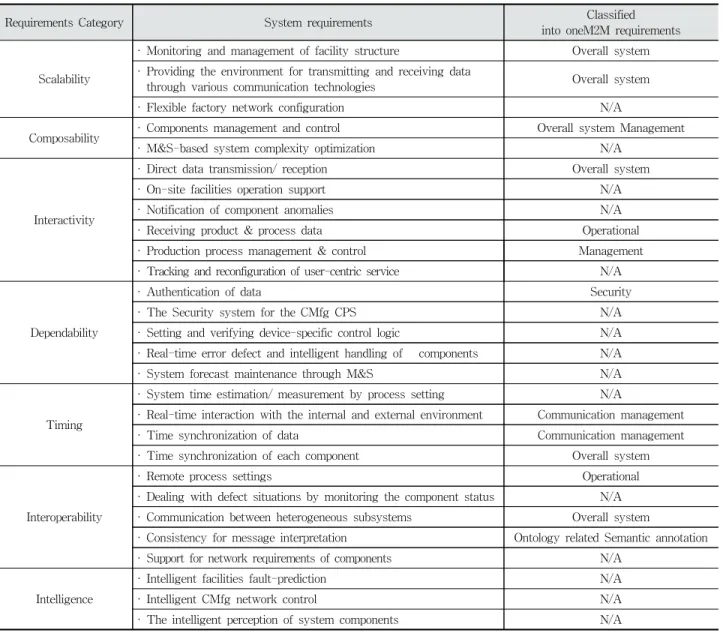
The CMfg CPS system requirements corresponding to representative user requirements are described in Table 3.
Since the CMfg CPS is one of the large-scale CPSs, it has essential CPS features including scalability, composability, interactivity, dependability, timing, interoperability, and intelligence. System requirements for each feature can be
Requirements Category System requirements Classified
into oneM2M requirements
Scalability
· Monitoring and management of facility structure Overall system
· Providing the environment for transmitting and receiving data
through various communication technologies Overall system
· Flexible factory network configuration N/A
Composability · Components management and control Overall system Management
· M&S-based system complexity optimization N/A
Interactivity
· Direct data transmission/ reception Overall system
· On-site facilities operation support N/A
· Notification of component anomalies N/A
· Receiving product & process data Operational
· Production process management & control Management
· Tracking and reconfiguration of user-centric service N/A
Dependability
· Authentication of data Security
· The Security system for the CMfg CPS N/A
· Setting and verifying device-specific control logic N/A
· Real-time error defect and intelligent handling of components N/A
· System forecast maintenance through M&S N/A
Timing
· System time estimation/ measurement by process setting N/A
· Real-time interaction with the internal and external environment Communication management
· Time synchronization of data Communication management
· Time synchronization of each component Overall system
Interoperability
· Remote process settings Operational
· Dealing with defect situations by monitoring the component status N/A
· Communication between heterogeneous subsystems Overall system
· Consistency for message interpretation Ontology related Semantic annotation
· Support for network requirements of components N/A
Intelligence
· Intelligent facilities fault-prediction N/A
· Intelligent CMfg network control N/A
· The intelligent perception of system components N/A
Table 3 System requirements of the CMfg CPS
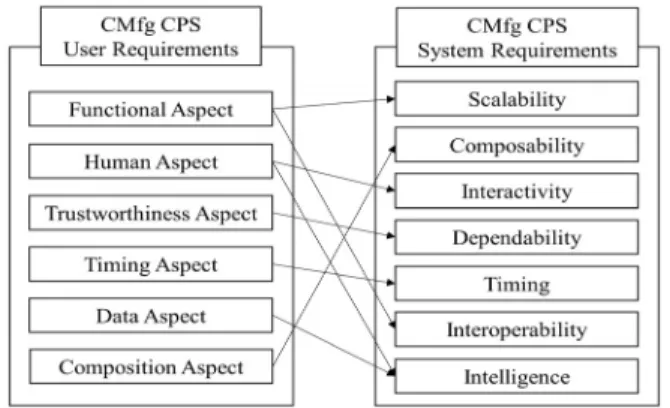
defined by an analysis of the user requirements. As shown in Fig. 4, CPS user requirements are mapped as relationships of one-to-one, many-to-one, or one-to-many, with the system requirements of the 7 characteristics of CPS. Each requirement is not completely orthogonal to the others.
1) Scalability
Scalability requirements of the CPS are described for the functional, performance, and physical scale of the system.
The Scalability functions of the CMfg CPS such as interworking between facilities, system reconfiguration, and monitoring are derived from the user requirements of the functional aspect. We defined scalable system requirements such as real-time monitoring and management of facility structures and flexible, large-scale network configurations in order to meet these features.
2) Composability
Composability requirement considers the configuration of the CMfg CPS subsystems. The features related to the complexity of the CMfg CPS components appear in the composition aspect of the user requirements. The system requirements of CMfg CPS for component management and control are defined to support CMfg CPS user requirements about high adaptability and flexible system construction.
The requirements for M&S-based complexity optimization are also defined for optimized system configuration.
3) Interactivity
Interactivity of the CMfg CPS is described in the human user requirements. A flexible interaction between CPSs or between CPS and human is required for certain service-oriented functions of the CMfg CPS such as facility control by engineers, process setting by administrators, and facility information tracking. Interactivity system requirements of the
CMfg CPS such as data transmission/receive, facility management, abnormal status alarm, and process management are defined to satisfy these characteristics.
4) Dependability
Features such as security, stability, and resilience should be provided to build a dependable system. The CMfg CPS requires information security mechanisms, precise process settings, fast machine defect recovery, and user safety features as described in the user requirements of the trustworthiness aspect. Dependability system requirements such as authentication for data security, real-time error detection and intelligent handling, and M&S based system predictive maintenance are defined to meet these user requirements.
5) Timing
Time-related characteristics including synchronization and real-time characteristics should be satisfied to configure the CMfg CPS. These features appear in the timing user requirement of the CMfg CPS. User requirements include the order of event, synchronization between nodes, precise time consideration, and inter-event intervals. Timing system requirements such as system time measurement, real-time interaction, and time synchronization of data according to process settings are defined in order to meet these requirements.
6) Interoperability
CMfg CPSs consisting of highly heterogeneous subsystems should provide interoperability between the subsystems. Thus, functions such as communication, control, monitoring, and sensing—which are described in the functional user requirement
—are needed. Interoperability system requirements of the CMfg CPS are defined for remote process setup, anomaly detection, data interpretation consistency, and network requirements support to provide these functions.
7) Intelligence
The CMfg CPS can provide intelligent services by analyzing and processing data generated in the system. Its functions, such as measurability, sensing, data processing, and size of data, should be considered to provide intelligent services. These are derived from functional user requirements and data user requirements. Intelligence system requirements of the CMfg CPS such as intelligent fault prediction and network control are defined by considering these requirements.
Fig. 4. Relationship of the Cmfg Cps User Requirements and
System Requirements
4. IoT Based CPS Platform for CMfg
In this chapter, the CMfg CPS system requirements are classified into oneM2M requirement by qualitative analysis of oneM2M standards. Classified requirements are verified by experiments based on Mobius, which is an implementation of oneM2M standards. Finally, we propose a platform model for CMfg CPS that can satisfy the system requirements of the CMfg CPS by analyzing the results of experiments conducted thereon.
4.1 System Requirements Classified into oneM2M Requirements The CMfg CPS system requirements are classified into oneM2M requirements in order to perform the evaluation of the CMfg CPS’ functions based on the IoT platform. The relationship between CPS system requirements and the oneM2M requirement is shown in Fig. 5. The functional requirements of oneM2M are defined for the overall system, network level management, semantics, security, operation state management, and communication management[33].
Classification into the oneM2M requirements of CMfg CPS system requirements is also shown in Table 3.
Fig. 5. Relationship of the CMfg CPS and oneM2M Requirements
4.2 Experiments of Classified CMfg CPS System Requirements
This section confirms the actual support of the oneM2M- supported CPS requirements identified as supporting through the requirements matching process performed in section 4.1.
1) Testbed Design
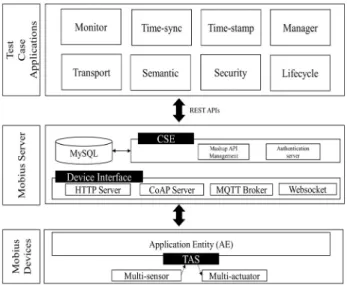
A testbed based on software-defined networking(SDN) is constructed for experimental verification in a flexible network configuration[34]. Mininet emulator is used to configure virtual networks where we deploy virtual edge devices, real edge devices, test case applications, and a oneM2M server[35]. Mobius, the well-known oneM2M
implementation, is used to configure the oneM2M edge devices and server. The testbed architecture is shown in Fig. 6. Then, as shown in Fig. 7, mininet emulates a network topology, which includes intra-factory and inter-factory networks.
Fig. 6. System Configuration of CMfg Testbed
Fig. 7. Network Configuration of CMfg Testbed
2) Test Cases for Verification
We designed and implemented test cases that operate on the testbed and verified the satisfaction of classified CMfg CPS requirements. The designed test cases operation structure is shown in Fig. 8.
Fig. 8. Operation structure of the Test Case Applications
Monitoring test case is used to verify the system requirements for monitoring the condition of the facilities. In this case, we implement and use monitoring application based on mobius platform. It receive sensor data and status data from mobius CSE which collect these data of virtual edge device. it sequence is shown in (a) of Fig. 9. Manager test case is designed to verify the requirements for adding and controlling components & processes. The component management application send PUT, UPDATE message to mobius CSE. it sequence is shown in (b) of Fig. 9. Transport test case is planned to verify the communication requirements such as various communication technologies and communication in heterogeneous environments. The transport application selects and configures for communication protocol. and it sends and receives messages by the selected protocol as shown in (c) of Fig. 9. Semantic test case is constructed to verify the consistency of message interpretation. The semantic test case application create, update and get oneM2M container ontology. Security test case is modeled to confirm the support of data access authentication. We implement and run two messaging application which one is authenticated application and another is not. Time-sync test case is conducted to verify time synchronization between components. The clock server update clock source for time synchronization. TAS which take a role of virtual edge device download and sync its local time to time-clock source of the clock server. Its sequence is describe in (d) of Fig. 9.
Time-stamp test case is performed for checking if the time synchronization function of data is provided. The time-stamp application create virtual data with time stamp. Then it receives
updated data and check the time-stamp of updated data.
Finally, Lifecycle test case is built to verify the data sharing and control functions according to the CMfg CPS process. The lifecycle application receives data from TAS and sends lifecycle control message to TAS as shown in (e) of Fig. 9.
4.3 Analysis of Experimental Results
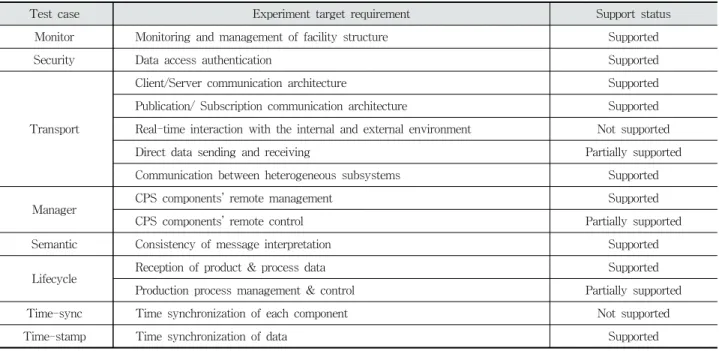
Through the 8 test cases described in Fig. 9, we performed verifications of CMfg CPS system requirements classified into oneM2M requirements. The results are shown in Table 4. We analyze the verification results of each system requirement.
1) CMfg CPS Scalability
Various communication technologies are supported and it is confirmed that data exchange between heterogeneous environments is possible by transport. In Monitoring test case, we verify that it supports the data acquisition function of the equipment constituting the system. However, oneM2M standards have a limitation to accurately detect the state of components when the scale of the system changes. There are also some challenges in exchanging data through direct communication between the services components composed of oneM2M architecture.
2) CMfg CPS Composability
We verified through Manager test case that oneM2M
can provide functions such as status management and
version control of subsystems. It does not provide the ability
to support flexible systems, such as checking system
Fig. 9. Test Sequence Diagram of Each Test Case
complexity and optimization of system design. There is also no consideration of M&S, a technology that is essential for the validation of complex system structures.
3) CMfg CPS Interactivity
As a result of Transport test case, we confirmed the exchange of data between subsystems with various communication protocols. It is also confirmed to support the exchange of data between heterogeneous subsystems. Since such communication does not guarantee real-time, however, interaction functions such as the status check, change, and control of facilities cannot be guaranteed to operate as designed.
4) CMfg CPS Dependability
We have corroborated that the system requirement for data access authentication is supported by Security test case.
oneM2M standards, however, do not consider features for the dependability requirements of the CMfg CPS, including executing device-specific control logic, intelligence error handling, and forecast maintenance. The need remains for functions related to the real-time guarantee of the process, intelligent prediction, and judgment of the state of the system.
5) CMfg CPS Timing
It is confirmed that time synchronization between each data can be made through Time-stamp test case. Time-sync test case verified that oneM2M standards do not provide accurate time synchronization in interworking between components.
Since the oneM2M platform provides simple data delivery and connectivity between configuration nodes, it does not guarantee real-time interaction and has difficulty in meeting real-time requirements. Thus, networking technology is needed to ensure real-time communication for timing requirements.
6) CMfg CPS Interoperability
We verified that the information about the product or production process can be managed through Lifecycle test case.
The consistency of data interpretation between heterogeneous systems is ensured through the Semantic test case. It is not possible to verify if the facilities are actually controlled, even though remote control messages are. It is also diagnosed that there is a lack of network control functions like SDN controller that can satisfy the network QoS requirements of facilities subsystem. Since oneM2M standards provides only message delivery, it is difficult to handle the defect situation.
7) CMfg CPS Intelligence
The IoT platform has no intelligent services and is focused on sensor data collection and management. The CMfg CPS requires intelligent facility error detection, network environment control, and intelligent cognitive skills of components. In order to support these functions, the platform should provide computing technologies such as AI and big data.
4.4 CMfg CPS Platform
The analysis results in section 4.3 confirmed that the
Test case Experiment target requirement Support status
Monitor Monitoring and management of facility structure Supported
Security Data access authentication Supported
Transport
Client/Server communication architecture Supported
Publication/ Subscription communication architecture Supported
Real-time interaction with the internal and external environment Not supported
Direct data sending and receiving Partially supported
Communication between heterogeneous subsystems Supported
Manager CPS components’ remote management Supported
CPS components’ remote control Partially supported
Semantic Consistency of message interpretation Supported
Lifecycle Reception of product & process data Supported
Production process management & control Partially supported
Time-sync Time synchronization of each component Not supported
Time-stamp Time synchronization of data Supported
Table 4. Experimental Results
oneM2M platform supports the CMfg CPS requirements for interworking and resource management. However, oneM2M has difficulties in providing functions such as strong time synchronization, system optimization, flexible network configuration, and intelligent management required by the CMfg CPS. Fig. 10 shows the reference model for the CMfg CPS platform that can support the system requirements of the CMfg CPS. The CMfg CPS platform is composed of an interworking layer that supports time critical networking service and flexible network configuration for oneM2M, and a CPS service layer that satisfies the CMfg service-related system requirements.
1) CPS Interworking Layer
The CPS interworking layer defines functions that focus on real-time guaranteeing for the IoT platform based on oneM2M. It is necessary to construct a deterministic network that satisfies the required QoS level based on SDN and Time Sensitive Networking(TSN)[36, 37]. Multifunctional IoT network service block consists of the SDN configuration module and real-time network configuration module. SDN configuration module is defined to satisfy the network QoS requirements of the application. An SDN controller such as Opendaylight and Floodlight can be the functional base of the SDN configure module[38, 39]. It can effectively control the network with a global view of networks. The real-time network configuration module provides real-time networking service by the synchronization of each node through TSN. For example, IEEE 1588 can be used for time synchronization among network switch of CMfg network[40].
2) CPS Service Layer
The CPS service layer consists of a common service for the overall CPS requirements and a specific service layer consisting of function blocks for each requirement. Modelling
& simulation block provides a distributed simulation framework module based on a digital twin model and a real-data based simulation engine module to facilitate system configuration and validation[41]. It also enables verification of the operation through the system and process logic modeling module. The intelligence block provides an AI framework for data learning and analysis[42].
The specific service layer includes vertical service blocks that depends on the specified application service requirements of the CMfg CPS. Scalability service block has the monitor and diagnosis module based on digital twin engine[43, 44]. In the composability service block, the process diagnosis module and system optimization module are defined to satisfy the requirements of system structure optimization. In interactivity service block, the multimodal human-machine interface(HMI) module including VR/AR is posed for efficient interaction between human and CPS. Human can interact with facilities of CMfg CPS through a mobile device with AR application[45].
It also includes the real-time message transmission module
that support real-time transmission policies like these of OMG
DDS[46]. Dependability service block has the intelligent
maintenance module that uses the AI framework for the
fault-tolerant system[47]. It also has the real-time operation
system(RTOS) module for deterministic execution[48]. In
timing service block, we defined the network QoS
configuration module to satisfy the QoS requirements of the
Fig. 10. A Reference Model for the CMfg CPS Platform
CMfg CPS. This provides an interface for configuring the network QoS required by the application and delivers QoS policies to the SDN configuration module of the interworking layer. It has the time synchronization module for correct interworking among the CMfg CPS subsystems or the digital twin. In interoperability service block, the heterogeneous data processing and analysis module provides consistency of data operation with the CMfg CPS subsystems. And it has the distributed task scheduling module to ensure stable operation of the distributed CMfg CPS subsystems as SoS.
5. Conclusion
Cloud manufacturing is a kind of futuristic manufacturing system that can flexibly configure processes to meet a variety of human needs. In order to construct an effective large-scale manufacturing environment which affected by human, CMfg CPS applying m&s, artificial intelligence, and other computing technologies are needed. In this paper, we suggested a formal analysis method of large-scale CPS through analysis of human-centered CMfg CPS and proposed a platform reference model that can support to efficiently establish a CMfg CPS based on the analysis results. Through the CPS analysis framework, user requirements of CMfg CPS were defined in various aspects. System requirements of CMfg CPS are derived for seven characteristics of CPS from user requirements. Then, for design the CMfg CPS platform based on the Internet of things, the CMfg CPS requirements were matched with oneM2M requirements. The support of IoT standard for CMfg CPS was confirmed through qualitative evaluation through simulation about corresponding requirements. By means of formal analysis processes, we analyzed the features of CMfg CPS in various aspects and interests and confirmed the essential functions through functional comparison with current IoT standards, and proposed a CMfg CPS platform reference model that can support them. The proposed platform is designed based on consideration of the overall characteristics of the CMfg CPS, so that it can be effectively configured to support the large-scale manufacturing environment.
References
[1] Edward A. Lee, “Cyber-physical systems-are computing foundations adequate,” Position Paper for NSF Workshop On Cyber-Physical Systems: Research Motivation, Techniques and Roadmap. Vol.2, pp.1-9, 2006.
[2] Radhakisan Baheti, and Helen Gill, “Cyber-physical systems,”
The Impact of Control Technology, Vol.12, pp.161-166, 2011.
[3] Edward Ashford Lee and Sanjit A. Seshia, “Introduction to embedded systems: A cyber-physical systems approach,”
Cambridge, Massachuetts: MIT Press, 2016.
[4] Jay Lee, Behrad Bagheri, and Hung-An Kao, “A cyber-physical systems architecture for industry 4.0-based manufacturing systems,” Manufacturing Letters, Vol. 3, pp.18-23, 2015.
[5] Lin Zhang, Yongliang Luo, Fei Tao, Bo Hu Li, Lei Ren, Xuesong Zhang, Hua Guo, Ying Cheng, Anrui Hu, and Yongkui Liu, “Cloud manufacturing: a new manufacturing paradigm,” Enterprise Information Systems, Vol.8, Issue 2, pp.167-187, 2014.
[6] Lei Ren, Lin Zhang, Lihui Wang, Fei Tao, and Xudong Chai,
“Cloud manufacturing: key characteristics and applications,”
International Journal of Computer Integrated Manufacturing, Vol.30, Issue 6, pp.501-515, 2017.
[7] F. Tao, Y. Cheng, L. Zhang, and A. Y. C. Nee, “Advanced manufacturing systems: socialization characteristics and trends,” Journal of Intelligent Manufacturing, Vol.28, Issue. 5, pp.1079-1094, 2017.
[8] Chunyang Yu, Xun Xu, and Yuqian Lu, “Computer-integrated manufacturing, cyber-physical systems and cloud manufacturing –concepts and relationships,” Manufacturing letters, Vol.6, pp.5-9, 2015.
[9] Fei Tao, Ying Cheng, Li Da Xu, Lin Zhang, and Bo Hu Li,
“CCIoT-CMfg: cloud computing and internet of things-based cloud manufacturing service system,” IEEE Transactions on Industrial Informatics, Vol.10, Issue 2, pp.1435-1442, 2014.
[10] Fei Tao, Jiangfeng Cheng, Qinglin Qi, Meng Zhang, He Zhang, and Fangyuan Sui, “Digital twin-driven product design, manufacturing and service with big data,” The International Journal of Advanced Manufacturing Technology, Vol.94, Issue 9-12, pp.3563-3576, 2018.
[11] C. Renzi, F. Leali, M. Cavazzuti, and A. O. Andrisano, “A review on artificial intelligence applications to the optimal design of dedicated and reconfigurable manufacturing systems,” The International Journal of Advanced Manu- facturing Technology, Vol.72, Issue 1-4, pp. 403-418, 2014.
[12] Jim Davis, Thomas Edgar, James Porter, John Bernaden, and Michael Sarli, “Smart manufacturing, manufacturing intelligence and demand-dynamic performance,” Computers & Chemical Engineering, Vol.47, pp.145-156, 2012.
[13] Ivan Stojmenovic, “Machine-to-machine communications
with in-network data aggregation, processing, and actuation
for large-scale cyber-physical systems,” IEEE Internet of
Things Journal, Vol.1, Issue 2, pp.122-128, 2014.
[14] García, J. A. and J. J. Rodríguez. “Open CPS platforms,” in Proceedings of the CPS 20 Years from Now--2nd Experts Workshop Cyphers, pp.22-26, 2014.
[15] Karsten Schweichhart, “Reference Architectural Model Industrie 4.0 (RAMI 4.0) an introduction,” Publikationen der Plattform Industrie, Vol.4, 2016.
[16] The Cyber-Physical Systems Public Working Group(CPS PWG), “Framework for Cyber-Physical System Release 1.0,”
NIST, 2016.
[17] Jaeseok Yun, Il-Yeop Ahn, Nak-Myung Sung, and Jaeho Kim, “A Device Software Platform for Consumer Electronics Based on the Internet of Things,” IEEE Trans. Consumer Electron, Vol.61, Issue 4, pp.564-571, 2015.
[18] Stefan-Helmut Leitner and Wolfgang Mahnke, “OPC UA–
service-oriented architecture for industrial applications,”
ABB Corporate Research Center, pp.1-6, 2006.
[19] Jorg Swetina, Guang Lu, Philip Jacobs, Francois Ennesser, and Jaeseung Song, “Toward a standardized common M2M service layer platform: Introduction to oneM2M,” IEEE Wireless Communications, Vol.21, Issue 3, pp.20-26, 2014.
[20] Open Connectivity Foundation(OCF), “OCF 1.3 Core Specification,” OCF, 2018.
[21] Biqing Huang, Chenghai Li, Chao Yin, and Xinpie Zhao,
“Cloud manufacturing service platform for small-and medium-sized enterprises,” The International Journal of Advanced Manufacturing Technology, Vol.65, Issue 9-12, pp.1261-1272, 2013.
[22] Fei Tao, Ying Zuo, Li Da Xu, and Lin Zhang, “IoT-based intelligent perception and access of manufacturing resource toward cloud manufacturing,” IEEE Transactions on Industrial Informatics, Vol.10, Issue 2, pp.1547-1557, 2014.
[23] Jihong Liu and Bo Li, “An ontology-based architecture for service-orientated design knowledge fusion in Group Corporation Cloud Manufacturing,” Computer Supported Cooperative Work in Design(CSCWD), 2012 IEEE 16th International Conference on, Wuhan, China, May, pp.811-816, 2012.
[24] TTA, “An ICT Integrated Smart Factory Reference Model,”
TTA standard, 2015.
[25] Agnieszka Radziwon, Arne Bilberg, Marcel Bogers, and Erik SkovMadsen, “The smart factory: exploring adaptive and flexible manufacturing solutions,” Procedia Engineering, Vol.69, pp.1184-1190, 2014.
[26] Hyoung Seok Kang, Ju Yeon Lee, SangSu Choi, Hyun Kim, Jun Hee Park, Ji Yeon Son, Bo Hyun Kim, and Sang Do Noh,
“Smart manufacturing: Past research, present findings, and future directions,” International Journal of Precision
Engineering and Manufacturing-Green Technology, Vol.3, Issue 1, pp.111-128, 2016.
[27] Christopher Prinz, Friedrich Morlock, Sebastian Freith, Niklas Kreggenfeld, Dieter Kreimeier, and Bernd Kuhlenkötter,
“Learning Factory modules for smart factories in Industrie 4.0.,” Procedia CIRP, Vol.54, pp.113-118, 2016.
[28] Amy J. C. Trappey, Charles V. Trappey, Usharani Hareesh Govindarajan, John J. Sun, and Allen C. Chuang, “A review of technology standards and patent portfolios for enabling cyber-physical systems in advanced manufacturing,” IEEE Access, Vol.4, pp.7356-7382, 2016.
[29] Kazi Masudul Alam and Abdulmotaleb El Saddik. “C2ps: A digital twin architecture reference model for the cloud-based cyber-physical systems,” IEEE Access, Vol.5, pp.2050-2062, 2017.
[30] Edward A. Lee, “Cyber physical systems: Design challenges,”
Object oriented real-time distributed computing (isorc), 2008 11th ieee international symposium on, Orlando, FL, USA, pp.363-369, May, 2008.
[31] Stephan Weyer, Torben Meyer, Moritz Ohmer, Dominic Gorecky, and Detlef Zühlke, “Future Modeling and Simulation of CPS-based Factories: an Example from the Automotive Industry,” IFAC-PapersOnLine, Vol.49, Issue 31, pp.97-102, 2016.
[32] Ragunathan Rajkumar, Insup Lee, Lui Sha, and John Stankovic, “Cyber-physical systems: the next computing revolution,” in Proceedings of the 47th design automation conference, Anaheim, California, pp.731-736, Jun. 2010.
[33] oneM2M, “Draft Release 4 Technical Specifications TS-0002 Requirements,” 2018.
[34] Nick McKeown, “Software-defined networking,” INFOCOM Keynote Talk, Vol.17, Issue 2, pp.30-32, 2009.
[35] R. L. S. de Oilveira, A. A. Shinoda, C. M. Schweitzer, and L. R. Prete, “Using Mininet for emulation and prototyping Software-Defined Networks,” in Proceedings of the IEEE Colombian Conference on Communications and Computing (COLCOM), Bogota, Colombia, pp.1–6, Jun. 2014.
[36] Nayak, Naresh Ganesh, Frank Dürr, and Kurt Rothermel.
“Time-sensitive software-defined network (TSSDN) for real-time applications,” in Proceedings of the 24th International Conference on Real-Time Networks and Systems, Brest, France, pp.193-202, Oct. 2016.
[37] Kentis, Angelos Mimidis, Michael Stübert Berger, and José
Soler, “Effects of Port Congestion in the Gate Control List
Scheduling of Time Sensitive Networks,” International
Conference on the Network of the Future, London, UK,
pp.138-140, Nov. 2017.
[38] Jan Medved, Robert Varga, Anton Tkacik, and Ken Gray,
“Opendaylight: Towards a model-driven sdn controller architecture,” World of Wireless, Mobile and Multimedia Networks(WoWMoM), 2014 IEEE 15th International Symposium on a, Sydney, Australia, Jun. 2014.
[39] Y. E. Okian, S. G. Lee, H. J. Lee, and J. H. Lam, “Distributed SDN controller system: a survey on design choice,” Computer Networks, Vol.121, pp.100-111, 2017.
[40] Eidson, John and Kang Lee, “IEEE 1588 standard for a precision clock synchronization protocol for networked measurement and control systems,” Sensors for Industry Conference, 2nd ISA/IEEE, 2002.
[41] Virginie Galtier, Stephane Vialle, Cherifa Dad, Jean-Philippe Tavella, Jean-Philippe Lam-Yee-Mui, and Gilles Plessis
“FMI-based distributed multi-simulation with DACCOSIM,”
in Proceedings of the Symposium on Theory of Modeling
& Simulation: DEVS Integrative M&S Symposium. Society for Computer Simulation International, 2015.
[42] Microsoft Azure [Internet], http://www.microsoft.com/
azure.
[43] Roland Rosen, Georg von Wichert, George Lo and Kurt D.Bettenhausen, “About the importance of autonomy and digital twins for the future of manufacturing,” IFAC- PapersOnLine, Vol.48, Issue 3, pp.567-572, 2015.
[44] Henry D. Morris, Simon Ellis, Jill Feblowitz, Kimberly Knickle, and Marcus Torchia, “A software platform for operational technology innovation,” International Data Corporation, pp.1-17, 2014.
[45] Pentenrieder, Katharina, et al., “Augmented Reality-based factory planning-an application tailored to industrial needs,”
Mixed and Augmented Reality, 2007. ISMAR 2007. 6th IEEE and ACM International Symposium on, Nara, Japan, pp.1-9, Jun. 2007.
[46] Pardo-Castellote, Gerardo, “Omg data-distribution service:
Architectural overview,” Distributed Computing Systems Workshops, Proceedings. 23rd International Conference on.
IEEE, 2003.
[47] Jia, Feng, et al., “Deep neural networks: A promising tool for fault characteristic mining and intelligent diagnosis of rotating machinery with massive data,” Mechanical Systems and Signal Processing, Vol.72, pp.303-315, 2016.
[48] Antonio Barbalace, et al. “Performance comparison of VxWorks, Linux, RTAI, and Xenomai in a hard real-time application,” IEEE Transactions on Nuclear Science, Vol.55, No.1, pp.435-439, 2008.
Seongjin Yun
https://orcid.org/0000-0003-4082-2052
e-mail : [email protected] He received the B.S. degree and M.S.
degree in computer science & engineering from the KOREATECH University, Cheonan, Republic of Korea, in 2019. He is currently a Ph.D. student in computer science & engineering at the KOREATECH University. His research interests include cyber-physical systems, industrial IoT, and software defined networking.
Hanjin Kim
https://orcid.org/0000-0002-2436-3784
e-mail : [email protected]
He received the B.S. degree in Mechatronics and M.S. degree in computer science & engineering from the KOREATECH University, Cheonan, Republic of Korea, in 2019. He is currently a Ph.D. student in computer science & engineering at the KOREATECH University.
His research interests include cyber-physical systems, time-sensitive networking, and unmanned aerial vehicles.
Hyeonyeop Shin
https://orcid.org/0000-0001-8316-5828
e-mail : [email protected] He received the B.S. degree in computer science & engineering from the KOREATECH University, Cheonan, South Korea, in 2018. He is currently a M.S.
student in computer science & engineering at the KOREATECH University. His research interests include ad-hoc network and real-time communication.
Hoe Seung Chin
https://orcid.org/0000-0001-9098-9403
e-mail : [email protected]
She received a M.S. degree in Computer
and information Science from Univ. of
Oregon in 2000. She has been a Principal
Researcher at Software Policy and
Research Institute since 2015. Her research interests are in the
area of Software Safety, Dependable Computing and Cyber
Physical Systems.
Won-Tae Kim
https://orcid.org/0000-0003-3426-3792