• 검색 결과가 없습니다.

Proposal of Image Noise Improvement Algorithm for Implementing Hand Gestures

N/A
N/A
Protected

Academic year: 2021

Share "Proposal of Image Noise Improvement Algorithm for Implementing Hand Gestures"

Copied!
4
0
0

로드 중.... (전체 텍스트 보기)

전체 글

(1)

Proposal of Image Noise Improvement Algorithm for Implementing Hand Gestures

Yu-Sung Moon

*

, Ung-Se Choi

**

, Jung-Won Kim

*

Abstract

The image noise improvement algorithm proposed in this paper extracts the boundary line by using the window of the binarized image to detect the gesture motion. Boundary line blurring is prevented by improving Gaussian noise generated during video output. To improve gesture recognition in low-light environments, an image noise enhancement algorithm has been designed to provide an output image close to the base image.

Analyzing the experimental results, we found almost 10% improvement in the results compared to the results of the existing Median filter.

Key words:LOW LIGHT, BINARY CODE, THRESHOLD, MEDIAN, BLURRING

* UNITEL ELECTRONICS Co., Ltd.

** Dept. of Electronics Engineering, Korea Polytechnic University

★ Corresponding author

E-mail:[email protected], Tel:+82-2-783-8322

Manuscript received Dec. 8, 2019; revised Dec. 24, 2019; accepted Dec. 26. 2019.

This is an Open-Access article distributed under the terms of the Creative Commons Attribution Non-Commercial License (http://creativecommons.org/licenses/by-nc/3.0) which permits unrestricted non-commercial use, distribution, and reproduction in any medium, provided the original work is properly cited.

Ⅰ. Introduction

When the gesture motion is detected in the dark surroundings and in the poor space of the room, the false recognition rate is increased due to a lot of noise. In order to improve the probability that these images are not recognized, studies for improving image noise have been variously studied.

An optimized algorithm is needed to detect gesture motion for the environment using a camera sensor[1].

Generally, when outputting an image for detecting a gesture operation in a low-illuminance environment, white noise and thermal noise generated in a camera sensor operation process are generated. These noises are generated in the form of Gaussian noise in the output image, resulting in distortion of the basic image[2]. As a research method to improve the image mixed with Gaussian noise in general, research examples

using a median filter and a mean filter are utilized[3].

However, when these methods are applied, the blurring phenomenon is caused at the edge.

Various methods have been studied to improve the blurring phenomenon[4].

Ⅱ. Conventional Image Noise Improvement Method

In order to improve Gaussian noise, a concept based on non-spatial linear filtering and a method based on the modification method are being studied.

The concept and pros and cons of these can be summarized as follows. The spatial linear filtering approach is generally divided into an average filter method and a transform method applied in a modified form. First, the average filter scheme is to filter and replace the average value of adjacent pixels to improve noise. However, because ISSN:1226-7244 (Print)

ISSN:2288-243X (Online) j.inst.Korean.electr.electron.eng.Vol.23,No.4,1465~1468,December 2019

논문번호 19-04-50 http://dx.doi.org/10.7471/ikeee.2019.23.4.1465

350

(1465)

(2)

Proposal of Image Noise Improvement Algorithm for Implementing Hand Gestures 351

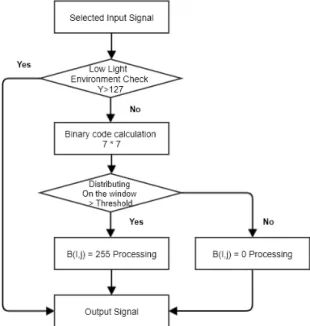
Fig. 1. Signal noise improvement algorithm.

the detailed information of the high-frequency region boundary line is not considered, there is a disadvantage that the blurring phenomenon can not be preserved. Second, there is a method of improving the edge preservation by a transformation method in which the noise mixed image is applied in a modified form according to the change of the threshold value.

Among the methods of using non-spatial linear filtering, there is a median filter method as a leading research method. This is a way of arranging processed pixels and adjacent pixels in small pixel order and then replacing them with the median of the pixel[5].

Ⅲ. Presented method

The algorithm proposed in this paper is an improved algorithm to detect only Gaussian noise in the image output process in order to detect gesture motion in low illumination environment[6].

After extracting only the pixels expected to be Gaussian noise by using the binarized image, the blurring phenomenon of the boundary line is prevented by comparing the dispersion value within the window with the threshold value to determine the binarization. As a result, it was

possible to improve the Gaussian noise of the image detected in the low illumination environment and to prevent the blurring phenomenon. The flowchart of the above algorithm is shown in Fig. 1.

First, all the processes of video output and processing are composed of four 2-dimensional arrays. The color image consists of the luminance signal (Y), the difference (U) between the luminance signal and the blue component. It is also converted to the YUV format, which is the difference (V) between the luminance signal and the red component. Further, only the image represented by the individual luminance signal Y is used. The process of converting to a YUV format image is shown in Equation (1).

Y = 0.3R + 0.59G+ 0.11B (1) U=4.93(B-Y)

V=0.877(R-Y)

Each pixel of the image expressed only by the luminance signal Y has a set value in the range of 0 to 255. If the average of all pixel values is greater than or equal to 128, it is determined that the illumination state is not the image output from the low illumination environment. However, if the average is less than 127, the image is judged to be an image output in a low-illuminance environment. Among the images output in the low-illuminance environment, an image expressed only by the luminance signal (Y) is applied to the binarized image to extract a boundary line.

For the binarization in various domains, the proposed algorithm applies block-sized variance as a threshold value as shown in Fig. 1. algorithm order. Therefore, a pixel having a binary pixel value of ‘255’ is divided into an edge region and a pixel having ‘0’ is a flat region. By determining the binarization by comparing the dispersion value in the window with the appropriate threshold value, the noise component to be recognized as an edge is improved. When determining the window size, the variance value varies depending

(1466)

(3)

352 j.inst.Korean.electr.electron.eng.Vol.23,No.4,1465~1468,December 2019

on the size, so it is set to a constant size of 7 * 7. In addition, when the noise image having a small threshold value is binarized, there is a case where the noise is ‘255’. Also, if the threshold value is high, all noise will have a value of ‘0’, but the edge region will have a value of ‘0’, resulting in an inappropriate binary image.

From above, the threshold values of 0 and 30 are the average of the pixel values represented by Gaussian noise in the image output through the detection of the gesture motion in most low-light environments. As a result, the Gaussian noise included in the image is improved and the portion indicated by the boundary line of the basic image is expressed as it is. When the noise improvement process is completed, a Y luminance signal with improved noise is obtained. Also, an output image of the detected gesture operation is obtained by being converted into a YUV format image.

Ⅳ. Experiment and performance evaluation

After applying the proposed image noise improvement algorithm, it is compared with the Median filter, which is a conventional Gaussian noise improvement method.

(a) Basic image (b) Binarized image

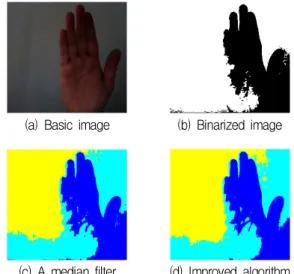
(c) A median filter (d) Improved algorithm Fig. 2. Experiment results on gesture pattern.

Fig. 2. (a) is the basic image and (b) is the

binarized image. In addition, (c) is a median filter applied image and (d) is an experimental result using an improved algorithm. (c) is good for noise improvement in the image reconstruction process, but the boundary line is blurred and the pixel is more deformed than the basic image. The result of the algorithm presented in (d) is similar to (c) in terms of noise improvement performance, but detailed information such as the border is preserved in more detail[7]. Therefore, it can be effectively used to improve noise in images for detecting gesture motion in a low-illuminance environment.

The results of the specific performance analysis are shown in Table 1. As a result, when the proposed method is compared with existing filter application studies, it shows excellent noise improvement performance. Therefore, when the proposed algorithm is applied to the image for detecting the gesture motion in the low illumination environment, it shows that it outputs much better image than the existing image.

Table 1. Comparison of noise components of filters with threshold values.

Threshold Basic image Median filter Improved algorithm

5 12 10 9

10 22 18 16

15 30 24 23

20 40 33 31

25 50 42 39

V. Conclusion

The image noise improvement algorithm proposed in the paper improved the detection of Gaussian noise generated in the video output procedure in order to detect the gesture motion in low illumination environment. As a result, the blurring phenomenon of the boundary line could be improved, and the proposed algorithm selected only the pixels expected to be Gaussian noise using the binarized image.

(1467)

(4)

Proposal of Image Noise Improvement Algorithm for Implementing Hand Gestures 353

Therefore, the dispersion value in the window is compared with the threshold value to prevent the blurring of the boundary line. As a result, noise was reduced by almost 10% compared to the existing Median filter. Therefore, the image noise improvement algorithm proposed in this paper can improve the noise of the output image in the low illumination environment and enlarge the application area for the image detection within complex gesture recognition.

References

[1] K.-I. Kim, S.-H. Han, and J.-S. Park, “A Distortion Correction Method of Wide-Angle Camera Images through the Estimation and Validation of a Camera Model,” JKIECS, Vol.8, No.12, pp.1923-1932, 2013.

DOI: 10.13067/JKIECS.2013.8.11.1923

[2] J.-S. Park, J.-K. Song, and B.-W. Yoon,

“Gaussian Mixture Model Based Smoke Detection Algorithm Robust to Lights Variations,” Journal of the Institute of Electronics Engineers of Korea, Vol.7, No.4, pp.733-739, 2012.

[3] THOMAS S. HUANG, GEORGE J. YANG, GREGORY Y. TANG, “A Fast Two-Dimensional Median Filtering Algorithm,” IEEE TRANSACTIONS ON ACOUSTICS, SPEECH, AND SIGNAL PROCESSING, Vol.ASP-27, NO.1, 1979.

DOI: 10.1109/TASSP.1979.1163188

[4] PETER J. BURT, MEMBER, IEEE, AND EDWARD H. ADELSON, “The Laplacian Pyramid as a Compact Image Code,” IEEE TRANSACTIONS ON COMMUNICATIONS, Vol. COM-3l, NO. 4, 1983. DOI: 10.1109/TCOM.1983.1095851

[5] Tarun Dewangan, M. A. Siddiqui, RCET Bhiali, “Analysis of Contrast Enhancement Method Using Modified Dynamic Histogram Equalization,”

International Journal of Engineering Science and Innovative Technology (IJESIT), Vol.2, 2013.

[6] J.-S. Park, H.-T. Kim and Y.-S. Yu, “Video Based Fire Detection Algorithm using Gaussian Mixture Model,” Journal of the Institute of Electronics

Engineers of Korea, Vol.6, No.2, pp.206-211, 2011. DOI: 10.1007/s11760-017-1102-y

[7] E.-J. Woo, Y.-S. Moon, U.-S. Choi, and J.-W. Kim, “Proposal of Image Detection Algorithm to Implement Hand Gestures,” Dept. of Electronics Engineering, Korea Polytechnic University, 2018.

(1468)

수치

Fig. 1.  Signal  noise  improvement  algorithm.
Table 1.  Comparison  of  noise  components  of  filters  with  threshold  values.

참조

관련 문서