1. INTRODUCTION
With the spread of social network services and online media platforms, the availability of user- created data content increases drastically. These data are often accompanied by human-annotated labels, such as tags associated with images or vid- eos, topic words assigned to Web articles, and ti- tles given to sound clips, etc. In terms of data ac- cessibility, such annotations are generally found to be useful in that they provide a brief idea of data content and can be utilized to design another in- formation retrieval service.
As for the data labels annotated by human, how- ever, those tags or keywords sometimes contain errors in that they are mistakenly selected by the user and irrelevantly matched with the data.
Apparently, identifying and removing those erratic
labels in user-annotated data are one of the im- portant steps in data preprocessing, when one con- siders utilizing the data for any purpose. One way to analyze and discover such mistakes in data is outlier (or anomaly) detection. Outlier detection is a data analytic task that pursues to find unusual instances in a dataset [1-4]. It has been an active research topic in data science and artificial in- telligence communities and frequently used in var- ious applications to identify rare and interesting data patterns that may be associated with either beneficial or malicious events such as fraud identi- fication [5, 6], network intrusion surveillance [7, 8], disease outbreak detection [9], patient monitoring for preventable adverse events (PAE) [10, 11], etc.
It is also utilized as a primary data preprocessing step that helps to remove noisy or irrelevant sig- nals in data [12, 13].
Identification of Incorrect Data Labels Using Conditional Outlier Detection
Charmgil Hong
†ABSTRACT
Outlier detection methods help one to identify unusual instances in data that may correspond to erroneous, exceptional, or surprising events or behaviors. This work studies conditional outlier detection, a special instance of the outlier detection problem, in the context of incorrect data label identification.
Unlike conventional (unconditional) outlier detection methods that seek abnormalities across all data attributes, conditional outlier detection assumes data are given in pairs of input (condition) and output (response or label). Accordingly, the goal of conditional outlier detection is to identify incorrect or unusual output assignments considering their input as condition. As a solution to conditional outlier detection, this paper proposes the ratio-based outlier scoring (ROS) approach and its variant. The propose solutions work by adopting conventional outlier scores and are able to apply them to identify conditional outliers in data. Experiments on synthetic and real-world image datasets are conducted to demonstrate the benefits and advantages of the proposed approaches.
Key words: Conditional Outlier Detection, Outlier Analysis, Anomaly Detection
※ Corresponding Author : Charmgil Hong, Address:
(37554) Handong-ro 558, Buk-gu, Pohang, Gyeongbuk, Korea, TEL : +82-10-2663-9088, FAX : +82-54-260- 1309, E-mail : [email protected]
Receipt date : Jul. 10, 2020, Approval date : Jul. 20, 2020
†School of Computer Science and Electrical Engineering, Handong Global University
This work considers conditional outlier de- tection (COD) [10, 14] and proposes a novel ap- proach to identify errors or mistakes in the annota- tion space. COD is a special case of the outlier de- tection problem that aims to find data objects with unusual values for a subset of variables given the values of the remaining variables. COD is partic- ularly useful when data is considered to manifest conditional dependences among its variables; i.e., a set of variables defines context (input), while the rest are treated as response given the context.
Unlike conventional (unconditional) outlier detec- tion methods that seek abnormalities across all da- ta attributes, COD examines and looks for data in- stances with unusual pairing of input and output values. Accordingly, in the problem of unusual im- age tags (labels) identification, the COD approach could be especially useful as the approach directly considers the annotation (output) space given as- sociated data instance (input).
Despite its importance and usefulness, COD has received relatively less attention, while the ma- jority of existing research have focused on uncon- ditional outliers [2, 15]. However, as conditional outliers are fundamentally different from uncondi- tional outliers in that conditional outliers reflect unusual responses for a given set of contextual at- tributes, applications of unconditional outlier de- tection methods to a COD problem may lead to in- correct results. For instance, consider where one wants to find mistaken image tags in a collection
of annotated images. If an unconditional outlier de- tection method is applied jointly to both images and tags, images with rare themes may get flagged in- stead of images with mistaken tags (false pos- itives) due to the scarcity of the themes in the dataset. Similarly, images with frequent themes but with unusual annotations may not be detected as outliers due to the abundance of similar themes in the dataset (false negative). Fig. 1 illustrates a COD problem with image-annotation pairs.
This paper proposes a new COD solution that works by comparing (via ratio) two unconditional outlier scores: one score calculated against data with the same observed output value; and another calculated against data with the opposite output value. This new approach offers a couple of merits in addressing the COD problem. First, it allows the user to utilize a wide variety of unconditional out- lier scores. Second, it lets one effectively avoid the cases where instances with rare observation but properly associated with the output undesirably re- ceive a high conditional outlier score. Through the paper, the derivation and development of the meth- od is explained. With experiments, the performance and usefulness of the proposed method is demon- strated.
The rest of the paper is organized as follows.
Section 2 revisits the background of conditional outlier detection and relevant research work.
Section 3 presents the new COD framework and discuss its properties. Section 4 compares and
Fig. 1. Examples of conditional outliers. In this example, each data instance contains an image of handwritten digit
[16] and a user-annotated label. Data instances marked with dotted (red) rectangles represent conditional
outliers that are annotated with unusual or incorrect labels compared to the rest.
demonstrates the performance of the proposed solution. Section 5 concludes the paper.
2. BACKGROUND
2.1 Problem Definition: Conditional Outlier Detection (COD)
Given dataset x
n N
, where x∈ℝ
mand ∈ , conditional outliers are the outliers that occur in the output space ( ) conditioned on the input ( X ). That is, the goal in conditional out- lier detection (COD) is to identify data instances that have unusual output value given their input.
This special type of outlier detection problem is challenging because the dependence relations be- tween input and output should be taken into ac- count when identifying outliers. The following subsections review the relevant research and pin- point the main differences that the proposed ap- proach has.
2.2 Conditional Outlier Detection
Conventionally COD for discrete output space is addressed by modeling the posterior distribution and by identifying data objects that do not fit well the model. In other words, data objects that are as- signed a very low posterior probability are consid- ered conditional outliers. Accordingly, depending on how to represent the posterior, a number of methods have been proposed. Hauskrecht et al. [10]
is one of the earliest work that introduced the con- cept and importance of the conditional approach to the outlier problem. The authors used a localized Bayesian networks to represent data with discrete input and output variables. The same group [11, 17] further developed the framework to address COD with mixture of continuous and discrete inputs. Valko and Hauskrecht [18] investigated the instance-specific methods to acquire more accu- rate predictive models for COD. To select instances that are similar to the target instance, the authors presented a new metric learning algorithm.
Although the abovementioned methods directly tackled the COD problem, they are different from the approach proposed in this paper, in that the ex- isting methods are based on specially designed da- ta models or algorithms for conditional outlier de- tection. This work proposes a solution that works by adopting existing unconditional outlier detection methods.
2.3 Unconditional Outlier Detection
While the COD problem has been the focus of some recent research efforts, its unconditional counterpart has long been investigated as the main area of the outlier detection research. One way to summarize existing unconditional methods is to organize them according to the assumptions that each method builds upon. Out of many, the dis- cussion conducted in this paper is directly relevant to the following categories of methods.
∙ Density-based approaches: Density-based approaches assume that the density around a nor- mal data instance is similar to the density around its neighbors, while that of an outlier is relatively lower than its neighbors. Local Outlier Factor (LOF) [19] is one of the most popular methods in this category. LOF has shown a good performance in many applications and is considered as an off-the-shelf outlier detection method. Section 3.1.1 reviews this method more in detail and dis- cusses how to combine LOF with the proposed approach.
∙ Classification-based approaches: Classifica-
tion-based approaches are based on a parametric
assumption that a function of feature classifying
normal and outlier instances can be learned from
data. One-class classification strategy is a popular
technique falls in this category. It assumes that all
training instances are normal, and attempts to
learn a discriminative boundary around the training
(normal) instances. For testing, instances that fall
out of the obtained decision boundary are consid-
ered to be outliers. Support vector machines (SVMs) have been applied to outlier detection us- ing this strategy [20]. Section 3.1.2 reviews this approach and discusses how it is combined in the proposed solution.
2.4 Ensemble Approach to Outlier Detection The approach proposed in this work can be seen as an ensemble approach in that it combines un- conditional outlier scores and weaves them into a conditional outlier score. There have been several work in this direction in the purpose of improving the overall (unconditional) outlier detection per- formance [21, 22]. However, to the best of knowl- edge, there has been no conditional outlier detection method that can is based on an ensemble approach.
3. PROPOSED METHOD
3.1 Ratio of Outlier Scores (ROS)
This paper proposes a new conditional outlier detection approach that works by comparing two unconditional outlier scores and forming a ra- tio-like score: One score is calculated against data with the same observed output value; Another cal- culated against data with the opposite output value.
This new score is referred to as Ratio of Outlier Scores (or Ratio-based Outlier Scoring; ROS). It offers a couple of important advantages. First, it allows to utilize a wide variety of unconditional outlier scores. Also, it lets one effectively avoid the cases where instances with rare observation but properly associated with the output undesirably re- ceive a high conditional outlier score.
More formally, consider a binary-labeled dataset
x
where each instance in con- sists of a continuous input vector x
∈ℝ
, and an associated output value
. For notational convenience,
and
are defined to denote subsets of based on the value of
:
x
A subset of whose output value is equal to
(
does not include the n-th instance)
x
≠
A subset of whose output value is not equal to
Then, for the n-th data instance x
,
R O S
x
is defined as the ratio between two unconditional outlier scores evaluated on
and
, respectively:
R O S
x
x
x
(1)
where
denotes an unconditional outlier score computed for x
on dataset .
ROS measures the unusualness of the input x
being associated with its output
. For normal data instances
R O S
x
would be low, which in turn indicates the outlier score based on
is low and/or
is high. On the other hand, instances with a high ROS score are deemed as outliers, because
R O S
x
is high when the outlier score based on
is high and/or
is low.
Note that Equation (1) easily turns many exist-
ing unconditional outlier scores to conditional out-
lier scores. That is, it can compute and compare
the conditional outlier score of data instances by
simply applying any unconditional outlier score -
such as density-based outlier scores [19, 23], clas-
sification-based outlier scores [20, 24], etc. - to the
subsets of and computing their ratio. Another
advantage of this approach is that it can properly
handle instances that fall in regions of the input
space with low support. For a data instance that
does not have enough support (i.e., an instance falls
in a sparse neighborhood of X ), it is not straight-
forward to come up with an outlier score that is
confident. However, the proposed score suffers less
from the issue, because both
and
will be high in such a sparse region and, as a result, by cancelling each other out in Equation (1), the resulting conditional outlier score will not be high.
In summary, the new conditional outlier de- tection approach based on the ratio-score defines a general and flexible framework that allows one to plug in an unconditional outlier score and use it to perform conditional outlier detection. The next subsections (Sections 3.1.1 and 3.1.2) introduce how to use ROS in combination with the Local Outlier Factor (LOF) and One-Class Support Vec- tor Machine (OCSVM) methods and their defi- nitions [19, 20].
3.1.1 ROS with Local Outlier Factor (LOF) Recall that LOF [19] is a non-parametric ap- proach used to detect unconditional outliers based on the density of the local neighborhood of the tar- get data instance. More specifically, it computes the outlier score of an instance by comparing the local density of the instance to the average local density of its nearest neighbors:
x
x
x
x∈
x
x
x
(2) where
x
denotes the unconditional outlier score for instance x
and dataset ,
x
denotes the -nearest neighbors of instance x
in dataset , and
ξ
∈
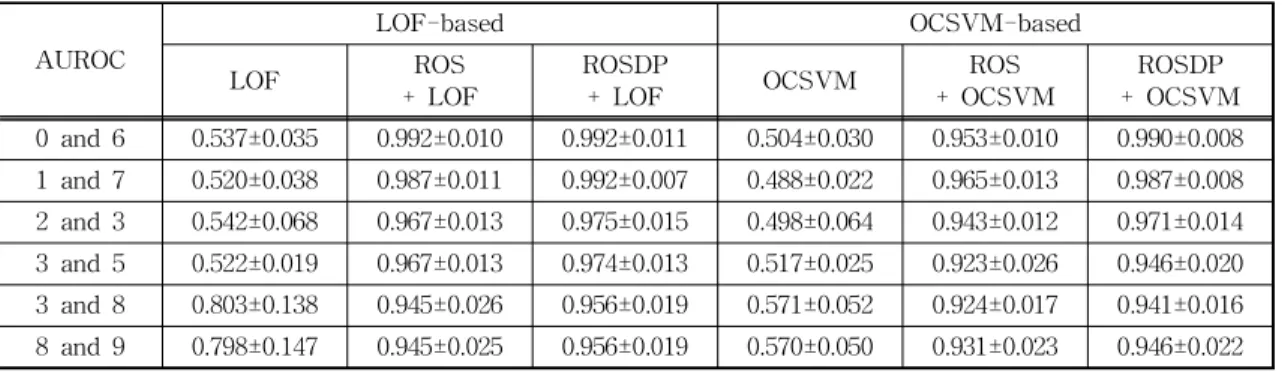
![Fig. 1. Examples of conditional outliers. In this example, each data instance contains an image of handwritten digit [16] and a user-annotated label](https://thumb-ap.123doks.com/thumbv2/123dokinfo/4755234.515764/2.807.122.690.818.958/examples-conditional-outliers-example-instance-contains-handwritten-annotated.webp)
![Fig. 3. The MNIST dataset [16].](https://thumb-ap.123doks.com/thumbv2/123dokinfo/4755234.515764/9.807.85.724.149.301/fig-the-mnist-dataset.webp)