1. Introduction
Considering the number of Small Medium-sized
Enterprises (SME) and the number of their employees, SMEs play an important role in the national economy [1]. However, there are still many improvements to
A Study on Consulting Performance and Intelligibility according to the Consulting Key Activity Index.
- Focusing on Government Supported Convergence Consulting Chang-jae Lee
1, Yen-yoo You
2*, Joo-Sang Jeon
31
Ph.D. student, Dept. of Knowledge Service & Consulting, Hansung University
2
Professor, Dept. of Knowledge Service & Consulting, Hansung University
3
Professor, College of Social Sciences, Hansung University
컨설팅 주요활동지수에 따른 컨설팅 성과 및 이해도에 관한 연구
이창재1, 유연우2*, 전주상3
1한성대학교 지식서비스 컨설팅대학원 박사과정, 2한성대학교 지식서비스 컨설팅 대학원 교수,
3한성대학교 사회과학부 교수
Abstract The purpose of this study is to identify the effects of consulting participation level, consulting specialty, and consulting capability on consulting intelligibility and consulting performance for Small Medium-sized Enterprises (SMEs).This study performed statistical analysis such as AMOS 22.0 to conduct exploratory factor analysis and measurement model in order to identify interrelationship among the consulting participation level, consulting intelligibility and consulting performance. The results of our study are as follow. Firstly and secondly consulting participation level, consulting specialty and consultant capability has positive effect on consulting performance and consulting intelligibility. Thirdly, consulting intelligibility has non positive effect on consulting performance.
According to this survey, it is important to make good consulting performance through consulting participation level, specialty and capability. But the consulting intelligibility is not effected on consulting performance.
Key Words : Convergence, Consulting Participation Level(CPL), Consulting Specialty(CS), Consultant Capability (CC), Consulting Intelligibility(CI), Consulting Performance(CP)
요 약 이번 연구의 목적은 중소기업의 컨설팅성과 및 컨설팅 이해도에 대해 컨설팅 참여도, 전문성 및 컨설팅 능력의 효과를 확인하는 데 있다. 이번 연구는 AMOS 22.0와 같은 통계분석을 수행함으로써 컨설팅 참여 수준, 컨설팅 이해도 및 컨설팅 성과 간의 상호 관계를 파악하기 위해 탐구적 분석과 측정 모델을 실시하였다. 연구 결과는 다음과 같다. 첫째, 두 번째 컨설팅 참여 수준, 컨설팅 전문성과 컨설턴트 능력은 컨설팅 성과 및 컨설팅 파악에 긍정적인 영향을 미친다. 세 번째 로 컨설팅 이해도는 컨설팅 성과에 긍정적인 영향을 미치지는 않는다. 이번 설문조사에 따르면 컨설팅 참여 수준, 전문성과 능력을 통해 좋은 컨설팅 성과를 내는 것이 중요하다. 컨설팅 성과에 대한 컨설팅 이해도는 영향을 주지 않는다.
주제어 : 융합, 컨설팅 참여 수준 (CPL), 컨설팅 전문 분야 (CS), 컨설턴트 역량 (CC), 컨설팅의 명료도 (CI), 컨설팅 성과(CP)
*This research was financially supported by Hansung University.
*Corresponding Author : Yeon-yoo You ([email protected]) Received March 31, 2018
Accepted October 20, 2018
Revised October 1, 2018 Published October 28, 2018
make in terms of maximizing their volume of outputs and value added. In order to solve this problem, the government has continually pursued financial support and consulting service program and policies for SMEs.
We decided to execute this study as there have not been many studies on the significance of such policies and program on companies’ management performance.
In their study on SMEs’ technological competence, Zahra and Bogner [2] claims that how good SME utilizes external assistance from a third party determines their level of performance and Kim Kwang Hun[3] and Ryu Jae Hee[4] claims that more consulting participation level tends to yield better consulting performance. Bae Yong Seop’s [5] study showed consulting specialty’s positive impact on consulting performance. Jeon Woo So’s [6] and Walker [7]
research showed consultant capability’s positive impact on consulting performance. And, Geoghegan and Dulewicz [8] and Simon and Kumar [9] claims that the consulting performance should be evaluated by comprehensive approach. However, there have not been many studies that evaluate the effect of government support for early stage SMEs on their consulting intelligibility and performance. Thus, the purpose of our research is to evaluate the influence on consulting performance and intelligibility by consulting participation level, consulting specialty and consulting capability financial support program and to provide insights whether to expand or continue the government support program and policies like consulting.
2. Literature Reviews
2.1 Consulting Participation Level
Because it is not possible to accurately predict all situations during the actual stage of the execution plan, there may be differences between planning and execution, and monitoring and managing to bridge these gaps at the execution stage is a very important factor. For this reason, consultants who have
participated in previous steps often want to participate in the implementation phase. However, due to the lack of customer awareness of consultants participating in the execution phase, most common consulting projects are completed at the time of submission of the action plan, and in fact only about 30 percent of the practice involves consulting[10]. According to McLachilim[11]
studies, the importance of clear consulting and requirements for consultants, preparation and participation, clear contracts on requirements, expectations, consultants’ encouragement for active participation. And also, Shapiro, Eccles & Soske[12]
showed that consultant interaction for active participation of practitioners and problem solving in the process of consulting and its execution.
2.2 Consulting Specialty
In various studies like Simon & Kumar[9] and Zeira
& Avedisian[13], reputation is defined as the degree of the firm’s brand, size and the consulting result among several characteristics of consulting firm that affect consultants’ competence and achievement. And the consulting specialty is consisted of the scope of the consulting project, the specificity of the project, the appropriacy of the firm’s methodology toward the consulting task, the overall capability of executing project and management ability in Bae young sub’s study[5].
2.3 Consulting Capability
Parry[14] decribes the capability of a consultant to
be measured in terms of relative degree of intellectual
and attitude, based on the given standard. And
McCelland[15] identifies behavior and characteristics of
excellent performers who perform above average on
the given function. Consultant capabilities are
successful in consulting projects. It's a key factor to
do. Consulting completeness, consulting satisfaction,
Research results that affect management performance
and repurchase intentions were confirmed. Consultant
Traces require diverse capabilities such as expertise,
customer orientation, leadership, and job ethics[6]
2.4 Consulting Performance
From the viewpoint of consultant, consulting performance is seen as successful execution of consulting process while progressive companies view performance as consulting activity or business improvements.
In Shapiro et al[12]’s study, according to a research on a means to maximize consulting achievements, it is necessary to adopt appropriate methodology, after considering price pr profits. Also everyone should participate in order to improve the achievements. And Zeira & Avedisan[13] argue that whether an organization can successfully execute an innovation or planned change can be explained by nature of customers, consultants and the environmental characteristics that surround these conditions.
2.5 Consulting Intelligibility
Yoon Sung-hwan[16] said that consulting Intelligibility was a requirement of consulting firm, planned budget and defined to the extent that the project is performed within the scope of the workforce, cost, time and neck Management and effectiveness of a well-developed company in completing consulting based on the degree of achievement of table quality.
They argued that it affects management performance, such as improvement of the eulogy. Similar to consulting completion. If we look at the terms used as a concept in the preceding study, we see that Kerzner[17]. Measuring project performance, meeting time and budget, achieving planned performance, It proposed customer satisfaction and utilization.
Consulting intelligibility refers to whether the company adopts and applies consulting service provided when solving practical problems of the company. Kim ik-sung[18] reported that consulting intelligibility is seen as calculation of SMEs’
representatives, and consulting satisfaction has a positive effect on comprehension.
3. Research Model
3.1 Population and Sample Data selection We selected SMEs that have experienced government supported consulting services as the subjects of study and conducted surveys for about a month starting from January 2016. The total of 283 cases of survey were collected out of 600 that were distributed and after eliminating those with missing entries, 283 cases were actually used in our analysis.
3.2 Measurement and Operational Definition of Variables
For the survey utilized in this study, consulting participation level is defined and measured by management support, the new special organization or TFT, internal support and execution capability of management and consulting specialty is defined by brand awareness and keeping professional manpower in consulting company and possession of consulting tool or methodology [4,5]. Consultant capability is defined as “general capability, ability, knowledge and attitude” for a company to consult [6,19]. And consulting intelligibility is defined by acceptance of consulting effect, needs to solve problems, supporting ability to improve lack of certain area in company [20,21]. Finally consulting performance is defined by improvement of management, R&D and marketing, satisfaction of consulting and management performance [22-24].
Thus, in this study, based on the past studies mentioned above theoretical background and operational definition of variables, we formulated following hypothesis.
H1: The consulting participation level will have a positive impact on the consulting performance.
H2: The consulting participation level will have a positive impact on the consulting intelligibility.
H3: The consulting specialty will have a positive impact on the consulting performance.
H4: The consulting speciality will have a positive
impact on the consulting intelligibility.
H5: The consulting capability will have a positive impact on the consulting performance.
H6: The consulting capability will have a positive impact on the consulting intelligibility.
Fig. 1. Research Model
3.3 Research Model
Based on past studies, we proposed a research model as demonstrated in Fig. 1, to identify the effects of consulting participation level, consulting specialty and consulting capacity on consulting performance and consulting intelligibility among SMEs that have experienced government supported consulting services, and to identify the effects of consulting intelligibility on the consulting performance.
3.4 Validity and Reliability Analysis
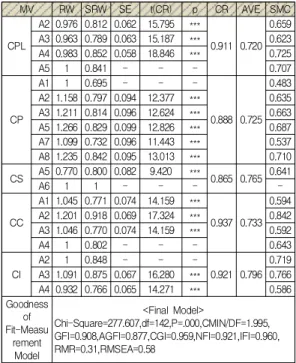
Prior to hypothesis testing, we conducted validity and reliability analysis. We performed exploratory factor analysis for testing the validity, and Varimax rotation method for factor selection and factor loading simplification process. Our analysis is based on those components with eigenvalues greater than 1.0 and loadings greater than 0.40.
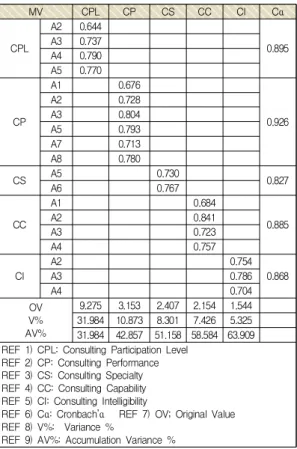
We decided to use all the components as all of them were found reliable and our factor analysis was able to explain 63.909% of the total variance. Based on past studies, 5 variables, which are Consulting Participation Level, Consulting Specialty, Consultant capability, Consulting Intelligibility and Consulting performance, were selected, and reliability testing was performed for
each variable. As shown in Table 1, all the variables appeared reliable as their Cronbach’α values were distributed within 0.827∼0.926.
Table 1. Exploratory Factor Analysis
MV RW SRW SE t(CR) p CR AVE SMC
CPL
A2 0.976 0.812 0.062 15.795 ***
0.911 0.720 0.659 A3 0.963 0.789 0.063 15.187 *** 0.623 A4 0.983 0.852 0.058 18.846 *** 0.725
A5 1 0.841 - - - 0.707
CP
A1 1 0.695 - - -
0.888 0.725 0.483 A2 1.158 0.797 0.094 12.377 *** 0.635 A3 1.211 0.814 0.096 12.624 *** 0.663 A5 1.266 0.829 0.099 12.826 *** 0.687 A7 1.099 0.732 0.096 11.443 *** 0.537 A8 1.235 0.842 0.095 13.013 *** 0.710 CS A5 0.770 0.800 0.082 9.420 ***
0.865 0.765 0.641
A6 1 1 - - - -
CC
A1 1.045 0.771 0.074 14.159 ***
0.937 0.733 0.594 A2 1.201 0.918 0.069 17.324 *** 0.842 A3 1.046 0.770 0.074 14.159 *** 0.592
A4 1 0.802 - - - 0.643
CI
A2 1 0.848 - - -
0.921 0.796 0.719 A3 1.091 0.875 0.067 16.280 *** 0.766 A4 0.932 0.766 0.065 14.271 *** 0.586 Goodness
of Fit-Measu
rement Model
<Final Model>
Chi-Square=277.607,df=142,P=.000,CMIN/DF=1.995, GFI=0.908,AGFI=0.877,CGI=0.959,NFI=0.921,IFI=0.960, RMR=0.31,RMSEA=0.58
*1)MV : Measurement Variable, 2) RW : Regression Weights, 3)SRW : Standard Regression Weights, 4) SE ; Standard Errors, 5)CR ; Critical Ratio. 6)SMC : Squared Multiple Correlation
3.5 Measurement Model Analysis
Prior to analyzing the hypothetical relationship among the variables, confirmatory factory analysis was conducted to test the uni-dimensionality of each measured variable. To assess the fitness of data we used CMIN/DF (<3.0, GFI·AGFI· CFI·NFI·TLI (>0.9), AGFI (>0.8), RMSEA (<0.8).
In order to maximize measurement model’s goodness of fit, any variables that violate acceptable level of SMC values were continually eliminated. Through such process of elimination, acceptable level of convergent validity was achieved with Standardized Regression Weights above 0.7, CR above 0.7 and AVE above 0.5.
Ultimately, the measurement model shown in Table 2 was found to be most appropriate model[25].
Consulting Participation
Level
Consulting Speciality
Consulting Capability
Consulting Intelligibility
Consulting Performance H1
H2 H3
H4
H5 H6
Table 2. Confirmatory Factor Analysis and Goodness of Fit of Measurement Model
MV CPL CP CS CC CI Cα
CPL
A2 0.644
0.895 A3 0.737
A4 0.790 A5 0.770
CP
A1 0.676
0.926
A2 0.728
A3 0.804
A5 0.793
A7 0.713
A8 0.780
CS A5 0.730
0.827
A6 0.767
CC
A1 0.684
0.885
A2 0.841
A3 0.723
A4 0.757
CI
A2 0.754
0.868
A3 0.786
A4 0.704
OV V%
AV%
9.275 3.153 2.407 2.154 1.544 31.984 10.873 8.301 7.426 5.325 31.984 42.857 51.158 58.584 63.909 REF 1) CPL: Consulting Participation Level
REF 2) CP: Consulting Performance REF 3) CS: Consulting Specialty REF 4) CC: Consulting Capability REF 5) CI: Consulting Intelligibility
REF 6) Cα: Cronbach’α REF 7) OV; Original Value REF 8) V%: Variance %
REF 9) AV%: Accumulation Variance %
4. Results and Discussion
4.1 Goodness of Fit of Research Model Structural equation model’s goodness of fit was tested according to the finalized measurement model’s criteria in order to test research model’s goodness of fit and Table 3 explains research model’s goodness of fit.
Table 3. Goodness of Fit of Research Model Reference Value Measured Value
Chi-Square - 277.607
Df - 142
P >0.05 0
CMIN/DF <3.0 1.955
GFI >0.9 0.908
AGFI >0.8 0.877
CFI >0.9 0.959
NFI >0.9 0.921
IFI >0.9 0.960
RMSEA <0.1 0.058
Most of measured Value would be satisfactory compared to Reference level, so the Research model can be selected as suitable model for this research. We can analysis this model and get the testing result which can be explained next line.
4.2 Basic Model Hypothesis Testing result As research model is found appropriate, path coefficients, which are shown in Fig. 2, were analyzed for more detailed hypothesis testing. Better awareness of consulting participation level(H1), consulting specialty(H3) and consulting capability(H5) leads to better awareness of consulting performance (standardized coefficients β=.248, 0.285, 0.320, p<.001 p<0.1) and better awareness of consulting participation level(H2) and consulting capability(H6) leads to better awareness of management intelligibility and consulting specialty(H4) leads to negative impact on that (standardized coefficients β=.270 p<.001, -.179 p<.01, 0.445, p<.001).
Consulting Participation
Level
Consulting Speciality
Consulting Capability
Consulting Intelligibility
Consulting Performance 0.248***
0.270***
0.285***
-.179**
0.320***
0.445***
R2 = 0.370
R2 = 0.342