Application of the Extract of Zanthoxylum piperitum DC to Manufacturing Eco-friendly Antimicrobial Interior Fabric Blind Materials
Li Rui Xie
1, Do Youn Jun
1, Ju Eun Park
1, Gi Hyun Kwon
1, Bonggeun Cho
2, Hyun Woo Park
2, Chang Woo Lee
2, Chang Young Kim
3, Hyo-Il Jung
3and Young Ho Kim
1*
1Laboratory of Immunobiology, School of Life Science and Biotechnology, College of Natural Sciences, Kyungpook National University, Daegu 41566, Korea
2Space Curtains and Blind, Kaksandong 1023-2, Inovelly Ro 89, Daegu 41064, Korea
3Techran Corporation, Gangnamgu Gangnamdae Ro 62 gil 7, Hae-Ju Buiding 2nd Floor, Seoul 06253, Korea Received August 9, 2016 /Revised August 25, 2016 /Accepted August 29, 2016
As the incidence of environmental diseases is increasing due to harmful environmental factors, there is a rising interest in developing eco-friendly materials for housing. In this study, we sought to devel- op antimicrobial interior fabric blind materials by employing ethanol extract of a medicinal plant Zanthoxylum piperitum DC. As determined by the disc diffusion method, the zones of inhibition of the pericarp ethanol extract at a concentration of 5 mg/disc against Klebsiella pneumoniae, Staphylococcus aureus, and Streptococcus mutans were 13.5±1.5 mm, 14.0±0.5 mm and 15.0±0.1 mm, respectively, whereas the leaf ethanol extract (5 mg/disc) against K. pneumoniae, S. aureus, and S. mutans were 12.8±
0.3 mm, 13.5±1.0 mm, and 12.0±0.1 mm, respectively. The IC
50of the leaf ethanol extract against K.
pneumoniae, S. aureus and S. mutans were about 0.5 mg/ml, 0.1 mg/ml and 1.0 mg/ml respectively.
To examine whether the leaf ethanol extract possessing antibacterial activity of Z. piperitum DC can be applicable to production of antimicrobial fabric blind materials, the fabrics treated with either 1.0%
or 2.0% of the leaf ethanol extract were tested for antibacterial activity against K. pneumoniae and S.
aureus using International Standard Fabrics Test Method. The results indicate that the fabric treated with the ethanol extract of Z. piperitum DC possesses an excellent antimicrobial activity against both pathogenic bacteria. These results suggest that Z. piperitum DC may be applicable to producing func- tional fabrics which are effective in reducing the harmful bacterial factors in indoor environments.
Key words : Antibacterial activity, eco-friendly fabric blind materials, Klebsiella pneumoniae, Staphylococcus
aureus, Zanthoxylum piperitum DC
*Corresponding author
*Tel : +82-53-950-5378, Fax : +82-53-955-5522
*E-mail : [email protected]
This is an Open-Access article distributed under the terms of the Creative Commons Attribution Non-Commercial License (http://creativecommons.org/licenses/by-nc/3.0) which permits unrestricted non-commercial use, distribution, and reproduction in any medium, provided the original work is properly cited.
Journal of Life Science 2016 Vol. 26. No. 8. 936~942 DOI : http://dx.doi.org/10.5352/JLS.2016.26.8.936
서 론
생활수준 향상과 더불어 청결과 위생에 대한 개인 및 사회 의 요구 수준이 높아지고 있으며, 산업화에 따른 환경오염과 각종 유해 물질의 사용 증가로 아토피·비염·천식 등 면역계 관련 질환이 폭발적으로 증가하면서 친환경관련 제품에 대한 수요도 함께 커지고 있다. 또한 고도의 인터넷 기술 발달과 생활양식의 변화로 실내 환경에 노출되는 시간이 늘어나면서 실외오염 보다 실내 환경오염에 따른 인체 위해성이 더욱 중 요하게 인식되고 있다[27]. 실내 공기 오염원으로는 화학물질 과 부유물과 같은 무기요소 외에 미생물과 진드기와 같은 생 물학적 요인도 있다. 미생물과 진드기와 같은 생물학적 인자
는 인체에 대해 천식, 알레르기 및 아토피 질환 유발과 밀접한 관계가 있으므로 이들의 제어는 실내 환경 개선에 매우 중요 하다[24]. 이에 본 논문에서는 실내 환경 개선 측면에서 초피의 항균력과 향취를 이용한 기능성 블라인드 원단 개발에 관한 것이다.
초피나무(Zanthoxylum piperitum DC)는 운향과(Rutaceae) 에 속하는 나무로 우리나라 경상남북도 부근에 자생하는 낙엽 떨기나무이다. 주 서식지는 한국을 비롯한 같은 위도 상의 중 국과 일본에서도 서식하는 것으로 알려져 있다. 6월에 황록색 꽃이 피어 가을에 지름 4 mm 정도의 둥근 열매가 익으면 껍질 이 터져 새까만 씨앗이 과피로부터 쉽게 방출된다. 우리나라 에서는 예로부터 식용 및 약용과 관련하여 주로 과피를 많이 이용하여 왔다. 초피나무(Z. piperitum)의 근연식물로 황초피 나무(Z. coreanum), 개산초나무(Z. planispinum), 산초나무(Z.
schinifolium)가 알려져 있으며 지방에 따라 조피, 제피, 지피,
천초, 남초, 진초, 산초, 파초, 촉초으로 불린다. 우리나라와
중국에서는 오래 전부터 민간 및 한방 약재로써 소화제, 탈항
방지, 지사제와 항염증 제재로 이용되어 왔다. 초피의 생리활
성에 대한 연구에 따르면 뛰어난 항산화 활성[11, 26]뿐만 아니
라 타이로시나아제 저해에 의한 미백 작용[14], 항비만[6], 간 기능 보호작용[21], 항균[9, 20] 및 방충활성[3, 5, 10, 18] 등이 보고되었다. 초피에서 분리 동정된 화합물로는 초피잎에서 protocatechuic acid [12], 향기관련 물질로 과피 정유로부터 geranyl acetate, citronellol, alpha-terpineol, citronellal, lina- lool 과 isopulegol [15-17], polymeric procyanidin [20], ali- phatic acid amide [8], hydroxyl-alpha-sanshool [19], querce- tin과 kaempferol [7], 그리고 2종류의 세레토인 유도체인 N,N-dimethylserotonin 5-O-β-glucoside (1a)와 N-methylser- otonin 5-O-β-glucoside (1b) 등이 보고되었다. 초피의 항균력 에 관한 연구보고에 따르면 초피의 정유 성분은 Staphylococcus aureus, Bacillus cereus, Vibrio parahaemolyticus [2], Streptococcus mutans [25] 등에 대해 뛰어난 항균력을 나타낼 뿐만 아니라, 초피 과피 추출물이 메치실린 내성 Staphylococcus aureus (MRSA)에 대해서도 강한 항균력[9]을 지닌 것으로 나타났다.
본 논문에서는 Z. piperitum DC의 방향성 향기와 항균력을 이용한 친환경적 기능성 창호 자원 이용 가능성을 조사하고자 하였다. 먼저 항균력은 뛰어나지만 원료단가가 높은 초피 과 피를 대체할 수 있는 가능성을 타진하기 위해, 초피잎, 종자 추출물의 항균력을 비교 조사하였으며, 항균력과 관련된 물질 을 구명하기 위하여 항균력이 확인된 초피잎 에탄올과 에틸아 세테이트 추출물을 GC-MS로 분석하였다. 또한 초피잎 추출 물을 처리한 블라인드 원단의 항균력을 FITI시험연구원에 의 뢰하여 K. pneumoniae ATCC 4352와 S. aureus ATCC 6538을 공시균주로 하여 KSK 0693방법으로 항균 기능성을 조사하였 다. 이와 같은 연구 결과는 농산폐자원으로 간주되는 초피잎 에 부가가치를 부여할 뿐 아니라 친환경 기능성 창호 자재 개발을 통한 환경성 질환 예방과 실내 환경 개선에도 크게 활용될 수 있을 것으로 사료된다.
재료 및 방법
초피 부위별 추출물 조제
초피나무의 잎, 과피와 종자를 대광농장(DAEKWAG Farm, Gyeongsangnam-do, Korea)으로 부터 2015년도 8월 말경에 구입하여 부위별로 세절 후 Grinder로 분쇄하여 시료로 사용 하였으며, 시료 일부는 경북대학교 생명공학부 면역학연구실 에 보관하였다. 초피 각 부위별 추출물은 80% 에탄올(EtOH) 로 3시간 동안 환류 추출하고 같은 방법으로 3회 반복한 후 모든 추출물을 합하여 회전식 감압농축기로 농축, 및 동결건 조기를 이용하여 건조하였다. 잎의 EtOH 추출물을 물에 녹인 후 메틸렌클로라이드(MC), 에틸아세테이트(EtOAc) 및 부탄 올(n-BuOH) 등의 유기용매를 이용하여 단계별로 추출하였고, 이를 감압농축 후 동결건조하여 본 실험에 사용하였다.
공시균주 및 배지
실험에 사용한 균주는 Klebsiella pneumoniae ATCC 13883, Staphylococcus aureus ATCC 25923과 Streptococcus mutans KCTC 3065이었으며 배양은 Luria-Bertani (LB) 배지를 사용 하였다.
Disc 확산법에 의한 항균활성 측정
초피의 항균활성은 disc 확산법으로 측정하였다. 이를 위해 시험균주를 도말법 또는 double layer 방식으로 고체 플레이 트배지 표면에 접종한 다음, 각 추출물을 DMSO에 용해하여 항균활성 측정에 사용하였다. 이때 DMSO 용액은 직경 7 mm 의 3M paper disc 에 50 μl까지 로딩할 경우에도 균 생육에는 별다른 영향을 미치지 않았다. 항균력은 균 생육 저해에 의한 clear zone 지름으로 확인하였고 각각의 IC
50값은 액체 배양법 으로 측정하였다. 즉, 전 배양한 병원성 미생물들을 LB broth 20 ml 에 OD
600값이 0.01~0.02가 되게 접종하고, 시험하고자 하는 초피 추출물을 농도 별로 처리하여 24 시간 동안 배양한 후 배양액을 적당히 한천배지에 희석 도말하고 배양하여 생균 수를 계측하였다.
초피 활성 성분의 GC-MS 분석
활성성분의 gas chromatography-mass spectrometry (GC-MS) 분석에는 Hewlett-Packard (HP) 6890 gas chroma- tography와 HP5903N mass spectrometer를 사용하였다.
Column은 5% Phenyl Methyl Siloxane을 충진한 HP-5MS ca- pillary column이었으며, helium carrier gas flow rate는 0.7 ml/min으로 60℃에서 15분간 holding 한 후 detector의 온도 를 280℃로 하였고, split ratio은 30:1로 하였다. MS 장비는 electron impact (EI) mode로 50-800 mass unit의 m/z범위에 서 작동시켰다. 시료의 각 성분은 실험에서 얻은 mass spec- trum과 library search로 찾아낸 mass spectrum을 비교하여 확인하였으며, 사용한 program은 NIST/EPA/MSDC이었다.
블라인드 원단에 대한 초피 추출물 처리 및 항균력 검정 초피 추출물을 실내 블라인드 원단에 처리하였을 때, 처리 된 원단에 초피 유래 항균력이 나타나는지를 조사하기 위해 창호전문기업 ㈜ 스페이스로부터 블라인드 소재 원단을 제공 받아, 1% 혹은 2% 농도의 초피잎 EtOH 추출물로 처리한 후, FITI시험연구원에 의뢰하여 검정하였다(www.fiti.re.kr).
통계처리
모든 결과는 3회 이상 반복 실험하였으며 모든 실험값은
평균±표준편차(mean±SD)로 표시하였고, 통계학적 유의치는
비교 분석은 SPSS Statistics 23 (IBM, New York, NY, USA)를
이용하였고 각 결과의 통계 유의치는 Student’s t-test 로 계산
하였다. 검정 유의치는 p 값이 0.05 미만 수준일 때를 기준으로
하였다.
Table 1. Comparison of antimicrobial activities of the EtOH extracts from the pericarps, seeds, or leaves of Zanthoxylum piperitum
DC (mm)*
Microorganisms Pericarps (mg/disc)** Seeds (mg/disc)** Leaves (mg/disc)** Antibiotics***
1 3 5 1 3 5 1 3 5 Ampicillin Tetracycline
K. pneumoniae S. aureus S. mutans
8.8±0.3 8.3±0.3 7.8±0.8
11.5±1.0 11.5±0.5 11.3±1.8
13.5±1.5 14.0±0.5 15.0±0.1
7.5±0.1 7.3±0.3 8.2±0.5
8.8±0.3 9.8±0.8 11.0±0.5
12.3±0.8 12.3±0.3 14.8±1.0
8.8±0.3 8.5±0.0 7.5±0.1
10.8±0.3 11.8±0.8 9.5±1.0
12.8±0.3 13.5±1.0 12.0±0.1
- 35.5±0.5 19.5±0.5
24.5±0.5 28.5±0.5 22.5±0.5
* Zone of inhibition (mm).
** The concentration of extract (mg/disc).
*** Antibiotics (ampicillin and tetracycline) used a positive control at 12.5 μg/disc.
Each value represents the mean±SD.
결과 및 고찰
초피잎의 항균 활성
식용 및 약용으로 활용되고 있는 초피과피의 우수한 방향성 향기 및 항균력을 직물 블라인드소재 산업 분야에서 이용하기 에는 생산 원가면에서 합리적이지 않다. 따라서 농산물 폐자 원으로 폐기되고 있는 초피잎을 이용하여 천연 항균 기능성 블라인드 원단 개발 가능성을 타진하였다. 초피잎을 80% 에탄 올로 추출하여 확보한 추출물의 항균 활성을 초피 종자와 과 피 에탄올 추출물과 비교해 보았다. Table 1에서 보는 바와 같이 시험 균주 K. pneumoniae, S. aureus와 S. mutans에 대한 항균력이 과피에서 가장 강함을 확인하였다. 이때 초피종자와 잎 추출물의 항균력은 과피보다는 약하였으나 초피잎의 항균 력이 시험한 균종에 관계없이 전반적으로 높아 낙엽활엽수인 초피잎 이용은 자원의 활용측면에서 유용할 것으로 사료되었 다(Table 1).
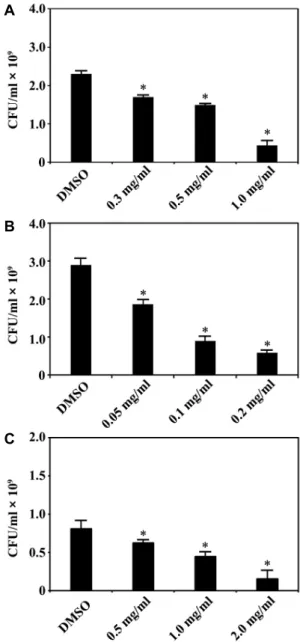
초피잎 에탄올 추출물의 K. pneumoniae, S. aureus와 S. mu- tans에 대한 IC
50값을 조사해 본 결과, K. pneumonia, S. aureus, 및 S. mutans에 대하여 0.5 mg/ml, 0.1 mg/ml, 및 1.0 mg/ml 의 IC
50값을 각각 나타내었다(Fig. 1). 이는 Bhattacharya 등이 Z. nitidum의 뿌리와 줄기 EtOH 추출물을 이용하여 S. aureus 에 대한 MIC를 조사한 결과로서, 뿌리 EtOH 추출물은 0.1563 mg/ml인데 반해 줄기 EtOH 추출물은 0.3125 mg/ml이라고 보고[1]하여 초피잎 EtOH 추출물의 항균력과 유사한 수준이 었다. 그리고 이는 Z. schinifolium의 정유성분이 S. aureus에 대해 MIC값이 10 mg/ml이라고 보고[4]한 것에 비하면 항균 력이 매우 뛰어남을 알 수 있었다. 초피잎의 항균력 관련 소재 를 확인하기 위해, 초피잎 EtOH 추출물을 물에 녹인 후 MC, EtOAc와 n-BuOH로 단계별 추출하여 각 유기용매 분획물을 확보하였으며 이들의 항균력을 그람-양성 세균과 그람-음성 세균을 대상으로 비교 조사하였다. Table 2에서 나타난 바와 같이, 초피잎 유래 각 유기용매 분획물 중 항균 활성을 가지는 분획은 EtOH 추출물과 EtOAc 분획이었으며, 또한 EtOH 추 출물 및 EtOAc 추출물의 항균 활성은 그람-음성세균과 그람- 양성세균에서 공통적으로 나타났으나 균에 대한 감수성은 차
A
B
C
Fig. 1. Inhibitory effect of the EtOH extract from Z. piperitum DC leaves on the viability of K. pneumoniae (A), S. aureus, (B), and S. mutans (C) for 24 hr. Each value is expressed as mean±SD (n = 3 with three replicates per independent experiment). *p<0.05 compared with control.
Table 2. Inhibitory effect of various organic solvent extracts from Z. piperitum DC leaves on the growth of K. pneumoniae, S. aureus, and S. mutans (mm)*
Microorganisms
Ethanol extract (mg/disc)**
Methylene chloride extract (mg/disc)**
Ethyl acetate extract (mg/disc)**
n-Butanol extract (mg/disc)**
1 2 3 1 2 3 1 2 3 1 2 3
K. pneumoniae S. aureus S. mutans
- - -
- 7.5±0.3
-
10.8±0.3 12.0±0.5 10.5±0.1
- - --
- - -
7.5±0.1 9.0±0.3 8.0±0.5
- - 8.0±0.3
- 8.5±0.5 12.5±0.3
7.5±0.1 12.0±1.0 14.0±0.8
- - -
- - -
7.5±0.1 9.0±0.5 8.0±0.1
* Zone of inhibition (mm).
** The concentration of extract (mg/disc).
Each value represents the mean±SD.
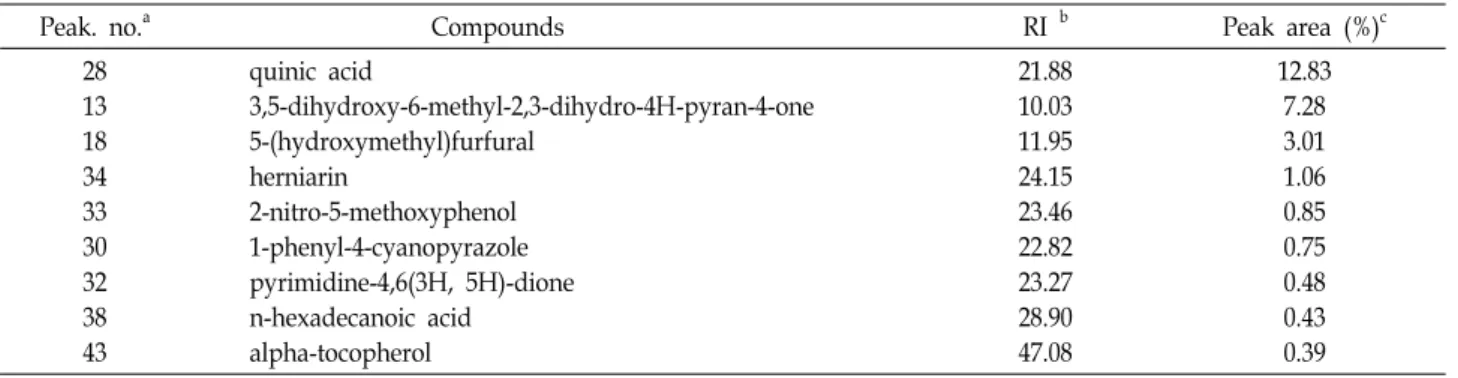
Table 3. The chemical composition of the EtOH extract from Z. piperitum DC leaves
Peak. no.a Compounds RI b Peak area (%)c
28 13 18 34 33 30 32 38 43
quinic acid
3,5-dihydroxy-6-methyl-2,3-dihydro-4H-pyran-4-one 5-(hydroxymethyl)furfural
herniarin
2-nitro-5-methoxyphenol 1-phenyl-4-cyanopyrazole pyrimidine-4,6(3H, 5H)-dione n-hexadecanoic acid
alpha-tocopherol
21.88 10.03 11.95 24.15 23.46 22.82 23.27 28.90 47.08
12.83 7.28 3.01 1.06 0.85 0.75 0.48 0.43 0.39
aNumbering refers to the elution order on a HP-5MS column.
bRetension index on a HP-5MS column.
cPeak area (%) was related to total detected compounds by GC-MS.
이가 있었다. 이는 대부분의 Zanthoxylum속의 추출물이 그람- 음성세균보다는 그람-양성세균에 대해 더 강한 항균력을 나타 낸다는 선행연구 결과와는 상이하였다[4, 23].
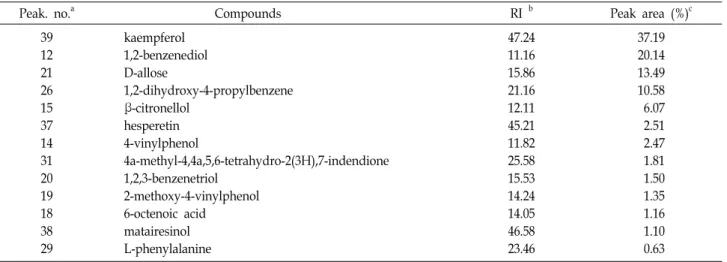
따라서 초피잎으로 부터 항균 관련 소재를 검토하기 위하여 초피잎 EtOH 추출물과 EtOAc 추출물을 GC-MS로 비교 분석 하였다. 초피잎 EtOH 추출물에서는 quinic acid, 3,5-dihy- d r o x y - 6 - m e t h y l - 2 , 3 - d i h y d r o - 4 H - p y r a n - 4 - o n e , 5-(hydroxymethyl)furfural, herniarin, 2-nitro-5-methox- yphenol 등이 상대적으로 높게 확인되었으며, EtOAc 분획에 서는 kaempferol과 1,2-bezenediol이 주성분으로 확인되었고 이 외에 D-allose, 1,2-dihydroxy-4-(1- propyl) benzene, be- ta-citronellol, hesperetin 순으로 확인되었다(Table 3, Table 4). 이들 물질 중 항균력이 보고된 것으로 quinic acid [29], hesperetin [13]과 kaempferol [26] 등이 있다. 현재까지 보고 된 초피 유래 항균 활성 물질은 대부분 정유성분에서 확인된 citronellal, citronellol, isopulegol 등 citronellol계와 neryl acetate 또는 geranyl acetate계 그리고 2-β-pinene, γ -terpinene, β-myrcene, β-phellandrene류들이 알려져 있다.
이상의 연구 결과는, 초피 종자 및 과피 정유성분 외에 잎에서 확인된 quinic acid, hesperetin 및 kaempferol 등도 초피의 항균력과 관련됨을 나타낸다.
항균블라인드 소재로의 초피잎 추출물의 활용 가능성 타진 실내 블라인드 원단에 초피잎 추출물을 가공처리하여 환경 성 질환 관련 유해 미생물 제어 가능성이 있는지를 확인하기 위하여, 블라인드 원단 소재에 초피잎 EtOH 추출물을 1.0%와 2.0% 두 농도를 처리하였다. 블라인드 원단 소재는 대구 소재
㈜ 스페이스에서 제공 받았으며, 초피잎 EtOH 추출물 처리 원단의 항균력은 초피잎 추출물을 처리하지 않은 원단을 대조 구로 하여 비교 조사하였다. Table 5에서 보는 바와 같이, 섬유 의 항균성 시험의 공시 균주인 K. pneumoniae ATCC 4352와 S. aureus ATCC 6538의 증식은 초피잎 EtOH 추출물 1.0%농도 의 처리로도 99.9% 저해함을 알았다. 특히 S. aureus에 대한 항균성이 K. pneumoniae 보다 더 강함을 알았다. S. aureus는 피부 상재균으로 아토피 원인으로 알려져 아토피 환자 약 90%
에서 검출되는 균으로 2차 감염에 따른 화농도 문제가 되지만 이들이 증식하며 분비하는 enterotoxin은 피부염을 악화시키 므로[28], 이 균의 제어는 환경성 질환 예방에 크게 기여할 것 으로 사료된다. 또한 Lin 등이 Zanthoxylum avicennae 추출물은 식물 병원성 미생물에 대한 항균성도 뛰어나다고 보고 한 바 있다[22]. 따라서 같은 속에 속하는 Z. piperitum에도 항 진균성 활성도 검토되면 초피의 보건 위생 및 친환경 소재로의 활용 도가 매우 높을 것으로 사료된다.
이와 같은 연구결과를 종합해 보면 초피과피 정유성분에서
Table 4. The chemical composition of the EtOAc extract from Z. piperitum DC leaves
Peak. no.a Compounds RI b Peak area (%)c
39 12 21 26 15 37 14 31 20 19 18 38 29
kaempferol 1,2-benzenediol D-allose
1,2-dihydroxy-4-propylbenzene β-citronellol
hesperetin 4-vinylphenol
4a-methyl-4,4a,5,6-tetrahydro-2(3H),7-indendione 1,2,3-benzenetriol
2-methoxy-4-vinylphenol 6-octenoic acid
matairesinol L-phenylalanine
47.24 11.16 15.86 21.16 12.11 45.21 11.82 25.58 15.53 14.24 14.05 46.58 23.46
37.19 20.14 13.49 10.58 6.07 2.51 2.47 1.81 1.50 1.35 1.16 1.10 0.63
aNumbering refers to the elution order on a HP-5MS column.
bRetension index on a HP-5MS column.
cPeak area (%) was related to total detected compounds by GC-MS.
Table 5. Antibacterial activity of fabric blind materials treated with the EtOH extract from Z. piperitum DC leaves against the viabilities of K. pneumoniae and S. aureus
Fabric blind materials
K. pneumoniae ATCC 4352 S. aureus ATCC 6538
0 hr 18 hr Reduction of
viable cells (%) 0 hr 18 hr Reduction of viable cells (%) Blank*
Untreated
Treated with 1.0% EtOH extract Treated with 2.0% EtOH extract
2.0×10⁴ 2.0×10⁴ 2.0×10⁴ 2.0×10⁴
2.6×10⁷ 1.3×10⁷ 1.5×10³
<10
- 50.0%
99.9%
99.9%
2.0×10⁴ 2.0×10⁴ 2.0×10⁴ 2.0×10⁴
2.8×10⁶ 5.9×10⁶
<10
<10
- 0.0%
99.9%
99.9%
*None fabric.
확인되던 항균성이 초피잎에서도 확인되었으며, 고온 처리에 의해 휘발되는 정유성분과는 달리 초피잎 추출물을 처리한 블라인드 원단은 autoclave 처리한 후에도 항균력을 유지하여 매우 안정한 화합물 일 것으로 추정되었다. 특히 가격이 높은 초피과피에 비해 농산폐자원으로 버려지는 초피잎을 이용한 항균 블라인드 및 실내 창호 소재 개발은 급증하는 실내 환경 유래 환경성 질환 제어에 매우 유용할 것으로 기대된다. 특히, 항생제 내성 미생물의 원내 감염이 문제 시 되는 병원, 요양원 및 어린이 보육시설의 환경 관리에도 활용 할 수 있어 그 부가 가치가 매우 높을 것으로 사료된다.
감사의 글
이 논문은 중소기업청 2015 구매조건부 신제품개발사업 (Grant No. S2283977) 연구비 지원에 의하여 수행되었음.
References
1. Bhattacharya, S., Zama, M. K. and Haldar, P. K. 2009. Anti-
bacterial activity of stem bark and root of indian Zanthox- ylum nitidum. Asian J. Pharm. Clin. Res. 2, 30-34.
2. Choi, S. I., Chang, K. M., Lee, Y. S. and Kim, G. H. 2008.
Antibacterial activity of essential oils from Zanthoxylum pi- peritum A.P. DC. and Zanthoxylum schinifolium. Food Sci.
Biotechnol. 17, 195-198.
3. Choochote, W., Chaithong, U., Kamsuk, K., Jitpakdi, A., Tippawangkosol, P., Tuetun, B., Champakaew, D. and Pitasawat, B. 2007. Repellent activity of selected essential oils against Aedes aegypti. Fitoterapia 78, 359-364.
4. Diao, W. R., Hu, Q. P., Feng, S. S., Li, W. Q. and Xu, J.
G. 2013. Chemical composition and antibacterial activity of the essential oil from green huajiao (Zanthoxylum schinifo- lium) against selected foodborne pathogens. J. Agric. Food Chem. 61, 6044-6049.
5. Epple, G., Bryant, B. P., Mezine, I. and Lewis, S. 2004.
Zanthoxylum piperitum DC, a potential feeding deterrent for mammals: studies with Mocrotus ochrogaster (Wagner). Pest Manag. Sci. 60, 624-630.
6. Gwon, S. Y., Ahn, J. Y., Kim, T. W. and Ha, T. Y. 2012.
Zanthoxylum piperitum DC ethanol extract suppresses fat ac- cumulation in adipocytes and high fat diet-induced obese
mice by regulating adipogenesis. J. Nutr. Sci. Vitaminol. 58, 393-401.
7. Ha, S. Y., Youn, H., Song, C. S., Kang, S. C., Bae, J. J., Kim, H. T., Lee, K. M., Eom, T. H., Kim, I. S. and Kwak, J. H.
2014. Antiviral effect of flavonol glycosides isolated from the leaf of Zanthoxylum piperitum on influenza virus. J.
Microbiol. 52, 340-344.
8. Hatano, T., Inada, K., Ogawa, T. O., Ito, H. and Yoshida, T. 2004. Aliphatic acid amides of the fruits of Zanthoxylum piperitum. Phytochemistry 65, 2599-2604.
9. Hatano, T., Kusuda, M., Inada, K., Ogawa, T. O., Shiota, S., Tsuchiya, T. and Yoshida, T. 2005. Effects of tannins and related polyphenols on methicillin-resistant Staphylococcus aureus. Phytochemistry 66, 2047-2055.
10. Hieu, T. T., Kim, S. I., Kwon, H. W. and Ahn, Y. J. 2010.
Enhanced repellency of binary mixtures of Zanthoxylum pi- peritum pericarp steam distillate or Zanthoxylum armatum seed oil constituents and Calophyllum inophyllum nut oil and their aerosols to Stomoxys calcitrans. Pest Manag. Sci. 66, 1191-1198.
11. Hisatomi, E., Matsui, M., Kobayashi, A. and Kubota, K.
2000. Antioxidative activity in the pericarp and seed of Japanese pepper (Zanthoxylum piperitum DC). J. Agric. Food Chem. 48, 4924-4928.
12. Hur, J. M., Park, J. G., Yang, K. H., Park, J. C., Park, J. R., Chun, S. S., Choi, J. S. and Choi, J. W. 2003. Effect of meth- anol extract of Zanthoxylum piperitum leaves and of its com- pound, protocatechuic acid, on hepatic drug metabolizing enzymes and lipid peroxidation in rats. Biosci. Biotechnol.
Biochem. 67, 945-950.
13. Iranshahi, M., Rezaee, R., Parhiz, H., Roohbakhsh, A. and Soltani, F. 2015. Protective effects of flavonoids against mi- crobes and toxins: The cases of hesperidin and hesperetin.
Life Sci. 137, 125-132.
14. Jeong, C. H. and Shim, K. H. 2004. Tyrosinase inhibitor iso- lated from the leaves of Zanthoxylum piperitum. Biosci.
Biotechnol. Biochem. 68, 1984-1987.
15. Jiang, L. and Kubota, K. 2001. Formation by mechanical stimulus of the flavor compounds in young leaves of Japanese pepper (Zanthoxylum piperitum DC). J. Agric. Food Chem. 49, 1353-1357.
16. Jiang, L., Kojima, H., Ymada, K., Kobayashi, A. and Kubota, K. 2001. Isolation of some glycosides as aroma precursors in young leaves of Japanese pepper (Zanthoxylum piperitum DC ). J. Agric. Food Chem. 49, 5888-5894.
17. Jiang, L. and Kubota, K. 2004. Differences in the volatile components and their odor characteristics of green and ripe fruits and dried pericarp of Japanese pepper (Zanthoxylum piperitum DC). J. Agric. Food Chem. 52, 4197-4203.
18. Kamsuk, K., Choochote, W., Chaithong, U., Jitpakdi, A.,
Tippawangkosol, P., Riyong, D. and Pitasawat, B. 2007.
Effectiveness of Zanthoxylum piperitum-derived essential oil as an alternative repellent under laboratory and field applications. Parasitol Res. 100, 339-345.
19. Koo, J. Y., Jang, Y., Cho, H., Lee, C. H., Jang, K. H., Chang, Y. H., Shin, J. and Oh, U. 2007. Hydroxy-alpha-sanshool ac- tivates TRPV1 and TRPA1 in sensory neurons. Eur. J.
Neurosci. 26, 1139-1147.
20. Kusuda, M., Inada, K., Ogawa, T. O., Yoshida, T., Shiota, S., Tsuchiya, T. and Hatano, T. 2006. Polyphenolic con- stituent structures of Zanthoxylum piperitum fruit and the an- tibacterial effects of its polymeric procyanidin on methi- cillin-resistant Staphylococcus aureus. Biosci. Biotechnol. Biochem.
70, 1423-1431.
21. Lee, S. J. and Lim, K. T. 2008. Glycoprotein of Zanthoxylum piperitum DC has a hepatoprotective effect via anti-oxidative character in vivo and in vitro. Toxicol. In Vitro 22, 376-385.
22. Lin, Y., Han, W., Ge, W. C. and Yuan, K. 2014. Chemical composition of the volatile oil from Zanthoxylum avicennae and antimicrobial activities and cytotoxicity. Pharmacogn.
Mag. 10(Suppl 1), S164-S170.
23. Luo, X., Pedro, L., Milic, V., Mulhovo, S., Duarte, A., Duarte, N. and Ferreira, M. J. 2012. Antibacterial benzofuran neo- lignans and benzophenanthridine alkaloids from the roots of Zanthoxylum capense. Planta Med. 78, 148-153.
24. Milligan, K. L., Matsui, E. and Sharmam, H. 2016. Asthma in urban children: epidemiology, environmental risk factors, and the public health domain. Curr. Allergy Asthma Rep. 16, 1-10.
25. Park, H. S., Jun, D. Y., Fang, Z., Woo, M. H. and Kim, Y.
H. 2008. Antimicrobial activity of seeds of Zanthoxylum pi- peritum against oral pathogen Streptococcus mutans. J. life Sci.
18, 167-174.
26. Tatsimo, S. J. N., de Dieu Tamokou, J., Havyarimana, L., Csupor, D., Forgo, P., Hohmann, J., Kuiate, J. R. and Tane, P. 2012. Antimicrobial and antioxidant activity of kaempfer- ol rhamnoside derivatives from Bryophyllum pinnatum. BMC Res. Notes 5, 1-6.
27. Viegi, G., Simoni, M., Scognamiglio, A., Baldacci, S., Pistelli, F., Carrozzi, L. and Annesi-Maesano, I. 2004. Indoor air pol- lution and airway disease. Int. J. Tuberc. Lung Dis. 8, 1401- 1415.
28. Wu, S., Duan, N., Gu, H., Hao, L., Ye, H., Gong, W. and Wang, Z. 2016. A review of the methods for detection of Staphylococcus aureus enterotoxins. Toxins 8, 176.
29. Zhang, M., Liu, W. X., Zheng, M. F., Xu, Q. L., Wan, F.
H., Wang, J., Lei, T., Zhou, Z. Y. and Tan, J. W. 2013.
Bioactive quinic acid derivatives from Ageratina adenophora.
Molecules 18, 14096-14104.
초록:초피 추출물을 이용한 친환경 항균 실내 직물 블라인드 소재 개발
시에 리루에이
1․전도연
1․박주은
1․권기현
1․조봉근
2․박현우
2․이창우
2․김창영
3․정효일
3․김영호
1*
(1경북대학교 자연과학대학 생명과학부, 2㈜ 스페이스, 3테크란 컨설턴트)