Effect of the Extract of Hydrangea Dulcis Folium on Alcohol-induced Psychiatric Deficits
Dong Hyun Kim1†, Hye Jin Park1†, Ji Wook Jung2 and Seungheon Lee3*
1Department of Medicinal Biotechnology, College of Natural Resources and Life Science, Dong-A University, Busan 49315, Korea
2Division of Bio-technology and Convergence, College of Herbal Bio-industry, Daegu Haany University, Gyeongsan 38578, Korea
3Department of Marine Life Sciences, School of Marine Biomedical Sciences, College of Ocean Sciences, Jeju National University, Jeju 63243, Korea
Received January 26, 2017 /Revised February 28, 2017 /Accepted March 8, 2017
Consumption of high doses of ethanol can lead to amnesia, which often manifests as a blackout. This incoordination of blackout may be a major cause in various social problems in alcohol consumption.
However, there is still no treatment for preventing these alcohol-induced problems. Hydrangeae dulcis folium is a drug or a tea which is made from the fermented and dried leaves of Hydrangea serrata Seringe. The present study, we tested the ethanol extract of the Hydrangeae dulcis folium (EHDF) on ethanol-induced psychological deficits. To test behavioral deficits, an object recognition test was con- ducted using a mouse model. To evaluate synaptic deficits, N-methyl-D-aspartate (NMDA) re- ceptor-mediated excitatory postsynaptic potential EPSP and long-term potentiation (LTP) in the mouse hippocampal slices were tested, as they are known to be vulnerable to ethanol and are associated with ethanol-induced amnesia. In the tests, ethanol (1 g/kg, i.p.) impaired object recognition memory, but EHDF (10 or 30 mg/kg) prevented this impairment in object recognition test. Interestingly, EHDF (30 μg/ml) significantly ameliorated ethanol-induced LTP and NMDA receptor-mediated synaptic trans- mission in the hippocampal slices. EHDF prevented ethanol-induced object recognition memory defi- cits induced by ethanol. Interestingly, EHDF significantly ameliorated ethanol-induced LTP and NMDA receptor- mediated synaptic transmission in the hippocampal slices.
Key words : Ethanol, hydrangea dulcis folium, NMDA receptor, synaptic plasticity
†Authors contributed equally.
*Corresponding author
*Tel : +82-64-754-3476, Fax : +82-64-756-3493
*E-mail : [email protected]
This is an Open-Access article distributed under the terms of the Creative Commons Attribution Non-Commercial License (http://creativecommons.org/licenses/by-nc/3.0) which permits unrestricted non-commercial use, distribution, and reproduction in any medium, provided the original work is properly cited.
ISSN (Online) 2287-3406 Journal of Life Science 2017 Vol. 27. No. 3. 355~360 DOI : https://doi.org/10.5352/JLS.2017.27.3.355
서 론
알코올은 신경전달물질의 변화를 초래하여 다양한 신경정 신질환을 유발할 수 있다. 대뇌피질 및 해마 등 변연계통의 GABA와 glutamate의 균형에 이상을 초래하여 알코올성 블랙 아웃과 같은 단기 기억상실 현상을 비롯하여 전두엽 기능의 현저한 저하에 따른 판단 능력, 충동 조절 능력 및 기억력 저하 를 부르며 심한 경우 알코올성 치매나 여러 뇌질환으로 이어 진다[8, 17, 21].
이러한 음주에 의한 신경정신 질환의 유발은 개인의 건강과 삶의 질을 현저히 악화시킴은 물론 사회적으로도 매우 위협적 으로 작용한다. 음주 후 정신을 놓은 상태에서는 충동적으로 행동할 가능성이 높고 행동조절이 어렵기 때문에 폭력, 음주 운전, 절도, 심지어 성폭행, 살인과 같은 강력 범죄를 행할 수
있다. 따라서 이러한 알코올에 의한 뇌신경 기능의 변화를 억 제할 수 있는 물질은 다양한 사회적 문제를 줄일 수 있는 수단 이 될 수 있을 것이다[16].
시냅스 가소성은 다양한 신경정신활성에 필요한 뇌의 기능 으로, 시냅스 가소성의 억제는 치매, 건망증, 우울증, 정신분열 증 및 의존증 등에서 변화가 나타난다[6]. 알코올은 농도에 따 라 시냅스 가소성을 다양하게 변화시킬 수 있다고 연구되어 있고 이는 뇌의 기본 신경전달물질인 GABA와 glutamate의 불균형에 의한 것임이 연구되어 있다[18]. 알코올은 GABA 수 용체의 활성화를 유도하고 상대적으로 glutamate 수용체의 활 성 저하를 유도한다[5]. 관련 기전으로는 티로신 탈인산화 효 소(tyrosine phosphatase)의 활성의 억제, NO의 과다 생산을 비롯한 산화적 스트레스가 연구되어 있다[3]. 따라서 알코올에 의한 시냅스 가소성 억제 현상을 개선할 수 있는 물질은 관련 신경정신질환을 치료 또는 경감시키는 의약품 또는 건강보조 식품 소재로 개발이 가능할 것이다.
수국(Hydrangea serrata Seringe)은 쌍떡잎식물 장미목 범의 귀과의 낙엽관목으로, 잎은 마주나고 달걀 모양이며 두껍고 가장자리에는 톱니가 있다. Hydrangea dulcis folium은 수국 잎을 건조 숙성처리한 것으로 예로부터 차로 음용되어왔고 민간에서는 해열제로 사용되기도 했다. 또한, 항말라리아작
- Note -
용, 면역억제작용 및 항비만, 피부미백효과 등이 보고되어있 다[13, 24, 25]. 하지만 신경계에서의 작용, 특히 알코올에 의해 유발되는 신경정신질환에 대한 연구 및 보고는 전무하다.
본 연구자들은 알코올에 의한 신경정신질환에 대해 개선 효능이 탁월한 한약재를 찾고자 연구한 결과, 수국 추출물이 알코올에 의한 시냅스 가소성 장애 극복 효과를 갖는다는 사 실을 확인하여 의약품 또는 건강기능식품의 개발을 위한 기초 자료를 얻고자 하였다.
재료 및 방법 재료
약물 및 시약
알코올(99.9% 에탄올)은 Sigma-Aldrich Chemistry Co. (St.
Louis, MO, USA)에서 구입하여 사용하였다. NBQX는 Tocris Bioscience (Ellisville, MO, USA)에서 구입하여 사용하였다.
그 외 시약은 시중에서 구입할 수 있는 최상급을 사용하였다.
추출물의 제조
본 실험에 사용한 수국은 2015년 5월 한농원(대구, 대한민 국)에서 구입하였으며 정확히 감정한 후 실험에 사용하였고, 그 기준 표본은 제주대학교 해양과학대학 수산약리학 실험실 에 보관하였다(JJUHMP-15-05). 잘 건조된 수국을 분쇄하여 증 류수로 2회 세척한 후, 원생약의 10배의 70% EtOH 수용액을 가하고 60℃로 중탕 가열하여 2회 추출하였다. 추출액을 Whatman (No.1) 여과지로 감압여과하고, 그 여과액을 rotary evaporator로 감압농축하였다. 감압농축을 통해 얻은 점조상 의 추출물을 동결 건조기(FDU-1200, EYELA, Japan)에서 건조 하여 수득한 분말을 실험에 사용하였으며 이 추출물을 EHDF 라 명명하였다(수득률: 24.18%).
실험 동물
6주령의 ICR 마우스(26-28 g)를 (주)샘타코에서 공급받아 동아대학교 생명자원과학대학의 clean cage에 약 5일간 적응 시켜 사용하였으며, 물과 사료는 자유롭게 섭취하도록 하였 고, 온도(23±2℃), 습도(55±10 %) 및 명암주기(12시간)는 자동 으로 조절되도록 하였다. 실험동물의 취급은 실험동물윤리위 원회 동물실험 취급 규정에 따라 사육하고 실험하였다. 동아 대학교 동물실험 윤리심의 위원회의 승인(승인번호: DIACUC- 16-7)을 받아 진행하였다.
방법
해마 조직편의 제작
마우스를 안락사시킨 후, 마우스의 뇌를 빠르게 적출하여, 차가운 인공 뇌척수액(95% O2/5% CO2 폭기; NaCl 124 mM;
KCl 3 mM; NaHCO3 26 mM; NaH2PO4 1.25 mM; CaCl2 2 mM; MgSO4 1 mM; D-glucose 10 mM)에 담가두었다. Micro- vibratome (Lafayette-campden neuroscienceTM)을 이용하여
가로 방향, 400 μm 두께로 절단하여 hippocampal slice를 준비 하였다. Hippocampal slice는 recording chamber (28-30℃, 유 속 ~3 ml/min)에 옮기기 전, 인공 뇌척수액(20-25℃)에 1시간 동안 담가 배양하였다.
세포외 전기생리학적인 측정
해마 조직편을 약 60분간 배양 후 용적이 1 ml 이하인 re- cording chamber로 옮겼다. 기록조 안에서는 산소가 환기되 고 28-30℃가 유지되는 인공 뇌척수액이 분당 3 ml의 속도로 관류되게 유지시켰다. 해마의 CA1 영역의 피라미드층에서 나 오는 신호를 기록하였다. 자극 전극을 셰퍼 평행 접합면 경로 에 위치시키고, 30초 간격으로 정전압 자극을 가하였다.
NMDA 수용체(NMDAR)을 매개하는 field 흥분성 시냅스후 전위(field excitatory postsynaptic potential: fEPSP)를 분리하 기 위하여, NBQX (50 μM)를 기록 중에 관류하였다. 또한 LTP 를 유도하기 위하여, 연속 고주파 자극(high frequency stim- ulation; HFS, 100 pulses at 100 Hz) 을 가하였다. 유발된 field potential response의 기울기는 30초 간격으로 유발된 4회의 연속 기록(EPSP)으로부터 평균을 내어 평가하였다. 또한 전기 생리 실험에서 에탄올(80 mM)을 사용하였다.
Object recognition test
실험 장치는 검은색 아크릴 박스(25 cm×25 cm×25 cm)로 구성되어 있으며, 본 실험은 기존 보고에 묘사된 방법을 이용 하여 진행되었다[23]. 실험이 진행될 환경에서 실험동물을 1시 간 적응시킨 후 본 실험에 앞서 적응 훈련을 진행하기 위해 인식시킬 물체가 없는 실험 장치에 넣어 10분간 적응시켰다.
Sample session은 에탄올의 복강 주사(1 g/kg) 30분 후에 진행 되었다. Sample session 동안, 2 개의 유사한 물체를 넣어 10분 간 마우스가 각 물체를 탐색하는 시간을 측정하였다. 24시간 후 같은 방법으로 실험을 진행하되 2 개의 물체 중 하나는 새로운 물체를 넣어 각 물체를 탐색하는 시간을 5분간 측정하 여 결과값을 discrimination ratio = (새로운 물체 탐색시간 - 다른 물체 탐색시간/(새로운 물체 탐색시간 + 다른 물체 탐색 시간)으로 처리하여 계산하였다. 실험에 사용된 물체는 비슷 한 높이의 금속 재질의 실린더와 플라스틱 재질의 육면체였 다. EHDF는 에탄올 주사 30분 전에 투여되었다.
통계처리
모든 실험 결과의 값은 mean±S.E.M.으로 표현하였으며, 일 원배치분산분석(one-way ANOVA)을 한 후, p<0.05 수준에서 Student-Newman-Keuls test를 이용하여 각 실험군 평균치 간 의 유의성을 검정하였다.
결 과
EHDF rescues binge ethanol-induced memory im- pairment
A B
C D
Fig. 1. EHDF rescues ethanol-induced recognition impairment. (A) EHDF (0-30 mg/kg) was orally treated 30 min before ethanol treatment. Ethanol was intraperitoneally injected 30 min before sample session. Test session was conducted 24 hr after the sample session. (B) Total exploration time during sample test. (C) Total exploration time during test session. (D) Discrimination ratio during test session. Data represent mean±SEM. EtOH, ethanol. EHDF, ethanol extract of the Hydrangea dulcis folium.
CF, caffeine. (*p<0.05 vs EtOH only group, # p<0.05 vs control).
EHDF가 에탄올로 유도된 기억 손상에 미치는 영향을 시험 하기 위해, 우리는 물체 인식 테스트를 수행하였다. EHDF를 EtOH 투여 30분 전에 투여 하였다. 에탄올(1 g/kg, i.p.)은 훈 련 세션 30분 전에 투여되었다. 시험 세션은 24시간 후 수행되 었다(Fig. 1A). 에탄올(1 g/kg)의 급성 투여는 총 탐사시간에 영향을 주지 않으면서 인식 기억과 EHDF가 에탄올 유발 기억 손상(Fig. 1D)에 대해 보호하는 것을 현저하게 손상시켰다 (Fig. 1B, Fig. 1C).
EHDF ameliorates ethanol-induced NMDAR-mediated fEPSP impairment
이전의 보고서에 따르면, 에탄올이 해마 NMDA 수용체 매 개 fEPSP를 손상시키고 이것이 에탄올로 유발된 기억 손상의 메커니즘일 수 있다고 제안했다[9]. 따라서 본 연구자들은 해 마에서의 에탄올 유도 N-methyl-D-aspartate (NMDA) 수용 체 매개 fEPSP 손상에 대한 EHDF의 영향을 시험 하였다.
NMDA 수용체 매개 fEPSP을 분리하기 위해 우리는 α-amino- 3-hydroxy-5-methyl-4-isoxazolepropionic acid (AMPA) 수용 체 길항제인 NBQX (50 μM)를 관류시켰다[1]. EHDF 자체는 NMDA 수용체 매개 fEPSP에 영향을 미치지 않았다(data not shown). 그러나 에탄올(80 mM)은 NMDA 수용체 매개 fEPSP 를 감소시켰지만, EHDF는 에탄올에 의해 억제된 NMDA 수 용체 매개 fEPSP를 회복시켰다(Fig. 2).
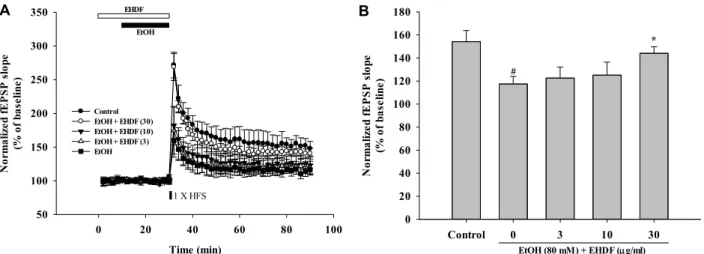
EHDF blocks ethanol-induced LTP impairment 에탄올로 인한 기억 장애에 대한 EHDF의 영향을 시험하기 위해, 에탄올에 의해 LTP가 손상된다는 이전의 보고를 근거하 여 LTP를 검사하였다[9, 10]. 에탄올(80 mM) 처리에 의하여 LTP를 현저하게 감소시켰으나(Control, 154.2±9.7, ethanol, 117.4±6.5%; p<0.05), EHFD의 처리(30 μg/ml)가 에탄올에 의 해 감소된 LTP를 정상수준으로 회복시킴을 확인할 수 있었다 (144.1±5.7%; p<0.05, Fig. 3).
Time (min)
0 20 40 60 80 100
Normalized fEPSP slope (% of baseline)
60 70 80 90 100 110 120
Control EtOH + EHDF EtOH
EtOH EHDF
Fig. 2. EHDF (30 μg/ml) rescues ethanol-induced decrease of fEPSPNMDAR. To isolate fEPSPNMDAR, NBQX (50 μM) was perfused during recording. EHDF reduced ethanol-in- duced decrease of fEPSPNMDAR. Data were normalized to baseline (0-30 min) and represent mean±S.E.M. EtOH, ethanol. EHDF, ethanol extract of the Hydrangea dulcis folium.
Time (min)
0 20 40 60 80 100
Normalized fEPSP slope (% of baseline)
50 100 150 200 250 300 350
Control EtOH + EHDF (30) EtOH + EHDF (10) EtOH + EHDF (3) EtOH
EtOH EHDF
1 X HFS
EtOH (80 mM) + EHDF (μg/ml)
Control 0 3 10 30
Normalized fEPSP slope (% of baseline)
0 20 40 60 80 100 120 140 160 180
#
*
A B
Fig. 3. EHDF rescues ethanol-induced LTP impairment. (A) EHDF (0-30 μg/ml) was perfused from 10 min before ethanol perfusion.
To induce LTP, one train of high frequency stimulation (HFS, 100 pulses at 100 Hz) was delivered. (B) Quantitative analysis of fEPSP slope at 50 min after HFS treatment. Data were normalized to baseline (0-30 min) and represent mean ± S.E.M.
#p<0.05 vs control group. *p<0.05 vs EtOH only group. EtOH, ethanol. EHDF, ethanol extract of the Hydrangea dulcis folium.
고 찰
알코올의 소비량이 증가하면 여러 가지 사회적 문제를 야기 할 수 있으며, 그 사회적 문제를 해결하기 위하여 많은 공적 자금 과 상당한 시간을 투자해야만 한다. 그러나 이러한 문제 를 해결하기 위한 뚜렷한 대책은 아직 마련되어 있지 있다.
알코올 중독으로 인한 신경 장애 중 가장 위험한 것은 운동 장애와 기억 장애(blackout)이다. 본 연구에서, 연구자들은 EHDF가 에탄올로 유도된 이런 장애를 차단한다는 것과 또한 EHDF가 에탄올로 유도된 시냅스 가소성 결손과 NMDA 수용
체 매개 시냅스 전달 장애를 회복시킨다는 것을 확인하였다.
결과적으로 EHDF는 에탄올로 유발된 신경학적 손상을 치료 를 위한 훌륭한 후보 물질이라고 생각된다.
에탄올은 해마에서의 NMDA 수용체 의존형 LTP를 차단하 는 것으로 알려져 있다[4]. 그리고 해마에서의 NMDA 수용체 의존형 LTP는 학습과 기억의 결정적인 메커니즘으로 오래 동 안 믿어져 왔다[2, 11, 12, 15]. NMDA 수용체 길항제는 NMDA 수용체 의존형 LTP 및 학습을 차단한다. 따라서 NMDA 수용 체는 해마에서의 LTP 유도에 밀접한 관련이 있다고 알려져 있다. 또한 에탄올은 NMDA 수용체에 대한 억제제로 알려졌 고[7, 20], 과량의 에탄올이 생쥐의 뇌 내 adenylyl cyclase (AC) 의 활성을 감소시킨다고 보고된 바가 있다[22]. 이것은 AC 활 성제인 forskolin로 해마 절편에서 LTP를 유도할 때, NMDA 수용체가 매개한다는 Otmakhov et al. [19]의 보고와 밀접한 관련이 있다. 과량의 에탄올이 직접적으로 NMDA 수용체를 차단함과 동시에 AC를 억제하여 cyclic adenosine mono- phosphate (cAMP)의 생성을 방해하고, 이 현상의 복합적인 작용으로 NMDA 수용체 의존형 LTP의 유도를 억제한다고 사료된다. 수국의 성분 중 하나인 phyllodulcin은 잠재적인 phosphodiesterase 억제제로 알려져 있다[14]. 게다가 본 연구 에서, EHDF가 해마에서 에탄올로 유도한 NMDA 수용체 의 존형 fEPSP의 감소를 회복시킨다는 것을 알 수 있었다. 그렇기 때문에, EHDF가 cAMP의 회복 또는 증가를 통하여 에탄올로 유도한 NMDA 수용체 의존형 fEPSP의 감소를 회복시킨다고 사료된다.
본 연구 결과는 EHDF가 알코올로 인한 blackout과 같은 신경장애를 치료하기 위한 기능성 소재로 개발이 가능할 것이 라는 것을 시사하지만, 추가적으로 EHDF의 명확한 작용 기전 및 활성 성분에 대한 연구가 필요하다고 사료된다.
감사의 글
이 논문은 2016학년도 제주대학교 학술진흥연구비 지원사 업에 의하여 연구되었음.
References
1. Alvestad, R. M., Grosshans, D. R., Coultrap, S. J., Nakazawa, T., Yamamoto, T. and Browning, M. D. 2003. Tyrosine de- phosphorylation and ethanol inhibition of N-Methyl-D-as- partate receptor function. J. Biol. Chem. 278, 11020-11025.
2. Castillo, P. E., Weisskopf, M. G. and Nicoll, R. A. 1994. The role of Ca2+ channels in hippocampal mossy fiber synaptic transmission and long-term potentiation. Neuron 12, 261-269.
3. Chandler, L. J., Sutton, G., Norwood, D., Sumners, C. and Crews, F. T. 1997. Chronic ethanol increases N-meth- yl-D-aspartate-stimulated nitric oxide formation but not re- ceptor density in cultured cortical neurons. Mol. Pharmacol.
51, 733-740.
4. Chandler, L. J. 2003. Ethanol and brain plasticity: receptors and molecular networks of the postsynaptic density as tar- gets of ethanol. Pharmacol. Ther. 99, 311-326.
5. Chandrasekar, R. 2013. Alcohol and NMDA receptor: cur- rent research and future direction. Front. Mol. Neurosci. 6, 14.
6. Cohen, S. and Greenberg, M. E. 2008. Communication be- tween the synapse and the nucleus in neuronal develop- ment, plasticity, and disease. Ann. Rev. Cell Dev. Biol. 24, 183-209.
7. Dodd, P. R., Beckmann, A. M., Davidson, M. S. and Wilce, P. A. 2000. Glutamate-mediated transmission, alcohol, and alcoholism. Neurochem. Int. 37, 509-533.
8. Gulick, D. and Gould, T. J. 2009. Effects of ethanol and caf- feine on behavior in C57BL/6 mice in the plus-maze dis- criminative avoidance task. Behav. Neurosci. 123, 1271-1278.
9. Hicklin, T. R., Wu, P. H., Radcliffe, R. A., Freund, R. K., Goebel-Goody, S. M., Correa, P. R., Proctor, W. R., Lombro- so, P. J. and Browning, M. D. 2011. Alcohol inhibition of the NMDA receptor function, long-term potentiation, and fear learning requires striatal-enriched protein tyrosine phosphatase. Proc. Natl. Acad. Sci. USA 108, 6650-6655.
10. Izumi, Y., Nagashima, K., Murayama, K. and Zorumski, C.
F. 2005. Acute effects of ethanol on hippocampal long-term potentiation and long-term depression are mediated by dif- ferent mechanisms. Neuroscience 136, 509-517.
11. Jaffe, D. and Johnston, D. 1990. Induction of long-term po- tentiation at hippocampal mossy-fiber synapses follows a Hebbian rule. J. Neurophysiol. 64, 948-960.
12. Johnston, D., Williams, S., Jaffe, D. and Gray, R. 1992.
NMDA-receptor-independent long-term potentiation. Ann.
Rev. Physiol. 54, 489-505.
13. Kamei, K., Matsuoka, H., Furuhata, S. I., Fujisaki, R. I., Kawakami, T., Mogi, S., Yoshihara, H., Aoki, N., Ishii, A.
and Shibuya, T. 2000. Anti-malarial activity of leaf-extract of hydrangea macrophylla, a common Japanese plant. Acta Med. Okayama 54, 227-232.
14. Kawamura, M., Kagata, M., Masaki, E. and Nishi, H. 2002.
Phyllodulcin, a constituent of "Amacha", inhibits phospho- diesterase in bovine adrenocortical cells. Pharmacol. Toxicol.
90, 106-108.
15. Komatsu, Y., Nakajima, S. and Toyama, K. 1991. Induction of long-term potentiation without participation of N-meth- yl-D-aspartate receptors in kitten visual cortex. J. Neurophys- iol. 65, 20-32.
16. Koordeman, R., Anschutz, D. J. and Engels, R. C. 2014.
Self-control and the effects of movie alcohol portrayals on immediate alcohol consumption in male college students.
Front. Psychiatry 5, 187.
17. Liguori, A. and Robinson, J. H. 2001. Caffeine antagonism of alcohol-induced driving impairment. Drug Alcohol Depend. 63, 123-129.
18. McCool, B. A. 2011. Ethanol modulation of synaptic plasti- city. Neuropharmacology 61, 1097-1108.
19. Otmakhov, N., Khibnik, L., Otmakhova, N., Carpenter, S., Riahi, S., Asrican, B. and Lisman, J. 2004. Forskolin-induced LTP in the CA1 hippocampal region is NMDA receptor dependent. J. Neurophysiol. 91, 1955-1962.
20. Silveri, M. M. and Spear, L. P. 2002. The effects of NMDA and GABAA pharmacological manipulations on ethanol sensitivity in immature and mature animals. Alcohol. Clin.
Exp. Res. 26, 449-456.
21. Spinetta, M. J., Woodlee, M. T., Feinberg, L. M., Stroud, C., Schallert, K., Cormack, L. K. and Schallert, T. 2008. Alcohol- induced retrograde memory impairment in rats: prevention by caffeine. Psychopharmacology 201, 361-371.
22. Tabakoff, B., Whelan, J. P., Ovchinnikova, L., Nhamburo, P., Yoshimura, M. and Hoffman, P. L. 1995. Quantitative changes in G proteins do not mediate ethanol-induced downregulation of adenylyl cyclase in mouse cerebral cortex. Alcohol. Clin. Exp. Res. 19, 187-194.
23. Yi, J. H., Park, H. J., Kim, B. C., Kim, D. H. and Ryu, J.
H. 2016. Evidences of the role of the rodent hippocampus in the non-spatial recognition memory. Behav. Brain Res. 297, 141-149.
24. Zhang, H., Matsuda, H., Kumahara, A., Ito, Y., Nakamura, S. and Yoshikawa, M. 2007. New type of anti-diabetic com- pounds from the processed leaves of Hydrangea macro- phylla var. thunbergii (Hydrangeae Dulcis Folium). Bioor.
Med. Chem. Lett 17, 4972-4976.
25. Zhang, H., Matsuda, H., Yamashita, C., Nakamura, S. and Yoshikawa, M. 2009. Hydrangeic acid from the processed leaves of Hydrangea macrophylla var. thunbergii as a new type of anti-diabetic compound. Eur. J. Pharmacol. 606, 255- 261.
초록:수국 추출물이 알코올로 유도한 기억 장애 및 long-term potentiation 억제에 미치는 영향 김동현1†․박혜진1†․정지욱2․이승헌3*
(1동아대학교 건강과학대학 의약생명공학과, 2대구한의대학교 바이오산업대학 바이오산업융합학부, 3제주대학교
해양과학대학 해양생명과학과)
다량의 에탄올을 섭취하면 기억 상실로 이어질 수 있으며, 종종 blackout으로 나타난다. Blackout의 불균형은 알코올 소비에 있어 다양한 사회 문제의 주요 원인이 될 수 있다. 그러나 이러한 알코올 유발 문제를 예방하는 치료법은 아직 존재하지 않는다. Hydrangeae dulcis folium은 Hydrangea serrata Seringe의 잎을 발효가공을 통해 만든 민간약 또는 차이다. 본 연구에서는 에탄올로 유도한 정신적 결핍에 대한 Hydrangeae dulcis folium의 에탄 올 추출물(EHDF)의 효과를 평가하였다. 행동적 결핍 또는 장애를 테스트하기 위해 마우스에서 물체 인식 테스트 가 수행하였다. 또한 시냅스 결손을 평가하기 위해, 마우스 해마 조각에서 에탄올에 취약한 것으로 알려져 있고 에탄올로 유발한 기억 상실과 관련이 있는 N-methyl-D-aspartate (NMDA) 수용체-매개 흥분성 시냅스 후 전위 및 long-term potentiation (LTP)을 측정하였다. 본 연구에서 에탄올(1 g/kg, i.p.)은 물체 인식 메모리를 손상 시켰 지만, EHDF (10 또는 30 mg/kg)는 물체 인식 테스트에서 이러한 장애를 극복하였다. 흥미롭게도, EHDF (30 μ g/ml)는 해마 절편에서 에탄올 처리 후 억제되었던 LTP 및 NMDA 수용체 매개 시냅스 전달을 유의하게 개선시 켰다. EHDF는 에탄올에 의해 유발된 물체 인식 기억력 결핍을 개선하였고, 또한 EHDF는 해마 절편에서 에탄올 유도성 LTP 및 NMDA 수용체 매개성 시냅스 전달을 상당히 개선시켰다.