블랜디드 러닝 기반 STEAM 교육 적용 음악수업이 예비유아교사의 음악지식 및 융합인재소양에 미치는 영향
김옥주
춘해보건대학교 유아교육과
The Effects of Music Lesson Applying the Blended Learning-based STEAM Education on the Musical Knowledge and STEAM Literacy
of Pre-service Kindergarten Teachers
Ok-Ju Kim
Department of Early Childhood Education, Choonhae College of Heath Sciences
요 약 본 연구의 목적은 블랜디드 러닝 기반 STEAM 교육 적용 음악수업이 예비유아교사의 음악지식 및 융합인재소양에
미치는 영향을 분석하는 것이다. 연구를 위하여 O광역시에 소재한 C대학교 유아교육과 3학년 유아음악교육 수강생 20명과 B광역시에 소재한 D대학교 유아교육과 3학년 유아음악교육 수강생 19명을 대상으로 음악지식 및 융합인재소양에 대한 사 전-사후 실험설계를 통하여 효과를 검증하였다. 연구결과, 블랜디드 러닝 기반 STEAM 교육 적용 음악수업을 실시한 실험 집단이 일반적 음악수업을 실시한 통제집단보다 음악지식 모든 영역과 융합인재소양 중 융합, 창의, 소통에서 유의미하게 향상된 결과를 보였다. 이러한 연구결과는 향후 대학교육 현장에서 예비유아교사의 음악지식과 융합인재소양 향상을 돕기 위한 교수학습방법으로 블랜디드 러닝 기반 STEAM 교육 적용 음악수업이 유용하게 활용될 수 있음을 시사한다.
주제어 : 예비유아교사, STEAM 교육, 블랜디드 러닝, 음악지식, 융합인재소양
Abstract
The objective of this study is to analyze the effects of music lesson applying the blended learning-based STEAM education on the musical knowledge and STEAM literacy of pre-service kindergarten teachers. After conducting a pre-test on the musical knowledge and STEAM literacy targeting 20 students(3rd year) of early childhood music lesson in Dept. of Early Childhood Education of C University in O Metropolitan City and 19 students(3rd year) of early childhood music lesson in Dept. of Early Childhood Education of D University in B Metropolitan City, the effectiveness of the pre - post test design was verified. In the results of study, the experimental group with music lesson applying the blended learning-based STEAM education showed significantly improved results in all the areas of musical knowledge and convergence, creativity, and communication out of STEAM literacy than the control group with general music lesson. Such results of this study imply that music lesson applying the blended learning-based STEAM education could be usefully used as a teaching/learning method to improve musical knowledge and STEAM literacy of pre-service kindergarten teachers in university education site in the future.Key Words :
pre-service kindergarten teachers, STEAM education, blended learning, musical knowledge, STEAM literacy*This research was supported by Choonhae College of Health Sciences(2016)
*Corresponding Author : Ok-Ju Kim([email protected]) Received December 13, 2017
Accepted February 20, 2018
Revised December 20, 2017
Published February 28, 2018
1. 서론
유아교사는 생애 첫 단계의 교육을 담당하는 교사로 다른 연령을 담당하는 교사들에 비해 교육에 대한 책무 성이 높다[1]. 유아교사가 교사로서 역할에 대한 책무성 을 다하기 위해서는 교사로서 역량을 키우는 것이 선행 되어야 한다. 역량 있는 교사의 요소는 다양하나, 현대 사 회에서 바라는 역량 있는 교사상은 전공 교과에 대한 교 수지식, 학급 운영, 유아 지도 등의 전문적인 역할 수행 능력뿐만 아니라 그러한 역할을 수행하는데 영향을 미치 는 인성이나 가치관과 같은 개인적인 자질이 수반되어야 한다. 또한 유아의 발달을 촉진시키는 것에서부터 미래 사회를 준비할 수 있도록 좀 더 적극적인 역할을 수행해 줄 것을 기대한다[2].
2016년 다보스포럼을 통해 공표된 4차 산업혁명 시대 는 온라인과 오프라인, 가상과 현실이 결합되는 산업시 스템의 변화로 지금과는 새로운 차원의 세상이 펼쳐질 것으로 예견되었다[3]. 이에 미래사회에서는 혁신적인 사 고를 하기 위해 비판적 사고력, 창조적 문제해결력, 의사 소통능력, 다원화 사회 적응력 등의 중요성이 함께 부각 된다[4]. 이러한 측면에서 유아교사는 유아들이 미래사회 에 적응할 수 있는 인재로 성장할 수 있도록 시대적인 변 화에 대응할 수 있는 능력을 함양해야 할 것이다. 이는 향후 유아교사로서 역할에 대한 책무성을 다하는데 긍정 적인 영향을 미칠 것으로 사료된다. 따라서 유아교사를 양성하는 대학에서부터 시대적 변화에 대응할 수 있는 직업교육의 패러다임 정립으로 예비유아교사를 지원할 수 있는 교육콘텐츠 개발 및 교육방법의 변화를 시도할 필요가 있겠다.
우리 정부는 미래 산업을 주도할 인재를 육성하고자 초ㆍ중등학교를 중심으로 융합인재교육(이하 STEAM 교육)을 강화하였다. STEAM 교육은 과학(Science), 기 술(Technology), 공학(Engineering), 예술(Arts), 수학 (Mathematics)의 약자로, 주어진 문제 상황에 대한 인식 을 통해 창의적으로 문제를 해결하는 과정에서 학문을 통합해 사고하고 스스로 지식을 깨우치게 하는 교육방법 이다[5]. 궁극적으로 학습자들의 융합적 사고력이나 창의 적인 문제 해결력을 배양할 수 있는 수업 설계를 지원한 다[6]. 이러한 배경으로 대학의 단위 교과 수업에서부터 STEAM 교육을 도입한다면, 예비유아교사들이 스스로 지식을 탐구하는 과정 속에서 시대적 변화에 대응할 수
있는 능력을 함께 기를 수 있는 수업 운영으로 의미가 있 을 것이다.
STEAM 교육의 적용 학문은 다양할 수 있겠으나, 선 행연구들[7-9]은 감성과 창의성을 극대화 할 수 있는 음 악을 중심으로한 타 영역과의 STEAM 교육에 대한 긍정 적인 가치를 제안한다. 그동안 음악수업에 STEAM 교육 을 활용한 선행연구들은 주로 초등학생[10,11], 중학생 [12], 고등학생[13,14]을 대상으로 실행되어 왔다. 먼저 초 등학생을 대상으로 한 연구는 수학과 과학의 지식 개념 을 음악활동에 연계하여 다양한 실험 및 음악적 탐구활 동을 통해 음악적 체험의 질적 경험이 가능하도록 음악 교과 중심 STEAM 교육 프로그램을 개발[10]하였거나, STEAM 교육을 적용한 음악 활동들을 구안하여 초등학 교 5학년을 대상으로 음악 교수 학습에 대한 이해도, 흥 미도, 참여도 상승의 요인으로 분석한 연구[11]이다. 다음 으로 중학생 대상 음악적 지식과 음악활동 경험의 심화 를 통하여 창의적이고 융합적인 능력을 키울 수 있는 STEAM 음악수업 적용 연구[12], 고등학생 대상 STEAM 교육을 적용한 음악활동에 대한 수업지도안 및 수업자료를 개발 연구들[13,14]이 있다. 반면 예비유아교 사 대상 STEAM 교육 적용 연구는 음악지식, 음악교수 효능감, 음악태도 및 창의성의 효과를 검증한 연구[5]로 매우 제한적이며, STEAM 교육을 통해서 융합적 사고력 이나 문제 해결력 신장에 효과가 있는지 검증한 연구는 전무한 실정이다. 이에 STEAM 교육을 통해 교과 수업 에 대한 지식뿐만 아니라 융합인재소양 능력을 측정하여 STEAM 교육 본연의 목적에 적절한 수업 운영이었는지 에 대한 검증은 매우 의미 있는 과제일 것이다.
일반적으로 예비유아교사들이 수강하는 음악수업은 단위 교과목에서 학습할 주요 개념에 대한 이론과 유아 교육현장에서 수행하는 음악수업에 대한 모의수업 시연 실기로 구성된다. STEAM 교육의 교수ㆍ학습과정은 상 황제시, 창의적 설계, 감성적 체험, 성공의 경험을 통한 새로운 문제에 도전하는 틀을 제시한다[15]. STEAM 교 육에서 문제해결의 필요성을 구체적으로 느낄 수 있는
‘상황제시’는 학습에 대한 동기부여 측면에서 핵심인 부 분이다. 이에 교과 이론의 핵심 개념에 대해서 주차별 문 제를 제시하고, 유아교육현장과 연계한 모의수업 시연 실기는 프로젝트로 제시하여 STEAM 교육의 효과 [4,5,7-9]를 극대화 하고자한다.
또한 STEAM 교육의 교수ㆍ학습과정과 단위 교과목
의 주차별 학사를 고려할 때, 오프라인 수업만으로 전공 지식에 대한 개념을 학습하는데 충분한 시간을 할애하는 것에는 한계가 있다. 대학에서 배운 방식은 교사가 되어 가르치는데 영향을 주기 때문에 유아교사 양성과정에서 유아음악교육 내용에 근거한 교수법을 연결시킬 수 있도 록 지도하는 것은 중요하다. 전통적인 면대면 교실 수업 에서 부족한 활동을 보완해 주는 블랜디드 러닝은 면대 면 수업 방식과 온라인 수업 방식을 혼합 적용하는 교수 ㆍ학습 방법이다. 블랜디드 러닝은 면대면 교실 수업이 갖고 있는 교육의 유용성을 함께 활용 시 교과 영역에 대 한 개념 이해 및 교수학습방법이 대한 긍정적인 인식 등 에서 학습효과를 높일 수 있다[17,18,24]. 최근 교육용 강 의 및 동영상 자료를 주제별로 정리하여 무상으로 제공 하는 인터넷 사이트가 등장함에 따라 이를 활용하는 새 로운 형태의 블랜디드 러닝인 플립드 러닝[16,19]이 대두 되나, 본 연구에서는 교과목 담당 교수자가 유아음악교 육의 교과 이론에 대해 촬영한 차시 학습주제에 대한 온 라인 동영상 콘텐츠를 대학 내 LMS(Learning Management System)에 탑재 후 학습자가 주도적으로 선행 학습할 수 있도록 온라인 예습-오프라인 교수모형 [24]을 활용한 블랜디드 러닝을 적용하였다. 학습자들이 미리 수업 내용과 관련된 학습을 선행[16]하여 수업시간 에는 STEAM 교육에 대해 교수자와 학생 간의 상호작용 과 심화학습이 가능하도록 하였다.
이런 수업 적용 과정을 통해서 STEAM 교육이 대학 교육 현장에 정착하는데 작은 가이드라인을 제시할 수 있음은 물론, 타 학문 분야에 비해 실천적 연구가 부족한 음악교육 분야에서 STEAM 교육의 방향성에 대한 시사 점을 제시하는데 본 연구의 의의가 있을 것이다.
따라서 본 연구에서는 블랜디드 러닝 기반 STEAM 교육 적용 음악수업을 예비유아교사에게 적용하여 음악 교과에 대한 지식뿐만 아니라 STEAM 교육의 주된 목적 인 융합인재소양 증진에 대한 효과를 검증하는 것을 연 구의 목적으로 하였다.
이러한 연구 목적을 위하여 다음의 연구문제를 설정 하였다.
연구문제1. 블랜디드 러닝 기반 STEAM 교육 적용 음 악수업에 참여한 실험집단 예비유아교사 의 음악지식은 일반적 음악수업에 참여한 통제집단 예비유아교사의 음악지식과 비
교하여 어떤 효과가 있는가?
연구문제2. 블랜디드 러닝 기반 STEAM 교육 적용 음 악수업에 참여한 실험집단 예비유아교사 의 융합인재소양은 일반적 음악수업에 참 여한 통제집단 예비유아교사의 융합인재 소양과 비교하여 어떤 효과가 있는가?
2. 연구방법
2.1 연구대상
본 연구의 대상은 O광역시에 소재한 C대학교 유아교 육과 3학년 유아음악교육 수강생 25명을 실험집단에, B 광역시에 소재한 D대학교 유아교육과 3학년 유아음악교 육 수강생 25명을 비교집단에 무선 배치하였다. 해당 학 기 수업에 1주 이상 참여하지 못하였거나 사전, 사후 검 사 중 어느 하나에 응하지 못한 학생을 제외하고 최종 실 험집단 20명, 통제집단 19명을 연구대상자로 선정하였다.
2.2 연구 설계
본 연구는 블랜디드 러닝 기반 STEAM 교육 적용 음 악수업에 참여한 실험집단 예비유아교사의 음악지식과 융합인재소양이 일반적 음악수업에 참여한 통제집단 예 비유아교사의 음악지식과 융합인재소양과 비교하여 어 떤 효과가 있는지 검증하기 위해 다음의 Table. 1과 같이 실험집단과 통제집단 예비유아교사를 대상으로 각각 사 전, 사후 검사를 실시하였다. 이에 대한 연구 설계는 다 음과 같다.
Group Pre-test Experiment Post-test
Experimental
group O1 X1 O2
Control group O1 X2 O2
O1 : Musical knowledge, STEAM literacy O2 : Musical knowledge, STEAM literacy
X1 : Blended learning-based STEAM education music lesson X2 : General music lesson
Table 1. Research design
2.3 연구 도구 2.3.1 검사 도구 가. 음악지식 검사
예비유아교사의 음악지식을 측정하기 위해 관련 선행
연구들[20, 21]에서 사용한 도구를 본 연구의 목적에 맞 게 수정ㆍ보완하여 사용하였다. 음악지식 검사 도구의 문항은 음악의 개념 8문항, 음악교육방법 5문항, 통합적 교수방법 5문항 총 18문항으로 구성되었다. 5점 척도로 점수가 높을수록 음악지식이 풍부한 것을 의미한다.
나. 융합인재소양 검사
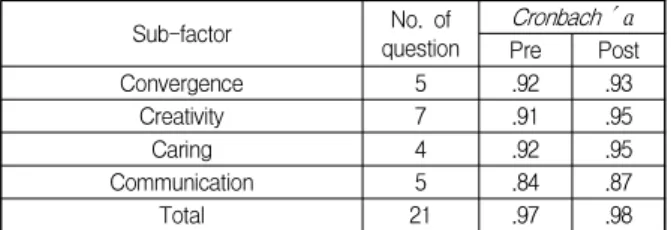
예비유아교사의 융합인재소양을 측정하기 위해 최유 현 등[22]의 연구에서 개발한 융합인재소양 검사 도구를 사용하였다. 검사 도구는 융합 지식을 이해하고 활용하 는 수준을 측정하는 융합 4문항, 창조와 혁신을 추구하는 수준을 측정하는 창의 7문항, 배려와 존중을 실천하는 수 준을 측정하는 존중 4문항, 소통 능력은 갖춘 수준을 측 정하는 소통 5문항 총 21문항으로 구성되었다. 각 문항은 5점 척도로 구성되었으며, 하위요인별 신뢰도는 다음 Table. 2와 같다.
Sub-factor No. of
question Cronbach′α Pre Post
Convergence 5 .92 .93
Creativity 7 .91 .95
Caring 4 .92 .95
Communication 5 .84 .87
Total 21 .97 .98
Table 2. Cronbach′α of each sub-factor of STEAM literacy test tool
2.3.2 실험 도구
본 연구를 위하여 사용한 실험도구는 2014년 한국전 문대학교육협의회 교수학습연구대회 인문사회분야에서 수상한 예비유아교사의 교직역량 강화를 위한 블랜디드 러닝 기반 STEAM-2PBL 교수학습 모형[23]을 토대로 하였다. 본 음악수업의 목적은 국가수준의 음악교육 원 리를 이해하고 유아의 발달에 적합한 음악교육방법을 통 합적으로 계획하여 유아교육현장에 적용할 수 있는 음악 모의수업에 대한 실천적 지식을 함양하는 것이다. 총 14 차시로 구성된 음악수업에서 1~7주차는 유아음악교육 의 이론적인 개념인 음악의 요소, 유아음악교육 내용, 3-5세 누리과정의 이해, 음악영역 내에서의 통합적 교수 방법, 예술영역 내에서의 통합적 교수방법, 학문적 교과 영역 내에서의 통합적 교수방법 등에 대한 내용으로 구 성하였다. 8~14주차는 STEAM 기반 유아음악교육에 대한 모의수업을 설계하여 대학에서 실행 후 수정ㆍ보완 한 최종 모의수업을 유아교육현장에서 실행 후 이론과 실제에 대한 실천적 지식을 함양할 수 있도록 구성하였 다. 본 수업은 1주일에 1회, 블랜디드 러닝 기반 STEAM 교육 적용 음악수업을 총 14차시 적용하였으며, 한 차시 당 150분 내외로 수업을 진행하였다. 반면, 일반적 음악수 업은 1-14차시 수업을 유아음악에 대한 이론적 개념과 모의수업 시연으로 구성하였다. 본 연구의 블랜디드 러 닝 기반 STEAM 교육 적용 음악수업에 대한 구성은 다
section Topic Learning Objectives Lesson contents Blended
learning STEAM education-based
problem & project STEAM element S T E A M 1 Music in daily
life
In daily life, various musical elements can
be found and music activities can be
organized.
․Pre-evaluation of musical knowledge and STEAM literacy
․Music in daily life
․Importance and necessity of music education
- ․Finding musical material in daily life & freely
expressing it in music ○ ○ ○
2 Elements of music
Describe the elements of music that are the classification criteria of
sound.
․Properties of sound
․Elements of music
․Basic music theory ○ ․Finding/classifying
sounds of daily life ○ ○ ○ ○ ○
3
Music educational contents &
development of musicality of young children
The contents of music education can be
distinguished./
Understand musical cognition and expressive ability of
young children.
․Music educational contents(singing, playing instrument, appreciating music, creative activity, expressive activity)
․Development of musicality of young children
○
․Analyzing music educational contents through musical activity video composed by each team in the 1st week ㆍPredicting the age of
young children suitable for the composed musical activity
○ ○ ○ ○ ○
4
Curriculum & Nuri musical environment
Analyze music education education
goals and content categories of 3-5 year
old Nuris course.
․Goal & contents system of music education for young
children(3-5Y) in Nuri Curriculum
․Physical music environment of early childhood education site
○
․Classifying the goals of music education of Nuri Curriculum and then analyzing them in the area of comprehension and expression
○ ○ ○ ○ ○
Table 3. Composition of blended learning-based STEAM education music lesson음 Table. 3과 같다.
2.4 연구절차
본 연구에서는 블랜디드 러닝 기반 STEAM 교육 적
용 음악수업이 예비유아교사의 음악지식 및 융합인재소 양에 미치는 영향을 알아보기 위해서 사전-사후 실험설 계를 통하여 효과를 검증하였다.
section Topic Learning Objectives Lesson contents Blended
learning STEAM education-based
problem & project STEAM element S T E A M 5
Integrated music education method①
This course explores how to utilize integrated music education in music
area.
․Integrated music education area
․Planning/practicing the integrated activity within music area ○
․Expressing musical elements into art after
appreciating music ○ ○ ○ ○ ○
6
Integrated music education method②
This course explores how to use integrated music education in the
arts field.
ㆍIntegration within the academic subject area
ㆍPlanning/practicing the integrated activity within art area
○ ㆍDiscovering musical elements from picture
book ○ ○ ○ ○ ○
7
Integrated music education method③
Students will explore how to use integrated music education within the academic subject
area.
ㆍIntegration within the academic subject area
ㆍPlanning/practicing the integrated activity within the academic subject area
○ ․Combining elements of music, math, science,
and language ○ ○ ○ ○ ○
8 Designing the musical activity
simulation class performance process①②
It is possible to plan music activities that incorporate STEAM elements in the
national level curriculum.
ㆍDesigning the musical activity simulation class demonstration process
․Writing the 1st activity plan for musical activity simulation class demonstration
․Planning/producing the 1st production of teaching aids
○
ㆍDesigning the integrated musical activity simulation class suitable for age
○ ○ ○
9
․Modifying/complementing the 1st activity plan of musical activity simulation class demonstration
․Checking/modifying/complementi ng the 1st production of teaching aids
○
ㆍIntensifying the integrated musical activity simulation class suitable for age
○ ○
10, 11
Demonstrating the musical
activity pre-simulation
class①②
You can demonstrate to the procedure that you planned for the demonstration of music
simulations for infants.
․Explaining the design process of musical activity simulation class demonstration in each team
․Demonstrating the simulation class in each team
․Modifying the simulation class in each team
․Finding the complementation of simulation class in each team
○
ㆍPlanning the
modification/complement ation through the evaluation of preliminary simulation class
○ ○ ○ ○
12
Practicing/eval uating the simulation class demonstration
in site
It is possible to operate the demonstration of the music simulation of
the infant planned in the infant education field according to the
procedure.
․Practicing the 3rd musical activity simulation class in each team at early childhood education site
․Recording the simulation class in video and photo
○
ㆍPracticing the 3rd modified/complemented musical activity simulation class in early childhood education site
○ ○ ○ ○ ○
13
Modifying &
complementing the simulation
class demonstration
in site
Reflect on mock lessons applied in the field of early childhood education and cultivate reflective thinking.
․Analyzing the field practice of musical activity simulation class demonstration after field class
․Discussing the improvement for the efficient application of musical activity simulation class demonstration to site
○
ㆍCompleting the final simulation class after the 4th
modification/complement ation of preliminary simulation class demonstration
○ ○ ○ ○ ○
14 General
discussion
After applying the theoretical knowledge
to the field of early childhood education, the difference between
theory and practice is found.
․Discussing desirable music education in early childhood education site
․Post-evaluation of musical knowledge and STEAM literacy
․Overall evaluation of class satisfaction
-
ㆍEstablishing the meaning of desirable 'early childhood music education'(resolving the practice)
○ ○ ○ ○
2.4.1 사전검사
사전검사는 실험처치를 실시하는 1주차인 2017년 2월 마지막 주에서 3월 첫째 주 실험집단과 통제집단의 음악 지식 수준과 융합인재소양 수준을 파악하기 위해 실험집 단 25명과 통제집단 25명을 대상으로 실험집단은 본 연 구자가 실시하고, 통제집단은 검사 방법에 대한 안내를 받은 교과목 담당 교수자가 실시하였다. 검사는 연구대 상 예비유아교사가 개별적으로 실시하였으며, 소요된 시 간은 20~30분 정도였다.
2.4.2 실험처치
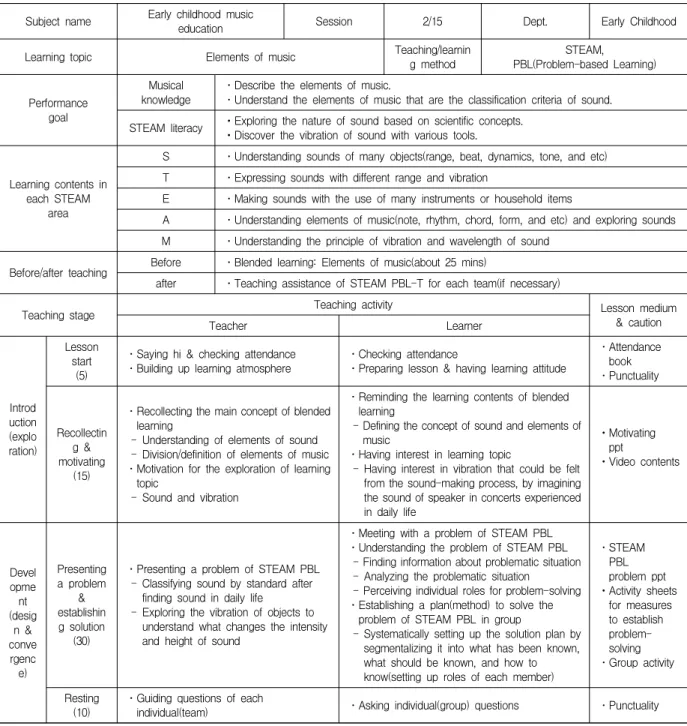
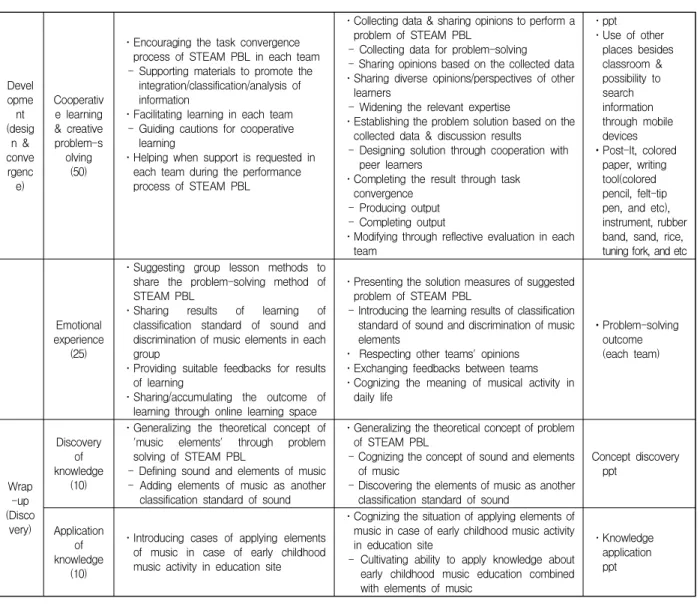
실험처치는 실험집단의 예비유아교사에게 2017년 2월 27일부터 6월 16일까지 주 1회 블랜디드 러닝 기반 STEAM 교육 활용 음악수업을 총 14차시에 걸쳐 진행하 였다. 다음 Table. 4는 실험집단의 블랜디드 러닝 기반 STEAM 교육 적용 음악수업의 2주차 내용을 제시한 것 이다.
Subject name Early childhood music
education Session 2/15 Dept. Early Childhood
Learning topic Elements of music Teaching/learnin
g method STEAM,
PBL(Problem-based Learning)
Performance goal
Musical
knowledge ․Describe the elements of music.
․Understand the elements of music that are the classification criteria of sound.
STEAM literacy ㆍExploring the nature of sound based on scientific concepts.
ㆍDiscover the vibration of sound with various tools.
Learning contents in each STEAM
area
S ․Understanding sounds of many objects(range, beat, dynamics, tone, and etc) T ․Expressing sounds with different range and vibration
E ․Making sounds with the use of many instruments or household items
A ․Understanding elements of music(note, rhythm, chord, form, and etc) and exploring sounds M ․Understanding the principle of vibration and wavelength of sound
Before/after teaching Before ․Blended learning: Elements of music(about 25 mins)
after ․Teaching assistance of STEAM PBL-T for each team(if necessary)
Teaching stage Teaching activity Lesson medium
& caution
Teacher Learner
Introd uction (explo ration)
Lesson start
(5)
․Saying hi & checking attendance
․Building up learning atmosphere ․Checking attendance
․Preparing lesson & having learning attitude
․Attendance
․Punctuality book
Recollectin g &
motivating (15)
․Recollecting the main concept of blended learning
- Understanding of elements of sound - Division/definition of elements of music
․Motivation for the exploration of learning topic
- Sound and vibration
․Reminding the learning contents of blended learning
- Defining the concept of sound and elements of music
․Having interest in learning topic
- Having interest in vibration that could be felt from the sound-making process, by imagining the sound of speaker in concerts experienced in daily life
ㆍMotivating ㆍVideo contents ppt
Devel opme (desig nt n &
conve rgenc e)
Presenting a problem
&
establishin g solution
(30)
․Presenting a problem of STEAM PBL - Classifying sound by standard after
finding sound in daily life
- Exploring the vibration of objects to understand what changes the intensity and height of sound
․Meeting with a problem of STEAM PBL
․Understanding the problem of STEAM PBL - Finding information about problematic situation - Analyzing the problematic situation
- Perceiving individual roles for problem-solving
․Establishing a plan(method) to solve the problem of STEAM PBL in group
- Systematically setting up the solution plan by segmentalizing it into what has been known, what should be known, and how to know(setting up roles of each member)
․STEAM PBL problem ppt ㆍActivity sheets
for measures to establish problem- solving
․Group activity Resting
(10) ․Guiding questions of each
individual(team) ․Asking individual(group) questions ․Punctuality
Table 4. Example of blended learning-based STEAM education music lesson for experimental group(2nd week)
2.4.3 사후검사
사후검사는 블랜디드 러닝 기반 STEAM 교육 적용 음악수업을 14차시에 걸쳐 진행 한 후 2017년 6월 12부터 23일까지 2주간에 거쳐 해당 교과목 시간에 사전검사와 동일한 방법으로 실시하였다.
2.5 자료처리
본 연구를 통해 수집된 자료는 통계프로그램 PASW 18.0을 사용하여 다음과 같이 분석하였다. 첫째, 측정도 구의 신뢰도를 검증하기 위해Cronbach′α 계수를 산출 하였다. 둘째, 실험집단과 통제집단의 사전ㆍ사후 검사 자료를 수집하고 실험집단과 통제집단 각각 사전-사후 대응표본t-검증을 실시한 후 집단 간 독립표본 t-검증을 실시하여 효과를 검정하였다.
3. 연구결과
우선 본 연구를 진행하기에 앞서 예비유아교사의 음 악지식과 융합인재소양 검사 도구를 사용해 사전검사를 실시하여 분석한 결과, 실험집단과 통제집단 간에 음악 지식과 융합인재소양에 있어서 유의미한 차이가 없음을 확인하여 사전검사 결과에서 동질성이 확인되었다.
Section Group N M SD t
music knowledge
Experiment
al 20 2.86 .74
1.21
Control 19 2.66 .31
STEAM literacy
Experiment
al 20 3.78 .59
1.86
Control 19 3.49 .67
Table 5. Pre-test results of music knowledge and STEAM literacy
Devel opme nt (desig n &
conve rgenc e)
Cooperativ e learning
& creative problem-s olving
(50)
․Encouraging the task convergence process of STEAM PBL in each team - Supporting materials to promote the
integration/classification/analysis of information
․Facilitating learning in each team - Guiding cautions for cooperative
learning
․Helping when support is requested in each team during the performance process of STEAM PBL
․Collecting data & sharing opinions to perform a problem of STEAM PBL
- Collecting data for problem-solving - Sharing opinions based on the collected data
․Sharing diverse opinions/perspectives of other learners
- Widening the relevant expertise
․Establishing the problem solution based on the collected data & discussion results
- Designing solution through cooperation with peer learners
․Completing the result through task convergence
- Producing output - Completing output
․Modifying through reflective evaluation in each team
․ppt ․Use of other places besides classroom &
possibility to search information through mobile devices ㆍPost-It, colored
paper, writing tool(colored pencil, felt-tip pen, and etc), instrument, rubber band, sand, rice, tuning fork, and etc
Emotional experience
(25)
․Suggesting group lesson methods to share the problem-solving method of STEAM PBL
․Sharing results of learning of classification standard of sound and discrimination of music elements in each group
․Providing suitable feedbacks for results of learning
․Sharing/accumulating the outcome of learning through online learning space
․Presenting the solution measures of suggested problem of STEAM PBL
- Introducing the learning results of classification standard of sound and discrimination of music elements
․ Respecting other teams' opinions
․Exchanging feedbacks between teams
․Cognizing the meaning of musical activity in daily life
ㆍProblem-solving outcome (each team)
Wrap -up (Disco very)
Discovery of knowledge
(10)
․Generalizing the theoretical concept of 'music elements' through problem solving of STEAM PBL
- Defining sound and elements of music - Adding elements of music as another
classification standard of sound
․Generalizing the theoretical concept of problem of STEAM PBL
- Cognizing the concept of sound and elements of music
- Discovering the elements of music as another classification standard of sound
Concept discovery ppt
Application knowledge of
(10)
․Introducing cases of applying elements of music in case of early childhood music activity in education site
․Cognizing the situation of applying elements of music in case of early childhood music activity in education site
- Cultivating ability to apply knowledge about early childhood music education combined with elements of music
․Knowledge
application
ppt
3.1 블랜디드 러닝 기반 STEAM 교육 적용 음악수 업이 예비유아교사의 음악지식에 미치는 영향 블랜디드 러닝 기반 STEAM 교육 적용 음악수업이 예비유아교사의 음악지식에 영향을 미치는지 알아보기 위하여 실험 실시 후 사후 점수를 이용하여 집단 간 차이 검증을 실시하였다. 본 연구를 통해 나타난 연구결과는 다음 Table. 6과 같다.
Section Group N M SD t
music knowledge total score
Experime
ntal 20 4.01 .58
6.87
***Control 19 3.02 .37 concept of music Experime
ntal 20 4.04 .58 4.99
***Control 19 3.22 .56 music education method Experime
ntal 20 4.24 .69 6.33
***Control 19 3.20 .38 integrated teaching metho Experime
ntal 20 3.75 .62 6.44
***Control 19 2.65 .53
***
p <.001
Table 6. Post test results of musical knowledge between experimental group and control group
Table 6.에서 제시된 바와 같이, ‘전체 음악지식’에 대 한 집단 간 차이를 검증한 결과, 평균 점수가 실험집단 (M=4.01, SD=.58)이 통제집단(M=3.02, SD=.37)보다 높 은 것으로 유의미한 통계적 차이를 보이고 있다(t=6.87, p<.001). 이러한 결과는 일반적 음악수업이나 블랜디드 러닝 기반 STEAM 교육 적용 음악수업 모두 예비유아교 사의 음악지식을 향상시키는데 효과적이나, 상대적으로 블랜디드 러닝 기반 STEAM 교육 적용 음악수업이 예비 유아교사의 음악지식에 더 효과적이라는 것을 입증하는 결과이다.
음악지식 하위요인인 ‘음악적 개념(t=4.99, p<.001)’,
‘음악교육방법(t=6.33, p<.001)’, ‘통합적 교수법(t=6.44, p<.001)’에 대한 집단의 사후검사 결과, 음악지식 하위요 인 모두에서 실험집단이 통제집단보다 높은 것으로 유의 미한 통계적 차이를 보이고 있다. 따라서 일반적 음악수 업이나 블랜디드 러닝 기반 STEAM 교육 적용 음악수업 모두 예비유아교사의 음악지식 하위영역인 ‘음악적 개 념’, ‘음악교수방법’, ‘통합적 교수법’을 향상시키는데 효 과적이나, 상대적으로 블랜디드 러닝 기반 STEAM 교육 적용 음악수업이 모든 음악지식 하위영역에 더 효과가
있다고 해석할 수 있다.
3.2 블랜디드 러닝 기반 STEAM 교육 적용 음악수 업이 예비유아교사의 융합인재소양에 미치는 영향
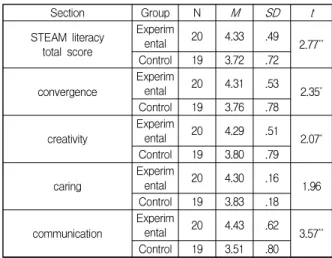
블랜디드 러닝 기반 STEAM 교육 적용 음악수업이 예비유아교사의 융합인재소양에 영향을 미치는지 알아 보기 위하여 실험 실시 후 사후 점수를 이용하여 집단 간 차이 검증을 실시하였다. 본 연구를 통해 나타난 연구결 과는 다음과 같다.
Section Group N M SD t
STEAM literacy total score
Experim
ental 20 4.33 .49 2.77
**Control 19 3.72 .72 convergence Experim
ental 20 4.31 .53 2.35
*Control 19 3.76 .78 creativity Experim
ental 20 4.29 .51 2.07
*Control 19 3.80 .79
caring Experim
ental 20 4.30 .16 1.96
Control 19 3.83 .18 communication
Experim
ental 20 4.43 .62 3.57
**Control 19 3.51 .80
*
p <.05,
**p <.01
Table 7. Post test results of STEAM literacy between experimental group and control group
Table. 7에 제시된 바와 같이, ‘전체 융합인재소양’에 대한 집단 간 차이를 검증한 결과 평균 점수가 실험집단 (M=4.33, SD=.49)이 통제집단(M=3.72, SD=.72)보다 높 은 것으로 유의미한 통계적 차이를 보이고 있다(t=2.77, p<.01). 이러한 결과는 일반적 음악수업이나 블랜디드 러 닝 기반 STEAM 교육 적용 음악수업 모두 예비유아교사 의 융합인재소양을 향상시키는데 효과적이나, 상대적으 로 블랜디드 러닝 기반 STEAM 교육 적용 음악수업이 예비유아교사의 융합인재소양에 더 효과적이라는 것을 입증하는 결과이다.
융합인재소양 하위요인인 ‘융합인재소양 하위요인인
‘융합’, ‘창의’, ‘존중’, ‘소통’에 대한 집단의 사후검사 결과, 융합인재소양 하위요인 중 ‘융합(t=2.35, p<.05)’, ‘창의 (t=2.07, p<.05)’, ‘소통(t=3.57, p<.01)에서 통계적으로 유 의미한 차이를 보였다. 예비유아교사의 융합인재소양 중
‘존중’에서 실험, 통제집단별 차이를 검증한 결과 실험집단 (M=4.30, SD=.16)이 통제집단(M=3.83, SD=.18)보다 높게 나왔으나 통계적으로 유의미한 것으로 나타나지 않았다 (t=1.96, p>.05). 이러한 결과는 일반적 음악수업이나 블 랜디드 러닝 기반 STEAM 교육 적용 음악수업 모두 예 비유아교사의 융합인재소양 향상에 효과가 있으며, 특히,
‘융합’, ‘창의’, ‘소통’을 향상시키는데 효과가 있다고 해석 할 수 있으나, 상대적으로 블랜디드 러닝 기반 STEAM 교육 적용 음악수업이 더 효과가 있다고 해석할 수 있다.
4. 논의 및 결론
본 연구의 연구문제 별 주요결과를 중심으로 논의하 면 다음과 같다.
첫째, 블랜디드 러닝 기반 STEAM 교육 적용 음악수 업은 예비유아교사의 음악지식에 긍정적인 영향을 미치 는 것으로 나타났다. 실험집단 예비유아교사는 통제집단 에 비해 음악지식 전체와 하위영역인 음악의 개념, 음악 교육방법, 통합적 교수법 모두에서 유의미하게 높은 점 수 변화를 보였다. 이러한 결과는 STEAM 교육이 예비 유아교사의 음악지식에 유의한 영향력을 미친다는 이춘 자[5]의 연구 결과와 같은 맥락이다. 이와 같은 긍정적인 효 과가 나타난 것은 두 가지 측면에서 생각해볼 수 있다.
먼저 그 중 하나는 본 연구에서 적용한 음악수업의 교 수ㆍ학습방법 측면이다. 실험집단의 음악수업에서 면대 면 학습과 이러닝 학습을 결함한 블랜디드 러닝을 온라 인 예습-오프라인 강의[17, 18, 24]로 설계하여 오프라인 강의를 보충할 수 있도록 수업 전략을 세웠다. 이를 통해 시간과 공간의 제약을 극복하여 교과의 이론적 주요 개 념에 대한 학습 효과를 극대화하였다. 또한 온라인을 통 해 선행 학습한 음악교과의 주요 개념에 대한 문제 상황 을 오프라인에서 타 학문과 통합할 수 있도록 STEAM 교육을 적용하여 교과 지식에 몰입하여 탐구하고 해결하 는 지속적인 과정에 참여할 수 있도록 하였다. 즉, 예비유 아교사에게 단편적인 지식 전달을 목적으로 하는 것이 아니라 단위 교과의 15주 수업을 통해 예비유아교사가 교과 관련 지식에 대한 문제를 인식하고 스스로 지식을 융합하고 해결할 수 있도록 확장해 가는 과정을 경험해 봄으로써 음악지식이 더욱 증진된 것으로 여겨진다.
실험집단 예비유아교사의 음악지식이 증진되었던 또
다른 이유는 교과목에서 학습한 이론의 주요 개념을 모의수 업 시연과 연계하고 이를 유아교육현장에서 재차 시연할 수 있도록 단계적ㆍ통합적인 수업을 설계함으로써 실제 상황 에 맞는 실천적 지식을 습득할 있다는 점에서 찾아볼 수 있 을 것이다.
둘째, 블랜디드 러닝 기반 STEAM 교육 적용 음악수 업을 실시한 실험집단과 일반적 음악수업을 실시한 통제 집단을 사후 검증한 결과, 실험집단 예비유아교사의 융합인 재소양이 통계적으로 유의미하게 높은 것으로 나타났다.
연구결과를 융합인재소양의 하위영역별로 살펴보면 다음 과 같다.
융합인재소양 하위요소인 ‘융합’은 블랜디드 러닝 기 반 STEAM 교육 적용 음악수업을 실시한 실험집단이 통 계적으로 유의미하게 높은 것으로 나타났다. 이러한 결 과는 매주 문제나 프로젝트를 해결하기 위한 과정에서 관련 지식들을 상황에 적절하게 반영하여 타 학문과 융 합하고 적용하는 과정에서 융합 지식을 이해하고 활용하 는 능력이 향상된 결과라고 사료된다.
‘창의’에 있어서도 블랜디드 러닝 기반 STEAM 교육 적용 음악수업을 실시한 집단이 통계적으로 유의하게 높 은 것으로 나타났다. 이러한 결과는 STEAM 교육이 창 의성 향상에 의미가 있다는 선행연구들[25, 26]의 분석과 일맥상통하는 결과이다. 반면, STEAM 교육이 예비유아 교사의 창의성 점수는 향상에는 영향을 미쳤으나, 통계 적으로 유의미하지 않았다는 이춘자[5]의 연구 결과와는 상이한 부분이 있었다. STEAM 교육의 본래 목적이 학 생들의 창의성 계발과 관련성이 높다[27]는 점에서 창의적 설계 과정과 밀접한 관련이 있을 것으로 사료된다. 본 연 구에서 적용한 음악수업은 150분의 전체 수업에서 80분을 창의적 설계에 할애하고 있다. 이에 실험집단 예비유아 교사의 창의적 사고활동의 향상을 지원한 것으로 추론할 수 있다.
‘소통’ 또한 블랜디드 러닝 기반 STEAM 교육 적용 음악수업을 실시한 집단이 통계적으로 유의하게 높은 것 으로 나타났다. 본 수업은 STEAM 교육의 수업설계 원 칙을을 적용하여 실생활 관련 주제를 문제와 프로젝트로 제시하고 수업을 진행하면서 학생들이 팀을 중심으로 상 호작용을 하면서 과제를 해결할 수 있도록 하였다. 이러 한 점들이 동료 학습자 간의 상호작용을 통해 소통 능력 을 향상시킨 것으로 해석된다.
이상의 논의 및 결론을 바탕으로 후속연구에 대한 제
언을 하면 첫째, 양적연구로 음악지식이나 융합인재소양 등을 정의적인 측면에서 깊이 있게 파악하기 못하였다는 한계가 있다. 앞으로 질적 연구가 함께 이루어진다면 예 비유아교사에 대한 이해를 바탕으로 한 교수ㆍ학습방법 제시에 도움이 될 것이다. 둘째, 음악 교과 외 타 교과에 서도 STEAM 교육을 적용한 음악수업을 실천하고 그 효 과를 검증하는 연구가 지속될 수 있도록 대학교육 현장 교수자의 블랜디드 러닝과 STEAM 교육에 대한 인식 및 필요성에 관한 후속 연구가 수행될 필요가 있다. 마지막으 로 본 연구에서는 대학교육 현장에서 교과지식과 융합인 재소양의 향상을 위해 블랜디드 러닝 기반 STEAM 교육 적용 수업을 활용할 수 있다는 가능성을 제시하였으므로 앞으로 예비유아교사의 교과지식과 융합인재소양의 향상 을 위해 좀 더 다양한 교수ㆍ학습방법에 대한 후속 연구 가 필요하다고 할 수 있다.
REFERENCES
[1] H. S. Kim. (2006). On Becoming the Teacher : Newly Appointed Preschool Teachers' Teaching Stories.
Korean Journal of Early Childhood Education, 26(2).
283-306.
[2] M. H. An, (2005). Relation between Teachers' Specialities and Incentives for their Enhancement, as perceived by Elementary School Teachers. Konkuk of University Graduate school, Ph.D. thesis.
[3] K. W. Jeon. (2017). 4th Industrial Revolution and the infant's creativity training. Journal of Workplace childcare, 51. 4-5.
[4] K. J. Mun. J. Y. Mun. Y. H. Hwang. & S. W. Kim.
Changes in High School Students’ Creative Leader Competency through STEAM R&E. Journal of the Association for Science Education, 37(5).825-833.
[5] C. J. Lee. (2017). The Effect of Music Education for Early Years Using STEAM Education on the Pre-service Early Childhood Teachers’ Musical Knowledge, Music Teaching Efficacy, Musical Attitude and Creativity. The Journal of Humanities and Social Science, 8(5). 1037-1058.
[6] H. K. Hee. (2013). Math lesson applying STEAM education development and application.Daegu National of University Education, Ph.M. thesis.
[7] M. S. Kim. (2015). A music learning method for the development of creativity in liberal education. Journal of
The Korean Association of General Education, 9(1).
333-359.
[8] K. S. Moon. Y. H. Seung. & J. W. Chung. (2016). A Review on the Current Policy and Program Development Studies for STEAM Education from a Perspective of Music Education. Journal of Future Music Education, 1(1).41-61.
[9] E. J. Yang & M. S. Kang. (2015). Development of Music-Science Convergence Program(STEAM):
Focusing on Popular Music Instrument Making and Smart phone Application Composition. Korea Association of Arts Education, 13(3).. 205-219.
[10] M. J. Seok. M. Y. Choi. D. E. Jung & J. H. Jung. (2014).
The Development of a Music-Centered STEAM Program for Elementary School Students. Journal of Research in Curriculum & Instruction, 18(2). 365-385.
[11] E. H. Jung. (2014).STEAM Based Music Teaching and Learning Methods for 5thgraders of Elementary School.
Seoul National University of Education, Ph.M. thesis.
[12] O. J. Hyang. J. E. Jung. S. Y. Kang & M. J. Ha. (2014).
A Study of Application and Examples of STEAM in Secondary Music Classroom. The Journal of Learner-Centerd Curriculum and Instruction, 14(1).
69-97.
[13] K. H. Choi. (2015).A study for the development of music lesson method applying STEAM theory : focused on high-school music class. Yonsei National University of Education, Ph.M. thesis.
[14] D. Y. Sim. (2017). A Study to Develop Lesson Plans and Materials of ‘Creative’ Activities in Music Class by Applying STEAM Education Targeted for Second Year Students in High School. Korean Journal of Arts Education, 15(3).77-100.
[15] H. S. Cho. M. J. Kim & K. W. Nam. (2014). Effects of
"STEAM Education Focusing Music and Movement Activity" on Children`s Problem-Solving skills, Creative Personality, and Emotional Intelligence. Journal of The Korean Society for Early Childhood Teacher Education, 18(2).421-445.
[16] D. Y. Lee. (2013). Research on Developing Instructional Design Models for Flipped Learning. Journal of Digital Convergence, 11(12).83-92.
[17] C. J. Lee. (2011). The Effects of Blended Learning on Early Childhood Pre-Service Teachers` Attitudes toward Mathematics and Perception of Mathematics Teaching Contents and Methods. CNU Journal of Educational Studiesm, 32(2), 149-165.
[18] S. J. Heo. S. D. Cheul & C. S. Kim. (2017). Learning
Effect Analysis for Flipped Learning based Computer Use Instruction. Journal of the Korea Convergence Society, 8(1), 155-162.
[19] D. R. Kim. (2017). Flipped Learning mathematics impact on the University Academic Achievement.Journal of the Korea Convergence Society, 8(6), 209-218.
[20] C. J. Lee. (2015). The Effects of Preservice Early Childhood Teacher’s Music Knowledge and Music Teaching Anxiety on Beliefs of Music Education for Children. Journal of The Korea Society for Children’s Media, 14(4).229-246.
[21] E. J. Jang. (2007). Development of the early childhood music education program model for in-service teachers.
Ewha Womans of University, PhD. thesis.
[22] Y. H. Choi. J. A. Noh. Y. J. Lee. D. W. Lee. E. S. Lee.
& J. H. Noh (2013). The Development of the STEAM Literacy Measurement Instrument for elementary, junior-high, and high school students.Journal of Korean Technology Education Association, 13(2).177-198..
[23] O. J. Kim. (2014). A Study pre-service teachers' teaching capacity Study on Development of blended Learning-based STEAM-2PBL Teaching Learning Model. Teaching and learning research conference excellent case book, 35(2).51-100.
[24] J. T. Kim & H. J. Kim. (2012). Developing a blended instructional learning model optimized for English teaching at off-line universities. Multimedia Assisted Language Learning, 15(1).135-155.
[25] J. W. Km & H. H. Won. (2016). Meta-analysis of creativity effects of STEAM education.Korean journal of educational research, 54(2).169-195.
[26] K. H. Lee. E. K. Kim & K. H. Yo. (2013). The Relationships of Creativity, Problem Solving Ability and Motivation in College Students.The Journal of creativity education, 13(1). 129-139.
[27] M. H. Yoo. G. S. Park. J. J. Choi. M. L. Lim. J. A. Kim.
M. C. Shin. C. S. Lee. Y. E. Lee. H. S. Yu. H. & K.
Chung. (2016). The Development of Appropriate Technology theme STEAM Program for the Elementary Students and its Application Effects on Creative Thinking Activity, Scientific Attitude and Leadership.
Journal of Science Education, 40(2).44-165.
김 옥 주(Ok-Ju Kim) [정회원]
▪2006년 8월 : 신라대학교 교육대 학원 유아교육전공(교육학석사)
▪2010년 2월 : 신라대학교 일반대 학원 유아교육과(교육학박사)
▪2011년 3월 ~ 현재 : 춘해보건대 학교 유아교육과 교수
▪2014년 8월 ~ 2015년 2월 : 춘해보건대학교 교육인증 평가센터장
▪2015년 3월 ~ 현재 : 춘해보건대학교 NCS기반 교육 지원센터장
▪관심분야 : 유아교육, 교사교육, 교육과정, 교수학습
▪E-Mail : [email protected]