Isolation and Characteristics of Fucoidan Degrading Bacterium from Marine
Yu-Ri Lee 1 , Jong Min Lim 3 , Ki-Young Kim 3 , Sung-Bae Mun 3 , Inseok Kwak 2 and Jae Hak Sohn 1 *
1
Department of Bio-Food Material, College of Medical & Life Sciences, Silla University, Busan 617-736, Korea
2
Department of Bioscience, College of Medical & Life Sciences, Silla University, Busan 617-736, Korea
3
Glucan Corp. Kijang-gun, Busan 619-912, Korea
Received November 15, 2012 /Revised December 20, 2012 /Accepted December 21, 2012
A marine bacterial strain that degraded fucoidan from Ecklonia cava was isolated from seawater. The crude fucoidanase of this strain efficiently degraded fucoidan at pH 8 and 50℃. The crude enzyme hydrolyzed 7.1% (w/w) fucoidan within 24 hrs from an 1% (w/v) fucoidan solution and produced oligosaccharides by endo-type hydrolysis as the reaction products. The results of 16S rRNA gene sequence analysis and biochemical tests permitted a tentative identification of strain SB 1493 as a Pseudoalteromonas species.
Key words : Fucoidan, fucoidanase, hydrolysis, marine bacterium, Pseudoalteromonas
*Corresponding author
*Tel:+82-51-999-5629, Fax:+82-51-999-5458
*E-mail : [email protected]
This is an Open-Access article distributed under the terms of the Creative Commons Attribution Non-Commercial License (http://creativecommons.org/licenses/by-nc/3.0) which permits unrestricted non-commercial use, distribution, and reproduction in any medium, provided the original work is properly cited.
Journal of Life Science 2012 Vol. 22. No. 12. 1724~1728 DOI : http://dx.doi.org/10.5352/JLS.2012.22.12.1724
서 론
Fucoidan은 다양한 갈조류의 세포벽에서 발견된다.
Fucoidan과 저분자의 다양한 oligosacchride는 anticoagulant [18,31], antithrombotic/antithrombin activity [20], antiviral [10], anti-inflammation [12], immumodulation [6] 등의 다양 한 생리활성을 갖는다. Fucoidan의 생리활성은 2 또는 4번 위 치에 황을 함유하고 있는 fucose로 구성되고 α-1,2 또는 α-1,3 배당결합을 갖는 homo 또는 hetero형 산성다당류로 구성되는 특이적인 구조에 의해 결정된다. Fucoidan은 fucose 뿐만 아니 라 mannose, xylose, galactose, rhamnose 및 uronic acid를 구성할 수 도 있다. 이러한 생리적인 특성은 전통적인 식품산 업뿐만 아니라 향장 및 의약산업에서 그 활용성에 관심이 집 중되고 있다.
Fucoidan은 고분자량으로 구성되어있어 고부가가치 산업 으로 발전하는데 제한요인으로 작용하고 있으며 생리활성을 증가시키기 위한 저분자량의 fucoidan (low molecular weight fucoidan (LMWF))에 더 관심이 집중되고 있다. 이러한 생리 활성은 분자량, 황함량, 당조성비 등에 의존하고 있다[4,19].
LMWF는 산 및 효소 가수분해에 의해 얻을 수 있으나 전자의 경우 함황 정도와 크기 조절에 어려움을 가지고 있다. 반면 Fucoidan 가수분해효소는 가수분해 특성에 의해 함황량의 변 화 없이 LMWF를 생산하는 특징이 보고되고 있어 산가수분해 기술 보다 이점을 가진다.
Exo- 및 endo-fucoidanase는 척추동물의 간췌장[8,16,22], 해양세균[2,5,9,13-14,24-28,30,33] 및 진균[21,32]이 생산하는 것으로 보고되고 있다. 본 연구에서는 저분자량의 fucoidan 생산을 목적으로 해양으로부터 fucoidan을 분해하는 해양세 균을 분리하고 분류학적 특성과 함께 효소의 특성을 보고하고 자 한다.
Fucoidan 분해미생물의 분리
Fucoidan 분해세균의 분리를 위해, 해수시료를 멸균해수로 희석하여 fucoidan-agar medium (FA; 0.4% (w/v) fucoidan (Ecklonia cava), 10 g Bacto-peptone, 1 g yeast extract, 1 mM ferrous solution, 1.6 mg ammonium nitrate, 8 mM disodium phosphate, 1 l aged seawater, 1.5% agar)에 평판도말하여 25℃
에서 5일간 배양하였다. 성장된 집락들은 동일배지를 이용하 여 순수배양한 후 fucoidan-liquid medium (FL)에 접종하여 25℃에서 2일간 150 rpm에서 진탕배양하였다. 원심분리 (10,000x g, 10 min)한 배양액의 fucoidanase 활성은 Wu 등[32]
의 방법에 의거하여 반응한 후 dinitrosalicylic acid 방법[17]에 의해 전환된 환원당을 정량하였다. 1% (w/v) fucoidan이 첨가 된 0.1 M citric acid–sodium citric buffer (pH 6.0) 1 ml과 배양액 0.1 ml을 첨가하여 50℃에서 10분간 반응하였다. 환원 당 정량을 위한 표준물질은 fucose (Sigma, USA)를 이용하였 다. 효소의 활성은 1분에 1 uM의 fucose를 생산하는 효소의 양을 1 unit (IU)로 정하였다. 단백질의 정량은 Bradford 방법 [3]에 의해 분석하였다.
분리균주의 성장조건과 효소활성을 조사하기 위해 균주 는 FL배지에 접종하여 25℃에서 1일간 전배양한 후 신선한 배지에 0.1% (v/v)를 접종하였다. 배양 온도는 25, 30, 35℃
에서 진탕배양(150 rpm)하였다. pH에 따른 성장조사를 위
한 FL배지는 1 N NaOH와 1 N HCl을 이용하여 pH 4~9로
조정하였으며 NaCl 농도에 따른 성장조사를 위한 FL배지는
- Note -
A
Temperatutre(
oC )
24 26 28 30 32 34 36
O D a t 6 6 0 n m
0 2 4 6 8 10
80 100 120 140 160 180
B
pH
3 4 5 6 7 8 9 10
0 2 4 6 8 10
80 100 120 140 160 180
C
NaCl concentration(%, w/v)
0 5 10 15 20
0 2 4 6 8 10
U n it /m l
80 100 120 140 160 180
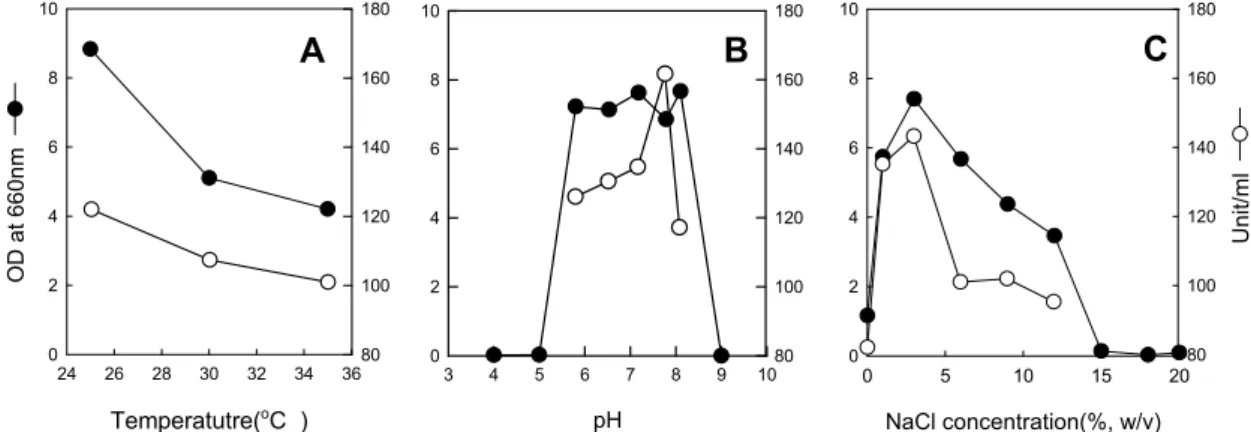
Fig. 1. Effect of temperature (A), pH (B) and NaCl concentration (C) on the growth and fucoidanase activity of strain SB 1493.
숙성해수대신 증류수로 대치하였고 0~20% (w/v) NaCl로 조정하여 전배양액을 접종 후 25℃, 150 rpm에서 진탕배양 하였다. 성장은 흡광광도계를 이용하여 660 nm에서 흡광도 를 측정하였다. Fucoisanase 활성은 배양액을 원심분리 (12,000× g, 10 min)한 후 상등액을 대상으로 상기에 기술된 방법에 따라 측정하였다.
해양으로부터 분리된 세균을 대상으로 FL 배지에서 2일간 배양한 후 fucoidanase 활성을 측정한 결과 SB 1493균주는 가 장 높은 활성을 나타내었다. SB 1493균주의 생장조건에 따른 성장과 fucoidanase 활성을 검토한 결과 온도, pH 및 NaCl 요구성은 최적성장조건과 효소활성이 일치하였다(Fig. 1). 즉, 온도는 25℃, pH는 7.8 그리고 NaCl 요구성은 3%로 나타나 SB 1493균주는 fucoidan을 분해하는 전형전인 호염성의 해양 세균임을 확인할 수 있었다.
Fucoidan 분해특성
SB 1493균주로부터 생산된 fucoidanase 활성에 미치는 온 도, pH에 대한 특성은 최적조건으로 2일간 배양한 후 원심분 리한 상층액을 0.2 um pore size의 여과지로 여과한 여과액을 조효소액으로 하여 조사하였다. Fucoidanase 활성을 위한 온 도는 1% fucoidan이 첨가된 0.1 M citric acid–sodium citric buffer (pH 6.0) 1 ml과 조효소액 0.1 ml을 첨가하여 30, 35, 40, 45, 50, 55℃에서 10분간 반응하였다. pH에 따른 조효소액 의 활성은 pH 4, 5, 6 (0.1 mM acetate buffer), pH 7 (0.1 M phosphate buffer), pH 8과 9 (0.1 M Tris-HCl buffer)로 조정된 완충용액에 1% (w/v) fucoidan을 용해한 기질용액 1 ml과 조효소액 0.1 ml을 첨가하여 50℃에서 10분간 반응하였으며 이후 상기 기술된 방법에 의해 환원당을 정량하여 상대적 활 성으로 표현하였다. SB 1493균주의 조효소액을 대상으로 시간 에 따른 효소활성과 TLC를 이용한 분해산물을 분석하였다.
반응조건은 1% (w/v) fucoidan이 첨가된 0.1 M Tris-HCl buf- fer 용액 4 ml과 조효소액 1 ml를 첨가한 후 50℃에서 0, 1, 2, 4, 6, 12, 24시간 반응한 후 효소활성을 측정하였다. 반응액을
대상으로 한 산물의 확인을 위한 TLC분석은 Ryu 등[22]의 방 법에 따라 silica gel plate에 시료를 점적한 후 전개용매(n-bu- thanol:acetic acid:H
2O=2:1:1)로 전개하였다. 전개한 plate는 전개용매를 건조시킨 후 20% (v/v) H
2SO
4-methanol 용액으 로 분무하여 150℃에서 10분간 건조한 후 나타나는 band를 비교하였다.
조효소액의 온도와 pH에 따른 fucoidanase 최적활성을 확 인한 결과는 Fig. 2에 도식화하였다. 조효소액에서 fucoidanse 활성은 50℃ (활성영역: 45~55℃), pH 8 (활성영역: pH 7~9) 로 결정되었다. 기존보고에 따르면 endo- 또는 exo-fucoida- nase의 주된 보고는 Pseudoalteromonas, Alterominas, Vibrio, Sphinomonas, Fucobacteria, Gelidibacter, Vibrio속 등으로 해양 세균에서 발견되어져 왔으며[2,5,9,13-14,24-28,30,33] 특히, Pseudoalteromonas, Gelidibacter, Sphinomonas 및 Alterominas가 생산하는 효소는 endo-type으로 fucoidan으로부터 다양한 형 태의 저분자량인 oligosaccharide를 생산하는 것으로 보고하 였다. SB 1493균주가 생산하는 조효소액과 fucoidan을 반응하 였을 때 Fig. 3A에서 보는 것과 같이 fucoidanase에 의해 환원 당은 4시간(0.54 mg/ml)까지 급격히 증가하였고 이후 24시간 까지(0.71 mg/ml) 완만히 증가하였다. TLC 크로마토그램을
pH
4 5 6 7 8 9
R e la ti v e a c ti v it y ( % )
20 40 60 80 100 120
Temperature (
oC)
25 30 35 40 45 50 55 60R e la ti v e a c ti v it y ( % )
20 40 60 80 100 120
A B
Fig. 2. Effect of temperature (A) and pH (B) on fucoidan hydrol-
ysis by crude enzyme of strain SB 1493.
A B
Fig. 3. Time courses of reducing sugar (A) and TLC chromatogram (B) in fucoidan hydrolyzates by crude enzyme (1: L-fucose, 2~8: hydrolyzate by crude enzyme with fucoidan for 0, 1, 2, 4, 6, 12 and 24 hr).
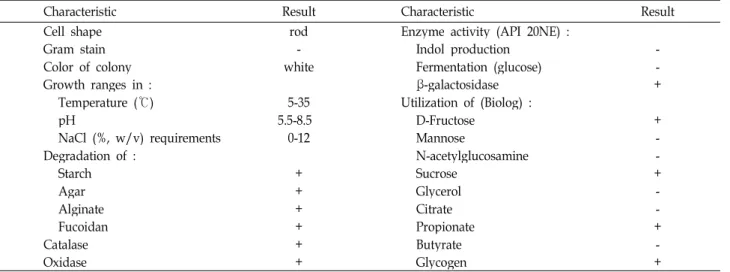
Table 1. Characteristics of strain SB 1493
Characteristic Result Characteristic Result
Cell shape rod Enzyme activity (API 20NE) :
Gram stain - Indol production -
Color of colony white Fermentation (glucose) -
Growth ranges in : β -galactosidase +
Temperature (℃) 5-35 Utilization of (Biolog) :
pH 5.5-8.5 D-Fructose +
NaCl (%, w/v) requirements 0-12 Mannose -
Degradation of : N-acetylglucosamine -
Starch + Sucrose +
Agar + Glycerol -
Alginate + Citrate -
Fucoidan + Propionate +
Catalase + Butyrate -
Oxidase + Glycogen +
통한 분해산물의 변화를 관찰한 결과 하나의 뚜렷한 oligo- saccharide (R
f0.3)만이 관찰되었다(Fig. 3B). 이러한 결과로 SB 1493균주는 endo-type의 oligosaccharide로 가수분해된 반 면 fucose는 검출되지 않았다.
Fucoidan 분해 균주의 동정
API 20NE (biomerieux), Microlog GN2 plate (Biolog)은 제조사에서 제공된 지침서에 의거하여 생화학적 특성 및 기질 이용도를 분석하였다. 16S rRNA gene 염기서열 분석은 Kwon 등[15]의 방법에 따라 총 DNA를 추출한 후 universal primer (27f, 1492r)를 이용한 PCR을 수행하여 얻어진 산물을 대상으 로 염기서열을 결정하였다. 확보된 염기서열은 National Center for Biotechnology Information (NCBI)의 Basic Local Alignment Search Tool (BLAST) [1]에 등록되어 있는 data- base를 사용하여 검색하였으며, 높은 유사성을 가지는 염기서 열을 기초로 하여 group별로 정리한 후, PHYDIT version 3.2
(http://plaza.snu.ac.kr/~jchun/phydit/index.php?ver=3.1) 운영 프로그램을 이용하여 CLUSTAL_X software, version 1.64b [29]에 의한 alignment를 수행하였다. 계통분석은 PHYLIP package [7]를 이용한 neighbour-joining [23]와 max- imum-likelihood [7]방법에 의해 수행하였다. Neighbour- joining tree topology는 1000 resampling에 기초한 bootstrap 분석에 의해 평가되었다. DNA-DNA hybridization실험은 Kaneko 등[11]의 방법에 의해 수행하였다.
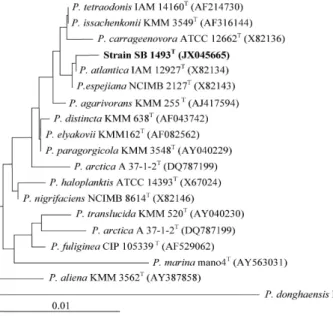
SB 1493균주는 그람음성, 호기성 간균으로 효소 및 기질 이용성에서 다양한 특징을 보였으며(Table 1), 특히 fucoidan 외에 전분, 한천 및 알긴산과 같은 고분자물질에 대한 분해능 을 가지고 있었다. 16S rDNA염기서열을 이용한 계통학적 분 석에서 SB 1493균주(JX045665)는 Pseudoalteromonas atlantica IAM 12927
T(X82134), P. espejiana NCIMB2127
T(X82143), P.
agarivorans KMM 255
T(AJ417594)과 99.85, 99.78 및 99.70%의
유사도를 나타내었으며 Fig. 4와 같이 계통도를 작성하였다.
Fig. 4. Neighbour-joining tree showing the relation- ship of strain SB 1493 to other members of the genus Pseudoalteromonas based on 16S rRNA gene sequences. The sequence of P. donghaensis HJ51
T(FJ754319) was used as the out group.
Bootstrap values ≥70% based on 1000 resam- plings are shown at nodes. Bar, 0.01 sub- stitutions per nucleotide position.
DNA-DNA hybridization을 통하여 종 수준에서 상동성을 조 사한 결과 Pseudoalteromonas atlantica IAM 12927
T(X82134)와 79.24% 그리고 P. espejiana NCIMB 2127
T(X82143)와 71.45%
의 상동성을 나타내었다(자료미제시). 또한 SB 1493균주와 cluster 를 이루고 있는 Pseudoalteromonas 종들은 16S rDNA 염기서열에 의한 유사성과 DNA-DNA 상동성이 매우 높은 그룹으로 향후 분류학적 특징의 조사가 필요할 것으로 판단된 다. 이러한 결과로부터 SB 1493균주는 Pseudoalteromonas 속에 속하는 Pseudoalteromonas sp. SB 1493으로 명명하였다.
감사의 글
본 논문은 지식경제부 지역산업기술개발사업의 연구비 지 원에 의해 연구되었으며 이에 감사드립니다.
References