정상 성인의 신체조성과 폐 기능의 연관성
김현승
1조성현
2ǂ1
남부대학교 일반대학원 통합의학과 학생,
2ǂ남부대학교 물리치료학과 교수
Correlation between Body Composition and Lung Function in Healthy Adults
Kim Hyunseung, PT
1Cho Sunghyoun, PT, Ph.D
2ǂ1
Dept. of Medical Sciences, Graduate School of Nambu University, Student
2ǂ
Dept. of Physical Therapy, Nambu University, Professor
Abstract
Purpose : We investigated the correlation between body composition and lung function in healthy adults.
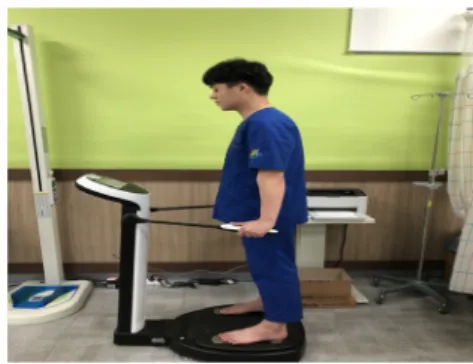
Methods : This study included 204 healthy adults in whom all measurements were obtained once, and all data were analyzed using the SPSS software for Windows, version 22.0. Pearson's correlation analysis was performed to determine the correlation between body composition (represented by the total body water, protein mass, soft lean mass, mineral mass, basal metabolic rate, fat-free mass, skeletal muscle mass, and body fat percentage) and lung function (represented by the forced vital capacity [FVC], forced expiratory volume in 1 second [FEV
1], the FEV
1/FVC ratio, maximum voluntary ventilation [MVV], maximum expiratory pressure [MEP], and the maximum inspiratory pressure [MIP]). All measurements were obtained by two investigators to improve reliability. A significance level of α=.05 was used to verify statistical significance.
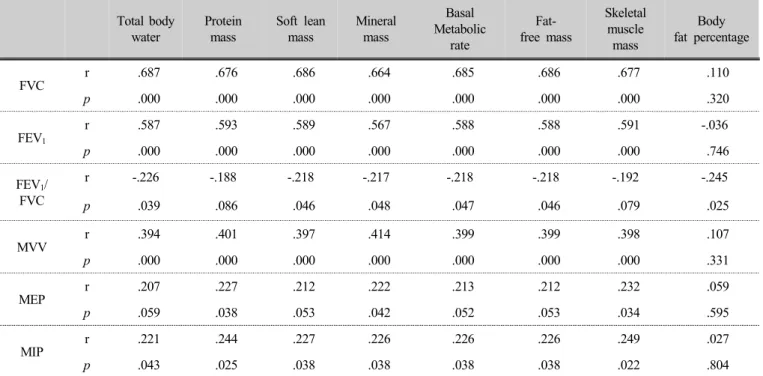
Results : Among the lung function measurements obtained in both men and women, the FVC, FEV
1, MVV, and MIP were positively correlated with the total body water, protein mass, soft lean mass, mineral mass, basal metabolic rate, fat-free mass, and skeletal muscle mass in men (p<.05). The FEV
1/FVC ratio was negatively correlated with the total body water, soft lean mass, mineral mass, basal metabolic rate, fat-free mass and the body fat percentage (p<.05). Notably, the FVC, FEV
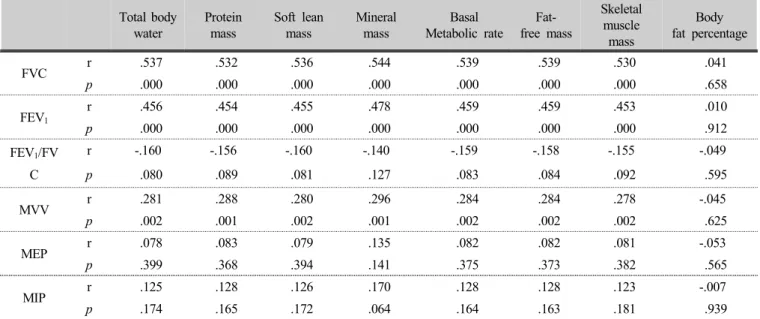
1, and MVV were positively correlated with the total body water, protein mass, soft lean mass, mineral mass, basal metabolic rate, fat-free mass, and skeletal muscle mass in women (p<.05).
Conclusion : This study showed a significant correlation between body composition and lung function in healthy adults. In combination with future studies on lung function, our results can provide objective evidence regarding the importance of prevention of lung disease, and our data can be utilized in rehabilitation programs for patients with respiratory diseases.
Key Words : body composition, forced expiratory volume in one second, forced vital capacity, in body, lung function, maximum voluntary ventilation
1)
ǂ