Weed control is one of the most important practice not only for organic farming but also for modern agriculture.
According to Oerke (2006), the potential crop yield losses are caused by weed worldwide. In general, the spatial dis- tribution of weeds is a heterogeneous forming patch which varies in size, shape, and density (Cardina et al., 1997;
Jurado-Expósito et al., 2003; Rew et al., 1996). However, such variation within fields has mainly been neglected owing to technical limitations to detect those patches. As consequences, unnecessarily large volume of herbicides has been applied to fields (Christensen et al., 1998). This causes two major problems, polluted environments and higher management costs due to chemical and labor because
most weeds are controlled by chemically (Christensen et al., 2009). These issues led many researchers to study site-specific weed management (SSWM) (Brown & Noble, 2005; Johnson et al., 1997; López-Granados, 2011; Swinton, 2005; Tian et al., 1999; Torres-Sánchez et al., 2013).
To detect weed patches in the field, remote sensing technologies were incorporated (Thorp & Tian, 2004).
Methods for weed patch detection could fall largely into two categories. One is by image segmentation based on morphology (Gerhards & Oebel, 2006; Pérez-Ortiz et al., 2015; Ribeiro et al., 2005) and the other is by vegetative indices based on light wavelength (Alexandridis et al., 2007;
Gerhards et al., 2002; Goel et al., 2002). Between those,
Case Study: Cost-effective Weed Patch Detection by Multi-Spectral Camera Mounted on Unmanned Aerial Vehicle in the Buckwheat Field
Dong-Wook Kim1‡, Yoonha Kim2‡, Kyung-Hwan Kim3, Hak-Jin Kim1,†, and Yong Suk Chung4,†
ABSTRACT Weed control is a crucial practice not only in organic farming, but also in modern agriculture because it can lead to loss in crop yield. In general, weed is distributed in patches heterogeneously in the field. These patches vary in size, shape, and density. Thus, it would be efficient if chemicals are sprayed on these patches rather than spraying uniformly in the field, which can pollute the environment and be cost prohibitive. In this sense, weed detection could be beneficial for sustainable agriculture.
Studies have been conducted to detect weed patches in the field using remote sensing technologies, which can be classified into a method using image segmentation based on morphology and a method with vegetative indices based on the wavelength of light.
In this study, the latter methodology has been used to detect the weed patches. As a result, it was found that the vegetative indices were easier to operate as it did not need any sophisticated algorithm for differentiating weeds from crop and soil as compared to the former method. Consequently, we demonstrated that the current method of using vegetative index is accurate enough to detect weed patches, and will be useful for farmers to control weeds with minimal use of chemicals and in a more precise manner.
Keywords : normalized difference vegetation index (NDVI), remote sensing, site-specific weed management (SSWM), weed distribution
DOI : https://doi.org/10.7740/kjcs.2019.64.2.159 Original Research Article
ⓒ 본 학회지의 저작권은 한국작물학회지에 있으며, 이의 무단전재나 복제를 금합니다.
This is an Open-Access article distributed under the terms of the Creative Commons Attribution Non-Commercial License (http://creativecommons.org/licenses/by-nc/3.0) which permits unrestricted non-commercial use, distribution, and reproduction in any medium, provided the original work is properly cited.
1)Department of Biosystems & Biomaterials Science and Engineering, College of Agriculture and Life Sciences, Seoul National University, Seoul, 08826, Republic of Korea
2)Plant Bioscience, School of Applied Biosciences, Kyungpook National University, Daegu 41566, Republic of Korea
3)National Institute of Agricultural Sciences, Rural Development Administration (RDA), Jeonju 54874, Korea
4)Department of Plant Resources and Environment, Jeju National University, Jeju 63243, Republic of Korea
‡These authors also contributed equally to this work.
†Corresponding author: Hak-Jin Kim & Yong Suk Chung; (Phone) +82-2-880-4604 & +82-64-754-3118;
(E-mail) [email protected] & [email protected]
<Received 1 May, 2019; Revised 7 June, 2019; Accepted 8 June, 2019>
the latter is easier to operate because it does not need a sophisticated algorithm for deciding weeds from crop and soil as the formal one. Thus, the objective of the current study is to determine if NDVI obtained from the data by the low-resolution camera mounted on the unmanned aerial vehicle (UAV) could discriminate weed patch from the buck- wheat field. If it could so, it will be useful for farmers to control weeds with less chemicals in a more precise manner.
Furthermore, it would be very much helpful for stepping closer to sustainable agriculture with less chemical pollution in the environments.
MATERIALS AND METHODS Test Site and Plant Materials
A field experiment was conducted in buckwheat field, located in Seogwipo-si, Jeju, Republic of Korea during the 2018 growing season. Buckwheat seeds of the cultivar
“Dasan” were scattered to be sown (120 kg ha-1) on August 27th, 2018. Prior to sowing, twice of tillage were executed to prepare the field on August 14th and 21st 2018. Fertilizer (300 kg ha-1) was applied on August 21st, 2018.
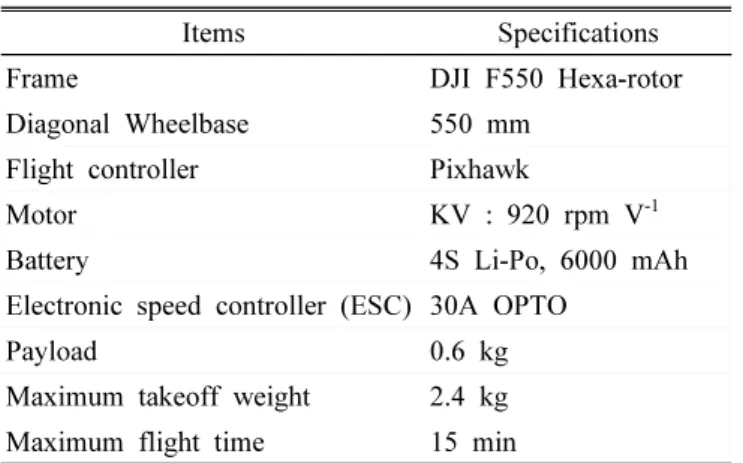
Unmanned Aerial Vehicle Flight and Image Acquisition Images were taken on October 14th, 2018 using a ma- nufactured DJI F550 hexa-rotor. Details of the unmanned aerial vehicle (UAV) platform specifications are described in Table 1. The UAV fly over automatically the experimental field using a flight controller (Pixhawk, 3DR, USA), a global positioning system (GPS), and inertial measurement
unit (IMU). An open source autopilot software (Mission Planner, ArduPilot, USA) was used to monitor autonomous flight paths and flight status in UAVs. The flight path was designed to ensure the overlapping ratio of at least 85%
forward overlap and 70% side overlap, which is necessary to identify enough key points for image orthomosaic(?). A 2.4 GHz wireless remote controller was used for manual takeoff and landing.
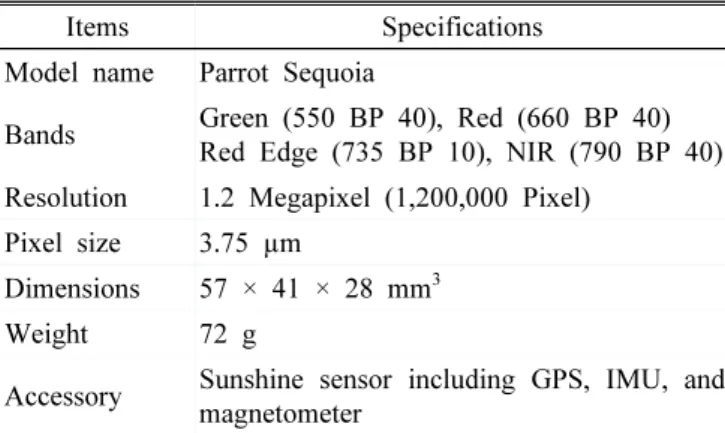
A multi-spectral camera (Sequoia, Parrot, France) was used to collect images of buckwheat (Fig. 1(a)). Four separate images of green, red, red edge and near infrared (NIR) bands could be acquired using the multi-spectral camera. Spectral responses of four bands are shown in Fig.
1(b). Details of the camera technical specifications are des- cribed in Table 2. Radiometric calibration was conducted based on UAV-mounted sunshine sensor for obtaining a precise image even under changing light conditions.
The details of the experimental flight are shown in Table 3. The images were acquired based on a time-lapse function of the multi-spectral camera that took one image every one and a half seconds for ensuring at least 85%
forward overlapping ratio.
Table 1. Specifications of developed unmanned aerial vehicle (UAV) platform.
Items Specifications
Frame DJI F550 Hexa-rotor
Diagonal Wheelbase 550 mm
Flight controller Pixhawk
Motor KV : 920 rpm V-1
Battery 4S Li-Po, 6000 mAh
Electronic speed controller (ESC) 30A OPTO
Payload 0.6 kg
Maximum takeoff weight 2.4 kg Maximum flight time 15 min
(a)
(b)
Fig. 1. (a) View of a commercial multi-spectral camera with sunshine sensor (Parrot Sequoia) and (b) spectral response of four bands in the camera.
Image Processing
The flow chart of the image preprocessing and analysis steps, including image orthomosaic, calculation of NDVI and weed detection, is shown in Fig. 2. The Pix4Dmapper Pro 3.0.17 (Pix4D SA, Lausanne, Switzerland) was used for orthomosaic of the collected UAV images. Image preprocessing was conducted in the same way as pre- viously described (Kim et al., 2018). As results of image preprocessing, orthomosaic generation procedure was con- ducted with the image exported in GeoTIFF data format (*.tif). After image preprocessing, image extraction for data analysis was conducted using Esri ArcGIS 10.1 software (ArcGIS, Redlands, CA, USA). Normalized difference vegetation index (NDVI) based on NIR channel was tested for weed detection in buckwheat field. NDVI is the most popular vegetation index widely been used for crop monitoring applications in precision agriculture. NDVI was calculated like following Equation 1 (Rouse 1974):
NDVI
(1)
where, R790 = reflectance values (%) of NIR channel (770-810 nm); R660 = reflectance values (%) of red channel (640-680 nm). NDVI could be calculated and NDVI maps could be generated using raster calculator function in the ArcGIS software.
Weed detection, a process for extracting only weeds from buckwheat and soil in UAV images, is an important step. As widely known, the higher NDVI value is, the greener crop is. In this study, the experimental crop, buckwheat, produces white flowers. Weed is greener than the white flower of buckwheat in UAV-based top-view images. Therefore, NDVI values of weed are higher than those of buckwheat in UAV images. As shown in Fig. 3, on histogram analysis of UAV-based multi-spectral images in terms of NDVI, it was possible to effectively separate the images of weeds from the background using threshold value.
After weed segmentation, 10 m by 10 m grids were generated in the whole field for a detailed data analysis.
Each grid was used to detect weed patch as a basic unit Table 2. Technical specifications of multi-spectral camera.
Items Specifications
Model name Parrot Sequoia
Bands Green (550 BP 40), Red (660 BP 40) Red Edge (735 BP 10), NIR (790 BP 40) Resolution 1.2 Megapixel (1,200,000 Pixel)
Pixel size 3.75 µm
Dimensions 57 × 41 × 28 mm3
Weight 72 g
Accessory Sunshine sensor including GPS, IMU, and magnetometer
Table 3. Experimental unmanned aerial vehicle (UAV) flight details.
Flight date
The number
of images
Flight altitude
(m)
Flight speed (m s-1)
Ground resolu-
tion (cm pixel-1)
Illumi- nation
Wind (m s-1)
Oct. 13,
2018 1,220 80 2 8.12 Clear 1.5
Fig. 2. Flow chart of the image processing and analysis steps.
of regions of interest (ROIs). The weed patch detection in each grid was used to control weeds with less chemicals in a more precise manner.
RESULTS AND DISCUSSION
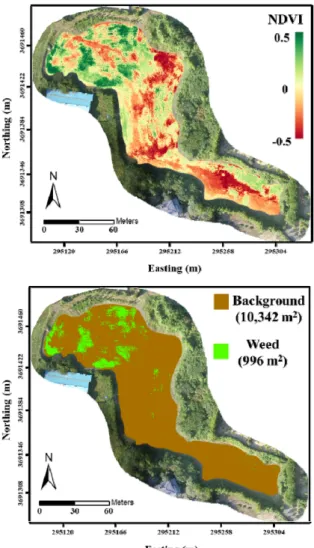
The whole field was mapped using NDVI based on the obtained data using a multi-spectral camera mounted on the UAV (Fig. 3 (upper)). The NDVI threshold of 0.17 was used in order to discriminate weeds out of buckwheat based on the inflection point of the histogram (Fig. 4) because it could indicate different leaf structure from different kind of plant. Weed fields were extracted from
the whole field using the NDVI threshold so that the weed map is constructed as shown in Fig. 3 (lower). In Fig. 3 (lower), out of total field area (11,338 m2), weeded area was 8.8 percent (996 m2).
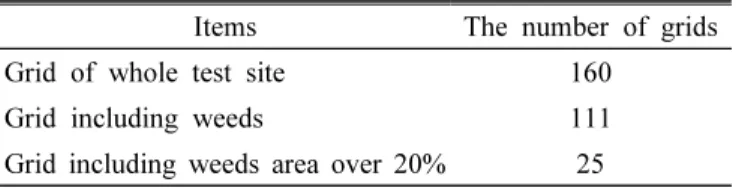
In order to suggest precise weeding method for minimizing chemicals, 10 m by 10 m grids map were generated in the whole field as shown in Fig. 5. When the field was divided by 10 m by 10 m grids, the number of total grids including the buckwheat test plot was 160 (Table 4).
Among them, the number of those grids imbedding weeds was 111. The large patches where the weeds in the grid are over 20 percent could be pointed out in the map of which number was 25 grids. The percentage of weeds area
Fig. 3. Generated normalized difference vegetation index (NDVI) map of the whole test site (upper) and detected weed map based on NDVI value (lower).
NDVI value reflects chlorophyll content.
Fig. 4. Normalized difference vegetation index (NDVI) histo- gram for weed detection with threshold value based on inflection point.
Fig. 5. Normalized difference vegetation index (NDVI) histo- gram for weed detection with a threshold value based on inflection point.
within one grid can be adjusted otherwise as a necessity.
As a result, the grids required weeding are 25 out of 160, which is 15% of the whole grids. Therefore, it is demon- strated that weed patches could be detected and targeted according to their size. With this method, it is possible to save a lot of chemicals by using only in the designated grids including the large weed patches (25 grids), instead of using chemicals in the whole map.
As stated above, this is not the first study for weed detection in the field using UAV nor using NIR camera.
Nevertheless, this study has its unique features; cost- effective and easy operation, unlike others. Many other studies mentioned in the introduction are useful and well performed (Alexandridis et al., 2007; Gerhards et al., 2002;
Gerhards & Oebel, 2006; Goel et al., 2002; Pérez-Ortiz et al., 2015; Ribeiro et al., 2005). However, their methods have to be operated by very skilled persons using complex algorithms.
In contrast, the current study requires relatively cheap camera (Sequoia, Parrot, France, around USD 3,500 or
$3,500) mounted on the consumer affordable priced UAV (DJI F550 Hexa-rotor, Pixhawk, 3DR, USA, around USD 3,500 or $3,500). The images obtained from this camera are easily mosaicked and extracted using Pix4Dmapper Pro 3.0.17 and ArcGIS 10.1 software with a couple of training for the software operation. NDVI could be simply calculated using the values from four separate spectral sensors of green (550 BP 40), red (660 BP 40), red edge (735 BP 10), near infrared (790 BP 40) in the extracted images. Then, weed segmentation using NDVI histogram could be set based on the inflection point.
This method has a weak point, which is possible when the NDVI of the crop in the field and the weeds are different. However, the different NDVI between crop and weeds would be not rare because the leaf structure of crop and weeds in the same field would not frequently be same
and their difference in leaf structure may necessitate species-specific calibration equations for its detection (Richardson et al., 2002). Thus, it could be applied to most fields for site-specific weed detection.
Another issue with the method in the current study is that the inflection point may not be very accurate.
However, this should be acceptable because the whole purpose of this method is to know the weed patches in the field. Furthermore, the size of these weed patches does not need to be accurately measured. The weed patches for control should be large enough for efficient weed manage- ment. Small patches or individual weeds scattered across the field could not be threats for high yield potential. The decision for weed patch size could be determined based on a simulation study for economical site-specific manage- ment (Barroso et al., 2004). Furthermore, they do not generate the large size of seed bank which can be potential threats for the following year because the buried seed bank would allow weeds to become more abundant the following year (Thompson & Grime, 1979). Thus, this method in the current study should be enough to control the weeds in the postseason from the seed banks generated by the large weed patches.
Indeed, large weed patch control could be more efficient in terms of chemical usage due to seed bank compared with object-based analysis (Peña et al., 2013), which detects weeds at the individual basis. In this sense, the results from this study would be very useful for the weed control by target specific control with much less chemical usage in a cost-effective manner. Furthermore, it would be very helpful to sustain environments.
ACKNOWLEDGEMENTS
This research was supported by a grant from the Next- Generation BioGreen 21 Program (Project No. PJ01451203), Rural Development Administration, Republic Korea. Also, we thank Jeju Buckwheat Farmers Association Corporation, Jeju, Republic of Korea for offering and managing the study site and Sustainable Agriculture Research Institute (SARI) in Jeju National University for providing the experimental facilities. We would like to thank Editage (www.editage.co.kr) for English language editing.
Table 4. Number of grids extracted from the generated grid map.
Items The number of grids
Grid of whole test site 160
Grid including weeds 111
Grid including weeds area over 20% 25
REFERENCES
Alexandridis, T., A. A. Tamouridou, X. E. Pantazi, A. Lagopodi, J. Kashefi, G. Ovakoglou, V. Polychronos, and D. Moshou.
2017. Novelty Detection Classifiers in Weed Mapping: Sily- bum Marianum Detection on Uav Multispectral Images.
Sens. 17(9) : 2007.
Barroso, J., C. Fernandez‐Quintanilla, B. Maxwell, and L.
Rew. 2004. Simulating the Effects of Weed Spatial Pattern and Resolution of Mapping and Spraying on Economics of Site‐Specific Management. Weed Res. 44(6) : 460-468.
Brown, R. B. and S. D. Noble. 2005. Site-Specific Weed Management: Sensing Requirements—What Do We Need to See?. Weed Sci. 53(2) : 252-258.
Cardina, J., G. A. Johnson, and D. H. Sparrow. 1997. The Nature and Consequence of Weed Spatial Distribution.
Weed Sci. 45(3) : 364-373.
Christensen, S., E. Nordbo, T. Heisel, and A. Walter. 1998.
Overview of Developments in Precision Weed Manage- ment, Issues of Interest and Future Directions Being Con- sidered in Europe. CRC Weed Manage Syst. 3-13.
Christensen, S., H. T. Søgaard, P. Kudsk, M. Nørremark, I.
Lund, E. S. Nadimi, and R. Jørgensen. 2009. Site‐Specific Weed Control Technologies. Weed Res. 49(3) : 233-241.
Gerhards, R. and H. Oebel. 2006. Practical Experiences with a System for Site‐Specific Weed Control in Arable Crops Using Real‐Time Image Analysis and Gps‐Controlled Patch Spraying. Weed Res. 46(3) : 185-193.
Gerhards, R., M. Sökefeld, C. Timmermann, W. Kühbauch, and M. Williams. 2002. Site-Specific Weed Control in Maize, Sugar Beet, Winter Wheat, and Winter Barley.
Precis Agric. 3(1) : 25-35.
Goel, P., S. Prasher, R. Patel, D. Smith, and A. DiTommaso.
2002. Use of Airborne Multi–Spectral Imagery for Weed Detection in Field Crops. Trans ASAE. 45(2) : 443.
Johnson, G., J. Cardina, and D. Mortensen. 1997. Site-Specific Weed Management: Current and Future Directions. Site- Specific Manage Agric. 131-147.
Jurado-Expósito, M., F. López-Granados, L. García-Torres, A.
García-Ferrer, M. S. de la Orden, and S. Atenciano. 2003.
Multi-Species Weed Spatial Variability and Site-Specific Management Maps in Cultivated Sunflower. Weed Sci.
51(3) : 319-328.
Kim, D.-W., H. Yun, S.-J. Jeong, Y.-S. Kwon, S.-G. Kim, W.
Lee, and H.-J. Kim. 2018. Modeling and Testing of Growth Status for Chinese Cabbage and White Radish with UAV-Based RGB Imagery. Remote Sens. 10(4) : 563.
LÓPEZ‐GRANADOS, F. 2011. Weed Detection for Site- Specific Weed Management: Mapping and Real‐Time App- roaches. Weed Res. 51(1) : 1-11.
Oerke, E.-C. 2006. Crop Losses to Pests. The Journal of Agricultural Science. 144(1) : 31-43.
Peña, J. M., J. Torres-Sánchez, A. I. de Castro, M. Kelly, and F. López-Granados. 2013. Weed Mapping in Early-Season Maize Fields Using Object-Based Analysis of Unmanned Aerial Vehicle (UAV) Images. PloS One. 8(10) : e77151.
Pérez-Ortiz, M., J. Peña, P. A. Gutiérrez, J. Torres-Sánchez, C. Hervás-Martínez, and F. López-Granados. 2015. A Semi-Supervised System for Weed Mapping in Sunflower Crops Using Unmanned Aerial Vehicles and a Crop Row Detection Method. Appl Soft Comput. 37 : 533-544.
Rew, L., G. Cussans, M. Mugglestone, and P. Miller. 1996.
A Technique for Mapping the Spatial Distribution of Elymus Repots, with Estimates of the Potential Reduction in Her- bicide Usage from Patch Spraying. Weed Res. 36(4) : 283- 292.
Ribeiro, A., C. Fernández-Quintanilla, J. Barroso, M. García- Alegre, and J. Stafford. 2005. Development of an Image Analysis System for Estimation of Weed Pressure. Precis Agric. 5 : 169-174.
Richardson, A. D., S. P. Duigan, and G. P. Berlyn. 2002. An Evaluation of Noninvasive Methods to Estimate Foliar Chlorophyll Content. New Phytol. 153(1) : 185-194.
Swinton, S. M. 2005. Economics of Site-Specific Weed Ma- nagement. Weed Sci. 53(2) : 259-263.
Thompson, K. and J. P. Grime. 1979. Seasonal Variation in the Seed Banks of Herbaceous Species in Ten Contrasting Habitats. J Ecol. 893-921.
Thorp, K. and L. Tian. 2004. A Review on Remote Sensing of Weeds in Agriculture. Precis Agric. 5(5) : 477-508.
Tian, L., J. F. Reid, and J. W. Hummel. 1999. Development of a Precision Sprayer for Site-Specific Weed Manage- ment. Trans ASAE. 42(4) : 893.
Torres-Sánchez, J., F. López-Granados, A. I. De Castro, and J. M. Peña-Barragán. 2013. Configuration and Specifications of an Unmanned Aerial Vehicle (UAV) for Early Site Specific Weed Management. PloS One. 8(3) : e58210.