• 검색 결과가 없습니다.

Development of a Creative Robot School Program for Motivating Elementary School Students

N/A
N/A
Protected

Academic year: 2021

Share "Development of a Creative Robot School Program for Motivating Elementary School Students"

Copied!
7
0
0

로드 중.... (전체 텍스트 보기)

전체 글

(1)

Development of a Creative Robot School Program for Motivating Elementary School Students

Seul Jung

Intelligent Systems and Emotional Engineering Laboratory, Department of Mechatronics Engineering Chungnam National University

ABSTRACT

This article presents program development and analysis of a creative robot school for elementary school at the local university.

The purpose of opening the creative robot school is to give motivation to children for having interests in science and engineering at their young ages. The creative robot school program is developed by using facilities of a local university to spread scientific knowledge to young children in their communities to draw their interests in science as well as an engineering field for future careers. Since the robot system is a popular subject to draw attention of children and has a relation with Mechatronics Engineering, a program related with robots is selected for educating children. College students are also involved in helping children to build robots within a given time. Experiences and self-evaluations from the previously held creative robot schools at Chungnam National University(CNU) are presented to share with.

Keywords: Creative robot school, community service, knowledge transfer, Mechatronics engineering

I. Intoduction 1)

Education for children is the most important issue to be considered above all in all of the counties. All of our cultural developments have been successfully accomplished by child education. Specially, development of science and engineering technologies enable us to live in comfortable and high technology environment.

Recently, however, young high school students prefer to entering medical schools or law schools instead of going to science or engineering schools. Our statistics shows that a student portion of going to science or engineering schools decreases every year. This becomes an important political & educational issue in setting up educational policies.

One of solutions for solving this issue is to make children have interests in science and engineering fields in their young ages. So, they can choose either science or engineering as a major in the college.

One of interesting topics for getting attention of children

Received December 16, 2010; Revised February 11, 2011 Accepted February 15, 2011

† Corresponding Author: [email protected]

is robots. Robots are popular toys and robot movie characters give enough inspiration to children. Recently, in Korea, robots are selected as one of seven national projects and Korean government tries to support intelligent robotics area in many aspects.

Universities are positioned at an important level to handle both conducting researches and educating students about basic sciences as well as engineering. Universities can play an important role to educate children since universities have good facilities and resources to share with children as well as college students. Universities can provide not only working spaces but materials for experiments of robot related works.

The creative robot school for elementary school students

has been held every year since 2007 at the Solidarity

of Mechatronics for Aiming Robot Technology(SMART)

center in Chungnam National University. The role of the

hosting university for educating children is not to educate

detailed knowledge about robots but to give some scientific

intuition to children. Our goal is for children to have

interests in science and engineering so that they can

grow with dreams of future careers in the science and

engineering fields.

(2)

In this article, the program development of the creative robot school for children is presented. Formats of the school program, contents of a lecture, and robot ex- periments are discussed. After holding successive robot schools for children, positive outcomes can be shared along with other requirements to be improved technically and academically.

II. Robot School Program

Since the class hour is limited to one day, program should be tightly scheduled and cover as many as possible contents including experiments. The reason of selecting one day program instead of long term program is to spread knowledge to as many children as possible by holding robot school.

A room capacity of holding one class is limited to 20 students as shown in Fig. 1. Students are selected from all grades of elementary school. One day program schedule

Fig. 1 Creative robot school class

Table 1 Program of the creative robot school

Time Program

09:30 – 10: 30 Lecture on robots 10:30 – 11:30 Demonstration of real robots 11:30 – 12:30 Drawing children’s creative robots

12:30 – 13:30 Lunch

13:30 – 15:00 Soldering and Building robots

15:00 – 16:00 Robot games

16:00 – 16:30 Award ceremony

is given in Table 1. The program is composed of two parts: a morning session and an afternoon session. In the morning session, students hear and learn about robot lecture and demonstration. The afternoon session is a do-it-yourself (DIY) session that students build their robots.

One teacher is responsible for two children to help them to build robots since building a robot within a limited time is difficult. Teachers are composed of college student volunteers.

Another important benefit of the creative robot school is participation of college students for volunteering work.

III. Lecture On Robots

Lecture contents include definition of robots, robots in movies, various robots, robot competition games, and real robots developed in our laboratory. Most of lecture contents should be pictures and movies for children to understand and pay attention. Otherwise, they are ignorant, sleeping, or playing each other. It is important to ask many questions to children. Lecture should be less than one hour.

Fig. 2 shows one slide that focuses on how ASIMO appears in 2000, why the car company, Honda built it, and how it has been developed for many years. One important remark is to mention that ASIMO has been successfully developed by engineers who had been

Fig. 2 Lecture on robots

(3)

influenced by the cartoon ‘Atom’. This example is an important fact that explains how important dream at early ages is. This is the one of goals of this creative robot school.

Other contents include robots in movies, especially in the cartoon, a history of robots, a definition of robot, and ethics of robots.

IV. Robot Demonstration

After robot lecture, demonstration of real robots is presented to show real movements by student volunteers.

The purpose of real demonstration of robots is to show reality about robots whose characters have been over- estimated in movies. Robot demonstration includes some of commercial robots and laboratory built robots obtained from the previous research.

Fig. 3 shows the demonstration of a commercial tracked mobile robot. A graduate student explains and demonstrates operations of the tracked mobile robot. The tracked mobile robot is a good example of showing the sophisticated mechanical design that can be transformed into various configurations with respect to different situations.

Another commercial robot is a service robot as shown in Fig. 4. The IT based service robot has more intelligent capabilities such as talking, vision processing, and collision avoidance. Children may understand a clear distinction in wheel mechanism between two types of robots.

Fig. 3 Demonstration of a tracked mobile robot

Next, robots built by college students are demonstrated.

A line tracer is a good example to demonstrate fast line following movements of a mobile robot in Fig. 5.

Fig. 6 shows another demonstration by a student volunteer. Boxing robots have been built for amusing children in Daejeon Science Festival, 2005. Since then,

Fig. 4 Demonstration of an IT based service robot

Fig. 5 Demonstration of a line tracer robot

Fig. 6 Demonstration of CNU Boxing Robot

(4)

control algorithm has been improved to have balancing motion instead of wheeled drive motion. One good point is that the previous research results can be used to educate children.

V. Drawing Robots

After getting information about robots from the lecture given earlier in the class, students are required to draw their own future robots. All the materials for drawing are given in the class. One student is drawing his robot in Fig. 7. After finishing drawing their robots, their drawings are posted on the blackboard as shown in Fig. 8. After finishing drawing, lunch will be given in the campus.

Fig. 7 A student is drawing his robot

Fig. 8 Picture are selected by children

Then, robot pictures drawn by children are evaluated by children and teachers. Fig. 8 shows the moment when students pick pictures deserved for awards.

Several students are allowed to come forward to see pictures, to think for a few minutes, and to choose their own decision. Pictures with high scores selected by children are awarded at the end of the class.

VI. Building Robots

1. Soldering Names on PCB

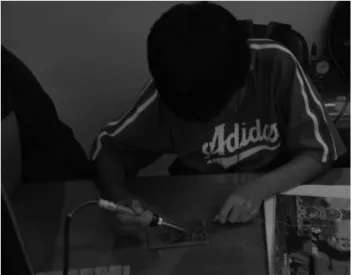
In the afternoon after coming back from lunch, students are required to perform experimental studies. More caution should be advised in the afternoon session since the soldering task is hot and dangerous. Firstly, students solder their names on the PCB board as shown in Fig.

9. The reason of letting children solder their names is to make them understand that scientific or engineering fields require hands on experiences. When students solder in the class, careful attention is required because sometimes students burn themselves.

2. Building Robots

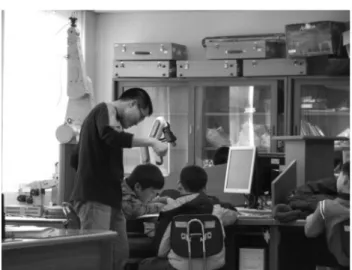
Students are required to assemble robots parts into a complete one. A teacher can help two children to finish their projects on time as shown in Fig. 10.

Fig. 9 A student is soldering his name

(5)

Fig. 10 Robot building class

Another example is a commercial robot that needs assemble to operate. After finishing assembling, students are allowed to take their robots back to home.

VII. Robot Games

After finishing building their robots, students play games with their own robots. Fig. 11 shows the remote controlled soccer robot.

Fig. 12 shows that children play boxing games with boxing robots that have been built by CNU students as a class project of robotics course in 2008.

Senior students in Mechatronics engineering taking the robotics course are required to build boxing robots as

Fig. 11 Students are playing with their robots

Fig. 12 Children are playing with boxing robots

Fig. 13 2009 year creative robot class

a project by grouping two students as one team.

All of children are awarded certificates saying ac- complishment of the creative robot school at the end of the class. Those who are selected by themselves for nice pictures are also awarded with gifts. Lastly, a photo is taken together with student volunteers. Fig. 13 shows the creative robot school that has been held in 2009 by inviting elementary students in Yuseong, Daejeon.

VIII. Evaluation & Effectiveness

1. Relation with Mechatronics Engineering

First of all, we have to evaluate whether the creative

robot program is beneficial to both participants of children

and students. After offering this program for more than

5 years, we found that this program is beneficial. Both

(6)

children and volunteer students are quite satisfied with what they have done at the creative robot school according to the survey reports.

For students’ point of view, since the creative robot program has been developed based on robots which are one area of mechatronics systems which they have learned before, they have knowledge about it and gain experiences of teaching what they have learned at the university.

From the university point of view, we can introduce our university and department to young children and their parents by showing our laboratory facilities. This contributes to the way of advertising the Mechatronics department at the Chungnam National University.

2. Analysis of Survey Report from Volunteer Students

After school, a survey has been done for volunteer students asking questions about the program. Reports can be summarized as two important opinions.

All of volunteer students have enjoyed working with children and felt that they did good things for children.

However, they felt difficulties of dealing with children.

Since most of them do not have experiences in teaching children before, they have difficulties of how to teach, how to control, and how to communicate with children.

Table 2 shows summary of survey report of 7 volunteers.

Table 2 Summary of survey reports

Survey Questions Yes No

5 4 3 2 1

1) Overall evaluation about the robot

school? 2 5

2) Program organized well? 2 5

3) Your satisfaction about the robot

school? 2 5

4) Children's satisfaction? 3 4

5) Degree of relation with your study in

University? 3 3 1

6) Pre-education about the robot

school? 4 3

7) Your satisfaction about service to

community? 7

Total score 16 32 1 0 0

Table 2 indicates that the majority of students were satisfied with the program. It is interesting that there is no 5 points for question (7).

3. Analysis of Survey Reports from Children

Children are always happy when they participate in new program. Survey reports tell us that they all are satisfied, but the likable gradient depends upon gender.

It tells us that boys have more interests in this class than girls since topics are related with robots although portions of boy and girl are tried to be equal in the class.

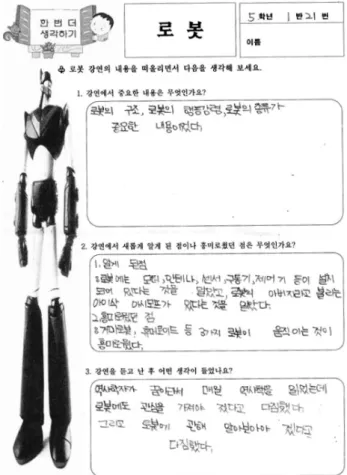
At the beginning of the lecture, students are asked what their dreams are. There are about 2 or 3 students out of 20 students of saying that their dreams are to become a scientist or an engineer. After school finishes, however, when the same questions are asked. the number

Fig. 14 One of survey report examples

(7)

of students interested in science or engineering fields is increased by double. This cannot justify that more children go to science or engineering fields, but the program at least draws children’s interest in science or engineering field. Fig. 14 indicates one student's interest in robots.

4. Advantages over Other Private Robot School

Comparing our robot school with other private robot school, there are many advantages.

Firstly, one most important thing is the free participation in the program. Our creative robot program is offered by a non-profit organization which is a local university such that all expenses are provided by a hosting institution or other sources.

Secondly, laboratory facilities are much better than those of private robot school since we use college student laboratories.

Thirdly, our program can be reached to those children who cannot have this kind of program since they are poor or they live at the country side. One of goals of this program is to give a service to the community we belong to.

Lastly, a variety of research results related with robots can be used to visualize and to demonstrate the subject for easy understanding.

IX. Conclusion

Experiences from the creative robot school for educating elementary students are presented. The creative robot school programs have been developed and modified based on the experiences from previously held schools.

It will be good for local universities to host this kind of program for spreading scientific or engineering know- ledge to educate children as a service to communities.

Successful education projects can be accomplished by providing financial supports as well as facilities from universities. It will be good to provide volunteers with some credits for community service.

The proposed program asks the role of local universities and students for community services to spread scientific knowledge. Since this program eventually attracts children’s interests in science or engineering fields, expansion of this program will help students understand science.

This Research Has Been Supported By The Ministry Of Education, Science And Technology.

References

1. “ASIMO”, http://world.honda.com/ASIMO.

2. “HUBO”, http://ohzlab.kaist.ac.kr.

3. Jeon, P. W., Jang, P. S., Joo, B. K., Cho, K. H., and Jung, S.(200), “Boxing robot design for mechatronics education”, Korea Control Conference : 330-334.

4. Kim, S. S. and Jung, S.(2008), “Control experiment of a wheel-driven mobile inverted pendulum using neural network”, IEEE Trans. on Control Systems Technology, 16 (2): 297-303.

5. Jung, S., Ahn, J. K., Lee, S. J., and Park, J. H.(2009),

“Development of Robot Education Program of Creative Robot School for Children”, URAI : 264-268.

6. Kang, D. K.(2010), “A Case Study of Puzzle Solving Applied to Programming Practice”, Journal of Engineering Education Research, 13 (2): 3-6.

7. Shim, J. H.(2010), “Capstone Design Project by Team Activities”, Journal of Engineering Education Research, 13 (2): 33-37.

Jung, Seul

1988: B.S. in Electrical & Computer Engineering, Wayne State University, USA

1991: M.S. in Electrical & Computer Engineering, University of California, Davis, USA

1996: Ph.D. in Electrical & Computer Engineering, University of California, Davis, USA

1997~Present: Professor at Mechatronics Engineering, Chungnam National University, Korea

Research Interests: Intelligent robots, Robot education, Knowledge Transfer Phone: 042-821-6876

Fax: 042-823-4919

E-mail: [email protected]

수치

Fig.  2  shows  one  slide  that  focuses  on  how  ASIMO  appears  in  2000,  why  the  car  company,  Honda  built  it,  and  how  it  has  been  developed  for  many  years
Fig.  3  shows  the  demonstration  of  a  commercial  tracked  mobile  robot.  A  graduate  student  explains  and  demonstrates  operations  of  the  tracked  mobile  robot
Fig.  8  Picture  are  selected  by  children
Fig.  10  Robot  building  class
+2

참조

관련 문서

Regarding to development stages of robot literacy, the study applied the classical model of curriculum development by Tyler (1949), and intended to

We use Tangible User Interface(TUI) for elementary student's(1st grade) convenience of programming and developed the robot programming task for improvement

Using modified curriculum and school enrichment cluster, robot programming education is implemented at the pilot school... (Ed.), The Cambridge Handbook of

빠르게 변화하는 지식정보화사회에서 창의적인 사고력을 갖춘 인재를 육성하는 일은 우리 교육의 핵심과제라 할 수 있다. 특히 컴퓨터 지도 영역 중 알고리즘은

In conclusion, this study suggests that design thinking-based maker education program has a positive effect on elementary school students' creative problem solving

In this study, we presented a robot programming education program in the process of programming education for creativity kidney of elementary school girls.. The

This study is aimed at developing a curriculum in relation to programming learning by using robot, for it has been judged as a scientific learning tool to

A learning effect of the STEAM education in terms of an upper grade students of elementary school students scientific attitude and creative problem