DOI: https://doi.org/10.14579/MEMBRANE_JOURNAL.2021.31.1.16
1)
†
Corresponding author(e-mail: [email protected], http://orcid.org/0000-0002-3820-141X)
해수담수화와 청정 에너지 하베스팅을 위한 산화 그래핀 결합 합성 폴리머 방오 멤브레인
이 대 원ㆍ라즈쿠마 파텔†
연세대학교 언더우드국제대학 융합과학공학부 에너지환경과학공학 (2021년 1월 13일 접수, 2021년 1월 17일 수정, 2021년 1월 21일 채택)
Graphene Oxide Incorporated Antifouling Thin Film Composite Membrane for Application in Desalination and Clean Energy Harvesting Processes
Daewon Lee and Rajkumar Patel
†Energy and Environmental Science and Engineering (EESE), Integrated Science and Engineering Division (ISED), Underwood International College, Yonsei University, Songdogwahak-ro, Yeonsu-gu, Incheon 21983, South Korea
(Received 13 January, 2021, Revised 17 January, 2021, Accepted 21 January, 2021)
요 약: 물 공급은 늘어나는 담수 수요와 다르게 줄어들고 있다. 담수의 수요를 충당하기 위해서 나노여과법은 가장 효율 적이고 경제적인 방법이라고 할 수 있다. 해수담수화를 위한 나노여과법의 일반적인 방법으로는 나노여과 멤브레인을 이용한 역삼투압 방식이다. 하지만 기존의 멤브레인들은 주요 특성인 안정성, 경제성, 그리고 살균 및 방오특성이 부족하다. 기존의 나노여과 멤브레인을 향상시키기 위해서 친수성과 방오성이 높은 흑연 산화물이 가장 향상성이 높으며 널리 연구되고 있는 재료이다. 멤브레인 변형은 다른 레이어에 적용될 수 있다. 얇은 막으로 이루어진 멤브레인은 다른 세 레이어로 구성되어 있 다, 표면의 폴리아미드 레이어, 기공 레이어, 그리고 전체적인 구조를 구성하는 지원 직물이다. 정삼투압 토한 에너지 효율적 인 해수담수화 방식이지만 효율이 생물 오염 때문에 떨어진다. 산화그래핀 결합은 향균 기능을 향상할 수 있으며 멤브레인 표면에 바이오필름 생성을 억제할 수 있다. 압력지연삼투는 해수에서 청정에너지를 발전시키는 최고의 방법 중 하나이다. 멤 브레인의 생물 오염은 합성 폴리머 멤브레인의 합성 레이어에 산화 그래핀을 합성하여 줄일 수 있다. 나노여과 멤브레인을 개량하는 여러 연구가 각자의 장단점을 가지고 이루어지고 있다. 이 보고서는 나노여과 멤브레인의 개량, 성질, 그리고 성능 에 대해 논의한다.
Abstract: Water supplies are decreasing in comparison to increasing clean water demands. Using nanofiltration is one of the most effective and economical methods to meet the need for clean water. Common methods for desalination are reverse osmosis and nanofiltration. However, pristine membranes lack the essential features which are, stability, economic efficiency, antibacterial and antifouling performances. To enhance the properties of the pristine membranes, graphene oxide (GO) is a promising and widely researched material for thin film composites (TFC) membrane due to their characteristics that help improve the hydrophilicity and anti-fouling properties. Modification of the membrane can be done on different layers. The thin film composite membranes are composed of three different layers, the top filtering active thin polyamide (PA) layer, supporting porous layer, and supporting fabric. Forward osmosis (FO) process is yet another energy efficient desalination process, but its efficiency is affected due to biofouling. Incorporation of GO enhance antibacterial properties leading to reduction of biofilm formation on the membrane surface. Pressure retarded osmosis (PRO) is an excellent process to generate clean energy from sea water and the biofouling of membrane is reduced by introduction of GO into the active layer of the TFC membrane. Different modifications on the membranes are being researched, each modification with its own advantages and disadvantages. In this review, modifications of nanofiltration membranes and their composites, characterization, and performances are discussed.
Keywords: nanofiltration, pressure retarded osmosis, desalination, antifouling
1. Introduction
Water resources are limited compared to the growing global demand due to exponentially growing population and increasing industrial activities. In recent years, an- tifouling and desalination techniques of wastewater and seawater are the most important methods of fresh wa- ter supply in water scarce regions. Currently, many dif- ferent methods of water desalination techniques are be- ing researched[1-19]. Among the water desalination techniques, using RO, NF, and FO are simple, econom- ical, and energy effective. Currently, number of tech- nologies are being researched such as distillation and advanced oxidization processes. However, the tech- nologies mentioned suffer from the complex equipment needed with the high energy consumption and high op- eration costs. The membrane filtration process is the new generation of water purification technology. There are inherent properties of membrane separation such as high selective separation, continuity, automatic oper- ation, chemical free, easy scale-up, low space require- ment, and low energy consumption. RO, NF, and FO techniques are also environmentally friendly as they re- move foulants and bacteria effectively. Various tech- nologies are being combined for enhanced properties for the membrane. However, the membrane fouling is the setback for the efficiency restrictions reducing wa- ter flux rate, deteriorating water quality, and increasing energy consumption. The membrane fouling can take place by pore blocking, bio film formation, organic ad- sorption, inorganic precipitation and cake formation.
There are different types of methods to improve the membrane fouling. The pretreatment of raw water, op- timizing the operating conditions, membrane cleaning and developing antifouling membranes. However, the existing methods had some setbacks in their own fields.
Therefore, the passive and active antifouling is both in- corporated into the membrane structure. Graphene oxide is one of the most promising material that can be in- corporated to the RO, NF, and FO membranes. Graphene oxide with its unique properties, shows excellent anti-
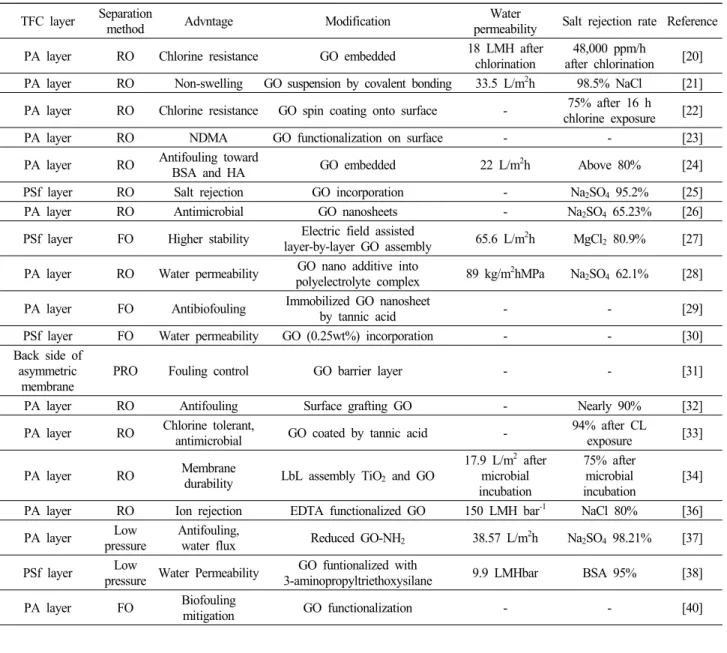
fouling properties while increasing the water flux of the membrane. Due to the possible enhancements by graphene oxide related modification on the membranes, graphene oxide is widely researched. There are different types of filtering and different types of modification methods for the membrane. In this review graphene oxide incorporated composite membrane are discussed in detail. Desalination and PRO process is explained in Fig. 1 and the review is summarized in Table 1.
2. Graphene Oxide 2.1. Reverse osmosis
Reverse Osmosis shows high energy efficiency in desalination. While PA-TFC RO membrane are used for their high-water permeability and high salt rejection rate, it can be improved in permselectivity, anti-foul- ing, and chlorine resistance[20]. Chlorine is used for membrane cleaning, but PA layer is vulnerable to the chlorine. Therefore, instead of coating GO on top of PA layer, GO was embedded into the PA layer by adding it to aqueous solution of m-phenylenediamine (MPD) before polymerization. GO was prepared by chemical exfoliation of graphite by Hummers method.
After graphite being oxidized, it was converted into
graphitic oxide. Then the aqueous solution was neutral-
ized then sonicated to convert into GO. Only small
sized GO was used to prepare GO-TFC membrane. Go
was polymerized onto the PSF UF membrane. GO was
characterized by scanning probe microscope and SPM
measurements. TEM and XPS were also used. FTIR
spectrums were also measured. GO-TFC membranes
were examined by a Raman spectrometer. The water
contact angle, surface zeta potential, and surface aver-
age roughness were measured. Anti-biofouling proper-
ties were also measured by tagged microbials. Chlorine
resistance was measured by soaking in chlorite solution
then rinsed to measure water flux and salt rejection
rate. GO showed different sizes and the sizes indicated
the single-double layer GOs. GO FTIR spectrum showed
O-H groups, C=O carboxyl groups, C=C bonds, epoxy
TFC layer Separation
method Advntage Modification Water
permeability Salt rejection rate Reference
PA layer RO Chlorine resistance GO embedded 18 LMH after
chlorination
48,000 ppm/h
after chlorination [20]
PA layer RO Non-swelling GO suspension by covalent bonding 33.5 L/m2h 98.5% NaCl [21]
PA layer RO Chlorine resistance GO spin coating onto surface - 75% after 16 h chlorine exposure [22]
PA layer RO NDMA GO functionalization on surface - - [23]
PA layer RO Antifouling toward
BSA and HA GO embedded 22 L/m2h Above 80% [24]
PSf layer RO Salt rejection GO incorporation - Na2SO4 95.2% [25]
PA layer RO Antimicrobial GO nanosheets - Na2SO4 65.23% [26]
PSf layer FO Higher stability Electric field assisted
layer-by-layer GO assembly 65.6 L/m2h MgCl2 80.9% [27]
PA layer RO Water permeability GO nano additive into
polyelectrolyte complex 89 kg/m2hMPa Na2SO4 62.1% [28]
PA layer FO Antibiofouling Immobilized GO nanosheet
by tannic acid - - [29]
PSf layer FO Water permeability GO (0.25wt%) incorporation - - [30]
Back side of asymmetric
membrane
PRO Fouling control GO barrier layer - - [31]
PA layer RO Antifouling Surface grafting GO - Nearly 90% [32]
PA layer RO Chlorine tolerant,
antimicrobial GO coated by tannic acid - 94% after CL
exposure [33]
PA layer RO Membrane
durability LbL assembly TiO2 and GO
17.9 L/m2 after microbial incubation
75% after microbial incubation
[34]
PA layer RO Ion rejection EDTA functionalized GO 150 LMH bar-1 NaCl 80% [36]
PA layer Low pressure
Antifouling,
water flux Reduced GO-NH2 38.57 L/m2h Na2SO4 98.21% [37]
PSf layer Low
pressure Water Permeability GO funtionalized with
3-aminopropyltriethoxysilane 9.9 LMHbar BSA 95% [38]
PA layer FO Biofouling
mitigation GO functionalization - - [40]