어린이·청소년의 비스페놀 A 인체 노출에 영향을 미치는 요인:
제3기 국민환경보건 기초조사(2015-2017)
정선경*
,** · 신형호*
,*** · 박상신*
†*서울시립대학교 도시보건대학원, **국립환경과학원 환경보건연구과,
***국립중앙의료원 영상의학과
Factors Affecting on Human Exposure to Bisphenol A in Children and Adolescents: Korean National Environmental Health Survey
(KoNEHS) Cycle 3, 2015-2017
Sunkyoung Jung*
,**, Hyeongho Shin*
,***, and Sangshin Park*
,†*Graduate School of Urban Public Health, University of Seoul
**Environmental Health Research Division, National Institute of Environmental Research, Ministry of Environment
***Department of Radiology, National Medical Center
ABSTRACT
Objectives: The purpose of this study was to analyze the factors affecting Bisphenol A (BPA) exposure in children and adolescents using the results of the Korean National Environmental Health Survey (KoNEHS) cycle 3.
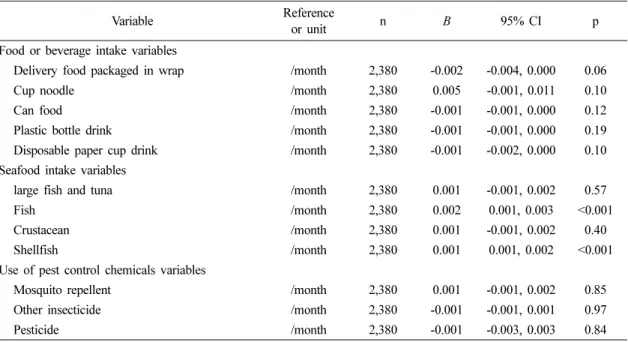
Methods: A total of 2,380 subjects (n=571, 887, and 922 for 3-5, 6-11, and 12-17 years of age, respectively) were analyzed using an environmental exposure survey and environmental chemical substances concentration levels. Univariable linear regression analysis was performed to determine associated variables such as sex, age, income level, housing type, secondhand smoke time, cup noodles and canned food consumption, seafood consumption, new furniture (within the previous six months), drinking water type, and consumption of herbal medicines. Variables with p-values of less than 0.2 were extracted from the results and a multivariable linear regression analysis was performed using stepwise selection.
Results: Univariable linear regression analysis showed positive associations between BPA concentration levels and variables including sex, age, secondhand smoke time, new furniture (within the previous six months), renovated living space (within the previous six months), fish and shellfish consumption, plastic-bottled drink consumption, and herbal medicine. As a result of performing multivariable linear regression analysis, the lower was the age the higher was the concentration of BPA levels. Additionally, women showed higher BPA levels than those of men. The more frequently fish was consumed, the higher was the BPA concentration. Moreover, higher BPA concentrations were observed when taking herbal medicine.
Conclusions: The main factors affecting BPA concentration levels were age, gender, and consumption of fish and herbal medicine.
Key words: Bisphenol A, children and adolescents, human exposure, risk factor, KoNEHS
†
Corresponding author: Graduate School of Urban Public Health, University of Seoul, 163 Seoulsiripdae-ro (Jeonnong-dong), Dongdaemun-gu, Seoul 02504, Republic of Korea, Tel: +82-2-6490-6758, Fax: +82-2-6490-6754, E-mail: [email protected] Received: 11 January 2021, Revised: 9 February 2021, Accepted: 9 February 2021
원 저 Original articles