DOI: http://dx.doi.org/10.3339/chikd.2015.19.1.31 ISSN 2384-0250 (online)
Long-term Results of Endoscopic Deflux ® Injection for Vesicoureteral Reflux in Children
Purpose: We evaluated the long-term results of endoscopic Deflux® injection for treating vesicoureteral reflux (VUR) in children.
Methods: Between September 2004 and September 2014, 243 children (137 boys and 106 girls) with a mean age of 53 months underwent Deflux® injection.
Our clinical protocol included radionuclide voiding cystography (RNC) at postoperative 3 months, 1 year and 3 years to assess the VUR resolution.
Results: The cure rates at 3 months, 1 year, and 3 years by patients were 70.8%, 64.3%, and 65.6% for the total patients and 79.2%, 75.2%, and 76.4%, for the ureters, respectively. The recurrence rate of postoperative febrile urinary tract infection (UTI) was 20% in patients without VUR at postoperative 1 year. Twenty patients undergoing ureteroneocystostomy (UNC) significantly had younger age (P=0.003), higher VUR grade (P<0.001), and lower success rates of Deflux® injection (P<0.05). On univariate analysis, older age (P=0.014) and lower grade of VUR (P=
0.031) were the significant predictors of a successful outcome. But there was none on multivariate analysis. Younger age, especially age of 0-12 month-old, was the only significant predictor of postoperative febrile UTI recurrence on both univariate and multivariate analysis.
Conclusion: Deflux® injection is efficacious with a low complication rate for the anti-reflux procedure in children. There is low recurrence rate of UTI though VUR persists, and high probability of no VUR at 3 years if no VUR at 1 year. It is recom- mendable not to perform follow-up RNC at 3 years routinely if no VUR at 1 year.
Key words: Vesicoureteral reflux, Deflux®, Endoscopic treatment, Children, Uri- nary tract infection
Hwanik Kim, M.D.
1Byung Soo Kim, M.D.
1Hae Il Cheong, M.D.
2, 3Byoung Soo Cho, M.D.
4Kwang Myeong Kim, M.D.
1Department of Urology1, Seoul National University College of Medicine, Seoul, Department of Pediatrics2, Seoul National University Children’s Hospital, Seoul, Kidney Research Institute, Medical Research Center3, Seoul National University College of Medicine, Seoul, Department of Pediatrics4, School of Medicine, Kyung Hee University, Seoul, Korea
Corresponding author:
Kwang Myeong Kim, M.D.
Department of Urology, Seoul National University Hospital, Seoul National University College of Medicine, 101 Daehak-ro, Jongno-gu, Seoul 110-744, Korea
Tel: +82-2-2072-2407 Fax: +82-2-747-9824
E-mail: [email protected] Received: 31 March 2015 Revised: 20 April 2015 Accepted: 25 April 2015
This is an open-access article distributed under the terms of the Creative Commons Attribu tion Non-Commercial License (http://
crea tivecom mons.org/licenses/bync/3.0/) which permits unrestricted non-commercial use, distribution, and reproduction in any medium, provided the original work is properly cited.
Copyright © 2015 The Korean Society of Pediatric Nephrology
Introduction
Vesicoureteral reflux (VUR) is known to occur in 1% of children and is one of the major causes of urinary tract infection (UTI) and chronic renal failure
1, 2). The purpose of diagnosing and treating VUR is to prevent these compli
cations. In the past, if medical treatment represented by prophylactic low
dose antibiotics failed, ureteroneocystostomy (UNC) was the only alternative.
However, a subureteral injection technique has been in the limelight as a sur
gical method to replace UNC after Matouscheck first reported on this tech
nique using a cystoscope in 1981 and O’Donnell reported the first clinical examples in 19843, 4). Teflon®, bovine collagen, Macroplastique® and other
materials have been used as injection substances, but there are still many limitations in their efficacy and safety in the pedi atric area57). Since Stenberg and Läckgren reported the first clinical application of Dextranomer/hyaluronic acid (DX/HA) copolymer (Deflux®, QMed Scandinavia, Up psala, Sweden) in 19958), Deflux® injection therapy has been recognized as an alternative treatment for VUR in the pediatric area. The overall success rate of Deflux® in jection therapy has been reported as 6892% and is known to be affected mainly by the grade of VUR6, 911). Deflux® injection therapy also has the clinical advantages of fewer complications and a shorter hospital stay. Since research on the success rate of Deflux® injection therapy for VUR in children was first reported in Korea12), there have not been enough reports on its longterm prognosis, including the amount of pyelonephritis occurrence and the recur
rence of VUR. Thus, this study analyzed the longterm results in children who underwent Deflux® injection and evaluated the prognosis of Deflux® injection therapy.
Materials and methods
This study retrospectively examined and analyzed the 419 ureters of 243 patients who underwent Deflux® injec
tion therapy with a cystoscope performed by a single oper
ator in the Children’s Hospital of Seoul National University Hospital between September 2004 and Sep tember 2014.
All patients were diagnosed with VUR through voiding cystourethrography (VCUG) during urination and under
went Deflux® injection.
All procedures were performed under general anesthesia, and an 8Fr Pediatric Cystoscope (Wolf®, Storz®) was used.
Before Deflux® injection, the location and type of both ureteral orifices and the condition of the bladder were evaluated. Subureteral or intraureteral Deflux® injec tion therapy was carried out by the hydrodistention implanta
tion technique. A postoperative RNC test was con ducted three times, at postoperative 3 months, 1 year, and 3 years, and the presence or absence of acute pyelone phritis, the urine’s white blood cell count and a Dimer captosuccinic acid (DMSA) renal scan were also examin ed.
We adopted the definition of febrile UTI used in the Randomized Intervention for Children with Vesicou re
teral Reflux (RIVUR) study: a fever of more than 38℃, pyuria findings in a urine test (≥10 white blood cells (WBC) per mm3 (uncentrifuged specimen) or ≥5 WBCs per high power field (centrifuged specimen) or a trace or more leuko
cyte esterase on a dipstick) and more than 100,000 colony
forming units of bacteria per mL in a uri ne culture test of a clean urine specimen24). The indica tions for Deflux® injection therapy were the following: a deteriora tion in the affected renal function due to febrile UTI; Persistence of VUR despite relatively old age; severe VUR of grade IVV;
and patients whose caregivers were reluc tant to antibiotics prophylaxis. The therapy was carried out preventively when there were abnormal find ings in the ureteral orifice shape on the opposite side of the affected area in a cystoscopy conducted during surgery (3 ureters were done for this in
dication). Post operatively, VUR Grade I was considered to be a suc cessful procedure (pre operative Grade I based on the suc cess rate of the ure ter was judged as a successful surgery when the postoperative grade was 0), and a con
tinuous postopera tive VUR of more than Grade II or a re
currence was judged as a failure. If VUR was present during the RNC test conducted after the procedure, prophylactic oral anti biotics were given, or Deflux® injection was per
formed again, or UNC were performed on patient who required definite surgical pro cedure.
Voiding dysfunction is defined as urination pattern that is abnormal for the child's age. We considered child has voiding dysfunction if child has any of these symptoms;
incontinence (urine leakage) during the day and/or night, increase in urinary frequency, urgency (the need to void immediately), urinary hesitancy, dribbling, intermittent urine flow, straining at urination, and/or pain in the back, flank or abdomen. Constipation is defined as defecation less than twice a week according to ROME III criteria.
Trabeculation of bladder is graded by formation of muscle bundle and depth of mucosal layer on cystoscopic exam (none, mild, moderate, and severe). Cortical defect on DMSA scan is decided by nuclear radiologists and defined as single or multiple, focal or diffuse areas of decreased or completely absent activity in the renal cortex; (2) diffuse or sharp indentation in contour with thinning of renal cortex;
and (3) loss of renal cortex volume.
The statistical analysis was carried out by using IBM SPSS Statistics 18.0 (SPSS Inc., IBM Company, Chicago, IL,
USA) to determine the success rate of the Deflux® injection thera py, the many factors that may affect the success rate, several preoperative factors that may affect UTI recurrence, and a subgroup analysis for the patient group that under
went UNC (Paired Ttest, chisquare test, and binary logi
stic re gression analysis for univariate analysis and multi
variate analysis was used.). A Pvalue of less than 0.05 was consider ed statistically significant.
Results
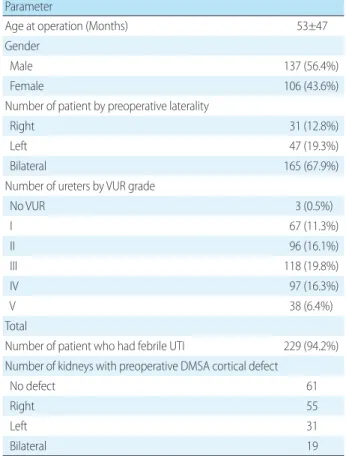
The mean age of the 243 patients included in this study was 53 (1270) months at the time of surgery; there were 137 boys and 106 girls. The followup period of pediatric urology outpatient was 32 (1113) months. Five patients complained of preoperative dysuria, such as straining or hesitancy, and 12 people complained of constipation. In a preoperative voiding cystourethrogram (VCUG), VUR was observed in 416 ureter units and the frequency of each VUR grade was 67 for grade I, 96 for grade II, 118 for grade III, 97 for grade IV and 38 for grade V. Postoperative com
plica tions were observed in one case that gross hema turia oc curred after leaving the hospital, but was treated with con servative treatments such as oral fluid intake, etc. There were no cases of urinary tract infection caused by the sur
gery (Table 1). All 243 patients under went an RNC test at postoperative 3 months, and 172 patients (70.8%) had no VUR. At postoperative 1 year, 171 patients under went an RNC test and 110 patients (64.3%) had no VUR. At post
operative 3 years, 90 patients under went an RNC test and 59 patients (65.6%) had no VUR. In ureteral num bers, an RNC test was evaluated for 419 ureters at post operative 3 months and 333 ureters showed no VUR (79.5 %); at post
operative 1 year, 212 ureters out of 282 ureters (75.2%) and at postoperative 3 years, 97 ureters out of 127 ureters (76.4
%) showed no VUR.
Based on VUR grade, the cure rates at postoperative 3 months were 92.5%, 84.4%, 72.9%, 75.3% and 73.7% for grade I, grade II, grade III, grade IV and grade V, respec
tive ly. At postoperative 1 year, the cure rates were 84.2%, 74.3%, 81.6%, 72.4% and 48.2%, respectively, and at post
operative 3 years, 81.3%, 70.6%, 81.1%, 78.6% and 63.6%, respectively. The cure rates by grade at postoperative 3
months and 1 year showed a statistically significant differ
ence (P=0.015, P=0.010). Based on age, the cure rates at post operative 3 months, 1 year and 3 years were 58.1%, 51.1
% and 66.7% for 012 months; 75.5%, 50.0% and 65.0% for 1336 months; 76.2%, 75.8% and 68.8% for 3760 months;
and 74.4%, 74.6% and 63.6% in more than 60 months. The cure rates by age at postoperative 1 year showed a statisti
cally significant difference (P=0.012) (Fig. 1).
Of the ureters that underwent RNC tests at both post
operative 1 year and 3 years, reflux was observed in 22 ureters (55.0%) after 3 years out of 40 ureters that showed reflux in an RNC test at 1 year. In contrast, reflux was ob
served in only 8 ureters (10.3%) after 3 years out of 78 ure
ters that did not show reflux at 1 year and there was a statistically significant difference (P<0.001).
After the first Deflux® injection, another Deflux® injection was carried out for 33 patients. Among them, 5 pa tients
Table 1. Patient Characteristics Parameter
Age at operation (Months) 53±47
Gender
Male 137 (56.4%)
Female 106 (43.6%)
Number of patient by preoperative laterality
Right 31 (12.8%)
Left 47 (19.3%)
Bilateral 165 (67.9%)
Number of ureters by VUR grade
No VUR 3 (0.5%)
I 67 (11.3%)
II 96 (16.1%)
III 118 (19.8%)
IV 97 (16.3%)
V 38 (6.4%)
Total
Number of patient who had febrile UTI 229 (94.2%) Number of kidneys with preoperative DMSA cortical defect
No defect 61
Right 55
Left 31
Bilateral 19
Values were expressed as mean±SD (age at operation) or number (%) (gender, number of patient by preoperative laterality, number of ureters by VUR grade, number of patient who had febrile UTI, number of kidneys with preoperative DMSA cortical defect).
Abbreviations: VUR, vesicoureteral reflux; UTI, urinary tract infection;
DMSA, dimercaptosuccinic acid.
with VUR received UNC due to febrile urinary tract infec
tion (3 cases) or consultation with caregivers (2 cases).
UNCs were carried out for 15 patients without con ducting Deflux® injections again. The UNCs were carried out due to febrile UTI after Deflux® injection in 7 cases, the presence of VUR even though there was no febrile UTI in 12 cases, and the occurrence of ureterovesical junction ob struction after Deflux® injection in 1 case. As for the UNC techni
ques, there were 14 cases of transtrigonal tech nique, 4 cases of detrusorrhaphy technique, 1 case of Poli tanoLeadbetter technique and 1 case of modified Paquin technique. There were no febrile UTIs requiring hospital treatment after UNC in all 20 patients. The pa tients who underwent UNC were significantly younger than those who did not (22.1 months vs. 55.7 months, P=0.003), their VUR grades were significantly higher (4.3 vs. 3.2, P<0.001), and the success rate of Deflux® injection by period was signifi cantly lower (35.0% vs. 74.0%, P<0.001; 31.3% vs. 67.7%, P=0.004; and
33.3% vs. 69.1%, P=0.032 at 3 months, 1 year and 3 years, respectively).
Postoperative febrile UTIs occurred in 44 patients (18.1
%) out of total 243 patients. With regard to the VUR grades of these 44 people, 0 were in grade I (0/2, 0%), 9 in grade II (9/54, 16.7%), 11 in grade III (11/81, 13.6%), 14 in grade IV (14/76, 18.4%) and 10 in grade V (10/30, 33.3%). There were no significant differences in the incidence between grades (P=0.176). Patients with febrile UTIs were younger, their VUR grades were higher, and their Deflux® injection cure rates were lower compared to patients without UTIs, but these were not statistically significant (P>0.05). After 1 year, febrile UTIs occurred after Deflux® injection in 20 out of 110 patients without VUR (22.2%), but the presence or absence of VUR after 1 year showed no statistically signifi
cant correlation with febrile UTI occurring after surgery (P=0.141). All these 20 patients received conser vative treat
ment in the hospital, such as the administra tion of intra
venous antibiotics in the early days. However, UNCs were carried out on 8 of them (40%) to prevent re currence. Fe
brile UTIs after the procedure showed no statistically signi
ficant correlation with pre operative VUR grade and age at surgery (P>0.05), but did show a correla tion with whether to conduct a Deflux® injection again (31.8% vs. 9.6%, P<
0.001) or whether to conduct a UNC (18.2% vs. 6.0%, P=
0.008). Of the predic tors of postope rative UTI recurrence, the age of 012 mon ths was the only statistically significant factor in both the univariate analy sis and multivariate analysis (univariate analysis: odds ratio (OR)=2.87, 95%
confidence interval (CI)=[1.276.48], P=0.038; multivariate analysis: OR=7.62, 95% CI= [1.8431.54], P=0.028). Of the several factors that may affect the success rate of Deflux® injection therapy, such as sex, age at surgery, degree of VUR, presence or absence of voiding dysfunction, presence or absence of constipation, degree of trabeculation in the bladder, etc., age at surgery and degree of VUR were the factors that may affect the success rate at postoperative 1 year accord ing to the uni variate analysis, and in the multi
variate ana lysis, it was found that no factors had a statistic
ally signifi cant correlation (P>0.05). There was no statistic
ally sig ni ficant factor that may affect the success rate at post operative 3 months and postoperative 3 years (Table 2).
Fig. 1. Success rate at postoperative 3 months, 1 year, and 3 years according to age and VUR grade. *The cure rates by age at postoperative 1 yeara) and VUR grade at postoperative 3 monthsb) and 1 yearc) showed statistically significant differ ences (P=0.012, P=0.015, P=0.010, respectively). Abbreviation: VUR, vesicoureteral reflux.
Discussion
In the treatment of VUR, the concept of subureteral in
jection therapy under a cystoscope has developed conside
rably since it was introduced in the 1980s3, 4). This treatment is thought to resolve VUR by forming solid sup port behind the intravesical ureter and increasing the submu cosal length of the ureter3). Many studies have reported the effi
cacy and safety of endoscopic treatment as a firstline treatment for VUR1316). Since first reported by Sten berg and Läckgren in 1995, Dextranomer/hyalu ronic acid (DX/
HA), out of a number of injection sub stances8), is the most commonly used in VUR injection treatment in pediatrics and the only healing substance approved by the Food and Drug Administration for its safety.
There have been many reports on the early success rate of Deflux® injection therapy and the overall success rate is relatively good, 6892%6, 911). In 2004, Kirsch report ed that the early success rates of Deflux® injection using the hy
drodistention implantation technique are similar to those of UNC6). In our study as well, the case that VUR was cured in an RNC test in the 3rd month after Deflux® injection Table 2. Correlation between postoperative 1 year success rate of endoscopic Deflux® injection and other factors.
Factor Number (%) Univariate analysis Univariate analysis
OR 95% CI P value OR 95% CI P value
Sex
Female 73 (42.7) 1(ref) 0.510 1(ref) 0.721
Male 98 (57.3) 0.80 0.43-1.53 1.14 0.57-2.28
Age
0-12 months 45 (26.3) 1(ref) 0.014 1(ref) 0.093
13-36 months 30 (17.5) 0.96 0.38-2.41 0.84 0.32-2.25
37-60 months 33 (19.3) 2.99 1.11-8.03 2.54 0.88-7.31
>60 months 63 (36.8) 2.81 1.24-6.35 2.17 0.85-5.54
Preoperative VUR grade
V 24 (14.0) 1(ref) 0.031 1(ref) 0.143
IV 45 (26.3) 2.75 0.99-7.63 2.00 0.67-5.95
III 63 (36.8) 5.33 1.94-14.64 3.88 1.31-11.49
II 38 (22.2) 2.86 0.99-8.22 1.86 0.56-6.16
I 1 (0.6) 2692458107.16 >0 1487622898.63 >0
Voiding dysfunction
No 167 (97.7) 1(ref) 0.138
Yes 4 (2.3) 0.18 0.02-1.74
Constipation
No 160 (93.6) 1(ref) 0.550
Yes 11 (6.4) 1.52 0.39-5.94
Trabeculation
None 109 (63.7) 1(ref) 0.802
Mild 50 (29.2) 0.91 0.46-1.82
Moderate 6 (3.5) 1.11 0.20-6.36
Severe 6 (3.5) 2.79 0.31-24.7
Cortical Defect on DMSA scan
None 44 (37.0) 1(ref) 0.636
Right 37 (31.1) 1.44 0.58-3.60
Left 24 (20.2) 1.39 0.49-3.92
Bilateral 14 (11.8) 0.69 0.21-2.32
Age at surgery and degree of VUR were the factors that may affect significantly the success rate in the univariate analysis.
Abbreviations: OR, Odds ratio for success; 95 % CI, 95 % confidence interval; VUR, vesicoureteral reflux; DMSA scan, Dimercaptosuccinic acid scan; ref, reference value.
(based on the ureter) was found to be 74.6%. However, there are few reports on the longterm results of Deflux® injection therapy. In 2001, Läckgren reported on the long
term followup results of 7.5 years after Deflux® injection and reported a good success rate: the success rate was 84%
in the first VCUG, but dropped slightly to 74% in the long
term followup17). However, there is a problem in interpre
ting these results, because longterm VCUG was only carried out for 45 ureters (13.4%) out of 334 treated ureters and there was a high dropout rate. On the other hand, unlike Läckgren’s report, Lee and Gatti reported18) rather disappointing longterm followup results in 2009. The success rate in the first postoperative VCUG was 73%, but recurrence was identified in 39 (26%) out of 150 ureters in the postoperative 1 year VCUG and the overall cumula tive failure rate was 54% (130/241 ureters). In our study, the success rate in the first RNC test conducted at 3 months after Deflux® injection was 79.5% (333/419 ureters) and re
latively good longterm followup results were shown with a success rate of 75.2% (212/282 ureters) at the 1 year follow
up and 76.4% (97/127 ureters) at the 3 year followup. How
ever, only 127 out of 419 ureters (30.3%) were tracked through the 3 years, which can be said to lack numeric significance.
Previous studies have analyzed the factors that can pre
dict the success rate of Deflux® injection therapy. In the paper published in our center in 2007, the degree of VUR (P=0.035) and the presence or absence of voiding dysfunc
tion (P=0.001) were the factors that could predict the success rate12). In 2013, Kajbafzadeh analyzed 372 pa tients who underwent Deflux® injection therapy and the success rate was 86.6%. The degree of preoperative VUR, treatment techniques, and whether to form a mound, hyper/iso
echogenic oval protuberance around the ure tero vesical junction in an ultrasound performed after the procedure were factors that can predict the success rate in the univa
riate analysis. The degree of preoperative VUR and whether to form a mound were statistically signifi cantly related to the success rate in the multivariate analy sis21). In our study, the degree of preoperative VUR (P= 0.031) was a factor that can predict the success rate, but another predictor could be identified if more extensive research is performed.
There is no definite answer regarding how long follow
up should be carried out after Deflux® injection therapy.
According to a multicenter prospective trial that reported
longterm followup results in recent years19), the early success rate was 68% (based on ureters, postoperative 6 months) in 284 patients (424 ureters). It was also reported that 46% of the entire patient group was followed up at postoperative 3 years and 21% of recurrence was identified between 6 months and 3 years in the ureters among them.
Thus, the authors argued that even if successful injection therapy was conducted, the presence or absence of VUR needs to be tracked for at least 3 years. In this study, the re
currence rate was 20.0% based on the ureters at post opera
tive 3 years, showing a similar level of recurrence rate.
Given that the presence or absence of VUR recur rence is not statistically correlated with postoperative febrile UTI occurrence in the reflux test carried out at postoperative 1 year, there is a need for longterm followup of at least 1 year or more after Deflux® injection thera py. According to the longterm results of the endo scopic treatment of VUR with a bulking agent in a study publish ed by Stredele et al.
in 2013, the success rate at 3 months after Deflux® injection was 81.5% and the success rate after 37 months was 78.5%.
Approximately 20% may experi ence recurrence at post
operative 23 years, so a 3year followup was recommended after successful endoscopic treatment22). However, from the result that VUR was observed in 55.0% after 3 years of ureters that showed VUR in RNC test at 1 year, while VUR was ob served in 10.3% after 3 years of ureters without VUR at 1 year, we can draw conclusion that it is recommendable not to per orm followup RNC at 3 years routinely if no VUR at 1 year due to low recurrence rate of UTI though VUR per sists and high probability of no VUR at 3 years if no VUR at 1 year.
Previous studies have reported that the degree of VUR and the degree of voiding dysfunction influence the success rate of injection therapy12). This may be con sidered due to the fact that the position of Deflux® uplift changes due to high detrusor pressure accom panying voiding dysfunction.
According to the recent research of Puri et al.20), 47.3 % of patients with voiding dysfunction before surgery have been treated successfully. Our study did not identify a signifi
cant correlation between the presence or absence of voiding dysfunction and the surgi cal success rate. When viewed in light of this information, future research seems to be needed to evaluate relation ship between voiding dys
function and success rate.
In this study, there were few cases of urinary tract infec
tion due to VUR persisting after Deflux® injection therapy (22.2%). Even if the statistical significance is insignificant due to the small number of patients, it can be assumed that the effect of Deflux® injection therapy itself drops the pro
bability of urinary tract infection. The study published by Baek et al. in 2013 explained that the pro bability of urinary tract infection after Deflux® injection therapy drops be
cause VUR grade decreases and bladder function is im
proved, depending on the growth of the child23).
This study has several limitations. The first includes the retrospective study characteristics, the somewhat small number of patients, and the large amount of RNC follow
up loss (especially at 3 years) during the longterm follow
up. The second limitation is that only the presence or ab
sence of VUR was identified, and it was difficult to determine the grade due to the nature of the RNC test. The third limi
tation is that the analysis of the longterm follow up results of Deflux® injection therapy was evaluated by the presence or absence of postoperative VUR recur rence and the pre
sence or absence of febrile UTI occur rence, while several other elements, including the degree of renal scarring and renal function etc., should also be considered. Finally, the number of patients who under went the DMSA scan and renal ultrasound for postope rative followup was so small that it was difficult to find out if there was a corre lation bet
ween the size, shape, pa renchymal thickness of the kidney and the postoperative urinary tract infection. Thus, multi
institutional prospec tive study will be needed to find an answer to the con troversy over the longterm followup results of Deflux® injection therapy.
Conclusion
This study found that the success rates of Deflux® injec
tion therapy are excellent: 79.5% at postoperative 3 months, 75.2% at postoperative 1 year, and 76.4% at postoperative 3 years. The probability of urinary tract infec tion is not high, although VUR can occur after Deflux® injection therapy, and if there is no VUR at postoperative 1 year, it is highly likely that there will be no VUR at post operative 3 years.
Therefore, if there is no VUR at postope rative 1 year, it is recommendable that there is no need to follow up with
RNC at 3 years. In the future, the longterm followup results of Deflux® injection therapy through multiinstitu tional prospective research are needed.
Conflict of interest
No conflict of interest exists in relation to submitted manuscript, and there was no source of funding.
References
1. Smellie JM, Barratt TM, Chantler C, Gordon I, Prescod NP, Ransley PG, et al. Medical versus surgical treatment in children with severe bilateral vesicoureteral reflux and bilateral nephropathy:
a randomised trial. Lancet 2001;357:1329-33.
2. Jacobson SH, Hansson S, Jakobsson B. Vesico-ureteric reflux:
occurrence and long-term risks. Acta Paediatr suppl 1999:22-30.
3. Matouschek E. Treatment of vesicorenal reflux by transurethral Teflon-injection. Urologe A 1981:263-4.
4. O'Donnell B, Puri P. Treatment of vesicoureteric reflux by endo- scopic injection of Teflon. J Urol 2002;167:1808-9; discussion 1810.
5. Dodat H, Aubert D, Chavrier Y, Geiss S, Guys JM, Lacombe A, et al., Vesicoureteric reflux in children: long-term results of endo- scopic treatment by Macroplastique injection. Prog Urol 2004;
14:380-4.
6. Kirsch AJ, Perez-Brayfield M, Smith EA, Scherz HC. The modified sting procedure to correct vesicoureteral reflux: improved results with submucosal implantation within the intramural ureter. J Urol 2004;171:2413-6.
7. van Capelle JW1, de Haan T, El Sayed W, Azmy A. Azmy, The long- term outcome of the endoscopic subureteric implantation of polydimethylsiloxane for treating vesico-ureteric reflux in child- ren: a retrospective analysis of the first 195 consecutive patients in two European centres. BJU Int 2004;94:1348-51.
8. Stenberg A, Läckgren G. A new bioimplant for the endoscopic treatment of vesicoureteral reflux: experimental and short-term clinical results. J Urol 1995;154:800-3.
9. Puri P, Chertin B, Murugesh V, Dass L, Colhoun E. Treatment of vesicoureteral reflux by endoscopic injection of dextranomer/
hyaluronic acid copolymer (Deflux): preliminary results. J Urol 2003;170:1541-4.
10. Chertin B, Colhoun E, Velayudham M, Puri P. Endoscopic treat- ment of vesicoureteral reflux: 11 to 17 years of followup. J Urol 2002;167:1443-6.
11. Routh JC, Vandersteen DR, Pfefferle H, Wolpert JJ, Reinberg Y.
Single center experience with endoscopic management of
vesicoureteral reflux in children. J Urol 2006;175:1889-92.
12. Park, Y, Kim, G. Dextranomer/hyaluronic acid copolymer (Deflux®) injection for vesicoureteral reflux in children: The efficacy and safety. KJU 2007;48:620-6.
13. Capozza N, Caione P. Dextranomer/hyaluronic acid copolymer implantation for vesico-ureteral reflux: a randomized comparison with antibiotic prophylaxis. J Pediatr 2002;140:230-4.
14. Elder JS, Diaz M, Caldamone AA, Cendron M, Greenfield S, Hurwitz R, et al. Endoscopic therapy for vesicoureteral reflux: a meta- analysis. I. Reflux resolution and urinary tract infection. J Urol 2006;175:716-22.
15. Puri P, Chertin B, Velayudham M, Dass L, Colhoun E. Treatment of vesicoureteral reflux by endoscopic injection of dextranomer/
hyaluronic acid copolymer: preliminary results. J Urol 2003;170:
1541-4.
16. Al-Hunayan AA, Kehinde EO, Elsalam MA, Al-Mukhtar RS. Out- come of endoscopic treatment for vesicoureteral reflux in children using polydimethylsiloxane. J Urol 2002;168:2181-3.
17. Läckgren G, Wählin N, Sköldenberg E, Stenberg A. Long-term followup of children treated with dextranomer/hyaluronic acid copolymer for vesicoureteral reflux. J Urol 2001;166:1887-92.
18. Lee EK, Gatti JM, DeMarco RT, Murphy JP. Long-term followup of dextranomer/hyaluronic acid injection for vesicoureteral reflux:
late failure warrants continued follow-up. J Urol 2009;181:1869-
74.
19. Schmedding A, Zeeh U, Huebner U, Krause M, Lorenz C. Sx IN- prospective multicenter survey of subureteral injection in child- ren. Presented at International Conference on VUR in Child ren, Goteborg, Sweden, 4-6 June 2009.
20. Puri P, Kutasy B, Colhoun E, Hunziker M. Single center experience with endoscopic subureteral dextranomer/hyaluronic Acid injection as first line treatment in 1,551 children with inter me- diate and high grade vesicoureteral reflux. J Urol 2012;188(4 Suppl):1485-9.
21. Kajbafzadeh A, Tourchi A, Aryan Z. Factors that impact the out- come of endoscopic correction of vesicoureteral reflux : a multi- variate analysis. Int Urol Nephrol 2013;45:1-9.
22. Stredele RJF, Dietz HG, Stehr M. Long-term results of endoscopic treatment of vesicoureteral reflux in children : Comparison of different bulking agents. J Pediatr Urol 2013;9:71-7.
23. Baek M, Kang MY, Lee HE, Park K, Choi H Clinical value of persis- tent but downgraded vesicoureteral reflux after Dextranomer/
Hyaluronic acid injection in children. J Korean Med Sci 2013;
28:1060-4.
24. Keren R, Carpenter MA, et al. Rationale and Design Issues of the Randomized Intervention for Children With Vesicoureteral Reflux (RIVUR) Study Pediatrics 2008;122:240-50.