Print ISSN: 2288-4637 / Online ISSN 2288-4645 doi:10.13106/jafeb.2020.vol7.no10.939
Influence of Brand Trust, Perceived Value on Brand Preference and Purchase Intention
Tri Cuong DAM
1Received: August 01, 2020 Revised: September 06, 2020 Accepted: September 10, 2020
Abstract
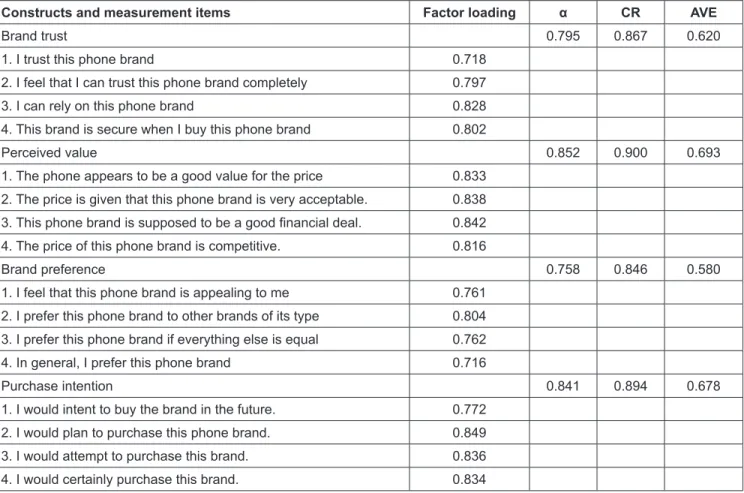
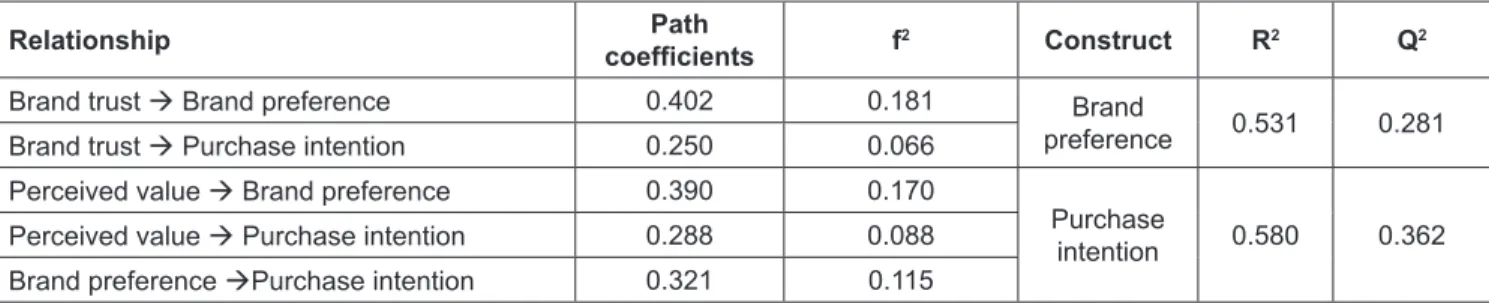
The aim of this research was to empirical examine the influence of brand trust, perceived value on brand preference, and purchase intention for branded phones. The samples were gathered by a convenient sampling method. We collected data from 285 consumers who were visiting electronic supermarkets in Ho Chi Minh City, Vietnam. The measurement used a 5-point Likert scale ranging from 1=completely disagree, and 5=completely agree. PLS - Partial Least Squares method was performed to analyze the measurement model and the structural model. The study model was proposed from prior research. We had assessed the reliability of the scales through Cronbach’s alpha and composite reliability. As well, we also had evaluated discriminant validity through the Fornell-Larcker criterion. The findings of the study demonstrated that brand trust had a significantly positive influence on brand preference. Likewise, the findings of the research also stated that brand trust had a positive impact on purchase intention. The results revealed that perceived value had a positive effect on brand preference. Furthermore, the outcomes show that perceived value had a positive influence on purchase intention as well. Furthermore, the findings of the research showed that brand preference had a positive effect on purchase intention.
Keywords: Brand Trust, Perceived Value, Brand Preference, Purchase Intention, SEM-PLS JEL Classification Code: C38, M30, M31, M37
choose the goods in a competitive and fluctuating business context recently (Choi et al., 2020).
Moreover, trust has been one of the essential elements of long-term and reliable connections between persons.
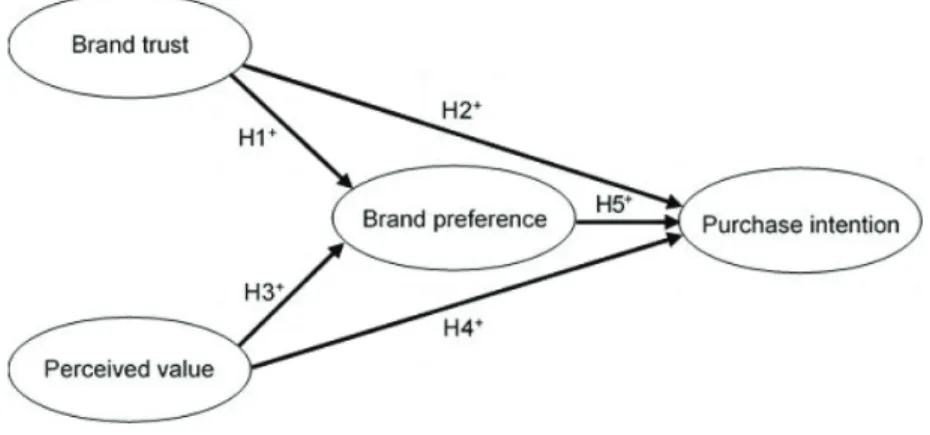
Personal relationships were often employed as a comparison when describing the connection between the brand and the purchaser (Fournier, 1998). In this view, brand trust unveiled its vital importance in individual relationships and the building of a lasting connection between the brand and the purchaser (Aydin & Taskin, 2014). Some scholars said that brand trust was a precursor of brand preference (Afsar, 2014;
Chinomona et al., 2013) and purchase intention (Aydin et al., 2014; Chae et al., 2020).
On the other hand, previous research revealed that perceived value was an antecedent of brand preference (Hellier et al., 2003; Muzakir & Damrus, 2018) and purchase intention (Calvo-Porral & Lévy-Mangin, 2017; Hu, 2011).
Brand preference was the component that pushed consumers to buy the brand and to repeat this activity (Ebrahim et al., 2016; Soenyoto, 2015). Besides, some empirical studies confirmed that brand preference was a predictor of purchase intention (Chen & Chang, 2008; Emor & Pangemanan, 2015; Pool et al., 2018).
1. Introduction
Purchasing intention has been one of the principal topics examined in the marketing literature, and triggered the interest of marketing scholars on purchase intention coming from buying behavior. Besides, practitioners also have studied purchase intention to predict transactions of current and new goods/services. Purchase intention information could support practitioners in their marketing decisions linked to goods (new and current), market segmentation, and promotion plans (Tsiotsou, 2006). Therefore, how to get customers to purchase commodities has become essential to marketers because customers have more opportunities to
1
First Author and Corresponding Author. Lecturer, Faculty of Business Administration, Industrial University of Ho Chi Minh City, Vietnam [Postal Address: 12 Nguyen Van Bao Street, Ward 4, Go Vap District, Ho Chi Minh City, 700000, Vietnam]
Email: [email protected]
© Copyright: The Author(s)
This is an Open Access article distributed under the terms of the Creative Commons Attribution Non-Commercial License (https://creativecommons.org/licenses/by-nc/4.0/) which permits unrestricted non-commercial use, distribution, and reproduction in any medium, provided the original work is properly cited.