• 검색 결과가 없습니다.

Blood Aluminum Concentrations among Residents of the South-east Costal Area of Korea

N/A
N/A
Protected

Academic year: 2021

Share "Blood Aluminum Concentrations among Residents of the South-east Costal Area of Korea"

Copied!
9
0
0

로드 중.... (전체 텍스트 보기)

전체 글

(1)

우리나라 일부 지역 주민들의 혈중 알루미늄 농도

서정욱* · 김병권*

,

** · 김유미*

,

** · 정진용** · 임현주** · 예병진**

,

*** · 홍영습*

,

**

*동아대학교 의과대학 예방의학교실

**동아대학교 환경보건센터

***동아대학교병원 직업환경의학과

Blood Aluminum Concentrations among Residents of the South-east Costal Area of Korea

Jeong-Wook Seo *, Byoung-Gwon Kim*

,

**, Yu-mi Kim*

,

**, Jin-Yong Chung**, Hyoun-Ju Lim **, Byeong-Jin Ye**

,

***, and Young-Seoub Hong*

,

**

*Department of Preventive Medicine, College of Medicine, Dong-A University

**Environmental Health Center, Dong-A University

***Department of Occupational & Environmental Medicine, Dong-A University Hospital

ABSTRACT

Objectives: Aluminum is well known as a potent neurotoxicant. There are many reports that aluminum can be toxic to humans and to animals. However, there are only few studies on the assessment of aluminum exposure among humans in Korea. Therefore, the aim of this study was to evaluate current aluminum concentrations among the adult population in regions of Korea.

Methods: We selected 439 adults aged 20-89 years from the Busan-Ulsan-Gyeongnam region and certain other sites. Blood aluminum concentrations were analyzed using inductively-coupled plasma mass spectrometry (ICP/

MS). The geometric means (GM) and 95% confidence intervals (CI) of aluminum concentrations were calculated, and we also confirmed the proportion of excess of the aluminum reference value.

Results: Total GM (95% CI) of aluminum levels was 14.26 (13.43-15.14) ppb. Levels among males (15.58 [14.09-17.22] ppb) were higher compared to among females (13.51 [12.54-14.55] ppb), and levels increased with subject age from 40 years and over. Three point one nine percent of the subjects exceed the reference value of 50 ppb. Lastly, aluminum concentration has a log-normal distribution with lnN (x; 2.89, 0.642), x>0.

Conclusion: In the present study, we evaluated the distribution of blood aluminum concentrations among the normal population in Korea, and we found some adults exceeding the reference levels. However, in order to compare the results with other studies, an extended study including measurement of serum aluminum level is required. In addition, further research on various population groups, including occupational exposure of workers, is required.

Keywords: Blood aluminum, normal population

I. 서 론

알루미늄(aluminum)은 비중 2.7의 가볍고 무른 은

백색 경금속으로 산소(oxygen), 규소(silicone)에 이 어 지각을 구성하는 3번째로 많은 원소이다. 알루미 늄은 인장강도가 우수하며 재활용성이 뛰어나 생활

Corresponding author: Department of Preventive Medicine, College of Medicine, Dong-A University, 32, Daesingongwon- ro, Seo-gu, Busan, Republic of Korea, Tel: +82-51-240-2888, Fax: +82-51-253-5729, Email: [email protected] Received: 10 March 2016, Revised: 8 June 2016, Accepted: 14 June 2016

원 저 Original articles

(2)

환경 및 산업환경에서 폭넓게 활용되고 있다. 호일, 캔 등 생활환경 중 식품의 포장용기로 많이 사용되 고 있으며, 항공우주, 교통, 건축 분야 등 산업 전반 에서 중요한 구조재로서 사용되며, 의약품 제조에 있 어서도 그 활용도가 매우 광범위하다. 거의 모든 음 식, 물, 공기 및 토양에 알루미늄이 일부 함유되어 있 다는 점과 높은 활용도에 따라, 최근 인체독성에 대 한 많은 연구결과가 보고되어 관심의 대상이 되고 있다.

1)

일반 인구집단에 있어 알루미늄의 주 노출원은 식 품 섭취이며 식수, 호흡을 통해 노출되는 비중은 상 대적으로 매우 낮다.

1)

일부 유럽 국가의 연구 결과 에 따르면 대부분의 가공되지 않은 식품에는 일반적 으로 5 mg/kg 이하의 알루미늄이 포함되어 있고, 조 리 과정 중 사용되는 알루미늄 화합물에 의해 농도 가 증가할 수 있다.

2)

한편, 의학적으로 알루미늄 화 합물은 제산제, 진통제(예를 들어 알루미늄 염기가 붙은 아스피린), 발한 억제제, 지사제와 항 궤양치료 제, 수렴제와 백신용 보조약 등에 사용된다.

3)

그 밖 에 직업적 노출이 있을 수 있다.

섭취, 흡입에 의한 알루미늄 흡수율은 낮은 수준 이며 피부 접촉에 의해서는 흡수되지 않는다. 경구 섭취에 의한 알루미늄의 흡수율은 0.1~0.6% 수준으 로 알려져 있다. 생체이용률(bioavailability)이 낮은 수산화알루미늄의 경우 0.1% 이하의 흡수율을 보일 수도 있다.

1)

알루미늄의 고농도 급성?만성노출에 대 해 가장 민감하게 반응하는 표적은 신경계이다. 투 석 뇌병증 증후군(dialysis encephalopathy syndrome) 은 알루미늄 독성의 중증 소견이며 이에 대한 관련 성은 충분히 확립되어 있다.

4,5)

직업적으로 알루미늄 에 만성 노출된 근로자에게서 다소의 신경학적 영향 이 관찰되었고

6,7)

신경행동검사에서 손상된 기능과 주관적인 신경학적 증상의 증가를 보였다.

6,8,9)

알루 미늄 노출에 의한 운동 기능, 감각 기능, 인지 기능 의 장애는 다수의 동물 실험 연구에 의해 지지되고 있다.

10-13)

또한 호흡기계,

14,15)

피부,

16)

신장,

4,17)

생식,

18)

유전

19)

등에서 인체 독성을 보인다. International Agency for Research on Cancer(IARC) 에서 1987년 알루미늄 생산을 인체 발암물질(carcinogenic to humans) 로 규정하였다.

20)

현재까지 알루미늄에 대한 국내 모니터링으로 2007 년 학계전문가 및 관련 부처가 참여하여 알루미늄 내용일일노출량(Tolerable Daily Intake, TDI)을 평가

하였다.

21)

그리고 2005년 국민건강영양조사 중 식품 섭취량 자료 및 2005년 계절별 국민영양조사 자료 를 기초로 대표식품 113종을 선정하여 중금속 함량 을 분석하였다.

22)

이들 연구에서 국내 TDI가 0.3 mg/

kg bw/day로 제안하였으며 알루미늄 섭취에 곡류와 채소류, 어패류가 크게 기여하는 것으로 나타났다.

현재까지 국내 고유의 인체안전기준(gealth based guidance value) 은 물론, 일반 인구 집단의 알루미늄 노출정도 및 건강영향의 기준치 등이 제안된 사례가 거의 없어 국내 위해평가 사안발생 시 해외기관에서 제안한 기준을 사용하고 있는 실정이다. 이에 본 연 구는 우리나라 일반 인구집단의 알루미늄 노출수준 을 파악하기 위한 기초조사의 일환으로 수행되었으 며, 향후 본 연구결과를 바탕으로 노출경로 파악 등 확대된 연구가 수행되기를 기대한다.

II. 대상 및 방법 1. 연구대상

본 연구는 중금속노출 환경보건센터(heavy metal exposure-environmental health center, HM-EHC) 의 일반 인구 집단 중금속 노출 평가 및 국립환경과학 원(National Institute of Environmental Research, NIER) 의 폐금속광산지역 환경보건평가 사업의 대조 군 439명을 대상으로 하였다. 2013년 7월부터 2015 년 5월까지 부산·울산·경남 지역 및 그 외 일부 지 역에서 거주하는 소수 인원을 조사하였다. 일반 인 구 집단 중금속 노출 평가 사업의 경우 유사 할당 표본추출을 실시하였다. 부산 3개 구, 울산 5개 구 군, 경남 3개 군 지역을 대상으로 남녀 성별 및 연 령군별로 분류하여 각 층의 최소한의 표본수를 할당 하였다. 그 뒤 할당된 표본수 이상의 대상자를 모집 하여 혈액을 채취하였다(Fig. 1).

대상자에게 연구의 목적과 과정에 대해 충분한 설 명을 하였고 동의서를 받았다. 본 연구는 동아대학 교 및 동아대학교병원 연구윤리심의위원회(Institutional Review Board, IRB)의 승인을 받았다.

2. 시료 채취

혈액 시료는 혈액의 응고 방지를 위해 EDTA로 처

리된 3 ml 진공 채혈관(Vacutainer, Beckton & Dickton,

Franklin Lakes, NJ, USA) 을 사용하여 8시간 이상

(3)

공복 상태를 유지한 대상자의 정맥혈에서 채취하였 다. 이후 아이스 팩에 보관, 이송하여 분석 전까지 4

o

C 에서 냉장보관 하였다.

3. 분석기기 및 검량선 설정

분석기기는 Inductively Coupled Plasma-Mass Spectrometer(ICP/MS, 7700 series, Agilent Techno- logies, CA, USA) 를 사용하였다. 희석용액은 2% 1- butanol, 0.05% EDTA, 0.05% Triton X-100, 1%

NH

4

OH 으로 제조하였다. 검량선은 혈액첨가법으로 10 mg/L Multi-element calibration standard(Agilent Technologies, USA)을 사용하여 0.05~20.00 ppb 사 이의 7개의 검정표준용액을 제조하였고, 검정표준용 액의 농도는 미지시료의 농도가 포함될 수 있는 범 위 내에 설정하였다. 검량선의 직선성(r)이 0.999 이 하일 때는 재검 처리하였다. 검출한계는 검정표준용 액의 중간값을 이용하여 7회 이상을 반복 측정하여 표준편차에 3.14를 곱하여 계산하였고 검출한계 값 은 0.70 ppb으로 나타났다.

4. 분석방법

혈액 시료는 상온에서 roll mixer를 이용하여 30~60

분 이상 교반한 후 500 µl를 분리하여, 희석용액 4.5 ml 에 넣고 피펫으로 충분히 희석하여 사용하였으며, 검체 20개마다 표준물질을 이용하여 검량선을 확인하였다.

5. 정도관리

시험방법의 검증을 위하여 표준물질로 whole blood metals control level 1,2(Seronorm)(SERO AS, Billingstad, Norway) 를 사용하여 매 검사마다 측정법의 신뢰성 을 확보하였다.

6. 통계분석 방법

통계 분석은 SAS(Version 9.4, SAS Institute, Cary, NC) 를 이용하였다. 혈중 알루미늄은 치우친 분포로 (skewness>0) 성별, 연령에 따른 기하평균 및 95%

신뢰구간을 제시하였고, 분위수와 히스토그램을 이 용하여 분포를 확인하였다. 그리고 참고치 초과자에 대한 비율을 확인하였다. 모든 검정은 유의수준 5%

하에서 실시되었다.

III. 결 과

1. 일반인구의 혈중 알루미늄 분포

Fig. 1. Sampling regions.

(4)

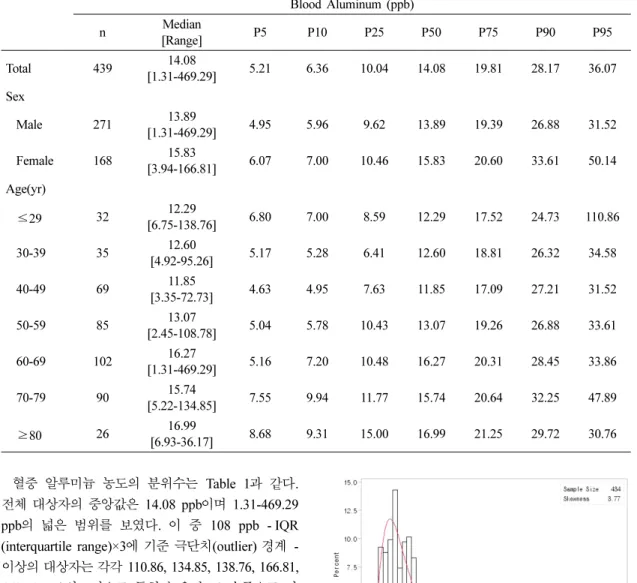
혈중 알루미늄 농도의 분위수는 Table 1과 같다.

전체 대상자의 중앙값은 14.08 ppb이며 1.31-469.29 ppb 의 넓은 범위를 보였다. 이 중 108 ppb - IQR (interquartile range)×3 에 기준 극단치(outlier) 경계 - 이상의 대상자는 각각 110.86, 134.85, 138.76, 166.81, 469.29 ppb 의 5명으로 특히 높은 농도 수준으로 나 타났다.

극단치를 절삭한 혈중 알루미늄의 히스토그램은 Fig. 2 와 같다. 왜도가 3.95으로 좌측으로 치우친 분 포를 보였으며, 대수변환 후의 Shapiro-Wilk 통계량 이 0.983, Kolmogorov–Smirnov 통계량이 0.056으 로 로그정규분포(log-normal distribution)를 만족하는 것으로 판단된다. 대수변환된 혈중 알루미늄 농도의 , 는 각각 51.17, 96.92 ppb로 확률밀 도함수에서 하위 97.5%, 99.9%의 영역을 담보한다.

이들 경계를 초과하는 최상위 극단치의 개수는 각각 13 개(51.95-469.29 ppb), 6개(101.07-469.29 ppb)로 나타났다.

2. 혈중 알루미늄 중심위치 추정

혈중 알루미늄의 성별, 연령에 따른 중심위치 추 정 결과는 Table 2와 같다. 전체 대상자의 기하평균 (95% 신뢰구간)은 14.26(13.43-15.14) ppb로 나타났 다. 여성[13.51(12.54-14.55) ppb]에 비해 남성[15.58 (14.09-17.22) ppb] 이 통계적으로 유의하게 높았으며 μˆ 2σˆ + μˆ 3σˆ +

Table 1. Distribution of the blood aluminum concentration


Blood Aluminum (ppb)

n Median

[Range] P5 P10 P25 P50 P75 P90 P95

Total 439 14.08

[1.31-469.29] 5.21 6.36 10.04 14.08 19.81 28.17 36.07

Sex

Male 271 13.89

[1.31-469.29] 4.95 5.96 9.62 13.89 19.39 26.88 31.52

Female 168 15.83

[3.94-166.81] 6.07 7.00 10.46 15.83 20.60 33.61 50.14

Age(yr)

≤29 32 12.29

[6.75-138.76] 6.80 7.00 8.59 12.29 17.52 24.73 110.86

30-39 35 12.60

[4.92-95.26] 5.17 5.28 6.41 12.60 18.81 26.32 34.58

40-49 69 11.85

[3.35-72.73] 4.63 4.95 7.63 11.85 17.09 27.21 31.52

50-59 85 13.07

[2.45-108.78] 5.04 5.78 10.43 13.07 19.26 26.88 33.61

60-69 102 16.27

[1.31-469.29] 5.16 7.20 10.48 16.27 20.31 28.45 33.86

70-79 90 15.74

[5.22-134.85] 7.55 9.94 11.77 15.74 20.64 32.25 47.89

≥80 26 16.99

[6.93-36.17] 8.68 9.31 15.00 16.99 21.25 29.72 30.76

Fig. 2. Histogram of the blood aluminum concentration.

(5)

(p=0.023), 20 대 이하 13.68(10.64-17.60) ppb에서 40 대 11.49(9.91-13.33) ppb까지 감소하는 경향을 보였 으나 50대 13.95(12.10-16.08) ppb부터 80대 이상 17.32(14.67-20.45) ppb 까지 점차 증가하는 경향을 보였다. 사후검정 결과 40대와 80대 이상에서 통계 적으로 유의한 차이가 있었다. 남성, 여성 각각의 연 령에 따라 감소 후 증가하는 유사한 경향성이 나타 났다. 특징적으로 남성은 50대[16.47(13.69-19.83) ppb], 여성은 60대[14.12(11.58-17.22) ppb]부터 연령 이 증가할수록 농도가 증가하였다. 여성의 50대 [11.66(9.44-14.42) ppb] 는 남성의 50대와 통계적으 로 유의한 차이를 보였다(p=0.015).

3. 참고치 초과자

혈중 알루미늄 농도 참고치 초과자의 비율은 Table 3 과 같다. 50 ppb에 대한 전체 초과자 비율(표준오 차)은 3.19(0.84)%이었으며, 남성[5.36(1.74)]이 여성

[1.85(0.82)] 에 비해 더 높았다. 20대 이하 저연령층 에서 극단치를 가지는 대상자들로 인해 6.25(4.35)%

의 특히 높은 비율을 보였다.

20 ppb 참고치 기준 전체 24.15(2.04)%의 초과자 비율을 보였고, 남성[27.98(3.47)]이 여성[21.77(2.51)]

에 비해 더 높은 것으로 나타났다. 20대 이하 저연 령층 12.50(5.94)%에서 80대 이상의 고연령층 38.46(9.73)% 까지 연령이 증가할수록 초과자 비율이 증가하는 경향성을 보였다.

혈중 알루미늄 농도를 로그정규분포라 가정할 때, 97.5 분위수에 해당하는 는 51.17 ppb로 참 고치인 50 ppb와 유사한 수치로 나타났다. 또한 50 ppb 초과자 비율은 3.19%로 오차범위 내에서 2.5%

를 포함하고 있어 가정된 분포에 부합되는 것을 확 인할 수 있었다. 최종적으로 본 연구의 일반 인구 혈중 알루미늄 농도는 lnN(x; 2.89, 0.642), x>0의 로그정규분포를 따르는 것으로 나타났다.

μˆ 2σˆ + Table 2. Geometric means of the blood aluminum concentration

  Total Sex

p-value

Male Female

n GM(95% CI) n GM(95% CI) n GM(95% CI)

Total 439 14.26

(13.43-15.14) 168 15.58

(14.09-17.22) 271 13.51

(12.54-14.55) 0.023

Adjusted 14.49

(13.52-15.53)

15.34 (13.37-17.60)

13.40

(12.35-14.53) 0.020 Age(yr)

≤29 32 13.68

ab

(10.64-17.60) 15 15.54

(9.30-25.96) 17 12.23

a

(9.93-15.05) 0.341

30-39 35 12.29

ab

(9.76-15.48) 9 12.43

(6.30-24.52) 26 12.24

a

(9.60-15.61) 0.955

40-49 69 11.49

a

(9.91-13.33) 21 11.41

(8.86-14.70) 48 11.53

a

(9.55-13.92) 0.950

50-59 85 13.95

ab

(12.10-16.08) 44 16.47

(13.69-19.83) 41 11.66

a

(9.44-14.42) 0.015

60-69 102 15.17

ab

(13.19-17.44) 43 16.72

(13.78-20.30) 59 14.12

a

(11.58-17.22) 0.237

70-79 90 16.30

ab

(14.64-18.15) 32 16.64

(13.29-20.82) 58 16.12

a

(14.33-18.14) 0.782

≥80 26 17.32

b

(14.67-20.45) 4 19.79

(14.91-26.28) 22 16.91

a

(13.92-20.54) 0.492

p-value   0.008   0.285   0.024  

GM(95% CI): geometric mean (95% confidence interval) Adjusted: Adjusted for sex, age

ab
: Bonferroni post-hoc; same letter are not significantly different

(6)

IV. 고 찰

본 연구는 최근 우리나라 국민들의 혈중 알루미늄 농도 수준을 표준화된 분석기법을 활용하여 측정 분 석한 의미 있는 연구이다. 본 연구에서 일반 성인의 혈중 알루미늄 농도의 기하평균(95% 신뢰구간은)은 14.26(13.43-15.14) ppb 이었다.

국내 일반 인구집단에 대한 연구결과 혈청(Serum) 알루미늄의 평균±표준편차가 5.67±3.51 ppb,

23)

혈중 알루미늄의 경우 5.7±3.5 ppb,

24)

남녀 성별에 따라 남성 5.9±3.9 ppb, 여성 5.6±2.8 ppb로 보고된 바 있 다.

25)

한편, 비교적 최근의 일부 대학생을 대상으로 한 연구에서 남성 9.12±2.11 ppb, 여성 8.03±2.14 ppb 으로 본 연구 결과에 비해 낮은 것으로 나타났 다.

26)

기존 연구에서 연령에 따른 혈중 알루미늄 농 도에 차이는 없었고

23-25)

40대 이상에서 통계적으로

유의하게 증가하는 것으로 나타난 본 연구 결과와 차이가 있었다. 이러한 결과는 각 연구의 상이한 분 석 방법, 시점 등으로 직접적인 비교에는 다소 무리 가 있을 것으로 보인다.

국외의 경우, Sorenson은 1940~1970년의 연구 결 과를 정리하여 일반 성인의 혈중 알루미늄 농도 범 위를 14.0-62.4 ppb로 보고하였다.

27)

이는 본 연구에 비해 높은 수준이었으나 시점의 큰 차이가 있다. 비 교적 최근인 Schultze의 연구 결과는 70세 이상 고 연령에서 평균±표준편차를 19.13±14.53 ppb, 중앙값 ( 사분위수 범위)을 17.18(13.60-21.45) ppb로 보고하 였고 본 연구의 고연령군과 비교하여 유사한 수준으 로 나타났다.

28)

House 는 71명의 비노출 직업군의 혈 청 알루미늄 농도에 대한 기하평균을 26.7 ppb로 보 고하였고,

29)

Drablos 는 230명의 조사에서 평균 5 ppb 수준으로 보고하였다.

30)

또한 House는 다양한 연구 Table 3. The proportion of excess subjects in blood aluminum concentration

Reference

value  

Excess subjects

Total Sex

Male Female

n %(Stderr) n %(Stderr) n %(Stderr)

≥50 ppb

Total 14 3.19(0.84) 9 5.36(1.74) 5 1.85(0.82)

Age (year)

≤29 2 6.25(4.35) 2 13.33(9.09) 0 0.00

30-39 1 2.86(2.86) 1 11.11(11.11) 0 0.00

40-49 1 1.45(1.45) 0 0.00 1 2.08(2.08)

50-59 4 4.71(2.31) 3 6.82(3.84) 1 2.44(2.44)

60-69 4 3.92(1.93) 2 4.65(3.25) 2 3.39(2.38)

70-79 2 2.22(1.56) 1 3.13(3.13) 1 1.72(1.72)

≥80 0 0.00 0 0.00 0 0.00


≥20 ppb

Total 106 24.15(2.04) 47 27.98(3.47) 59 21.77(2.51)

Age (year)

≤29 4 12.50(5.94) 2 13.33(9.09) 2 11.76(8.05)

30-39 5 14.29(6.00) 1 11.11(11.11) 4 15.38(7.22)

40-49 11 15.94(4.44) 3 14.29(7.82) 8 16.67(5.44)

50-59 19 22.35(4.55) 10 22.73(6.39) 9 21.95(6.54)

60-69 30 29.41(4.53) 19 44.19(7.66) 11 18.64(5.11)

70-79 27 30.00(4.86) 10 31.25(8.32) 17 29.31(6.03)

≥80 10 38.46(9.73) 2 50.00(28.87) 8 36.36(10.50)

50 ppb: considered to be a reasonable “limit” below which aluminum neurotoxicity was not likely to occur

20 ppb: recommendation level provided by some laboratories

(7)

에서 혈청 및 혈장(plasma)의 평균이 1.6-35.0 ppb 수준임을 보고하였다.

29)

Nieboer 역시 다수의 연구 를 종합하여 일반 인구 집단의 농도가 10 ppb 미만 임을 제시하였다.

31)

Schultze 의 연구에서 혈청에 대 한 혈중 알루미늄 평균의 비는 1.67, 중앙값의 비는 3.81 수준으로 나타났다.

23)

이를 적용한 본 연구의 혈청 알루미늄 농도의 평균은 8.54 ppb, 중앙값은 3.70 ppb 로 추정되며, 국외와 비교하여 비슷한 수준 일 것으로 추측되나 추가 연구를 통한 구체적인 확 인이 필요할 것이다.

현재 적용되고 있는 국내 인체안전기준이 전무한 것에 비해 국제 기준을 포함하여 미국, 캐나다, 유 럽, 일본 등은 자국 내 인체안전기준을 제시하여 관 리를 하고 있다. Joint FAO/WHO Expert Committee on Food Additives(JECFA) 는 잠정주간섭취허용량 (Provisional Tolerable Weekly Intake, PTWI) 을 1 mg/kg bw/week 으로 제시하였다.

32)

US Environmental Protection Agency(EPA) 는 인화알루미늄 기준용량 (reference dose, RfD) 를 4×10

−4

mg/kg/day 로 정하고 있으며

33)

EFSA(European Food Safety Authority) 의 주간섭취허용량(Tolerable Weekly Intake, TWI)을 1 mg/kg bw/week 로 제시하고 있다.

2)

일부 선진국 이 정기적인 모니터링으로 자국민의 일상적인 식이 패턴에 대한 유해 중금속과 독성물질 등의 노출량 을 평가하는 동시에 대기, 물, 음식, 노출 직업군 등 세부 항목에 따른 개별 기준치를 제시함으로써 노출수준을 관리하는 것에 반해

1)

국내의 노출량 평 가 및 관리 기준은 그 규모와 항목에서 매우 미흡 한 실정이다. 관리 기준치의 부재는 정보 부족에 따른 노출 위험을 증가시킬 수 있다. 미국, EU, 일 본 등은 특정 식품 내 알루미늄 함량 관련 법규 및 기준을 제·개정하는 등 안전 관리를 강화하는 추세 에 있다.

혈중 알루미늄 생체 농도에 대한 타당성 있는 기 준치는 아직 마련되어 있지 않다. 제안된 참고치들 을 살펴보면, 과거 100 ppb 이하를 일반적으로 고 려하였으나, 1980년대 후반 50 ppb 이하에서 건강 문제가 발견됨에 따라 1995년 Yokel은 일련의 사례 연구를 근거로 하여 건강한 사람에 대한 농도로서 참고치를 10 ppb 로 권고하였다.

34)

본 연구에서 10 ppb 이상의 비율(표준오차)는 75.2(2.06)%에 달하며 50 ppb 초과 대상자는 14명[3.19(0.84)%], 100 ppb

초과 대상자는 7명[1.59(0.60)%]으로 나타났다. 일부 연구소에서는 혈중 알루미늄에 대한 일반적 참고치 로서 20 ppb를 제시하고 있으며

35,36)

이에 대한 초과 자 비율은 24.15(2.04)%로 나타났다. 본 연구와 유 사 분석 방법인 ICP/SFMS(double-focusing sector field ICP/MS)를 이용하여 분석한 바이오모니터링 결과 농도의 범위를 4.9-14.9 ppb,

37)

HR-ICP/MS(high resolution ICP/MS) 를 이용한 분석에서 중앙값을 15.0 ppb 로 제시한 바 있다.

38)

본 연구에서 15 ppb 이상 은 47.6(2.38)%로 나타났다.

일반 성인 인구의 혈중 알루미늄 농도를 파악하 는데 있어 다양한 인구·사회학적 특성이 반영되지 못한 점과, 혈청 알루미늄 분석을 통한 국외 연구 와의 직접적인 비교 분석이 부족한 점은 향후 추 가적인 연구의 필요성으로 지적될 수 있다. 또한, 일부 고농도 대상자들의 노출요인 및 노출경로를 파악하지 못한 것은 본 연구의 제한점으로 지적될 수 있다. 이러한 단점에도 불구하고 본 연구는 기 존 국내 연구와 비교해 볼 때, 신뢰할 수 있는 표 준 분석법을 이용하여 혈중 알루미늄 농도를 산출 하고 국내 일반 성인 인구의 분포 상태를 제시하 였다는 점에서 의미가 있다. 향후 우리나라 국민들 의 알루미늄노출 수준을 대표할 수 있는 보다 광 범위한 연구와 노출경로를 파악할 수 있는 연구가 수행되어지기를 기대한다.

V. 결 론

국내 일반 성인 인구의 혈중 알루미늄 농도는 lnN(x; 2.89, 0.642), x>0의 로그정규분포를 따르며 기하평균(95% 신뢰구간은)은 14.26(13.43-15.14) ppb 로 국외 농도 수준과 비교해 다소 높은 것으로 나타났다. 경험적 건강 영향 참고치 50 ppb를 초과 하는 3.19%의 고농도 노출자의 빈도를 고려해 본 다면 일반 인구에 대한 적극적인 관리가 필요하다 고 판단된다.

감사의 글

This study was supported by grants from the

Environmental Health Center funded by the

Ministry of Environment, Republic of Korea.

(8)

References

1. ATSDR. Toxicological profile for aluminum. 2008.

2. EFSA. Safety of aluminium from dietary intake-Sci- entific opinion of the panel on food additives, fla- vourings, processing aids and food contact materials (AFC). 2008.

3. Harbison RD, Bourgeois MM, Johnson GT. Hamil- ton and Hardy's industrial toxicology: John Wiley &

Sons; 2015.

4. Monteagudo F, Cassidy M, Folb P. Recent develop- ments in aluminium toxicology. Med Toxicol Adverse Drug Exp. 1989; 4(1): 1-16.

5. Sprague SM, Corwin HL, Wilson RS, Mayor GH, Tanner CM. Encephalopathy in chronic renal fail- ure responsive to deferoxamine therapy: Another manifestation of aluminum neurotoxicity. Arch Intern Med. 1986; 146(10): 2063-2064.

6. Bast-Pettersen R, Skaug V, Ellingsen D, Thomas- sen Y. Neurobehavioral performance in aluminum welders. Am J Ind Med. 2000; 37(2): 184-192.

7. Buchtaa M, Kiesswetterb E, Schäperb M, Zschies- chec W, Schallerd K, Kuhlmanna A, et al. Neuro- toxicity of exposures to aluminium welding fumes in the truck trailer construction industry. Environ Toxicol Pharmacol. 2005; 19(3): 677-685.

8. Iregren A, Sjögren B, Gustafsson K, Hagman M, Nylén L, Frech W, et al. Effects on the nervous sys- tem in different groups of workers exposed to alu- minium. Occup Environ Med. 2001; 58(7): 453-460.

9. Riihimäki V, Hänninen H, Akila R, Kovala T, Kuosma E, Paakkulainen H, et al. Body burden of alumi- num in relation to central nervous system function among metal inert-gas welders. Scand J Work Envi- ron Health. 2000: 118-130.

10. Colomina MT, Roig JL, Torrente M, Vicens P, Domingo JL. Concurrent exposure to aluminum and stress during pregnancy in rats: Effects on postnatal development and behavior of the offspring. Neuro- toxicol Teratol. 2005; 27(4): 565-574.

11. Donald JM, Golub MS, Gershwin ME, Keen CL.

Neurobehavioral effects in offspring of mice given excess aluminum in diet during gestation and lacta- tion. Neurotoxicol Teratol. 1989; 11(4): 345-351.

12. Golub MS, Germann SL. Long-term consequences of developmental exposure to aluminum in a sub- optimal diet for growth and behavior of Swiss Web- ster mice. Neurotoxicol Teratol. 2001; 23(4): 365- 372.

13. Oteiza PI, Keen CL, Han B, Golub MS. Aluminum accumulation and neurotoxicity in Swiss-Webster

mice after long-term dietary exposure to aluminum and citrate. Metabolism. 1993; 42(10): 1296-1300.

14. Baxter PJ, Aw T-C, Cockcroft A, Durrington P, Harrington JM. Hunter's diseases of occupations:

CRC Press; 2010.

15. Bingham E, Cohrssen B, Powell CH. Patty's toxi- cology. Volume 2: toxicological issues related to met- als, neurotoxicology and radiation metals and metal compounds: John Wiley and Sons; 2001.

16. Agius R. Patty’s Industrial Hygiene. Occup Med.

2012; 62(1): 69-70.

17. Gruskin A. Aluminum: a pediatric overview. Adv Pediatr. 1988; 35: 281-330.

18. Domingo JL. Reproductive and developmental tox- icity of aluminum: a review. Neurotoxicol Teratol.

1995; 17(4): 515-521.

19. Rao KSJ, Rao BS, Vishnuvardhan D, Prasad KV.

Alteration of superhelical state of DNA by alumin- ium (Al). Biochimica et Biophysica Acta (BBA)- Gene Structure and Expression. 1993; 1172(1): 17- 20.

20. IARC. IARC Monographs on the Evaluation of Car- cinogenic Risks to Humans, Supplement 6, Genetic and Related Effects: An Updating of Selected IARC Monographs from Volume 1 to 42. Lyon. 1987: 57- 59.

21. MFDS. The annual report of Korea food & drug administratoin: TDI evaluation of aluminum. 2007:

402.

22. MFDS. Dietary Intake and Risk Assessment of Contaminants in Korean Foods. 2009.

23. Roberts N, Zhu H, Kim J, Shin H, Kim J, Choi S.

Further studies on the interrelationship of alumi- num and silicon in patients receiving aluminum hydroxide therapy for dyspepsia and factors that relate to the solubilization of aluminum. The Jour- nal of Trace Elements in Experimental Medicine.

2002; 15(1): 9-19.

24. Kim JY, Shin HR, Kim JI, Kim DH, Choi SR, Seoh JI, et al. Effect on Aluminum and Silicon in Peptic Ulcer Patients. Korean Journal of Preventive Med- icine. 1999; 32(2): 200-205.

25. Kim JM, Ahn JM, Kim WS, Kim JI, Shin HR, Jung KY, et al. Blood lead, MAnganese, alumin- ium and silicon concentrations in korean adults.

Korean Journal of Preventive Medicine. 2000;

33(2): 157-164.

26. Jung EI, Song KH. A Study of Anthropometric

Characteristics, Serum Lipids and Serum Alumin-

ium Levels in College Students. Korean Living Sci-

ence Association: workshop presentation file. 2009;

(9)

2009(0): 123-124.

27. Sorenson JR, Campbell IR, Tepper LB, Lingg RD.

Aluminum in the environment and human health.

Environ Health Perspect. 1974; 8: 3.

28. Schultze B, Lind PM, Larsson A, Lind L. Whole blood and serum concentrations of metals in a Swedish population-based sample. Scand J Clin Lab Invest. 2014; 74(2): 143-148.

29. House RA. Factors affecting plasma aluminum con- centrations in nonexposed workers. J Occup Envi- ron Med. 1992; 34(10): 1013-1017.

30. Drablos P, Hetland S, Schmidt F, editors. Uptake and excretion of aluminum in workers exposed to aluminum fluoride and aluminum oxide. Proceed- ings of the second international conference on alu- minum and health, Tampa, Fl; 1992.

31. Nieboer E, Gibson BL, Oxman AD, Kramer JR.

Health effects of aluminum: a critical review with emphasis on aluminum in drinking water. Environ-

mental Reviews. 1995; 3(1): 29-81.

32. JECFA. Summary and conclusions of the sixty-sev- enth meeting of the Joint FAO/WHO Expert Com- mittee on Food Additives (JECFA). 2006.

33. EPA. Health Hazard Assessments for Effects Other than Cancer: Aluminum phosphide Reference Dose for Oral Exposure. 2008.

34. Yokel RA, Golub MS. Research issues in alumin- ium toxicity: Taylor & Francis; 1997.

35. GCLabs. Test Information, reference value. 2016.

36. Quest Diagnostics Test aluminum, reference rage.

37. Axelsson M, Rodushkin I. Multi-element analysis of body fluids by double-focusing ICP-MS. Tran- sworld Res Network Recent Res Devel Pure & Applied Chem. 2001; 5: 51-66.

38. Rodushkin I, Ödman F, Branth S. Multielement

analysis of whole blood by high resolution induc-

tively coupled plasma mass spectrometry. Fresenius J

Anal Chem. 1999; 364(4): 338-346.

수치

Table 1. Distribution of the blood aluminum concentration

참조

관련 문서