
A Study on the Pump Efficiency Measurement Using the Thermodynamic Method
Cherl-O Bae
*․Duc-Phuc Vuong
**†․Hwi-Il Lee
****, ** Division of Maritime Engineering System, Mokpo National Maritime University, Mokpo, 530-729, Korea
*** Hae Dong Engineering Co. Ltd, Yeongam-gun, Jeollanam-do, 526-852, Korea
열역학적 방법을 사용한 펌프 효율 측정에 관한 연구
배철오
*․브엉득푹
**†․이휘일
****, ** 목포해양대학교, *** 해동엔지니어링(주)
Abstract : Carbon emission generated by energy issues is one of the major problems which all countries concern. The International Energy Agency recommends to improve 15-30[%] of energy efficiency than now. Government has pushed the domestic energy saving policies and incentives and penalties were also given in that direction. Pumps are widely used to transfer fluids and they consume at least 20[%] power of each nation. Their loss of energy is huge if they have been operated at low efficiency for long time. Low efficiency of these pumps is often due to incorrect design or degradation. Pump efficiency can be measured to estimate energy loss. If it is low, the pump may be repaired or replaced with new one. This paper introduces thermodynamic method to measure pump efficiency using only two kinds of sensors for temperature and pressure. It can calculate best efficiency point(BEP) of actual systems easily and fast. Its values were compared with the real performance curve provided by pump maker and we got almost similar performance curves from the repeated experiment.
Key Words : International Energy Agency, Pump efficiency, Thermodynamic method, Best Efficiency Point(BEP), performance curve
요 약: 에너지 생성에 따른 탄소배출문제로 국제 에너지 기구는 세계 주요국의 에너지 효율을 15~30[%]이상 향상시키도록 권고하고 있으 며, 국내 에너지 정책 동향도 에너지 절감 및 탄소 배출에 대해 정부에서 인센티브 및 페널티 프로그램을 제고하는 방향으로 가고 있다.
각국의 산업 현장에서 유체 이송용 펌프가 전기에너지의 20[%]를 소비하고 있는 실정으로, 주요 에너지 낭비 요인으로는 장시간 운전에 따 른 효율 저하, 부적절한 설계 및 설비 등이 있다. 이러한 낭비를 줄이기 위해 펌프의 효율을 측정하여 펌프의 운전 상태를 진단하고자, 본 논 문에서는 열역학적 방법으로 온도와 압력센서만을 활용하여 펌프의 최고 효율점을 측정할 수 있는 방법을 제시하고 실제 펌프의 효율을 계 산하여 펌프제조사에서 제공한 성능곡선과 비교한 결과 유사한 성능곡선을 얻어 그 유효성을 확인하였다.
핵심용어: 세계에너지기구, 펌프효율, 열역학적 방법, 최고 효율점(BEP), 성능곡선
1
1. Introduction
Pump efficiency is usually measured by two methods.
They are called traditional technique and the thermodynamic method(Kwon et al., 2004). In traditional technique, pump efficiency is calculated from the pump equation, flow rate, head, and electrical power. Of these parameters, flow rate is the most difficult to determine accurately. Many pumps do not have installed the accurate and individual flow meters because they are high in cost and more expensive for larger
* First author : [email protected], 061-240-7223
†Corresponding author : [email protected], 061-240-7232
diameter pipes especially. Also they can be difficult or impossible to install, calibrate, and maintain in some system.
The accuracy of flow meter is variable depending on the pump's operating point and other factors such as build-up of debris in pipes or on sensor's surface. The advent of the thermodynamic method(Routleyand Baxter, 2005) has provided a solution to this problem.
2. The principle of the thermodynamic method
The thermodynamic method results from the application of the principle of energy conservation which transfers the
energy between water and pump rotor(Noah, 2005).
Measurement of pump efficiency is given below
(1)
where
: hydraulic energy per unit mass of fluid
: mechanical energy per unit mass of fluid
(2)
and
(3)where
: differential pressure
: discharge pressure
: suction pressure : differential temperature
: discharge temperature
: suction temperatureAbove 6 values are measured by the temperature and pressure probes.
: specific heat capacity
: isothermal coefficient
: fluid density
And above 3 parameters are specified in fluid properties table(ISO 5198).
The critical parameter is the differential temperature across the pump, which must be measured to an accuracy of typically 1 mK[℃]. This is especially important for fixed installations and is achieved with this method.
From classical pump efficiency formula (4), flow rate (
) will be calculated if Watt transducer is available or electrical power to motor (
) will be determined if flow rate is given in advance(PumpCalcs, 2012). × ×
×
(4)
In case of Watt transducer and flow rate are available, energy losses transmission of electrical power to the motor are effectively being measured.
The thermodynamic method is the simplified methodology to measure pump efficiency. It is simple and possible to measure pump efficiency on installed pumps to evaluate the
condition of the pump. Only two parameters, temperature and pressure are required to determine pump efficiency(Berge, 2009; Teodor and Alexandru, 2004). Furthermore temperature and pressure transmitters are installed easily with low cost.
They are reasons why it has been widely used in all over the world with great success.
3. Measuring instruments based on the thermo- dynamic method
3.1 Calculation software
LabVIEW software is used in this study. It is the most suitable for this application(Zangeneh, 2007). It is a graphical programming environment used by millions of engineers and scientists to develop sophisticated measurement, test, and control systems using intuitive graphical icons and wires that are resemble a flowchart. With LabVIEW, real time operating becomes easier and helps to find out a friendly interface for users.
3.2 Hardware
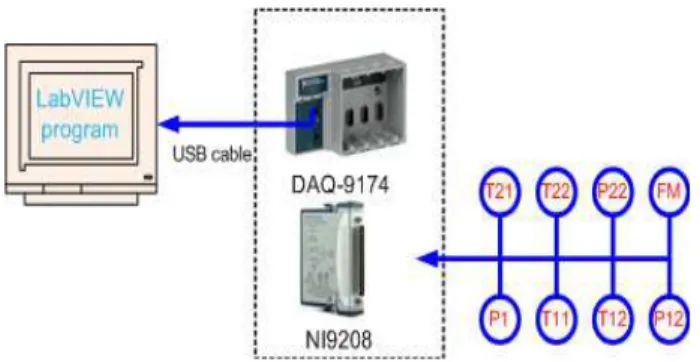
Fig. 1 shows the data acquisition diagram composed of 8 sensors and data acquisition devices.
Fig. 1. Data acquisition diagram.
The NI 9208 current input C Series module has 16 channels of ± 21 mA input with built-in 50/60 Hz noise rejection. Resolution is 24 bits, operating system/target with Real-Time. The NI cDAQ-9174 is a 4-slot NI CompactDAQ USB 2.0 Hi-Speed chassis designed for small, portable, mixed-measurement test systems(National Instrument, 2012).
Several sensor data were collected from temperature probe (T), pressure transmitter(P) and flow meter(FM). These sensors have all current outputs with 4-20[mA] range. They are connected as Fig. 2.
Fig. 2. The wiring diagram for input signals.
3.3 Programming
Data received from hardware has actual value in mA.
These signals are converted to temperature in oC or pressure in bar, etc..
It has output current signal for temperature probe from 4-20 mA which is corresponded to the original 0-40 ℃ so that the temperature is as follows
× × (5)
And also pressure transmitter has current output from 4-20 mA which is corresponded to the original 0-20 kg/cm2 so the pressure in bar(1bar = 1.02 kg/cm2) is as follows
× × × (6)
The temperature probes do not measure a absolute temperature accurately but they are calibrated in pairs to read the differential temperature to one milli-Kelvin(One thousandths of a degree Celsius). The system acquires multiple sampling as an averaged reading(Typically at one second intervals for ten seconds) to take a test as accurate as possible and then take 8 or more readings at 15 to 30 second intervals(Teodor and Alexandru, 2004). This averaging of multiple readings is used to smooth out the temperature differential fluctuations and average the instrument variability. Flow meter is similar.
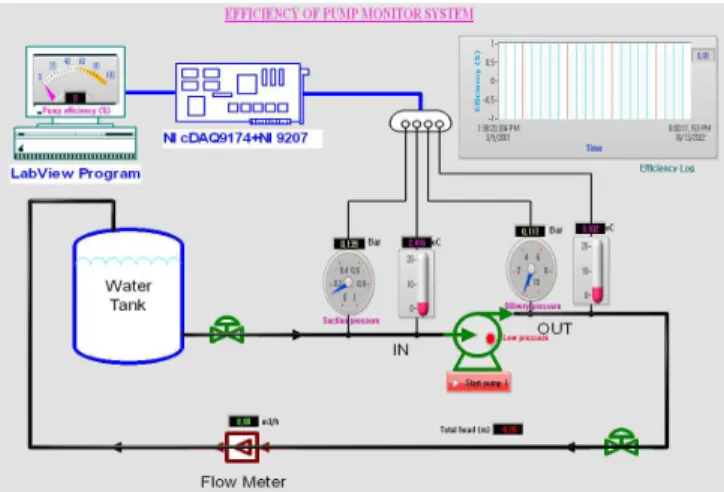
Fig. 3 shows the monitoring program for pump efficiency measurement(Robertson Technology, 2012). Parameters are monitored continuously with time. Graphs can be plotted from measured parameters and compared with manufacturer’s curves to illustrate any changes in pump efficiency. In addition, these parameters are saved in special type of file which is useful information to operator.
Fig. 3. Monitoring program for pump efficiency measurement.
4. Experimental instruments
Description of the experimental installation and of the measuring instruments are shown Fig. 4.
Fig. 4. Experiment installation in closed loop.
A 2000 liters water tank is set to reserve of liquid at out side. Pump A(Model DRL8-50) and pump B(Model DRL16-50) are a vertical multistage pump and were manufactured by DOOCH. Table 1 shows the detail specification of each motor.
This method requires high temperature probe and pressure transmitter as accurate as possible. It is important to choice a temperature probe which it’s range closes to the temperature of the liquid that the pump operates. The temperature difference between suction and delivery of pump changes very small when the pump is running and the pressure transmitter range is also similar. Temperature probes(ATT2100-S1K0-M1BA) made by AUTROL and pressure transmitter(TPS-G17F8) made by KONICS are used. Product details are given in Table 2.
A flow meter(T-W1000) made by WinTEC is used. It has LCD indicator and current signal output with 4-20[mA]
range.
Pump A
Model DRL8-50
Power 3 [kW]
Q 9 [m3/h]
Total head 66 [m]
Motor efficiency 87.5 [%]
Speed 3500 [rpm]
Pump B
Model DRL16-50
Power 7.5 [kW]
Q 20 [m3/h]
Total head 85 [m]
Motor efficiency 89.5 [%]
Speed 3500 [rpm]
Table 1. Description of pump
Temperature transmitter
Model ATT2100-S1K0-M1BA
Power supply 12-45 Vdc
Output 4-20 mA
Input RTD PT100
Range PT100(0-40) C
Pressure transmitter
Model TPS20-G17-F8
Power supply 15-35 Vdc
Output 4-20 mA
Range 0-20 kg/cm2
Load 600 ohm
Zero 0.03 [%] FS
Span 0.03 FS
Table 2. Description of temperature and pressure sensor
5. Results and discussions
5.1 Water temperature
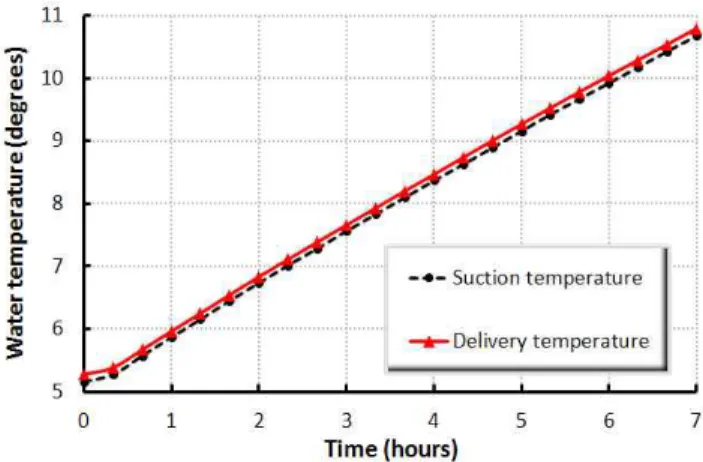
Fig. 5 is the graph of suction and delivery water temperature after operating of pump A in 7 hours at 6.2 bar.
Temperature of water increases gradually because the water is just circulated in closed loop.
The delivery temperature is lager than suction side and its difference is close to 0.182[℃].
Fig. 5. Water temperature of pump A.
Fig. 6 is the graph of suction and delivery water temperature after operating of pump B in 7 hours at 9 bar.
The decline of temperature graph is similar to the Fig. 5 but the difference of temperature is close to 0.105[℃]. Pump B’s temperature values between suction and delivery is smaller than pump A. So if the pump has a lager power, the temperature change between suction and delivery will be smaller.
Fig. 6. Water temperature of pump B.
5.2 Water pressure
The pump efficiency will vary when difference pressure values are changed. We obtained the best efficient point from the repeated experiment when the pressure difference was about 6.2 bar at pump A. And also it was about 9 bar in case of pump B. Pump efficiency curve offered by pump maker is usually showed as a graph related to pump efficiency and flow rate, so it is convenient to compare and evaluate the accuracy of thermodynamic method. We used flow rate parameter instead of the difference pressure values because the pressure relates to flow rate closely.
5.3 Efficiency of pump
Firstly, pump A’s efficiency was measured. In this case, the output valves of pump B(VB) and pump A(VA) are fully closed. After running of pump A and then valve(VA) is opened slowly. Its efficiency curve is shown in Fig. 7. It is clear that pump efficiency curve measured by traditional technique has the almost same curve offered pump maker but it has a little lower values.
Fig. 7. Comparison of pump efficiency curve for pump A.
There were unstable values when the flow rate varies from 0 bar to 1 bar(15 to 19[m3/h]). Pump efficiency measured is not exact at full flow(18.5-19[m3/h]). However, pump is not usually operated at these flow rate values. Working points of pumps are in range of -20[%] to +10[%] flow rate in which pump efficiency is maximum as Fig. 8. The best efficiency point(BEP) is found and it reaches 60[%] when the flow rate is close to 6.2 bar(11[m3/h]).
Fig. 8. Better practice of pumps.
Fig. 9 presents efficiency of pump A in over 20 operating hours at 11[m3/h] flow rate. There have been fluctuations
from near 58[%] to 61[%], but about 3[%] fluctuation is acceptable to determine the pump efficiency. There are a lot of parameters to make the fluctuations of efficiency, however the critical parameter is the differential temperature across the pump. The fluctuations will be reduced if we use the more accuracy temperature transducer.
Fig. 9. Efficiency of pump A at Q = 11[m3/h].
Secondly, pump B’s efficiency was measured. Now the output valves of pump B(VB) and pump A(VA) are fully closed. After running of pump B and then valve(VB) is opened slowly.
Fig. 10. Comparison of pump efficiency curve for pump B.
Their efficiency characteristic is shown in Fig. 10. It is similar to pump A like Fig. 7. However, it has greater values. The best efficiency point of pump B is 63[%] when delivery pressure is around 9 bar(22[m3/h]).
Fig. 11 shows efficiency values of pump B in over 20 operating hours at flow rate Q = 22[m3/h]. Its efficiency is from 62[%] to 64[%].
Fig. 11. Efficiency of pump B at Q = 22[m3/h].
6. Conclusion
This paper introduced the thermodynamic method as the simplified methodology to measure a pump efficiency.
Following conclusions are given from this research.
1) The measured BEPs from two pumps were the almost same values compare to be offered pump maker.
2) The efficiency fluctuated between 2 and 3[%] when pumps operate continuously, but those values are enough to determine the efficiency. Also the fluctuations will be reduced if we install the more accuracy temperature transducers.
3) Only two parameters, temperature and pressure are required to determine a pump efficiency, thus it makes simple and possible to measure a pump efficiency on installed pumps with low cost.
4) Making pump efficiency instrumentation based on this method is not difficult. This instrumentation can be applied in practice to find a BEP and evaluate on real pump systems.
It provides the information required for management of energy.
Acknowledgment
This study was supported by the Small & Medium Business Administration(SMBA), Korea. This financial support is gratefully acknowledged.
References
[1] Kwon, Y. J., C. D. Seo, Y. C. Jung and J. W.
Park(2004), Efficiency measuring in pump using thermodynamic method, Proceedings of Korean Fluid Machinery Association, pp. 546-551.
[2] Berge, Djebedjian(2009), Theoretical Model to Predict the Performance of Centrifugal Pump Equipped with Splitter Blade, Mansoura Engineering Journal, vol. 34, no. 2, pp. 50-70.
[3] Zangeneh, M.(2007), Advanced Design Software for Pumps, Wold Pumps, pp. 28-31.
[4] National Instrument(2012), http://www.ni.com/products/.
[5] Noah, D. Manring(2005), Measuring Pump Efficiency, Uncertainty Considerations, The ASME, Vol. 127, pp.
280-283.
[6] PumpCalcs(2012), Http://www.pumpcalcs.com/calculators/
view/107/.
[7] Robertson Technology(2012), http://www.pumpmonitor.c om/The-Thermodynamic-Method.php.
[8] Routley, Ross and Ken Baxter(2005), Pump Efficiency Monitoring and Management at Melbourne Water, Bendigo, pp. 35-43.
[9] Teodor, Milos and Baya Alexandru(2004), Modelling of the automatic adjustment of the optimum operating point of a pump depending on the requirements of the water supply, The 6th International conference, Romania, pp. 46-51.
Received : 2012. 05. 14.
Revised : 2012. 06. 18.
Accepted : 2012. 06. 25.
![Fig. 9 presents efficiency of pump A in over 20 operating hours at 11[m 3 /h] flow rate](https://thumb-ap.123doks.com/thumbv2/123dokinfo/5078491.318640/5.892.458.809.683.918/fig-presents-efficiency-pump-operating-hours-flow-rate.webp)
![Fig. 11. Efficiency of pump B at Q = 22[m 3 /h].](https://thumb-ap.123doks.com/thumbv2/123dokinfo/5078491.318640/6.892.78.432.126.359/fig-efficiency-pump-b-q-m-h.webp)
