부유성 유공충의 δ 18 O 및 Mg/Ca 분석에 의한 제 4 기 후기 동해의 고해양 변화
김정무1, 佐川拓也2, 이영주3, 석봉출4, 현상민4
1
民族史觀學校 地球科學科
2
日本 北海島大學 環境地球科學大學院
3
韓國地質資源硏究院 石油海底資源硏究部
4
韓國海洋硏究院 海洋環境硏究本部
요 약: 동해의 제4기 고해양 변화를 조사하기 위하여 한국대지의 시추코아 퇴적물(M04-PC1A)에서 산출된 중층수종인 부유성 유공충 Neogloboquadrina pachyderma의 산소 동위원소(δ
18O)와 표층수종인 부유성 유 공충 Globigerina bulloides의 미량원소(Mg/Ca)를 측정하였다. 총 29개의 Mg/Ca 측정 결과를 얻은 이번 동 해 부유성 유공충의 미량원소 분석은 국내외적으로 처음 시도되었으며, 지난 30만년 동안(Marine Isotope Stage: MIS 1∼8) 동해의 표층수온(SST; sea surface temperature) 변화 범위가 약 3.2~15.5
oC(평균 6.8
oC) 라는 사실을 밝힐 수 있었다. 또한 Mg/Ca 분석 결과를 근거로 한 SST 변동곡선은 δ
18O 변동곡선 및 알케논 (alkenone) 추정온도와 거의 일치하며 동해의 장․단기적인 고해양/고기후 변화 주기를 정밀하게 기록하고 있다. 따라서 부유성 유공충의 안정 동위원소와 미량원소 측정결과는 동해의 제4기 후기 고해양 변화 연구에 중요한 proxy로 사용될 수 있다.
주제어: 부유성 유공충, 지화학적 분석, δ
18O, Mg/Ca, SST, 고해양, 제4기 후기
서 론
1970년대 이후 해양 퇴적물의 제4기 표층수온(sea surface temperature; 이하 SST)을 복원하기 위하여 여러 가지 측정방법이 사용되고 있는데, 일반적으로 잘 알려진 방법으로는 미화석 군집의 통계적 처리자료를 이용한 미고생물학적인(micropaleontological) 방법과, 탄산염 유공충의 미량원소(trace element)와 산소 동위 원소 및 석회질 초미화석의 알케논(alkenone unsaturation ratios)을 측정하는 생지화학적인(biogeochemical) 방법 등이 있다(Mix et al., 2001).
최근 SST 연구에서 산소 동위원소 방법과 더불어 가장 활발하게 이용되고 있는 측정법 중의 하나는 부유성 유공충에 함유된 마그네슘과 칼슘의 성분비를 이용한 Mg/Ca 온도 측정법(thermometry)이다. Mg2+는 이 가(二價, divalent) 이온을 갖는 원소 중 하나이며 생물기원의 탄산염(biogenic calcium carbonate)이 생성 될 때 온도의 영향을 받아 Mg 성분은 Ca 성분으로 치환된다. 해수 온도가 상승하면 생물기원 탄산염에 포함 된 Mg/Ca도 함께 증가하는 경향을 나타내는데 이러한 사실은 Chave(1954), Blackmon and Todd(1959) 등에 의해 알려지기 시작하였다. Mg/Ca 분석을 위해 처음에는 X-선 회절기를 사용하였지만, Kilbourne and Sen Gupta (1973)는 원자흡광분석기, Duckworth (1977)는 전자미량분석기(electron microprobe) 등 을 사용하여 탄산염에 포함된 미량원소의 분석방법을 발전시킬 수 있었다. 또한 Cronblad and Malmgren (1981)은 시추 코아 퇴적물에서 산출된 유공충의 Mg 및 Sr 함량비를 측정하여 미량원소의 성분변화가 고기 후 연구에 중요하다는 사실을 밝힌 바 있다.
부유성 유공충을 이용한 Mg/Ca 온도측정법은 지질시대 동안의 고해양 변화에 따른 해수온도 복원 연구 에 주로 이용되고 있다(예를 들면, Nürnberg et al., 1996; Hastings et al., 1998; Lea et al., 1999, 2000, 2002;
Mashiotta et al., 1999; Elderfield and Ganssen, 2000; Rosenthal et al., 2000; Koutavas et al., 2002; Stott et al., 2002; Lea, 2003; Pahnke et al., 2003; Visser et al., 2003; Barker et al., 2005). 다른 석회질 화석들의
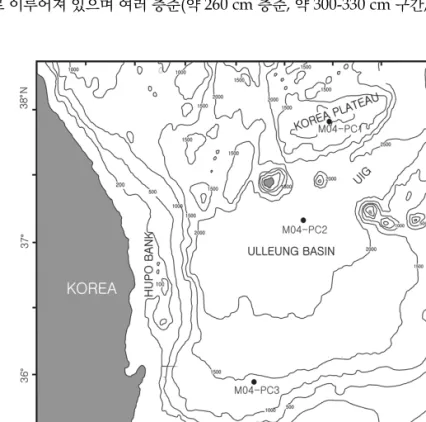
Fig. 1. Site location for Core M04-PC1A from the Korea Plateau, East sea.
Mg/Ca 함량비도 해수온도 변화에 민감하게 반응하기 때문에, 최근에는 저서성 유공충(예를 들면, Izuka, 1988; Rathburn and De Deckker, 1997; Rosenthal et al., 1997; Lear et al., 2000; Toyofuku et al., 2000;
Martin et al., 2002; Billups and Schrag, 2003; Raja et al., 2005), 개형충(예를 들면, Chivas et al., 1986;
Dwyer et al., 1995; Wansard, 1996; De Deckker et al., 1999), 초미화석(Stoll et al., 2001) 및 산호(예를 들 면, Mitsuguchi et al., 1996; Wei et al., 1999; Watanabe et al., 2001) 등을 이용한 광범위한 Mg/Ca 측정 연 구가 이루어지고 있다.
한편, 국내에서는 유공충의 안정 동위원소 측정결과를 이용한 고해양 연구가 발표된 적은 있지만(예를 들 면, Kim and Kennett, 1998; 김정무 등, 1999; Kim et al., 2000; 김정무, 2004; 김정무 등, 2004), 유공충의 Mg/Ca 분석 결과는 아직까지 보고된 적이 없다. 이번 연구에서는 동해의 한국대지에서 채취된 시추코아 퇴 적물로부터 부유성 유공충을 추출하여 산소 및 탄소 동위원소비(δ18O, δ13C)를 분석하고 미량원소(Mg/Ca) 를 측정하여 국내에서 처음으로 동해의 제4기 후기 표층수온(SST) 및 고해양 변화를 밝히고자 하였다.
연구 재료 및 방법
안정 동위원소(δ
18
O, δ13
C) 분석이번 연구에서는 2004년 6월 한국해양연구원 소속 온누리호가 동해의 고해양 연구를 위하여 울릉도 북부 의 한국대지(Korea Plateau: latitude 38° 00.043'N; longitude, 131° 27.937'E; water depth, 758.7m)에서 채취한 M04-PC1A 코아 퇴적물을 사용하였다(Fig. 1). 이 코아는 주로 암녹회색 내지 올리브 회색의 사질니 (dark∼light greenish gray 또는 olive grey muddy sand∼sandy mud)로 구성된 전형적인 심해 퇴적물 세립질 입자로 이루어져 있으며 여러 층준(약 260 cm 층준, 약 300-330 cm 구간, 약 390-410 cm 구간 등)에
Fig. 2. Lithologic characteristics for Core M04-PC1A.
서 화산활동에 의한 화산재 및 화산탄 파편 등이 협재되어 있다. 그리고 코아 하부(약 430 cm∼최하부 587 cm)에서는 조개껍질 파편과 유공충(주로 Globigerina bulloides) 등으로 이루어진 탄산염 퇴적층(carbonate deposits)이 특징적으로 나타난다(Fig. 2).
안정 동위원소 측정용 부유성 유공충을 추출하기 위하여 코아 퇴적물 중에서 최상부로부터 하부 465 cm 층준까지의 퇴적물을 10 cm 간격으로 깊이별로 약 10g씩 총 43개의 시료를 채취하였다. 이 시료들은 약 50oC의 전기건조기에서 완전히 건조시킨 다음, 전자저울로 소수점 2자리까지 무게를 측정하고 63 μm 체 (sieve)로 수세(washing)하여 퇴적물을 선별(sieving)하였다. 선별된 건조시료는 다시 무게를 측정하고 유 공충을 추출하였으며 쌍안실체현미경을 이용한 부유성 유공충의 분류작업은 주로 Saito et al. (1981), Kennett and Srinivasan (1983)을 참고로 하였다.
안정 동위원소 측정용 시료는 유공충의 정성적인 빈도분포로부터 유공충이 비교적 많이 산출되는 시료를 선 정하여 150 μm 체로 분별한 후, 150 μm 체의 잔사(remnant)에서 추출한 부유성 유공충 Neogloboquadrina pa- chyderma를 사용하였다. 유공충의 크기는 종(species)과 개체(specimen)의 성숙 정도에 따라 다르지만, 일반 적으로 N. pachyderma는 약 200∼300 μm로 비교적 작은 편이다. 안정 동위원소 측정에 필요한 유공충 개체수 는 N. pachyderma의 경우 약 50∼60개체가 소요된다.
유공충의 안정 동위원소 측정은 일본 북해도대학(Hokkaido University)의 질량분석기를 사용하였으며 시 료준비 과정은 이 대학의 시료처리 방법을 따랐다(Wada et al., 1984). 이 대학의 안정 동위원소비 질량분석 기(Finnigan MAT 251)는 미량가스 발생장치를 부착한 수동측정 방법과 자동 측정 장치를 부착한 측정방법 을 병행하여 사용하고 있다. 부유성 유공충 시료에 포함된 불순물을 제거하기 위하여 먼저 직경 2 mm의 stainless tub에 유공충을 넣고 주사기를 이용하여 아세톤을 tub에 주입한 후 가는 바늘로 조심스럽게 분쇄한 다. 분쇄한 유공충 시료는 메탄올을 주입한 후, 흡착종이를 이용하여 메탄올 일부를 흡착시키면서 유공충에 포 함된 불순물을 제거하였다. 유공충 시료는 50˚C의 전기건조기에서 완전히 건조시킨 후, 60.0˚C로 유지되는 진공반응장치 내에서 인산과 반응시켜 발생된 CO2가스를 n-펜탄과 액체질소를 사용하여 정제하였다. 정제 된 CO2가스는 질량분석기에 도입하여 산소 및 탄소 동위원소비(δ18O, δ13C)를 측정하였으며 산소 및 탄소 동위원소비는 NBS20 표준시료를 이용하여 PDB에 대한 δ값으로 환산하였다.
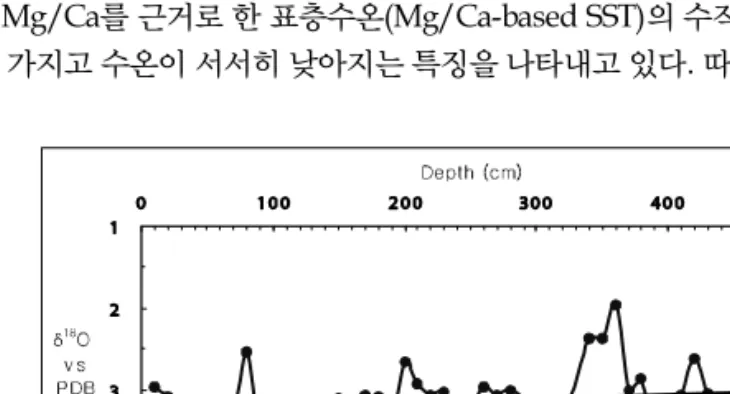
Fig. 3. Stratigraphic variations of oxygen isotopic values for intermediate water dweller planktonic foraminifer N.
pachyderma in Core M04-PC1A.
미량원소(trace element) 분석
이번 연구에서는 동해의 한국대지 부근에서 채취된 M04-PC1A 시추 코아 퇴적물 시료를 약 10 cm 간격으 로 채취하여 부유성 유공충 G. bulloides의 Mg/Ca 값을 측정하였다. 부유성 유공충의 미량원소(Mg/Ca) 분 석에 사용되는 유도결합원자방출분광기(ICP-AES; inductively coupled plasma atomic emission spectrometer)는 부유성 유공충 G. bulloides의 경우 약 100개체(약 0.5 mg) 이상이 소요된다. 이번 연구에 사용된 코아 퇴적물의 상부(0∼100 cm 구간) 및 하부(440∼587 cm 구간)에서는 미량원소 분석에 필요한 만 큼의 충분한 양의 G. bulloides의 산출되지 않았기 때문에 Mg/Ca 측정이 가능한 111 cm 층준부터 431 cm 층준까지의 구간에서 총 29개의 시료에 대해 미량원소를 측정하였다.
부유성 유공충의 Mg/Ca 측정은 일본 북해도대학 환경지구과학대학원의 Toyoda 교수 실험실 측정방법 을 이용하였으며(Sagawa et al., 2005), 측정기기는 ICP-AES (SEIKO instrument, model SPS-7700)를 사 용하였다. 이 측정기기의 오차한계는 ±0.5%이며, 평균재현율(reproducibility)은 ±1 standard error 범위 내에서 ln(Mg/Ca)의 ±5% (±0.4oC해당)이다.
안정 동위원소 및 미량원소 분석 결과 및 논의
이번 연구에 사용된 코아 퇴적물 M04-PC1A에서는 화산재 등이 나타나는 상부의 일부 구간을 제외하고는 전반적으로 부유성 유공충이 풍부하게 산출하고 있으며 코아 전 구간에서 연속적으로 산출되는 부유성 유공 충은 N. pachyderma, G. bulloides 등이 있다. N. pachyderma에 대한 안정 동위원소(δ18O, δ13C) 측정 결과와 G.
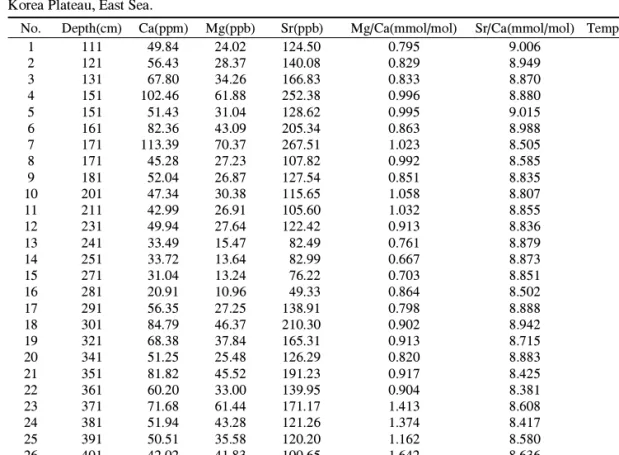
bulloides에 대한 미량원소 측정 결과는 각각 표 1 및 표 2와 같다.
표 1에서 보는 바와 같이 총 43개의 산소 및 탄소 동위원소 측정 결과로부터 깊이별로 산소 동위원소 변동곡 선을 나타내었다(Fig. 3). 그림 3에서 보는 바와 같이, δ18O 변동곡선은 1∼2‰의 진폭을 유지하며 대략 4회 정도의 규칙적인 증감 주기를 나타내고 있다. 가장 낮은(lighter) δ18O값은 360 cm 층준의 약 2‰이며 가장 높은(heavier) δ18O값은 240 cm 층준의 약 4‰이다. 이 δ18O 변동곡선은 y=-0.0005x+3.2404의 직선방정식 으로 나타낼 수 있으며 전체적으로는 코아 상부로 갈수록 미약하게 증가하는 경향을 보이고 있다. 높은 δ18O 값을 기록하고 있는 4개의 층준(최상부로부터 40 cm 층준 3.4‰, 110 cm 층준 3.7‰, 240 cm 층준 3.9‰ 및 390 cm 층준 3.7‰)에서는 한랭한 시기(cold episode 또는 빙하기)였을 것으로 추정된다.
표 2는 G. bulloides에 대한 Mg/Ca 측정값과 Mg/Ca를 근거로 한 표층수온(SST)을 나타내고 있다.
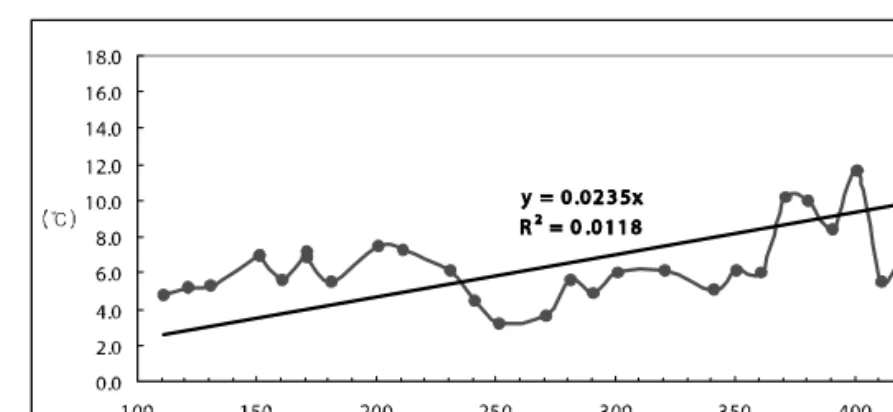
Mg/Ca 측정값으로부터 추정된 제4기 후기 동해의 수온변화 범위는 약 3.2∼15.5oC(평균 6.8oC)인 것으로 밝혀졌다. 그림 4는 Mg/Ca를 근거로 한 표층수온(Mg/Ca-based SST)의 수직변화를 나타내는데 y=0.0235x 의 직선방정식 값을 가지고 수온이 서서히 낮아지는 특징을 나타내고 있다. 따라서 G. bulloides의 Mg/Ca 측
Fig. 4. Stratigraphic variations of Mg/Ca-based SST for surface water dweller planktonic foraminifer G. bulloides in Core M04-PC1A.
정 결과로부터 동해에서는 제4기동안 고해양/고기후학적 변화가 주기적으로 일어나고 있었음을 알 수 있다.
그림 5는 부유성 유공충의 Mg/Ca 측정을 근거로 한 SST 변화와 산소 동위원소값(δ18O)의 변화를 비교한 것이다. 이 2개의 곡선은 전체적으로 볼 때 일치하는 경향을 보이며 증감변화를 주기적으로 반복하고 있다.
SST 변동 곡선은 코아 하부로부터 중부(약 100 cm 층준 이하)까지의 구간에서 해수온도가 감소하는 경향을 나타낸다. 이번 연구에서는 상부(100 cm 층준 이상) 구간에서 Mg/Ca 측정이 이루어지지 않았기 때문에 N.
pachyderma의 δ18O값을 근거로 온도 변화를 추정해 보면, 최상부로 갈수록 해수온도가 약간 증가하는 경향이 있다.
중층수종인 N. pachyderma와 표층수종인 G. bulloides의 변동곡선(Fig. 5)에서 증감 변화를 나타내기 시작 하는 시기는 부분적으로 정확하게 일치하지는 않는다. 코아 퇴적물 중에서 250∼260 cm 구간을 보면, Mg/Ca-based SST는 251 cm 층준에서 최저온도 3.2oC를 기록하며, δ18O값은 240 cm 층준에서 최고값 3.9‰
을 기록하고 있다. 빙하기에 접어들면서 해수온도가 낮아지는 경우에는 표층수부터 낮아지기 시작하며 최저 수온을 기록하지만, 중층수는 약간의 시간적 간격을 두고 서서히 낮아지는 경향을 나타내는 것으로 해석할 수 있다.
또한, Mg/Ca-based SST는 361 cm 층준에서 최고온도 10.2oC를 기록하며 δ18O값은 360 cm 층준에서 최저값 1.9‰을 기록하고 있는데, 이것은 간빙기의 수온이 상승하는 경우에도 표층수가 중층수보다 큰 폭으 로 상승하여 최고 수온을 기록한 후, 약간의 시간적 간격을 두고 중층수의 수온이 완만하게 상승하는 특징을 나타내고 있는 것으로 해석할 수 있다. 그러나 전반적인 Mg/Ca-based SST와 δ18O값의 증감 패턴은 대체로 유사한 편이다.
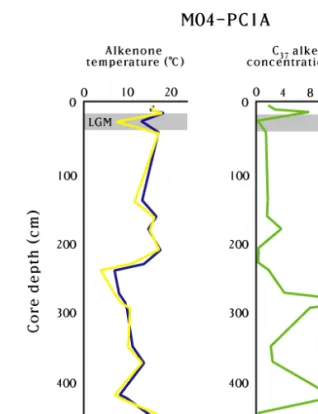
Hyun et al. (2005) 및 Suk et al. (2005)은 지난 30만년 동안(MIS 1∼8) 동해의 초미화석 알케논 농도로부 터 알케논 추정온도를 구하였으며 부유성 유공충의 δ18O값과 알케논 추정온도를 비교하였다(Figs. 6, 7 참 조). 그림 6-7에서 보는 바와 같이, 알케논 추정온도는 가장 추운 시기인 251 cm 층준에서 약 4oC를 기록하는 데 G. bulloides의 Mg/Ca-based SST(3.2oC)와 거의 유사하다. 그러나 코아 상부에서는 알케논 추정온도가 약 15oC내외로 Mg/Ca-based SST(약 7oC) 보다 훨씬 높게 나타난다. 이와 같이 알케논 변동곡선은 Mg/Ca-based SST보다 변동폭이 큰 편이지만, 알케논 추정온도와 Mg/Ca-based SST 변동곡선 사이의 증 감 패턴은 거의 유사하게 나타난다.
따라서, 이번 연구에서 수행한 부유성 유공충의 미량원소 Mg/Ca 측정값은 산소 동위원소(δ18O)값 및 알 케논 추정온도와 함께 고해양 및 고기후학적인 해양환경 변화 해석에 중요한 proxy를 제공한다는 사실을 확 인할 수 있었다.
Table 1. Stable isotopic data from planktonic foraminifer Neogloboquadrina pachyderma in Core M04-PC1A of the Korea Plateau, East Sea.
No. Sample no. Depth (cm) Species δ
18O vs. PDB δ
13C vs. PDB
1 PC1A10 10 Neogloboquadrina pachyderma 2.963 -0.129
2 PC1A20 20 Neogloboquadrina pachyderma 3.083 -0.424
3 PC1A30 30 Neogloboquadrina pachyderma 3.387 -0.288
4 PC1A40 40 Neogloboquadrina pachyderma 3.428 -0.266
5 PC1A55 55 Neogloboquadrina pachyderma 3.237 -0.325
6 PC1A60 60 Neogloboquadrina pachyderma 3.310 -0.324
7 PC1A70 70 Neogloboquadrina pachyderma 3.343 -0.214
8 PC1A80 80 Neogloboquadrina pachyderma 2.540 -0.130
9 PC1A90 90 Neogloboquadrina pachyderma 3.486 -0.276
10 PC1A100 100 Neogloboquadrina pachyderma 3.241 -0.231
11 PC1A110 110 Neogloboquadrina pachyderma 3.680 0.118
12 PC1A120 120 Neogloboquadrina pachyderma 3.471 -0.098
13 PC1A130 130 Neogloboquadrina pachyderma 3.523 -0.144
14 PC1A140 140 Neogloboquadrina pachyderma 3.205 -0.434
15 PC1A150 150 Neogloboquadrina pachyderma 3.108 -0.416
16 PC1A160 160 Neogloboquadrina pachyderma 3.127 -0.473
17 PC1A170 170 Neogloboquadrina pachyderma 3.070 -0.368
18 PC1A180 180 Neogloboquadrina pachyderma 3.096 -0.199
19 PC1A190 190 Neogloboquadrina pachyderma 3.315 -0.239
20 PC1A200 200 Neogloboquadrina pachyderma 2.653 -0.277
21 PC1A210 210 Neogloboquadrina pachyderma 2.920 -0.316
22 PC1A220 220 Neogloboquadrina pachyderma 3.080 -0.409
23 PC1A230 230 Neogloboquadrina pachyderma 3.021 -0.391
24 PC1A240 240 Neogloboquadrina pachyderma 3.911 -0.335
25 PC1A250 250 Neogloboquadrina pachyderma 3.291 -0.270
26 PC1A260 260 Neogloboquadrina pachyderma 2.972 -0.381
27 PC1A270 270 Neogloboquadrina pachyderma 3.067 -0.350
28 PC1A280 280 Neogloboquadrina pachyderma 3.006 -1.235
29 PC1A320 320 Neogloboquadrina pachyderma 3.265 -0.290
30 PC1A340 340 Neogloboquadrina pachyderma 2.366 -0.955
31 PC1A350 350 Neogloboquadrina pachyderma 2.366 -0.955
32 PC1A360 360 Neogloboquadrina pachyderma 1.971 -1.182
33 PC1A370 370 Neogloboquadrina pachyderma 3.004 -0.462
34 PC1A380 380 Neogloboquadrina pachyderma 2.862 -0.338
35 PC1A390 390 Neogloboquadrina pachyderma 3.703 -0.354
36 PC1A400 400 Neogloboquadrina pachyderma 3.479 -0.299
37 PC1A410 410 Neogloboquadrina pachyderma 3.064 -0.445
38 PC1A420 420 Neogloboquadrina pachyderma 2.625 -0.615
39 PC1A430 430 Neogloboquadrina pachyderma 3.055 -0.461
40 PC1A440 440 Neogloboquadrina pachyderma 3.281 -0.320
41 PC1A455 455 Neogloboquadrina pachyderma 3.431 -0.354
42 PC1A460 460 Neogloboquadrina pachyderma 3.606 -0.314
43 PC1A465 465 Neogloboquadrina pachyderma 3.161 -0.462
Table 2. List of Mg/Ca measurement for planktonic foraminifer Globigerina bulloides from Core M04-PC1A of Korea Plateau, East Sea.
No. Depth(cm) Ca(ppm) Mg(ppb) Sr(ppb) Mg/Ca(mmol/mol) Sr/Ca(mmol/mol) Temperature(
oC)
1 111 49.84 24.02 124.50 0.795 9.006 4.8
2 121 56.43 28.37 140.08 0.829 8.949 5.2
3 131 67.80 34.26 166.83 0.833 8.870 5.3
4 151 102.46 61.88 252.38 0.996 8.880 6.9
5 151 51.43 31.04 128.62 0.995 9.015 6.9
6 161 82.36 43.09 205.34 0.863 8.988 5.6
7 171 113.39 70.37 267.51 1.023 8.505 7.2
8 171 45.28 27.23 107.82 0.992 8.585 6.9
9 181 52.04 26.87 127.54 0.851 8.835 5.5
10 201 47.34 30.38 115.65 1.058 8.807 7.5
11 211 42.99 26.91 105.60 1.032 8.855 7.3
12 231 49.94 27.64 122.42 0.913 8.836 6.1
13 241 33.49 15.47 82.49 0.761 8.879 4.4
14 251 33.72 13.64 82.99 0.667 8.873 3.2
15 271 31.04 13.24 76.22 0.703 8.851 3.7
16 281 20.91 10.96 49.33 0.864 8.502 5.6
17 291 56.35 27.25 138.91 0.798 8.888 4.9
18 301 84.79 46.37 210.30 0.902 8.942 6.0
19 321 68.38 37.84 165.31 0.913 8.715 6.1
20 341 51.25 25.48 126.29 0.820 8.883 5.1
21 351 81.82 45.52 191.23 0.917 8.425 6.2
22 361 60.20 33.00 139.95 0.904 8.381 6.0
23 371 71.68 61.44 171.17 1.413 8.608 10.2
24 381 51.94 43.28 121.26 1.374 8.417 9.9
25 391 50.51 35.58 120.20 1.162 8.580 8.4
26 401 42.02 41.83 100.65 1.642 8.636 11.6
27 411 60.80 31.61 139.49 0.857 8.270 5.5
28 421 74.66 50.81 174.85 1.122 8.443 8.1
29 431 39.08 59.20 93.43 2.498 8.618 15.5
Fig. 5. Stratigraphic variations of Mg/Ca-based SST and oxygen isotopic value (δ
18O) for planktonic foraminifera
(G. bulloides, N. pachyderma) in Core M04-PC1A.
Fig. 6. Alkenone temperature and C
37alkenone concentration in Core M04-PC1A (from Suk et al., 2005).
Fig. 7. Stratigraphic variations of oxygen isotopic value (δ
18O) and alkenone (U
k37') temperature in Core M04-
PC1A (from Suk et al., 2005).
결 론
1. 북서 태평양 주변해에 속하는 동해의 한국대지에서 연속적인 피스톤 코아 퇴적물을 채취하여 중층수종 부 유성 유공충 N. pachyderma의 안정 동위원소와 표층수종 G. bulloides의 미량원소를 국내외적으로 처음 측 정하였다.
2. G. bulloides에 대한 Mg/Ca 측정값으로부터 추정된 제4기 후기 동해의 수온변화 범위는 약 3.2∼15.5oC (평균 6.8oC)이다. Mg/Ca-based SST 변동곡선은 y=0.0235x의 직선방정식으로 나타낼 수 있으며 코아 상부로 갈수록 수온이 서서히 낮아지는 특징을 나타내고 있다.
3. 전반적인 Mg/Ca-based SST와 δ18O 증감 패턴은 대체로 유사한 편이다. 가장 추운 시기인 코아 251 cm 층준에서 알케논 추정온도는 약 4oC를 기록하는데, G. bulloides의 Mg/Ca-based SST(3.2oC)와 비교하면 거의 유사하다. 그러나 코아 상부에서는 알케논 추정온도가 약 15oC내외로 Mg/Ca-based SST(약 7oC) 보다 높게 나타난다. 이와 같이 알케논 변동곡선은 Mg/Ca-based SST보다 변동 진폭이 다소 크게 나타나 지만, 이들 변동곡선 사이의 증감 패턴은 거의 유사하게 나타난다.
4. 이번 연구에서 수행한 G. bulloides의 미량원소 Mg/Ca 측정 결과로부터 제4기 후기에 해당되는 지난 30만 년 동안 동해에서 고해양/고기후학적 변화가 주기적으로 일어나고 있음을 알 수 있었다. 또한, 부유성 유 공충의 미량원소 Mg/Ca 측정값은 산소 동위원소(δ18O)값과 알케논 추정온도와 함께 제4기 고해양 및 고 기후학적인 해양환경 변화 해석에 중요한 proxy를 제공한다는 사실을 확인할 수 있었다.
감사의 글
이 연구를 위하여 안정 동위원소 측정기기 및 시설을 제공해 주신 홋카이도대학의 Irino 교수에게 깊은 감 사를 드리며, Mg/Ca 분석을 위해 ICP-AES 측정기기를 제공해 주신 Toyoda 교수에게도 감사드립니다. 그 리고 이 논문을 심사해 주신 김일수 박사와 익명의 심사자에게도 감사드립니다. 이 논문은 한국지질자원연구 원에서 시행한 2005년 해양자원의 개발․이용 및 해양조사 사업 및 한국해양연구원의 2005년 정책연구사업 의 연구 결과이며 연구비를 지원해 주신 해양수산부 및 공공기술연구회 관계자 여러분께 감사드립니다.
LATE QUATERNARY PALEOCEANOGRAPHIC CHANGES IN δ 18 O AND Mg/Ca ANALYSES OF PLANKTONIC
FORAMINIFERA IN EAST SEA (JAPAN SEA)
Jung-Moo Kim
1, Takuya Sagawa
2, Young-Joo Lee
3, Bol-Chul Suk
4and Sang-Min Hyun
41
Dep't of Earth Science, Korean Minjok Leadership Academy, Kangwon-do, 225-823 Korea [email protected]
2
Graduate School of Environmental Earth Science, Hokkaido University, Sapporo, 060-0810, Japan
3
Petroleum and Marine Resources Research Division, Korea Institute of Geoscience and Mineral Resources, Daejon 305-350, Korea
4
Marine Geoenvironment & Resources Research Division, Korea Ocean Research & Development Institute, Ansan P.O.Box 29, 425-600, Korea
Abstract: To unravel the Quaternary paleoceanographic condition, we have conducted the paired measurements of
δ
18O and Mg/Ca ratio of planktonic foraminifera from a piston-cored sequence of M04-PC1A in Korea Plateau of
East Sea (Japan Sea). We have measured a total 29 Mg/Ca-based SSTs (sea surface temperature) for planktonic
foraminifer Globigerina bulloides, ranging from 3.2 to 15.5
oC (average 6.8
oC) for the first time in East Sea area.
Especially, these two curves of δ
18O and Mg/Ca ratio are almost consistent with each other, reflecting possible de- termination of the magnitude and timing of SST changes in East Sea since MIS 8 (∼300,000 yrs B.P.). Through this study we can conclude that geochemical analyses related to oxygen isotope and Mg/Ca-based SST using plank- tonic foraminifera will play an important role in studying the high-resolution regional/global climatic changes.
Key words: planktonic foraminifera, geochemical analysis, δ
18O, Mg/Ca, SST, paleoceanography, Late Quaternary
참고문헌