백립계 고제분 붉은곰팡이병 중도저항성 제면용 밀(Triticum aestivum L.)
‘중모2004’
강천식1・ 정영근1・ 김경훈1・ 김학신1・ 김영진1・ 김경호1・ 박종철1・ 박형호1・ 김홍식2・ 강성주3・ 최홍집4・ 김정곤5・ 김기종1・ 이춘기1・ 박광근1・ 박기훈1・ 박철수6*
1농촌진흥청 국립식량과학원, 2농촌진흥청, 3전남농업기술원, 4경북농업기술원, 5(사)한국맥류산업발전연구원,
6전북대학교 농업생명과학대학 작물생명과학과
A White Wheat Variety, ‘Joongmo2004’ with High Milling, Good Noodle Quality and Moderate Resistance to Fusarium Head Blight
Chon-Sik Kang1, Young-Keun Cheong1, Kyeong-Hoon Kim1, Hag-Sin Kim1, Young-Jin Kim1, Kyong-Ho Kim1, Jong-Chul Park1, Hyung-Ho Park1, Hong-Sik Kim2, Sung-Ju Kang3, Hong-Jip Choi4, Jung-Gon Kim5,
Kee-Jong Kim1, Choon-Ki Lee1, Kwang-Geun Park1, Ki-Hun Park1, and Chul-Soo Park6*
1National Institute of Crop Science, RDA, Iksan, 570-080, Korea
2Rural Development Bureau, RDA, Suwon, 441-707, Korea
3Jeollanamdo Agricultural Research & Extension Services, Jangsung, 515-804, Korea
4Gyeongsangbukdo Agricultural Research & Extension Services, Daegu, 702-708, Korea
5Korean Wheat &Barley Industry Development Institute, Suwon, 441-857, Korea
6Department of Crop Science and Biotechnology, Chonbuk National University, Jeonju, 561-756, Korea
Abstract : ‘Joongmo2004’, a winter wheat (Triticum aestivum L.) cultivar was developed by the National Institute of Crop Science, RDA. It was derived from the cross ‘Bacanora88/Keumkang//Keumkang’ during 1996. ‘Joongmo2004’ was evaluated as ‘Iksan320’ in advance yield trial test in 2006. It was tested in the regional yield trial test between 2007 and 2009. Its heading date was April 26 in upland and April 23 in paddy filed conditions, and Maturity date was June 5 in upland and June 4 in paddy field, which were similar to Keumkang, respectively. It showed 830 in number of spikes per m2, 35 of grain number per spike, 44.9g of 1,000 grain weight, and 806g of test weight. ‘Joongmo2004’ showed moderate to fusarium graminearum (Scab) in test of specific character although ‘Keumkang’ is susceptible to scab. ‘Joongmo2004’ had higher flour yield (75.5%) than
‘Keumkang’(72.5%). ‘Joongmo2004’ showed similar ash (0.42%), lower protein content (12.3%), SDS-sedimentation volume (43.0 ml) and gluten content (10.3%) than ‘Keumkang’ (0.42%, 13.1%, 57.8ml and 10.8%, respectively). It showed higher lightness (89.97), redness (-1.38) and yellowness (10.76) in flour color than ‘Keumkang’ (89.61, -1.15 and 9.46, respectively).
‘Joongmo2004’ exhibited lower hardness (3.50N), similar springiness and higher cohesiveness of cooked noodles (0.92 and 0.65) compared to ‘Keumkang’ (4.54N, 0.93, and 0.63, respectively). The average grain yield in the regional yield trial was 517 kg/10a in upland and 534 kg/10a in paddy field, which were 11% lower and 3% higher than that of the check cultivar, ‘Keumkang’, respectively.
Keywords : Joongmo2004, Keumkang, Milling, Noodles, Wheat
*Corresponding author (E-mail: [email protected], Tel: +82-63- 270-2533, Fax: +82-63-270-2640)
(Received on December 17, 2013. Revised on August 21, 2014.
Accepted on September 11, 2014.)
276
http://dx.doi.org/10.9787/KJBS.2014.46.3.276 Print ISSN: 0250-3360
Copyright ⓒ 2014 by the Korean Society of Breeding Science
This is an Open-Access article distributed under the terms of the Creative Commons Attribution Non-Commercial License (http://creativecommons.org/licenses/by-nc/3.0) which permits unrestricted non-commercial use, distribution, and reproduction in any medium, provided the original work is properly cited.
Year ’96 ’97 ’98 ’99 ’00 ’01 ’02 ’03 ’04 ’05 ’06 ’07 ’08 ’09
Generation F1 F2 F3 F4 F5 F6 F7 F8 F9 F10 F11 F12 F13 F14
Bacanora88 / Keumkang
YW2948 - B - B - 1 - 1 - 1 - 1 - 1 - 1 - PYTz - AYTy - RYTx - RYT - RYT
Keumkang Joongmo2004
Procedure Artificial
crossing Bulk and line selection Yield trial test Regional yield trial
zPYT: Preliminary yield trial
yAYT: Advanced yield trial
xRYT: Regional yield trials
Fig. 1. Pedigree diagram of wheat variety, ‘Joongmo2004.
서 언
주요 밀(Triticum aestivum L.) 수출국가의 기상이변에 따 른 생산량 감소와 재고량의 감소로 세계 밀 곡물가격은 상승 하면서 수입밀과 국산밀의 가격이 현재 2.4배까지 좁혀져 식 량안보가 부각되고 있다. 국민 1인당 밀 소비량은 33.9 kg으 로 쌀(69.8 kg) 다음으로 많이 소비되고 있지만, 9천ha를 재 배하여 37천톤을 생산하여 사료를 제외한 식량자급도는 1.6%
로 낮아 거의 전량을 수입에 의존하여 사용하고 있는 실정이 다(MAFRA 2013).
그 동안 국내 밀 품종 육성은 조숙 다수성을 주요 목표로 이루어지고 있으며, 1970년 이후 약 30여 품종이 개발되었다.
제분율은 밀의 곡립 중에서 배유 부분의 비율이므로 제분율 의 향상은 곧 수량의 증가와 동일하다고 할 수 있다. 국내 개 발된 밀 품종 중 1990년 이전 품종의 제분율은 평균 60% 미 만이었고, 1990이후 품종들은 65% 이상으로 많이 향상되었 다(Nam et al. 1998). 현재 금강밀(Nam et al. 1998), 조경밀 (Kang et al. 2006), 한백밀(Park et al. 2009)의 제분율은 72% 이상 높은 것으로 보고 되었다. 국내 밀의 주요 병해 중 붉은곰팡이병(Fusarium graminearum, Scab)은 개화기경에 강우만으로도 병원균의 감염이 되고(Parry et al. 1995), 종실 의 등숙에 영향을 미치기 때문에 수량 감소와 독소를 종실 내 에 축적하여 사람과 가축에게 2차적인 피해를 준다(Lee et al.
1985, Windel 2000). 국내에서도 기상이상에 따른 출수기에 잦은 강우로 인하여 2010년과 2011년에 남부지역에 많은 발 생을 보여 농가의 소득이 감소하였다(Park et al. 2012). 수량 감소를 국내 재배 밀 품종의 70% 이상을 차지하는 ‘금강밀’
은 중단간으로 도복에 강하며 남부 이모작 재배가 가능하고, 품질은 수입밀 중 미국산 적립계 추파용 경질밀(Hard Red Winter Wheat; HRWW)과 비슷한 특성을 보였다(Kang et al. 2008, Park et al. 2009). 이러한 시점에서 농촌진흥청 국 립식량과학원에서는 수량성과 국수용으로 금강밀과 비슷하지 만, 제분율이 높고 붉은곰팡이병에 중도저항성인 중간모본인
‘중모2004’을 육성하여 이 품종의 육성 경위와 주요 특성을 보고하고자 한다.
재료 및 방법
육성 경위
국내 품종의 제분율 증가와 붉은곰팡이병 저항성 증진을 목적으로 1996년도에 백립게 춘파 다수성인 Bacanora88을 모본으로 하고 현재 국내 최대 재배되고 있는 금강밀을 부본 으로 인공 교배하여 YW2948 조합을 육성하였다. 경기도 연 천에서 집단재배 후에 계통을 전개하여 초형과 수형이 우수 하고 내한성이 강한 계통인 YW2948-B-B-1-1-1-1-1-1은 조 숙계통으로 수량성이 우수하여, 2005년에서 2006년까지 2년
Jupateco F73
Bluejay
Ures T81
Eunpa
Geuru ‘S’
Kanto75
Bacanora
Keumkang
Keumkang
Joongmo 2004
Fig. 2. Pedigree chart of wheat variety, ‘Joongmo2003’.
간 생산력 검정에 공시하였다. 생산력 검정에서 생육특성, 생 리장해, 내병성, 내도복성, 수발아성 및 수량구성요소를 조사 한 결과 그 특성이 우수하여 ‘익산320호’로 계통명을 부여하 였다. 2007년부터 3개년 동안 밭 조건 2개소와 논 조건 2개 소에서 지역적응시험을 수행한 결과 숙기가 빠르며 백립계이 고, 붉은곰팡이병에 중도저항성을 나타냈다. 밀가루 품질에 있어서도 제분율이 높으며 밀가루와 국수 색택이 좋고, 삶은 국수 특성이 부드럽고 탄성이 있어 국수용 밀가루로 우수하여 2009년 농작물 직무육성 신품종선정심의회에서 ‘중모2004’으 로 명명하였다. 그 후 국립종자원의 재배심사를 거쳐 2013년 종자산업법 제55조에 따라 품종보호 등록원부에 등록(품종보 호 제4321호) 되었다. 육성 경위를 도식화하면 Fig. 1과 2와 같다.
농업형질 조사 및 품질 분석
본 연구는 2007년부터 2009년까지 3년 동안 밭 조건재배 는 국립식량과학원(수원)과 경북농업기술원(대구)에서 수행 하였고, 논 조건재배는 국립식량과학원 벼맥류부(익산)와 전 남농업기술원(나주)에서 수행하였다(RDA 2007, 2008, 2009).
생육특성, 내한성, 내병성, 수발아 저항성, 붉은곰팡이병 및 수량구성요소를 조사하였으며, 조사 및 평가방법은 농업과학 기술 연구조사 분석 기준(RDA 2003)에 준하였다. 품질 분석 을 위해 제분은 Buhler 제분기를 이용하였으며, 밀가루의 수 분, 단백질과 회분함량은 각각 AACC (2000) 44-15A, 46-30
과 08-10의 방법에 준하여 측정하였다. 침전가는 밀가루 3.0 g을 이용하여 Axford et al. (1979)의 방법에 준하여 측정 하 였으며, 글루텐 함량은 10 g 밀가루에서 전체 글루텐 무게를 비율로 나타내었으며, 글루텐의 추출은 AACC (2000) 38-10 방법에 준하여 측정하였다. 반죽 특성은 10 g Mixograph (National Mfg. Co., USA)를 이용하여 AACC (2000) 54-40A 방법에 준하여 측정하였다. 밀가루 색도는 Minolta JS-555 (Minolta Camera Co., Japan)을 이용하여 백도, 적색도와 황 색도를 측정하였으며, 이를 각각 L(백도), a(적색도)와 b(황색 도) 값으로 나타내었다. 아밀로스 함량은 Gibson et al. (1997) 의 방법을 이용하여 측정하였으며, 호화특성을 알아보기 위해 AACC (2000) 38-10 방법을 이용하여 전분을 추출하였으며, Micro-viscoamylograph (Brabender Instruments Inc., Germany) 를 이용하여 최고점도, 최저점도, 최종점도와 Breakdown(최 고점도-최저점도)을 측정하였다. 호화조건은 초기온도를 50℃
로 1분간 유지한 후 분당 12.16℃로 가온하여 95℃까지 올린 후 3분간 유지하고, 분당 12.16℃로 감온하여 50℃까지 내린 후 2분간 유지하였다. 고분자량 글루텐닌(HMW-GS; High molecular weight glutenin subunits) 조성과 국수 제조 및 특 성과 삶은 국수 특성은 Park et al. (2006)의 방법에 따라 측 정하여 평가하였다. 분자표지인자와 관련된 GBSS(granule bound starch synthase)와 puroindolines 검정은 각각 Nakamura et al. (2006)과 Bhave & Morris (2008) 방법에 따라 실시하 였다.
Fig. 3. Heading, seed and noodle of ‘Joongmo2004’ (Left) and ‘Keumkang’ (Right).
Table 1. Growth habit and morphological characteristics of ‘Joongmo2004’.
Variety Vernalization Leaf Stem Spike Awn Kernel
Color Width Angle Length Color Thick Color Shape Color Length Size Color
Joongmo2004 III Gz My M M LYx M LYw Rod LY M M Ww
Keumkang III G M M M LY M LY Rod LY M M W
zG: green
yM: middle
xLY: light yellow
wW: white
Table 2. Heading and maturity date of ‘Joongmo2004’ in the regional yield trials.
Field
condition Location Heading date (Mon. Day) Maturity date (Mon. Day)
Joongmo2004 Keumkang Joongmo2004 Keumkang
Upland
Suwon 5.4 5.3 6.10 6.9
Daegu 4.18 4.18 5.31 6.1
Mean 4.26az 4.26a 6.5a 6.5a
Paddy
Iksan 4.23 4.23 6.3 6.3
Naju 4.23 4.23 6.5 6.4
Mean 4.23b 4.23b 6.4a 6.4b
zMeans with the same letter are not significantly different at 5% significant level by Duncan’s multiple range test.
결과 및 고찰
고유특성
고유 특성은 Table 1과 Fig. 3과 같다. 파성은 III형이고, 잎의 색은 녹색이며 폭은 중 정도이고, 다소 늘어지는 형태이 다. 줄기 색은 밝은 노란색이며 굵기는 중 정도이고, 이삭색은
밝은 노란색이며 방추형 모양이다. 까락은 밝은 하얀색이며 중간 정도의 크기이고, 종자는 중간 정도 크기이며 백색이다.
출수기와 성숙기
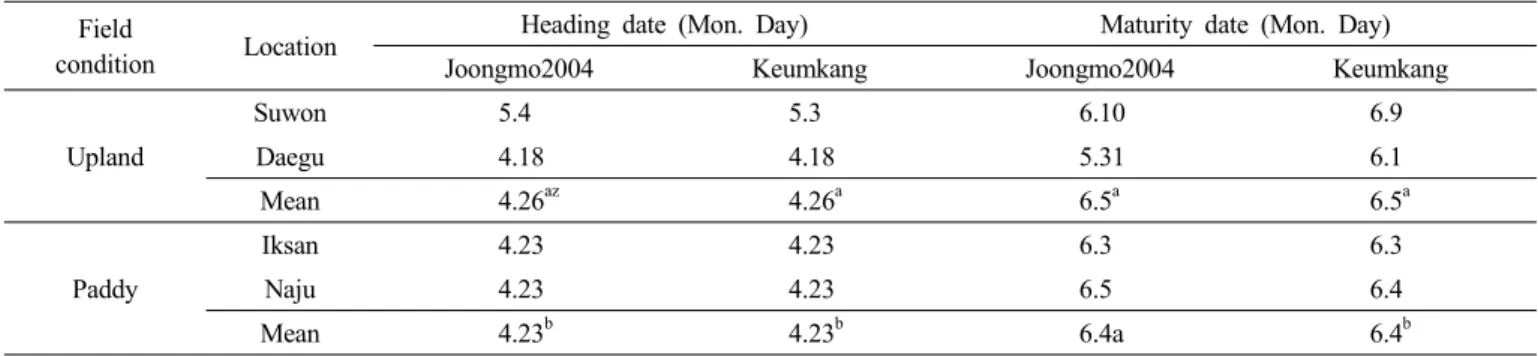
출수기와 성숙기는 Table 2와 같이 3년간 수원과 대구에서 밭 조건조건으로, 익산과 나주에서 논 조건으로 조사하였다.
Table 3. Agronomic characteristics of ‘Joongmo2004’ in the regional yield trials.
Variety Culm length (cm)
Spike length (cm)
Number of spike/m2
Number of grains/spike
Test weight (g)
1,000 grain weight (g)
Joongmo2004 85az 8.0a 830b 35a 806a 44.9b
Keumkang 83b 7.9a 888a 31b 814b 46.2a
zMeans with the same letter are not significantly different at 5% significant level by Duncan’s multiple range test
Table 4. Tolerance assessment of ‘Joongmo2004’ to environmental stress in the regional yield trials.
Variety
Winter hardiness Disease resistance
(S, M, R)z Sprout resistance Loading
(0~9) Withered plant
(%) Scab Powdery mildew Pre-harvest sprouting
(%) Suwon Iksan Daegu Naju
Joongmo2004 24.5ay M S 18.5b 5a 3a 3a 0a
Keumkang 9.2b S S 25.8a 2b 2a 1b 0a
zS: susceptible, M: moderate, R: resistant
yMeans with the same letter are not significantly different at 5% significant level by Duncan’s multiple range test
Table 5. Flour yield and characteristics of ‘Joongmo2004’ in the regional yield trials.
Variety Flour yield (%)
Ash (%)
Protein (%)
SDSSz (ml)
Gluten (%)
Color of floury
L a b
Joongmo2004 75.5ax 0.42a 12.3b 43.0b 10.3a 89.97a -1.38a 10.76a
Keumkang 72.6b 0.42a 13.1a 57.8a 10.8a 89.61b -1.15a 9.46b
zSDSS: SDS-sedimentation volume
yL: lightness, a: redness (+) – greeness (-), b: yellowness (+) – blueness(-)
xMeans with the same letter are not significantly different at 5% significant level by Duncan’s multiple range test 출수기는 밭 조건조건에서 4월 26일, 논 조건에서 4월 23일
로 금강밀과 동일하다. 성숙기는 밭 조건과 논 조건에서 각각 6월 5일과 6월 4일로 금강밀과 동일하다. 대구 지역의 출수기 와 성숙기는 4월 18일과 5월 31일로 다른 지역에 비해 빨랐 고, 수원의 출수기와 성숙기는 각각 5월 4일과 6월 10일로 다 른 지역에 비해 느린 특성을 보였다.
간장 및 수량구성 요소
간장 및 수량구성 요소는 Table 3에서 보는 바와 같다. 간 장은 85 cm로 금강밀보다 2 cm 길고, 수장은 8.0 cm로 금강 밀과 비슷하다. m2당 수수는 830개로 금강밀보다 42개 적으 며 1수립수는 35개로 4개 더 많고, 리터중은 806 g으로 적으 며 천립중은 44.9 g으로 1.3 g 적다.
재해저항성
재해저항성은 Table 4에서 보는 바와 같이 고사주율은
24.5%로 금강밀보다 높아 내한성이 약하고, 수발아율은 63.3%
로 금강밀보다 높다. 흰가루병은 감수성을 보였지만 붉은곰팡 이병은 중도저항성을 보였고, 나주에서는 도복이 일어나지 않 았으나 다른 지역에서 금강밀보다 도복에 낮은 저항성을 나 타냈다.
품질특성
제분율은 Table 5에서 보는 바와 같이 75.5%로 금강밀보 다 2.9% 높고, 회분함량은 0.42%로 금강밀과 같으며 밀가루 색의 L 값은 89.97로 금강밀과 비슷하다. 단백질 특성에서 단 백질함량은 12.3%로 금강밀보다 약간 낮고, 침전가와 글루텐 함량은 각각 43.0.0 ml와 10.3%로 약간 낮다. 반죽관련 특성 (Table 6)에서 가수량과 반죽시간은 각각 59.7%와 3.7 min 으로 금강밀과 비슷하지만, 반죽 안전성은 15.8 mm로 3.4 mm 낮다. 아밀로스 함량은 24.9%로 금강밀과 비슷하고, 최 고점도는 120.0BU로 비슷하지만 Breakdown은 6.0BU로 금
Table 6. Rheological properties of dough and pasting properties of ‘Joongmo2004’ in the regional yiels trials.
Variety
Mixograph
Amylose (%)
Pasting properties (BU) Water absorption
(%)
Mixing time (min)
Mixing tolerance
(mm) Peak viscosity Breakdown
Joongmo2004 59.7az 3.7b 15.8b 24.9a 120.0a 60.0b
Keumkang 60.3a 3.8a 19.2a 25.0a 117.5a 10.3a
zMeans with the same letter are not significantly different at 5% significant level by Duncan’s multiple range test.
Table 7. Subunits of HMW-GS, GBSS and puroindolines of ‘Joongmo2004’.
Variety HMW-GSz GBSSy Puroindolines
Glu-A1 Glu-B1 Glu-D1 Wx-A1 Wx-B1 Wx-D1 Pina-D1 Pinb-D1
Joongmo2004 N 7+9 5+10 ax a a a bw
Keumkang 2* 7+8 5+10 a a a a b
zHMW-GS: high molecular weight glutenin subunit
yGBSS: granule bound starch synthase
xa: wild type
wb: mutant
Table 8. Noodle dough properties and texture of cooked noodles prepared from ‘Joongmo2004’ in the regional yield trials.
Varieties
Color of noodle dough sheetz Texture properties of cooked noodles
L a b Hardness
(N)
Springiness (Ratio)
Cohesiveness (Ratio)
Joongmo2004 80.41ay -1.86a 20.03a 3.50b 0.92b 0.65a
Keumkang 80.28a -1.05b 18.04b 4.54a 0.93a 0.63b
zL: lightness, a: redness (+) – greeness (-), b: yellowness (+) – blueness (-)
yMeans with the same letter are not significantly different at 5% significant level by Duncan’s multiple range test 강밀보다 낮다.
품질 관련 표지 인자 특성
밀 품질관련 표지인자에 대한 특성은 Table 7과 같다. 단백 질 질적 특성을 나타내는 HMW-GS 조성은 Glu-A1과 Glu-B1 에서 각각 N, 7+9를 나타내 금강밀과 조성이 달랐으나, Glu-D1에서는 5+10가 발현되어 금강밀과 같은 특성을 나타 냈다. 밀의 아밀로스 합성에 관여하는 GBSS 조성은 금강밀 고 같은 야생형으로 나타났으며, 이러한 유전적 조성은 Table 6에서 아밀로스 함량이 금강밀과 비슷한 결과와 일치한다. 밀 종실의 경도와 관련된 puroindolines의 조성에서 Pina-D1은 야생형이고, Pinb-D1은 돌연변이형으로 금강밀과 다른 특성 을 보여 제분율이 높은 결과와 일치한다.
제면특성
제면특성은 Table 8에서 보는 바와 같이 면대 색의 L값과 a(적색도)값은 각각 80.41과 -1.86으로 금강밀과 비슷하고, b (황색도)는 20.03으로 금강밀보다 높다. 삶은 국수의 경도, 탄 성과 점성은 각각 3.50N, 0.92와 0.65로 금강밀보다 좀더 부드 럽고 점탄성이 우수하였고, 국수용으로 적합한 특성을 보였다.
수량성
2007년부터 2009년 동안 3개년 간 밭 조건 2개소와 논 조 건 2개소에서 실시한 지역적응성시험결과는 Table 9와 같다.
밭 조건 수량은 평균 517 kg/10a으로 금강밀보다 11% 감수 되었고, 논 조건 수량은 534 kg/10a로 금강밀보다 3% 증수 되었다. 지역적으로는 익산에서 574 kg/10a로 가장 많았고, 수원에서 490 kg/10a로 가장 낮은 수량을 나타냈다.
Table 9. Yield of ‘Joongmo2004’ in the regional yield trial.
Field
condition Location
Joongmo2004 (kg/10a)
Keumkang (kg/10a)
2007 2008 2009 Mean 2007 2008 2009 Mean
Upland
Suwon 537 311 621 490 665 531 716 637
Daegu 652 618 361 544 610 576 376 521
Mean 595az 465b 491a 517b 638a 554b 546a 579a
Paddy
Iksan 586 620 515 574 513 627 555 565
Naju 445 579 461 495 400 605 420 475
Mean 516b 600a 488b 534a 457b 616a 487b 520b
zMeans with the same letter are not significantly different at 5% significant level by Duncan’s multiple range test
적 요
농촌진흥청 국립식량과학원에서 논 조건 적응 국수용 품종 의 제분율 증가와 붉은곰팡이병 저항성 증진을 목적으로 1996년도에 백립계 춘파 다수성인 Bacanora88을 모본으로 하고, 현재 국내 최대 재배되고 있는 금강밀을 부본으로 인공 교배하여 YW2948 조합을 육성하였다. 경기도 연천에서 집 단재배 후 계통을 전개하여 초형과 수형이 양호하며 숙기가 빠르고 내한성이 강한 계통인 YW2948-B-B-1-1-1-1-1-1을 2005년과 2006년도 2년간 생산력검정을 거쳐 ‘익산320호’로 계통명을 부여하고, 2007년부터 3개년 동안 지역적응시험을 실시한 결과 숙기가 빠르며 백립계이고, 붉은곰팡이병에 중도 저항성을 나타냈다. 제분율이 높으며 밀가루와 국수 색택이 밝고, 식미감이 우수하여 2009년 농작물 직무육성 신품종심 의회에서 ‘중모2004’로 명명하였다. 그 후 국립종자원의 재배 심사를 거쳐 2013년 종자산업법제55조에 따라 품종보호 등 록 원부에 등록되었다. 중모2004의 파성은 III형으로 양절형 이고, 엽색은 녹색이며 이삭은 방추형이고, 종자는 중간크기 로 백색이다. 출수기와 성숙기는 밭 조건 조건에서 각각 4월 24일과 6월 4일로 금강밀보다 1~2일 빠르고, 논 조건에서는 각각 4월 21일과 6월 2일로 2일 빠르다. 내한성은 금강밀보 다 약하지만 수발아 저항성은 금강밀보다 강하고, 흰가루병과 붉은곰팡이병은 감수성이다. 중모2004의 제분율은 금강밀보 다 약간 낮지만, 밀가루의 품질과 국수 가공특성이 비슷한 특 성을 보였다. 천립중은 42.5 g으로 금강밀보다 약간 적은 소 립이며, 지역적응성 시험에서 밭 조건 수량은 517 kg/10a으 로 11% 감소하였고, 논 조건 수량은 534 kg/10a로 금강밀보 다 3% 증수하였다.
사 사
본 연구는 농촌진흥청 국립식량과학원 농업과학기술 연구 개발사업(과제명 : 가공용도별 밀 품종 개발 및 육종효율 증 진 연구, 과제번호 : PJ008756)의 지원에 의해 이루어진 것임.
REFERENCES
1. American Association of Cereal Chemists (AACC). 2000.
Approved Methods of the AACC. 10th ed. The Association:
St. Paul, MN.
2. Axford DWE, McDermott EE, Redman DG. 1979. Note on the sodium dodecyl sulfate test of breadmaking quality:
Comparison with Pelschenke and Zeleny tests. Cereal Chem. 56: 582-584.
3. Bhave M, Morris CF. 2008. Molecular genetic of puroindolines and related genes: Allelic diversity in wheat and other grasses. Plant Mol. Biol. 66: 205-219.
4. Gibson TS, Solah VA, McCleary BV. 1997. A procedure to measure amylase in cereal starches and flours with concanavalian. Am. J. Cereal Sci. 25: 111-119.
5. Kang MS, Lee CK, Park DS, Ku BC, Park KG, Ko JM, Hyun JN, Kim JC, Nam JH, Suh DY, Kim SJ, Yun YS, Hwang JJ, Kim JG. 2006. A new white wheat cultivar,
“Jokyoung” for bread making. Korean J. Breed. Sci. 38:
139-140.
6. Kang CS, Park KS, Park JC, Kim HS, Cheong YK, Kim JG, Park CS. 2008. Flour and end-use quality of “Charmdlerak”
wheat, a Korean wheat. Korean J. Food Preserv. 15: 219-224.
7. MAFRA. 2013. Food, agriculture, forestry and fisheries statistical yearbook. pp.250-295.
8. Lee US, Jang HS, Tanaka T, Hasegawa A, Oh YJ, Ueno Y. 1985. The coexistence of the Fusarium mycotoxins nivalenol and zearalenone in Korean cereals harvested in 1983. Food Addit. Contam. 2: 185-192.
9. Nakamura T, Shimbata T, Vrinten P, Saito M, Yonemaru J, Seto Y, Yasuda H, Takahama M. 2006. Sweet wheat.
Genes Genet. Syst. 81: 361-365.
10. Nam JH, Song HS, Park HH, Heo HY, Park MW, Park KH, Rho CW, Nam SY, Ju JI, Park CB, Lee YS, Park SG, Kim DH. 1998. A new high milling, early Maturity, semi-dwarf and white grain wheat variety “Keumkangmil”
with good bread quality. RDA J. Crop Sci. 40: 81-87.
11. Park CS, Baik BK, Kang MS, Park JC, Park JG, Chung MG, Lim JD. 2006. Flour characteristics and end-use quality of Korean wheats with 1Dx2.2+1Dy12 subunits in high molecular weight glutenin. J. Food Sci. Nutr. 11:
243-252.
12. Park CS, Heo HY, Kang MS, Kim HS, Park HH, Park JC, Kang CS, Kim HS, Cheong YK, Park KH. 2009. A new white wheat variety, “Hanbaek” with good noodle
quality, high yield and resistant to winter hardiness. Korean J. Breed. Sci. 41: 130-136.
13. Park JM, Shin SH, Kang CS, Kim KH, Cho KM, Choi JS, Kim HM, Park JC. 2012. Fungicide effects in vitro and in field trials on Fusarium head blight of wheat. Res.
Plant Dis. 18: 194-200.
14. Parry DW, Jenkinoson P, McLeod L. 1995. Fusarium ear blight(Scab) in small grain cereals-a review. Plant Pathol.
44: 207-238.
15. RDA. 2003. Standard of research and analysis for agricultural technology. pp. 291-310.
16. RDA. 2007. 2007 Project plan for collaborative research program to develop new variety of winter crop. pp.75-91.
17. RDA. 2008. 2008 Project plan for collaborative research program to develop new variety of winter crop. pp.85-117.
18. RDA. 2009. 2009 Project plan for collaborative research program to develop new variety of winter crop. pp.79-114.
19. Windel CE. 2000. Economic and social impacts of Fusarium head blight: Changing farms and rural communities in the northern Great Plains. Phtopathology 90: 17-21.