Building An Ontology Model for Warehouse Management using Sensor
1)
Hyun-Chang Lee *
센서를 이용한 웨어하우스 관리 온톨로지 모델 구축
이 현 창*
Abstract
According to the ubiquitous technology development, managing of the warehouse system which stores and manages agriculture products is realized effectively. This paper proposes an ontology-based context aware system model for the purpose of storing and managing agricultural products using ubiquitous sensors to share and distribute information. In these days, owing to penetrating ubiquitous technologies into our way of life, the importance of information is increasing gradually. The importance of ontology in a domain is getting as well.
Therefore, this paper focuses on describing to get data from ubiquitous devices such as sensors, and designs and build an ontology-based agricultural product warehouse model.
요 약
유비쿼터스 기술개발에 따라 농산물을 저장 및 관리를 주 기능으로 하는 창고시스템의 관리는 효과적으로 이루 어지고 있다. 이에 본 논문에서는 유비쿼터스 센서를 사용하여 농산물을 저장하고 관리하기 위한 목적으로 온톨로지 기반 상황 인지 시스템 모델을 제안하여 정보를 공유하고 분산하도록 한다. 오늘날 우리 생활속에 유비쿼터스 기술 이 확산되어짐에 따라 정보에 대한 중요성은 점진적으로 증가하고 있다. 뿐만 아니라, 한 도메인에서 온톨로지의 중 요성 또한 중요해지고 있다. 그러므로 본 논문에서는 센서와 같은 유비쿼터스 장치로부터 데이터를 획득하는데 초점 을 두고 기술하고 있으며, 온톨로지 기반 농수산물 창고 모델을 설계하고 구축한것을 보인다.
▸ Keyword : 창고관리(Warehouse Management), 온톨로지(Ontology), 센서(Sensor)
∙제1저자,교신저자 : 이현창
∙투고일 : 2009. 12. 09, 심사일 : 2009. 12. 30, 게재확정일 : 2010. 01. 26.
* 원광대학교 정보․전자상거래학부, 정보과학연구소
※ 이 논문은 2009년도 원광대학교의 교비 지원에 의해서 수행됨
Ⅰ. INTRODUCTION
Recently, a warehouse management system(WMS) which is necessary to store and distribute some products and others operates on managing from production to cultivation and distribution. By using the context aware information obtained from the WMS, they have an affirmative effect that customers place confidence in the originality and cultivation data of agricultural products. To ensure the originality and freshness of agricultural products such as food is very important without saying.
In delivering the agricultural products from production to customers, there are many delivery processes in which require periods and temporary places to store the products.
For that reasons, the freshness and quality of the goods in course of delivering is affected by the state of the warehouse inner. Therefore, it needs a warehouse with maintaining the optimum condition to keep the freshness of products. It is necessary to use ubiquitous technologies to get the state information automatically as well.
The use of ubiquitous technologies like various sensors in warehouse management system brings a problem awaiting solution to store and keep the freshness of the agricultural product in an agricultural exportation with strengthening the competitiveness[1]. In ubiquitous environment, using tools such as RFID/USN, by pushing computers into the background, embodied virtuality will make individuals more aware of the people on the other ends of their computer links and cope with the state of the changeable of which is a context aware[1,2,3]. It has been used to be characterized the faced environment in accordance with the state of people, place, physical computing device[4].
With the context aware information which has received from sensors, it can build OWL based context ontology and use abstraction to manage efficiently sensor data[5]. The information that is abstraction data will be stored to DB as a semantic data model[6] and used to decide the state of things automatically.
Therefore, this paper is to solve and suggest a methodology as an expediency with ontology modeling by using data obtained from sensors in ubiquitous environment.
With the context aware information which has received from sensors, it can build OWL based context ontology and use abstraction to manage efficiently sensor data.
The rest of this paper is organized as follows. Part 2 begins the discussion on related work. In part 3, it reviews and describes the modeling concept, followed by the architecture design and analysis briefly in sub-sections.
Finally, part4 is the conclusion.
Ⅱ. RELATED WORKS
In generally, Warehouse Management System(WMS) which has functions of warehousing of goods and taking goods out of the warehouse, storing, preservation of quality and processing of information for the product needs all over the fields to secure the harmonious flow of all supply-chain[1]. The warehouse management generally has implied the functions of inventory control, storing, classification and distribution. However, in addition to the above things, the warehouse management has more various functions to create valuable added things[7].
WMS consists of 3 steps : inbound process, outbound process and internal process. The warehouse management service generally has functions of receiving data for expected arrival of goods and processing the work information management of warehousing operators.
According to the service functions, the warehousing management service also has functions that set the proper strategies and make reports.
In outbound process, WMS has functions that set an output schedule, review the amount of shipping and manage the status of shipping. In according to the above, functions of WMS has contained stocktaking of warehouse and histories of stock information etc.
Specially, RFID is capable of reading and writing
compared to conventional bar-code system including
processing several tasks at the same time, so that the
technology is evaluated as an innovative technology in
logistics industry[2]. In addition, to keep optimal states of
goods inner warehouse using USN in ubiquitous
environment, much research has been done in the area of
context-aware computing in the past few years[7]. So,
context-aware computing has been drawing much attention from researchers since it was proposed about a decade ago.
A number of context-aware system have been developed to demonstrate the usefulness of this new technology, such as Context Toolkit[8], HP’s Cooltown[9] and MIT’s AIRE spaces[10], whereas some other systems are still under research.
Context-aware systems, however, have never been widely available to everyday users because building context aware systems is still complex and time-consuming task.
Therefore, this paper is first to consider the context-aware system models based on ontology using OWL to support various tasks in some other aspects and show the usefulness. The existing context models is classified into three categories[7]:
A. Application-oriented approach:
In this approach, a lot of context aware systems model represent context only for specific applications. For example, HP’s Cooltown[9] project proposed a web-based context model which retrieves object using URL. The application oriented approach lacks the formal basis and does not support knowledge sharing across different systems.
B. Model-oriented approach:
This approach generally uses conceptual modeling methodology to represent context. ER-based context model was proposed by several projects [11][12]. Also, the context can be easily managed with relational databases. Though this approach supports formality, this does not address issues including knowledge sharing and context reasoning.
C. Ontology-oriented approach:
Ontology-oriented methodology is focusing on constructing an ontology for context in a specific domain to reach the goals of knowledge sharing across distributed systems. The context is developed based on RDF to represent context by means of session profiles. Therefore, it uses a warehouse domain to share the information for context aware using wireless sensors.
Ⅲ. SYSTEM MODEL AND ONTOLOGY
This part shows whole components for the system and describes physical sensors consisting of ubiquitous
environment to get and monitor the state of the things. Also it describes ontology classes, hardware model and a typical scenario in order to illustrate our modeling concept[7].
3.1 SYSTEM MODEL
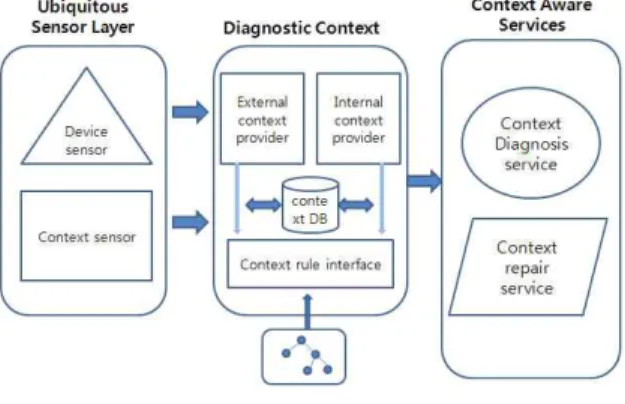
The system is composed of three component modules as shown in figure 1 which is including ubiquitous sensor layer, diagnostic context, context aware services.
Fig. 1. Overview of context aware model architecture 그림 1. 상황인지 모델 구조
First, in the context aware service module layer, the context aware services module can serve to convert the diagnosis of the context state from the internal context and external provider to OWL representation so that contexts can be shared and served by other components.
In the next place which is diagnostic context module, diagnostic context component consists of external/internal contexts, context Db used by external and internal contexts and context rule interface which uses ontology. Context DB provides the service that other components can query and manipulate context stored in the database.
At last, in the ubiquitous sensor layer, ubiquitous sensor
can get and serve the information of the context aware from
device sensors and context sensors to be diagnosed of
which the result is transferred to diagnostic context
component. The following figure 2 shows the sensors to get
and monitor the information.
Fig. 2. Sensors for temperature, humidity, light 그림 2. 온도, 습도, 조도 측정용 센서
The system model aims to help application programmers to build context aware services efficiently.
3.2 ONTOLOGY FOR WAREHOUSE
In the previous part, we look at the physical sensors which are a sort of sensors to measure temperature and humidity. The following figure 3 shows the ontology for warehouse class.
Fig. 3. OWL based warehouse ontology diagram 그림 3. OWL 기반 웨어하우스 온톨로지 다이어그램
The main advantage of ontology model such as OWL based warehouse ontology in figure 3 is also sharing common understanding on the structure of context information among devices, users and services to enable semantic interoperability.
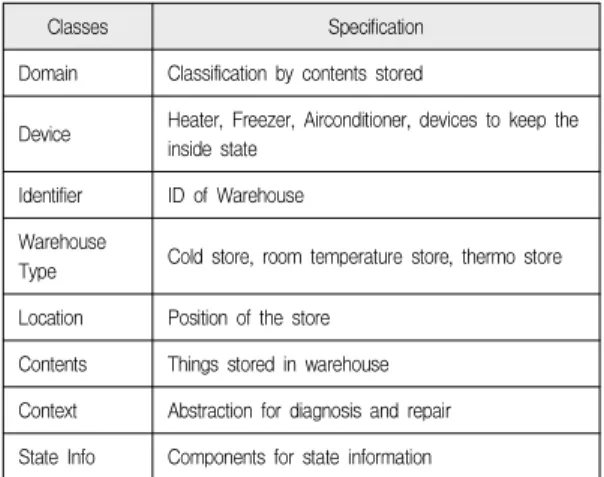
In table 1, conceptual ontology for warehouse describes.
Classes Specification
Domain Classification by contents stored
Device Heater, Freezer, Airconditioner, devices to keep the inside state
Identifier ID of Warehouse Warehouse
Type Cold store, room temperature store, thermo store Location Position of the store
Contents Things stored in warehouse Context Abstraction for diagnosis and repair State Info Components for state information
Table 1. Conceptual Ontology for Warehouse 표 1. 웨어하우스의 개념 온톨로지The warehouse ontology model has functions to retrieve the location, form and contents of the warehouse. Each warehouse to be possible to get context awareness information from sensors is able to operate own devices in the warehouse and to notify the state information to do another thing
3.3 IMPLEMENTATION AND ANALYSIS
In this paper, to get the state information of warehouse to keep the freshness and quality of food stored in that warehouse, it uses sensors in figure 2 which is used in various industry fields. For development, we use C#
language with .NET framework. Figure 4 shows the result of implementation to get the state information obtained from sensors.
Fig. 4. Snapshot to get the state data 그림 4. 획득한 센서 상태 데이터
Features conventional WMS
sensor based WMS using
ontology use of the state
information X O
Type Wire Wireless
accuracy of
context information Simplicity Granularity
core dependency Manual Automation
RealTime Support X O
Table 2. Comparison of WMS with sensor and ontology 표 2. 센서와 온톨로지를 이용한 WMS 시스템 비교