• 검색 결과가 없습니다.

English /s/ and Korean s<sup>h</sup>/-/s<sup>*</sup>/ Contrast in Seoul and Busan Dialects: A Study of Category Solidity

N/A
N/A
Protected

Academic year: 2021

Share "English /s/ and Korean s<sup>h</sup>/-/s<sup>*</sup>/ Contrast in Seoul and Busan Dialects: A Study of Category Solidity"

Copied!
10
0
0

로드 중.... (전체 텍스트 보기)

전체 글

(1)

말소리와 음성과학 제4권 제3호 (2012) pp. 3~12

English /s/ and Korean /s h /-/s*/ Contrast

in Seoul and Busan Dialects: A Study of Category Solidity

Kang, Kyoung-Ho

1)

ABSTRACT

The primary goal of the current study was to examine category solidity of Korean alveolar fricatives in the Busan and Seoul dialects of Korean. Considering the common belief of /s

h

/-/s*/ neutralization in Kyungsang speech, plain /s

h

/ and fortis /s*/ fricatives of Busan speakers were examined against the same fricatives of Seoul speakers. Perceptual distance between Korean /s

h

/ and /s*/ on the one hand and English /s/ on the other was investigated by use of across-linguistic mapping method. Two experiments of a perceptual mapping task of English /s/ to Korean /s

h

/ and /s*/ and a /s*/-production task were conducted on users of the Busan and Seoul dialects of Korean. The results from the perception and production experiments suggested that at a micro-level, younger Busan speakers have less solid category stability for Korean /s*/ compared with Seoul speakers, although their production of /s

h

/ and /s*/ was as highly distinctive from each other as that of Seoul speakers.

Keywords: Korean fricatives, perceptual category representation, neutralization, category solidity

1. Introduction

Korean has only two fricatives in its consonant system while English has nine fricatives and it has only a single category, /s/

for voiceless alveolar fricative. Plain /s

h

/

2)

and fortis /s*/ of Korean are both voiceless sibilants and alveolar sounds in place of articulation. These two similar fricatives contrast most apparently in the manner of vocal fold vibration for the following vowel. Only /s*/ is accompanied with glottalized, tensed voicing quality for the vowel portion, and this disparity in voice quality is in line with the same contrast between fortis and aspirated and lenis stops of Korean (Cho et al, 2002;

1) Kyungsung University, [email protected]

2) In this paper, ‘plain /s

h

/’ does not similarly refer to one of the common labels for Korean stops, such as ‘aspirated’,

‘lenis/plain’, and ‘fortis/tense.’ Rather, it simply refers to a descriptive label of whether aspiration is involved or not in the production of Korean lenis/plain /s

h

/.

Received: July 25, 2012 Revised: September 3, 2012 Accepted: September 3, 2012

Kenstowicz & Park, 2006). Besides this, there has been plenty of research that attempted to locate acoustic, phonetic correlates of the /s

h

/ - /s*/ contrast. For example, Kagaya (1974), Iverson (1983), and Cho et al. (2002) reported tighter glottal closure and non-aspiration for fortis /s*/, and Ladefoged & Maddieson (1996) observed greater subglottal pressure, and tenser vocal tract walls for the fortis fricative. For duration measure, Yoon (1998, 2002) and Cheon (2006) reported that the aspiration duration was an invariant acoustic property contrasting the fricatives with /s

h

/ being longer than /s*/, but it turned out to work only in low or mid vowel contexts. Another reliable correlate contrasting the fricatives is the centroid frequency of fricative noise. Cho et al. (2002) and Kang (2008) found significantly higher centroid frequency for /s*/ for various prosodic contexts. Whatever the most reliable acoustic, phonetic properties contrasting the two fricatives are, a potential problem in cross-linguistic speech perception between English and Korean is the mismatch situation of two fricative categories in Koran and a single category in English. The other potential problem is Korean-language internal in nature. The /s

h

/ - /s*/

contrast in Korean is phonemic (e.g., [s

h

al] ‘flesh’ and [s*al]

(2)

‘rice’). The contrast is, however, commonly attested to be neutralized to plain /s

h

/ in Kyungsang Korean (Lee, 2002;

Kenstowicz & Park, 2006; Holliday, 2012). Older speakers in that area are frequently found to produce [s

h

al] meaning ‘rice’

and they do not notice the difference in their speech from the so called ‘standard’ Korean of the Seoul dialect.

These cross-linguistic and within-linguistic problems related to Korean /s

h

/ and /s*/ bring up two questions to us. One is how one English category will be perceptually mapped into two Korean categories for Korean speakers, and the other is, on top of the cross-linguistic mismatch, how the dialectal difference between the Seoul and Busan dialects will be reflected in the cross-linguistic mapping behavior. Answers to the first question have already been pursued. Some studies attempted a cross-linguistic comparison of the English and Korean fricatives.

Kim & Curtis (2001) and Kang & Yoon (2005) observed that English /s/ is adapted in Korean loanwords as fortis /s*/ before a vowel and as plain /s

h

/ after consonants in word/

utterance-initial position. Cheon (2008) compared English /s/, Korean /s

h

/, and /s*/ both acoustically and perceptually. Korean fortis [s*a] was very similar to English [sa] in frication and aspiration duration while plain [s

h

a] was significantly shorter in frication duration and longer in aspiration duration than either English /sa/ or Korean /s*a/. This acoustic similarity was correlated with perceptual similarity, such that Korean [s*a] was perceived as far more similar to English [sa] than Korean [s

h

a]

was to English [sa] for Korean listeners. For spectral peak frequency, English [si] was higher than Korean [s*i] with English [ʃi] and Korean [s

h

i] being similar. Korean listeners found that the English [si] - Korean [s*i] pair was the most similar to each other than the other two pairs, English [si] - Korean [s

h

i], English [si] - English [ʃi]. These studies indicates that English /s/ is more similar to Korean fortis /s*/ than to Korean plain /s

h

/ acoustically and perceptually for Koreans.

Regarding the second question of the neutralization, other studies contrasted the Seoul and Kyungsang dialects for the sibilant fricatives. Lee (2002) reported that plain /s

h

/ and fortis /s*/ of Busan speakers were overall shorter than those of Seoul speakers for both frication and aspiration duration. This result indicates that Busan speakers’ /s*/ was not comparable to Seoul speakers’ /s

h

/ for both frication and aspiration duration measures. In Kenstowicz & Park (2006), the same line of results was found for the voice quality of the following vowel indexed by H1-H2 values. Kyungsang speakers from Busan and Daegu areas showed significant difference in H1-H2 between

plain /s

h

/ and fortis /s*/ for both vowel onset and midpoint positions. In a most recent study of Korean sibilant fricatives, Holliday (2012) attested that Daegu speakers’ /s*/ was not neutralized to /s

h

/, at least acoustically. Any of the acoustic measures used in the study, aspiration duration, frication duration, H1-H2, ƒ0, and spectral mean did not reliably separate Seoul speakers’ fricatives from Daegu speakers’ fricatives. The results from these studies, unlike the common belief that fortis /s*/ is merged to plain /s

h

/ in Kyungsang speakers’ speech, suggest that the contrast is not neutralized, at least acoustically, in production.

The cross-linguistic mismatch and the dialectal difference being taken together, an arising question is whether or not there will be differences between Seoul and Busan speakers in the perceptual mapping behavior of English /s/ to Korean /s

h

/ and /s*/. As suggested in the studies above that contrasted the Busan and Seoul dialects, plain /s

h

/ and /s*/ are not neutralized in the speech of Kyungsang speakers, at least acoustically. This finding can be viewed as suggesting that the two categories are realized distinctively in speech and thus, Busan speakers’

production of /s

h

/ and /s*/ do not sound different from that of Seoul speakers. However, this does not necessarily mean that /s

h

/ and /s*/ exist in the same form in the perceptual domain of Seoul and Busan speakers’ speech. A task of attempting to measure the perceptual representation of /s

h

/ and /s*/ is needed to address the question of the /s

h

/ - /s*/ neutralization in Kyungsang speech in a more comprehensive manner.

To address the question of measuring potentially different perceptual representation of /s

h

/ and /s*/ in Seoul and Busan speakers’ mind will be a challenging task. A study pursuing categorical perception of fortis /s*/ and plain /s

h

/ will be of no interest, because at least for younger speakers of the Kyungsang area the /s

h

/ - /s*/ distinction appears to be well-retained. As mentioned in Lee (2002), the neutralization seems to be subject to vary with age, gender, and/or education level. For high-educated, younger speakers of that area the distinction may or may not be neutralized in production possibly with the influence from ambient language of older speakers of the region. However, distinguishing Korean /s

h

/ from /s*/

categorically would be too easy for young users of the Kyungsang dialect, although we may find the merger in production occasionally.

Thus, macro-difference in perception from Seoul speakers

will not be observed for younger Kyungsang speakers, and

micro-difference was sought to measure in the current study.

(3)

Through cross-linguistic perception, that is, by use of a non-native category (i.e., English /s/) that are highly similar to native categories (i.e., Korean /s

h

/, /s*/) but still do not perfectly match the native categories, potential difference in the perceptual representation of /s

h

/ and /s*/ was investigated between Seoul speakers having a firm /s

h

/ - /s*/ contrast and Busan speakers potentially holding a less stable /s

h

/ - /s*/

contrast. Specifically, this study explored how differently Seoul and Busan speakers perceived English /s/ in terms of Korean /s

h

/ and /s*/ categories, and a production experiment on /s*/

was followed to support the perception experiment.

2. Experiment 1: cross-linguistic mapping task  

Experiment 1 aimed to examine whether Busan and Seoul speakers of Korean perceived English /s/ differently when they perceptually map the English alveolar fricative /s/ to Korean counterparts, /s

h

/ and /s*/. English /s/ framed in various phonological contexts were perceptually classified to Korean alveolar fricative categories, /s

h

/ and /s*/ by two groups of Korean participants.

2.1 Participants

Participants were recruited in two separate groups of ‘Busan’

and ‘Seoul’ speakers. Participants in each group were considered to speak the dialect of the region they were currently living in and it was checked by a questionnaire inquiring participants and their parents’ linguistic background. Some participants were born in other areas and moved to the current place of residence at early childhood, but they lived most of their lives in the current residence. The 12 Busan speakers were all sophomore or junior students recruited from a university in Busan, so that they were all in early 20’s in their age. The 10 Seoul speakers were mostly graduates students recruited from a university in Seoul except one male participant. The age ranged from mid-20’s to early 30’s except a male speaker whose age was 46 years old.

For both Busan and Seoul groups, male speakers were two and the rest were female speakers. Their participation was all voluntary and paid.


2.2 Stimulus preparation

The stimuli presented to the Korean listeners were recorded by two native speakers of American English. One male and one female speaker read phonetically transcribed English words.

Each item had English /s/ in three phonological contexts: /s/ in

a word-initial, intervocalic, or initial of onset consonant cluster position. For the word-initial position (hereafter, ‘initial’

position), the following vowel was /i/, /ɛ/ /æ/, /u/, /o/, or /ɑ/

(e.g., [sik], [sɛk]), and this was to examine the effect of adjacent vowels on the perception. For the intervocalic position (hereafter, ‘V_V’ position), /s/ was surrounded by one of the same five vowels used in initial position (e.g., [kisik], [kɛsɛk]

and this was to examine whether the vowel effects potentially found in initial position are replicated in intervocalic position.

For the consonant cluster initial position (hereafter, ‘pre-C’

position), /s/ was followed by a consonant and a vowel /i/ (e.g., [spip], [stik]) (see Appendix for perception stimuli). The speakers read each item twice as transcribed in phonetic alphabet putting it in a carrier phrase, “I say _______.”. The recordings were conducted in a sound-attenuated booth using a high quality head-mounted microphone (Shure SM 10A) and a Marantz digital recorder (PMD 670). The total number of recorded stimuli was 76 (6 for initial, 6 for V_V, and 7 for pre-C position, multiplied by 2 time repetition and 2 speakers).


2.3 Procedure

The Busan and Seoul speakers heard each stimulus 5 times, so that a total of 380 tokens were collected from each participant. The instruction given to the participants was to listen to the stimuli containing English /s/ and to classify it as Korean /s

h

/ or /s*/. In short, the perception task was to perceptually map an English /s/ category embedded in different phonological contexts into a Korean /s

h

/ or /s*/ category. The Multiple Forced Choice (MFC) function of Praat for speech perception experiment was used to administer the entire listening task. The 380 stimuli were presented in random order arranged by the MFC function. The perception task was performed individually in a quiet room using a laptop computer and a headset. The listeners chose either a /s

h

/ or a /s*/

category presented in a Korean orthography on a computer screen. The task progressed at listeners’ own pace and no time limit was enforced to complete the task. Several practice trials were presented before the test sets. Each listener spent about 35 to 40 minutes to complete the task.


2.4 Results

2.4.1 Effect of phonological contexts

The effect of phonological context where English /s/ was situated was observed for both Seoul and Busan groups:

/s*/-preference for initial context, considerably reduced

(4)

/s*/-preference for V_V context, and /s

h

/-preference for pre-C context. When the intervocalic context was considered only, group difference became apparent (see Figures 1 (a) and (b) below). For Seoul speakers, /s

h

/ response and /s*/ response were quite comparable: 47% for /s*/ and 53% for /s

h

/. For Busan speakers, English /s/ was more likely perceived as Korean /s

h

/:

38% for /s*/ and 62% for /s

h

/. These results indicate that Busan speakers perceived intervocalic English /s/ as Korean /s

h

/ more often times than Seoul speakers did. However, for the other two contexts, the mapping patterns were identical for Busan and Seoul groups. When English /s/ was in initial position, it was apparent that English /s/ was perceptually more similar to Korean /s*/ than /s

h

/, whereas when English /s/ was in pre-C position, English /s/ was evidently more similar to Korean /s

h

/ than /s*/ for both Seoul and Busan speakers (compare Figures 1 (a) and (b) for initial and pre-C positions). These phonological context effects of initial and pre-C positions coincide with the findings of previous studies that reported great similarity of Korean /s*/ to English /s/ (e.g., Kim & Curtis, 2001; Kang &

Yoon, 2005; and Cheon, 2008). To summarize, for both Seoul and Busan speakers, English /s/ was perceptually more similar to Korean /s*/ than Korean /s

h

/ only when /s/ was in initial position. When English /s/ was in the context of V_V position, Busan speakers preferred plain /s

h

/ mapping, whereas Seoul speakers did not show the same preference.

2.4.2 Vowel effects

The overall mapping patterns found for the three phonological contexts were further explored in terms of vowel contexts. The effects of different vowels on the perception of English /s/ in terms of Korean /s

h

/ and /s*/ categories were examined: the pre-C context was excluded for the analysis because the vowel context was invariably /i/.

2.4.2.1 Word-initial context

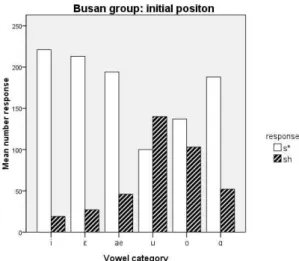
Figures 2 (a) and (b) show the number of /s

h

/ and /s*/

response in each of the /i/, /ɛ/, /æ/, /u/, /o/, and /ɑ/ vowel contexts. For the initial context, that is, where English /s/ was followed by one of the six vowels at word-initial position, /s*/

response was apparently dominant in front vowel /i/, /ɛ/, and /æ/

and back vowel /ɑ/ contexts. To put it the other way, /s

h

/ response was more frequent in rounded vowels, /u/ and /o/

contexts. This pattern was constant for the Seoul and Busan groups. This dominant /s*/ response in /i/, /ɛ/, /æ/, and /ɑ/

contexts explains to a great extent the greater /s*/ response in

initial position for both Seoul and Busan groups shown in Figure 1. For back vowels, /u/, /o/, and /ɑ/ contexts, /s

h

/ response was relatively more frequent for both Busan and Seoul groups when compared with front vowels. What was noticeable from the back vowel contexts was that the number of /s

h

/ or /s*/ response changed progressively according to vowel height:

/s*/ response was progressively less frequent to higher vowels.

Thus, the only vowel context showing more /s

h

/ response in initial position was the high back /u/ context. These patterns remained identical between the two groups. The Seoul and Busan speakers were greatly similar to each other for the initial context where English /s/ occurred word-initially.

2.4.2.2 Intervocalic context

In the analyses of the effect of phonological context, the Busan and Seoul speakers showed difference for the intervocalic context: greater /s

h

/ response for Busan speakers. Here the difference is further investigated by looking into each vowel context. The analysis of V_V position revealed both similarities and differences from the initial context. For similarities, the vowel effect found in initial position, that is, the more /s*/

response in non-rounded vowels than in rounded vowels was retained in V_V context. The overall vowel effects were kept constant between the two positions. On the other hand, the most distinct diversion from the initial context was that /s*/ response decreased and /s

h

/ response increased dramatically for all vowel contexts and as a result, /s

h

/ response became absolutely dominant over /s*/ response for rounded vowel /u/ and /o/

contexts. Both Seoul and Busan groups showed these patterns, and it is shown in Figures 3 (a) and (b) where the number of /s

h

/ and /s*/ response for each of the /i/_/i/, /ɛ/_/ɛ/, /æ/_/æ/, /u/_/u/, /o/_/o/, and /ɑ/_/ɑ/ contexts is presented.

The analysis also showed differences between the two groups. For each of the /ɛ/ and /æ/ contexts, the Seoul group gave greater /s*/ response whereas Busan group did give comparable responses between the two response categories, /s

h

/ and /s*/ (compare Figures 3 (a) and (b) for /ɛ/ and /æ/). As a result, /i/_/i/ was the only context where more /s*/ responses were given in V_V position for Busan group. This means that the only V_V position shared by both Seoul and Busan groups where greater /s*/ response was given was the /i/_/i/ context.

To summarize, English /s/ was far less frequently perceived as

Korean /s*/ fricative in intervocalic positions compared with

initial positions, and the intervocalic positions compared with

initial positions, and the Busan and Seoul groups were different

(5)

Figure 1 (a). The mean number of /s*/ and /s

h

/ response for each of the three /s/-positions by 10 Seoul participants

Figure 1 (b). The mean number of /s*/ and /s

h

/ response for each of the three /s/-positions by 12 Busan participants

Figure 2 (a). Mean number of /s*/ and /s

h

/ responses in word-initial context for Seoul group of 10 participants

Figure 2 (b). Mean number of /s*/ and /s

h

/ responses in word-initial context for Busan group of 12 participants

Figure 3 (a). Mean number of /s*/ and /s

h

/ responses in V_V context for Seoul group of 10 participants

Figure 3 (b). Mean number of /s*/ and /s

h

/ responses

in V_V context for Busan group of 12 participants

(6)

S101 S102 S201 S202 S203 S204 S205 S206 S207 S208

/ɛ/

12 20

1

20 11 11

6 16 20 18

/æ/

18 20

0

17 14 13

5 15 18 19

Table 1. The number of /s*/ response in /ɛ/ and /æ/ contexts for each of the 10 Seoul participants.

Participants who showed 11 times (out of 20 tokens) or greater /s*/ responses are indicated bold.

B101 B102 B201 B202 B203 B204 B205 B206 B207 B208 B209 B210

/ɛ/

19 11 19

6 8 4

14

9 4 9

11

7

/æ/

18 13 20

4 9 6

15

6 7 3

11

6

Table 2. The number of /s*/ response in /ɛ/ and /æ/ contexts for each of the 12 Busan participants.

Participants who showed 11 times (out of 20 tokens) or greater /s*/ responses are indicated bold.

from each other in the perception of English /s/ situated in /ɛ/-/ɛ/ and /æ/-/æ/ contexts with /s*/ response being less for Busan speakers.


2.4.3 Individual listeners

The group difference between Seoul and Busan speakers for the /ɛ/ and /æ/ contexts was further investigated by examining each individual listener’s perception behavior. Tables 1 and 2 show the number of /s*/ response (out of 20 tokens) for each individual listener for each of the Seoul and Busan groups. The participants who gave more /s*/ responses, that is, those who showed /s*/ responses of 11 times or greater are indicated bold.

As can been in the tables, Seoul speakers showed far greater /s*/ preference. 8 out 10 participants (80%) gave greater /s*/

response in the Seoul group, whereas 5 out of 12 participants (42%) did it in the Busan group (In fact, the participant, S201 gave all /s

h

/ responses for all vowel contexts, except 4 tokens out of 120 tokens. This means that, excluding S201, 8 out of 9 Seoul participants showed greater /s*/ response for the /ɛ/ and /æ/ contexts). In addition, within those who showed greater /s*/

response, most Seoul participants showed dominant /s*/ response (more than 15 /s*/ responses out of 20 tokens), whereas only three Busan participants (B101, B201, and B205) showed the similar dominance. Therefore, the group difference found for /ɛ/

and /æ/ contexts in V_V position was consolidated in the examination of individual listeners.

3. Experiment 2: Korean /s*/ production  

Experiment 1 showed that the Busan and Seoul speakers of Korean were similar to each other in cross-linguistic mapping patterns of English /s/ to Korean /s*/ and /s

h

/ except for the difference in intervocalic context. Experiment 2 investigated whether the two speaker groups were different in their production of Korean /s*/. Considering the standard status of the Seoul dialect in modern Korean, whether the Busan speakers produced Korean /s*/ appropriately to the norm of the Seoul dialect was examined. The Busan speakers were predicted to produce Korean /s*/ authentically, given that they were all early 20’s in their age and the dialectal characteristics in their speech are expected to be diluted compared with their parents’

generation. This prediction is also based on the findings of the previous studies that reported acoustic distinction of /s

h

/ and /s*/

in Kyungsang speakers’ speech (Lee, 2002; Kenstowicz & Park, 2006; Holliday, 2012).


3.1 Participants

The participants in Experiment 2 were identical to those who participated in Experiment 1.


3.2 Procedure

The Korean /s*/ production task was performed prior to the

perception task conducted in Experiment 1. This sequence was

deliberately planned to prevent the participants from being

informed of the production task through the category-assigning

(7)

tasks in Experiment 1. Because the primary goal of the production experiment was to examine potential difference between Busan and Seoul speakers in their production of Korean /s*/, it was critical to elicit the inherent dialectal characteristics of the Busan speech as best as possible. For this purpose, citation form speech commonly obtained from a word- or text-reading task was considered inappropriate. Citation speech tends to be produced with enhanced attention to segmental and/or prosodic accuracy, and this tendency may combine with the sociolinguistic preference to a standard variety, currently the Seoul dialect. To minimize the speakers’

attention to speech production process and thus to elicit better

‘Busan speech,’ the participants were asked to read English sentences in their mind and translate them verbally into Korean.

By this design, a speaker’s attention was expected to be driven to the ‘translation job’ as much as possible.

Appendix shows the list of English sentences used in the translation task into Korean. Each sentences had, when properly translated, one Korean word that begins with Korean /s*/. The target English word that needs to be translated into a Korean word beginning with /s*/ are indicated bold. The participants (10 Seoul speakers and 12 Busan speakers) verbally produced Korean sentences for each of the 14 English sentences in the translation task. The translation work was conducted two times for the entire 14 sentences, such that each sentence was recorded twice by each participant. 5 sentences that do not contain a /s*/-initial word in a Korean version were included as a distractor to minimize the chance of the participants noticing the purpose of the production task. The recording was made in a quiet room using a headset microphone (audio-technica ProSeries) and a laptop computer. The 22 speakers spent about 18 minutes on average to finish the two cycles of translation work.


3.3 Analyses

The primary goal of the analyses was to examine whether the Busan speakers produced Korean /s*/ authentically, in other words, without substitution of fortis /s*/ with lenis /s/. The substitution is frequently heard among the users of the Busan/Kyungsang dialect, especially among older speakers of the dialect. To check the authenticity of the Busan participants’

production of /s*/ against the Seoul speakers’ production, a user of the Seoul dialect examined the recorded /s*/-initial words perceptually. A female graduate student who was born and had lived in Seoul listened to the recorded speech and evaluated the

goodness of the /s*/ productions from both Busan and Seoul participants. The identity of the individual speakers was completely unknown to the evaluator. To minimize evaluator’s prejudice over each speaker’s dialectal origin, only the target words, that is, the /s*/-initial words were presented to the evaluator. The target words were excised from the recorded sentences and provided to the evaluator for rating. Listening to target words were expected to far less informative of the dialectal origin than listening to the entire sentences because prosodic information is more likely signaled at a sentence level and the prosodic characteristics of the dialects are more limitedly indicated in a short stretch of word duration.

The assessment of the goodness of /s*/ production was performed through the Multiple Forced Choice (MFC) function of Praat, a software program for speech analysis. The evaluator first gave a categorical judgment of whether the word began with /s

h

/ or /s*/ and then gave goodness ratings on a scale of 1 to 7 (1: worst /s*/, 7: best /s*/) for each of the 139 tokens from the Seoul and Busan speakers. This evaluation was made twice for each of the 139 tokens. Some Busan participants were excluded from the analyses due to their less authentic Busan speech than the others in prosodic characteristics (e.g., overall intonation contour). In some cases, the intended Korean words were not used by the speakers (e.g., rice → [pap], not [s*al]) and thus the number of the target words submitted to the analyses varied among speakers.


3.4 Results

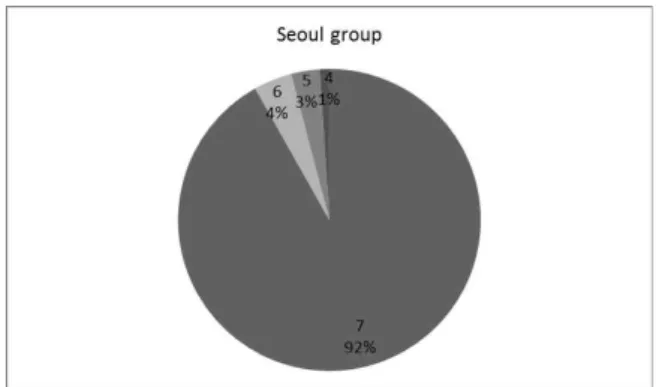
On the whole, the Busan and Seoul speakers were not much different from each other in the production of Korean /s*/. The average rating for the Busan group was 6.6 and the one for the Seoul group was 6.8. Figures 4 (a) and (b) show pie charts of the frequency of ratings for Busan and Seoul speakers. Low ratings, such as 1, 2, or 3 were never found for both groups, and a mid-rating, 4 was scarcely found for both groups (only once for Seoul group and twice for Busan group). All over the participants, the case where the target Korean words were judged as being produced with /s

h

/ was only once for Busan group, and it was not the case for Seoul group.


(8)

Figure 4 (a). Frequency of goodness ratings given to /s*/

productions by Seoul speakers


Figure 4 (b). Frequency of goodness ratings given to /s*/

productions by Busan speakers   

Difference also existed between the two groups. The highest rating, 7 was absolutely dominant (92%) in Seoul group but the dominance was lower (77%) in Busan group. Similarly, the lower ratings, 5 and 6 were found more frequently in Busan speakers’ /s*/-production: 10% for 5-rating, 12% for 6-rating in Busan group and 3% and 4%, respectively in Seoul group (compare Figures 4 (a) and 4 (b). Variability in ratings indexed by standard deviation showed the same trend. Busan speakers showed greater variability in the ratings than Seoul speakers did. Standard deviation in the ratings given to /s*/-judged tokens was 0.7 for Busan group and was 0.5 for Seoul group (the lower the value is, the less the variability is).

The results of the /s*/ production experiment suggested that the young Busan speakers produced Korean /s*/ with high resemblance to the production of the Seoul speakers, but with some differences at the same time. The goodness of the /s*/

production was high for both groups. The high ratings, 6 and 7 occupied 89% in Busan group and 96% in Seoul group (see Figure 4). The average rating was similar: 6.6 for Busan group and 6.8 for Seoul group. However, the dominance of the highest rating, 7 was somewhat lower in Busan group, and the /s*/

production from Busan speakers showed a greater variability in ratings compared with Seoul speakers’ production.

4. Discussion

Considering the prevalent belief of /s

h

/-/s*/ neutralization in Kyungsang speech, the current study investigated category solidity of sibilant fricatives in Seoul and Busan dialects. In a cross-linguistic mapping task conducted to Seoul and Busan speakers, whether Busan speakers perceived English /s/

differently from Seoul speakers in terms of Korean /s

h

/ and /s*/

categories was examined. The perception patterns revealed both similarity and difference. For both speaker groups, English /s/

situated in initial position was perceived more likely as Korean /s*/, whereas /s/ in pre-C position was perceived as Korean /s

h

/.

English /s/ in V_V position was less dichotomously mapped into a single category, /s*/ or /s

h

/ (refer back to Figures 1 (a) and (b)), and the two groups revealed differences for this position.

The most outstanding difference was the obviously less /s*/

response for /ɛ/ and /æ/ vowel contexts by Busan speakers (refer to Figures 3 (a) and (b)). Seoul speakers perceived English /s/ in /ɛ/_/ɛ/ and /æ/_/æ/ positions more likely as Korean /s*/. In contrast, Busan speakers relatively gave more /s

h

/ response for the /ɛ/ and /æ/ contexts and thus, /s

h

/ and /s*/

responses were comparable to each other. Also, as revealed in

the investigation of individual speakers’ perception patterns

(section 2.4.3), most Seoul speakers showed an apparent

/s*/-preference for /ɛ/ and /æ/ contexts, whereas only a few

showed the same preference in Busan group. Besides, for all

over the intervocalic contexts (except for /i/ context) Busan

speakers gave relatively more /s

h

/ response than Seoul speaker

did, that is, the proportion of /s

h

/ response was greater than that

of /s*/ response for each vowel context. In short, what can be

seen from the results of V_V context is that Busan speakers

were largely more ‘stingy’ /s*/-response givers and Seoul

speakers were more ‘generous’/s*/-response givers. What would

be the reason for this? One of the simplest answers would be

that the perceptual representations of /s

h

/ and /s*/ are simply

different between Seoul and Busan speakers’ mind. In other

words, English /s/ in /ɛ/_ /ɛ/ and /æ/_ /æ/ contexts was more

similar to /s*/ than to /s

h

/ in Seoul speakers’ perceptual

category representation of /s

h

/ and /s*/, whereas it was more

similar to /s

h

/ in Busan speakers’ perceptual category

representation of /s

h

/ and /s*/.

(9)

The other possible answer would attribute the different perception behavior of the Busan and Seoul speakers more likely to the stability of the category itself rather than inherent differences in the category. Seoul speakers as users of the standard dialect have solid perceptual categories of /s*/ and /s

h

/.

When they were confronted with non-native stimuli that is phonetically similar to more than one native category, here the instances of English /s/ in /ɛ/ and /æ/ contexts that are more or less similar to both /s

h

/ and /s*/ of Korean, they had to give a response of one way or the other, and they generously gave more /s*/ response according to their solid perceptual category representation of /s

h

/ and /s*/. In contrast, in the case of Busan speakers, they were more rigid. When facing the puzzling non-native stimuli, they felt less competent to give a single-category response mostly due to their less solid status of /s*/ category. Thus, they applied a stricter rule to /s*/-category membership and this led to the relatively less /s*/-response compared with the Seoul speakers.

These speculations about category status can find grounds from the findings of the experiments in this study. The results of /s*/ production by Seoul and Busan speakers (section 3) showed overall similarity between the two groups. The average goodness rating for the Busan speakers was as high as that of the Seoul speakers, and this suggests that Busan speakers produced Korean /s*/ distinctively from /s

h

/ as much as Seoul speakers did. However, at the same time their /s*/ production revealed difference in a more detailed examination. The proportion of mid-high ratings, 5 and 6 for Busan speakers was relatively greater than Seoul group, and the consistency among the judged goodness rating values was lower in Busan group.

These results suggest that although Busan speakers’ production of /s*/ is distinctive enough from /s

h

/, at a micro-level their production could still be different from the production by Seoul speakers. For perception side of the story, the same line of difference was found. The Seoul speakers made relatively a more dichotomous decision than Busan speakers. Recall that for both Busan and Seoul speakers the initial position was obviously favored by /s*/ response and the pre-C position was no doubtedly preferred by /s

h

/ response (Figures 1 (a) and (b)).

Here, the dominance of the preferred-response was relatively greater in Seoul group, that is, the proportion of /s*/ response for initial position, and the proportion of /s

h

/ response for pre-C position was greater in Seoul group than in Busan group.

Likewise, within the initial position, the vowel contexts where /s*/ response was preferred, that is, /i/, /ɛ/, and /æ/, and the

other way, the context where /s

h

/ response was preferred, that is, /ɑ/ showed the same direction of dominance. Seoul speakers showed relatively greater preferred-response dominance. In other words, the proportion of non-preferred-response (diagonally filled in the figure) was relatively less in Seoul group (see Figures 2 (a) and (b)). These results indicate that Seoul speakers chose more unanimously a single category when non-native stimuli were clearly similar enough to a native category. The production difference being considered together, this can be viewed as suggesting that the less dichotomous, less unanimous decision of the Busan speakers for ‘unclear’ contexts (that is, instances of /s/ in /ɛ/_/ɛ/ and /æ/_ /æ/ contexts) should be related to their less solid perceptual category of /s*/ and this less stable status of /s*/ category explains the more stingy /s*/-response for /s/ in /ɛ/ and /æ/ contexts.


 5. Conclusion

The current study investigated Kyungsang speakers’

perceptual representation of Korean sibilant fricatives, /s

h

/ and /s*/ at a micro-level. On the whole, younger users of the Busan dialect were highly similar to Seoul speakers for both production and perception. However, when facing non-native stimuli that are highly similar to a native category but still do not perfectly match the native category, the Busan speakers revealed difference from Seoul speakers in perception. For English /s/ in /ɛ/_/ɛ/ and /æ/_/æ/ contexts, Seoul speakers were more generous in giving /s*/response, whereas Busan speakers were stricter. These results were interpreted to suggest that Busan speakers’ perceptual category of /s*/ was less solid: a less stable native category should be related to stricter category-inclusion behavior in a cross-linguistic mapping task for perceptually, phonetically highly similar non-native stimuli.

In short, the results of the perception and production experiments in this study suggested that although Busan speakers’ production of Korean /s

h

/ and /s*/ was as highly distinctive as that of Seoul speakers, their perceptual category representation of /s

h

/ and /s*/ should be less categorical than that of Seoul speakers.


References

Cheon, S. Y. (2006). Production of Korean fricatives in second

language acquisition: Acoustic characteristics. Korean

Linguistics, Vol. 13, 17-48.

(10)

Cho, T., Jun, S.-A., & Ladefoged, P. (2002). Acoustic and aerodynamic correlates of Korean stops and fricatives. Journal of phonetics, Vol. 30, 193-228.

Holliday, J. (2012). The acoustic realization of the Korean sibilant fricative contrast in Seoul and Daegu. Journal of the Korean society of speech sciences, Vol. 4, No.1, 67-74.

Iverson, G. K. (1983). Korean s. Journal of Phonetics, Vol. 11, 191-200.

Kagaya, R. (1974). A fiberscopic and acoustic study of the Korean stops, affricates, and fricatives. Journal of Phonetics, Vol. 2, 161-80.

Kang, Y. (2008). English voiced stops in Korean in the 1930s. A talk presented at the annual meeting of the Montreal- Ottawa-Toronto (MOT) Phonology workshop.

Kang, Y. (2008). The Adaptation of English /s/ in Korean.

Inquiries into Korean linguistics, Vol. 3, 1-14.

Kenstowicz, M. & Park, C. (2006). Laryngeal features and tone in Kyungsang Korean: a phonetic study. Studies in Phonetics, Phonology and Morphology, Vol. 12, no. 2, 247-264.

Kim, S. & Curtis, E. (2001). Phonetic duration of English /s/ and its borrowing in Korean. Proceedings of the 10th Japanese/

Korean Linguistics Conference.

Ladefoged, P. & Maddieson, I. (1996). The sounds of the world’s languages. Malden, MA: Blackwell.

Lee, K. (2002). Comparison of acoustic characteristics between Seoul and Busan dialect on fricatives. Speech Sciences, Vol. 9, No. 2, 223-235.

Yoon, K. & Kang, H. (2005). Tense/lax distinctions of English [s]

in intervocalic position by Korean speakers: consonant/vowel ratio as a possible universal cue for consonant distinctions.

Studies in phonetics, phonology and morphology, Vol.11, no. 3, 407-418.

Yoon, K. (1998). A study of Korean alveolar fricatives: an acoustic analysis, synthesis, and perception experiment (unpublished MA thesis).

Yoon, K. (2002). A production and perception experiment of korean alveolar fricatives. Speech sciences, Vol. 9, no. 3, 169-184.

•Kang, Kyoung-Ho Kyungsung University Email: [email protected]  

Appendix  

I. Perception task stimuli

1. Word-initial context (initial context)  [sik] [sɛk] [sæk] [suk] [sok] [sɑk]

2. Intervocalic context (V_V context)

 [kisik] [kɛsɛk] [kæsæk] [kusuk] [kosok] [kɑsɑk]

3. Pre-Consonant context (pre-C context)  [spip] [stik] [skik] [snit] [smik] [slit] [swik]


II. Production task stimuli

The target words containing Korean /s*/ are indicated bold (not indicated when presented to the participants).

Please read following sentences and translate them into Korean. (This instruction was provided in Korean)

1. Because the notebook computer is very cheap, it sells very well.

2. Madonna fought with her husband.

3. English is not a language to learn.

4. Put rice in to the pot and add some water.

5. Weather is very chilly this week.

6. I love Michael Jackson’s song so much.

7. Lately, the double-eyelid operation is very popular among Korean girls.

8. I am very proud of myself.

9. I like video games so much and play all night frequently.

10. I used to write a diary every day when I was young, but I don’t write anymore.

11. It is hard to find a garbage can at a subway station these days.

12. My favorite TV show is One night and Two days.

13. According to some studies, it has been found that sunflower seeds are good for health.

14. Jake chewed the gum and spit it on the ground.

수치

Figure  2  (a).  Mean  number  of  /s*/  and  /s h /  responses in  word-initial  context  for  Seoul  group  of  10  participants
Table  2.  The  number  of  /s*/  response  in  /ɛ/  and  /æ/  contexts  for  each  of  the  12  Busan  participants
Figure  4  (a).  Frequency  of  goodness  ratings  given  to  /s*/

참조

관련 문서