http://dx.doi.org/10.7236/JIIBC.2013.13.3.39
JIIBC 2013-3-6
간섭 제약 네트워크에서 파운틴 코드를 사용한 협동 릴레이 프로토콜 설계
Cooperative Relaying Protocol using Fountain Codes under Interference Constraint Networks
공형윤
*Hyung-Yun Kong
요 약 본 논문에서는, 간섭 조건의 2차 네트워크에서 파운틴 코드를 사용하는 협력 릴레이 프로토콜을 제안한다. 제안된 프로토콜에서 2차 소스는 2차 릴레이의 도움으로 2차 목적지까지 파운틴 코드로 메시지를 전송한다. 2차 소스 와 릴레이는 언더레이 모델에서 작동하며, 1차 사용자에 의해 발생된 간섭의 경우, 허용된 임계 값보다 낮기 때문에 2차 소스와 릴레이의 전송 전력에 적응해야한다. 제안된 프로토콜의 성능 평가를 위해, 레일리히 페이딩 채널환경에 서 평균 전송 시간의 식을 유도한다. 또한, 몬테-카를로 시뮬레이션을 통하여 유도된 식을 검증 하였다.
Abstract In this paper, we propose a cooperative relaying protocol using Fountain codes for secondary network under interference constraint. In the proposed protocol, a secondary source uses Fountain codes to transmit its message to a secondary destination with help of a secondary relay. The secondary source and relay operate in the underlay model, in which they must adapt their transmit power so that the interference caused at a primary user is lower than an allowable threshold. To evaluate performance of the proposed protocol, we derive the expressions of average number of transmission times over Rayleigh fading channel. Various Monte-Carlo simulations are presented to verify the derivations.
Key Words : Underlay network, Rayleigh fading channel, Fountain codes, Cooperative diversity.
*정회원, 울산대학교 전기전자정보시스템공학부 접수일자 : 2013년 5월 1일, 수정완료 : 2013년 6월 5일 게재확정일자 : 2013년 6월 14일
Received: 1 May 2013 / Revised: 5 June 2013 / Accepted: 14 June 2013
*Corresponding Author: [email protected]
School of Electrical Engineering, University of Ulsan, Korea
Ⅰ. Introduction
Fountain codes or Rateless codes[1] have obtained much attention in wireless networks. In Fountain codes, a transmitter can transmit a limitless number of encoded packets until it receives an ACK message from an intended receiver to inform that its data has been received successfully[2]. Recently, cooperative
relaying protocols using Fountain codes have been studied. In[3], the authors proposed the use of Fountain codes for dual-hop relaying in cooperative sensor networks. In[4], the performance of the multi-hop cooperative transmission scheme with Fountain codes was evaluated.
Recently, underlay protocols in cognitive radio have been investigated[5-6]. In these protocols, the secondar
transmitters can use same frequency bands with primary users, provided that the interference created by secondary operations is lower than a given threshold. To avoid the effect of fading channels, the cooperative communication can be used to enhance the performance of secondary network[5-6].
To the best of our knowledge, there has not been published works related to the use of Fountain codes in underlay cognitive radio networks. In this paper, we propose a such scheme and evaluate its performance over Rayleigh fading channel. In the proposed protocol, a secondary source uses Fountain codes to transmit its message to a secondary destination. In addition, there is a secondary relay which is ready to help the secondary source transmit the source message to the secondary destination if it can successfully decode it earlier than the secondary destination. To evaluate performance of the proposed protocol, we derive the expression of the average number of encoded packets transmitted by the secondary source for the proposed protocol and the direct transmission protocol. Then, various Monte-Carlo simulations are presented to verify the derivations and compare the performances of the proposed protocol with the direct transmission protocol.
The rest of the paper is organized as follows. The system model is described in Section II. In Section III, the performance evaluation of the protocols is analyzed.
The simulation results are presented in Section IV.
Finally, the paper is concluded in Section V.
Ⅱ. System Model
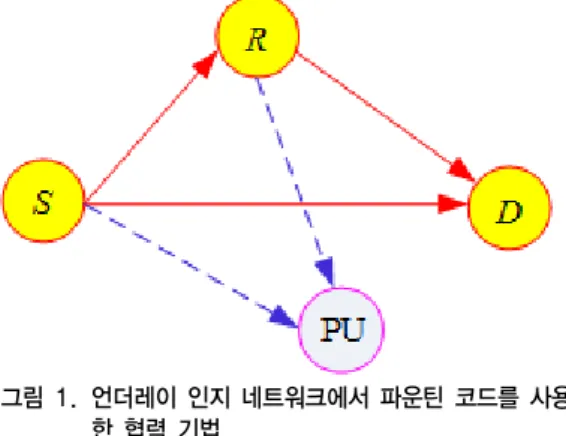
In Fig. 1, we present a cooperative relaying scheme using Fountain codes in underlay cognitive radio network. In this model, a secondary source (S) attempts to transmit its message to a secondary destination (D) with the help of a secondary relay. It is also assumed that each node has a single half
duplex radio and a single antenna and hence, for medium access, a time-division channel allocation is occupied in order to realize orthogonal channels. We also assume that the original message of the source is divided into H packets and the source uses Fountain codes right to encode them. At each time slot, the source broadcasts an encoded packet to the relay R and destination D. These receivers are assumed to be able to decode successfully the original message if they can receive any
encoded packets at least, where
is the decoding overhead. In practice, this overhead depends on concrete code design but it is bounded and not too large[2]. Before transmitting an encoded packet, the source (relay) must adapt its transmit power so that interference caused at a primary user (PU) is lower than a predefined threshold
.그림 1.언더레이 인지 네트워크에서 파운틴 코드를 사용 한 협력 기법
Fig. 1. The cooperative scheme using Fountain codes in underlay cognitive radio network.
At first, we describe the operation of the direct transmission protocol (DT), in which the source S directly transmits encoded packets to the destination.
In this protocol, whenever the destination sufficiently receives
encoded packets, it sends an ACK message to the source to inform. In this case, the transmission of the original message ends.In the proposed protocol, named PR, if the
destination is the first node which sufficiently receives
encoded packets, it sends an ACK message via feedback to inform the source. After receiving the ACK message, the source stops the transmission of coded packets. In the case that the relay R which sufficiently receives
encoded packets earlier than the destination, it also sends an ACK to inform the source. The source then stops its transmission. Next, the relay decodes the original message and re-encodes it by using Fountain codes. Then, the relay replaces the source to transmit the coded packets to the destination. In this case, the destination will attempt to collect the coded packets transmitted by the relay. If it sufficiently receives total
encoded packet, it sends an ACK message to inform the successful status and do decoding. Also, the relay stops the transmission of the coded packets after receiving the ACK message.Ⅲ. Performance Evaluation
We assume that the channel between two nodes captures block and flat Rayleigh fading distribution which keeps constant in a time slot but independently change from a time slot to a time slot.
At the time slot n, assume that the source wants to transmit the encoded packet
to the destination and relay. Before transmitting
, the source must adapt its transmit power as in[5-6]:
, where
is channel coefficient between the source and the primary user in this time slot.The packet received at the destination and relay at this time slot is given respectively as
(1)
(2)where
and
are channel coefficients ofthe
→
and→
links, respectively,
and
are additive white Gaussian noise (AWGN) at the destination and relay, respectively.Assume that the variance of
and
equals to
; from (1) and (2), we obtain the instantaneous received Signal-to-Noise Ratio (SNR) at the destination and relay as
(3)
(4)where
Similarly, if the relay wants to transmit the encoded packet
to the destination at time slot n, the instantaneous received SNR at the destination can be given as
(5)where
and
are channel coefficients of the→
and→
links in this time slot, respectively, and
is transmit power of the relay which is given as
Similar to[7],
,
,
,
and
are exponential random variables (RVs). Also, to take path loss into account, we can model the parameter of these RVs as a function of the distance between two nodes:
and
respectively, where
is the path loss exponent that varies from 2 to 6, and
is the distance between nodes X and Y,∈
We assume that there is a SNR threshold,
, at the receiver. In each time slot, an encoded packet will be dropped if the received SNR is below
, which is considered as an erasure[2]. Otherwise, it is assumed that the encoded packet will be received successfully.By using[6, eq.(4)]
, the erasure probability of the
→
,→
and→
links can be respectively given as
(6)
(7)
(8)
Considering the DT protocol, similar to[2], the number of transmission times follows the negative binomial distribution as
(9)
where M is the number of transmission times of the source so that the destination can receive
encoded packet successfully.From (9), we obtain the average number of transmission times of the DT protocol as[2, eq.(8)]
:
(10)Next, considering the proposed protocol, we first denote
and
is the number of encoded packets that the destination and relay successfully received from the source.Case 1:
and
≤
In this case, the destination receives enough
encoded packets earlier than the relay. Hence, the destination decodes the original message from the received packets. Assume the source transmitted M encoded packets, the probability for this case can be approximated as follows:
≈
×
(11)
Because the random variables
and
are not independent, the probability
can be approximated by the value of the right side of (11).
It is noted that from Case 1 that
can change from 0 to
. Therefore, the total probability of the event
can be given as
≈
×
(12)
From (12), we obtain an approximate expression of the average number of transmission times
as
∞
≈
∞
×
(13)
Case 2:
and
In this case, the operation is divided into two stages. In the first stage, because the relay receives enough
encoded packets earlier than the destination, it decodes the original message from these received packets. After decoding, it re-encodes the message using Fountain codes and then transmits the encoded packets to the destination. In the second stage, the destination continues to collect the encoded packets until it receives enough
encoded packets.Assume that the total number of transmission times of the destination and relay is M . We also assume that the source transmitted
encoded packets at the first stage. Similar to (11-12), we obtain the total probability for this case as
≈
(14)
In the second stage, the destination must successfully receive enough
encoded packets from the
encoded packets transmitted from the relay. Similar to (9), the probability of this event is given as
×
(15)
Combining (14) and (15), we obtain an approximate expression for the probability that the total number of transmission times equals M as follows:
≈
(16)Therefore, the average number of transmission times in Case 2 is given as
∞
(17)From (13)-(17), we obtain an approximate expression for the average number of transmission
times of the PR protocol as
.Ⅳ. Simulation Results
In this section, we present Monte-Carlo simulations to verify the mathematical derivations. In a two-dimensional plane, we assume the co-ordinates of the source S, the relay R, the destination D, and the primary user PU are (0, 0),
, (1, 0) and
, respectively. In all of the simulations, the path-loss exponent
equals 3, the threshold
equals 1 and the number of encoded packets required
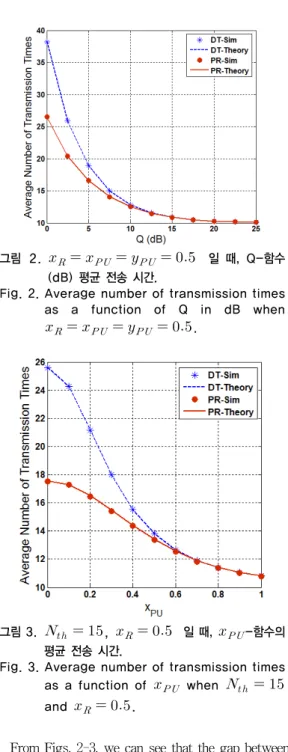
equals 10. For the infinite series, we truncate them by 500 terms.In Fig. 2, we present the average number of transmission times as a function of Q in dB. In this simulation, we assign the value of
,
and
by 0.5, 0.5 and 0.5, respectively. It can be observed from this figure that the PR protocol uses less the number of transmission times than the DT protocol does. At high Q values, since almost encoded packets can be received successfully by the destination, the average number of transmission times of both protocols is quite same. It is easily to see that the average number of transmissions converges to
at high Q region.그림 2.
일 때, Q-함수 (dB) 평균 전송 시간.Fig. 2. Average number of transmission times as a function of Q in dB when
.그림 3.
,
일 때,
-함수의 평균 전송 시간.Fig. 3. Average number of transmission times as a function of
when
and
.From Figs. 2-3, we can see that the gap between simulation results and theoretical results is small.
This validates our derivations.
Ⅴ. Conclusion
In this paper, we studied performances of the
underlay protocols using Fountain codes in cognitive radio network. Results presented that with the use of cooperative communication, the underlay system can significantly reduces the average number of transmission times as compared with the direct transmission scheme.
Reference
[1] D.J.C. Mackay, “Fountain codes”, IEEE Proc.
Communication, vol. 152, pp. 1062-1068, 2005.
[2] X. Wang, W. Chen, Z. Cao, “A Rateless Coding based Multi-Relay Cooperative Transmission Scheme for Cognitive Radio Networks“, IEEE Global Telecommunications Conference, pp. 1-6, 2009.
[3] A. F. Molisch, N. B. Mehta, J. S. Yedidia, and J.
Zhang, “Performance of fountain codes in collaborative relay networks,” IEEE Trans. Wireless Commun., vol. 6, no. 11, pp. 4108–4119, Nov. 2007.
[4] T. T. Duy, A. Anpalagan and H.Y. Kong,
"Multi-hop Cooperative Transmission Using Fountain Codes over Rayleigh Fading Channels", Journal of Communications and Networks (JCN), vol. 14, no. 3, pp. 267-272, June 2012.
[5] T. T. Duy and H.Y. Kong, "Exact Outage Probability of Cognitive Two-Way Relaying Scheme with Opportunistic Relay Selection under Interference Constraint", IET Communications, vol. 6, no. 16, pp. 2750-2759, Nov. 2012.
[6] T. T. Duy and H.Y. Kong, "Performance Analysis of Incremental Amplify-and-Forward Relaying Protocols with Nth Best Partial Relay Selection under Interference Constraint", Wireless Personal Communications (WPC), pp. 1-17, Online First, Dec. 2012.
[7] T. T. Duy, B. An and H.Y. Kong, "A Novel Cooperative-Aided Transmission in Multi-Hop Wireless Networks", IEICE Transactions on Communications, vol. E93-B, no. 3, pp. 716-720, March 2010.
저자 소개
공 형 윤(정회원)
∙1989년 2월 : New York Institute of Technology(미국) 전자공학과 학사
∙1991년 2월 : Polytechnic University (미국) 전자 공학과 석사
∙1996년 2월 : Polytechnic University (미국) 전자 공학과 박사
∙1996년 ~ 1996년 : LG전자 PCS팀장
∙1996년 ~ 1998년 : LG 전자 회장실 전략 사업단
∙1998년 ~ 현재 : 울산대학교 전기전자정보시스템공학부 교수
<주관심분야> 모듈레이션, 채널 부호화, 검파 및 추정 기술, 협력통신, 센서네트워크