DOI : http://dx.doi.org/10.5394/KINPR.2015.39.2.125
A Study on the Entry of Korean Shipping & Logistics Company into the Offshore Plant Logistics Service Market
Seok-Hyun Shin
*․†Moon-Kyu Kwon
*․Jin-Hee Park
*․Young-Kyu Park
*** Graduate school of Korea Maritime and Ocean University, Busan, Rep. of Korea 606-791
† Department of Logistics, Korea Maritime and Ocean University, Busan, Rep. of Korea 606-791
**Department of Port & Logistics, Kaya University, Gimhae-si, Gyeongnam, Korea 621-748
Abstract : Korea is worldwide top manufacturer of offshore plant industry, while shown weakness in high-valued offshore plant service industry (OPSI). The governmental support policies and studies for fostering programs are centered on shipbuilding and engineering sector. On the other hand, offshore logistics service sector among the programs is neither included as governmental fostering support sectors nor ever-studied. Domestic shipping and logistics companies have many experience of handling various project, heavy-lift cargo and even super blocks on shipbuilding industry. However they are faced with lack of appropriate heavy carrier and others. So for their successful entering into offshore plant logistics market, systematic preparation, studies and supporting policies are highly recommended.
Key words : offshore logistics service market, domestic logistics company, fostering program, offshore logistics, offshore plant service industry(OPSI), offshore support vessel(OSV)
* [email protected] 051)467-1905
†Corresponding author : [email protected] 051)410-4331 [email protected] 051)410-4337
** [email protected] 055)330-1136
Note) This paper was presented on the subject of "A Study on Entry into Local Shipping & Logistics Company's Offshore Plant Logistics Service Market" in Asia Navigation Conference 2013, (KIMFT, Busan, Korea 24∼26 Oct., 2013)
1. Introduction
The size of global offshore plant market is USD140 billion in 2010 and expected to be reach USD320 billion in 2020. It is 6~7% of growing rate. The demand on ordering offshore plant is rapidly increased with accumulating world-top class ship-building technology.
New ocean market in offshore plant or resource development is expected to be expanded to the rate of 10%
every year whereby expect also radical growth on logistics market related to offshore plant. Such a prospect shows the expansion of the size in offshore logistics market and means to open bigger entrance for local logistics companies.
But current local logistics companies are suffering in depression and facing lack of surplus capitals to invest and securing exclusive heavy transport vessels. High dependency on foreign heavy marine transport vessels of domestic major export companies and Engineering, Procurement, Construction(EPC) is also one of negative factors.
The strategic support at country levels required to expand market share for local logistics industry in the offshore plant logistic market which is esteemed as one of
future promising industries. Government should drive offshore logistics as new growth engine to foster local logistics companies into the global offshore plant market and make up global logistics network through appropriate supporting policy.
The lack of competitiveness in fleets, technical specialists, capable to handle mega sized project cargoes are the weak point of local logistics companies.
Cooperation between EPC/export manufacturing companies and local logistics companies/carriers will output win-win effect. Opening training programs, organized by both academy and industry to improve required engineering skills of installment and high technique in transportation offshore products is needed.
The purpose of the study proposes to help local shipping
& logistics company find new logistics market from growing offshore plant export in Korea.
But local logistics company was less interested in this offshore plant market than foreign competitors nor much experience they had in this business area compared to overseas major logistics companies.
So, in this study says offshore plant service industry
(OPSI) explains how to be comprised of and involved in
what service sector local logistics company should join as
profit source in future for which propose effective entry measure by analyzing problem area to advance to this potential offshore plant logistics market.
OPSI is comprised of Operation & Maintenance(O&M) and supporting business by OSV. Currently local logistics company is joining rarely in transportation and installation sectors among supporting business of OPSI. So, this study just limited to logistics sector but needed to study future O&M area related to OPSI.
In local logistics studies, as there is no preceding research of offshore plant logistics nor correct data of offshore plant logistics company. But Korea is a fast-growing offshore plant manufacturing country and ranked one of top exporting countries worldwide. To this end, this study propose local shipping & logistics company enter into potential offshore logistics business area to create value-added in future.
As to method of study, because no data of logistics market of OPSI but this paper just have offshore plant industry in value-added creation portion viz. exploration (7%), design(8%), shipbuilding(35%), transportation(2%), installation(3%), commissioning(1%), O&M(40%), etc(4%).
which basis local logistics company might have chance to enter into transportation, installation and future O&M sector as potential market of OPSI boomed by offshore plant export recently.
In this study method needs to first analyze market status of potential logistics-related sector of transportation, installation among OPSI so that local shipping & logistics company can advance to this new offshore logistics market.
2. The Status of Offshore Plant Service Industry(OPSI)
2.1 The Concept of OPSI
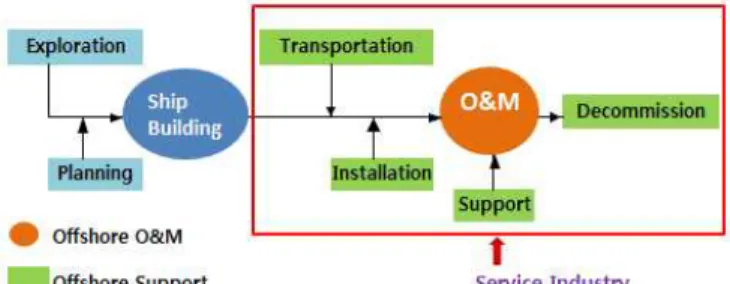
OPSI includes transportation, installation, operation &
maintenance(O&M), decommission and support after building of offshore structure. It is divided by one operation business that is directly operated and managed offshore facilities to produce oil or gas, and another support business that serves various services to transport, install/uninstall, and utilize OSV(Figure 1).
In wide concept, exploration and planning before ship building are also considered as service industry, but in this paper the service industries are restricted in the process after ship building.
Fig. 1 Categories of OPSI
2.2 World Offshore Logistics Market
Worldwide specializing in offshore heavy transport market is pre-occupied and formed monopolistic market by world leading companies such as Dockwise, Biglift, Jumbo and Netherlandish Carriers, and German shipping companies, SAL, Rickmers Line. They serve not only transportation but provide total service including inland transportation and installation in loading/discharging place and have various technical careers and specialist in offshore logistics.
Especially marine structures in offshore are ranged from thousands to ten thousand tons products. For example, Dockwise operates lots of Semi-Submersible ships by FO-FO(Floating On Floating Off) and exclusively occupies this market. The oil plant belongs to the high value-added industry and gain USD10 million per one transit, but has high barriers to enter, such as expensive transporter fleet, advanced marketing skills, technical engineering and so on.
2.3 The Domestic Offshore Logistics Market Domestic companies, Hyundai Merchant Marine Co., Ltd.(HMM), Dong Bang Transport Logistics Co., Ltd., Hanjin Transportation Co., Ltd., CJ Korea Express Corporation, Sebang Co., Ltd., KCTC Co., Ltd.(Mega Line), Pantos Logistics Co., Ltd. are providing transportation service in heavy lift cargo but still showing in high portion focused on onshore(inland transportation).
Lately they secure Self-propelling(Submersible) vessel by Ro-Ro(Roll On Roll Off) and actively try to enter into new global market. Yet it is self-estimated insufficient to reach the global level to compete with global advanced offshore specialists.
In the global offshore transportation market, domestic
companies occupy a minor position. The weak points are
lack of fleet competitiveness and lower technical capacity
Classification 2012 2011 2010
Revenue 539 399 439
Operating Profit 71 12 69
Net Profit 40 2 17
Total Assets 2,209 1,618 1,628
Company Barge
/Vessel type Max. Lifting
Revolving (st)
Heerema
Balder DP Deepwater
Construction 3300 + 2200 Hermond S S Crane
Vessel 5000 + 3000 Thialf DP Deepwater
Construction 7810 + 7810
McDermott
DB 50 DP Derrick
Laybarge 3527
DB 101 S S Derrick
Barge 2700
DB 30 Derrick Laybarge 2800 Seipem S-700 DP Deepwater 7840 + 7840
for large and heavy structures. And also lack of
engineering skills requiring installation at destination after ocean transportation and marketing ability in attracting offshore plant cargoes are pointed out as problems.
The weak competitiveness of domestic logistics companies and pre-occupation of advanced foreign companies are main reasons of high dependency on foreign carriers. But the matter should solve step by step for successful entry into the high value markets. Advanced foreign companies, i.e, Dockwise and Biglift have costliness equipments and do not stop to invest for purchasing.
Moreover the global market tendency shows increasing in the size of platform(topside), 10,000∼30,000 ton, so the change of float follows simultaneously. Netherlandish Dockwise exclusively takes its position and currently Cosco, China joins into this business, bringing technique from Noble Denton and building a submergible barge.
Some domestic logistics companies and shipping companies have submergible barges and surplus energy to jump into the market, if they are assisted some technical aids of offshore plant technology services(OPTS). It is known a few of them was already either in business or have plans to perform. But long-term strategies are needed in Korea.
2.4 Characteristics of OPSI
High value-added and fast growing industry, OPSI stands 50% of total value-added of offshore plant industry after building, including exploration and planning, will be charged 60∼70% of the total(Ahn, 2010).
Fig. 2 Rate of Generation of Value Added in Offshore Plant Industry
3. The Status of Offshore Support Business
3.1 Transportation
Transportation means that transport offshore facilities from the shipyard to the gas & oil blocks by huge Barge/Ocean Tug Boat or Heavy Transportation Semi-submersible Ship(Dockwise, 2012). Netherlandish Dockwise, specialized in offshore logistics, is monopolistic sharing over 80%. It is established on 1993 and has 1,200 employees, 5 Open-stern vessels, 12 Closed-stern vessels and 2 Dock-type vessels. 2012 it earned revenue of USD539 million and net profit of USD40 million(Table 1).
Table 1 Business Turnover of Dockwise (unit: $mil.)
3.2 Installation
Installation is to set equipment like pipelines, underwater tools in the entry of oil blocks to produce oil & gas.
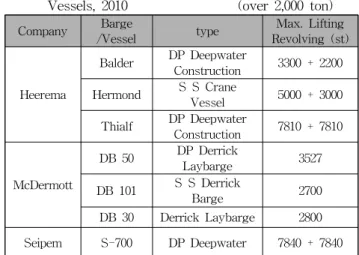
Heerema, McDermott and Seipem are leading companies in this field(Choi, 2012). Due to required advanced technologies and equipment, the entry into this market for late comers is harsh. Derrick Laybarge, Derrick Barge, DP Deep water Construction, Heavy Lift Vessel, Self-Propel Crane Vessel, Heavy Lift/Lay Barge and so on are used(Table 2).
Table 2 The Possession Status of Offshore Installation
Vessels, 2010 (over 2,000 ton)
Construction Castro
Otto Derrick Laybarge 2000 S-300 DP Deepwater
Construction 2400 Seaway
Heavy Lifting
Stanislav
Yudin Heavy Lift
Vessel 2750
StrashnovOlg DP Heavy Lift
Vessel 5500
HHI HD-2500 Heavy Lift/Lay
Barge 2500
COOEC Lan Jing Self-Propel
Crane Vessel 8600 Lan Jiang Derrick/Lay
Barge 3800