Ⅰ. INTRODUCTION
Radiation therapy uses high energy radiation to treat cancer and aims at minimizing the dose to normal tissue. Radiation therapy technology is advancing more rapidly as science and technology become more advanced. In the past, It has changed from KV radiation therapy to radiotherapy of the high doses in the small field and the recent radiotherapy used particle radiation[1].
In addition, IGRT (image-guided radiotherapy) using an image acquisition device is used for precise set-up of the patient[2], and respiration gating radiation therapy and tumor tracking radiation therapy are also used in the clinic considering the internal organs movement of the patient[3].
In order to support the above-mentioned radiation treatment technology, it is necessary to continuously upgrade the hardware of the radiation treatment equipment as well as the physical radiation treatment
Journal of Radiological Science and Technology, 40(4), 627-632 ISSN 2384-1168(On-line) ISSN 2288-3509(Print) http://dx.doi.org/10.17946/JRST.2017.40.4.13
<원저>
Modeling of Dual Head Gantry Radiotherapy System with Monte Carlo Simulation
- 듀얼 헤드 갠트리 방사선치료 시스템 설계를 위한 몬테칼로 시뮬레이션 연구 -
Division of Medical Radiation equipment, Korea Institute of Radiological and Medical Sciences Seungwoo Park
―Abstract ―
In order to design a dual-head gantry radiotherapy system, the single head of LINAC was modeled using GATE as a preliminary study. The LINAC head was designed with VARIAN manufacturer’s information. 6 MV photons were generated from the head and the photons w irradiated to a water phantom for beam evaluation.
GATE simulation was segmented by two stages, the one was to generate X-ray spectrum and the other one was for irradiation X-ray to the water phantom. The quantitative results were described in Percentage depth dose and beam profile. Two field size conditions were employed as 5 × 5 and 10 × 10 ㎠. After beam quality was verified, dual heads gantry radiotherapy system were simulated and they was compared to the single head of LINAC system in terms of dose deposition with in the phantom. The simulated LINAC head showed accept- able beam quality result for radiotherapy. The efficiency was calculated that deposited dose from dual heads was divided by the dose from single head. At all conditions, dual heads showed higher treatment efficiency.
Efficiency was increased about 40 to 60%. Form the result, The dual head gantry system of new LINAC system will contribute to the practical radiotherapy of tumor and to reduce treatment time.
Key Words : Dual Head Gantry, LINAC, Monte carlo simulation, GATE, Radiotherapy efficiency
This work was supported by the ICT R&D program of MSIP / IITP [R0101-16-0126(10043897), Development of 500 cGy level radiation therapy system based on automatic detection and tracing technology with dual-head gantry for 30% reducing treatment time for cancer tumors]
Corresponding author: Seungwoo Park, Division of Medical Radiation Equipment, Korea Institute o f Radiological and Medical Sciences, 75, Nowon-ro, Nowon-gu, Seoul, 01812, Korea / Tel: +82-2-970-1672 / E-mail: [email protected]
Received 11 December 2017; Revised 21 December 2017; Accepted 24 December 2017
technique.
For example, It is following that cyber knife radiotherapy devices using robot arm[4], Tomotherapy treatment unit designed with functionality of a CT scanner[5], and rapid arc radiotherapy unit capable of high-speed gantry rotation based the LINAC[6]. The radiotherapy unit is developing for optimized purpose of treatment using radiation, continuously.
Recently, A dual-head gantry system for radiation therapy using two electron linear accelerators has been under development. Two LINAC are used to generate X-rays and can operate and move independently within one gantry structure, reducing the treatment time by up to 30%[7].
In this study, we evaluated a new LINAC system which had dual head to reduce irradiation time for tumor treatment using monte carlo simulation.. In order to design the dual head gantry radiotherapy system, 6 MV photon beam was simulated and evaluated quantitatively with GATE monte carlo code as a preliminary study. The generated 6 MV photon beam was demonstrated from a single head simulation in terms of the Percent Depth Dose (PDD) and cross-line profile. Then, the dual head was simulated and deposited dose was measured according to irradiation time, field size and the shape of a phantom.
Ⅱ. Material &Methods
In order to describe 6 MV photon beam with given
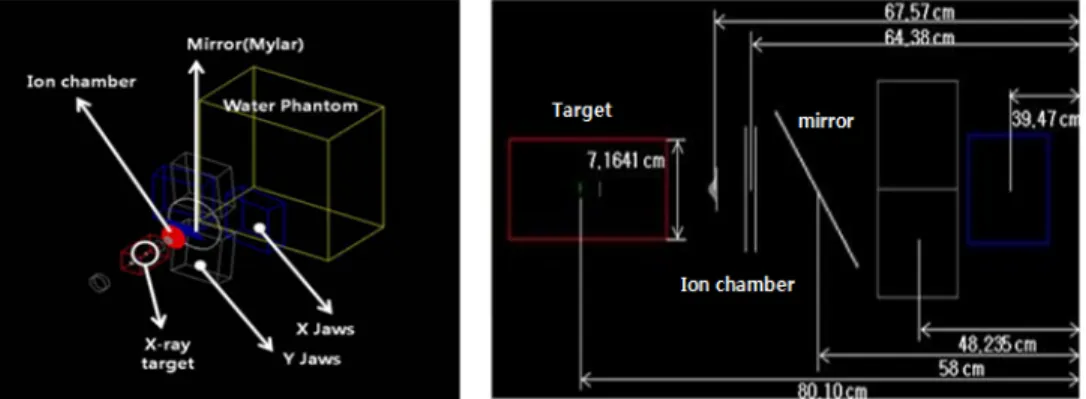
geometry, GATE simulation code (version 6.1) was employed and geometrical and material properties were concerned. The GATE simulation was commonly utilized for tomography system such as PET and SPECT but it also had been verified for LINAC modeling[8-10]. The geometrical and material properties were derived from a VARIAN’s manufacturer (Clinac 2300EX medical linear accelerator) specified layout [Fig. 1]. The simulated components were primary collimator, target, mirror, ion chamber, X-Y jaws and water phantom. The simulation was separated by two stages.
The first stage was to generate 6 MV photon beam.
At the first stage, a single LINAC head was modeled with GATE platform. The properties of head which were geometry, dimension, material and density were defined from the manufacturer information and described as precisely as possible. The electron source was placed within the primary collimator and it generated 6 MeV electrons. To be exact, the electron source generated 6.1 MeV electrons to fit the conventional 6 MV photon spectrums with given geometry. The electrons hit the target and 6 MV photon spectrums were generated. The simulated photons were stored within a Phase Space (PhS) which saved entering particles ’information in terms of position, direction ,energy, etc. The PhS was attached to predetermined volume and placed above the X jaws (Secondary collimators). The number of primary electrons was 1×10⁸.
In the second stage, PhS was acted as the photon source at the same location. In order words, the
Fig. 1 Modeling of single head LINAC in the GATE simulation and distance among element of single head LINAC
simulation was begun at top of the secondary collimators and the source was located at the same space with a PhS record volume. In this stage, the photon spectrum was irradiated to water phantom after passed through X-Y jaws with given field size.
The field size was set by 5 × 5 and 10 × 10 ㎠ depending on the jaws location. The Source to Surface Distance(SSD) was 80cm. The simulated photon spectrum was irradiated to the water phantom below the lower jaws.
The shape of the phantom was box with 50 × 50 × 30
㎤ of dimension. In the water phantom, cross-line profile and PDD were measured to verify the simulation quantitatively. The line profile was evaluated at the surface of the phantom and had 100 × 1× 1resolution with 5 × 500 × 500 ㎣ of voxel size. PDD was also evaluated with the same manner for the line profile but it had 1 × 1 × 60 resolution along the z-direction. The line profile was estimated by field flatness and symmetry.
Both quantities were defined as equations(1),(2) below.
Flatness (%) = m ax m in
m ax m in
× 100 (1)
Here Dmax was a maximum dose bin and Dmin was a minimum dose bin along the field size, respectively
Symmetry (%)=
× 100 (2)
where ALt. was the sum of bins along left side from center axis and ARt. was the sum of bins along right
side from the central axis, respectively
After verify the single head and spectrum, the dual heads were described and both of the heads irradiated 6 MV photons with various field size. One head was stationary and the other head was rotated by 45 degree and 90 degree to describe arbitrary treatment moment. At the center of the dual heads, water phantom was placed and various shape of the phantom was modeled. As the result, photons’ distribution within the phantom was visualized and the deposited dose was measured. We compared the deposited dose forgiven time which was described in terms of the number of particles on the single head case and the dual head case, respectively. The efficiency was calculated that deposited dose from dual heads was divided by the dose from single head. All the processes above were repeated for each field size, phantom shape and simulation times. The simulation geometry designed on GATE was shown on Fig. 1.
Ⅲ. Results
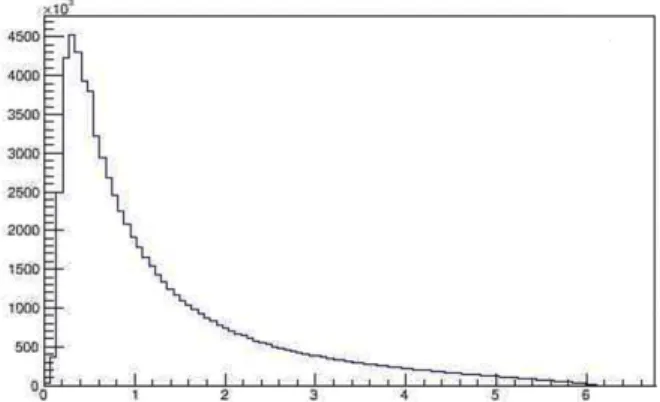
The simulated 6 MV photon spectrum was shown on Fig. 3. The mean energy of the spectrum was 1.303 MeV and maximum energy 6.1 MeV. The spectrum peak was 1.303 MeV and maximum energy was 6.1 MeV.
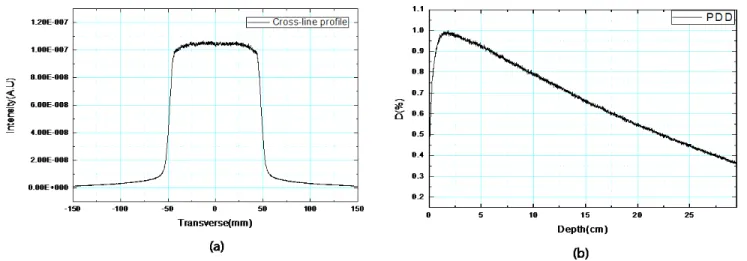
In order to evaluate the X-ray beam generated from the simulated head, cross-line profile and PDD were measured within the water box phantom. Fig. 4a
Fig. 2 Location of dual head gantry radiotherapy system for this study (a) 4 5 degree (b) 90 degree
Fig. 3 Photon spectrum of 6 MV in the single head LINAC depending on Energy
showed the measured cross-line profile on water phantom with 10 × 10 ㎠ field size. From the result, field flatness and symmetry were calculated. The calculated field flatness with 10 × 10 ㎠ of field size was 4.65% and symmetry was 0.115% [Fig. 4b]. The flatness and symmetry showed that the simulated head generated 6MV photon beam and the spectrum was able to be used for another application. Then, the spectrum in formation was used to describe the dual heads.
The dual head irradiation was compared to single head irradiation in terms of the deposited energy which corresponded to treatment time. Both simulations
were performed with 2 × 10⁸ particles which were from PhS file. At single head simulation, the head was fixed along longitudinal axis direction. Where as in dual head simulation the one head was place dat same position with the single head case but the other head was rotated along transversal axis direction. Fig. 5, Fig 6, showed the deposited dose at box and sphere phantom. The efficiency was calculated that deposited dose from dual heads was divided by the dose from single head. At all conditions, dual heads showed higher treatment efficiency. Efficiency was increased about 40 to 60%.
Fig. 4 Beam profile of cross-line and percentage depth dose in th 10 × 10 ㎠
Fig. 5 Comparison of treatment efficiency between single head and dual head gantry radiotherapy in the box phantom
[Fig. 6 Comparison of treatment efficiency between single head and dual head gantry radiotherapy in the sphere phantom
Ⅳ. Discussions
Monte Carlo simulation has been conducted as a preliminary study for the evaluation of equipment before the development of radiotherapy equipment and diagnostic equipment, and has been evaluated as a useful tool[8-14].
Monte Carlo (MC) simulation is widely recognized as an essential method to study the physics of nuclear medicine, radiology, and radiation therapy[15]. In this study, we evaluated the treatment efficiency of pre-development equipment using GATE opensoure.
GATE was initially developed for PET and SPECT applications. From version 6.0, some specific tools has been added for radiation therapy (RT) applications
In general, the symmetry and flatness was evaluated in the radiotherapy unit before use them . the symmetry and flatness of simulated LINAC was evaluated. the results of this study were confirmed to be within tolerance of general radiotherapy unit. For the evaluation of the beam characteristics of the modeled radiation therapy equipment, the evaluation of relative depth dose(PDD) was calculated and it was confirmed that the depth of the maximum dose was not nearly the same as the value of 6 MV.
Lee et al evaluated X-band LINAC for a 6 MeV dual-head radiation therapy gantry, focusing the equipment of RF system[7]. However, our study was focused on the efficiency of radiotherapy before develop the equipment for radiotherapy. and The main concern is different between both studies. The main concern of Lee et al. was RF system and x-band accelerator. it of our study was dose of water phantom.
This study has limitations in that it is evaluated with the funding and geomorphological information of the radiation therapy currently being used in the clinic. However, through this preliminary study, it is expected to apply the financial and geometrical information of the developed equipment in real time.
This study is a preliminary study for the dual head gantry radiation therapy system and it is a Monte Carlo simulation. Based on this research, we provide a lot of information before the clinical research of the development equipment.
Ⅴ. Conclusion
In this study, the dual head gantry radiotherapy system has been simulated and evaluated. The simulated geometry with a single head generated an initial condition for the dual head system. From the result, the dual head system had a higher dose deposition than a single head system. The dual head system will contribute to the real radiotherapy.
However, the treatment planning system for dual head gantry radiotherapy and dosimetry method are not established yet. The result was that measured deposited dose within the whole phantom size.
Therefore, the planning method has to be defined and estimated. The real dual head gantry radiotherapy system is being built and the specific research will be conducted on with the dual head system.
Ⅵ. Acknowledgement
This work was supported by the ICT R&D program of MSIP/IITP [R0101-16-0126(10043897), Development of 500 cGy level radiation therapy system based on automatic detection and tracing technology with dual-head gantry for 30% reducing treatment time for cancer tumors]
REFERENCES
[1] Thariat J, Hannoun-Levi JM, Sun Myint A, Vuonq T, Gerard JP, Past. present and future of radio- therapy for the benefit of patent. Nat. Rev. Clin.
Oncol. 2013;10(1):52-60.
[2] Sorcini B, Tilikidis A. Clinical application of im- age-guided radiotherapy, IGRT(on the Varian OBI platform). Caner Radiother. 2006;10(5):252-7.
[3] Shimizu S, Shirato H et al. Detection of lung tumor movement in real-time tumor-tracking radiotherapy.
Int. J Radiat. Oncol. Biol. Phys. 200;51(2)304-310.
[4] Chang SD, Main W, Martin DP, Gibbs IC, Heilbrum MP. An analysis of the accuracy of the cyberknife:
a robotic frameless stereotacitc radiosurgical system. Neurosurgery. 2003;52(1):140-6.
[5] Yu CX. Intensity-modulated arc therapy with dynamic mulfileaf collimation: an alterative to tomotherapy.
Phys. Med. Biol. 1995;40(9):1435-1449.
[6] Ling CC, Zang P, Archambaut Y, Bocanek J, Tang G, Losasso T. Commissioning and quality assurance of RapidArc radiotherapy delivery system. Int. J Radiat. Oncol. Biol. Phys., 2008;72(2):575-81.
[7] Lee S, Shin SW et al. X-band Linac for a 6 MeV dual-head radiation therapy gantry. Nuclear Instruments and Methods in Physics Research A.
2017;852(21): 40–5.
[8] Grevillot L, Frisson T, Maneval D, Zahra N, Badel JN, Sarrut D. Simulation of a 6 MV Elekta Precise Linac photon beam using GATE/GEANT4. Phys. Med.
Biol. 2011;56(4):903-918.
[9] Lourenco B, Maigne L, Perrot Y, Chassin D, Donnarieis D. Intensity-modulated arc therapy us- ing the gate Monte Carlo simulation platform in a grid environment”, Physica Medica. 2013;29(1): e24.
[10] Kim HK, Han SJ, Kim JL, Kim BH, Chang SY, Lee
JK. Monte Carlo Simulation of the Photon Beam Characteristics from Medical Linear Accelerators.
Radiation Protection Dosimetry. 2006;119(1-4):
510-3.
[11] Han SC, Park S. Monte Carlo simulation for develop- ment of diagnostics multleaf collimator. Journal of Radiological Science and Technology, 2016;39(4):
595-600.
[12] Verhaeven F, Nhum AE, Van de Putte S, Namito Y. Monte Carlo modeling of radiotherapy KV x-ray unit. Phys. Med. Biol. 1999;44(7):1769-89.
[13] Fix MK, Keal PJ, Dawson K, Siebers JV. Monte Carlo source model for photon beam radiotherapy: photon source characteristics. Med. Phys. 2004;31(11):
3106-21.
[14] Bush K, Towonson R, Zavqorodni S, Monte Carlo simulation of Rapidarc radiotherapy delivery. Phys.
Med. Biol. 2008;53(19):N359-370.
[15] Sarrut D, Bardies M et al. A review of the use and potential of the GATE Monte Carlo simulation code for radiotherapy and dosimetry applications. Med.
Phys. 2014;41(6): 064301.
∙국문초록
듀얼 헤드 갠트리 방사선치료 시스템 설계를 위한 몬테칼로 시뮬레이션 연구
박승우
한국원자력의학원 방사선기기부
듀얼 헤드 갠트리(dual-head) 갠트리 방사선치료 시스템을 설계하기 위해 LINAC의 단일 헤드는 GATE를 예비 연구로 사용하여 모델링되었다. LINAC 헤드는 임상에서 사용되고 있는 VARIAN사를 대상으로 모델링되 었다. LINAC 헤드에서 생성된 6MV의 광자선을 물 팬텀에 조사하여 빔의 특성을 평가하였다. GATE 시뮬레 이션은 X- 선 스펙트럼을 생성한 후 물 팬텀에 광자선을 조사하였다. 결과로는 백분율 깊이 선량 과 빔의 프 로파일을 평가하였으며, 5 × 5와 10 × 10 ㎠에서 수행하였다. 빔 품질이 검증 된 후 듀얼 헤드 갠트리(dual head gantry) 방사선치료 시스템을 시뮬레이션 한 후 팬텀(phantom)을 이용한 선량 분포 측면에서 LINAC 시 스템의 단일 헤드와 비교하였다. 듀얼 헤드 갠트리 방사선치료 시스템은 단일 헤드 방사선치료 시스템에 비 해 방사선치료의 효율 면에서 40~60% 높은 것을 확인할 수 있었으며, 듀얼 헤드 방사선치료 시스템은 방사 선치료 및 치료시간을 줄일 수 있을 것이 사료된다.
중심 단어 : 듀얼 헤드 갠트리, 선형가속기, 몬테칼로 시뮬레이션, GATE, 방사선치료 효율