• 검색 결과가 없습니다.

Confirmation of Male Specific Fetal Free RNA in Maternal Plasma and Comparison of Accuracy on the Sex Determination using Real-time PCR Method in Korean Native Cattle

N/A
N/A
Protected

Academic year: 2021

Share "Confirmation of Male Specific Fetal Free RNA in Maternal Plasma and Comparison of Accuracy on the Sex Determination using Real-time PCR Method in Korean Native Cattle"

Copied!
6
0
0

로드 중.... (전체 텍스트 보기)

전체 글

(1)

http://dx.doi.org/10.12750/JET.2013.28.4.343

Confirmation of Male Specific Fetal Free RNA in Maternal Plasma and Comparison of Accuracy on the Sex Determination using Real-time PCR

Method in Korean Native Cattle

Sang-Ho Lee

1

, Chul-Ho Park

1

, Jun-Tae Park

1

, Sang-Guk Park

2

, Jin-A Lee

3

, Guk-Hyun Suh

1

, Ki-Seok Oh

1

and Chang-Ho Son

1,

1

Laboratory of Veterinary Obstetrics, College of Veterinary Medicine, Chonnam National University, Gwangju 500-757, Korea

2

Rural Development Administration, National Institute of Animal Science, Chungnam 331-801, Korea.

3

Laboratory of Veterinary Infectious Disease, College of Veterinary Medicine, Chonnam National University, Gwangju 500-757, Korea

ABSTRACT

Cell-free fetal RNA has been highlighted as useful tools for the fetal sex determination or other genetic inherent disorder. However, there is no knowledge about the sex determination using cell free fetal RNA in bovine field. Thus, the present study aimed to evaluate the presence of transcripts of DDX3Y, USP9Y and ZRSR2Y genes in maternal plasma of pregnant cows to determine the sex of the fetus using real-time quantitative polymerase chain reaction assay, and verify its accuracy, sensitivity and specificity compared with the molecular testing and the calf sex at birth.

Transcripts of USP9Y and DDX3Y genes were expressed in the all plasma of males and females both the control group and the experimental group. However, ZRSR2Y gene was matched up with the molecular testing and the true sex in control group and has an overall accuracy of 82.6%, a sensitivity of 75%, and a specificity of 100% in experimental group. Therefore, these results indicated that real time PCR technique, as a noninvasive and cost-efficient method, is possible to determination fetal sex in the bovine species using circulating cell free RNA in maternal plasma and es- pecially ZRSR2Y gene could be a good candidate for the RNA based sex determination work.

(Key words : cell free fetal RNA, real-time PCR, sex determination, ZRSR2Y, bovine)

Correspondence : E-mail : [email protected]

INTRODUCTION

The development of fetal sex determination methods in live- stock still remains animal science, veterinary and zootechnical challenge (da Cruz et al., 2012). Various methods have been used for determining the sex of fetus to direct the management of animals, giving producers a merit in decision-making regar- ding activity planning and financial profits (Shea, 1999).

In the livestock industry, transrectal ultrasonography based on location of the genital tubercle has been the most frequen- tly used method of early fetal sex determination. The best time for fetal gender determination by ultrasonography in cows is between days 56 and 98 of gestation, although the breed and age should be taken in consideration (Ali, 2004). However, there are some limitations using ultrasonographic method in fetal sex determination as pregnancy progresses after the first trimester (Quintela et al., 2012). As the fetus grows, it be-

comes more difficult to obtain the desired ultrasound image because the fetus moves more actively.

In mammals, primary sex differentiation is rigidly regulated

by chromosome and is not influenced by the environmental

agent (Ali, 2004). DNA carries the genetic blueprint which con-

tains all characteristics of an organism including sex determi-

nation related components. Therefore, DNA-based techniques,

especially polymerase chain reaction (PCR) has been used to

sex determination over the last few decades. Lo et al. (1997)

first reported that human free fetal DNA can cross the placenta

and is present in peripheral maternal plasma with enough

quality to be used as a template in PCR. Also, it has been

demonstrated that the mean level of fetal DNA in early and

late gestation consist of 3.4% and 6.2%, respectively, of the

total DNA existent in maternal plasma (Lo et al., 1998). Since

then, circulating cell free fetal DNA (ccffDNA) has emerged

as a valuable source for prenatal fetal sex determination and

(2)

genetic evaluation. For that reason, noninvasive fetal sex deter- mination by PCR using ccffDNA recently has been highlighted in veterinary fields. da Cruz et al. (2012) reported that the fetal sex predicted by PCR using ccffDNA isolated from mater- nal plasma was in accordance with the sex of the calf at birth in 88.6% of case in bovine. However, there was some limitation of using DNA in maternal blood, because the DNA based sex determination method is only possible to detect paternally in- herited fetal DNA sequences and it is difficult to detect gene expression patterns in fetus, as well. For these reasons, the de- velopment of gender independent nucleic acid markers, such as RNA, was greatly interested. Poon et al. (2000) demonstrated the presence of circulating cell-free fetal RNA (ccffRNA) in maternal plasma that might be used as a marker for noninva- sive fetal sex determination in human. In bovine field, noninva- sive fetal sex determination method by using of ccffRNA has not been well established yet. However, Hamilton et al. (2012) analyzed consistency of expression of eight Y chromosome linked genes, such as DDX3Y, EIF1AY, HSFY, SRY, TSPY, USP9Y, ZFY and ZRSR2Y in bovine blastocyst and confirmed that DDX3Y, USP9Y and ZRSR2Y were the strong candidate for the RNA based sex determination work. This previous study prompted us to examine the RNA based sex determination me- thod in bovine ccffRNA, especially using DDX3Y, USP9Y and ZRSR2Y genes. Therefore, this present study aimed to evaluate the presence of transcripts of DDX3Y, USP9Y and ZRSR2Y genes in maternal plasma using real-time PCR assay, and verify its accuracy, sensitivity and specificity in terms of sex determi- nation in bovine practical field.

MATERIALS AND METHODS

1. Blood Sampling and Plasma Separation

Blood samples were obtained from 23 pregnant Korean na- tive cattle with gestational weeks of 7 ∼40. Three normal heifers which had no pregnant history and three normal bulls served as control group. 10 mL of maternal peripheral blood samples were collected from the jugular vein using evacuated tubes containing EDTA (BD Vacutainer Tubes, Becton Dickinson, UK Ltd, Oxfordshire, UK) and transported from the field to the laboratory in Styrofoam boxes containing ice, without free- zing. The blood samples were centrifuged at 1000 g for 10min with the brake and acceleration powers set to zero. Following centrifugation, plasma was divided into 1 ml aliquots and stored

at —80℃ before the ccffRNA extraction.

2. ccffRNA Extraction and Reverse Transcription

Total RNA extraction was performed using PureLink

®

Viral RNA/DNA Mini Kit (Invitrogen, Grand Island, NY, USA) according to manufacturer’s instrument. The RNA concentra- tion was quantified using NanoDrop ND-1000 (Thermo Scien- tific, Waltham, MA, USA). Reverse transcription of an equal amount of target RNA was performed using QuantiTect

®

re- verse transcription kit (Qiagen, Valencia, CA, USA). Following reverse transcription, the cDNA stored at —80℃ before real- time PCR.

3. Quantitative Real-time PCR Analysis

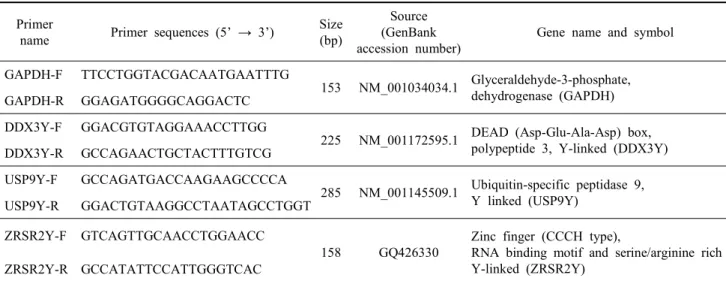
The transcripts of ZRSR2Y, USP9Y and DDX3Y genes were analyzed for expression of ccffRNA in the maternal plasma and normalized to glyceraldehyde-3-phosphate dehydrogenase (GAPDH) using the Ct method. The details of all the primers used in this present study are outlined (Table 1).

Quantitative real-time polymerase chain reaction (PCR) was performed with iQ

TM

SYBR Green Supermix (Bio-Rad Labora- tories, Hercules, CA, USA) using MyiQ

TM

2 thermocycler and SYBR green detection system (Bio-Rad Laboratories). The real- time PCR conditions were 95 ℃for 10 min, then 50 cycles at 95 ℃, 30 sec; 57℃, 30 sec and 72℃, 30 sec.

4. Statistical Analysis

The efficiency of correct fetal sex determination and the calf sex at birth were compared statistically by chi-square test or Fisher exact test. Contingency tables were suited to real-time PCR fetal gender assignment and phenotypic sex at birth to calculate sensitivity, specificity, male predictive value (MPV), female predictive value (FPV) and accuracy. Sensitivity was de- fined as the number of males correctly identified by real-time PCR examination, divided by the total of males at birth. Speci- ficity was the number of females correctly identified by real- time PCR examination, divided by the total of females at birth.

Male predictive value was calculated as the number of male

fetuses correctly diagnosed divided by the total (true and erro-

neous) male diagnoses. Female predictive value was calculated

as the number of female fetuses correctly diagnosed divided

by the total (true and erroneous) female diagnoses. Accuracy

was the proportion of males and females that were correctly

identified (Quintela et al., 2012). Statistical significance was

(3)

Table 1. Primer sequences used for real-time PCR experiment

Primer

name Primer sequences (5’ → 3’) Size (bp)

Source (GenBank accession number)

Gene name and symbol

GAPDH-F TTCCTGGTACGACAATGAATTTG

153 NM_001034034.1 Glyceraldehyde-3-phosphate, dehydrogenase (GAPDH)

GAPDH-R GGAGATGGGGCAGGACTC

DDX3Y-F GGACGTGTAGGAAACCTTGG

225 NM_001172595.1 DEAD (Asp-Glu-Ala-Asp) box, polypeptide 3, Y-linked (DDX3Y)

DDX3Y-R GCCAGAACTGCTACTTTGTCG

USP9Y-F GCCAGATGACCAAGAAGCCCCA

285 NM_001145509.1 Ubiquitin-specific peptidase 9, Y linked (USP9Y)

USP9Y-R GGACTGTAAGGCCTAATAGCCTGGT

ZRSR2Y-F GTCAGTTGCAACCTGGAACC

158 GQ426330

Zinc finger (CCCH type),

RNA binding motif and serine/arginine rich 2, Y-linked (ZRSR2Y)

ZRSR2Y-R GCCATATTCCATTGGGTCAC

considered at P<0.05 significance level. All the statistical analy- ses were performed using GraphPad Instat (version 3.05).

RESULTS

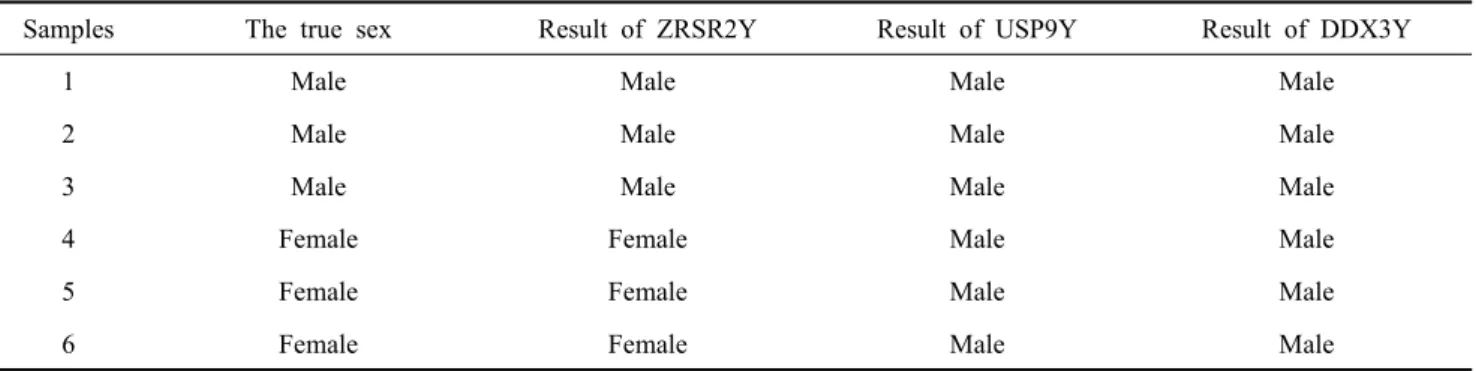
In this study, transcripts of gene ZRSR2Y, USP9Y and DDX3Y were expressed both the control group and the experi- mental group. There was amplification in all samples for trans- cripts of GAPDH qPCR demonstrating 100% efficiency of ccffRNA extraction. In ZRSR2Y gene, there was 100% accor- dance between the sex of the control group identified by the molecular testing and the true sex. However, transcripts of gene USP9Y and DDX3Y were expressed regardless of gender (Fig.

1 and Table 2). Furthermore, there was a strong relationship between the possibility of correct sex determination and the calf sex at birth using transcripts of ZRSR2Y gene in the experi- mental group (p = 0.0013). But, prediction of fetal gender using transcripts of USP9Y and DDX3Y genes were not considered significantly (p = 1.000).

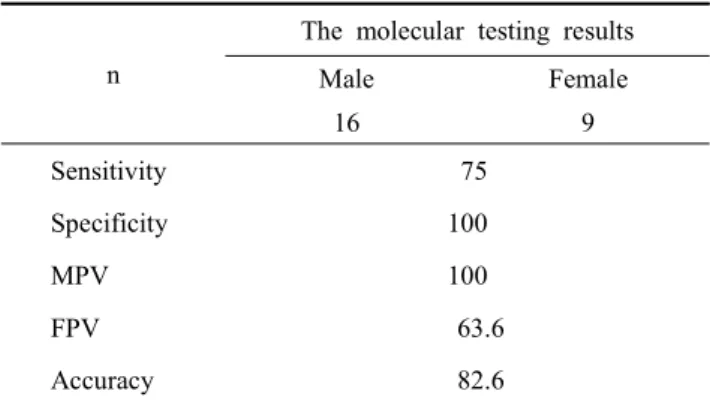
Transcripts of ZRSR2Y gene had an accuracy of 82.6% (19/

23), and a sensitivity of 75%, it correctly identified 12 of 16 male fetuses, whereas the specificity was 100%, all 7 female fetuses were correctly identified. And male and female predic- tive values were 100% and 63.6%, respectively (Table 3).

DISCUSSION

Many researches agreed that the placenta is a predominant source of the circulating fetal DNA in the maternal plasma

(Bianchi, 2004). During pregnancy, placental membrane sepa- rates the maternal and fetal circulations. However, ccffDNA can cross the placental membrane by the destruction of fetal cells result from the interaction between regulated apoptosis of fetal cells and the maternal immune system (Bianchi, 2004; de Leon et al., 2012).

In ruminants, the structure of placenta is different compared with human. Bovine species has a synepitheliocorial placenta which has no direct contact between the trophoblast and the maternal blood (Wooding, 1992). Furthermore, Poon et al.

(2000) reported that the detection of fetal RNA in maternal plasma is quiet difficult because of the low amount of fetal RNA. For that reason, our study is performed by real-time qPCR because it has a large dynamic range of over five orders of magnitude and a sensitive detection rate of very low copy numbers of nucleic acids (Heid et al., 1996; Finning and chitty, 2008).

In the present study, the Y-linked gene of ZRSR2Y, USP9Y and DDX3Y were examined in maternal plasma to determine the existence and consistency of their expression and to verify which genes may represent good candidates for sex determi- nation especially in the RNA-based gene expression studies.

Transcripts of the ZRSR2Y, USP9Y and DDX3Y genes were

expressed in the plasma of the control group and the experi-

mental group. However, only transcript of ZRSR2Y gene was

matched up with the molecular testing and the true sex in

control group, whereas transcripts of USP9Y and DDX3Y genes

were expressed in the all plasma of males and females both

the control group and the experimental group. Several studies

(4)

Table 2. Accordance between the sex of molecular testing and the true sex by ZRSR2Y, USP9Y and DDX3Y genes using real-time PCR in control group

Samples The true sex Result of ZRSR2Y Result of USP9Y Result of DDX3Y

1 Male Male Male Male

2 Male Male Male Male

3 Male Male Male Male

4 Female Female Male Male

5 Female Female Male Male

6 Female Female Male Male

Fig. 1. Genes amplification plot of male genomic RNA as a positive control (squares) and female genomic RNA as a negative control (triangles) : (A) amplification plot GAPDH; (B) amplification plot ZRSR2Y; (C) amplification plot USP9Y; (D) amplification plot DDX3Y.

have reported the extraction of nucleic acids from maternal pla- sma for fetal sex determination using real-time PCR in various animals. Khorram Khorshid et al. (2013) used the SRY, DYS14 and DAZ genes for fetal gender determination in the first trimester of pregnancy in human. Their results showed that sensitivity and specificity were 97.3% and 97.3%, respectively.

Jimenez et al. (2003) reported that fetal sex prediction in rhesus monkeys has 100% sensitivity and no false-positive results. And de Leon et al. (2012) detected the SRY gene from extracted nucleic acids in blood plasma of pregnant mares.

They confirmed that sensitivity and specificity were 90.9% and

95%, respectively. Similarly, Kadivar et al. (2013) used the

circulating cell free fetal nucleic acids in ewe blood plasma to

determine fetal sex using real-time PCR assay. Their results

reported that the sensitivity and specificity were 100% and no

false negative or false positive results. In the present study,

transcripts of ZRSR2Y gene showed that an overall accuracy

and sensitivity and specificity were 82.6%, 75% and 100% in

experimental group, respectively. Hence, this result suggested

that there was some possibility to influence the rate of gene

(5)

Table 3. Sensitivity, specificity, male predictive value (MPV), fe- male predictive value (FPV) and accuracy of fetal sexing by real-time PCR method using ZRSR2Y gene

n

The molecular testing results

Male Female

16 9

Sensitivity 75

Specificity 100

MPV 100

FPV 63.6

Accuracy 82.6

expression. Hamilton et al. (2012) reported that primer selec- tion is obviously an important consideration. Their results showed that there were practical differences in expression, even though different pairs of primers were targeting the same gene, but different regions. Also, Revil et al. (2010) suggested that there is an excessive expression of genes that seems to be required for proper development.

To our knowledge, this is the first investigation demonstra- ting the existence of ccffRNA in plasma of pregnant cows for fetal sex determination. Although our study has less accuracy and sensitivity compared with prior studies, this discovery pro- vides a novel potentiality for prenatal fetal sex determination of ccffRNA with non-invasive process and an opportunity for detecting genetic diseases by expression of transcripts of target genes. Therefore, we are planning to choice the correct target sequence for selection of optimal primer to increase the sensi- tivity and the accuracy of the gene for further study. Also, we intend to confirm the correct detection point of ccffRNA in maternal plasma of pregnant cows, and measure the quantita- tive changes of ccffRNA during pregnant period in maternal plasma.

In conclusion, our results confirmed that the real time PCR technique, as a noninvasive and cost-efficient method, is possi- ble to determination fetal sex in the bovine species using cir- culating cell free RNA in maternal plasma and ZRSR2Y gene might be a good candidate for the RNA based sex determi- nation work.

REFERENCES

Ali A. 2004. Effect of gestational age and fetal position on the

possibility and accuracy of ultrasonographic fetal gender determination in dairy cattle. Reprod. Dom. Anim. 39: 190- 194.

Bianchi DW. 2004. Circulating fetal DNA: its origin and diag- nostic potential-a review. Placenta 25: S93-101.

da Cruz AS, Silva DC, Costa EO, De M-Jr P, da Silva CC, Silva DM and da Cruz AD. 2012. Cattle fetal sex deter- mination by polymerase chain reaction using DNA isolated from maternal plasma. Anim. Reprod. Sci. 131: 49-53.

de Leon PM, Campos VF, Dellagostin OA, Deschamps JC, Seixas FK and Collares T. 2012. Equine fetal sex determi- nation using circulating cell-free fetal DNA (ccffDNA). The- riogenology 77: 694-698.

Finning KM, Chitty LS. 2008. Non-invasive fetal sex determi- nation: impact on clinical practice. Semin. Fetal. Neonatal.

Med. 13: 69-75.

Hamilton CK, Combe A, Caudle J, Ashkar FA, Macaulay AD, Blondin P and King WA. 2012. A novel approach to sexing bovine blastocysts using male-specific gene expression. The- riogenology 77: 1587-1596.

Heid CA, Stevens J, Livak KJ and Williams PM. 1996. Real time quantitative PCR. Genome Res. 6: 986-994.

Jimenez DF and Tarantal AF. 2003. Fetal gender determina- tion in early first trimester pregnancies of rhesus monkeys (Macaca mulatta) by fluorescent PCR analysis of maternal serum. J. Med. Primatol. 32: 315-319.

Kadivar A, Hassanpour H, Mirshokraei P, Azari M, Gholam- hosseini K and Karami A. 2013. Detection and quantifica- tion of cell-free fetal DNA in ovine maternal plasma; use it to predict fetal sex. Theriogenology 79: 995-1000.

Khorram Khorshid HR, Zargari M, Sadeghi MR, Edallatkhah H, Shahhosseiny MH and Kamali K. 2013. Early fetal gen- der determination using real-time PCR analysis of cell-free fetal DNA during 6th-10th weeks of gestation. Acta. Med.

Iran. 51: 209-214.

Lo YMD, Corbetta N, Chamberlain PF, Rai V, Sargent IL, Redman CWG. 1997. Presence of fetal DNA in maternal plasma and serum. Lancet 350: 485-487.

Lo YMD, Tein MSC, Lau TK, Haines CJ, Leung TN, Poon PMK. 1998. Quantitative analysis of fetal DNA in maternal plasma and serum: implications for noninvasive prenatal dia- gnosis. Am. J. Hum Genet. 62: 768-775.

Poon LL, Leung TN, Lau TK and Lo YM. 2000. Presence of fetal RNA in maternal plasma. Clin. Chem. 46:1832-1834.

Quintela LA, Barrio M, Peña AI, Becerra JJ, Cainzos J, Herra-

(6)

dón PG and Díaz C. 2012. Use of ultrasound in the repro- ductive management of dairy cattle. Reprod. Domest. Anim.

47: 34-44.

Revil T, Gaffney D, Dias C, Majewski J and Jerome-Maje- wska LA. 2010. Alternative splicing is frequent during early embryonic development in mouse. BMC Genomics. 11:

399.

Shea, BF. 1999. Determining the sex of bovine embryos using

polymerase chain reaction results: a six year retrospective study. Theriogenology 51: 841-845.

Wooding FBP. 1992. Current topic: the synepitheliochorial pla- centa of ruminants: binucleate cell fusions and hormone production. Placenta 13: 101-113.

( 접수: 2013. 12. 06/ 심사: 2013. 12. 07/ 채택: 2013. 12. 18)

수치

Table  1.  Primer  sequences  used  for  real-time  PCR  experiment
Fig.  1.  Genes  amplification  plot  of  male  genomic  RNA  as  a  positive  control  (squares)  and  female  genomic  RNA  as  a  negative  control  (triangles)  :  (A)  amplification  plot  GAPDH;  (B)  amplification  plot  ZRSR2Y;  (C)  amplification
Table  3.  Sensitivity,  specificity,  male  predictive  value  (MPV),  fe-  male  predictive  value  (FPV)  and  accuracy  of  fetal  sexing  by  real-time  PCR  method  using  ZRSR2Y  gene

참조

관련 문서