Journal of the Ergonomics Society of Korea
Vol. 31, No. 2 pp.291-298, April 2012 http://dx.doi.org/10.5143/JESK.2012.31.2.291
ACT-R Predictive Model of Korean Text Entry on Touchscreen
Sooyong Lim
1, Seongsik Jo
1, Rohae Myung
1, Sang-Hyeob Kim
2, Eun-Hye Jang
2, Byoung-Jun Park
21
School of Industrial Management Engineering, Korea University, Seoul, 136-713
2
BT Convergence Technology Research Department, Electronics and Telecommunications Research Institute, Daejeon, 305-700
ABSTRACT
Objective: The aim of this study is to predict Korean text entry on touchscreens using ACT-R cognitive architecture.
Background: Touchscreen application in devices such as satellite navigation devices, PDAs, mobile phones, etc. has been increasing, and the market size is expanding. Accordingly, there is an increasing interest to develop and evaluate the interface to enhance the user experience and increase satisfaction in the touchscreen environment. Method: In this study, Korean text entry performance in the touchscreen environment was analyzed using ACT-R. The ACT-R model considering the characteristics of the Korean language which is composed of vowels and consonants was established. Further, this study analyzed if the prediction of Korean text entry is possible through the ACT-R cognitive model. Results: In the analysis results, no significant difference on performance time between model prediction and empirical data was found. Conclusion:
The proposed model can predict the accurate physical movement time as well as cognitive processing time. Application: This study is useful in conducting model-based evaluation on the text entry interface of the touchscreen and enabled quantitative and effective evaluation on the diverse types of Korean text input interfaces through the cognitive models.
Keywords: ACT-R, Cognitive architecture, Model-based evaluation, Korean text entry, Visual search pattern
1. Introduction
1.1 Overview
터치스크린은 사용자와 시스템과의 상호작용에서 Stylus 나 사람의 손가락을 이용해 직관적으로 조작할 수 있기 때 문에 사용 방법이 간단하다는 장점이 있으며 넓은 디스플레 이 영역의 확보가 가능하다는 특징이 있다. 따라서 차량의 위성 내비게이션 장치나 PDA, 휴대폰과 같은 기기에서 터 치스크린의 적용이 늘어나고 있으며, 시장 규모도 확대되고 있는 추세이다. 따라서 스마트폰에서 인터넷을 통해 정보를
검색하고 SMS(Short Message Service)를 입력하거나, 운 전 시에 내비게이션 장치를 통해 목적지를 입력하는 행동과 같이 터치스크린에서 문자를 입력하는 인간의 행동 양식에 대한 관심이 증대되고 있다. 또한 이를 통해 터치스크린 환 경에서 사용자의 편리를 도모하고 만족도를 높이기 위한 인 터페이스의 개발 및 평가와 관련하여 연구가 진행되고 있다.
한편, 데스크톱 환경에서 양손을 사용해 문자를 입력하는 Hard-keyboard는 QWERTY 배열이 실제적인 산업표준 으로 사용되고 있기 때문에 그 외의 키보드 배열 연구에 제한이 있었다. 휴대폰 등에서 사용되는 12개의 버튼으로 구성된 Keypad에는 영문을 입력하기 위한 인터페이스가 크
Corresponding Author: Rohae Myung. School of Industrial Management Engineering, Korea University, Seoul, 136-713.
Phone: 02-3290-3392, E-mail: [email protected]
Copyright@2012 by Ergonomics Society of Korea(pISSN:1229-1684 eISSN:2093-8462). All right reserved.
○ccThis is an open-access article distributed under the terms of the Creative Commons Attribution Non-Commercial License(http://creativecommons.org/licenses/by-nc/3.0/), which permits unrestricted non-commercial use, distribution, and reproduction in any medium, provided the original work is properly cited.
게 Multi-press Input Method, Two-key Input Method, T9 Input Method의 세 가지로 존재하며 각 인터페이스 에 대한 평가 연구는 Silfverberg에 의해 수행된 바 있다 (Silfverberg et al., 2000). Silfverberg는 영문 입력에 관 한 인터페이스 평가를 위해 버튼 상에서의 Fitts' Law를 도 출하고, 물리적인 입력 시간을 산출함으로써 인터페이스를 비교, 평가하였다. 이뿐만 아니라 Keypad에서 초보자와 전 문가의 수행도를 나타내는 Model-based Evaluation이 이 루어지기도 했다(Pavlovych & Stuerzlinger, 2004; Das &
Stuerzlinger, 2007; Amant et al., 2007). 이와 마찬가지로 Keypad에서 한글 입력 인터페이스를 평가하기 위한 연구는 Keystroke Level Model을 통해 이루어진 바 있다(Myung, 2004).
그러나 터치스크린 상에서 문자를 입력하는 Soft- keyboard에서는 터치스크린의 넓이나 각 키의 크기, 배열 방식에 대한 표준이 정해져 있지 않기 때문에 다양한 키 배열 방식이 제안되었다. 대표적으로 'FITALY Keyboard' (TextwareSolution, 1998)는 영어 단어의 사용 빈도수를 고려하여 가장 자주 쓰이는 알파벳을 가운데 배열함으로써 물리적 입력 시간을 최소화시키고자 하였다. 한글 Soft- keyboard에서도 유전자 알고리즘을 이용하여 알고리즘에 따라 키 배열을 생성함으로써 기존의 한글 자판보다 효과적 인 입력을 가능하게 한 인터페이스가 개발되었다(Kang &
Han, 2001). Kong(Kong et al., 2009)은 터치스크린 상에 서 한글을 입력할 시에 물리적 이동 시간 뿐만 아니라 인지 적 처리 시간을 고려한 키 배열을 제안하였다. Kong은 Das 와 Stuerzlinger(2007)가 제안한 인지적 시간을 고려하였 는데 탐색 및 선택을 위한 인지적 시간은 총 수행 시간에서 해당 작업에 대한 물리적인 이동 시간을 뺀 값으로 산출될 수 있었다.
한편 현재까지 다양한 연구에서 ACT-R(Byrne &
Anderson., 1997; Byrne, 2001; Anderson et al., 2004) 이나 GOMS(Card et al., 1983; John & Kieras, 1996a, 1996b)와 같은 Cognitive Modeling을 이용해서 다방면에 서 인터페이스에 대한 평가가 이루어지고 있다(Amant et al., 2004; John et al., 2004; Luo & John., 2005; Das &
Stuerzlinger, 2007). 이와 같은 Model-based Evaluation 은 피실험자를 선발하고 훈련시키는 과정을 거치지 않고서 도 정량적인 평가가 가능하기 때문에 다양한 크기와 키 배 열을 가지는 Soft-keyboard의 평가가 인터페이스 개발 초 기에 가능하고, 이를 통해 시스템 개발이 지연되는 문제점을 보완할 수 있다. 또한 인간의 지각, 인지, 행동 과정을 세부 적으로 모의할 수 있다는 장점이 있어 인터페이스에 대한 부분적인 평가가 가능하다.
따라서 본 연구에서는 Cognitive Architecture 중에서도
인간의 행동을 비교적 낮은 수준의 세부 행위까지 묘사할 수 있고 정량적인 예측이 가능하다고 평가되는 ACT-R을 이 용해 터치스크린에서의 한글 입력 수행도를 분석하고자 한 다. 본 연구의 목적은 한글 입력 구조에서 자음과 모음으로 이루어진 한글의 특성을 고려한 ACT-R 모델을 수립하고, 기존 피실험자를 대상으로 한 연구(Kong et al., 2009)와 비교해 ACT-R 모델을 통해 한글 입력에 대한 예측이 가능 한지를 연구하는데 있다. 이를 위해 Kong의 연구에서 제안 된 터치스크린에서의 Fitts' Law 계수를 산출하여 ACT-R 모델에 반영하였다. 또한 사용자가 자음과 모음을 입력함에 있어 시각적 영역을 구역화하여 시각적 주의를 기울이도록 하는 전략을 이용하여 모델을 수립하였다.
1.2 Korean text entry system (Hangul)
한글은 알파벳과 마찬가지로 자음과 모음으로 구성되어 있고, 14개의 자음과 5개의 쌍자음, 10개의 기본 모음과 11개의 합성 모음이 있다. 한글의 음소는 초성(자음) + 중 성(모음) + 종성(자음) 또는 초성(자음) + 중성(모음)으로 조합되며, 음소들이 모여서 하나의 단어를 구성하게 된다.
또한 좌에서 우로 알파벳을 써가는 영어와는 다르게 한글은 필법에 따라 모임이 자음 오른쪽('ᅡ', 'ᅣ', 'ᅥ', 'ᅧ', 'ᅵ') 또 는 아래 부분('ᅩ', 'ᅭ', 'ᅮ', 'ᅲ', 'ᅳ')에 쓰인다.
터치스크린 키 배열에 대한 Kong의 연구에서는 모음의 위치에 대한 특성을 고려하였다. 자음은 좌측 상단에 위치하 도록 하고 자음의 오른쪽으로 향하는 모음은 인터페이스의 우측에 배치하고 아래로 향하는 모음을 인터페이스 하단에 분리하는 배치 방식을 고려하였다. 이를 통해 모음 선택에 있어서 대안의 수를 줄이고 선택 시간과 어려움을 줄일 수 있었다. 이와 같은 기존 연구를 바탕으로 본 연구에서는 터 치스크린 인터페이스에서의 물리적 이동 시간과 한글 모음 의 특성을 고려한 한글 입력 ACT-R 모델을 수립할 수 있 었다.
2. Method
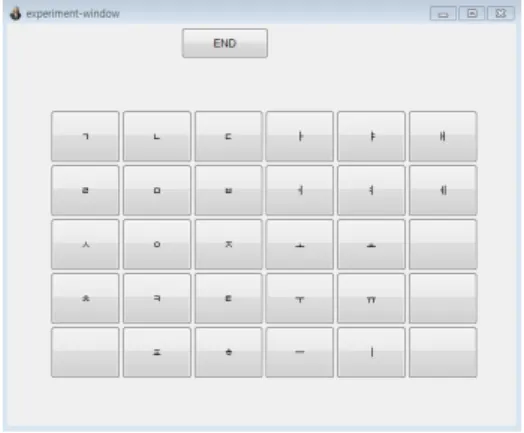
본 연구에서는 자음 3열과 모음 3열로 구성하고 자음과 모음 모두 한글 창제 순으로 배열한 인터페이스 1(Figure 1)과 모음을 오른쪽 2열과 아래쪽 1행으로 분리하여 배치 하고 자음은 한글 창제 순으로 배치한 인터페이스 2(Figure 2) 각각에 대해 수행도를 예측하는 모델을 수립하였고, 이를 기존의 연구 결과(Kong et al., 2009)인 피실험자의 Data 와 비교, 분석하였다. 본 연구에서는 Kong의 연구와 같이
10가지의 과제('당고개', '속리산', '야유회', '카센터', '중부고 속도로', '서울대공원', '판교신도시', '안녕하세요', '고맙습니다', '축하합니다')에 대해서 입력 시간을 예측하는 모델을 수립 하였다.
2.1 Fitts' law model for Korean text entry on touch- screen
Fitts' Law는 인터페이스에서 인간의 물리적 이동 시간을 예측하는 법칙으로 그 중 가장 대표적인 수식은 다음과 같다 (Fitts, 1954).
MT = a + b·log2(A/W + 1) (1)
여기서 A는 Target간의 거리(Amplitude)이고 W는 Target의 폭(Width)을 나타내고 로그 부분은 ID(Index of Difficulty)라고 하며 ID가 증가하는 것은 과제 수행에 필요한 정보의 양이 많아지는 것을 의미한다.
MT = a + b·ID (2)
계수 a와 b는 Device(keypad, keyboards)나 인터페이 스의 Interaction Style에 따라서 실증적으로 결정될 수 있 고, ACT-R의 Motor Module은 마우스 작업 시의 Fitts' Law 계수(a=0.1s, b=0.1s)를 적용하고 있다. 그러나 터치 스크린에서는 버튼간 이동을 위해서 직접 손을 움직여야 하 기 때문에 손의 물리적인 움직임이 많고 반응 시간 및 입력 속도가 상대적으로 느리다는 특징이 있다(Zhai et al., 2000).
따라서 터치스크린 상에서의 버튼 입력을 위한 Fitts' Law 계수 값의 조정이 필요하다. 따라서 Kong의 연구에서 이용 된 터치스크린 인터페이스에서의 버튼간 Fitts' Law를 도출 하기 위한 실험을 진행하였다.
6명의 피실험자(남자 5명, 여자 1명, 평균 28.5세)가 실 험에 자발적으로 참가하였으며 모두 대학원생이고 오른손잡 이였다. Kong의 연구에서 사용된 5행 6열 구조의 터치스크 린 인터페이스를 실험에 적용하였으며 각 버튼의 크기는 가 로 20mm, 세로 15mm였다.
Fitts' Law는 1차원에서의 물리적 움직임을 표현하는 공 식이기 때문에 터치스크린에서의 버튼간 물리적 이동 시간 과 같이 2차원적인 배열에서 적용할 수 있도록 Fitts' Law 의 확장이 필요하다. Mackenzie와 Buxton(1992)의 연구에 의하면 2차원에서의 Target의 크기(W)를 높이와 폭 중 작 은 길이를 선택하도록 하고 있다. 따라서 버튼의 크기(W)를 폭(20mm)으로 설정하여 Equation 1에 대입하여 버튼의 조합에 따른 ID 값을 산출하였다. 또한 실험을 통하여 버튼 의 조합별 평균 입력 시간을 산출할 수 있었으며 산출된 ID 와 평균 입력 시간과의 회귀분석을 실시한 결과, ID와 입력 시간은 Equation 2와 같이 선형의 관계를 가지는 것으로 나 타났다(r2=0.924)(Figure 3).
이를 통해 Fitts' Law가 터치스크린 상에서 입력 시간 예 측에 적용될 수 있음을 확인할 수 있고 입력 시간을 도출하 는 공식은 다음과 같다.
MT = 0.152 + 0.129·log2(A/W + 1) (3)
2.2 Model hypothesis for visual search strategy
터치스크린에서의 문자 입력과 같이 간단하고 고도로 익 숙한 과제일 경우 시각적 탐색 과정이 버튼 하나하나에 주 의를 주는 Exhaustive Search(Nilsen, 1991)보다는 자음 과 모음의 상대적인 위치를 구역화하여 그 구역 안에서 주 의를 옮기는 전략을 통해 찾고자 하는 버튼과 Declarative Memory에 저장되어 있는 값을 비교하는 Production Rule 을 구성하였다. 즉, 누르고자 하는 버튼을 비롯한 인접한 Figure 2. Interface 2
Figure 1. Interface 1
버튼에 대해 무작위로 하나의 버튼에 주의를 옮기고, 찾고자 하는 버튼과 일치하지 않으면 다시 시각적 주의를 이동하도 록 하여, 한 글자를 찾기 위해서는 최대 2번의 시각적 탐색 이 이루어지도록 하였다. 이는 첫째로 한글 입력이 음소 하 나로 구성된 버튼을 누르는 단순한 작업이기 때문에 메뉴 구조에서 단어 또는 문장으로 표현된 목표 메뉴를 찾는 과제 보다 단순하다고 볼 수 있기 때문이다. 터치스크린에서 메뉴 를 탐색하는 과제에 대해서 ACT-R 인지 모델을 통해 예측 한 연구(Min et al., 2010)에서도 시각적 주의를 이동하는 전략이 세로 형태의 메뉴 두 개를 한꺼번에 인식할 수 있도 록 하였다. 또한 두 인터페이스에서 한글의 배치는 자음과 모음이 분리 배치되어 있을 뿐 창제 순으로 구성되어 있기 때문에 사용자가 과제를 수행할 때 버튼의 대략적인 위치를 유추할 수 있다. 따라서 ACT-R 모델의 시각적 탐색 과 정은 목표 버튼과 인접한 버튼 중 무작위로 하나의 버튼에 시각적 주의를 이동하고 주의가 이동된 버튼을 확인하는 Encoding 과정으로 이루어진다.
2.3 Procedures
본 연구의 ACT-R 모델은 실제 피실험자가 한글을 입력 하는 패턴대로 자음과 모음의 영역으로 분리하여 시각적 주 의를 기울이는 전략을 구성하였다. 한글을 입력하는 과제를 수행할 때 사용자는 하나의 음소를 구성하는 자음과 모음 을 동시에 생각하기 때문에, ACT-R 모델의 Declarative Memory에 음소를 구성하는 자음과 모음의 조합과 순서를 미리 저장해 두었다. 이를 바탕으로 ACT-R 모델은 자음 또는 모음이 입력되는 절차에 따라 시각적 영역을 옮기면서 주의를 기울이고 주의를 기울인 곳의 글자가 Declarative Memory에 저장된 입력해야 할 순서의 글자와 일치할 경우 주의를 기울인 곳으로 손을 이동하는 동시에 다음 글자에 대 한 기억을 인출을 병렬적으로 수행하게 된다.
모델을 구성하는 Production Rule은 다음과 같다.
1. Start: 모델을 시작하기 위해 해당 과제의 음소들을 Declarative Memory에서 인출.
IF the goal is to find a target THEN retrieve target letter.
2. Search-Button: Declarative Memory에서 인출된 입 력해야 할 자음 또는 모음의 인접 위치로 탐색.
IF the goal is to find a target, and target letter retrieved
THEN search an unattended letter adjacent to the target button
3. Move-Attention: 시선이 옮겨간 자리로 시각적 주의 를 이동.
IF the goal is to find a target, and there is an unattended object the current location
THEN move visual attention to the current location
4. Encode-False: 만약 시각적 주의를 옮겨 확인한 버튼 이 Declarative Memory에서 인출한 글자와 다를 경 우 인접 위치로 주의를 이동.
IF the goal is to find a target,
and there are differences between the value at visual buffer chunk and declarative buffer chunk
THEN search an unattended target button
5. Encode-True: 시각적 주의를 옮긴 버튼과 Declara- tive Memory에서 인출한 글자가 같을 경우 시각적 주의가 옮겨진 곳으로 손을 이동시키면서 동시에 다 음 음소를 Declarative Memory에서 인출.
IF the goal is to find a target,
and the value at visual buffer chunk and declarative buffer chunk are same THEN move hand to the location where
visual attention shifted, and think next button to look at
6. Search-End: 다음 버튼에 대한 Declarative Memory 가 더 이상 존재하지 않을 경우 과제 종료.
IF the goal is to find a target, and no other buttons to retrieve any more THEN finish the task Figure 3. Relationships between ID and time
3. Results
실제 피실험자를 중심으로 한 Kong의 연구에서의 수행 시간과 인지 모델의 예측 값을 비교하기 위해서 회귀 분석이 수행되었다. Gluck과 Pew(2005)에 따르면, 인지 모델과 피 실험자의 결과를 통계적으로 비교할 때 전통적인 가설 검정 방법은 적합하지 않다고 보면서 그 대안으로 인지 모델의 적 합도를 고려해야 한다고 주장하였다. 이를 위해 모델과 피실 험자의 결과 간 경향의 적합도를 산정하기 위해서 r2를 계산 하였고 정확한 대응의 정도를 산정하기 위해서 RMS(Root Mean Square)를 계산하였다.
인터페이스 별로 모델 예측 값과 데이터를 회귀 분석한
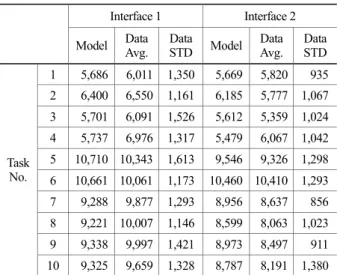
결과 r2 값이 두 종류의 인터페이스에서 0.938과 0.967로 모델 예측 값과 피실험자의 데이터 간에 높은 상관관계가 있 음이 나타났다. 이를 통해 ACT-R 모델이 전체 수행 시간 과 각 과제별 수행 시간에서 피실험자의 행동 양식을 정확 히 묘사하고 있음을 확인할 수 있다(Figure 5, Figure 6).
또한 물리적 이동 시간인 Fitts' Time을 분석한 결과 전체 수행 시간의 약 50% 를 차지하는 것으로 나타났으며, 이는 단순한 한글 입력 과정이라고 할지라도 인지적 시간이 차지 하는 비중이 높음을 확인할 수 있다(Figure 7).
Table 1. Comparison of performance time(msec) Interface 1 Interface 2 Model Data
Avg. Data
STD Model Data Avg. Data
STD 1 5,686 6,011 1,350 5,669 5,820 935 2 6,400 6,550 1,161 6,185 5,777 1,067 3 5,701 6,091 1,526 5,612 5,359 1,024 4 5,737 6,976 1,317 5,479 6,067 1,042 5 10,710 10,343 1,613 9,546 9,326 1,298 6 10,661 10,061 1,173 10,460 10,410 1,293 7 9,288 9,877 1,293 8,956 8,637 856 8 9,221 10,007 1,146 8,599 8,063 1,023 9 9,338 9,997 1,421 8,973 8,497 911 Task
No.
10 9,325 9,659 1,328 8,787 8,191 1,380 Figure 4. Process of ACT-R model
Figure 5. Graph of the results interface 1
Figure 6. Graph oh the results interface 2
Figure 7. Comparison between empirical, model and Fitts' time Figure 6. Graph oh the results interface 2
4. Discussion
본 연구에서는 터치스크린 인터페이스에서 한글을 입력할 때의 사용자의 행동 양식을 묘사할 수 있는 ACT-R 모델을 수립하였다. 자음과 모음이 한글 창제 순으로 구성된 인터페 이스 1에서와 모음이 옆 모음과 아래 모음으로 배치된 인터 페이스 2 모두 ACT-R 모델이 기존 피실험자를 바탕으로 한 연구의 데이터와 유사한 결과가 도출되었다. ACT-R Cognitive Architecture에서는 마우스를 이용한 Fitts' Law 계수를 적용하기 때문에 터치스크린 인터페이스에서 실험으 로 도출된 Fitts' Law 계수를 수정하여 적용하였다. 그 결과 물리적 이동 시간인 Fitts' Time과 모델이 유사한 수행 양식 을 보이는 것을 확인할 수 있다(Figure 5, Figure 6).
또한 자음과 모음이 한글 창제 순으로 배열된 인터페이스 1보다 자음은 창제 순으로, 모음은 옆 모음과 아래 모음으로 분리 배치한 인터페이스 2에서 더 좋은 수행 시간을 보였고, 모델 결과에서도 이를 찾아 볼 수 있다(Figure 7). 이는 원 하는 모음을 찾는데 있어서 대안의 수를 줄임으로써 선택 시간을 줄일 수 있었기 때문으로 분석된다. 모음 12개가 전 부오른쪽에 배치될 경우보다 옆 모음과 아래 모음으로 분 리하였을 때 옆 모음은 7개이고 아래 모음은 5개가 되어 상 대적으로 적은 대안의 개수로 그 선택 시간이 줄어든다는 점 에서 대표적 선택-반응 이론인 Hick-Hyman Law(Hick, 1952; Hyman, 1953)와도 부합한다.
본 연구의 ACT-R 모델은 시각적 주의를 기울임에 있어 서 물체 하나 하나에 주의를 기울이는 Exhaustive Search 로 시각적 탐색을 수행하지 않고 목표 주위를 구역화하여 시각적 주의를 이동하도록 하는 전략을 이용하였다. ACT-R Cognitive Architecture에서는 한번의 시각적 주의를 이동 하는데 소요되는 시간이 185msec로 고정되어 있다. 그러나 한글 자모음을 터치스크린에서 입력하는 상대적으로 익숙하 고 쉬운 과제에서 버튼에 대한 시각적 주의를 한 버튼에 한 번씩 옮기는 Exhaustive Search를 적용해 수행할 경우 피 실험자의 수행보다 시간이 오래 걸리는 결과가 도출되었다.
따라서 한글 입력과 같은 비교적 사용자에게 익숙하고 단 순한 작업에서는 사용자가 해당 버튼의 위치를 구역화하여 1~2번의 시각 탐색 후에 목표를 찾도록 하는 ACT-R 모델 을 구현한 것이 인간의 시각적 탐색 특성을 반영했다고 볼 수 있다.
5. Conclusion
본 연구에서는 ACT-R Cognitive Architecture를 이용 해 터치스크린과 같은 Soft-keyboard에서 사용자가 한글 을 입력하는 행동을 묘사하였다. 본 연구에서 제안된 한글 입력을 위한 ACT-R 모델은 터치스크린 상에서의 물리적 이동 시간을 산출해 반영하였고, 인간의 시각적 탐색을 반 영하여 수립되었다. 연구 결과, 한글의 고유한 문자적 특성 을 고려한 배열이 보다 효과적이라는 기존 연구의 결과를 ACT-R 모델이 적절히 표현하는 것으로 나타났다. 또한 각 인터페이스에서 ACT-R 모델이 사용자의 수행 시간을 정 확히 예측할 수 있었다. 이와 함께 전체적인 수행 시간에서 인지적 처리 시간이 비중이 높다는 분석을 통해 인터페이스 디자인 과정에서 단순한 물리적 이동 시간뿐만 아니라 인지 적 처리 과정 또한 고려하는 것이 필요하다. 본 연구는 터치 스크린에서 문자 입력을 위한 인터페이스에 대한 Model- based Evaluation이 이루어졌으며, 수립된 인지 모델을 통 해 다양한 형태의 한글 입력 인터페이스에 대한 정량적이고 효율적인 평가가 가능하다는 점에서 중요성을 가진다.
Acknowledgements
This research was supported by Basic Science Research Program through the National Research Foundation of Korea (NRF) funded by the Ministry of Education, Science and Technology (Grant No. 2011-0004349). This research was also supported by the Converging Research Center Program through the Converging Research Headquarter for Human, Cognition and Environment funded by the Ministry of Education, Science and Technology (No. 2011K000668).
References
Anderson, J. R., Bothell, D., Byrne, M. D., Douglass, S., Lebiere, C. & Qin, Y., An Integrated Theory of Mind, Psychological Review, 111, 1036 -1060, 2004.
Byrne, M. D. & Anderson, J. R., Enhancing ACT-R's Perceptual-Motor Abilities. In Proceedings of the Nineteenth Annual Conference of the Cognitive Science Society, Hillsdale, NJ: Lawrence Erlbaum Associates. 1997.
Byrne, M. D., ACT-R/PM and Menu Selection: Applying a Cognitive
Architecture to HCI, International Journal of Human-Computer Studies, Volume 55, Issue 1, 41-84, 2001.
Card, S. K., Moran, T. P. & Newell, A., The Psychology of Human- Computer Interaction, L. Erlbaum Associates, 1983.
Das, A. & Stuerzlinger, W., A Cognitive Simulation Model for Novice Text Entry on Cell Phone Keypads. In Proceedings of the ECCC 2007 Conference, London, UK, 28-31, 2007.
Fitts, P. M., The Information Capacity of the Human Motor Systems in Controlling the Amplitude of Movement. J. Exp. Psychology, 47(6), 381-391, 1954.
Hick, W. E., On the Rate of Gain of Information, Journal of Experimental Psychology, 4, 11-26, 1952.
http://act-r.psy.cmu.edu.
Hyman, R., Stimulus Information as a Determinant of Reaction Time, Journal of Experimental Psychology, 45, 423-432, 1953.
Ilinkin, I. & K, S., Design and Evaluation of Korean Text Entry Methods for Mobile Phones, In Human Factors in Computing Systems: CHI 2008 Conference Proceedings. New York, NY: ACM Press, 2008.
John, B. E. & Kieras, D. E., Using GOMS for User Interface Design and Evaluation: Which Technique?, ACM Transactions on Computer- Human Interaction, 3(4), 287-319, 1996a.
John, B. E. & Kieras, D. E., The GOMS Family of User Interface Analysis Techniques: Comparison and Contrast, ACM Transactions on Computer-Human Interaction, 3(4), 320-350, 1996b.
John, B. E., Prevas, K., Salvucci, D. D. & Koedinger, K., Predictive Human Performance Modeling Made Easy. In Human Factors in Computing Systems: CHI 2004 Conference Proceedings New York, NY: ACM Press, 455-462, 2004.
Kang, T. W. & Han, S. K., Genetic Algorithm for Korean Keyboard of Touchscreen Style, In Proceedings of the Korean Institute of Information Scientists and Engineering, 28(1B), 286-288, 2001.
Kong, B. D., Hong, S. K., Jo, S. & Myung, R., A Study of Korean Soft- Keyboards Layout for One Finger Text Entry. IE Interfaces, Vol. 22, No. 4, 329-335, 2009.
Luo, L. & John, B. E., Predicting Task Execution Time on Handheld Devices using the Keystroke-Level Model. In Human Factors in Computing Systems: CHI 2005 Conference Proceedings, ACM Press.
1605-1608, 2005.
Mackenzie, I. S. & Buxton, W., Extending Fitts' Law to Two-Dimensional Tasks. In Proceedings of CHI92. New York: ACM, 219-226, 1992.
Min, J., Jo, S. & Myung, R., Prediction of Menu Selection on Touch-screen using a Cognitive Architecture: ACT-R, Journal of the Ergonomics Society of Korea, 29(6), 1-8, 2010.
Myung, R., Keystroke-Level Analysis of Korean Text Entry Methods on Mobile Phones, International Journal of Human-Computer Studies, 60, 545-563, 2004.
Nilsen, E. L., Perceptual-Motor Control in Human-Computer Interaction.
Technical Report, No. 37, University of Michigan, Cognitive Science and Machine Intelligence Laboratory. 1991.
Pavlovych, A. & Stuerzlinger, W., Model for Non-Expert Text Entry Speed on 12-Button Phone Keypads, In Proceedings of the 2004 Conference
on Human Factors in Computing Systems, Vienna, Austria 2004, 351-358, 2004.
Silfverberg, M., MacKenzie, I. S. & Korhonen, P., Predicting Text Entry Speed on Mobile Phones. In Proceedings of the SIGCHI Conference on Human Factors in Computing Systems, 9-16, The Hague, The Netherlands, 2000.
St. Amant, R., Horton, T. E. & Ritter, F. E., Model-Based Evaluation of Cell Phone Menu Interaction. In Proceedings of the Conference on Human Factors in Computing Systems, 343-350, 2004.
St. Amant, R., Horton, T. E. & Ritter, F. E., Model-Based Evaluation of Expert Cell Phone Menu Interaction. ACM Transactions on Computer- Human Interaction, Vol. 14, No. 1, Article 1, 2007.
TextwareSolution., The FITALY one-finger keyboards, http://fitaly.com/
fitaly, 1998.
Zhai, S., Hunter, M., & Smith, B. A., The Metropolis Keyboard - An Exploration of Quantitative Techniques for Virtual Keyboard Design, In Proceedings of the UIST 2000, CHI Letters 2(2), ACM Press, 119-128, 2000.
Author listings
Sooyong Lim: [email protected]
Highest degree: BE in Department of Industrial System Information Engineering, Korea University
Areas of interest: HCI, Cognitive Modeling
Seongsik Jo: [email protected]
Highest degree: MS in Department of Mechanical Engineering, Auburn University
Areas of interest: HCI, Cognitive Modeling
Rohae Myung: [email protected]
Highest degree: Ph.D., Industrial Engineering, Texas Tech University Position title: Professor in School of Industrial Management Engineering, Korea University
Areas of interest: HCI, Cognitive Modeling
Sang-Hyeob Kim: [email protected]
Highest degree: Ph.D., Department of Apply Physics, Tohoku University Position title: Principle Member of Engineering Staff, BT Convergence Technology Research Department, Electronics and Telecommunications Research Institute
Areas of interest: Cognition Convergence, Emotion Recognition
Eun-Hye Jang: [email protected]
Highest degree: Ph.D., Department of Psychology, Chungnam National University
Position title: Researcher, BT Convergence Technology Research Department, Electronics and Telecommunications Research Institute Areas of interest: Cognition Convergence, Emotion Recognition
Byoung-Jun Park: [email protected]
Highest degree: Ph.D., Department of Electrical Engineering, Wonkwang University
Position title: Senior Member of Engineering Staff, BT Convergence Technology Research Department, Electronics and Telecommunications Research Institute
Areas of interest: Computational Intelligence, Pattern Recognition
Date Received : 2011-05-13 Date Revised : 2011-12-06 Date Accepted : 2011-12-12