198
섭입해양판의 탈수 및 탈수된 물의 거동 수치모델링: 선행 연구
이창열*
전남대학교 지구환경과학부
Numerical Modeling of Dehydration of Subducting Slab and Behavior of Expelled Water: A Preliminary Study
Changyeol Lee*
Faculty of Earth Systems and Environmental Sciences, Chonnam National University
요 약: 본 선행 연구에서는 섭입해양판의 탈수와 탈수된 물의 거동을 2차원 컴퓨터 수치모델링 하였다. 함수 광물을 포 함한 섭입해양판이 맨틀로 침강되면 온도와 압력이 증가함에 따라 함수 광물의 탈수가 발생, 상부에 위치한 맨틀 쐐기에 물을 공급한다. 탈수된 물의 거동은 맨틀 쐐기의 구석 유동과 맨틀 쐐기 내 광물의 공극을 따라 흐르는 공극 유동에 의 해 동시에 지배 받는다. 섭입해양판의 속도와 연령 그리고 광물 입자의 크기가 탈수된 물의 거동에 미치는 영향을 분석 하였다. 함수 광물이 포함된 해양 지각의 물의 용해도는 실험실에서 측정된 값을 근사 하여 사용하였다. 실험 결과는 대 부분의 함수 광물이 100 km 보다 얕은 깊이에서 탈수되며, 섭입해양판의 속도 및 연령은 탈수 및 탈수된 물의 거동에 크게 영향을 미치지 않음을 보였다. 광물 입자의 크기가 클수록 탈수된 물이 빠르게 맨틀 쐐기와 상부 대륙 지각을 거쳐 지표면으로 유출되므로 해양 지각, 맨틀 쐐기 그리고 상부 대륙 지각 내 물의 체적율이 광물 입자의 크기가 작은 다른 실험에 비하여 감소한다. 개발된 수치모델링 기법은 추가 개발을 통해 향후 호화산 연구에 활용될 예정이며 지진파 단층 도 등 타 분야 연구에도 활용될 수 있을 것으로 기대된다.
주요어: 섭입, 탈수, 공극 유동, 수치모델링
Abstract: In this preliminary study, dehydration of the subducting slab and behavior of the expelled water are numerically modeled using 2-dimensional model scheme. The hydrated minerals in the oceanic crust of the subducting slab experience dehydration by increases in temperature and pressure and expel their water into the overlying mantle wedge. Behavior of the expelled water is governed by both the corner flow in the mantle wedge and porous flow of the expelled water through the pores of the mantle minerals. The effects of convergence rate and age of the subducting slab as well as grain size of the minerals on the dehydration of the subducting slab and behavior of the expelled water are evaluated.
The water solubility of the oceanic crust measured from the laboratory experiments is considered for modeling dehydration of the oceanic crust. The model calculations show most of the hydrated minerals in the oceanic crust is dehydrated by a depth of 100 km and the effects of the convergence rate and age of the subducting slab on the dehydration of the subducting slab and behavior of the expelled water are not significant. The larger grain size allows faster porous flow of the expelled water through the oceanic crust, mantle wedge and overlying continental crust and reduces the volume fraction of the expelled water there. The developed technique will be used for future studies on arc volcanism and has a potential implication for the other fields such as seismic tomographic study.
Keywords: subduction, dehydration, porous flow, numerical modeling
서 론
섭입(subduction)은 태양계의 지구형 행성 중에서 오직 지구 에서만 발생하는 지구조(tectonic) 운동으로써 호화산(arc volcano) 및 지진을 발생시킨다. 또한 지구 면적의 1/3 정도를 차지하는 대륙 지각을 형성시킨 중요한 지구조 운동으로 여겨 져 왔다(Jagoutz and Kelemen, 2015). 호화산은 섭입해양판 (subducting slab)에서 탈수된 물이 맨틀 속에 유입되어 맨틀의 고상선(solidus)을 하강 시킴으로써 발생하는 유체유입용융 Received: 16 July 2018; Revised: 15 August 2018;
Accepted: 17 August 2018
*Corresponding author
E-mail: [email protected]
Address: 33 Yongbong-no, Bukgu, Gwangju 61186, Korea
ⓒ2018, Korean Society of Earth and Exploration Geophysicists
This is an Open Access article distributed under the terms of the Creative Commons Attribution Non-Commercial License (http://creativecommons.org/
licenses/by-nc/3.0/) which permits unrestricted non-commercial use, distribution, and reproduction in any medium, provided the original work is properly cited.
단 보
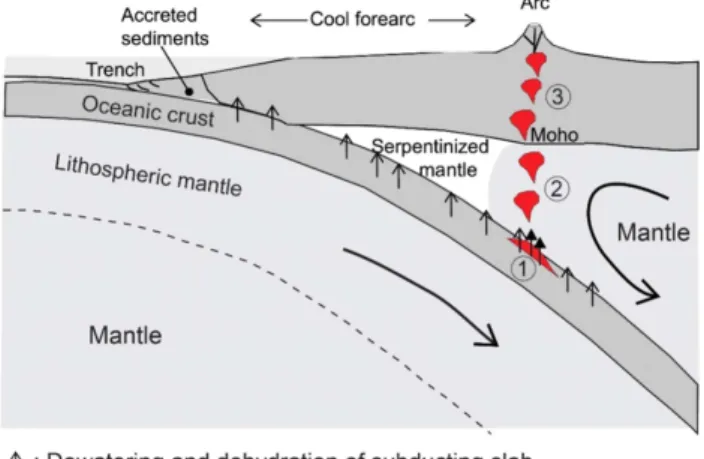
(flux melting)에 의해 형성된 마그마가 지표면에 분출되는 곳 으로 여겨진다(Grove et al., 2006; Hyndman and Peacock, 2003) (Fig. 1). 유체유입용융에 의하여 형성된 마그마는 부력 에 의하여 상승하여 맨틀 및 상부 지각과 혼염(assimilation) 및 분별 정출(fractional crystallization) 등에 의해 다양한 성분을 가진 마그마로 분화되어 지표면에 분출된다.
이처럼 호화산의 형성과 밀접한 맨틀의 유체유입용융을 이 해하기 위하여 섭입해양판에서 탈수된 물의 맨틀 내 거동에 대한 연구가 많은 관심을 받아 왔다. 현재까지 수행된 연구에 따르면, 섭입해양판은 맨틀로 침강하면서 온도와 압력이 증가 함에 따라 발생하는 함수 광물의 붕괴(breakdown)에 의해 함 수 광물 내 물을 주변으로 배출시킨다(Grove et al., 2006;
Hyndman and Peacock, 2003; Iwamori, 1998). 배출된 물의 거 동은 물과 주변 광물 입자 사이와의 밀도 차에 의한 부력 (buoyancy), 대류하는 맨틀에 의해 발생하는 압축(compaction) 및 동력학적 압력(dynamic pressure)에 따라 지배된다 (Iwamori, 1998; Wada and Behn, 2015; Wilson et al., 2014).
또한 암석 내에 이미 발달된 절리(joint) 등의 통로를 따라 물 이 흐르는 통로 유동(channelized flow)에 의해 거동 하는 것 으로도 알려졌다(Spiegelman et al., 2001).
맨틀 내부 물의 복잡한 거동을 정량적으로 이해하기 위하여 컴퓨터 수치모델링이 널리 활용되었다(e.g., Iwamori, 1998;
Wada and Behn, 2015; Wilson et al., 2014). 그럼에도 불구하 고 현재 국내에서 섭입해양판의 탈수 작용에 의해 배출된 물
의 맨틀 내 거동에 대한 연구는 미진하다. 과거 중생대 시기 한반도는 섭입 작용에 의해 다수의 호화산과 관입암체가 형성 되었기 때문에(Kim et al., 2016; Kim et al., 2012) 호화산 형 성에 대한 연구는 한반도 지구조사를 해석하는데 중요하다. 또 한, 백두산 및 추가령 일대에서 제 4기 화산 활동을 일으킨 마 그마가 상부 맨틀(upper mantle)의 전이대(transition zone)에 위치한 정체된 태평양판(stagnant Pacific plate)에서 탈수된 물 이 상부 맨틀에 유입되어 발생한 것이라는 연구 결과 (Sakuyama et al., 2014)는 한반도 화산 활동에서 유체유입용 융의 중요성을 암시한다. 그러므로 섭입해양판의 탈수 작용과 배출된 물의 맨틀 내 거동에 대한 정량적 연구는 한반도 지구 조 및 화산 활동 연구에 유용하게 활용될 수 있다.
본 연구에서는 섭입해양판의 탈수 및 탈수된 물의 거동을 정량적으로 해석하기 위하여 현재 개발 중인 컴퓨터 수치모델 링의 선행 연구 결과를 소개 한다. 섭입해양판의 탈수 및 탈수 된 물의 거동을 해석하기 위하여 맨틀과 물의 거동과 열에너 지를 동시에 해석해야 한다. 그러므로 본 연구에서는 유한요소 법(Finite Element Method, FEM) 기반 상용 수치해석 프로그 램인 콤솔 멀티피직스(COMSOL Multiphysics®)을 이용하여 맨틀과 물의 거동과 열에너지를 동시에 해석함으로써 섭입대 에서의 탈수 및 탈수된 물의 거동을 해석하였다.
실험 방법
지배방정식
본 연구에서 섭입해양판에서 탈수된 물은 섭입해양판의 해 양 지각과 상부에 위치한 맨틀 쐐기(mantle wedge)를 구성하 는 광물의 공극(pore)을 따라 거동하는 것으로 가정되었다. 탈 수된 물이 거동하는 맨틀 쐐기는 섭입에 의한 구석 유동에 의 해 대류 한다. 그러므로 탈수된 물의 공극 내 거동은 고체 상 태인 맨틀의 거동과 초임계 유체(supercritical fluid) 상태인 탈 수된 물의 공극 유동의 합으로 나타낼 수 있다. 고체 상태인 맨틀의 거동은 다음과 같이 매우 점성도가 높은 비압축성 유 체(incompressible fluid)의 유동으로 근사 될 수 있으며 지배 방정식(governing equations)은 다음의 연속(continuity), 모멘 텀(momentum) 그리고 에너지(energy) 방정식으로 표현된다 (Schubert et al., 2001).
(1) (2)
(3)
는 맨틀 속도(mantle velocity, m s−1), P는 압력(pressure, Pa), η는 맨틀 점성도(viscosity, Pa·s), 는 변형율 텐서(strain rate tensor, s−1), ρc는 밀도(density, kg m−3), Cp는 등압열용량
0 = ∇ V⋅
0 = – P + ∇ ∇ 2ηε·⋅( )
ρcCp ∂T --- V∂t+ ⋅∇T
⎝ ⎠
⎛ ⎞ = ∇ k∇T⋅( )
V
ε·
Fig. 1. Schematic cross section of subduction zone. Subducting slab consisting of oceanic crust and lithospheric mantle results in corner flow of the mantle wedge through viscous coupling between the subducting slab and mantle wedge. The expelled water through dehydration of the subducting slab due to increases in pressure and temperature generates the serpentinized mantle at the corner of the mantle wedge. One or more of the slab melting, flux melting and crust melting create arc magma. Modified from Hyndman and Peacock (2003).
(specific heat at constant pressure, J kg−1K−1), T는 온도 (temperature, K), t는 시간(time, s), k는 열전도도(thermal conductivity, W m−1K−1)이다. 맨틀 쐐기 내에서는 구석 유동 이 지배적이므로 맨틀의 온도 차이에 의한 부력을 무시하였 다. 또한 방사성 동위원소의 붕괴(decay)와 상전이(phase transformation)에 의한 에너지의 변화도 수치모델링의 간결함 을 위하여 무시하였다. 맨틀 점성도를 고려하기 위하여 온도와 압력 그리고 광물 입자 크기의 함수인 확산 포행(diffusion creep)식을 사용하였으며 다음과 같이 표현된다(Karato and Wu, 1993).
(4)
μ는 전단탄성율(shear modulus, Pa), A는 전지수계수(pre- exponential factor, s−1), b는 버거스 벡터(Burgers vector, m), d는 광물의 입자 크기(grain size, m), m은 광물의 입자 크기 지수(grain size exponent, 무차원), E는 활성화 에너지 (activation energy, J mol−1), V는 활성화 부피(activation volume, m3mol−1), R은 기체 상수(gas constant, J mol−1K−1)이 다. 지배방정식 및 맨틀 점성도와 관련된 값들은 Table 1에 제 시되었다.
맨틀 쐐기 내 공극을 따라 유동하는 탈수된 초임계 유체의 거동에 대한 이해는 여전히 부족하다. 그러므로, 많은 과거 연 구들이 일반적인 물의 거동에 대한 방정식을 이용하여 초임계 유체인 물의 거동을 설명하여 왔으며(e.g., Iwamori, 1998;
Wada and Behn, 2015; Wilson et al., 2014), 맨틀 내 공극에 존재하는 물의 보존 방정식은 다음의 유체 보존 방정식 (conservation of fluids)으로 정의될 수 있다.
(5)
φ는 유체 체적율(volume fraction)로써 무차원이며, 는 물의 속도(m s−1) 그리고 R은 탈수에 의한 물의 생성율 (production rate of water by dehydration)이며 해양 지각에서 만 유효한 값을 갖는다. 물의 속도는 맨틀 속도( )와 물이 공 극을 따라 맨틀에 대해 거동하는 공극 속도의 합이므로 다음 과 같이 나타낼 수 있다.
(6)
는 다시 속도(Darcy’s velocity)로써 다음과 같이 표현된다.
(7)
kf는 투수율(permeability, m2), ηf은 탈수된 물의 점성도 (water viscosity, Pa·s), Δρ는 맨틀과 탈수된 물의 밀도차 (density difference, kg m-3)이다. 이 연구에서 동력학적 압력은 무시(P = 0)되므로 물의 맨틀에 대한 상대 속도는 맨틀과 물 간의 밀도 차이에 의해서만 발생된다. 맨틀의 투수율(kf)은 다 음의 관계식으로 근사 된다.
(8)
C는 광물 입자의 기하학 인자(geometrical factor, 무차원)이다.
유체 보존 방정식(식 5)과 투수율(식 8)과 관련된 값들은 Table 1에 제시되었다.
제안된 유체 보존 방정식을 수치해석적으로 안정하게 계산 하기 위하여 인공 확산항(artificial term of diffusion)을 유체 보존 방정식(식 5)의 우변 항으로 추가하였다. 그리고 계산의 편의를 위하여 열확산율(thermal diffusivity, κ, m2s−1)과 깊이 를 이용하여 무차원화를 유체 보존 방정식에 다음과 같이 적 용하여 나타내었다.
(9)
는 무차원화된 변수를 나타내며 D는 유체 체적율의 인공 확 산율(artificial diffusivity of liquid fraction)이다. 인공 확산율 이 지나치게 크면 인공적인 확산에 의해 유체 거동의 정확성 이 감소하며 지나치게 작으면 수치계산에서의 안정성이 나빠 지게 된다. 이 연구에서는 다양한 인공 확산율을 사용하여 예 비 실험을 수행하였으며, 인공 확산율이 10−7 m2s−1이하인 경 우 확산에 의한 물의 거동이 대류에 의한 물의 거동에 비해 충 분히 작음을 확인하였다. 그러므로, 이 연구에서는 10−7 m2s−1 를 인공 확산율로 사용하였다. 무차원화 된 탈수에 의한 물의 생성율은 다음과 같이 정의될 수 있다(e.g., Wilson et al., 2014).
η = μ2A--- b ----d
⎝ ⎠⎛ ⎞–m exp E PV+ ---RT
⎝ ⎠
⎛ ⎞
∂φ∂t
--- + Vf⋅ φ = R∇
Vf
V
Vf = V + s φ---
S
S = kf ηf
---
– (Δρg ΔP+ )
kf = d2φ2 ---C
∂φ∂t′
--- − D
----κ∇′2φ + V′ ∇′⋅ φ = R′
′ Table 1. Parameters of model, rheology and expelled water and their reference values.
Temperature at surface (K) 273
Temperature at bottom (K) 1693
Density ρc (kg m−3) 3300
Specific heat at constant pressure Cp (J kg−1K−1) Thermal conductivity k (W m−1K−1)
1200 4.0
Shear modulus μ (Pa) 8.0 × 10¹⁰
Pre-exponential factor A (s−1) 8.7 × 10¹⁵
Burgers vector b (m) 5.0 × 10⁻¹⁰
Grain size d (m) 1.0 × 10⁻³
Grain size exponent m (·) 2
Activation energy E (J mol−1) 300 × 103 Activation volume V (m3mol−1) 6.0 × 10⁻⁶ Gas constant R (J mol−1K−1)
Density difference Δρ (kg m−3) Water viscosity ηf (Pa·s) Geometric factor of grain C (·)
8.314 2300 1 270
(10)
는 광물의 최대 물 용해도이며, Vsub는 무차원화 된 섭입 속 도, h는 기준 공극 척도(reference porosity scale)이며 Wilson et al. (2014)에서 사용된 값과 유사한 0.01을 사용하였다. ρs/ ρf는 광물과 탈수된 유체와의 밀도 비로 3을 사용하였다.
수치 모델
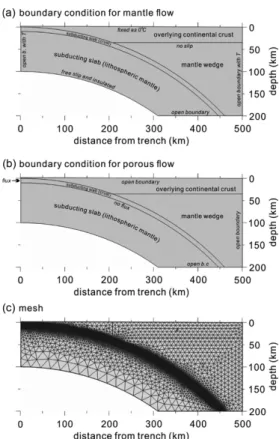
제시된 지배방정식과 유체 보존 방정식을 이용하여 섭입해 양판에서 탈수된 물의 거동을 계산하는 2차원 유한요소 수치 모델링을 수행하였다. 모델 범위(domain)는 너비 500 km, 깊 이 200 km의 2차원으로 설정되었으며 섭입해양판이 음의 부 력(negative buoyancy)에 의해 맨틀 속으로 침강하는 것을 모 사하기 위하여 일정한 속도로 운동학적 섭입(kinematic subduction)이 이루어지는 것으로 가정하였다(Fig. 2(a)). 섭입 해양판과 맨틀 쐐기 사이의 점성 결합(viscous coupling)에 의
하여 맨틀 쐐기는 구석 유동을 일으킨다. 섭입해양판의 두께는 100 km이며 암석권 맨틀(lithospheric mantle)로 구성된 두께 90 km인 지역과 해양 지각으로 구성된 두께 10 km인 지역으 로 분할 되었다. 섭입해양판의 하부에는 프리 슬립(free slip) 및 단열(insulated) 조건이 부여되었으며 섭입해양판 및 맨틀 쐐기와 모델 범위와의 경계에는 열린 경계(open boundary) 조 건이 부여되었다. 섭입해양판 상부에 존재하는 판은 대륙판으 로 가정되었으며 섭입해양판이 발생시키는 구석 유동에 의한 대륙판의 섭입을 막기 위하여 일반적인 대륙 지각의 두께인 35 km로 가정된 상부 대륙 지각(overlying continental crust)은 고정되었다(e.g., Lee and King, 2009; Wada and Behn, 2015).
상부 대륙 지각과 맨틀 쐐기와의 경계에는 노 슬립(no slip) 조 건을 부여하여 상부 대륙 지각 하부에 낮은 온도에 의한 높은 점성도를 가진 열암석권(thermal lithosphere)이 형성되어 구석 유동에 영향을 거의 받지 않도록 하였다. 섭입해양판의 온도 구조를 근사 하기 위하여 반-공간 냉각 모델(half-space cooling model)을 이용하여 섭입해양판의 연령에 해당하는 깊 이에 따른 온도 조건을 섭입해양판과 모델 범위 경계에 부여 하였고 상부판 및 맨틀 쐐기와 모델 범위 경계에는 50 Ma에 해당하는 온도 조건을 부여하였다. 전체 모델 범위에 부여한 초기 온도 조건은 반-공간 냉각 모델을 이용하여 50 Ma에 해 당하는 온도 조건으로 부여하였으며 이는 실험이 진행되며 정 상 상태(steady-state)의 온도로 수렴한다. 지표면의 온도는 273 K (0oC)로 고정되었다. 섭입해양판에 탈수된 물에 의하여 맨 틀 쐐기의 구석 부분에 사문암화 작용(serpentinization)이 발생 하는 것으로 알려져 있다(Peacock and Hyndman, 1999). 사문 암화 된 맨틀의 밀도와 점성도가 일반적인 맨틀보다 낮아 섭 입해양판과의 약한 점성 결합이 일어난다(Wada et al., 2008).
이 연구에서는 섭입해양판 표면을 따라 35 km에서 80 km 깊 이까지 섭입해양판 표면의 섭입 속도를 원래 설정된 섭입 속 도의 5%로 부여하고 80 km 이상의 깊이에서는 원래 섭입 속 도(100%)를 부여함으로써 사문암화 된 맨틀과 섭입해양판 사 이의 약한 점성 결합을 구현하였다(e.g., Wada and Behn, 2015; Wada et al., 2008).
섭입해양판에 포함된 함수 광물을 고려하기 위하여 모델 범 위와 해양 지각 사이의 경계에서 6 wt%의 물이 포함된 해양 지각이 맨틀 속으로 유입되도록 설정하였다(Fig. 2(b)). 함수 광물의 형태로 유입된 물은 온도와 압력이 높아짐에 따라 해 양 지각의 물 용해도가 감소하며 탈수를 일으킨다. 물의 탈수 를 결정하는 해양 지각의 물 용해도는 Iwamori (1998)에서 정 의된 현무암의 물 용해도를 근사 하여 사용하였다. 맨틀 쐐기 내에서의 유체의 거동과 마찬가지로 상부 대륙 지각 내의 유 체의 거동은 잘 알려져 있지 않다. 그리하여 과거 대부분의 연 구에서는 상부 대륙 지각과 맨틀 쐐기 경계에 물의 농도를 0 으로 설정하여 맨틀 쐐기에서 상승한 유체가 상부 대륙 지각 과 맨틀 쐐기 사이 경계에서 소멸되도록 설정하였다(e.g., R′ = ρsVsub(φs–φ)
ρfh --- –
φs
Fig. 2. The model domain, boundary condition and mesh used in this study. (a) The boundary condition for calculating mantle flow is described in the model domain. The subducting slab is kinematically subducted and the mantle wedge is dynamically convected by the viscous coupling. (b) The boundary condition for calculating porous flow is described in the model domain.
Dehydration and porous flow are neglected in the lithospheric mantle of the subducting slab. (c) The mesh used for the finite element analysis. To improve accuracy, mesh refinement is applied to the oceanic crust of the subducting slab.
Wada and Behn, 2015; Wilson et al., 2014). 이 연구에서는 모 델링의 편의상 해양 지각, 맨틀 쐐기 그리고 상부 대륙 지각의 투수율을 모두 같은 값으로 설정하여 탈수된 물이 상부 대륙 지각을 통해 거동할 수 있도록 하였다. 섭입해양판의 상부에 위치한 해양 지각과 하부에 위치한 암석권 맨틀의 경계에는 물의 유입 및 유출이 차단(no flux)되었으며 나머지 경계에는 열린 경계(open boundary)를 이용하여 매우 작은 유체 체적율 (10−5)을 경계 조건으로 부여하였다.
유한요소 수치해석을 위하여 사용자-임의(user-controlled)의 메쉬(mesh)를 사용하였으며 각 요소(element)의 크기를 지역 에 따라 다르게 설정하였다. 해양 지각에서의 탈수는 온도와 압력에 민감하게 반응하므로 탈수 계산의 정확도를 높이기 위 하여 메쉬 세밀화(refinement)를 적용하여 1 ~ 1.6 km 크기의
매우 작은 요소를 적용하였다. 맨틀 쐐기와 상부 대륙 지각에 는 약 2 ~ 10 km 크기의 요소를 적용하였으며 섭입해양판의 암석권 맨틀은 2 ~ 20 km 크기의 요소를 적용하였다. 모델에 서 사용된 총 요소의 수는 13,197개이다.
유한요소 수치해석을 위하여 상용 소프트웨어인 콤솔 멀티 피직스의 시간의존성 솔버(time-dependent solver)를 사용하였 으며, 시간-스텝핑(time-stepping)은 내장된 일반화된-알파 (generalized-alpha)법을 사용하였다. 모델의 안정된 수렴을 위 하여 내장된 직접 솔버인 MUMPS(MUltifrontal Massively Parallel Sparse direct Solver)를 사용하였다. 충분한 시간인 100 Ma의 계산 시간을 부여하여 맨틀 및 탈수된 물의 거동이 정상 상태에 도달하도록 하였다.
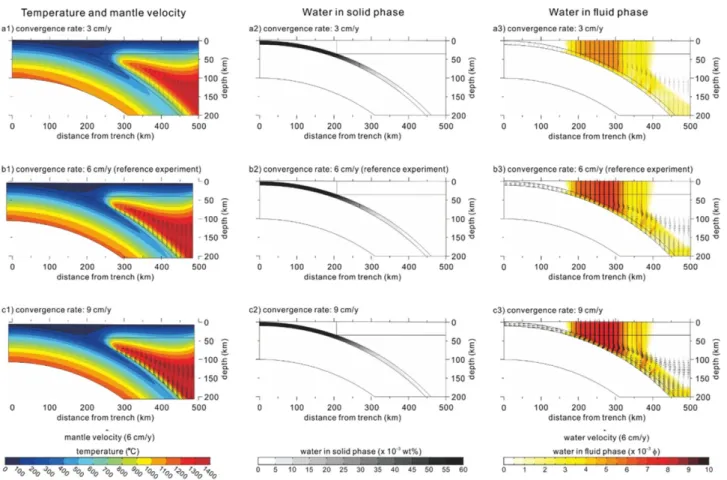
Fig. 3. Distributions of temperature and mantle velocity, water in solid phase, and water in fluid phase and water velocity from the model calculation varying convergence rates as 3, 6 (reference experiment) and 9 cm/y. (a1) Distributions of temperature and mantle velocity from the model calculation using convergence rate of 3 cm/y. Corner flow of the mantle wedge is developed by the viscous coupling between the subducting slab and mantle wedge. (a2) Distribution of the water in solid phase in the oceanic crust. Increases in pressure and temperature width depth reduce the water solubility of the oceanic crust (basaltic rock) by means of dehydration. Most of the dehydration occurs at shallow depth (< 100 km). (a3) Distribution of the water in fluid phase in the oceanic crust, mantle wedge and overlying continental crust. The expelled water almost vertically flows through the shallow mantle (< 100 km). Some of the expelled water in the deep mantle (> 100 km) is dragged by the subducting slab and flowed into the deeper mantle. (b1-b3) Same as a1-a3 except for the convergence rate of 6 cm/y. Due to the increased convergence rate, the corner flow is vigorous but the style of the dehydration of the oceanic crust and porous flow of the expelled water is similar to that from the experiment using the convergence rate of 3 cm/y. (c1-c3) Same as a1-a3 except for the convergence rate of 9 cm/y. The strongest corner flow and largest amount of the expelled water are observed because the amount of the water in solid phase in the oceanic crust is proportional to the convergence rate. However, the style of the dehydration of the oceanic crust and porous flow of the expelled water is similar to those from the experiments using the convergence rates of 3 and 6 cm/y.
실험 결과
우선 섭입해양판의 섭입 속도(convergence rate)에 의한 탈 수 및 탈수된 물의 거동에 대한 영항을 평가하였다. 섭입 속도 는 3, 6 그리고 9 cm/y가 고려되었으며 나머지 조건은 모두 같 기 때문에 6 cm/y의 섭입 속도가 사용된 실험이 기준 실험 (reference experiment)으로 지정되었다. 계산 결과는 섭입해양 판과 맨틀 쐐기와의 점성 결합에 의하여 구석 유동이 발생하 는 것을 보여준다. 그러나 사문암화 된 맨틀이 존재하는 맨틀 쐐기의 구석은 섭입해양판과 맨틀 쐐기와의 약한 점성 결합에 의하여 뜨거운 배호 맨틀(back-arc mantle)이 유입되지 않는다 (e.g., Fig. 3(a1)). 그 결과 맨틀 거동이 미미하므로 상부 대륙 지각을 통한 열전도에 의해 낮은 온도를 가진 사문암화 된 맨 틀이 형성된다. 섭입 속도의 증가에 따라 맨틀 쐐기의 구석 유 동 또한 강해진다. 그러므로, 배호 맨틀에서 유입된 뜨거운 맨 틀이 맨틀 쐐기로 더욱 강하게 유입되며 이는 맨틀 쐐기 내의 높은 온도 분포에서 잘 확인된다(Fig. 3(a1), 3(b1) and 3(c1)).
높은 섭입 속도에 의해 섭입해양판이 뜨거운 맨틀과의 접촉에 의해 온도 상승을 일으킬 시간이 감소하므로 섭입해양판의 온 도는 섭입 속도가 빠를수록 같은 깊이에서 낮은 온도를 보여 준다.
섭입 속도의 변화가 맨틀 쐐기 및 섭입해양판의 미치는 온 도 변화는 해양 지각의 물 용해도에 크게 영향을 미치지 못한 다(Fig. 3(a2), 3(b2) and 3(c2)). 해양 지각은 100 km 이내의 얕은 깊이에서 대부분 탈수되는데 이는 해양 지각의 물 용해 도가 온도 보다는 압력(깊이)에 크게 영향을 받기 때문에 온도 에 영향을 주는 섭입 속도의 영향이 작기 때문이다. 그러므로 전체적인 탈수의 양상은 섭입 속도와 관련없이 유사한 경향을 보이며 섭입 속도와 단위 시간당 맨틀 속으로 유입된 함수 광 물의 양이 비례하기 때문에 탈수된 물의 양이 섭입 속도에 비 례하여 증가하는 것이 관찰된다(Fig. 3(a3), 3(b3) and 3(c3)).
사문암화 된 맨틀 쐐기의 구석은 구석 유동의 영향을 거의 받 지 않기 때문에 탈수된 물의 거동에 거의 영향을 주지 못한다.
그러므로 맨틀 쐐기의 구석과 접한 해양 지각에서 탈수된 물
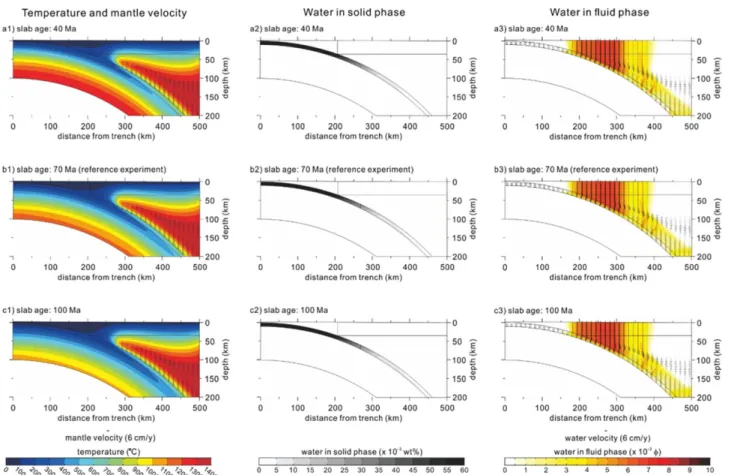
Fig. 4. Distributions of temperature and mantle velocity, water in solid phase, and water in fluid phase and water velocity from the model calculation varying slab ages as 40, 70 (reference experiment) and 100 Ma. (a1) Distributions of temperature and mantle velocity from the model calculation using the slab age of 40 Ma. Younger slab results in higher slab temperatures than those using older slab ages. (a2) Distribution of the water in solid phase in the oceanic crust. Most of the dehydration occurs at shallow depth (< 100 km) regardless of slab age. (a3) Distribution of the water in fluid phase in the oceanic crust, mantle wedge and overlying continental crust. The style of the porous flow of the expelled water is similar to that of the reference experiment. (b1-b3) Same as a1-a3 except for the slab age of 70 Ma, which are same as the experiment using the convergence rate of 6 cm/y. (c1-c3) Same as a1-a3 except for the slab age of 100 Ma. The style of the dehydration of the oceanic crust and porous flow of the expelled water is similar to that from the reference experiment.
은 대부분 수직으로 상승하여 사문암화 된 맨틀과 상부 대륙 지각을 거쳐 지표면으로 유출된다. 이와 달리 100 km 이상의 깊이에서 탈수된 물의 거동은 맨틀 거동에 영향을 받게 되며 섭입 속도가 빠를수록 강한 구석 유동에 의한 물 거동의 왜곡 이 크게 나타난다(Fig. 3(a3), 3(b3) and 3(c3)). 왜곡된 거동을 겪은 탈수된 물은 맨틀 거동이 거의 일어나지 않는 열암석권 과 고정된 상부 대륙 지각에서 수직 상승을 일으키며 지표면 으로 유출된다. 그러나 100 km 이상 깊이에서 탈수된 물의 일 부는 구석 유동에 의해 깊은 맨틀 속으로 유입되며 지표면으 로 되돌아가지 못한다.
다음은 섭입 속도와 함께 섭입에서 중요한 요소인 연령에 의한 영향을 분석하였다. 연령은 40, 70 그리고 100 Ma가 사 용되었으며 70 Ma가 사용된 실험이 기준 실험과 같다. 섭입 해양판의 연령이 증가함에 따라 보다 깊은 깊이에서 낮은 섭
입해양판의 온도가 관찰된다(Fig. 4(a1), 4(b1) and 4(c1)).
그러나, 앞서 언급한대로 해양 지각의 물의 용해도는 압력(깊 이)에 의해 주로 영향을 받으므로, 섭입해양판의 연령은 해양 지각의 물 용해도에 거의 영향을 주지 못한다(Fig. 4(a2), 4(b2) and 4(c2)). 그러므로, 섭입해양판의 연령과는 상관없이 탈수된 물의 양과 거동은 기준 실험에서 관찰된 것과 비슷한 양상을 보인다(Fig. 4(a3), 4(b3) and 4(c3)).
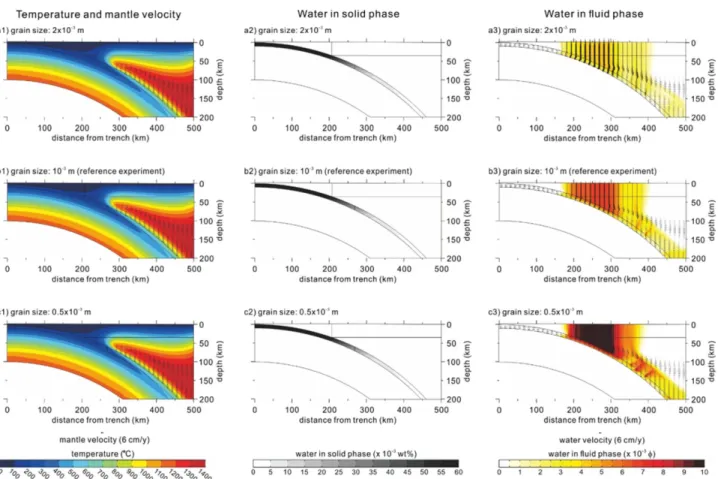
끝으로 투수율에 큰 영향을 미치는 광물 입자의 크기에 의 한 영향을 분석하였다). 해양지각, 맨틀 쐐기 그리고 상부 대 륙 지각을 구성하는 광물 입자 크기는 2 × 10⁻³, 10−3그리고 0.5 × 10⁻³ m가 사용되었으며 10−3 m가 사용된 실험이 기준 실험과 같다. 광물 입자의 크기가 맨틀 점성도에 미치는 영향 이 무시되었기 때문에 맨틀 속도 및 온도는 모든 실험에서 같 다(Fig. 5(a1), 5(b1) and 5(c1)). 맨틀 속도와 온도가 같으므로
Fig. 5. Distributions of temperature and mantle velocity, water in solid phase, and water in fluid phase and water velocity from the model calculation varying grain sizes as 2 × 10⁻³, 10−3 (reference experiment) and 0.5 × 10⁻³ m. (a1) Distributions of temperature and mantle velocity from the model calculation using the grain size of 2 × 10⁻³ m. Because the grain size does not affect the temperature and mantle velocity, all the distributions of the temperature and mantle velocity are the same regardless of grain size. (a2) Distribution of the water in solid phase in the oceanic crust. Because the temperature and mantle velocity in all the experiments show the same results, the water in solid phase also is the same regardless of grain size. (a3) Distribution of the water in fluid phase in the oceanic crust, mantle wedge and overlying continental crust. Larger grain size allows faster porous flow of the expelled water in the oceanic crust, mantle and overlying continental crust thus the fraction of the water in the fluid phase in the oceanic crust, mantle and overlying continental crust is lower than those of the other experiments using smaller grain sizes. (b1-b3) Same as a1-a3 except for the grain size of 10−3 m, which is same as the experiment using the convergence rate of 6 cm/y. (c1-c3) Same as a1-a3 except for the grain size of 0.5 × 10⁻³ m. The style of the dehydration of the oceanic crust and porous flow of the expelled water is similar to that from the reference experiment.
해양 지각의 깊이에 따른 물 용해도 역시 모든 실험에서 같은 값으로 도출되었다(Fig. 5(a2), 5(b2) and 5(c2)). 투수율은 광 물 입자 크기의 제곱에 비례하여 증가한다(식 8). 그러므로, 2
× 10−3 m의 광물 입자 크기를 사용한 실험이 10−3및 0.5 × 10⁻³ m의 광물 입자 크기를 사용한 실험보다 투수율이 4 및 16배 크다. 그러므로, 2 × 10⁻³ m의 광물 입자 크기를 사용한 실험은 탈수된 물이 빠르게 맨틀 및 지각을 통해 유출되므로 해양 지각, 맨틀 쐐기 그리고 상부 대륙 지각에서의 유체(물) 체적율이 다른 실험과 비교하여 작다(Fig. 5(a3), 5(b3) and 5(c3)). 이와 대조적으로 작은 광물 입자 크기를 사용한 실험은 탈수된 물을 외부로 빠르게 유출시키지 못하므로 해양 지각, 맨틀 쐐기 그리고 상부 대륙 지각에서 누적되어 높은 유체 체 적율을 보여준다.
토의 및 결론
본 연구에서 해양 지각의 온도와 압력에 따른 물 용해도를 고려하여 온도 및 압력 증가에 의한 해양 지각의 탈수 그리고 탈수된 물의 해양 지각, 맨틀 쐐기 그리고 상부 대륙 지각 내 부로의 공극 유동을 2차원 컴퓨터 수치모델링을 이용하여 구 현하였다. 실험 변수로써 섭입 속도, 연령 그리고 광물 입자의 크기를 고려하였다. 실험 결과는 섭입 속도와 연령 상관없이 해양 지각의 함수 광물에 포함된 물은 100 km 보다 얕은 깊 이에서 대부분 탈수된다는 것을 보여주었으며 이는 섭입대 호 화산의 위치 및 분포가 섭입 속도 및 연령과 상관 없이 대부 분 유사하다는 사실(Syracuse and Abers, 2006)과 연관될 수 있을 것이다. 또한 100 km 보다 얕은 깊이에서 탈수된 물은 맨틀의 구석 유동에 의해 거의 영향을 받지 않고 공극 유동을 통해 수직 방향으로 상승하여 맨틀과 상부 대륙 지각을 거쳐 지표면으로 유출된다. 100 km 보다 깊은 깊이에서는 상대적 으로 적은 양의 물의 탈수가 발생하며 구석 유동에 의해 유동 의 왜곡이 발생하나 구석 유동이 거의 발생하지 않는 열암석 권과 고정된 상부 대륙 지각을 수직으로 상승하여 지표면에 유출된다. 탈수된 물의 일부는 구석 유동과 함께 깊은 맨틀로 유입되며 지표로 되돌아오지 않는다. 이는 섭입해양판에 포함 된 일부의 물이 깊은 맨틀 속으로 유입된다는 것을 암시하는 것으로써 섭입 작용에 의해 지구 맨틀로 지속적인 물의 유입 이 이루어져 왔음을 암시한다. 섭입 속도는 단위 시간당 맨틀 로 유입되는 물의 양을 비례하여 증가시키므로 빠른 섭입 작 용이 일어나는 곳에서는 보다 많은 양의 물의 탈수 그리고 깊 은 맨틀로의 물의 유입이 발생함을 기대할 수 있다. 맨틀 입자 크기가 클수록 해양 지각, 맨틀 쐐기 그리고 상부 대륙 지각에 포함된 물을 빠르게 유출시키는데 이는 맨틀 쐐기 내부에 존 재하는 물의 양이 광물 입자 크기에 큰 영향을 받을 수 있음 을 암시한다.
이 연구에서 고려한 섭입 속도, 연령 그리고 광물 입자 크기
와 함께 탈수 및 탈수된 물의 공극 유동에 영향을 주는 요소 들이 과거 연구를 통하여 제시되었다. 첫째, 이 연구에서 상수 로 가정된 광물 입자의 크기는 온도 및 변형율(strain rate)에 의해 시간 및 공간에 따라 변화된다(Wada and Behn, 2015).
일반적으로 온도가 높으면 광물 입자는 성장하며 변형율이 높 으면 동력학적 재결정 작용(dynamic recrystallization)에 의해 입자의 크기가 감소한다. 그러므로 낮은 온도가 형성되는 맨틀 쐐기의 구석 부분과 섭입해양판과 맨틀 쐐기의 경계 부분에서 는 맨틀 광물 입자의 크기가 감소하여 투수율을 크게 감소시 킬 수 있다. 이와 대조적으로 높은 온도와 변형율이 발생하는 맨틀 쐐기의 중심부 부분은 광물 입자의 크기가 증가하여 투 수율을 크게 증가시킬 수 있다. 둘째, 상부 맨틀의 60% 이상 을 차지하는 감람석의 맨틀 쐐기 내 변형은 전위 포행 (dislocation creep)에 의해 지배되므로(Karato and Wu, 1993), 맨틀 쐐기 내 온도 및 속도 분포는 전위 포행에 의해 지배될 것으로 보이나 탈수된 물의 거동에 크게 영향을 미치는 광물 입자 크기는 확산 포행에 의해 결정될 것으로 보인다. 이는 보 다 사실적인 탈수 및 탈수된 물의 거동을 해석하기 위하여 이 실험에서 사용된 확산 포행과 더불어 전위 포행이 같이 맨틀 거동 계산에 고려되어야 함을 지시한다(e.g., Wada and Behn, 2015).
이 연구에서는 해양 지각의 탈수와 탈수된 물의 거동만이 고려되었다. 그러나, 맨틀은 상대적으로 건조된(dry) 상태로써 탈수된 물이 유입되면 함수 광물(사문석 등)이 형성된다. 탈수 된 물에 의하여 맨틀의 감람석이 사문석으로 변성되는 것이 실험에서 밝혀졌으며 탄성파 및 전기전도도 탐사 등을 통하여 맨틀 쐐기의 구석 지역에 사문암화 된 맨틀이 존재함이 제시 되었다(Carlson and Miller, 2003; Reynard et al., 2007). 사문 암화 된 맨틀은 밀도가 맨틀보다 낮으며 점성도가 훨씬 작으 므로 맨틀 쐐기의 구석 유동에 영향을 거의 받지 않고 오랫동 안 존재할 수 있을 것으로 생각된다(Nagaya et al., 2016). 사 문암화 된 맨틀을 형성시키는 물 유입이 섭입해양판의 탈수에 서 기인한다는 점에서 사문암화 된 맨틀의 형성 과정을 이해 하기 위하여 맨틀의 물 흡수 및 탈수 과정이 고려되어야 한다.
또한, 탈수된 물이 맨틀 속으로 유입될 시 건조된 맨틀의 고상 선을 크게 감소시켜 유체유입용융이 발생, 마그마를 형성시킨 다는 것이 잘 알려져 있다. 이는 맨틀의 부분 용융을 이해하는 데 섭입해양판의 탈수와 물의 거동에 대한 이해가 필요함을 잘 지시한다.
단순화된 실험에도 불구하고 이 연구는 상용 프로그램을 활 용하여 섭입대에서 발생하는 탈수 작용 및 탈수된 물의 거동 에 대한 연구가 가능함을 보였다. 향후 보다 사실적인 맨틀 점 성도, 광물 입자의 온도 및 변형율에 의한 변화, 사문암화 작 용 및 부분 용융 등을 고려하여 호화산 활동에 중요한 마그마 형성에 대한 연구 뿐만이 아니라 지진파 단층도(seismic tomography) 해석 등에 타 분야에도 개발된 기술이 활용될 수
있을 것으로 기대된다.
감사의 글
논문을 세심히 읽어주시고 유익한 의견을 주신 익명의 심사 위원 두 분께 감사드립니다. 이 연구는 한국연구재단 2016R1D1A1B03930906의 지원으로 수행되었습니다.
References
Carlson, R. L., and Miller, D. J., 2003, Mantle wedge water contents estimated from seismic velocities in partially serpentinized peridotites, Geophys. Res. Lett., 30(5), 1250.
Grove, T. L., Chatterjee, N., Parman, S. W., and Médard, E., 2006, The influence of H2O on mantle wedge melting, Earth Planet. Sci. Lett., 249(1-2), 74-89.
Hyndman, R. D., and Peacock, S. M., 2003, Serpentinization of the forearc mantle, Earth Planet. Sci. Lett., 212(3-4), 417- 432.
Iwamori, H., 1998, Transportation of H2O and melting in subduction zones, Earth Planet. Sci. Lett., 160(1-2), 65-80.
Jagoutz, O., and Kelemen, P. B., 2015, Role of Arc Processes in the Formation of Continental Crust, Annu. Rev. Earth Planet.
Sci., 43, 363-404.
Karato, S.-I., and Wu, P., 1993, Rheology of the upper mantle:
a synthesis, Science, 260, 771-778.
Kim, S. W., Kwon, S., Park, S.-I., Lee, C., Cho, D.-L., Lee, H.- J., Ko, K., and Kim, S. J., 2016, SHRIMP U–Pb dating and geochemistry of the Cretaceous plutonic rocks in the Korean Peninsula: A new tectonic model of the Cretaceous Korean Peninsula, Lithos, 262, 88-106.
Kim, S. W., Kwon, S., Ryu, I.-C., Jeong, Y.-J., Choi, S.-J., Kee, W.-S., Yi, K., Lee, Y. S., Kim, B. C., and Park, D. W., 2012, Characteristics of the Early Cretaceous Igneous Activity in the Korean Peninsula and Tectonic Implications, J. Geol., 120(6), 625-646.
Lee, C., and King, S. D., 2009, Effect of mantle compressibility on the thermal and flow structures of the subduction zones,
Geochem. Geophys. Geosyst., 10(1), Q01006.
Nagaya, T., Walker, A. M., Wookey, J., Wallis, S. R., Ishii, K., and Kendall, J. M., 2016, Seismic evidence for flow in the hydrated mantle wedge of the Ryukyu subduction zone, Sci.
Rep., 6, 29981.
Peacock, S. M., and Hyndman, R. D., 1999, Hydrous minerals in the mantle wedge and the maximum depth of subduction thrust earthquakes, Geophys. Res. Lett., 26(16), 2517-2520.
Reynard, B., Hilairet, N., Balan, E., and Lazzeri, M., 2007, Elasticity of serpentines and extensive serpentinization in subduction zones, Geophys. Res. Lett., 34(13), L13307.
Sakuyama, T., Nagaoka, S., Miyazaki, T., Chang, Q., Takahashi, T., Hirahara, Y., Senda, R., Itaya, T., Kimura, J. I., and Ozawa, K., 2014, Melting of the Uppermost Metasomatized Asthenosphere Triggered by Fluid Fluxing from Ancient Subducted Sediment: Constraints from the Quaternary Basalt Lavas at Chugaryeong Volcano, Korea, J. of Petrol., 55(3), 499-528.
Schubert, G., Turcotte, D., and Olson, P., 2001, Mantle Convection in the Earth and Planets, Cambridge Univ. Press, Cambridge, 1st Ed.
Spiegelman, M., Kelemen, P. B., and Aharonov, E., 2001, Causes and consequences of flow organization during melt transport: The reaction infiltration instability in compactible media, J. Geophys. Res., 106(B2), 2061-2077.
Syracuse, E. M., and Abers, G. A., 2006, Global compilation of variations in slab depth beneath arc volcanoes and implications, Geochem. Geophys. Geosyst., 7(5), Q05017.
Wada, I., and Behn, M. D., 2015, Focusing of upward fluid migration beneath volcanic arcs: Effect of mineral grain size variation in the mantle wedge, Geochem. Geophys. Geosyst., 16(11), 3905-3923.
Wada, I., Wang, K., He, J., and Hyndman, R. D., 2008, Weakening of the subduction interface and its effects on surface heat flow, slab dehydration, and mantle wedge serpentinization, J. Geophys. Res., 113(B4), B04402.
Wilson, C. R., Spiegelman, M., van Keken, P. E., and Hacker, B. R., 2014, Fluid flow in subduction zones: The role of solid rheology and compaction pressure, Earth Planet. Sci. Lett., 401, 261-274.