• 검색 결과가 없습니다.

Cadmium Accumulation, Phosphorus Concentration and Growth Response of Cd-treated Ectomycorrhizal Poplar Cuttings

N/A
N/A
Protected

Academic year: 2021

Share "Cadmium Accumulation, Phosphorus Concentration and Growth Response of Cd-treated Ectomycorrhizal Poplar Cuttings"

Copied!
7
0
0

로드 중.... (전체 텍스트 보기)

전체 글

(1)

602

F OREST S OCIETY

Cadmium Accumulation, Phosphorus Concentration and Growth Response of Cd-treated Ectomycorrhizal Poplar Cuttings

Sim-Hee Han

1

* , Du-Hyun Kim

1

, Nelly S. Aggangan

1

, Pan-Gi Kim

2

and Kyung Joon Lee

3

1

Department of Forest Resources Development, Korea Forest Research Institute, Suwon, 441-350, Republic of Korea

2

Division of Forest Environment and Resources, Kyungpook National University, Sangju, 742-711, Korea

3

Department of Forest Resources, Seoul National University, Seoul, 151-921, Korea

Abstract : We investigated whether cadmium (Cd) toxicity affects phosphorus (P) concentration and growth of poplar, which might be related to the ectomycorrhizal associations. Populus × tomentoglandulosa cuttings were treated with 0.1 mM and 0.4 mM CdSO

4

and inoculated with ectomycorrhizal fungus, Pisolithus tinctorius (Pt) and grown in autoclaved peat vermiculite mixture for five months under greenhouse conditions. Ectomycorrhizal plants showed significantly higher Cd concentration in leaves, stems and roots than in non-mycorrhizal plants. Likewise, P contents in leaves and roots of ectomycorrhizal plants were higher than those of non-mycorrhizal plants. Acid phosphatase activity in leaves of ectomycorrhizal plants, however, was significantly lower than that of non-mycorrhizal plants. 0.1 mM Cd significantly increased P content in leaves and stems of non-mycorrhizal plants. In spite of high P concentration, which is accompanied by lower acid phosphatase activity, plant growth was not improved by inoculation with P.

tinctorius . Total plant dry weight was lower than the non-mycorrhizal counterpart. The results imply that this might be caused by the large amount of energy consumption to alleviate Cd toxicity resulted from high Cd accumulation in their tissues.

Key words : Populus ×tomentoglandulosa, Pisolithus tinctorius, P content, acid phosphatase, growth

Introduction

Poplar ( Populus ) trees have been reported as good candidates for use in phytoremediation because they root deeply, cycle large amount of water and grow rapidly (Newman et al ., 1997; Palmroth et al ., 2002; Witting et al ., 2003). Poplar trees are known to be associated with the ectomycorrhizal fungus Pisolithus tinctorius (Cripps and Miller, 1995; Cairney and Chambers, 1999). Infec- tion by ectomycorrhizal (ECM) fungi may benefit hybrid poplar growing in contaminated soils by providing greater access to water and nutrients and protecting the trees from direct contact with the toxic contaminants (Gunderson et al ., 2007).

Cadmium (Cd) is invariably concentrated in the organic surface horizon of soils, where seedlings are rooted, together with any associated mycorrhizas (Smith and Read, 1997). Great interest has been raised in the ability of ectomycorrhizal (EM) fungi to regulate uptake of heavy metals. In a number of cases, growth and survival

of several species of pine growing on strip mine soil with high levels of metals and extreme pH values were improved by inoculation with Pisolithus tinctorius (Pers.) Coker and Couch (Berry, 1982).

Phosphorus (P) is present in limiting amounts in many soils and is consequently a very important factor affect- ing plant growth (Bielski, 1973). The role of P in lim- iting forest growth has been identified in many differing forest ecosystems throughout the world. Soil P is largely in the form of myoinositol hexaphosphate (phytic acid salts), a form unavailable for direct plant uptake (Bieleski, 1973). This organically bound P may constitute 50-67%

of the total soil P supply and cannot be utilized without the solubilization of orthophosphate (McLaren and Skujins, 1971).

Ho (1979) demonstrated an increase in acid phos- phatase activity (acid phosphomonoesterase, EC 3.1.3.2) in low pH forest soils and suggested this as a mecha- nism for increased levels of available P for plant uptake.

Acid phosphatase consists of a broad group of enzymes that share the ability to hydrolyze various phosphate esters with the release of phosphate ions (Hall and Hawes, 1991). Acid phosphatase activity in the plant

*Corresponding author

E-mail: [email protected]

(2)

increases with phosphorus deficiency (Reid and Bieleski, 1970; McLachlan, 1976; Besford, 1979).

Mycorrhizal associations have been demonstrated to potentially improve plant health and growth through increased uptake of required nutrients particularly P (Harley and Smith, 1983). The pool of available P to plants can be increased by colonization with mycorrhizal fungi through an increase in absorptive surface area, greater uptake efficiency, or less available to the non- mycorrhizal tree. Ectomycorrhizal fungi, which signifi- cantly enhance phosphate uptake by host roots (Bowen, 1973), are believed important in catalyzing the hydrol- ysis of organic phosphates and thus influencing the phosphorus cycle. However, these positive mycorrhizal effects could be reduced by various stresses such as drought and high level of heavy metals. The objective of the present study was to investigate whether Cd toxicity affects P concentration and growth of Populus × tomen- toglandulosa cuttings, which might be related to the ectomycorrhizal associations.

Materials and Methods 1. Plant and inoculum preparation

The clones used in this study were mainly hybrid pop- lar ( P. × tomentoglandulosa ). The stem cuttings were taken from one-year old micropropagated stock plants that were maintained in the nursery of the Department of Forest Genetic Resources, Korea Forest Research Insti- tute in Suwon, Korea.

Culture of P. tinctorius was obtained from Chonnam National University in Korea and the fungus was main- tained as described previously (Marx, 1969). Fungal inoculum was prepared using the method of Marx and Bryan (1975). An 1-L flask was filled with a mixture of 60 mL peat and 840 mL vermiculite. Liquid MMN solu- tion (400 mL) with 5 g glucose was added into the 900 mL peat-vermiculite mixture, mixed thoroughly and then autoclaved for 1h at 121

o

C. The sterilized MMN -peat- vermiculite mixture was inoculated with 10 MMN agar plugs (7 mm diameter) removed from the edge of actively growing colonies of P. tinctorius . For the con- trol treatment, 10 MMN agar plugs without mycelium were added to the mixture. The flasks were kept at 20

o

C in the dark. After the 3-month incubation, the P. tincto- rius colonized substrate was removed from the flasks, washed with running water to remove non-assimilated nutrients, and kept in a plastic bag at 5

o

C for 3 days until used for inoculation. Mycelial growth of P. tincto- rius in the substrate can be seen through the naked eye.

2. Production of mycorrhizal P. × tomentoglandulosa Ectomycorrhizal associations between P. × tomentoglan-

dulosa and P. tinctorius were synthesized aseptically in plastic pots filled with peat-vermiculite (1:1 v/v) mix- ture. The growth medium contained peat that passed through a 2 mm sieve and vermiculite that was retained in a 3 mm sieve. The mixture was autoclaved for 1h at 121

o

C. The fungal inoculum ( P. tinctorius colonized sub- strate) was mixed with the autoclaved clean peat-ver- miculite mixture at a ratio of 1:6 by volume and then placed into a plastic pot. Hybrid poplar cuttings (approx- imately length 10 cm ± 1) stored in the refrigerator for one month were inserted into rooting plastic pots filled with a mixture of fungal inoculum and growth mixture.

3. Cd treatment

Cd treatment was applied for thirty days after inserting the stem cuttings. Cd was applied every three days over a five-month period. At each Cd application, approxi- mately 200 mL of 0.1 mM or 0.4 mM CdSO

4

solutions were applied to the containerized plants. The pots were placed in plastic dishes to retain leached nutrients and CdSO

4

solution. Pots were randomized in the green- house and rearranged every two or three weeks through- out a five-month experimental period to minimize positional effects. During the experimental period (May-October), daily mean temperature and relative humidity were 23.1

± 2.1

o

C and 74.3 ± 10.9%, respectively.

4. Mycorrhizal infection

Ectomycorrhizae were detected easily after soaking in cool tap water for 5 minutes. Counting of mycorrhizal root tips (7 mm and shorter belonging to the orders of the secondary and smaller roots) was done under a dis- secting microscope. Percentage of mycorrhiza infection was expressed as the number of infected lateral root tips divided by the total number of such root tips multiplied by 100.

4. Biomass and Cd determination

At harvest, shoots and roots were carefully separated, rinsed thoroughly with distilled water twice and later partitioned into leaves, stem and roots. After oven dry- ing the tissues at 70

o

C to constant weight (three days), the dry weights were recorded. Dried leaves, stems and roots (0.5 g each) were ground and Cd concentration was measured by inductively coupled plasma spectrom- eter (ICPS-1000IV, Shimadzu, Japan). Cd content is the product of Cd concentration and plant dry weight.

6. P content and acid phosphatase activity

At the end of the 5 month trial, leaves and roots of the

freshly harvested plants were used for the determination

of acid phosphatase activity following the technique of

Macfall et al . (1991). P concentration in the ground tis-

(3)

sue was measured by inductively coupled plasma spec- trometer (ICPS-1000IV, Shimadzu, Japan). P content is the product of P concentration and plant dry weight.

7. Experimental design and statistics

The experiment was conducted following two factors in Randomized Complete Block Design with 25 repli- cates per treatment. Factor A was the Cd treatment (0, 0.1 and 0.4 mM) and Factor B was the mycorrhiza inoculation treatment (non-mycorrhizal and mycorrhizal with P. tinctorius ). Data were statistically analyzed using SAS System for Windows, Version 8.01 (SAS Institute, USA). Mean values per treatment were com- pared by GLM. When significant differences (P 0.05) were indicated Duncan's multiple range tests (Duncan, 1955) were performed.

Results

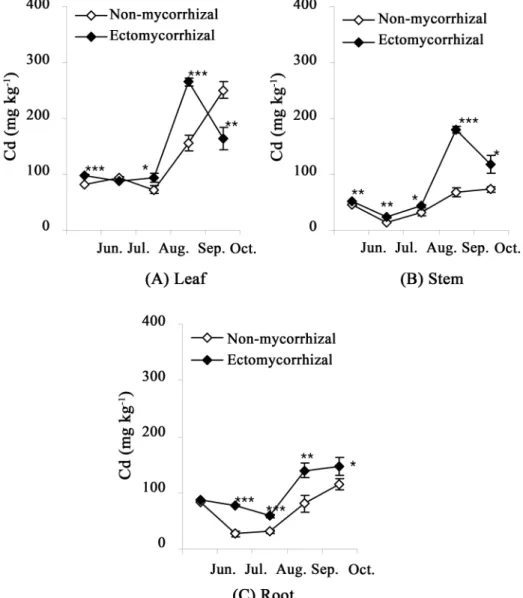
Figure 1 represents the monthly changes of Cd con- centration in the leaves, stems and roots of one-year-old poplar cuttings treated with 0.4 mM Cd solution. Ecto- mycorrhizal plants consistently gave higher Cd concen- trations in the leaves, stems and roots than those in the non-mycorrhizal plants throughout the growing season (Figure 1). Cd concentration in the leaves and stems of mycorrhizal plants were higher in June, August and Sep- tember. Cd concentration was highest in September which significantly dropped in October.

In October, leaf Cd concentration in mycorrhizal plants was significantly lower than non-mycorrhizal plants. Cd concentrations in leaves, stems and roots of non-mycorrhizal plants increased sharply in September and

Figure 1. Monthly Cd concentration in the leaves, stems and roots of one-year-old non-mycorrhizal and mycorrhizal

P. × tomentoglandulosa cuttings grown in an autoclaved 1:1 peat vermiculite mixture with 0.4 mM CdSO

4

. All values are

means of three replicates±SD; *, ** and *** indicate significant difference between non-mycorrhizal and ectomycorrhizal

plant at P<0.05, 0.01 and 0.001, respectively.

(4)

were highest in October.

Ectomycorrhiza infected root tips were predominantly monopodial and the mycelium associated with P. tincto-

rius treatment was dark brown in color. Ectomycorrhizal root infection ranged from 44 to 68%. Control seedlings were free of ectomycorrhizae. Cd level of 0.1 mM did not affect root colonization by P. tinctorius . However, increasing the Cd level to 0.4 mM decreased the rate of root colonization by 65% relative to the Cd-untreated cuttings (Figure 2).

Acid phosphatase (AP) activity in leaves of cuttings showed significant ( P≤ 0.05) difference between non- mycorrhizal and ectomycorrhizal plants but there were no significant differences among Cd levels and the inter- action between mycorrhizal status and Cd treatment. AP activity in the leaves of ectomycorrhizal plants was sig- nificantly lower than that in non-mycorrhizal plants (Fig- ure 3). AP activity in the roots was not affected by mycorrhizal inoculation and Cd treatment. However, Figure 2. Mycorrhizal infection rate of 1-year-old P. × tomentoglandulosa cuttings inoculated with ectomy- corrhizal fungus, P. tinctorius grown in an autoclaved 1:1 peat vermiculite mixture with three levels of CdSO

4

. All non-mycorrhizal plants did not have mycorrhiza infected roots. Means with the same letter are not significantly different at 5% level using Duncan's multiple range test.

Figure 3. Acid phosphatase activity in the leaves and roots of one-year-old P. × tomentoglandulosa cuttings inoculated with ectomycorrhizal fungus, P. tinctorius grown in an autoclaved 1:1 peat vermiculite mixture with three levels of CdSO

4

. All values are means of three replicates ± SD.

Leaf AP activity: Pt**, Cd

n.s.

, Pt×Cd

n.s.

; Root AP activity:

Pt

n.s.

, Cd*, Pt×Cd*; *, ** and *** indicate significant at P

< 0.05, 0.01 and 0.001, respectively, and n.s.= not significant.

Table 1. Phosphorus concentration in leaves, stems and roots of one-year-old P. ×tomentoglandulosa cuttings inoculated with ectomycorrhizal fungus, P. tinctorius grown in an autoclaved 1:1 peat vermiculite mixture with three levels of CdSO

4

.

Factor Treatment Leaf Stem Root

P (mg kg

−1

)

Non-mycorrhizal Control

0.1 mM 0.4 mM

1400±114 2792±263 1499±513

1013±129 1271±236 1182±43

3284±300 2759±154 3061±420

Ectomycorrhizal Control

0.1 mM 0.4 mM

2388±116 2784±370 2979±290

1346±455 1448±130 1570±486

3857±316 3831±561 4728±350

Pr > F Pt

Pt × Cd Cd

*** ***

**

n.s. n.s.

n.s.

*** *

All values are means of three replicates ± SD; * P < 0.05, ** P < 0.01, *** P < 0.001, and n.s.=not significant. n.s.

(5)

there was a significant ( P≤ 0.05) interaction between mycorrhizal and Cd treatments. Cd treatment did not show a clear influence on AP activity in non-mycor- rhizal plants, whereas AP activity in ectomycorrhizal plants increased linearly with the increasing levels of Cd treatment.

Table 1 shows the P content in leaves, stems and roots of 1-year-old poplar cuttings inoculated with ectomyc- orrhizal fungus, P. tinctorius at three levels of Cd added into the soil. Leaf and root P contents were significantly affected by inoculation with P. tinctorius and Cd treat- ments. Moreover, there was a significant interaction between mycorrrhizal inoculation and Cd treatments on leaf P content. On the other hand, stem P content was not affected by any of the treatments. Leaf and stem P contents of mycorrhizal plants were higher than those in non-mycorrhizal plants (Table 1). P contents in the leaves and stems of non-mycorrhizal plants were signif- icantly increased with 0.1 mM Cd solution. 0.4 mM Cd treatment significantly increased P contents in the leaves, stem and roots of mycorrhizal plants.

Dry weights of leaves, stems and roots were signifi- cantly different between non-mycorrhizal and ectomyc- orrhizal plants (Table 2). Leaf, stem and root dry weights of ectomycorrhizal plants were significantly lower than those of non-mycorrhizal plants. There was no effect of Cd treatments and the interaction between mycorrhizal inoculation and Cd treatments on plant dry weight.

Discussion

Ectomycorrhizal fungi play an important role in nutri- ent uptake under natural conditions, suggesting that mycorrhizal fungi might influence the uptake and accu- mulation of these toxic ions including heavy metals. A comparison of heavy metal concentrations in shoots of

mycorrhizal and non-mycorrhizal plants has been taken in many studies. These studies have shown that the con- centration in the non-mycorrhizal plants was higher than in the mycorrhizal plants, in the needles/leaves as well as in the stem (Colpaert and van Assche, 1993). Three reasons were suggested to explain these results. First, reduced concentrations in the shoots of mycorrhizal plants could be attributed by the dilution of the metal due to improved shoot growth (Jentschke and Godbold, 2000; Han et al ., 2006). Second, in some cases, some ectomycorrhizal fungi have been shown to restrict heavy metal uptake and transport by binding the heavy metals onto fungal cell walls, by sequestration in vacuoles and/

or by chelation by organic acids (Leyval et al ., 1997;

Jentschke and Godbold, 2000). Lastly, toxic metals may impair transpiration of plants by either interfering with stomatal regulation or reducing water uptake by the root system, or both (Barceló and Poschenrieder, 1990). In this case, portion of the absorbed heavy metals may be transported to the shoot via the transpiration stream, thus, reduced transpiration may result in decreased trans- location of metals into the shoots.

Interestingly, however, in this study, Cd concentration in the shoot of mycorrhizal plants was higher than in the non-mycorrhizal counterpart (Figure 1) similar to what has been shown in our previous study (Han et al ., 2001).

In addition, many studies have reported that mycorrhiza enhanced the uptake of Cu (Gildon and Tinker, 1983), Zn (Davies, 1987), Ni (Killham and Firestone, 1983), Cd (Guo et al ., 1996; Joner and Leyval, 1997), Pb (Díaz et

al ., 1996) and other metals (Galli et al ., 1994). Mycor- rhizal plants had higher Cd than the non-mycorrhizal ones because the former had lower biomass than the lat- ter (Tables 1 and 2).

Mycorrhizal fungi may alter metal sensitivity of their hosts by either directly affecting metal availability and speciation or indirectly modifying plant physiological Table 2. Dry weight of one-year-old P. × tomentoglandulosa cuttings inoculated with ectomycorrhizal fungus, P. tinctorius grown in an autoclaved 1:1 peat vermiculite mixture with three levels of CdSO

4

.

Factor Treatment Leaf Stem Root Total SR ratio

Dry weight (g) Non-mycorrhizal Control

0.1 mM 0.4 mM

2.36±0.24 2.09±0.10 2.22±0.38

1.01±0.15 1.01±0.15 0.99±0.05

1.60±0.07 1.64±0.36 1.37±0.27

4.97±0.28 4.74±0.55 4.58±0.64

2.11±0.23 1.95±0.41 2.37±0.20 Ectomycorrhizal Control

0.1 mM 0.4 mM

1.60±0.21 1.76±0.16 1.74±0.21

0.53±0.06 0.58±0.17 0.65±0.21

0.86±0.31 0.85±0.04 0.83±0.15

2.98±0.13 3.19±0.36 3.21±0.33

2.85±1.59 2.75±0.32 2.93±0.39

Pr > F Pt

Pt × Cd Cd

*** n.s.

n.s.

*** n.s.

n.s.

*** n.s.

n.s.

*** n.s.

n.s.

n.s. n.s.

All values are means of three replicates ± SD; *** P <0.001, and n.s.= not significant. n.s.

(6)

processes, for example, by phytohormone action (Gogala, 1991; Vodnik et al ., 1999; Jentschke and Godbold, 2000).

Mycorrhizal fungi might even increase the metal trans- location into the shoots.

The above two results create a complicated situation for the interpretation of mycorrhizal effects on shoot contents, as transpiration- driven metal translocation may differ between non-mycorrhizal and mycorrhizal plants because of differences in metal intoxication (Jentschke and Godbold, 2000).

Mycorrhizal formation was strongly suppressed by high Cd concentration in poplar cutting (Figure 2) like some forest tree seedlings inoculated with Suillus lutes

(Dixon, 1988; Dixon and Buschena, 1988).

Nevertheless, several ectomycorrhizal fungi can pro- tect their host plants against toxicity of heavy metals present at elevated concentrations in soil (Jones and Hutchinson, 1988; Colpaert and Van Asshe, 1992). In our study, although it wasn't significantly different, the growth of non-mycorrhizal plants was depressed lightly at 0.4 mM Cd treatment. On the contrary, the growth of ectomycorrhizal plants did not show significant changes by Cd treatment (Table 2).

Acid phosphatase activity in the leaves of ectomycor- rhizal plant was lower than that of non-mycorrhizal plants (Figure 3). This means that the leaves of ectomy- corrhizal plants retained higher P concentration in com- parison with non-mycorrhizal plants (Table 2) but this is not true in the root of Cd-treated cuttings, except for control cuttings.

Acid phosphatase activity in the plant increases with phos- phorus deficiency (Reid and Bieleski, 1970; McLachlan, 1976; Besford, 1979). Besford (1979) indicated that out of the 15 nutrient imbalances, only phosphorus defi- ciency markedly increased acid phosphatase activity in leaves. That work suggested that it may well be possible to use this enzyme as an indicator of phosphorus defi- ciency.

In another investigation comparing leaf and root phos- phatase activities in wheat grown in nutrient solution, McLachlan and De Marco (1982) showed that leaf phos- phatase was not necessarily a better measure of the phosphorus status of the growing plant than root phos- phatase. However, as leaves are more accessible than roots, leaf activity was suggested as a potentially useful measure of the growing plant's phosphorus status.

In this present study, in spite of high P concentration in the ectomycorrhizal plants, the growth was not improved in comparison with non-mycorrhizal plants. In fact, growth was reduced significantly in relation to the non-mycorrhizal plants (Table 2). This plant reaction can be considered as a series of compensation effects as a defense mechanism against Cd toxicity which results

from high Cd accumulation in mycorrhizal plants.

Conclusion

Ectomycorrhizal plants maintained high P concentra- tion in their tissues in comparison with non-mycorrhizal plants under both control and Cd treatments. It was con- sidered as the ectomycorrhizal positive effects. However, in spite of having high P concentration, which was accompanied by lower acid phosphatase activity, their growth was not improved by inoculation with Pisolithus

tinctorius . Total plant dry weight was lower than the non-mycorrhizal counterpart. The results imply that this might be caused by the large amount of energy con- sumption to alleviate Cd toxicity resulted from high Cd accumulation in their tissues.

References

1. Barceló, J. and Poschenrieder, C. 1990. Plant water relations as affected by heavy metal stress: a review.

Journal of Plant Nutrition 13: 1-37.

2. Berry, C.R. 1982. Survival and growth of pine hybrid seedlings with Pisolithus ectomycorrhizae on coal spoils in Alabama and Tennessee. Journal of Environ- mental Quality 11: 709-715.

3. Besford, R.T. 1979. Nutrient imbalances in tomato plants and acid phosphatase activity in the leaves. Jour- nal of the Science of Food and Agriculture 30: 275- 4. Bieleski, R.L. 1973. Phosphate pools, phosphate trans- 280.

port and phosphate availability. Annual Review of Plant Physiology 24: 225-252.

5. Cairney, J.W.G. and Chambers, S.M. 1999. Pisolithus . pp. 1-31. In: Cairney, J.W.G and Chambers, S.M. (Ed.), Ectomycorrhizal fungi: Key genera in profile. Springer, Berlin.

6. Colpaert, J.V. and Van Assche, J.A. 1992. Zinc toxicity in ectomycorrhizal Pinus sylvestris . Plant and Soil 143:

201-211.

7. Colpaert, J.V. and Van Assche, J.A. 1993. The effects of cadmium on ectomycorrhizal Pinus sylvestris L.

New Phytologist 123: 325-333.

8. Cripps, C.L. and Miller, O.K. 1995. Ectomycorrhizae formed in vitro by quaking aspen: Including Inocybe lac- era and Amanita pantherina . Mycorrhiza 5:357-370.

9. Davies, F.T. Jr. 1987. Mycorrhizal fungi, fertility and media effects on growth and nutrition of Rosa multi- flora. Plant and Soil 104: 31-35.

10. Díaz, G., Azcón-Aguilar, C. and Honrubia, M. 1996. Influ- ence of arbuscular mycorrhizae on heavy metal (Zn and Pb) uptake and growth of Lygeum spartum and Anth- yllis cytisoides. Plant and Soil 180: 2451-2459.

11. Dixon, R.K. 1988. Response of ectomycorrhizal Quer-

(7)

cus rubra to soil cadmium, nickel and lead. Soil Biol- ogy and Biochemistry 20: 555-559.

12. Dixon, R.K. and Buschena, C.A. 1988. Response of ecto- mycorrhizal Pinus banksiana and Picea glauca to heavy metals in soil. Plant and Soil 105: 265-271.

13. Galli, U., Schuepp, H. and Brunold, C. 1994. Heavy metal binding by mycorrhizal fungi. Physiologia Plan- tarum 92: 364-368.

14. Gildon, A. and Tinker, P. 1983. Interactions of vesic- ular-arbuscular mycorrhizal infection and heavy metals in plants. II. The effect of infection on uptake of cop- per. New Phytologist 95: 263-268.

15. Gogala, N. 1991. Regulation of mycorrhizal infection by hormonal factors produced by hosts and fungi.

Experientia 47: 331-340.

16. Gunderson, J.J., Knight, J.D. and Van Rees, K.C.J.

2007. Impact of ectomycorrhizal colonization of hybrid poplar on the remediation of diesel-contaminated soil.

Journal of Environmental Quality 36: 927-934.

17. Guo, Y., George, E. and Marschner, H. 1996. Contri- bution of an arbuscular mycorrhizal fungus to the uptake of cadmium and nickel in bean and maize plants. Plant and Soil 184: 195-205.

18. Hall, J.L. and Hawes, C. 1991. Electron microscopy of plant cells. Academic Press, London, p 466.

19. Han, S.H., Lee, J.C. Oh, C.Y. and Kim, P.G. 2006.

Alleviation of Cd toxicity by composted sewage sludge in Cd-treated Schmidt birch ( Betula schmidtii ) seed- lings. Chemosphere 65: 5421-546.

20. Han, S.H., Lee, K.J. and Hyun, J.O. 2001. The Cd and Pb accumulation in various tissues of rooted cuttings of four Populus species inoculated with ectomycorrhizal fungi, Pisolithus tinctorius . Journal of Korean Forestry Society 90: 495-504 (in Korean with English abstract).

21. Harley, J.L. and Smith, S.E. 1983. Mycorrhizal symbi- osis. Academic Press, New York.

22. Ho, I. 1979. Acid phosphatase activity in forest soil.

Forest Science 25: 567-568.

23. Jentschke, G. and Godbold, D.L. 2000. Metal toxicity and ectomycorrhizas. Physiologia Plantarum 109: 107- 24. Joner, E.J. and Leyval, C. 1997. Uptake of 116.

109

Cd by roots and hyphae of a Glomus mosseae/ Trifolium sub- terraneum mycorrhiza from soil amended with high and low concentration of cadmium. New Phytologist 135: 353-360.

25. Jones, M.D. and Hutchinson, T.C. 1988. Nickel toxicity in mycorrhizal birch seedlings infected with Lactartius rufus or Scleroderma flavidum . I. Effects on growth, photosynthesis, respiration and transpiration. New Phy- tologist 108: 451-459.

26. Killham, K. and Firestone, M.K. 1983. Vesicular-arbus- cular mycorrhizal mediation of grass response to acidic

and heavy metal depositions. Plant and Soil 72: 39-48.

27. Leyval, C., Turnau, K. and Haselwandter, K. 1997. Effect of heavy metal pollution on mycorrhizal colonization and function: physiological, ecological and applied aspects. Mycorrhiza 7: 139-153.

28. Macfall, J., Slack, S.A. and Iyer, J. 1991. Effects of Hebe- loma arenosa and phosphorus fertility on root acid phosphatase activity of red pine ( Pinus resinosa ) seed- lings. Canadian Journal of Botany 69: 380-383.

29. Marx, D.H. 1969. The influence of ectomycorrhizal fungi on the resistance of pine roots to pathogenic infections:

I. Antagonism of mycorrhizal fungi to root pathogenic fungi and soil bacteria. Phytopathology 59: 153-163.

30. Marx, D.H. and Bryan, W.C. 1975. Growth and ecto- mycorrhizal development of loblolly pine seedlings in fumigated soil infested with the fungal symbiont Pisolithus tinctorius. Forest Science 21: 245-254.

31. McLachlan, K.D. 1976. Comparative phosphorus responses in plants to a range of available phosphorus situations.

Australian Journal of Agricultural Research 27: 323- 32. McLachlan, K.D. and De Marco, D.G. 1982. Acid 341.

phosphatase activity of intact roots and phosphorus nutrition in Plants. III. Its relation to phosphorus gar- nering by wheat and a comparison with leaf activity as a measure of phosphorus status. Australian Journal of Agricultural Research 33: 1-11.

33. McLaren, A.D. and Skujins, J. 1971. Soil biochemistry.

Marcel Dekker, New York.

34. Newman, L.A., Strand, S.E., Choe, N., Duffy, J., Ekuan, G., Ruszaj, M., Shurtleff, B.B., Wilmoth, J., Heilman, P. and Gordon, M.P. 1997. Uptake and biotransforma- tion of trichloroethylene by hybrid poplars. Environ- mental Science and Technology 31: 1062-1067.

35. Palmroth, M.R.T., Pichtel, J. and Puhakka, J.A. 2002.

Phytoremediation of subarctic soil contaminated with diesel fuel. Bioresour. Technol. 84: 221-228.

36. Reid, M.S. and Bieleski, R.L. 1970. Changes in phos- phatase activity in phosphorus deficient Spirodela . Planta 94: 273-281.

37. Smith, S.E. and Read, D.J. 1997. Mycorrhizal Symbi- osis, second ed. Academic Press, San Diego.

38. Vodnik, D., Jentschke, G., Fritz, E., Gogala, N. and Godbold, D.L. 1999. Root-applied cytokinin reduces lead uptake and affects its distribution in Norway spruce seedlings. Physiologia Plantarum 106: 75-81.

39. Wittig, R., Ballach, H.J. and Kuhn, A. 2003. Exposure of the roots of Populus nigra L., cv. Loenen to PAHs and its effect on growth and water balance. Environ.

Sci. Pollut. Res. Int. 10: 235-244.

(Received August 27, 2009; Accepted September 25, 2009)

수치

Figure 1 represents the monthly changes of Cd con- con-centration in the leaves, stems and roots of one-year-old poplar cuttings treated with 0.4 mM Cd solution
Figure 3. Acid phosphatase activity in the leaves and roots of one-year-old  P.   × tomentoglandulosa  cuttings inoculated with ectomycorrhizal fungus,  P
Table 1 shows the P content in leaves, stems and roots of 1-year-old poplar cuttings inoculated with  ectomyc-orrhizal fungus,  P

참조

관련 문서

Sixth, there was no significant correlation between lower extremity muscle thickness, static stability, and dynamic stability of excellent athletes in college

There was no significant difference between the groups in problems of eating habits, but the obesity group considered overeating as a problem while the normal

Third, there was no significant difference in the frequency of second hospital evacuation after moving to the medical room due to experience and

In the control group, lifestyle-related factors were significantly different only in blood glucose (p &lt;.01) and there was no significant difference in

Results: The results demonstrated a significant positive correlation between the muscle atrophy and the tendon tear.(p&lt;0.05) And there was statistically

Third, the difference of perceived performance according to sports self - confidence showed significant difference, and coach leadership and physical /

Third, there was no statistically significant difference in their conspicuous consumption according to their and their parents' consumer life education, the places of the

Second, the difference of satisfaction of appearance by marital status showed significant difference in body strength among sub - factors of