• 검색 결과가 없습니다.

Recombinant Expression of Agarases: Origin, Optimal Condition, Secretory Signal, and Genome Analysis

N/A
N/A
Protected

Academic year: 2021

Share "Recombinant Expression of Agarases: Origin, Optimal Condition, Secretory Signal, and Genome Analysis"

Copied!
9
0
0

로드 중.... (전체 텍스트 보기)

전체 글

(1)

Recombinant Expression of Agarases: Origin, Optimal Condition, Secretory Signal, and Genome Analysis

Dong-Geun Lee and Sang-Hyeon Lee*

Major in Pharmaceutical Engineering, Division of Bioindustry, Silla University, Busan 46958, Korea Received September 20, 2019 /Revised October 20, 2019 /Accepted October 21, 2019

Agarase can be used in the field of basic science, as well as for production of agar-derived high-func- tional oligosaccharides and bioenergy production using algae. In 2012, we summarized the classi- fication, origin, production, and applications of agar. In this paper, we briefly review the literature on the recombinant expression of agarases from 2012 to the present. Agarase genes originated from 19 genera, including Agarivorans, Flammeovirga, Pseudoalteromonas, Gayadomonas, Catenovulum, Microbulbifer, Cellulophaga, Saccharophagus, Simiduia, and Vibrio. Of the 47 recombinant agarases, there were only two α-agarases, while the rest were β-agarases. All α-agarases produced agarotetraose, while β-agarases yielded many neoagarooligosaccharides ranging from neoagarobiose to neoagarododecaose. The opti- mum temperature ranged between 25 and 60℃, and the optimum pH ranged from 3.0 to 8.5. There were 14 agarases with an optimum temperature of 50℃ or higher, where agar is in sol state after melting.

Artificial mutations, including manipulation of carbohydrate-binding modules (CBM), increased ther- mostability and simultaneously raised the optimum temperature and activity. Many hosts and secre- tion signals or riboswitches have been used for recombinant expression. In addition to gene recombi- nation based on the amino acid sequence after agarase purification, recombinant expression of the pu- tative agarase genes after genome sequencing and metagenome-derived agarases have been studied.

This study is expected to be actively used in the application fields of agarase and agarase itself.

Key words : α-Agarase, β-agarase, neoagarooligosaccharides, recombinant expression

*Corresponding author

*Tel : +82-51-999-5624, Fax : +82-51-999-5628

*E-mail : [email protected]

This is an Open-Access article distributed under the terms of the Creative Commons Attribution Non-Commercial License (http://creativecommons.org/licenses/by-nc/3.0) which permits unrestricted non-commercial use, distribution, and reproduction in any medium, provided the original work is properly cited.

Journal of Life Science 2020 Vol. 30. No. 3. 304~312 DOI : https://doi.org/10.5352/JLS.2020.30.3.304

서 론

우리나라는 반도국가로 국토의 3면이 바다로 둘러싸여 있 어 김, 파래, 미역, 다시마, 우뭇가사리 등의 거대조류가 해마 다 많이 생산되고 있다. 한천(agar)은 거대홍조류에서 추출한 점질다당류로 차가운 물에는 녹지 않으며 85℃ 이상으로 가열 하면 융해하여 점조한 액체가 되고 32~39℃ 이하에서 응고하 는 성질을 갖는 물질로[27] 우뭇가사리나 꼬시래기를 주원료 로 하여 제조된다[28].

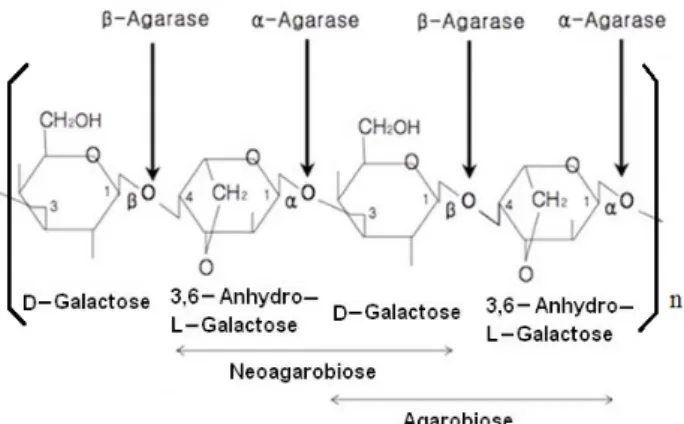
한천은 agarose와 agaropectin으로 이루어진 혼합물로 한 천을 구성하는 주된 단당류는 D-galactose와 3,6-anhydro-L- galactose (AHG)이다. Agarose는 겔(gel) 형성능력이 강하며 구성단당류인 AHG는 α(1→3) 결합으로 다음의 D-galactose 와 결합하고 D-galactose는 다음의 AHG와 β(1→4) 결합을 하 는 교차결합을 하여 직쇄구조를 형성한다. Agaropectin은 agarose와 같이 D-galactose와 AHG의 결합으로 형성되지만

황산기 등의 산성기를 함유하며 겔 형성능력이 약하다[32, 70].

홍조류는 자연계에서 다른 생물의 먹이가 될 수 있는데, 홍 조류의 자연적 분해에는 카라기난 분해효소인 carragenase와 한천분해효소인 agarase가 주로 작용한다. 이 효소들은 대부 분 미생물에 의해 생산되고 일부는 홍조류를 먹이로 하는 동 물에서 생산된다. 한천은 그 자체로도 식품산업과 의약품산 업, 향장품산업 등에 이용되고 있지만 agarase 분해산물인 네 오한천올리고당(neoagarooligosaccharides, NAOS)이나 한천 올리고당(agarooligosaccharides, AOS)은 면역증진, 항암, 간 보호, 항균, prebiotic 효과 등을 통한 인체보호기능 외에 항산 화, 미백, 보습 효과 등의 기능성을 보여 향장품산업에도 적용 가능성이 높은 고부가가치 물질이 될 수 있다. Agarase 분해산 물의 고기능성 이외에도 agarase 자체의 용도는 세포 및 DNA 의 회수, 의약학 연구 등에서의 세포의 배양과 생리현상 파악, 종자개량 등을 위한 해조류의 원형질체 생산, 홍조류를 기질 로 하는 바이오에너지 생산 등이 있다[43]. 또한, agarase는 항암제나 당뇨치료제의 후보물질이 될 수 있는 AHG의 생산 이외에도 분비발현을 확인하는 보고자(reporter)로서 활용되 며, agarase 유전자의 분비신호를 세포외 분비생산시스템에 활용할 수도 있다[87].

이에 agarase를 생산하는 세균의 탐색과 이들이 생산하는 agarase의 특성에 관한 많은 연구가 진행되었으며, 저자들도 새로운 한천분해세균들의 탐색과 이들의 agarase의 특성 파악

- Review -

(2)

[24, 67], agarase를 이용한 한천분해산물의 제조와 미백 등의 기능성 파악과[42] 함께 agarase 유전자의 확보 및 재조합 발 현[30, 37], 유전자의 돌연변이를 통한 agarase의 특성 개선[46]

등을 보고하였다.

본 연구에서는 저자들이 agarase에 대해 총설한[41] 2012년 부터 2019년 6월까지 발표된 agarase의 재조합발현에 대한 연 구동향을 정리하여 향후의 연구에 도움이 되고자 하였다.

Agarase 유전자의 기원 균주와 재조합 agarase

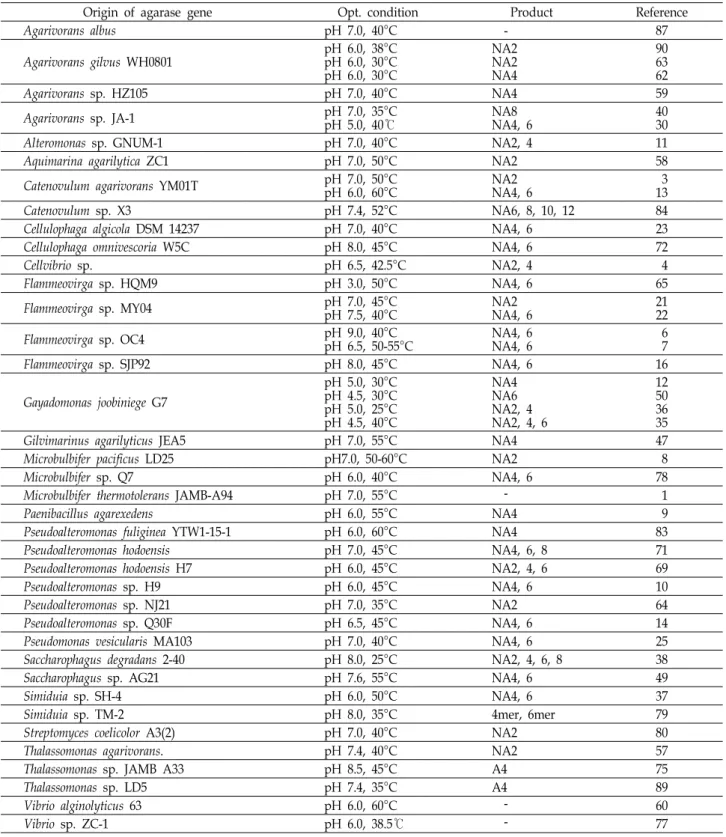
Table 1은 2012년부터 2019년 6월까지 세균 유래의 agarase 유전자를 재조합 발현한 내용들을 정리한 것이다. Agarase 유 전자의 재조합 발현을 위해 유전자 발굴의 source가 되었던 균주는 총 19개 속(genus)이었다(Table 1). Agarivorans 속 세균 이 7종으로 가장 많았고, Flammeovirga 속 세균과 Pseudoalter- omonas 속 세균이 각 6종, Gayadomonas 속 세균이 4종, Cate- novulum 속 세균과 Microbulbifer 속 세균이 각 3종, Cellulophaga 속 세균, Saccharophagus 속 세균, Simiduia 속 세균 및 Vibrio 속 세균이 각 2종이었다.

Agarase 유전자의 재조합 발현은 agarase의 생산량을 증진 시킬 수 있고 추가적인 유전자 조작으로 최적 활성 조건의 변화 및 열안정성의 증가[61, 77, 90], 정제의 용이성 부여[9, 10, 69] 등이 가능하기에 많이 이용되고 있지만, 재조합 발현을 위해서는 agarase 유전자의 확보가 전제되어야 한다. 이와 이 [41]는 agarase 유전자 확보 방법으로 첫째 같은 속(genus)이 나 종(species)에서 보고된 agarase 유전자에 기반한 PCR pri- mer를 새로운 한천분해세균에 적용하는 방법, 둘째 한천분해 효소의 순수분리 후에 파악된 아미노산 서열을 토대로 제작된 PCR primer를 이용하거나 agarase에서 공통으로 발견되는 아 미노산 보존 영역을 토대로 degenerative PCR primer을 이용 하는 방법, 셋째 메타게놈(metagenome) 서열이나 배양된 한 천분해세균의 게놈서열에서 agarase 유전자들을 파악하고 실 제 기능을 확인하는 방법, 마지막으로 이미 확보된 agarase 유전자의 돌연변이 유발로 새로운 특성을 얻는 방법 등을 제 시하였다. Table 1의 재조합 agarase의 유전자들도 기본적으 로 전술한 4가지 방법으로 확보한 것이었다.

α-Agarase와 β-agarase

전체 47개의 재조합발현 agarase들 중에서 2개는 Thalasso- monas 속 유래의 α-agarase였으며[75, 89], 42개는 β-agarase였 고, 3개는 특성을 알 수가 없었다. 아가로스를 기질로 하여 β-agarase는 neoagarobiose (NA2)와 neoagarotetraose (NA4) 등의 NAOS를, α-agarase는 AOS를 생산한다. Agarivorans al- bus [87]와 Vibrio sp. ZC-1 [77] 유래의 β-agarase는 분해산물 을 알 수가 없어서 Table 1에 나타내지 않았다.

AOS는 항산화 및 항암 활성 등이 보고된 반면, NAOS는 항산화 및 항암 활성 이외에도 미백, 대식세포 활성화, 장내세

균을 활성화하는 prebiotic 효과, 활성산소종(ROS)에 의한 간 피해를 막는 효과, 미생물 생장 억제 효과 등을 나타내어 AOS 보다 다양한 기능성이 있는 것으로 알려져 있다[42]. 또한, AOS는 산가수분해로도 생산할 수 있지만, NAOS는 오직 β- agarase에 의해서만 생성된다. 따라서 대부분의 agarase의 재 조합 연구가 β-agarase에 집중된 것으로 사료되었다.

재조합 agarase의 산물

2종의 α-agarase의 산물은 모두 agarotetraose였다[75, 89].

β-Agarase는 NA2, NA4 등의 2종류 이상의 산물을 생산하는 경우가 많았는데, NA2만을 생산하는 9개를 포함하여 NA2를 생산하는 agarase가 15개, NA4만을 생산하는 6개를 포함하여 NA4이상의 분자량을 가진 산물들만 생산하는 agarase가 22 개, neoagarohexaose (NA6) 이상을 생산하는 agarase가 3개였 다. 5개의 agarase는 산물에 대한 정보가 부족하였다. 효소를 구성하는 아미노산 서열의 상동성을 토대로 agarase를 분류하 면 GH (glycoside hydrolase) family로 나눌 수 있다[5]. GH 종류에 따라 agarase의 산물이 다른데 GH16은 NA4를, GH50 은 NA2 혹은 NA2와 NA4의 혼합물을, GH86은 NA6과 NA8 (neoagaroctaose)을, GH118은 NA10 (neoagarodecaose)을 생 산한다[18].

재조합 agarase의 활성 최적 조건

재조합 발현된 agarase들의 최적온도는 25~60℃, 최적 pH 는 3.0~8.5의 범위로 다양하였다(Table 1). 기질이 고체 상태일 때 보다 액체 상태일 때 효소가 작용하기 쉽다. 한천의 농도에 따라 차이를 보이지만 1.5%의 한천은 85℃ 이상에서는 녹아서 졸(sol) 상태가 되고 이후 온도가 낮아지더라도 45℃ 이상이면 졸상태가 되고 45℃ 이하가 되면 겔(gel) 상태가 되어[26] 효소 가 작용하는데 차이를 보일 것이다. 50℃ 이상의 최적 온도를 갖는 agarase는 14개로(Table 1) 이들은 한천이 sol 상태일 때 반응하여 산물을 원활히 생산할 수 있을 것이다. 하지만 sol 상태로 만들기 위해 85℃ 이상의 고온이 필요한데 이는 NAOS 생산공정에서 비용부담이 될 수 있다. Kim 등[37]은 재조합 agarase의 기질로 녹이지 않은 아가로스나 한천을 이용하여도 NAOS를 생산하여 향후 NAOS 생산공정의 비용을 줄이는 방 법을 모색하였다. Ko 등[38]도 25℃에서 재조합 agarase로 한 천분해를 시도하였지만 최적온도인지는 알 수 없고, Gayado- monas 속 유래의 agarase의 최적온도가 25℃로 가장 낮았으며, 5℃에서도 최적온도의 80% 활성을 유지하여[36] 저온 활성의 agarase에 대한 연구도 진행되고 있음을 알 수 있었다.

돌연변이와 융합 agarase

저온활성 agarase 등에 대한 연구도 보고되고 있지만 한천

의 sol상태가 유지되는 고온에서 효소 활성이 오래 유지되거

나, sol 상태가 유지되는 온도에서 활성이 아주 높으면 AOS나

(3)

Table 1. Recombinant agarases from bacteria since 2012

Origin of agarase gene Opt. condition Product Reference

Agarivorans albus pH 7.0, 40°C  - 87

Agarivorans gilvus WH0801 pH 6.0, 38°C

pH 6.0, 30°C pH 6.0, 30°C

NA2 NA2 NA4

90 63 62

Agarivorans sp. HZ105 pH 7.0, 40°C NA4 59

Agarivorans sp. JA-1 pH 7.0, 35°C

pH 5.0, 40℃ NA8

NA4, 6 40

30

Alteromonas sp. GNUM-1 pH 7.0, 40°C NA2, 4 11

Aquimarina agarilytica ZC1 pH 7.0, 50°C NA2 58

Catenovulum agarivorans YM01T pH 7.0, 50°C

pH 6.0, 60°C NA2

NA4, 6 3

13

Catenovulum sp. X3 pH 7.4, 52°C NA6, 8, 10, 12 84

Cellulophaga algicola DSM 14237 pH 7.0, 40°C NA4, 6 23

Cellulophaga omnivescoria W5C pH 8.0, 45°C NA4, 6 72

Cellvibrio sp. pH 6.5, 42.5°C NA2, 4 4

Flammeovirga sp. HQM9 pH 3.0, 50°C NA4, 6 65

Flammeovirga sp. MY04 pH 7.0, 45°C

pH 7.5, 40°C NA2

NA4, 6 21

22

Flammeovirga sp. OC4 pH 9.0, 40°C

pH 6.5, 50-55°C NA4, 6

NA4, 6 6

7

Flammeovirga sp. SJP92 pH 8.0, 45°C NA4, 6 16

Gayadomonas joobiniege G7

pH 5.0, 30°C pH 4.5, 30°C pH 5.0, 25°C pH 4.5, 40°C

NA4 NA6 NA2, 4 NA2, 4, 6

12 50 36 35

Gilvimarinus agarilyticus JEA5 pH 7.0, 55°C NA4 47

Microbulbifer pacificus LD25 pH7.0, 50-60°C NA2 8

Microbulbifer sp. Q7 pH 6.0, 40°C NA4, 6 78

Microbulbifer thermotolerans JAMB-A94 pH 7.0, 55°C  - 1

Paenibacillus agarexedens pH 6.0, 55°C NA4 9

Pseudoalteromonas fuliginea YTW1-15-1 pH 6.0, 60°C NA4 83

Pseudoalteromonas hodoensis pH 7.0, 45°C NA4, 6, 8 71

Pseudoalteromonas hodoensis H7 pH 6.0, 45°C NA2, 4, 6 69

Pseudoalteromonas sp. H9 pH 6.0, 45°C NA4, 6 10

Pseudoalteromonas sp. NJ21 pH 7.0, 35°C NA2 64

Pseudoalteromonas sp. Q30F pH 6.5, 45°C NA4, 6 14

Pseudomonas vesicularis MA103 pH 7.0, 40°C NA4, 6 25

Saccharophagus degradans 2-40 pH 8.0, 25°C NA2, 4, 6, 8 38

Saccharophagus sp. AG21 pH 7.6, 55°C NA4, 6 49

Simiduia sp. SH-4 pH 6.0, 50°C NA4, 6 37

Simiduia sp. TM-2 pH 8.0, 35°C 4mer, 6mer 79

Streptomyces coelicolor A3(2) pH 7.0, 40°C NA2 80

Thalassomonas agarivorans. pH 7.4, 40°C NA2 57

Thalassomonas sp. JAMB A33 pH 8.5, 45°C A4 75

Thalassomonas sp. LD5 pH 7.4, 35°C A4 89

Vibrio alginolyticus 63 pH 6.0, 60°C  - 60

Vibrio sp. ZC-1 pH 6.0, 38.5℃  - 77

NAOS 생산에 도움이 될 것이다. 인공진화라고도 표현하는 인위적 돌연변이를 통하여 agarase의 열안정성을 증가시키거 나[61, 77] 최적온도와 활성을 동시에 증가시키는[90] 보고들 도 있다. 정제목적으로 GST (glutathione-S-transferase) [10, 69]나 his tag [9, 49, 84]를 agarase와 융합한 연구도 있지만,

탄수화물 분해관련 효소의 CBM (carbohydrate-binding mod-

ule)을 교환하거나 추가하여 agarase의 활성을 증가시키거나

[1] 단백질 모듈(module)의 조합으로 agarase활성을 증진시킨

보고[31] 이외에도 neoagarobiose hydrolase와 agarase를 융

합 단백질 형태로 발현시킨 보고도 있다[2].

(4)

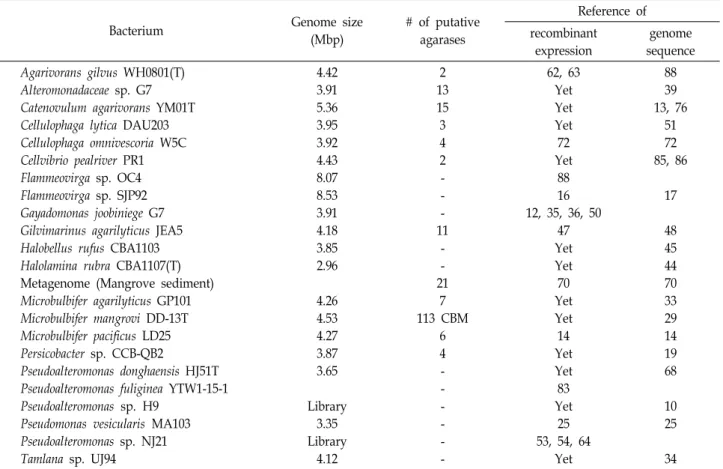
Table 2. Genome sequenced agarolytic bacteria and their putative agarases after gene annotation since 2012

Bacterium Genome size

(Mbp)

# of putative agarases

Reference of recombinant

expression

genome sequence Agarivorans gilvus WH0801(T)

Alteromonadaceae sp. G7 Catenovulum agarivorans YM01T Cellulophaga lytica DAU203 Cellulophaga omnivescoria W5C Cellvibrio pealriver PR1 Flammeovirga sp. OC4 Flammeovirga sp. SJP92 Gayadomonas joobiniege G7 Gilvimarinus agarilyticus JEA5 Halobellus rufus CBA1103 Halolamina rubra CBA1107(T) Metagenome (Mangrove sediment) Microbulbifer agarilyticus GP101 Microbulbifer mangrovi DD-13T Microbulbifer pacificus LD25 Persicobacter sp. CCB-QB2

Pseudoalteromonas donghaensis HJ51T Pseudoalteromonas fuliginea YTW1-15-1 Pseudoalteromonas sp. H9

Pseudomonas vesicularis MA103 Pseudoalteromonas sp. NJ21 Tamlana sp. UJ94

4.42 3.91 5.36 3.95 3.92 4.43 8.07 8.53 3.91 4.18 3.85 2.96

4.26 4.53 4.27 3.87 3.65

Library 3.35 Library

4.12

2 13 15 3 4 2 - - - 11

- - 21

7 113 CBM

6 4 - - - - - -

62, 63 Yet Yet Yet 72 Yet

88 16 12, 35, 36, 50

47 Yet Yet 70 Yet Yet 14 Yet Yet 83 Yet

25 53, 54, 64

Yet

88 39 13, 76

51 72 85, 86

17

48 45 44 70 33 29 14 19 68

10 25

34 Yet at ‘recombinant expression’ column means the null of recombinant expression although its genome sequenced or putative agarase was known. CBM is carbohydrate binding module and library means genome library.

발현 숙주와 신호서열

Agarase 재조합 발현의 숙주로 대부분 대장균을 이용하였 다. Agarase의 재조합 발현에 대장균 이외의 숙주가 사용된 사례는 Pseudoalteromonas sp. Q30F [14]와 P. hodoensis [71] 유 래의 agarase 발현숙주에 Bacillus subtilis가, Streptomyces coeli- color A3(2) 유래의 agarase에 Streptomyces lividans TK24 [80]

가, Thalassomonas JAMB A33 유래의 agarase에 Saccharomyces cerevisiae가 있다[75]. 대장균의 경우 봉입체(inclusion body)에 단백질이 축적될 수 있지만 B. subtilis는 분비형 발현을 하고 [55] S. lividans 역시 분비형 발현을 하며 목적유전자에 GC 비율이 높은 경우에 주로 사용된다. S. cerevisiae는 GRAS (generally recognized as safe) 균주로 많은 바이오의약품의 재조합 발현에서 숙주로 사용되며, agarase 유전자를 재조합 발현하는 효모는 바이오에탄올 생산에 바로 사용할 수 있는 장점도 있다[43, 75]. Pichia pastoris 효모에서 agarase를 재조합 발현한 연구도 있었다[56].

Agarase 유전자에 agarase 분비를 위한 신호서열(signal se- quence)이 있는 경우들이 보고되는데[9, 54] Microbulbifer sp.

Q7의 agarase 유전자에 존재하는 신호서열이 발현숙주인 대 장균에서도 작동하여 agarase가 분비형으로 발현되었다[78].

Agarase유전자에 존재하는 신호서열이 아닌 다른 신호서열을 사용한 연구를 보면 숙주표면에 발현된 단백질을 유지시키는 Autotransporters를 이용하여 대장균에서 agarase를 표면 발 현한 연구[38], Agarivorans albus 유래 agarase 유전자의 codon usage 변경과 분비서열 추가로 대장균에서 재조합 분비발현 한 연구[54], Saccharomyces cerevisiae에 특이적인 신호서열을 이용하여 세균의 agarase 유전자를 S. cerevisiae에서 발현한 연구[43] 등이 있다. 또한 Streptomyces lividans에서의 agarase 분비발현과 단백질의 접힘(folding)을 위해 Sec route와 Tat route 등을 비교하거나 amylase와 agarase의 신호서열을 바꾸 어 분비양상을 확인한 연구[20, 82] 이외에도 riboswitch를 이 용하여 agarase의 발현효율을 280배 증진시킨 보고도 있다[73, 74].

게놈분석과 putative agarase 발현

Pseudoalteromonas sp. NJ21 균주에서 agarase 정제 후의 특 성 파악[53], 게놈분석 후 agarase 후보유전자의 재조합 발현 [64], 유전체도서관(genomic library)에서 agarase 발굴과 재조 합 발현[54] 등의 다양한 연구방법에 의한 보고가 있었다.

Cohnella sp. LGH의 유전체도서관 유래의 agarase 재조합도

(5)

Fig. 1. Structure of agarose and catalytic sites of α-agarase and β-agarase. Agarose is composed of the repetition of neo- agarobiose or agarobiose subunit.

보고되고 있지만[52] 최근 게놈서열 분석 기술과 생물정보학 의 발달로 agarase 생성 균주의 게놈서열을 파악하고 게놈서 열에 근거하여 후보 agarase 유전자를 재조합 발현하여 agar- ase 활성을 파악하는 등의 연구가 많이 보고되고 있다. Table 2는 2012년부터 현재까지의 agarase 생산균주의 게놈서열 분 석이나 게놈서열에 근거한 재조합 발현 그리고 메타게놈 (metagenome)을 이용한 agarase의 재조합 발현 등에 관한 연 구들을 나타내었다. 유전자 분석이 끝나지 않은 draft genome 이나 유전자 분석이 끝난 유전체(genome)에 대한 분석 등에 근거한 agarase의 재조합 활성 등이 보고되고 있다. Agarase 후보(putative agariase)가 게놈에 따라 최대 21개까지 예상되 지만(Table 2) Victivallis vadensis ATCC BAA-548의 유전체에 서 putative agarase 유전자를 재조합 발현하니 galactosidase 로 판명된 보고도 있어[81] 유전자 분석 후에 재조합 발현을 통해 agarase 활성을 확인해야 한다. 게놈서열이 확보된 균주 들의 agarase 후보인 putative agarase의 재조합 발현으로 새 로운 agarase의 확보가 가능할 것이다. 한천분해 Microbulbifer mangrovi DD-13T 균주는 agarase 대신 113개의 CBM (carbohydrate binding module)이 검색되었다. 한편 자연계에 존재하는 미생물의 대부분은 배양이 불가능하거나 배양이 어 렵다. 이러한 배양 불가능한 미생물의 유전자를 활용하는 사 례 중에서 mangrove 저층(sediment)의 메타게놈을 확보하여 21개의 agarase 후보 유전자를 발굴한 보고도 있어 향후 새로 운 agarase 유전자 발굴에 메타게놈을 활용할 수 있을 것이다 [15, 66, 70].

결 론

Agarase를 이용한 세포/DNA의 회수와 종자개량을 위한 해조류의 원형질체 제조 등의 기초과학적 응용 이외에도 바이 오에너지 생산과 고기능성 한천올리고당이나 네오한천올리 고당 생산에 agarase가 필요하여, 새로운 한천분해효소 유전

자를 확보하기 위한 연구와 함께 재조합 발현에 관한 연구들 이 많이 보고되었다. 2012년 이후 현재까지 47개의 agarase 재조합 발현에 관한 연구가 있었으며 이들의 최적온도는 25~60℃, 최적 pH는 3.0~8.5의 범위로 다양하였다. 2개의 α- agarase는 agarotetraose (A4)를 생산하였고, 45개의 β-agar- ase는 NA2부터 NA12까지의 다양한 분해산물을 생산하였다.

항산화활성, 항암활성, 미백활성, 대식세포 활성화 활성, pre- biotic 효과, 미생물성장 억제 효과 등의 기능성을 나타내는 NAOS는 오로지 β-agarase에 의해서만 생산되므로 향후에도 β-agarase에 관한 연구가 많이 이루어질 것이다. 현재도 진행 되고 있는 재조합 발현량 상승과 분비발현 등에 대한 연구들 과 결합되면 한천유래 고기능성 올리고당의 활발한 이용이 기대된다.

The Conflict of Interest Statement

The authors declare that they have no conflicts of interest with the contents of this article.

References
1. Alkotaini, B., Han, N. S. and Kim, B. S. 2016. Enhanced cata- lytic efficiency of endo-β-agarase I by fusion of carbohy- drate- binding modules for agar prehydrolysis. Enzyme Microb. Technol. 93-94, 142-149.

2. Alkotaini, B., Han, N. S. and Kim, B. S. 2017. Fusion of agar- ase and neoagarobiose hydrolase for mono-sugar pro- duction from agar. Appl. Microbiol. Biotechnol. 101, 1573-1580.

3. An, K., Shi, X., Cui, F., Cheng, J., Liu, N., Zhao, X. and Zhang, X. H. 2018. Characterization and overexpression of a glycosyl hydrolase family 16 beta-agarase YM01-1 from marine bacterium Catenovulum agarivorans YM01T. Protein Expr. Purif. 143, 1-8.

4. Ariga, O., Inoue, T., Kubo, H., Minami, K., Nakamura, M., Iwai, M., Moriyama, H., Yanagisawa, M. and Nakasaki, K.

2012. Cloning of agarase gene from non-marine agarolytic bacterium Cellvibrio sp. J. Microbiol. Biotechnol. 22, 1237-1244.

5. Cantarel, B. L., Coutinho, P. M., Rancurel, C., Bernard, T., Lombard, V. and Henrissat, B. 2009. The Carbohydrate- Active EnZymes database (CAZy): an expert resource for Glycogenomics. Nucl. Acids Res. 37, D233-D238.

6. Chen, X., Lin, H., Jin, M., Zeng, R. and Lin, M. 2019. Charac- terization of a novel alkaline β-agarase and its hydrolysates of agar. Food Chem. 295, 311-319.

7. Chen, X. L., Hou, Y. P., Jin, M., Zeng, R. Y. and Lin, H.

T. 2016. Expression and characterization of a novel thermo- stable and pH-stable β-agarase from deep-sea Bacterium Flammeovirga sp. OC4. J. Agric. Food Chem. 64, 7251-7258.

8. Chen, Y. P., Wu, H. T., Wang, G. H., Wu, D. Y., Hwang, I. E., Chien, M. C., Pang, H. Y., Kuo, J. T. and Liaw, L.

L. 2019. Inspecting the genome sequence and agarases of

Microbulbifer pacificus LD25 from a saltwater hot spring. J.

(6)

Biosci. Bioeng. 127, 403-410.

9. Chen, Z. W., Lin, H. J., Huang, W. C., Hsuan, S. L., Lin, J. H. and Wang, J. P. 2018. Molecular cloning, expression, and functional characterization of the β-agarase AgaB-4 from Paenibacillus agarexedens. AMB Express 8, 49.

10. Chi, W. J., Lee, C. R., Dugerjonjuu, S., Park, J. S., Kang, D. K. and Hong, S. K. 2015. Biochemical characterization of a novel iron-dependent GH16 β-agarase, AgaH92, from an agarolytic bacterium Pseudoalteromonas sp. H9. FEMS Microbiol. Lett. 362, fnv035.

11. Chi, W. J., Park, D. Y., Seo, Y. B., Chang, Y. K., Lee, S. Y.

and Hong, S. K. 2014. Cloning, expression, and biochemical characterization of a novel GH16 β-agarase AgaG1 from Alteromonas sp. GNUM-1. Appl. Microbiol. Biotechnol. 98, 4545-4555.

12. Choi, U., Jung, S., Hong, S. K. and Lee, C. R. 2019. Characte- rization of a Novel Neoagarobiose-producing GH42 β- Agarase, AgaJ10, from Gayadomonas joobiniege G7. Appl. Bio- chem. Biotechnol. 189, 1-12.

13. Cui, F., Dong, S., Shi, X., Zhao, X. and Zhang, X. H. 2014.

Overexpression and characterization of a novel thermo- stable β-agarase YM01-3, from marine bacterium Catenov- ulum agarivorans YM01(T). Mar. Drugs 12, 2731-2747.

14. Cui, X., Jiang, Y., Chang, L., Meng, L., Yu, J., Wang, C. and Jiang, X. 2018. Heterologous expression of an agarase gene in Bacillus subtilis, and characterization of the agarase. Int.

J. Biol. Macromol. 120, 657-664.

15. Di, W., Qu, W. and Zeng, R. 2018. Cloning, expression, and characterization of thermal-stable and pH-stable agarase from mangrove sediments. J. Basic Microbiol. 58, 302-309.

16. Dong, Q., Ruan, L. and Shi, H. 2016. A β-agarase with high pH stability from Flammeovirga sp. SJP92. Carbohydr. Res.

432, 1-8.

17. Dong, Q., Ruan, L. and Shi, H. 2017. Genome sequence of a high agarase-producing strain Flammeovirga sp. SJP92.

Stand. Genomic Sci. 12, 13.

18. Fu, X. T. and Kim, S. M. 2010. Agarase: review of major sources, categories, purification method, enzyme character- istics and applications. Mar. Drugs 8, 200-218.

19. Furusawa, G., Lau, N. S., Suganthi, A. and Amirul, A. A.

2016. Agarolytic bacterium Persicobacter sp. CCB-QB2 exhib- ited a diauxic growth involving galactose utilization path- way. Microbiologyopen 6, e00405.

20. Gullón, S., Vicente, R. L., Valverde, J. R., Marín, S. and Mel- lado, R. P. 2015. Exploring the feasibility of the sec route to secrete proteins using the tat route in Streptomyces lividans. Mol. Biotechnol. 57, 931-938.

21. Han, W., Cheng, Y., Wang, D., Wang, S., Liu, H., Gu, J., Wu, Z. and Li, F. 2016. Biochemical characteristics and substrate degradation pattern of a novel exo-type β-agarase from the polysaccharide-degrading marine bacterium Flammeovirga sp. strain MY04. Appl. Environ. Microbiol. 82, 4944-4954.

22. Han, W. J., Gu, J. Y., Liu, H. H., Li, F. C., Wu, Z. H. and Li, Y. Z. 2013. An extra peptide within the catalytic module of a β-agarase affects the agarose degradation pattern. J.

Biol. Chem. 288, 9519-9531.

23. Han, Z., Zhang, Y. and Yang, J. 2019. Biochemical character- ization of a new β-agarase from Cellulophaga algicola. Int.

J. Mol. Sci. 20, 2143.

24. Heo, D. H., Lee, D. G. and Lee, S. H. 2019. Isolation of an agarase-producing Persicobacter sp. DH-3 and character- ization of its β–agarase. J. Life Sci. 29, 158-163.

25. Hsu, P. H., Wei, C. H., Lu, W. J., Shen, F., Pan, C. L. and Lin, H. T. 2015. Extracellular production of a novel endo-β- agarase AgaA from Pseudomonas vesicularis MA103 that cleaves agarose into neoagarotetraose and neoagarohexaose.

Int. J. Mol. Sci. 16, 5590-5603.

26. http://www.agargel.com.br/agar-tec-en.html

27. https://www.nongsaro.go.kr/portal/ps/psq/psqb/farm TermDicLst. ps?menu Id=PS00064

28. https://www.miryangagaragar.com/shop/Agar/agar05.

php

29. Imran, M., Pant, P., Shanbhag, Y. P., Sawant, S. V. and Ghadi, S. C. 2017. Genome sequence of Microbulbifer mangrovi DD- 13T reveals its versatility to degrade multiple polysaccha- rides. Mar. Biotechnol. (NY). 19, 116-124.

30. Jeon, M. J., Kang, A. R., Lee, D. G. and Lee, S. H. 2012.

Cloning, expression, and characterization of a novel GH-16 β-agarase from Agarivorans sp. JA-1. J. Life Sci. 22, 1545-1551.

31. Jeong, D. W., Hyeon, J. E., Joo, Y. C., Shin, S. K. and Han, S. O. 2018. Integration of bacterial expansin on agarolytic complexes to enhance the degrading activity of red algae by control of gelling properties. Mar. Biotechnol. (NY). 20, 1-9.

32. Jiao, G., Yu, G., Zhang, J. and Ewart, H. S. 2011. Chemical structures and bioactivities of sulfated polysaccharides from marine algae. Mar. Drugs 9, 196-223.

33. Jung, J. J., Bae, S. S., Chung, D. W. and Baek, K. H. 2018.

Complete genome sequence of Microbulbifer agarilyticus GP101 possessing genes coding for diverse polysaccharide- degrading enzymes. Kor. J. Microbiol. 54, 299-301.

34. Jung, J. J., Bae, S. S., Chung, D. W. and Baek, K, H. 2018.

Complete genome sequence of Tamlana sp. UJ94 degrading alginate. Kor. J. Microbiol. 54, 463-464.

35. Jung, S., Jeong, B. C., Hong, S. K. and Lee, C. R. 2017.

Cloning, expression, and biochemical characterization of a novel acidic GH16 β-agarase, AgaJ11, from Gayadomonas joo- biniege G7. Appl. Biochem. Biotechnol. 181, 961-971.

36. Jung, S., Lee, C. R., Chi, W. J., Bae, C. H. and Hong, S.

K. 2017. Biochemical characterization of a novel cold-adapt- ed GH39 β-agarase, AgaJ9, from an agar-degrading marine bacterium Gayadomonas joobiniege G7. Appl. Microbiol. Bio- technol. 101, 1965-1974.

37. Kim, J. D., Lee, D. G. and Lee, S. H. 2018. Cloning, expression, and characterization of a thermotolerant β-agarase from Simiduia sp. SH-4. Biotechnol. Bioprocess Eng. 23, 525-531.

38. Ko, H. J., Park, E., Song, J., Yang, T. H., Lee, H. J., Kim, K. H. and Choi, I. G. 2012. Functional cell surface display and controlled secretion of diverse Agarolytic enzymes by Escherichia coli with a novel ligation-independent cloning vector based on the autotransporter YfaL. Appl. Environ.

Microbiol. 78, 3051-3058.

(7)

39. Kwak, M. J., Song, J. Y., Kim, B. K., Chi, W. J., Kwon, S.

K., Choi, S., Chang, Y. K., Hong, S. K. and Kim, J. F. 2012.

Genome sequence of the agar-degrading marine bacterium Alteromonadaceae sp. strain G7. J. Bacteriol. 194, 6961-6962.

40. Lee, D. G., Jeon, M. J. and Lee, S. H. 2012. Cloning, ex- pression, and characterization of a glycoside hydrolase fam- ily 118 beta-agarase from Agarivorans sp. JA-1. J. Microbiol.

Biotechnol. 22, 1692-1697.

41. Lee, D. G. and Lee, S. H. 2012. The classification, origin, collection, determination of activity, purification, pro- duction, and application of agarases. J. Life Sci. 22, 266-280.

42. Lee, D. G., Jang, M. K., Lee, O. H., Kim, N. Y., Ju, S. A.

and Lee, S. H. 2008. Over-production of a glycoside hydro- lase family 50 β-agarase from Agarivorans sp. JA-1 in Bacillus subtilis and the whitening effect of its product. Biotechnol.

Lett. 30, 911-918.

43. Lee, J. S., Hong, S. K., Lee, C. R., Nam, S. W., Jeon, S. J.

and Kim, Y. H. 2019. Production of ethanol from agarose by unified enzymatic saccharification and fermentation in recombinant yeast. J. Microbiol. Biotechnol. 29, 625-632.

44. Lee, M. H., Lee, H. W., Song, E. J., Song, H. S., Yim, K.

J., Cha, I. T., Seo, M. J., Rhee, J. K., Choi, H. J., Kim, D., Kim, K. N., Roh, S. W. and Nam, Y. D. 2014. Draft genome sequence of Halolamina rubra CBA1107(T), an agarolytic hal- oarchaeon isolated from solar salt. Mar. Genomics 18 Pt B, 127-128.

45. Lee, M. H., Rhee, J. K., Cha, I. T., Song, E. J., Song, H. S., Yim, K. J., Seo, M. J., Choi, J. S., Choi, H. J., Yoon, C., Nam, Y. D. and Roh, S. W. 2015. Draft genome sequence of the agarolytic haloarchaeon Halobellus rufus type strain CBA 1103. FEMS Microbiol. Lett. 362, 1-3.

46. Lee, S., Lee, D. G., Jang, M. K., Jeon, M. J., Jang, H. J. and Lee, S. H. 2011. Improvement in the catalytic activity of β- agarase AgaA from Zobellia galactanivorans by site-directed mutagenesis. J. Microbiol. Biotechnol. 21, 1116-1122.

47. Lee, Y., Jo, E., Lee, Y. J., Hettiarachchi, S. A., Park, G. H., Lee, S. J., Heo, S. J., Kang, D. H. and Oh, C. 2018. A novel glycosyl hydrolase family 16 β-agarase from the agar-utiliz- ing marine bacterium Gilvimarinus agarilyticus JEA5, the first molecular and biochemical characterization of agarase in ge- nus Gilvimarinus. J. Microbiol. Biotechnol. 28, 776-783.

48. Lee, Y., Lee, S. J., Park, G. H., Heo, S. J., Umasuthan, N., Kang, D. H. and Oh, C. 2015. Draft genome of agar-degrad- ing marine bacterium Gilvimarinus agarilyticus JEA5. Mar.

Genomics 21, 13-14.

49. Lee, Y., Oh, C., de Zoysa, M., Kim, H., Wickramaarachchi, W. D., Whang, I., Kang, D. H. and Lee, J. 2013. Molecular cloning, overexpression, and enzymatic characterization of glycosyl hydrolase family 16 β-agarase from marine bacte- rium Saccharophagus sp. AG21 in Escherichia coli. J. Microbiol.

Biotechnol. 23, 913-922.

50. Lee, Y. R., Jung, S., Chi, W. J., Bae, C. H., Jeong, B. C., Hong, S. K. and Lee, C. R. 2018. Biochemical characterization of a novel GH86 β-agarase producing neoagarohexaose from Gayadomonas joobiniege G7. J. Microbiol. Biotechnol. 28, 284- 292.

51. Lee, Y. S. and Choi, Y. L. 2017. Complete genome sequence and analysis of three kinds of β-agarase of Cellulophaga lytica DAU203 isolated from marine sediment. Mar. Genomics 35, 43-46.

52. Li, G., Sun, M., Wu, J., Ye, M., Ge, X., Wei, W., Li, H. and Hu, F. 2015. Identification and biochemical characterization of a novel endo-type β-agarase AgaW from Cohnella sp.

strain LGH. Appl. Microbiol. Biotechnol. 99, 10019-10029.

53. Li, J., Hu, Q., Li, Y. and Xu, Y. 2015. Purification and charac- terization of cold-adapted beta-agarase from an Antarctic psychrophilic strain. Braz. J. Microbiol. 46, 683-690.

54. Li, J., Xie, M. and Gao, Y. 2019. Identification and bio- chemical characterization of a novel exo-type β-agarase Aga3463 from an Antarctic Pseudoalteromonas sp. strain. Int.

J. Biol. Macromol. 129, 162-170.

55. Li, L., Qu, W., Jin, M., Di, W. and Zeng, R. 2019. Extracellu- lar expression of agarase rAgaM1 in Bacillus subtilis and its ability for neoagaro-oligosaccharide production. J. Basic Microbiol. 59, 359-367.

56. Li, R. K., Chen, Z., Ying, X. J., Ng, T. B. and Ye, X. Y. 2018.

A novel GH16 beta-agarase isolated from a marine bacte- rium, Microbulbifer sp. BN3 and its characterization and high-level expression in Pichia pastoris. Int. J. Biol. Macromol.

119, 1164-1170.

57. Liang, S. S., Chen, Y. P., Chen, Y. H., Chiu, S. H. and Liaw, L. L. 2014. Characterization and overexpression of a novel β-agarase from Thalassomonas agarivorans. J. Appl. Microbiol.

116, 563-572.

58. Lin, B., Liu, Y., Lu, G., Zhao, M. and Hu, Z. 2017. An agarase of glycoside hydrolase family 16 from marine bacterium Aquimarina agarilytica ZC1. FEMS Microbiol. Lett. 364, fnx012.

59. Lin, B., Lu, G., Zheng, Y., Xie, W., Li, S. and Hu, Z. 2012.

Gene cloning, expression and characterization of a neo- agarotetraose-producing β-agarase from the marine bacte- rium Agarivorans sp. HZ105. World J. Microbiol. Biotechnol.

28, 1691-1697.

60. Liu, G., Wu, S., Jin, W. and Sun, C. 2016. Amy63, a novel type of marine bacterial multifunctional enzyme possessing amylase, agarase and carrageenase activities. Sci. Rep. 6, 18726.

61. Liu, H., Zhang, W., Liu, D., Yu, W. and Lu, X. 2015. High expression of agarase AgaD in Escherichia coli. Acta Microbiol.

Sin. 55, 1171-1176.

62. Liu, N., Mao, X., Du, Z., Mu, B. and Wei, D. 2014. Cloning and characterisation of a novel neoagarotetraose-forming-β- agarase, AgWH50A from Agarivorans gilvus WH0801. Carbo- hydr. Res. 388, 147-151.

63. Liu, N., Mao, X., Yang, M., Mu, B. and Wei, D. 2014. Gene cloning, expression and characterisation of a new β-agarase, AgWH50C, producing neoagarobiose from Agarivorans gil- vus WH0801. World J. Microbiol. Biotechnol. 30, 1691-1698.

64. Liu, X., Li, J., Hou, X. and He, P. 2016. Expression and char- acterization of the agarase gene aga3311 from an Antarctic bacterium. Acta Microbiol. Sin. 56, 1468-1476.

65. Liu, Y., Tian, X., Peng, C. and Du, Z. 2019. Isolation and

characterization of an eosinophilic GH 16 β-agarase (Aga

(8)

DL6) from an agar-degrading marine bacterium Flammeovir- ga sp. HQM9. J. Microbiol. Biotechnol. 29, 235-243.

66. Mai, Z., Su, H. and Zhang, S. 2016. Isolation and character- ization of a glycosyl hydrolase family 16 β-agarase from a mangrove soil metagenomic library. Int. J. Mol. Sci. 17, E1360.

67. Min, K. C., Lee, C. E., Lee, D. G. and Lee, S. H. 2018. Isolation of Agarivorans sp. KC-1 and characterization of its thermoto- lerant β–agarase. J. Life Sci. 28, 1056-1061.

68. Oh, J. S. and Roh, D. H. 2018. Complete genome sequence of Pseudoalteromonas donghaensis HJ51

T

isolated from sea- water. Kor. J. Microbiol. 54, 305-307.

69. Park, D. Y., Chi, W. J., Park, J. S., Chang, Y. K. and Hong, S. K. 2015. Cloning, expression, and biochemical character- ization of a GH16 β-agarase AgaH71 from Pseudoalteromonas hodoensis H7. Appl. Biochem. Biotechnol. 175, 733-747.

70. Qu, W., Lin, D., Zhang, Z., Di, W., Gao, B. and Zeng, R.

2018. Metagenomics investigation of agarlytic genes and ge- nomes in mangrove sediments in China, a potential reper- tory for carbohydrate-active enzymes. Front. Microbiol. 9, 1864.

71. Ramos, K. R., Valdehuesa, K. N., Cabulong, R. B., Moron, L. S., Nisola, G. M., Hong, S. K., Lee, W. K. and Chung, W. J. 2016. Overexpression and secretion of AgaA7 from Pseudoalteromonas hodoensis sp. nov in Bacillus subtilis for the depolymerization of agarose. Enzyme Microb. Technol. 90, 19-25.

72. Ramos, K. R. M., Valdehuesa, K. N. G., Nisola, G. M., Lee, W. K. and Chung, W. J. 2018. Identification and character- ization of a thermostable endolytic β-agarase Aga2 from a newly isolated marine agarolytic bacteria Cellulophaga omni- vescoria W5C. N. Biotechnol. 40, 261-267.

73. Rudolph, M. M., Vockenhuber, M. P. and Suess, B. 2013.

Synthetic riboswitches for the conditional control of gene expression in Streptomyces coelicolor. Microbiology 159, 1416- 1422.

74. Rudolph, M. M., Vockenhuber, M. P. and Suess, B. 2015.

Conditional control of gene expression by synthetic ri- boswitches in Streptomyces coelicolor. Methods Enzymol. 550, 283-299.

75. Seok, J. H., Kim, H. S., Hatada, Y., Nam, S. W. and Kim, Y. H. 2012. Construction of an expression system for the secretory production of recombinant α-agarase in yeast.

Biotechnol. Lett. 34, 1041-1049.

76. Shi, X., Yu, M., Yan, S., Dong, S. and Zhang, X. H. 2012.

Genome sequence of the thermostable-agarase-producing marine bacterium Catenovulum agarivorans YM01(T), which reveals the presence of a series of agarase-encoding genes.

J. Bacteriol. 194, 5484.

77. Su, B. M., Xu, X. Q., Yan, R. X., Xie, Y. and Lin, J. 2019.

Mutagenesis on the surface of a β-agarase from Vibrio sp.

ZC-1 increased its thermo-stability. Enzyme Microb. Technol.

127, 22-31.

78. Su, Q., Jin, T., Yu, Y., Yang, M., Mou, H. and Li, L. 2017.

Extracellular expression of a novel β-agarase from Microbul- bifer sp. Q7, isolated from the gut of sea cucumber. AMB Express 7, 220.

79. Tawara, M., Sakatoku, A., Tiodjio, R. E., Tanaka, D. and Nakamura, S. 2015. Cloning and characterization of a novel agarase from a newly isolated bacterium Simiduia sp. strain TM-2 able to degrade various seaweeds. Appl. Biochem.

Biotechnol. 177, 610-623.

80. Temuujin, U., Chi, W. J., Chang, Y. K. and Hong, S. K. 2012.

Identification and biochemical characterization of Sco3487 from Streptomyces coelicolor A3(2), an exo- and endo-type β- agarase-producing neoagarobiose. J. Bacteriol. 194, 142-149.

81. Temuujin, U., Chi, W. J., Park, J. S., Chang, Y. K., Song, J. Y. and Hong, S. K. 2012. Identification and character- ization of a novel β-galactosidase from Victivallis vadensis ATCC BAA-548, an anaerobic fecal bacterium. J. Microbiol.

50, 1034-1040.

82. Valverde, J. R., Gullón, S. and Mellado, R. P. 2018. Model- ling the metabolism of protein secretion through the Tat route in Streptomyces lividans. BMC Microbiol. 18, 59.

83. Wang, Y., Liu, T., Guo, S., Zhang, P., Sun, P., Chen, M. and Ming, H. 2019. Characterization and overexpression of a glycosyl hydrolase family 16 β-agarase Aga0917 from Pseu- doalteromonas fuliginea YTW1-15-1. J. Gen. Appl. Microbiol. 64, 276-283.

84. Xie, W., Lin, B., Zhou, Z., Lu, G., Lun, J., Xia, C., Li, S.

and Hu, Z. 2013. Characterization of a novel β-agarase from an agar-degrading bacterium Catenovulum sp. X3. Appl.

Microbiol. Biotechnol. 97, 4907-4915.

85. Xie, Z., Lin, W. and Luo, J. 2015. Genome sequence of Cellvibrio pealriver PR1, a xylanolytic and agarolytic bacte- rium isolated from freshwater. J. Biotechnol. 214, 57-58.

86. Xie, Z., Lin, W. and Luo, J. 2017. Comparative phenotype and genome analysis of Cellvibrio sp. PR1, a xylanolytic and agarolytic bacterium from the Pearl river. BioMed Res. Int.

2017, Article ID 6304248

87. Yoon, S. Y., Lee, H. M., Kong, J. N. and Kong, K. H. 2017.

Secretory expression and enzymatic characterization of re- combinant Agarivorans albus β-agarase in Escherichia coli.

Prep. Biochem. Biotechnol. 47, 1037-1042.

88. Zhang, P., Rui, J., Du, Z., Xue, C., Li, X. and Mao, X. 2016.

Complete genome sequence of Agarivorans gilvus WH0801(T), an agarase-producing bacterium isolated from seaweed. J.

Biotechnol. 219, 22-23.

89. Zhang, W., Xu, J., Liu, D., Liu, H., Lu, X. and Yu, W. 2018.

Characterization of an α-agarase from Thalassomonas sp. LD5 and its hydrolysate. Appl. Microbiol. Biotechnol. 102, 2203- 2212.

90. Zhang, P., Zhang, J., Zhang, L., Sun, J., Li, Y., Wu, L., Zhou,

J., Xue, C. and Mao, X. 2019. Structure-based design of agar-

ase AgWH50C from Agarivorans gilvus WH0801 to enhance

thermostability. Appl. Microbiol. Biotechnol. 103, 1289-1298.

(9)

초록:한천분해효소의 재조합발현 : 기원, 활성조건, 분비신호와 게놈분석 등

이동근․이상현*

(신라대학교 바이오산업학부 제약공학과)

한천분해효소(agarase)는 기초과학영역, 한천유래 고기능성 올리고당의 생산, 해조류를 이용한 바이오에너지

생산 등에 사용될 수 있다. 본 연구진은 2012년에 한천의 분류, 기원, 생산 및 응용에 관하여 총설하였다. 이에

본고에서는 2012년부터의 agarase 재조합 발현에 대해 총설하고자 한다. Agarase의 재조합 발현에 사용된 유전자

는 Agarivorans 속(genus) 세균, Flameovirga 속 세균, Pseudoalteromonas 속 세균, Gayadomonas 속 세균, Catenovulum

속 세균, Microbulbifer 속 세균, Cellulophaga속 세균, Saccharophagus 속 세균, Simiduia 속, Vibrio 속 세균 등의 19종

의 세균들에서 유래하였다. 47개의 재조합 발현된 agarase 중에서 α-agarase는 2개였고 나머지는 모두 β-agarase

였다. α-Agarase는 모두 agarotetraose (A4)를 생산하였고 β-agarase는 NA2부터 NA12까지 다양한 산물을 생산하

였다. 최적온도는 25~60℃, 최적 pH는 3.0~8.5의 범위였다. 50℃ 이상의 최적 온도를 갖는 agarase는 14개로 이들

은 한천을 가열한 후에 졸상태가 유지되는 온도에서도 활발한 활성을 보일 것이다. CBM (carbohydrate-binding

module)의 조작 등의 인위적 돌연변이로 agarase의 열안정성 증가, 최적온도와 활성의 동시 증가에 관한 연구

사례도 있었다. 재조합발현의 숙주로 E. coli, B. subtilis, S. lividans, S. cerevisiae 등이 활용되었으며, agarase 유전자

의 분비신호, 다른 생물의 분비신호 및 riboswitch가 agarase의 재조합 발현에 사용되었다. Agarase를 정제한 후에

아미노산 서열에 기반한 유전자 재조합 이외에도 게놈서열 파악과 유사성 비교를 통해 putative agarase와 메타게

놈에서 유래한 agarase의 재조합 발현에 관한 연구도 있다. 이러한 연구들은 향후 agarase 및 agarase를 이용한

한천분해산물의 응용 분야 등에 활발하게 이용될 것으로 기대된다.

수치

Table  1.  Recombinant  agarases  from  bacteria  since  2012
Table  2.  Genome  sequenced  agarolytic  bacteria  and  their  putative  agarases  after  gene  annotation  since  2012
Fig.  1.  Structure  of  agarose  and  catalytic  sites  of  α-agarase  and  β-agarase

참조

관련 문서