J. of the Korean Oil Chemists' Soc., 1 Vol. 28, No. 1. March, 2011. 6~9
- 6 -
Estimation of Optimal Operation Conditions in Step Feed Processes Based on Stoichiometric
Nitrogen Removal Reactions
Byung-Dae Lee
✝Department of Health, Uiduk University, Gangdong, Gyeongju, Gyeongbuk 780-713, S. Korea Fax:+82-54-760-1609; Tel.: +82-54-760-1702
(Received November 14, 2010 ; Accepted December 20, 2010)
Abstract : Step feed process was analyzed stoichiometrically for the optimal operation conditions in this study. In case of optimal operation conditions, minimum R (sludge recycling) value, r (internal recycling ratio) value, and n (influent allocation ratio) value for the step feed process to acquire the maximum TN removal efficiency were identified by theoretical analysis. Maximum TN removal efficiency, based on stoichiometric reaction, can be obtained by controlling n value for the step feed process.
Keywords : Nitrification, Denitrification, Stoichiometric Calculation, Maximum Nitrogen Removal, Optimal Sludge Recycling Ratio
1. INTRODUCTION
Rapid civilization and upgrading of living standards have increased production of pollutants, and consequently the role of wastewater treatment plants is more emphasized for the treatment of these pollutants[1-2]. Due to the lack of understanding of the basic concept behind the nitrogen removal, selection of optimal conditions on wastewater treatment plants (WWTPs) in traditional methods has sometimes led to lower removal efficiencies[3-5]. From the design and operation experience of WWTPs, it has become evident that comprehensive influent
✝
Corresponding author (E-mail : [email protected])
conditions and reaction mechanisms are required to optimize the design of WWTPs for nitrogen removal[6-8].
Therefore, it is conceded that the study, the exploring the optimal conditions for nitrogen removal in total wastewater treatment plants, is quite meaningful.
Selection of waste water plants should be made to optimize the whole system. The requirements are important especially for the processes intended for biological nitrogen removal
2. BASIC ASSUMPTION AND
STOICHIOMETRIC REACTIONS
Several water quality items have very
important role on the nitrogen behavior under
2 Byung-Dae Lee J. of the Korean Oil Chemists' Soc.
- 7 -
Key influent quality items System parameters
Substrate(ß), NH
4+-N(N), NO
3--N(NN),Alkalinity(α)
Influent allocation ratio to the second anoxic tank(n), Internal recycling ratio from second oxic tank to the first anoxic tank(r), Return sludge ratio or recycling ratio (R) (Fig. 1) Note, Symbols of each item are given in parenthesis
Table 1 System parameters and relevant key influent water quality items considered to study the nitrogen behavior
both system configurations[9]. Table 1 shows system parameters and relevant key influent water quality items considered in each system. Three non-dimensional variables (α, ß and D), which represent substrate and alkalinity respectively, were introduced for the simplification of calculation and will be used in zone analysis section.
α=0.28·[influent alkalinity (mg CaCO
3/L)/
Influent NH
4+-N(mgN/L)]
ß=0.35·[influent substrate (mg COD)/Influent NH
4+-N(mgN/L)]
D=0.28·[dissolved oxygen (mg O
2/L)/Influent NH
4+-N(mgN/L)]
3. RESULTS AND DISCUSSION
From the stoichiometry of nitrification- denitrification reactions, it can be estimated the concentration of effluent ammonium nitrogen, nitrate nitrogen, substrate and alkalinity in each tank. In this research, the TN removal efficiency was expressed as a function of influent components and design/operation conditions on the basis of stoichiometric nitrification and denitrification.
Influent water quality can mainly effect on nitrogen removal efficiency in the activated sludge system. The most important items are alkalinity for nitrification and substrate for denitrification. Therefore, if one or both of items in the influent are not enough for the
nitrification and denitrification, removal efficiency becomes lower.
The following assumption are used in this research
(1) Ammonium nitrogen and alkalinity are not taken or produced by microorganism, (2) Detention time in each reactor is long
enough to complete reactor,
(3) Ammonium nitrogen passes through anoxic reactor without any reaction, (4) In case of Anoxic-oxic system, aerobic
decomposition of substrate in the anoxic tank caused by DO from return sludge or mixed recycling flowrate occurred first, after that substrate remained in the influent was utilized in the denitrification reaction. And DO can be kept a certain value (D mg/l) in the oxic tank,
(5) Nitrate nitrogen was produced only from ammonium nitrogen,
(6) Substrate is completely consumed in the each oxic tank by aerobic bacteria Many modified processes are reported for nitrogen removal. Generally, the biological nitrogen removal process using activated sludge needed at least two reactors.
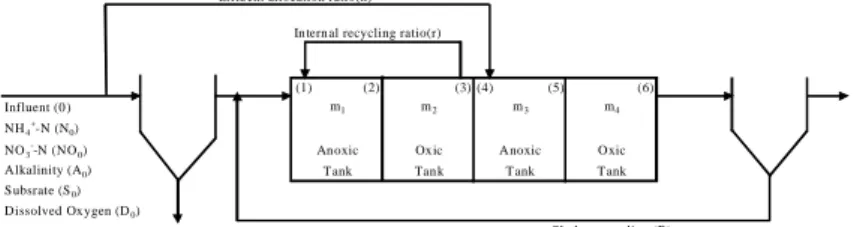
However, systems upto 12 tanks also has been reported. The Fig 1 shows the basic concept of nitrogen removal in step feed anoxic oxic process.
Stoichiometric reaction in denitrification
tank is :
Vol. 28, No. 1 (2011) Estimation of Optimal Operation Conditions in Step Feed Processes Based on Stoichiometric Nitrogen Removal Reactions 3
- 8 -
In flu ent allocation ratio(n)
Internal recycling ratio(r)
(1) (2) (3) (4) (5) (6)
Influent (0 ) m1 m2 m3 m4
NH4+ -N (N0)
NO3--N (NO0) Anoxic Oxic Anoxic Oxic
Alkalinity (A0) Tank Tank Tank Tank
Subsrate (S0) Dissolved Ox ygen (D0)
Sludge recycling (R)
Fig. 1. The basic concept of step feed anoxic oxic process
Note, 0 : Influent; 1 : Mixture of influent and recycling flowrate; 2 : After anoxic tank; 3 : After oxic tank; Symbols of item are given in parenthesis
NO
3-+1.25C+0.5H
2O→ 0.5N
2+HCO
3-+0.25CO
2(1) The above equation expresses 1mol of NO
3--N reacts with 1.25 mole of carbon.
2.86mg(=(32·1.25)/14) of substrate(COD) are needed to perform the complete denitrification and 3.57mg(=50/14) of alkalinity are produced for 1mg of NO
3--N. So following two equations can be deduced from the Eq1.
2.86·(NN
1-NN
2)=S
1-S
2→
NN
1-NN
2=0.35·(S
1-S
2) (2) This equation expresses the relationship between the amounts of nitrate nitrogen reduced and substrate consumed.
3.57·(NN
1-NN
2)=A
2-A
1→
NN
1-NN
2=0.28·(A
2-A
1) (3) This explains the relationship between the amounts of nitrate nitrogen reduced and alkalinity produced.
On the other hand, stoichiometric reaction in nitrification tank is:
NH
4++2O
2+2HCO
3-→ NO
3-+3H
2O+2CO
2(4) This equation proposes that theoretically 7.14mg (100/14) of alkalinity are required for 1mg of NH
4+-N oxidized. From the above stoichiometric relationship (Eq 4), the following equation can be obtained.
7.14·(N
2-N
3)=(A
2-A
3)→N
2-N
3=0.14·(A
2-A
3) (5) From the mass balance concept, total
amount of nitrogen (=ammonium nitrogen + nitrate nitrogen) from the position 2 to position 3 must be equal resulting Eq (6) will be acquired.
N
2+NN
2=N
3+NN
3(6) The Eqs (1) and (4) express theoretical reactions in biological nitrogen removal processes and show that the stoichiometrical ratio, α(=0.28· Alkalinity/NH
4+-N) must be equal to or more than 2(=7.14·0.28) for complete nitrification, and that the ratio, ß(=0.35·Substrate COD/NH
4+-N) must be equal to or more than 1(=2.86·0.35) for complete denitrification. Within the range of R values 0 to infinity in step feed anoxic oxic process, following Fig. 2 can be obtained.
0 1 2 3 4 5
0 1 2 3 4 5
β
α
80%
60%
40%