• 검색 결과가 없습니다.

Effects of career maturity, major satisfaction, and self-control on job stress of college students

N/A
N/A
Protected

Academic year: 2021

Share "Effects of career maturity, major satisfaction, and self-control on job stress of college students"

Copied!
8
0
0

로드 중.... (전체 텍스트 보기)

전체 글

(1)

Effects of career maturity, major satisfaction, and self-control on job stress of college students

Hee-Jeong Kim

1*

, Min-Sook Seo

2

, Dahye Park

3

1

Professor, Department of Nursing, Namseoul University

2

Professor, Department of Nursing, Sangji University

3

Professor, Department of Nursing, Semyung University

대학생의 진로성숙도, 전공만족도, 자기통제가 취업스트레스에 미치는 영향

김희정

1*

, 서민숙

2

, 박다혜

3

1

남서울대학교 간호학과 교수,

2

상지대학교 간호학과 교수,

3

세명대학교 간호학과 교수

Abstract The purpose of this study was to investigate the effects of career maturity major satisfaction, self-control on university students' job stress. Data collection was conducted from November 2018 to February, 2019 in 236 students who understood the purpose of the study and agreed to participate in the study. The collected data were analyzed by frequency, mean, standard deviation, Pearson correlation analysis, and multiple regression. The lower the career maturity (β=-.258), job stress was the higher.

Also, the lower major satisfaction (β=-.377), the higher the job stress, and the lower the self-control (β=

-.275), the job stress was the higher. Through these results, education programs that link students from their childhood to college students are needed to improve their career maturity, satisfaction with majors and self-control(r=-.410, p<.001).

Key Words : Career, Maturity, Stress, Self-control, Job

요 약 본 논문은 대학생의 진로성숙도, 전공만족도, 자기통제가 취업스트레스에 미치는 영향을 조사하기 의하여 시도 되었다. 자료수집은 2018년 11월부터 2019년 2월까지 대학생 236명을 대상으로 실시되었다. 수집된 데이터는 빈도, 평균, 표준편차, 피어슨 상관관계 분석 및 다중회귀분석을 사용하여 분석하였다. 진로성숙도는 전공만족도와 통계적으 로 유의한 양의 상관관계가 있었다(r=.452, p<.01). 진로성숙도는 취업스트레스와 통계적으로 유의한 음의 상관관계가 있었고(r= -.555, p<.001) 전공만족도는 자기통제와 통계적으로 유의한 양의 상관관계가 있었으며(r= .499, p<.01) 취업스트레스와는 유의한 음의 상관관계가 있었다(r=-.410, p<.001). 진로성숙도(β=-.258)가 낮을수록 취업스트레스 는 높았고 또한 전공만족도가 낮을수록(β=-.377), 자기통제가 낮을수록(β= -.275), 취업스트레스는 높았다. 본 연구결 과를 통하여 진로성숙도, 전공만족도 그리고 자기통제력을 향상시키기 위해 어린 시절부터 대학생까지 연계되는 교육 프로그램이 필요하다.

주제어 : 진로, 성숙도, 스트레스, 자기통제, 취업

*Corresponding Author : Hee-Jeong Kim([email protected]) Received March 9, 2021

Accepted June 20, 2021 Revised March 18, 2021

Published June 28, 2021

(2)

1. Introduction

The Korea economy has experienced a high unemployment rate of over 7 % in the wake of the foreign exchange crisis, as well as drastic but symbolic changes, with the proportion of irregular workers among wage earners exceeding 50 %. In addition to youth unemployment and non-regular workers, another important social issue is job insecurity, and talk of job-free growth continues. Although employment insecurity is not even properly defined, many people are sympathetic to it and occupy the ground for various press releases. A prior study examines and analyzes changes in job security and safety of full-time workers before and after the outbreak of the Asian financial crisis which define 'workability' as 'work security' for 'workdays to be shorter' and 'job security to be suspended purely because of user intentions and needs' [1]. The youth employment trend based on the NSO's 'Economic Population Survey' data shows the following data in the statistics for young people aged between 15 and 29. In 2010, 3,930 people were employed, and in 2016, 3,908 people were employed. The unemployment rate rose from 7.9% in 2010 to 9.8% in 2016 with 339 unemployed in 2016 and 426 in 2016 [2].

Therefore, it is assumed that the anxiety and stress of preparing young people are severe.

According to Statistics Korea's annual employment trend for 2016, the unemployment rate among young people reached a record high of 9.8 percent [3]. In addition, the Ministry of Education's survey found that the number of suspended graduates who were unable to get a job increased by another 2,000 to 17,000 in 2015 from 15,000 in 2013 [4]. These results are more likely than the unemployment rate felt in the statistics, the unemployment rate that young people actually feel will be much higher. The reason for this increase in youth unemployment is the increase in the number of young workers,

the decrease in quality, and the decrease in jobs.

Therefore, the chances of university students getting a job ahead of entering the labor market are gradually declining, and efforts by university students to increase their chances of getting a job are leading to excessive competition [5]. The resulting levels of job insecurity and the psychological and emotional distress of job stress are serious [6]. For college students living in modern society, employment is a very important factor in determining their overall life. As most college students go to higher grades, they are more likely to be stressed with regard to employment. This is not a problem confined to specific departments but is experienced by all university students in Korea [7].

Meanwhile, career maturity refers to an individual's ability to choose a career path wisely, taking into account its own ability and reality in making decisions for career choice [8].

Niles and Harris-Bowlsbey said career maturity is the crystallization of physical, psychological and social characteristics in career development [9].

Therefore, career advancement is self-directed by the right attitude and cognitive ability required to explore and plan one's career path, And it's very important because it can be defined to the extent to which one's decisions are carried out, and it's the ability to determine one's direction and quality of life [10] In the preceding study, college students were satisfied with their majors and decided on their jobs, which had a positive effect on their confidence in job performance, and as a result, students with high job satisfaction showed a high degree of career maturity [11].

One of the important human development tasks is to control, control and express one's emotions and behavior in an appropriate way.

This concept is self-regulation or self-control, which scholars define differently, but generally consider the same concept as self-control. [12]

Self-control also includes adjusting one's

(3)

emotions and behavior to the occasion, the ability to recognize social needs and to embrace changes in the environment. In addition, it said that self-control affects not only biological factors such as gender and age [13,14], but also psychological and mental factors such as perceived stress [15] and reports that perceived stress is closely related to self-control [16]

Therefore, this study seeks to find out the career maturity, major satisfaction, self-control, and job stress of university students and see how these variables affect the job stress. In particular, studies that have identified the effects of self-control and job stress have not been confirmed yet, so I would like to confirm them through this study.

2. Materials and method 2.1 Test methos

This study randomly selected three universities located in Gyeonggi-do and Chungcheong-do and selected 236 university students who understood the purpose of this research and agreed to the research method to voluntarily express their intention and agreed to participate in the research. Data collection was conducted from November 2018 to February 2019. Before starting the research, the researchers explained the purpose and questions of the research to the subjects and received written consent from them.

Selected a sample size of 222 using a significant level of .05 and a power of 0.9 medium effect size using the G* power program 3.1.9.2, 250 copies were collected in consideration of the losers and 236 of the districts were used.

2.2 Instruments

The tools used in this study are four tools, maturity, major satisfaction, self-control and job stress, all using a five-point lighter scale.

2.2.1 Career maturoty

Career maturity scale is one of the attitude measures of Care Maturity Inventory developed by Crites [17], and the consultation scale was modified to fit the Korean situation and the revised scale was used by Kim [18]. They are all composed of 30 questions and ‘are not’: 1 point. ‘Very true’: 5 points, consisting of a five-point Likert scale, higher the score, the higher the career maturity.

Cronbach's α was .83 in this study.

2.2.2 Major satisfaction

In order to measure the major satisfaction of those studied, the Program Evaluation Survey [19]

developed by Illinois University was modified by Kim and Ha [20]. It consists of 18 questions and consists of a five-point Likert scale for each question. And the higher the score, the higher the degree of major satisfaction. Cronbach's α in Kim's and Ha's study was .92, and Cronbach's α was .87 in this study.

2.2.3 Self control

In this study, the self-control measure was developed by Tangney et al [15] and modified by translating the Youth Self Report (YSR) into the Korean version of the brief self-control scale (BSCS) [21] were used. Originally composed of 13 items, it was translated into 11 except for two in the process of making the Korean version of the scale valid, and the response category was a five-point Likert scale for each question. They are classified as "not entirely" 1 point, "not always" 2 points, "unusually" 3 points, "yes" 4 points and

"very yes" 5 points. The scale has a score range of 11 to 55, and the higher the score, the higher the self-control. Cronbach's α in this study was .82.

2.2.4 Job stress

Based on the Cornell Medical Index (CMI) of

Cornell University's Shepherd et al [22] to

measure the employment stress of university

(4)

Variable Category N (%) Career maturity Major satisfaction Self-control Job stress

M (SD) t/F p M (SD) t/F p M (SD) t/F p M (SD) t/F p

Age 23.06± 2.02. Total: 3.51± .58 Total: 3.27± .63 Total: 3.47± .44 Total: 3.08± .75

Sex Male 107 (45.3) 3.8 (2.35)

1.500 .135 3.2 ( .34)

-1.588 .113 3.6 ( .36)

-.433 .665 3.1 ( .96)

2.201 .28

Female 129 (54.7) 3.3(2.58) 3.3 ( .69) 3.5 ( .44) 2.4( .74)

cademic year

1st 32 (13.6) 3.2 (1.02)

a

3.862

.007 a<b

3.2 ( .52)

a

1.862 .136

3.5( .50)

1.562 .184

2.6( .66)

a

3.401 .035 a<b

2nd 45 (19.1) 3.3

( 1.13)

a

3.2 ( .43)

a

3.4 ( .43) 2.8 ( .86)

a

3rd 70 (29.7) 3.7

(1.45)

ab

3.2 ( .51)

a

3.3 ( .50) 3.5 ( .66)

b

4th 89 (37.7) 4.0 (1.08)

b

3.4 ( .86)

b

3.6 ( .43) 3.6 ( .55)

b

Major

Health &

Medical 63 (26.7) 3.9 ( .71)

.156 .926

3.4( .59)

a

1.828 .139

3.8 ( .39)

b

3.514 .003 a<b

3.3 ( .87)

2.245 .060

Engineering 44(18.6) 3.7 (1.25) 3.4 ( .20)

b

3.6 ( .45)

ab

3.2 ( .84)

Business &

public 52 (22.0) 3.3( .82) 3.1 ( .34)

ab

3.0 ( .53)

a

3.2 ( .65)

Management 39 (16.5) 3.3

( .35) 3.3 ( .56)

a

3.0 ( .39)

a

3.0 ( .68)

Art & Physical

management 38(16.1) 3.3

( .89) 3.1( .12) 3.0( .38)

a

2.9( .70)

Motive of major selection

aptitude/interest 65 (27.5) 3.9 (1.08)

a

4.295 .021 a<b

3.8 ( .31)

a

3.295 .021 a<b

3.7 ( .46)

a

2.394 .037 b<a

3.8 ( .61)

a

3.370 .002 b<a popularity/

outlook 59 (25.0) 3.6

( .71)

ab

3.5 ( .37)

ab

3.4 ( .45)

b

3.7( .49)

a

According to the

grades 54(22.9) 3.3 (.24)

b

3.2 ( .33)a

b

3.5 ( .36)

b

2.7( .32)

ab

Urging of parents&

teachers 45 (19.1) 3.3 (.58)

b

2.6 ( .56)

b

3.4 ( .44)

b

2.3 ( .72)

b

3.821 .032 a<b

. 2.369 .039 a<b 3.762 .006 a<b

Field of hope employmen

t

professional

work 32 (13.6) 3.9

( .48)a 3.2 ( .80)

b

3.1 ( .80)

1.369 .765

2.7( .59)

a

A public officer 64 (27.1) 3.5 (1.59)b 3.2 ( .71)

b

3.2 ( .71) 3.1 ( .44)

ab

teacher

40 (16.9) 3.7

( .54)b 2.9 ( .41)

ab

3.2 ( .69) 3.1 ( .44)

ab

A publicly

owned company 10 (5.3) 3.4

( .46) 3.2 ( .69)

ab

3.0 ( .67) 3.4 ( 56)

b

A private

company 35 (18.7) 3.3 (1.21) 2.9 ( .67)

a

2.8 ( .73) 3.1 ( .59)

ab

Self-employmen

t 83 (44.4) 3.4

( .72) 2.7 ( .73)

a

3.1 (5.42) 3.1 ( .59)

ab

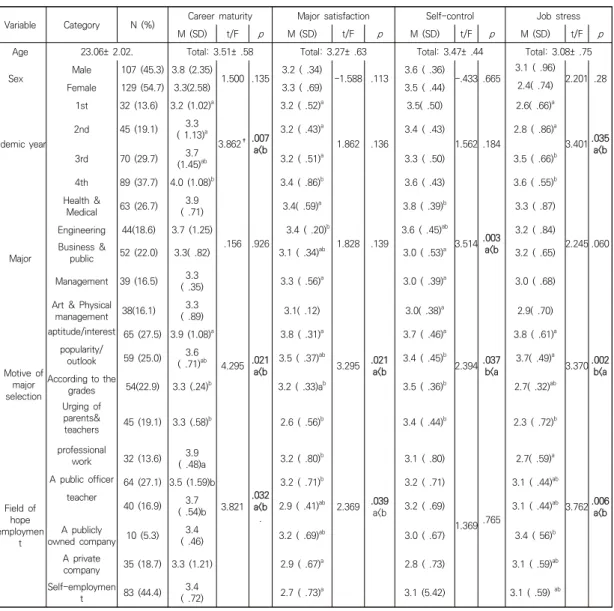
Table 1. General characteristics and differences in stress, depression, self-control and eating attitude (N=236)

students, Hwang [23] developed and the tools modified by Kang [24] were used. 21 questions in total. It consists on the 5-point Likert scale, the higher the score means higher economic stress.

In Kang [24]'s study, Cronbach's α was .70 and it was .74 in this study.

3. Results and Discussion

The general characteristics of the subject are

as shown in Table 1.

The mean age of the subjects was 23.06± 2.02 years Among the subjects, 107 male students (45.3 %), 129 female students (54.7 %), 32 first graders (13.6 %), 45 second graders (19.1 %), 70 third graders (29.7 %), and 89 fourth graders (37.7 percent). The majors included 63 health &

medical (26.7 %), 44 engineering majors (18.6 %),

52 Business & Public (22.0 %), 39 Management

(16.5 %), and 38 Art & Physical management

(16.1 %). Motives for selecting majors are as

(5)

Predictors

Job stress

B SE β t p Toleran

ce VIF

constantt 5.321 5.81 0.798 <..001

Career

maturity -.429 .054 -.258 .243 <..001 .983 1.011 Major

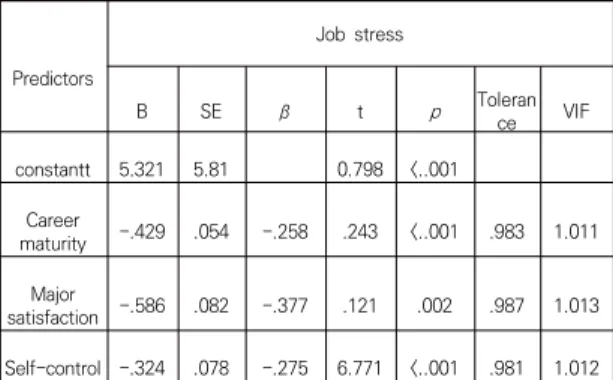
satisfaction -.586 .082 -.377 .121 .002 .987 1.013 Self-control -.324 .078 -.275 6.771 <..001 .981 1.012 Table 3. Multiple regression analysis of career maturity,

major satisfaction, self-control and job stress (N=236)

follows. Sixty-five (27.5 %) answered "interesting"

while 59 (25.0 %) answered "popularity" or "have future" and 54 (22.9 %) answered "depending on their grades and “Urging of parents& teachers”

answered 45(19.1%). When asked about areas they want to work in after graduation, the participants responded as follows, the answer was as follows. Thirty-two professionals (13.6 %), 64 a public office (27.1 %), 40 teachers (16.9 %), 10 publicly owned company (5.3 %), 35 private company (18.8 %), and 83 self-employed (44.4 %).

The difference in mean from each parameter by its general characteristics is shown in Table 1.

The research participants’ attitudes on career maturity showed statistically significant differences according to Grade (F=3.862), p=. 007), motive of major selector (F=4.295, p=. 021), and Field of hope employment (F=3.821, p=.032).

The characteristics of major satisfaction and statistically significant difference between motive of major selection (F=3.295, p=. 021), field of hope employment (F=2.369, p=. 039) appeared.

The research participants’ attitudes on self-control showed statistically significant differences according to major (F=3.514, p=. 003) and motive of major selector (F=2.394, p=. 037). There was a statistically significant difference according to academic year (F=3.401, p=.035), motive of major selector (F=3.370, p=. 002), Major Selector (F=3.370, p=. 002), and field of hope employment (F=3.762, p=. 006).

Correlations with each variable shows Table 2.

Career maturity is a statistically significant positive correlation with major satisfaction (r=.452, p<.01) and self-control (r=.589, p<01).

Meanwhile Career maturity is a statistically significant negative correlation with job stress (r=

-.555, p<.001). Major satisfaction is a statistically significant positive correlation with self-control (r= .499, p<.01) and negative correlation with job stress (r=-.410, p<.001).Self-control is a statistically significant negative correlation with job stress (r=-.410, p<.001).

Variable Career

maturity Major

satisfaction Self-control Job stress Career maturity 1

Major satisfaction 452** 1

Self-control .589** .499** 1

Job stress -.555*** .-.410*** -.489*** 1

*p<.05, **p<.01, ***p<.001

Table 2. Correlation of career maturity, major satisfaction, self-control and job stress

Table 3 shows the results of multiple regression.

According to the results of a multi-regression analysis to find out the impact of, career maturity, major satisfaction and self-control on the job stress. The lower the career maturity (β

=-.258), job stress was the higher. Also, the lower major satisfaction (β=--.377), the higher the job stress, and the lower the self-control (β=--.275), the job stress was the higher. Among the three variables, the most influential variable on job stress was the major satisfaction. This study tried to determine the effect of career maturity, major satisfaction, and self-control on job stress, and I would like to discuss the results of the study.

The degree of career maturity showed a

statistically significant difference in grades,

motive of major selection, and field of hope

employment, and also showed a statistically

significant correlation with major satisfaction.

(6)

This was supported by the same results in the study Jang and Park [11] and Lee’s study [25].

A college student's high major satisfaction is related to his career choices and we can say that their major matches well, suggesting that they will decide their career path with mature career attitudes in employment.

Career maturity refers to an individual's ability to choose a career path wisely, taking into account its own ability and reality in making decisions for career choice [8]. Therefore, during the four years of college, he or she continued to be educated and more mature. It is possible to predict that fourth grader students will have higher career maturity compared to other grades.

In this study, career maturity was statistically significantly higher than in other grades, which supported the results of the preceding study. The study by Oh and Gong, who conducted a study on self-leadership, career attitude, and major satisfaction of nursing students [26], was similar to this study that showed that the senior's career maturity was higher than other grades, although it was not a significant difference in the average difference between career maturity and grade.

On the other hand, this study found that the higher the degree of satisfaction, the lower the job stress The results of this research were the same as the results of a prior study to establish the relationship between major satisfaction and job stress, which showed that the degree of major satisfaction was negative to the job stress.

In other words, the higher the degree of satisfaction, the lower the job stress, and the higher the degree of satisfaction, the more stable the career decision state is, the lower the job stress [27].

Career maturity refers to an individual's ability to choose a career path wisely, taking into account its own ability and reality in making decisions for career choice [8]. Therefore, during the four years of college, he or she continued to be educated and more mature. It is possible to predict that fourth grader students will have

higher career maturity compared to other grades.

In this study, career maturity was statistically significantly higher than in other grades, which supported the results of the preceding study. The study by Oh and Gong, who conducted a study on self-leadership, career attitude, and major satisfaction of nursing students [26], was similar to this study that showed that the senior's career maturity was higher than other grades, although it was not a significant difference in the average difference between career maturity and grade.

On the other hand, this study found that the higher the degree of satisfaction, the lower the job stress The results of this research were the same as the results of a prior study to establish the relationship between major satisfaction and job stress, which showed that the degree of major satisfaction was negative to the job stress.

In other words, the higher the degree of satisfaction, the lower the job stress, and the higher the degree of satisfaction, the more stable the career decision state is, the lower the job stress [27]. Therefore, in order to help satisfy one's major by making a good and positive choice in college, and to minimize the upcoming job stress, it suggests that guidance should be conducted steadily and continuously from a young student's time. In this study, self-control showed statistically significant differences in mean according to the major and the motivation of major selection. Additionally there was a statistically significant negative correlation between job stress and self-control. That is to say, it is the higher the self-control, the lower the job stress was statistically significant.

Psychologists call the ability to resist temptation

and perform desirable actions 'self-control'. We

can often see cases in which self-controlled

college students overcome their job stress by

enduring many temptations and achieving goals

that they mean by moderation in order to choose

successful careers. Such information is supported

by the following prior research results.

(7)

Meta-analysis of 102 studies that explored the relationship between self-control and various behaviors reported that high self-control is positively related to subjective well-being, academic and professionalism, successful interpersonal relationships, and lack of self-control is related to eating, weight-related issues, alcohol use, and social deviance [28] Although there are no subjects in the college curriculum that strengthens self-control, self-control should be educated in the students' curriculum from an early age, as is the case with major satisfaction, so that they can develop when they are in college. Therefore, suggest a study to apply self-control improvement programs to college students.

4. Conclusion

This study is a descriptive study of how college students' career maturity, major satisfaction and self-control affect their job stress. The findings showed that career maturity, satisfaction with major and self-control had a statistically significant negative correlation with job stress.

Also, the higher the career maturity, the higher the major satisfaction, and the better the self-control, the lower the job stress. Through these results, education programs that link students from their childhood to college students are needed to improve their career maturity, satisfaction with majors and self-control. This study has limitations in expanding the results since it has only randomly extracted college students from certain areas.

REFERENCES

[1] B. Y. Cheon (2003). A study of selection of self-employment in Korea. Korean Journal of Labor Economics, 26(3), 111-151.

DOI : 10.12811/JKCS.201.11.2.129

[2] E contury index. (2020.02.12.). Statistical Office,

Economic Activity Population Survey- Youth Employment Trend (employment and Unemployment) Recent Renewal Date: Available from:

h t t p : / / w w w . i n d e x . g o . k r / p o t a l / main/EachDtlPageDetail.do?idx_cd=1495

[3] Statistics Korea. (2016. Dec. 15) Employment Trends in 2016 . Available from: http://kostat.go.kr/

[4] SBS News. (2017. Jan. 1). The number of fifth graders in universities has surged. young people who delay graduation due to the difficulty of getting a job.

Available from:

http://new.sbs.co.kr/news/ednPage.do?news_id=N100 3965256&pink=ORI&cooper=NAVER&plink=COPYPAS TE&cooper=SBSNEWSEN

[5] E. H. Lee. (2004). Life Stress and Depressive Symptoms among College Students: Testing for Moderating Effects of Coping style with Structural Equations. Korean Journal of Health Psychology, (91), 25-52.

[6] E. K. Byun & S. H. Park. (2014). Effects of major satisfaction and employment stress on depression in college students Journal of the Korea Academic- Industrial cooperation Society, 15(1) , 323-330.

DOI : 10.5762/KS.2014.15.1.323

[7] S. I. Kim & S. J. Yang (2018). Relationship among career decision self-efficacy, job seeking stress and career preparation behavior of physical education majoring college students. Journal of Sport and Leisure Studies, 71(2) , 295-307.

DOI : 10.51979/KSSLS.2018.02.71.295

[8] H. Y. Jeong (2009). A study on major satisfaction and career maturity according to values and self-efficacy of college students majoring in beauty. Doctoral dissertation. University of Kyunsung, Busan.

[9] S. G. Niles & J. His-Bowlsbey. (2002). Career development interventions in the 21

st

century, Columbus, OH: Merril Prentice Hall.

[10] M. J. Chung & I. H. Park. (2015). The Effects of Satisfaction in Major on the Career Preparation Behavior of Undergraduates majoring in Airline Service: Focusing on the mediating effects of Career Decision Making Self-Efficacy and Career Maturity.

The Korea Academic Society of Tourism and Leisure, 27(1) , 217-218. DOI: 10.14400/JDC.2019.17.7.359 [11] H. Y. Jan & O. L. Park. (2009). A correlation analysis

of the sense of value, self- efficacy, major satisfaction level. and career maturity level of beauty care major college students. Journal of the Korea Society Beauty and Art, 10(1) , 35-49.

[12] R. F. Baumeister, T. F. Heatherton, & D. M. Tice.

(1994). Losing control: How and why people fail at self-regulation . San Diego: CA, US: Academic press.

[13] S. Lee. (2014). A gender difference in interaction

effects between low self-control and both Social

bonding and differential association variables on

(8)

cyber delinquent behavior. Korean Journal of Youth Studies , 21(2) , 279-298.

[14] O. H. Lee. (2012). The influence of life stress, ego-resilience and social support on psychological well-being among college students. Korean Journal of Youth Studies, 19(1) , 29-57.

[15] J. P. tangney, R. F. Baumeister, & A. L. Boone. (2008).

High self-control predicts good adjustm24.ent, less pathology, better grades, and interpersonal success.

Personality , 72(2), 271-324.

DOI: 10.1111/j.0022-3506.2004.00263x

[16] H. J. Kang. (2011). The relationship among procrastination, self- efficacy, self-control, and perceived stress.

Locality and Globality , 35(2) , 233-251.

DOI: 10.33071/ssricb.35.2.201112.233

[17] J. O. Crites. (1987). Ceer maturity inventory: Administration and user’s manual 2nd ed New York: McGraw.

[18] H. O. Kim & C. G. Kim. (1989). The Relationship between the Career Maturity Levels of Korean Adolescents and the Related Variables. Korean Society for the Study of Vocational Education, 8(1), 143-160.

[19 L. A. Braskamp, S. L. Wise, & D. D. Hengatle. (1979).

Student satisfaction as a measure of developmental quality, Journal of. Educational Psychology, 71(4) , 494-498.

[20] K. H. Kim & H. S. Ha. (2002). A study of development satisfaction factors undergraduate students. Korean Journal of. Counseling, 1(1) , 7-20.

[21] H. G. Hong, H. S. Kim & J. H. Kim. (2012). Validity and reliability validation of the Korean version of the brief self-control scale (BSCS). Korean Journal of Clinical Psychology. 31(4), 1193-1210.

http://uci.or.kr/G704-001037.2012.31. 4.010 [22] M. Shepherd, B. Cooper, A. C. Brown & G. W. Kalton.

(1966). Psychiatric illness in general practice . London;

Oxford University Press.

[23] D. H. Han & Y. A. Cho. (2015). Moderating Effects of Career Optimism in the Relationship between Job seeking stress and Suicide Probability among Undergraduates. Korea Journal of Counseling, 16(1) , 111-128.

[24] Y. L. Kang. (2007). The Influence of jobs seeking stress on their career maturity dance majoring students.

Master’s thesis. University of Dankuck, Cheonan.

[25] J. S. Lee. (2014). A study on job seeking stress according to major satisfaction of university students in each grade. The Korean Entertainment Industry Association . 5 , 213-219.

[26] E. J. Oh & J. H. Kong. (2019). A study on self-leadership, maturity of career attitude and major satisfaction in nursing students. Journal of the Korean Society. Korean Society of Integrative Medicine, 7(1) , 135-144.

[27] Y. H. Jung &. G. H. Yang. (2013). The effect of major

satisfaction and career decision-making self-efficacy on employment stress of the pre-service teachers who majored early childhood education, Journal of Future Early Childhood Education, 20(3) , 229-248.

[28] D. T. D. De Ridder, L. M. Gerty, F. Catrin. Finkenauer, F. M. Stock & R. F. Baumeister. (2012). Taking stock of self-control: A meta-analysis of how trait self-control relates to a wide range of behaviors.

Personality and Social Psychology Review, 16(1) , 76-99. DOI: 10.1177/1088868311418749

김 희 정(Hee-Jeong Kim) [정회원]

․ 1986년 2월 : 중앙대학교 간호학과(간 호학사)

․ 1997년 2월 : 중앙대학교 대학원(보건 학석사)

․ 2011년 2월 : 중앙대학교 대학원(간호 학박사)

․ 2011년 3월 ~ 현재 : 남서울대학교간 호학과 교수

․ 관심분야 : 건강증진, 노인, 도구개발, 응급중환자

․ E-Mail : [email protected]

서 민 숙(Min-Sook Seo) [정회원]

․ 1995년 2월 : 중앙대학교 간호학과 (간호학사)

․ 2006년 2월 : 중앙대학교 간호학과 (간호석사)

․ 2013년 2월 : 중앙대학교 간호학과 (간호박사)

․ 2017년 5월 ~ 현재 : 상지대학교 간호 학과 교수

․ 관심분야 : 중환자, 응급간호, 성인간호

․ E-Mail : [email protected]

박 다 혜(Dahye Park) [정회원]

․ 2013년 8월 : 중앙대학교 대학원 간호 학과(간호학박사)

․ 2014년 3월 ~ 현재 : 세명대학교 간 호학과 교수

․ 관심분야 : 노인간호, 건강불평등, 건 강증진

․ E-Mail : [email protected]

수치

Table  1.  General  characteristics  and  differences  in  stress,  depression,  self-control  and  eating  attitude         (N=236)
Table  3  shows  the  results  of  multiple  regression.

참조

관련 문서

In this regard, this study analyzes the effect of the job characteristics and work environment of workers with physical disabilities on job satisfaction

Purpose: The present study was conducted to understand nursing students’ self-esteem, problem-solving ability, professionalism, and career identity, and to

Objectives: The present study was conducted to determine the relationship between degree of work performance and job satisfaction in NICU nurses.. Methods: The subjects of

The purpose of this study is to identify how the Customer Satisfaction (CS) policy affects the employees'level of stress and satisfaction, and to minimize the

Objective: The purpose of this study was to investigate the effect of clinical practice satisfaction on professional self-concept among dental hygiene students.. Methods:

The purpose of this study is to analyze the effects of service quality on customer satisfaction and revisit intention perceived by Chinese golf range

Therefore, this study investigated the interest, satisfaction and participation in STEAM of middle school students centering on programs where music education

This study was conducted to recognize the importance of self - management of dance major students and to understand the relationship between the sub -