JMLS
http://jmls.or.kr해산 규조류(
Skeletonema costatum
)의 개체군 성장률 분석을 이용한 신방오도료(Irgarol, Diuron)의 독성평가이주욱·최훈·박윤호·이승민·최윤석·허승·황운기* 국립수산과학원 서해수산연구소 자원환경과 해양생태위해평가센터
Toxic Evaluation of Antifouling Paint (Irgarol and Diuron) using the Population Growth Rate of Marine Diatom,
Skeletonema costatumJu-Wook Lee, Hoon Choi, Yun-Ho Park, Seung-Min Lee, Yoon-Seok Choi, Seung Heo, Un-Ki Hwang* Marine Ecological Risk Assessment Center, West Sea Fisheries Research Institute,
National Institute of Fisheries Science, Incheon 22383, Korea
Corresponding Author Un-Ki Hwang
Marine Ecological Risk Assessment Center, West Sea Fisheries Research Institute, National Institute of Fisheries Science, Incheon 22383, Korea
E-mail : [email protected]
Received : March 16, 2020 Revised : March 17, 2020 Accepted : May 13, 2020
Irgarol과 diuron에 각각 노출된 해산규조류(Skeletonema costatum)의 개체군 성장률(r)을 분석 하여 독성평가를 실시하였다. S. costatum을 irgarol (0, 0.31, 0.63, 1.25, 2.5, 5 μg l-1)과 diuron (0, 7.81, 15.63, 31.25, 62.5, 125 μg l-1)에 각각 96시간 노출하여 r을 계산하였고, 대조구의 r은 0.04 이상으로 시험기준에 적합하였다. S. costatum의 r은 irgarol에서 0.63 μg l-1, diuron은 15.63 μg l-1 이상에서 대조구 대비 유의하게 감소하기 시작하여 irgarol과 diuron의 농도가 증가할수록 r이 감소하는 농도의존적인 반응을 나타냈고, 시험 최고농도 5와 125 μg l-1에서 r이 대조구 대비 80% 이상 감소하였다. Irgarol과 diuron에 노출시킨 S. costatum r의 반수영향농도(EC50)는 1.09, 45.45 μg l-1, 무영향농도(NOEC)는 0.31, 7.81 μg l-1, 최소영향농도(LOEC)는 0.63, 15.63 μg l-1으로 나타났으며, EC50 기준으로 irgarol이 diuron보다 독성이 큰 것으로 나타났다. 본 연구결과로 해양 생태계에서 Irgarol과 diuron의 농도가 0.63과 15.63 μg l-1 이상이 되면, 해산 규조류 S. costatum 의 r은 독성영향을 받을 것으로 판단된다. 또한, 독성 값으로 제시된 결과들은 irgarol과 diuron 의 기준농도 설정을 위한 기초자료로 유용하게 활용될 것이다.
We evaluated the toxic effects of antifouling paint (irgarol and diuron) on the population growth rate (r) of the marine diatom, Skeletonema costatum. The r of S. costatum was determined after 96 hrs of exposure to irgarol (0, 0.31, 0.63, 1.25, 2.5 and 5 μg l-1) and diuron (0, 7.81, 15.63, 31.25, 62.5 and 125 μg l-1). It was observed that r in the control (absence of irgarol and diuron) were greater than 0.04, while r in the treatment groups decreased with increasing irgarol and diuron concentrations. Irgarol and diuron reduced r in a dose-dependent manner with significant decreases occurring at concentrations above 0.63 and 15.63 μg l-1, respectively. The EC50 values of r in irgarol and diuron exposure were 1.09 and 45.45 μg l-1. No observed effect concentration (NOEC) were 0.31 and 7.81 μg l-1, the lowest observed effect concentration (LOEC) were 0.63 and 15.63 μg l-1. This result indicate that a concentration of greater than 0.63 μg l-1 of irgarol and 15.63 μg l-1 of diuron in marine ecosystems induced to decreasing r of S. costatum. Also, these toxic values can be useful as a baseline data for the toxic evaluation of irgarol and diuron in marine ecosystems.
Keywords: Antifouling agent(방오도료), Irgarol(이가롤), Diuron(디유론), Toxicity(독성), Marine diatom(해산규조류)
butyltin oxide), TBTF (Tributyltin fluoride) 및 TBT 기반 SPC 페인트 가 가장 보편적으로 사용되었다(Amara et al., 2018). 하지만 어 패류에서 imposex를 유발할 뿐만 아니라, 미세조류(Thalassiosira pseudonana)의 성장을 억제하고 무척추동물 성게(Hemicentrotus pulcherrimus)와 멍게(Ciona intestinalis)의 배아발달을 방해하였으 며, 어류 넙치(Paralichthys olivaceus)의 배아의 기형 및 사망을 유 도하는 등 다양한 생물의 생식생리에 문제를 일으키는 등 강한 독성영향으로 2008년 국제해사기구(IMO)에서 사용을 금지하였다 (Amara et al., 2018; Lee et al., 2019; Moon et al., 2019; Zhang et al., 2019b). 현재 TBT 대체물질로 아산화동(copper oxide)을 사용하고 있으나 TBT에 비해 방오능력이 낮아, chlorothalonil, dichlofluamnid, diuron, irgarol 1051, sea-nine 211, ziram, zinc pyrithione 및 copper pyrihtione 등과 같은 신방오도료를 추가하여 아산화동의 부족한 방오능력을 보완하고 있다(Chen et al., 2015; Jung et al., 2017; Shin et al., 2015).
Irgarol (2-methythiol-4-tert-butylamino-6-cyclopropylamino-s- triazine)과 diuron (3-(3,4-dichlorophenyl)-1,1-dimethylurea)은 전 세계적으로 상업용 방오페인트에 광범위하게 사용되는 물질이다 (Konstantinou and Albanis, 2004). Irgarol과 diuron은 낮은 독성을 목표로 개발되었기 때문에 TBT에 비해 상대적으로 독성이 낮다고 알려져 있지만, booster biocide 특성상 TBT와 마찬가지로 플랑크 톤, 산호 및 어류 등에게 독성영향을 미칠 수 있다(Fernandez-Alba, 2002; Ishibashi et al., 2018; Lee et al., 2010). 또한, 현재 사용되고 있는 chlorothalonil, dichlofluamnid, sea-nine 211, ziram, zinc pyri- thione 및 copper pyrihtione과 같은 신방오도료 보다 수생태계에 오랜시간 잔류할 수 있어 해양생태계에 지속적으로 독성영향을 미칠 가능성이 충분하다(Marcheselli et al., 2010; Konstantinou and Albanis, 2004).
Irgarol은 광합성을 억제하는 강력한 s-triazine 계열의 제초제 (herbicide)로써 해양산업 전반에 사용되고 있고(Ishibashi et al., 2018; Zhang et al., 2019a), 해수에 용해도(7 mg l-1)가 낮지만 반감 기가 약 100~350일이며 생분해가 거의 불가능하여 해양환경에 잔류 가능성이 높다고 알려져 있다(Konstantinou and Albanis, 2004;
Moon et al., 2019; Zhang et al., 2019a). Diuron 또한 phenylurea 그룹의 광합성을 억제하는 제초제로 주로 선박 선체에 사용되며
나라 서남해역에서 가장 우점하고 있는 대표적인 미세조류로 (Yoon, 2016), 육상식물 종과도 유사한 광합성 기능을 가지고 있 어(Ensminger et al., 2001; Khanam et al., 2017), 제초제(herbicide) 성분으로 만들어진 irgarol과 diuron의 독성을 평가하기 위한 실 험생물로 매우 적절한 것으로 판단된다. 본 연구에서는 Irgarol과 diuron에 노출된 S. costatumr의 무영향농도(No-Observed Effect Concentration; NOEC), 최소영향농도(Lowest-Observed Effect Con- centration; LOEC) 및 반수영향농도(50% Effective Concentration;
EC50)를 도출하여 S. costatum에 대한 방오도료의 독성 값을 나타 냈으며, 이러한 자료는 해양생태계 내에서 이들 물질의 기준농도 를 설정하기 위한 귀중한 자료로 활용될 것이다.
재료 및 방법 1. 시험생물
시험생물은 해산규조류 Skeletonema costatum (Greville) Cleve 이며, 한국해양미세조류은행(Korean Marine Microalgae Culture Center, KMMCC)에서 분양받아 항온실에서 6개월 이상 계대배양 하였다. 배양온도는 20.0±1.0℃, 광량은 형광등을 이용하여 3,000~
4,000 Lux, 광주기는 10 Light : 14 Dark를 유지하며 f/2 배지로 배 양하였다(Lananan et al., 2013).
2. 시험물질 농도조성
시험에 사용된 irgarol (irgarol, Sigma-aldrich, USA)과 diuron (diuron, Sigma-aldrich, USA)은 DMSO (Dimethylsulfoxide, Sigma- aldrich, USA)에 녹여 10,000 mg l-1의 stock solution으로 제조하였 다. Irgarol과 diuron의 stock solution을 멸균된 자연해수로 희석 하여 irgarol (0, 0.31, 0.63, 1.25, 2.5, 5 μg l-1)과 diuron (0, 7.81, 15.63, 31.25, 62.5, 125 μg l-1)의 농도를 조성하였다. 시험용액제조 에 사용된 DMSO는 최대농도는 0.01%에서 96시간 노출하여 대조 구 대비 S. costatum의 개체군 성장률에 영향을 미치지 않는 것을 확인하였고(Okumura et al., 2001), 시험에 사용된 방오도료의 농 도범위는 irgarol (0.01, 0.1, 1, 10, 100 μg l-1), diuron (0.01, 0.1, 1,
100 μg l-1)의 예비실험을 통하여 적절한 범위로 설정하였다.
3. 시험 배양조건
시험 용액을 각 농도별로 50 ml test tube에 30 ml씩 총 3반복 분주하고 f/2 배지를 첨가하였다. S. costatum은 정량 분석을 위하 여 SR chamber와 inverted microscope (IX70, Olympus, Japan)로 계수하고 초기농도 5,000 cells ml-1의 세포밀도로 각 시험 용액에 분주하였다. 시험 배양은 조도 3,000~4,000 lux, 배양온도는 20.0±
1.0℃, 광주기 10 Light : 14 Dark로 유지하며 96시간 배양하였고 자세한 배양조건은 Table 1에 나타내었다(MOF, 2018).
4. 개체군 성장률 측정
S. costatum의 r을 측정하기 위해 fluorometer (Model 10-AU, Tuner designs, USA)를 이용하여 24시간 간격으로 각 시험관의 형광량을 측정하였고, 96시간 후 최종 형광량을 측정하였다. S.
costatum의 개체군 성장률(r)은 형광량으로 측정된 클로로필 농도 를 회귀방적식을 이용하여 세포밀도로 환산한 후(형광량=세포밀 도) 아래와 같은 계산식으로 도출하였고, 대조구의 r이 0.04 이상 일 경우에 유의한 시험결과로 판단하였다(MOF, 2018).
r=(lnNt-lnN0)/t
(r=개체군 성장률, Nt=실험종료 후 세포밀도, N0=초기 세포밀 도, t=배양시간)
5. 통계 분석
대조구와 실험군 사이의 유의성은 SigmaPlot software (Sigma- Plot 2001, SPSS Inc. USA)의 Student's t-test로 검정하였으며, p가 0.05 이하인 경우 유의한 차이로 판단하였다. 방오도료 독성시험 결과 S. costatum의 r에 대한 반수영향농도(EC50)와 95% 신뢰구 간(95% fiducial limit)은 Toxicalc software (Toxicalc 5.0, Tidepool scientific software, USA)의 probit 통계법을 사용하여 분석하였고, 무영향농도(NOEC)와 최소영향농도(LOEC)는 Dunnett's test를 사 용하여 분석하였다.
결 과
1. Irgarol이 S. costatum의 r에 미치는 영향
Irgarol이 S. costatum의 r에 미치는 영향은 Fig. 1, 2에 나타냈으 며, 대조구의 r은 0.04 이상으로 해양환경공정시험법 해양생물공 정시험기준(2018)에 적합하였다. S. costatum의 r은 최소농도 0.31 μg l-1에서 0.0415±0.0020으로 대조구 0.0415±0.0012와 유의한 차 이가 나타나지 않았으나, 0.63 μg l-1부터 r이 유의적(p<0.01)으로 급격하게 감소하기 시작하여 1.25 μg l-1에서 55% 이상(p<0.01) Table 1. Experimental culture condition of Skeletonema costatum
Items Conditions
Culture type Static non-renewal toxicity test
Photoperiod Ambient light condition and 10 L : 14 D period
Light intensity 3,000~4,000 Lux Temperature 20.0±1.0℃
Salinity 30.0±1.0 psu
pH 8.0±0.2
Chamber volume 50 ml test tube
Solution Filter (0.45 μm) and sterilized seawater Solution change None
Test solution volume 30 ml Culture medium f/2 medium Initial cell density 5,000 cells ml-1 Experiment period 96 hrs
Acceptability criterion >0.04 population growth rate by the hour
크게 감소하였다(Fig. 2, Table 2). 실험 최고농도 5.00 μg l-1에서 개 체군 성장률이 나타나지 않아, S. costatum의 r은 irgarol 농도가 증가할수록 농도의존적으로 감소하는 경향을 나타냈다(Fig. 2).
2. Diuron이 S. costatum의 r에 미치는 영향
Diuron이 S. costatum의 r에 미치는 영향은 Fig. 3, 4에 나타냈으 며, 대조구의 r은 0.04 이상으로 해양환경공정시험법 해양생물공 정시험기준(MOF, 2018)에 적합하였다. S. costatum의 r은 최소농도 7.81 μg l-1에서 0.0407±0.0005로 대조구 0.0413±0.0002와 유의한 차이가 나타나지 않았으나, 15.63 μg l-1부터 r이 유의적(p<0.05) 으로 감소하기 시작하여 62.5 μg l-1에서 60% 이상(p<0.01) 급격 하게 감소하였다(Fig. 4, Table 2). 또한, 실험 최고농도 125.00 μg l-1 에서 개체군 성장률이 약 90% 감소하여, S. costatum의 r은 농도 가 증가할수록 농도의존적으로 감소하는 경향을 나타냈다(Fig. 4).
3. S. costatum의 r을 이용한 irgarol과 diuron의 독 성평가
S. costatum의 r은 irgarol과 diuron에 노출되었을 때 농도가 증
가할수록 r이 급격하게 감소하는 농도의존적인 경향을 나타냈으
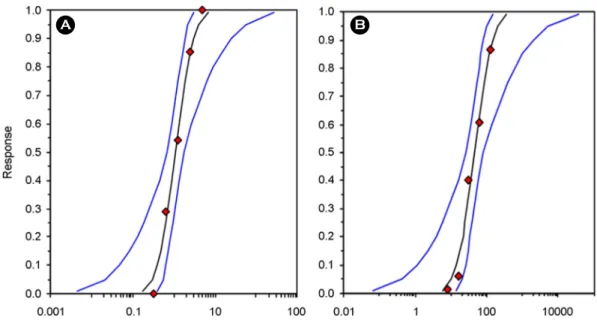
며(Fig. 2, 4), 또한 이들의 반응은 표준독성반응으로 잘 알려진 Sigmoid 형태로 나타났다(Fig. 5, Table 2). Irgarol에 대한 r의 NOEC 와 LOEC는 각각 0.31, 0.63 μg l-1으로 나타났고 EC50과 95% Fidu- cial limit는 1.09, 0.67~1.77 μg l-1으로 나타났다(Table 3). Diuron에 대한 r의 NOEC와 LOEC는 각각 7.81, 15.63 μg l-1으로 나타났고 EC50과 95% Fiducial limit는 45.45, 26.25~81.51 μg l-1으로 나타났 다(Table 3).
고 찰
Irgarol과 diuron은 PSII (Phoposystem II)의 전자전달을 방해하
여 광합성을 억제하고 활성산소를 유발하여 세포성장 및 세포사 멸을 일으킨다(Jones, 2005). 두 가지 방오도료는 PSII 반응중심인 D1 단백질의 QB에 결합하여, 광(light)에 의해 들뜬 전자가 D2 단 백질의 QA를 거쳐 QB로 전달을 막는 것으로 알려지고 있다(Deng et al., 2012; Jones, 2005). 이로 인해, PSII에서 PSI (phosystem I)으
로 전자가 전달되지 않아 ATP (adenosine triphosphate)와 NADP (nicotinamide adenine dinucleotide phosphate)가 합성되지 못하고, 결과적으로 성장률이 감소하게 된다(Kottuparambil et al., 2017). 그 리고 PSII가 억제되는 과정에서 과산화수소(H2O2)와 같은 활성산 소종(reactive oxygen species)을 발생시켜 산화스트레스를 유발하 고, 엽록소 및 세포손상을 일으켜 생물이 사망에 이르는 직접적 인 원인으로 판단된다(Flores et al., 2013; Jones, 2005). 또한 irgarol 과 diuron은 PSII의 D1 단백질의 같은 부위에 결합하여 유사한 방 식으로 광합성을 억제하지만, 서로 다른 결합방식으로 인해 본 연 구결과와 같이 물질 또는 생물 종에 따라 독성의 차이가 발생할 수 있다(Wilkinson et al., 2015).
본 연구결과 S. costatumr의 EC50은 irgarol이 1.09 μg l-1, diuron Table 3. Toxicity evaluation using population growth rate in the Skeletonema costatum exposed to irgarol and diuron (μg l-1)
Items Irgarol Diuron
NOEC 0.31 7.81
LOEC 0.63 15.63
EC50 1.09 45.45
95% Fl 0.67~1.77 26.25~81.51
NOEC: No observed effective concentration, LOEC: Lowest ob- served effective concentration, EC50: 50% Effective concentration, 95% Fl: 95% Fiducial limit
Table 2. Population growth rate in the Skeletonema costatum exposed to irgarol and diuron
Concentration (μg l-1) Population growth rate
Standard deviation
Irgarol
0.31 0.0416 0.0020
0.63 0.0295 0.0019
1.25 0.0190 0.0023
2.50 0.0060 0.0013
5.00 ND ND
Diuron
7.81 0.0407 0.0005
15.63 0.0388 0.0014
31.25 0.0247 0.0008
62.5 0.0161 0.0016
125.00 0.0032 0.0006
ND: Not detected
96시간 노출시켰을 때 EC50이 15, 6.64 μg l-1로 본 연구와 차이가 크지 않았으나(Hartgers et al., 1998; Jung et al., 2017), 동물플랑크 톤(Daphnia magna)와 잉어류(Pimephales promelas)를 각각 96시 간, 7일간 노출시켰을 때 17.9, 11.7 mg l-1로 미세조류보다 독성이 매우 낮았다(Nebeker and Schuytema, 1998). 이는 irgarol과 diuron 과 같은 광합성을 억제하는 방오도료가 다른 생물에 비해 식물성 플랑크톤에서 독성이 강하게 나타나는 것으로 판단된다(Jung et al., 2017).
일반적으로 irgarol이 diuron 보다 식물과 조류의 광합성 작용에 더 강한 독성을 나타낸다고 알려져 있으며(Fernandez-Alba et al., 2002; Chesworth et al., 2004; Karlsson et al., 2006), 본 연구에서도 EC50으로 단순 독성을 비교했을 때, irgarol이 diuron에 비해 독성 이 높게 나타났다. Irgarol과 diuron을 남조류(Synechococcus sp.) 에 96시간 노출시켰을 때 EC50이 0.019, 0.097 μmol l-1로 irgarol이 독성이 높았으며(Deng et al., 2012), 녹조류(Dunaliella tertiolecta) 에 96시간 노출시켰을 때 1.1, 5.9 μg l-1, 규조류(Navicula forcipata) 에 96시간 노출시켰을 때 0.6, 27 μg l-1로 대부분의 미세조류에 서 irgarol이 상대적으로 독성이 높게 보고되었다(Gatidou and Thomaidis, 2007). 또한 Chesworth et al. (2004)에 따르면 0.5 μg l-1 의 irgarol과 diuron에 노출된 거머리말(Zostera marina)의 EC20
이 1.14, 2.719 μg l-1로 해초류에서도 irgarol의 독성이 높았고, Kamei et al. (2020)는 산호(Seriatopora hystrix)에서도 irgarol의 독성이 더 높다고 보고하였다. 그러나, 미세조류인 Arthrospira maxima는 irgarol 보다 diuron에서 광합성이 강하게 저해되었고 (Kottuparambil et al., 2013), Moon et al. (2019)은 말똥성게(Hemi- centrotus pulcherrimus)와 유령멍게(Ciona intestinalis) 배아의 형 태형성(morphogenesis) 관련유전자는 diuron에 더 민감하다고 보 고하여 종 특이성이 있는 것으로 판단된다.
Irgarol과 diuron은 말레이시아, 일본 오키나와, 싱가포르, 프랑스, 영국, 미국, 브라질 등의 연안 및 항만지역에서 검출되었고(Ali et al., 2013; Basheer et al., 2002; Batista-Andrade et al., 2018; Caquet et al., 2012; Diniz et al., 2014; Sheikh et al., 2009), 우리나라 대부 분의 주요 연안 및 항구에서도 검출된다(Kim et al., 2014, 2015).
Kim et al. (2014)에 따르면 진해만 어항에서 irgarol은 4.0±4.2 μg l-1, diuron은 348±422 μg l-1로 조사지역 중에서 가장 높게 나타났고,
농도 설정과 같은 관리지침을 개발하는데 있어 유용한 기초자료 로 활용될 것이라 판단된다.
사 사
본 연구는 2020년도 국립수산과학원 경상과제(R2020027)연구비 지원으로 국립수산과학원 서해수산연구소 자원환경과 해양생태 위해평가센터에서 수행하였다.
참고문헌
Ali HR, Arifin MM, Sheikh MA, Shazili NAM, Bachok Z. 2013.
Occurrence and distribution of antifouling biocide irgarol- 1051 in coastal waters of Peninsular Malaysia. Mar Pollut Bull 70: 253-257.
Ali HR, Ariffin MM, Shikh MA, Shazili NAM, Bachok Z. 2015.
Toxicological studies of irgarol-1051 and its effects on fatty acid composition of Asian sea-bass, Lates calcarifer. Reg Stud Mar Sci 2: 171-176.
Amara I, Miled W, Slama RB, Ladhari N. 2018. Antifouling pro- cesses and toxicity effects of antifouling paints on marine environment. A review. Environ Toxicol Parmacol 57: 115-130.
Basheer C, Tan KS, Lee HK. 2002. Organotin and irgarol-1051 contamination in Singapore coastal waters. Mar Pollut Bull 44: 697-703.
Batista-Andrade JA, Caldas SS, Batista RM, Castro IB, Fillmann GF, Primel EG. 2018. From TBT to booster biocides: Levels and impacts of antifouling along coastal areas of Panama. Environ Pollut 234: 234-252.
Caquet TH, Roucaute M, Mazzella N, Delmas F, Madigou C, Farcy E, Burgeot TH, Allenou JP, Gabellec R. 2012. Risk assessment of herbicides and booster biocides along estuarine con- tinuums in the Bay of Vilaine area (Brittany, France). Environ Sci Pollut Res 20: 651-666.
Chen L, Xu Y, Wang W, Qian PY. 2015. Degradation kinetics of a
potent antifouling agent, butenolide, under various environ- mental conditions. Chemosphere 119: 1075-1083.
Chesworth JC, Donkin ME, Brown MT. 2004. The interactive effects of the antifouling herbicides irgarol and diuron on the sea- grass Zostera marina (L.). Aquat Toxicol 66: 293-305.
Cho E, Khim J, Chang S, Seo D, Son Y. 2014. Occurrence of micro- pollutants in four major rivers in Korea. Sci Total Environ 491-492: 138-147.
Delorenzo ME, Serrano L. 2006. Mixture Toxicity of the Antifouling Compound irgarol to the Marine Phytoplankton Species Dunaliella tertiolecta. J Environ Sci Health B 41: 1349-1360.
Deng X, Gao K, Sun J. 2012. Physiological and biochemical re- sponses of Synechococcus sp. PCC7942 to irgarol and diuron.
Aquat Toxicol 122-123: 113-119.
Diniz LGR, Jesus MS, Donguez LAE, Fellmann G, Vieira EM, Franco TCRS. 2014. First appraisal of water contamination by anti- fouling booster biocide of 3rd generation at Itaqui Harbor (São Luiz - Maranhão - Brazil). J Braz Chem Soc 25: 380-388.
Ensminger I, Xyländer M, Hagen C, Braune W. 2001. Strategies providing success in a variable habitat: III. Dynamic control of photosynthesis in Cladophora glomerata. Plant Cell Environ 24: 769-779.
Fernandez-Alba AR, Hernando MD, Piedra L, Chisti Y. 2002. Toxicity evaluation of single and mixed antifouling biocides measured with acute toxicity bioassays. Anal Chim Acta 456: 303-312.
Flores F, Collier CJ, Mercurio P, Negri AP. 2013. Phytotoxicity of Four Photosystem II Herbicides to Tropical Seagrasses. PLOS One 8: e75798.
Gatidou G, Thomaidis NS. 2007. Evaluation of single and joint toxic effects of two antifouling biocides, their main metabolites and copper using phytoplankton bioassays. Aquat Toxicol 85:
184-171.
Hartgers EM, Aalderink GH, Brink PJ, Gylstra R, Wiegman JWF, Brock TCM. 1998. Ecotoxicological threshold levels of a mixture of herbicides (atrazine, diuron and metolachlor) in freshwater microcosms. Aquat Ecol 32: 135-152.
Ishibashi H, Minamide S, Takeuchi I. 2018. Identification and char- acterization of heat shock protein 90 (HSP90) in the hard coral Acropora tenuis in response to irgarol. Mar Pollut Bull 133: 773-780.
Jones R. 2005. The ecotoxicological effects of Photosystem II herbicides on corals. Mar Pollt Bull 51: 495-506.
Jung SM, Bae JS, Kang SG, Son JS, Jeon JH, Lee HJ, Jeon JY, Sidharthan M, Ryu SH, Shin HW. 2017. Acute toxicity of organic antifouling biocides to phytoplankton Nitzschia
pungens and zooplankton Artemia larvae. Mar Pollut Bull 124: 811-818.
Kamei M, Takayama K, Ishibashi H, Takeuchi I. 2020. Effects of ecologically relevant concentrations of irgarol in tropical to subtropical coastal seawater on hermatypic coral Acropora tenuis and its symbiotic dinoflagellates. Mar Pollut Bull 150:
110734.
Karlsson J, Breitholtz M, Eklund B. 2006. A practical ranking system to compare toxicity of anti-fouling paints. Mar Pollut Bull 52:
1661-1667.
Key PB, Hoguet J, Chung KW, Venturella JJ, Pennington PL, Fulton MH. 2009. Lethal and sublethal effects of simvastatin, irgarol, and PBDE-47 on the estuarine fish, Fundulus heteroclitus. J Environ Sci Health B 44: 379-382.
Khanam MRM, Shimasaki Y, Hosain MZ, Mukai K, Tsuyama M, Qiu X, Tasmin R, Goto H, Oshima Y. 2017. diuron causes sinking retardation and physiochemical alteration in marine diatoms Thalassiosira pseudonana and Skeletonema marinoidohrnii complex. Chemosphere 175: 200-209.
Kim NS, Shim WJ, Yim UH, Hong SH, Ha SY, Han GM, Shin KH.
2014. Assessment of TBT and organic booster biocide con- tamination in seawater from coastal areas of South Korea.
Mar Pollut Bull 78: 201-208.
Kim NS, Hong SH, An JG, Shin KH, Shim WJ. 2015. Distribution of butyltins and alternative antifouling biocides in sediments from shipping and shipbuilding areas in South Korea. Mar Pollut Bull 95: 484-490.
Konstantinou IK, Albanis TA. 2004. Worldwide occurrence and effects of antifouling paint booster biocides in the aquatic environment: a review. Environ Int 30: 235-248.
Kottuparambil S, Lee S, Han T. 2013. Single and interactive effects of the antifouling booster herbicides diuron and irgarol on photosynthesis in the marine cyanobacterium, Arthrospira maxima. Toxicol. Environ Health Sci 5: 71-81.
Kottuparambil S, Bronw MT, Park J, Choi S, Lee H, Choi HG, Depuydt S, Han T. 2017. Comparative assessment of single and joint effects of diuron andirgarol on Arctic and temperate microalgae using chlorophyll a fluorescence imaging. Ecol Indic 76: 304-316.
ISO. 1995. Water quality-marine algal growth inhibition test with Skeletonema costatum and Phaeodactylum tricornutum. The International Organization for Standardization. ISO 10253, 7pp.
Lananan F, Jusoh A, Ali N, Lam SS, Endut A. 2013. Effect of Conway medium and f/2 medium on the growth of six genera of
fouling compounds in Korean coasts. Bull Environ Contam Toxicol 85: 538-543.
Lee S, Lee YW. 2016. Determination of the concentrations of alternative antifouling agents on the Korean coast. Mar Pollut Bull 113: 253-257.
Marcheselli M, Conzo F, Mauri M, Simonini R. 2010. Novel anti- fouling agent—Zinc pyrithione: Short- and long-term effects on survival and reproduction of the marine polychaete Dinophilus gyrociliatus. Aquat Toxicol 98: 204-210.
MOF. 2018. Marine Environment Standard Method, Part 3 Marine Organism Standard Method. Ministary of Oceans and Fisheries, Korea. pp 115-123.
Moon YS, Kim M, Hong CP, Kang JH, Jung JH. 2019. Overlapping and unique toxic effects of three alternative antifouling bio- cides (diuron, irgarol®, Sea-Nine 211®) on non-target marine fish. Ecotoxicol Environ Saf 180: 23-32.
Nebeker AV, Schuytema GS. 1998. Chronic Effects of the Herbicide Diuron on Freshwater Cladocerans, Amphipods, Midges, Min- nows, Worms, and Snails. Arch Environ Contam Toxicol 35:
441-446.
Okamura H. 2002. Photodegradation of the antifouling compounds irgarol and diuron released from a commercial antifouling paint. Chemophere 48: 43-50.
Okumura Y, Koyama J, Takaku H, Satoh H. 2001. Influence of organic solvents on the growth of marine microalgae. Arch Environ Contam Toxicol 41: 123-128.
Sheikh MA, Higuchi T, Fujimura H, Imo TS, Miyagi T, Oomori T.
2009. Contamination and impacts of new antifouling biocide
Soroldoni S, Abreu F, Castro IB, Duarte FA, Pinho GLL. 2017. Are antifouling paint particles a continuous source of toxic chem- icals to the marine environment? J Hazard Mater 330: 76-82.
Thomas KV. 2001. The Environmental Fate and Behaviour of Anti- fouling Paint Booster Biocides: a Review. Biofouling 17: 73 -86.
Wilkinson AD, Collier CJ, Flores F, Negri AP. 2015. Acute and addi- tive toxicity of ten photosystem-II herbicides to seagrass.
Sci. Rep. Article number 17443. DOI: 10.1038/srep17443.
Yee MSL, Khiew PS, Chiu WS, Tan YF, Kok YY, Leong CO. 2016.
Green synthesis of graphene-silver nanocomposites and its application as a potent marine antifouling agent. Colloids Surf B 148: 392-401.
Yoon YH. 2016. Bio-environmental Characteristics of the Uljin Marine Ranching Area (UMRA), East Sea of Korea. 1. Spatio- temporal Distributions of Phytoplankton Community. J Korean Soc Mar Environ Energy 19: 37-46.
Zhang AQ, Zhou GJ, Lam MHW, Leung KMY. 2019a. Toxicities of the degraded mixture of irgarol to marine organisms.
Chemophere 225: 565-573.
Zhang AQ, Zhou GJ, Lam MHW, Leung KMY. 2019b. Toxicities of irgarol derivatives, M2 and M3, to two marine diatom species.
Ecotoxicol Environ Saf 182: 109455.
Zhang AQ, Leung KMY, Kwok KWH, Bao VWW, Lam MHW. 2008.
Toxicities of antifouling biocide irgarol and its major degraded product to marine primary producers. Mar Pollut Bull 57:
575-586.