1. INTRODUCTION
Deep-fat frying is one of the oldest and popular food pre- paration method. The method is to use the frying oil as a heat transfer medium to cook the raw material for a short time at high temperature. It has a small amount of nutritious loss and a crispy texture using the method. It also gives a unique flavor and fragrance due to absorbed fat (Chu & Luo, 1994;
Son & Kang, 2012). Demand for edible fats and fat containing foods has been steadily increasing due to diversification and westernization of dietary life in recent years. The various deep- fat fired foods are being manufactured and their consumption is also rapidly increasing (Choi et al., 2001; Jeon et al., 2008;
Kim, 1999).
Lipid oxidation is an important factor in deteriorating the quality of edible oils and fatty foods because it affects their
the chemical, sensory and nutritional properties (Dobarganes
& Dobarganes & Márquez-Ruiz G., 2003; Frankel, 1998). Frying oil induces various chemical changes such as smoke point drop and foaming phenomenon by repeated heating at a high temperature of 140 to 200℃. Lipid oxidation also occurs slowly at low temperature and it is called autoxidation. In general, the oxygen uptake rate of lipid is constant for an initial period of time, but then increases sharply. Lipid oxi- dation cannot be stopped with low storage temperature be- cause it reacts with low activation energy (Naz et al., 2005).
In particular, when edible oils are cooked for a long time at high temperature or stored at room temperature for a long time, peroxides, aldehydes and ketones were produced due to physicochemical changes such as oxidation, polymerization and decomposition in oil and the oil was decreased flavor and stability (Choe & Lee, 1998). Off-flavor is developed by volatile
Information available at the Culinary Society of Korea (http://www.culinary.re.kr/)Culinary Science & Hospitality Research
Journal & Article Management System: https://cshr.jams.or.kr/
21-28
http://dx.doi.org/10.20878/cshr.2018.24.2.010
Oxidative Stability of Soybean Oil after Frying under the Different Storage Temperature
Youngsung Kim , Jinyoung Choi & Taeeun Kwon
Dept. of Food and Nutrition, Shinhan University, South Korea
KEYWORDS ABSTRACT
Oxidative stability of frying oil,
Soybean oil, Storage temperature, Lipid oxidation, Rancidity
.
The purpose of current study was to evaluate the oxidative stability of soybean oil after frying according to storage temperature. The soybean oil after 10 times deep fat frying with potato sticks (10% w/w of oil) were stored during 10 days at 30, 60 and 90℃ and chemical properties were determined. The acid value and peroxide value were the highest and the iodine value were the lowest when the oil stored at 90℃. Expecially, the production rate of peroxide was fast at over 60℃. According to the results, frying oil should not be stored for more than 6 days at 30℃ after use. Since the oil used had already produced unstable peroxides, oxidation could proceed relatively quickly even at low temperatures. Therefore, it is desirable to keep the used oil at a temperature as low as possible.
* This study was supported by Shinhan University Research grants in 2017.
Corresponding author: Youngsung Kim, Dept. of Food and Nutrition, Shinhan University, 95 Hoam-ro, Uijeongbu-si, Gyeonggi-do 11644, South Korea, Tel. +82-31-870-3502, Fax. +82-31-870-3519, E-mail: [email protected]
compounds that are produced by the decomposition of unstable hydroperoxides which are odorless during lipid oxi- dation. The hydroperoxides are converted into secondary products such as aldehydes, alcohols, ketones, acids, hydro- carbons, esters and lactones (Frankel, 1991; Frankel, 1985;
Grosch, 1987).
The increase in the consumption of edible oils and fat con- taining foods has been attributed not only to the increase in the obese population but also to the production of harm- ful substances such as peroxides, trans fatty acids as well as benzo [a] pyrene, acrylamide due to rancidity of the fat (Chough, 2004; Mann, 2005). Therefore, there is a growing concern about the health effects of ingesting carcinogens.
The autoxidation of oil is accelerated and the generation of peroxide is further increased (Shin & Kim, 1982). The inges- tion of foods containing oxidized fat accumulates lipid per- oxides in the body, and it can also cause various diseases such as hypertension, cancer and aging that can temporarily or permanently damage the cell membranes and DNA (Carla et al., 1998; Kitts, 1996; Lee & Park, 1995; Navarro et al., 1999;
Peter & Hakan, 1998; Yulan et al., 1998). Vegetable oils, which are called healthy fats, are relatively more unstable than ani- mal fat because of the high degree of unsaturation of fatty acid. They are also converted to trans fats when heated for extended periods of time. World Health Organization (WHO) recommends not to exceed 2.2 grams of trans fat per day.
In addition, the acrylamide is produced in the high starch containing foods such as french fries and popcorn are made from potato or corn. In commercial frying process, in some cases, the remaining oil after frying is supplemented with new oil and use it for a long time and the oil is not replaced on time in order to reduce the cost, which is a problem of the safety of the oiling. Soybean oil is widely used in cooking for multipurpose. Domestic production of edible oil is 907 billion won in 2013 and soybean oil accounts for 68% of the edible oil (The Yearbook of Korea Food; 2014). In this study, it was tried to evaluate the oxidative stability of soybean oil after frying a the potatoes according to storage temperature.
2. LITERATURE REVIEW
2.1. Increase in Consumption of Edible Oil
As people's eating habits are westernized and the fast food industry develops, there is a lot of interest in how to prepare foods using oil and store foods containing oil. Frying is a
method of cooking in a short time and high temperature using oil as a heat transfer medium. It has a low loss of nu- trients, crunchy texture, soft taste of absorbed fat and unique flavor (Jeon et al., 2008). Soybean oil, corn oil, canola oil, rice bran oil, cottonseed oil, and palm oil are used as deep fat frying (Lee et al., 1997). Recently, dietary habits have been diversified and dietary choices have been broadened accor- ding to changes in diet and consumer palatability (Yoon, 2001). Edible oil, which was used only for cooking in the past, is being changed into an healthiness item that is added to the concept of well- being. Accordingly, oils made of various materials in the premium oil market are being released. Trans fat and cholesterol have been problems in edible oils or hydrogenated oils. As a result, it became an opportunity to find more safe and healthier oil. A new market called pre- mium edible oil was created from 2008 (Jung, 2010). However, soybean oil is still used most frequently because it can be used for various purposes.
2.2. Lipids Oxidation and Health
The major component of common edible oil is a trigly- ceride, which is a combination of one molecule of glycerol and three molecules of fatty acid. It contains also a trace amount of free fatty acid, tocopherol, carotenoid. The trigly- ceride is composed of a large amount of unsaturated fatty acid, which is an unstable form. Therefore, oxidation is easily caused by factors such as heat and moisture, and the rate of oxidation is reported to be faster as the number of double bonds increases (Ahn et al., 2008; Lee et al., 2007; Lee et al., 2000; Lee et al., 2007). Soybean oil, which is often used as a frying oil, has a high content of polyunsaturated fatty acids such as oleic acid, linoleic acid and linolenic acid so that it is easily oxidized. Especially in the restaurants that reuse frying oil several times, it has a risk of various oxidative products which are harmful to our health.
It has been reported that frying oil is reused only 1 or 2 and 3 or more are not reused at home (Jung, 2010). However, frying oil has been reused for a long time because of cost sa- vings in some restaurants. The purpose of this study is to provide basic data to utilize the change of the edible oil by the differences of the storage temperature for reuse after the deep-fat frying.
3. MATERIALS AND METHODS
3.1. Materials
Soybean oil (CJ, Korea) and potato sticks (Dongwon, Korea) were purchased from local market in October 2017. All of the reagents used for the analysis were Guaranteed Reagent (G.R.).
3.2. Frying and Storage Conditions
The fryer with a temperature controller (dkr-201, Delki, Chi- na) was heated to 180±2℃. 10% potatoes of oil were put into the fryer and it was fried for 5 minutes. The amount of oil was measured after each frying process and new potatoes were fried 10 times in the same methods. Considering the amount of oil absorbed in the frying material during the frying process, the amount of frying was adjusted every time.
The frying oil was cooled and weighed 10 g into a 50 mL beaker (inside diameter: 4.0±0.2 cm) and placed in a dry oven at 30, 60 and 90℃ for oxidation. The oxidized sample was collected once every 24 hours for 10 days, packed in a con- tainer with a stopper, and stored in a freezer (-20℃).
3.3. Acid Value (AV)
5 g of oil was dissolved 100 mL of ethanol-ether solution (ethanol : ether = 1 : 2, v/v). 100 μL of 1% phenolphthalein reagent was added and the mixture was titrated with 0.1 N ethanolic potassium hydroxide solution (ethanolic KOH solu- tion) until pale red color persists for 30 seconds. A blank test was carried out using distilled water instead of sample, and AV was calculated.
3.4. Peroxide Value (PV)
1 g of sample was dissolved in 25 mL of acetic acid-chloro- form solution (acetic acid : chloroform = 3 : 2, v/v). 1 mL of saturated potassium iodide (KI) solution was added and was place for 10 minutes. 30 mL of distilled water and 1 mL of 1% starch solution as an indicator were added and shake vigorously. It was titrate with 0.01 N sodium thiosulfate (Na
2S
2O
3) solution until it becomes colorless. A blank test was carried out using distilled water, and PV was calculated.
3.5. Iodine Value (IV)
10 mL of chloroform was added to completely dissolve the 0.2 g of sample. 25 mL of wijs solution was added and mixed it slowly. The mixture was allow to stand in the dark for 2 hours. And 20 mL of 10% potassium iodide (KI) solution and
100 mL of distilled water were added and mixed. It was titrated with 0.1 N sodium thiosulphate (Na
2S
2O
3) solution.
When the solution turns yellow, 1% starch solution was add and titrate again while shaking well. The disappearance of blue color of starch was end point. A blank test was carried out using distilled water instead of sample, and IV was calculated.
3.6. Fatty Acid Profile
Fatty acid compositions were analyzed using gas chro- matography (Agilent GC 7890, Palo Alto, Calif., USA). The me- thylation was added BF
3methanol. The DB-WAX capillary co- lumn (60 m x 0.24 mm x 0.25 μm) was used. The column temperature was maintained at 50℃ for 1 minute, then the temperature was increased to 200℃ at 20℃ per minute. The temperature was raised to 230℃ at 3℃ per minute and maintained for 20 minutes. The detector was a Flame Ioniza- tion Detector (FID), the inject and detector temperature were at 250℃. The carrier gas was used helium. The sample injec- tion volume was 1μL and were analyzed by spiltless.
3.7. Statistical Analysis
All experiments were performed three times. The means and standard devastations were calculated. The results were analyzed using the analysis of the variance (ANOVA) method using SPSS for Windows, version 20.0 (SPSS, Inc., Chicago, IL).
The statistical significant difference of each sample was de- fined as p<0.05 by Duncan’s multiple range test.
4. RESULTS AND DISCUSSION
4.1. Acid Value (AV)
Acid value (AV) is the free fatty acid content that affects flavor, and promotes autoxidation and lowering of smoke point during oxidation or thermal decomposition of oil. AV is an index to measure the oxidation of oil (Shin et al., 1990).
The AV was measured to determine the oxidation of oil accor-
ding to the storage temperature after frying. The AVs of oil
were shown in Table 1. After 2 days of storage, there was
no significant difference in PVs of the oil, except at 90℃. The
AV was increased with increasing storage days at all storage
temperature conditions. The increase rate of AV was increased
sharply from the early stage of storage at 90℃. The increase
rate of AV at 60℃ was not high until 6 days but it was in-
Table 1. Change of acid value (AV) of soybean oil after frying according to storage temperature (Unit: mg of KOH/g oil)
Storage time (day)
Storage temperature ( )
30 60 90
0 0.14±0.03 0.14±0.03 0.14±0.03
2 0.24±0.03a 0.27±0.02a 0.36±0.02b 4 0.26±0.03a 0.31±0.01b 0.37±0.01c 6 0.24±0.03a 0.29±0.01b 0.40±.0.02c 8 0.27±0.02a 0.40±0.03b 0.43±0.02b 10 0.28±0.02a 0.42±0.02b 0.49±0.02c Values are shown as mean±S.D.; n=3.
Different superscript letter in a column indicate significant diffe- rences (p<0.05).
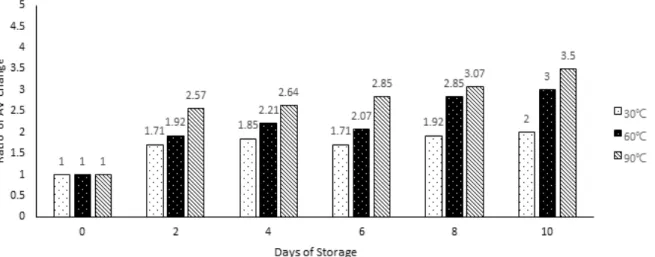
creased from 8 days. However, the increase rate of AV was not significantly changed when stored at 30℃ (Fig. 1). Ge- nerally, the AV of fresh soybean oil is less 0.6 (Korean Food Standards Codex, 2017). It is considered that there is no pro- blem even if the oil is reused at all temperatures during the storage period of this study. However, it is considered that the oil after frying should not be used when stored for more than 10 days at over 60℃. In addition, it would be undesi- rable to store oil after frying in close to heat such as a cooker.
4.2. Peroxide Value (PV)
The peroxide is primary oxidation product during the lipid oxidation process. It breaks down as the oxidative progresses further, and the PV decreases (Kim, 1990). Therefore, the PV
Fig. 1. Increase rate of acid value (AV) during storage. Frying oils were fried 10 times with potato sticks and stored at 30, 60 and 90℃ for 10 days.
is an indicator of initial oxidation. In the Korean Food Stan- dards Codex, the PV is presented together with AV for deter- mining the oxidation of frying oil. The oil to be used for frying should have an AV of less 2.5 mg of KOH per g of oil and a PV of less 50 meq of O
2per kg of oil (Korean Food Stan- dards Codex, 2017). PV was reached over 50 meq of O
2per kg of oil when oil were stored at 30℃ for 6 days and it had been exceeded 50 meq of O
2per kg of oil from the 2nd day of storage at 60℃ and 90℃ (Table 2). The PV was significantly higher at 90℃ than those of other temperatures. The increase rate of PVs were increased sharply from the early stage of storage at 60℃ and 90℃. However, the increase rate of PV was not significantly changed when stored at 30℃ (Fig. 2).
The PVs were steadily increased at all temperatures during
Table 2. Changes in peroxide value (PV) of soybean oil after frying according to storage temperature
(Unit: meq of O2/kg oil) Storage time
(day)
Storage temperature ( )
30 60 90
0 27.95±0.53 27.95±0.53 27.95±0.53 2 35.24±0.54a 134.54±0.94b 164.95±1.47c 4 39.79±0.97a 195.98±0.46b 252.89±0.50c 6 51.19±0.95a 252.42±0.97b 316.61±0.94c 8 72.35±1.02a 329.75±1.03b 387.07±0.49c 10 74.05±0.96a 407.96±0.92b 414.26±2.21c Values are shown as mean±S.D.; n=3.
Different superscript letter in a column indicate significant diffe- rences (p<0.05).
Fig. 2. Increase rate of peroxide value (PV) during storage. Frying oils were fried 10 times with potato sticks and stored at 30, 60 and 90℃ for 10 days.
storage. These results suggest that peroxides were produced by frying, and the autoxidation has occurred by unstable peroxides. The higher the storage temperature, the more peroxide is generated by autoxidation since autoxidation is accelerated by the high temperature. Therefore, the highest peroxide value was obtained when stored at 90℃.
4.3. Iodine Value
The oil, that is liquid at room temperature, contains a large amount of unsaturated fatty acids. The double bonds of un- saturated fatty acids easily react with hydrogen or halogen.
The iodine value (IV) means gram of iodine added in 100 g of oil. Therefore, the higher the content of unsaturated fatty acids, the larger the IV. Generally, the IV of soybean oil is 122~
134 g of I
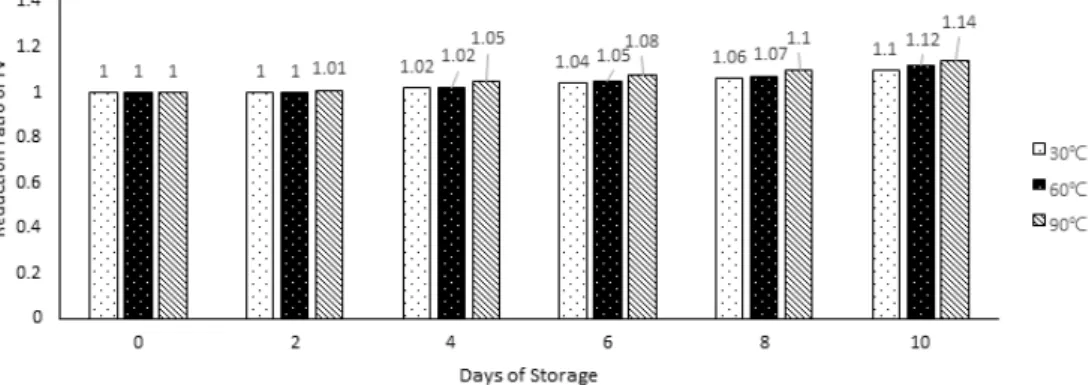
2per 100g of oil (Yun et al., 2000). IVs were steadily decreased at all temperatures during storage. IV was out of the range of common soybean oil after storage from 8 days at 30℃ and 60℃ and 6 days at 90℃ (Table 3). Also, the de- crease rate of IV was tended to increase with increasing sto-
Fig. 3. Decrease rate of iodine value (IV) during storage. Frying oils were fried 10 times with potato sticks and stored at 30, 60 and 90℃ for 10 days.
rage temperature (Fig. 3). The higher the storage tempe- rature, the lower the tendency of IV to decrease. It was indi- cated that the unsaturated fatty acid content decreases and
Table 3. Changes in iodine value (IV) of soybean oil after frying according to storage temperature
(Unit: g of I2/100 g oil)
Storage time (day)
Storage temperature ( )
30 60 90
0 128.87±0.64 128.87±0.64 128.87±0.64 2 128.00±0.70a 127.99±0.70a 126.62±0.44b 4 125.19±0.02a 125.85±0.15b 122.35±0.43c 6 123.84±0.33a 122.48±0.32b 119.06±0.79c 8 120.71±0.24a 120.17±0.14b 116.94±0.27c 10 116.80±0.51a 114.44±0.23b 112.80±0.66c Values are shown as mean±S.D.; n=3.
Different superscript letter in a column indicate significant diffe- rences (p<0.05).
the polymer content increases.
4.4. Fatty Acid Profile
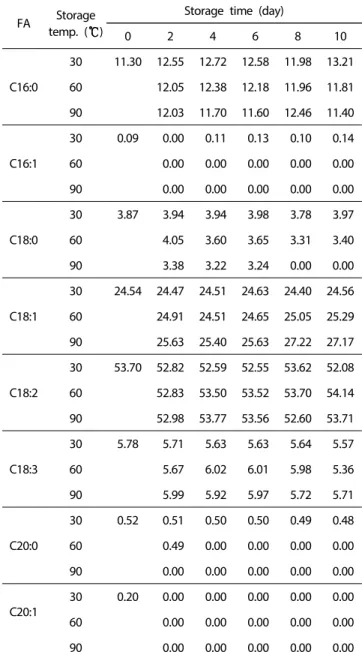
The changes in fatty acid composition according to storage temperature are shown in Table 4. The fatty acid compositions were 11% of palmitic acid (C16:0), 4% of stearic acid (C18:0), 25% of oleic acid (C18:1), 54% of linoleic acid (C18:2) and 6%
of linolenic acid (C18:3) in soybean oil which were fried 10 times with potato sticks before storage(Table 4). The ratio of major saturated fatty acid(C16:0) to unsaturated (C18:2) fatty acids was higher at 90℃ after 8 days. This result was thought to be a decrease in the relative content due to the oxidation of unstable unsaturated fatty acids.
5. CONCLUSIONS
Frying oil is one of the important factors in the quality of fried food. The purpose of this study was to investigate the quality of the oil after frying according to storage temperature by measuring the acid value (AV), peroxide value (PV), iodine value (IV) and fatty acid composition. After frying a commer- cial frozen potato stick, frying oil was stored at different temperatures and used for various physicochemical proper- ties. The AV of oil was 0.14, the PV was 27.95 and the IV was 129.87 before storage of oil after frying. As the storage tem- perature increased, AV and PV were increased and IV was decreased. The AV ,which indicate the content of free fatty acid, was significantly increased from 2 days after storage at 90℃ and 4 days after storage at 60℃. The increase rate of acid value was increased with all temperature during storage and it was 2.0 times higher at 30℃, 3.0 times higher at 60℃
and 3.5 times higher at 90℃ after 10 days storage than 0 day. The PV was steadily increased at all temperatures during
Fig. 4. Changes in the ratio of major saturated (C16:0) and unsaturated (C18:2) fatty acids in soybean oil during storage.
Frying oils were fried 10 times with potato sticks and stored at 30, 60 and 90℃ for 10 days.
Table 4. Changes in fatty acid (FA) composition of soybean oil after frying according to storage temperature
(Unit: area%)
FA Storage temp. ( )
Storage time (day)
0 2 4 6 8 10
C16:0
30 11.30 12.55 12.72 12.58 11.98 13.21
60 12.05 12.38 12.18 11.96 11.81
90 12.03 11.70 11.60 12.46 11.40
C16:1
30 0.09 0.00 0.11 0.13 0.10 0.14 60 0.00 0.00 0.00 0.00 0.00 90 0.00 0.00 0.00 0.00 0.00
C18:0
30 3.87 3.94 3.94 3.98 3.78 3.97 60 4.05 3.60 3.65 3.31 3.40 90 3.38 3.22 3.24 0.00 0.00
C18:1
30 24.54 24.47 24.51 24.63 24.40 24.56
60 24.91 24.51 24.65 25.05 25.29
90 25.63 25.40 25.63 27.22 27.17
C18:2
30 53.70 52.82 52.59 52.55 53.62 52.08
60 52.83 53.50 53.52 53.70 54.14
90 52.98 53.77 53.56 52.60 53.71
C18:3
30 5.78 5.71 5.63 5.63 5.64 5.57 60 5.67 6.02 6.01 5.98 5.36 90 5.99 5.92 5.97 5.72 5.71
C20:0
30 0.52 0.51 0.50 0.50 0.49 0.48 60 0.49 0.00 0.00 0.00 0.00 90 0.00 0.00 0.00 0.00 0.00
C20:1
30 0.20 0.00 0.00 0.00 0.00 0.00 60 0.00 0.00 0.00 0.00 0.00 90 0.00 0.00 0.00 0.00 0.00